

Microsoft made Azure Arc-enabled hotpatching available at no additional cost for Windows Server 2025 Standard and Datacenter machines on May 19, 2026, extending reboot-light security servicing to on-premises, hybrid, and multicloud servers managed through Azure Arc. The change turns what had been a paid add-on into a platform feature for organizations willing to connect their servers to Microsoft’s cloud control plane. That is not a small pricing footnote; it is Microsoft admitting that reboot reduction is now part of the baseline security story for Windows Server. The tradeoff is equally clear: fewer maintenance-window battles in exchange for deeper Azure Arc dependency.
For decades, the Windows Server patch cycle has carried a grim little ritual: read the bulletin, test the update, schedule the window, warn the business, install the patch, reboot the machine, and hope the application stack comes back in the same mood it left. Virtualization, clustering, live migration, and better automation softened the blow, but they never removed the basic fact that Windows security servicing has often meant planned interruption.
Hotpatching attacks that problem at the operating-system level. Instead of replacing files and waiting for a reboot to load the new code path, a hotpatch can modify running code in memory while the system stays online. It is the sort of feature that sounds mundane until you are responsible for a fleet of domain controllers, file servers, line-of-business application hosts, or database-adjacent systems whose owners insist there is no good time to restart.
Microsoft has had hotpatching in the Windows Server world before, most visibly for Azure Edition deployments. What changed here is reach. With Windows Server 2025, Microsoft is making the feature available to Standard and Datacenter servers outside Azure, as long as they are connected through Azure Arc and meet the technical prerequisites.
The important new development is cost. Microsoft’s own documentation and pricing pages now indicate that hotpatching for Arc-enabled Windows Server 2025 Standard and Datacenter machines is available at no additional cost. That reverses the earlier commercial posture, under which Arc-enabled hotpatching was framed as a subscription feature priced per CPU core per month.
That reversal matters because hotpatching was always easiest to defend technically and hardest to defend politically. Charging separately for fewer reboots turned an operational reliability improvement into a procurement debate. Removing that meter makes the feature much easier for infrastructure teams to propose, pilot, and standardize.
To use hotpatching on non-Azure Windows Server 2025 machines, organizations need to onboard those servers to Azure Arc through the Azure Connected Machine agent. They also need an Azure subscription, the right Windows Server 2025 edition, and virtualization-based security support. In practical terms, the server must be modern enough to support the security model Microsoft now expects from the platform.
That makes hotpatching less like a local Windows Update toggle and more like a hybrid-management capability. Administrators enable it through Azure-facing tools, and updates are managed through Azure Update Manager. Microsoft’s pitch is consistency: the same management plane can cover servers in a data center, in Azure, and in other clouds.
For many enterprises, that is a feature rather than a burden. Hybrid infrastructure is already a fact of life, and Azure Arc has become Microsoft’s preferred answer to the question of how to manage Windows servers that do not physically live in Azure. If an organization is already using Arc for inventory, policy, Defender for Cloud, monitoring, or update orchestration, hotpatching becomes a useful extension of an existing management model.
For others, the calculus is less comfortable. Arc enrollment is not just a technical prerequisite; it is a strategic commitment. It means putting more server metadata, management state, and operational workflow into Microsoft’s cloud orbit. The hotpatching fee may be gone, but Microsoft still wins when more servers become Arc-connected resources.
That is the central tension of the announcement. Microsoft has made a genuinely useful Windows Server feature cheaper to adopt, but it has done so in a way that reinforces Azure as the administrative center of gravity. Free hotpatching is not a retreat from cloud strategy. It is a more persuasive version of it.
That design is not a loophole; it is the mechanism that keeps the servicing model sane. Some operating-system changes cannot be safely or cleanly applied only by modifying in-memory code. Kernel-level changes, component servicing, driver-related fixes, and broader cumulative-update payloads may still need the old-fashioned reboot path.
This is where Microsoft’s marketing and administrator reality can diverge. “No reboot” is the phrase everyone remembers. “Fewer reboots, with quarterly baselines and possible exceptions” is the version that belongs in a change-management document.
Even so, the practical improvement is real. If a server fleet can move from monthly restart expectations to a cadence where many security updates land without immediate downtime, that changes the politics of patching. Security teams can push critical fixes faster, application owners face fewer scheduled interruptions, and operations teams get back some of the time normally consumed by maintenance choreography.
There is also a risk-management angle. When patching requires downtime, some organizations delay it. They wait for the next maintenance window, negotiate with service owners, or batch changes in ways that increase exposure. Hotpatching does not solve poor patch governance, but it removes one of the most common excuses for hesitation.
That may be the most consequential part of the feature. The win is not merely uptime. The win is reducing the gap between update availability and update deployment.
That matters because server upgrades are rarely glamorous. They are expensive, application-bound, and often blocked by vendor certification or institutional fear. Many organizations still run older Windows Server versions not because they love them, but because they cannot justify the migration pain until the support clock or a security event forces the issue.
Hotpatching gives Microsoft a better modernization story. It lets the company say that Windows Server 2025 is not merely the next supported version but a platform with measurable operational advantages. For an IT manager trying to make the case for refresh funding, “we can reduce restart-driven downtime” is more concrete than “we should stay current.”
The catch is that this advantage applies only to eligible Windows Server 2025 machines. Earlier versions do not suddenly gain the same Arc-enabled hotpatching treatment. For estates heavy with Windows Server 2016, 2019, or 2022, the announcement is less an immediate benefit than a migration incentive.
That distinction will matter in real deployments. The servers that would benefit most from fewer restarts are often the ones hardest to upgrade. Legacy application hosts, fragile middleware stacks, and domain-joined systems with years of undocumented assumptions are rarely the first candidates for a new OS rollout.
Still, Microsoft has shifted the conversation. Windows Server 2025 is no longer just where customers must eventually go to remain current. It is where Microsoft is placing some of the operational niceties administrators have wanted for years.
Hotpatching makes the Arc story more tangible. Instead of asking administrators to onboard servers for abstract “hybrid management,” Microsoft can point to a concrete payoff: fewer restarts for Windows Server 2025 security updates. That is the sort of benefit infrastructure teams can explain to application owners in one sentence.
It also changes the competitive texture of multicloud operations. A Windows Server 2025 VM running on VMware, Hyper-V, AWS, or Google Cloud can theoretically participate in the same hotpatching model if it is Arc-enabled and meets the requirements. Microsoft is not saying the server must run in Azure. It is saying Azure should manage it.
That is a clever boundary. It respects the reality that workloads are distributed while still giving Microsoft a control-plane relationship with those machines. In an enterprise world where the management plane is often as strategically important as the compute location, that is no small thing.
Administrators should therefore evaluate the announcement in two layers. At the servicing layer, free hotpatching is an obvious improvement. At the governance layer, it is another reason to standardize around Azure Arc, with all the identity, policy, networking, agent-management, and compliance implications that follow.
The best organizations will treat those implications seriously without letting them become paralysis. Arc is neither magic nor menace by default. It is an administrative surface that must be secured, monitored, documented, and owned like any other critical management system.
That does not mean every security update becomes instant or effortless. Hotpatch eligibility depends on the update payload, the server state, the baseline cadence, and Microsoft’s release decisions. There may still be months where a non-hotpatch update is necessary, and emergency updates can still disrupt tidy patch calendars.
But hotpatching changes the default posture. Instead of assuming that every meaningful Windows Server security update must negotiate with uptime, administrators can separate more updates from the reboot decision. That separation is valuable because reboots are not merely technical events; they are organizational events.
Operations teams, meanwhile, inherit a different kind of dependency. The update process now leans more heavily on Azure Update Manager, Arc connectivity, the Connected Machine agent, and the server’s ability to remain in a supported configuration. If those pieces are unhealthy, the hotpatching story weakens.
This is the part that should keep sysadmins honest. A feature designed to reduce maintenance overhead can create new maintenance responsibilities. Agents must be monitored. Arc enrollment must be governed. Azure permissions must be kept tight. Update rings and maintenance windows still need design.
The reward is worth pursuing, but it is not automatic. Hotpatching should be introduced as part of a patch-management program, not as a checkbox sprinkled across production machines on a Friday afternoon.
That requirement will be unremarkable in some environments and painful in others. Newer Hyper-V Generation 2 virtual machines are a natural fit. Modern VMware and cloud-hosted instances may also be straightforward, depending on configuration. Older physical servers, legacy VM templates, and conservative virtualization standards may require more work.
In that sense, hotpatching becomes a quiet audit of infrastructure maturity. If an organization cannot enable the security substrate required for hotpatching, the problem is not just hotpatching. It may indicate deeper drift between the server estate and Microsoft’s assumptions about modern Windows security.
This is especially relevant for environments that have treated VBS as optional because of compatibility concerns, performance worries, or simple inertia. Microsoft has been moving steadily toward a world where virtualization-backed protections are part of the expected baseline. Hotpatching adds another incentive to get there.
Administrators should not dismiss those concerns. Security features can expose brittle drivers, old agents, and unsupported workloads. Testing remains essential, especially on servers that run low-level security tools, backup agents, storage components, or performance-sensitive applications.
But the direction of travel is unmistakable. Microsoft is tying advanced servicing, security, and management features to a more modern hardware and firmware posture. Hotpatching is one more sign that the old server baseline is being retired piece by piece.
Administrators already pay for Windows Server. They already pay for Software Assurance in some cases, Azure services in others, and a thicket of security, backup, monitoring, and management tools around the operating system. Asking them to pay an additional per-core fee for a feature that reduces security-update disruption risked making hotpatching look like an upsell on responsible maintenance.
That optics problem was especially sharp because hotpatching serves Microsoft’s interests too. Faster patch adoption reduces the population of vulnerable Windows systems. Fewer delayed updates mean fewer incidents that damage trust in the platform. If Microsoft wants the ecosystem to patch faster, pricing the feature like a premium convenience was counterproductive.
Making it free reframes the feature as part of Windows Server 2025’s value proposition. It also reduces the burden on IT teams who otherwise would have had to forecast core counts, estimate monthly costs, justify the spend, and defend the difference between hotpatched and non-hotpatched servers.
The move does not make Arc free in the broadest sense. Azure management and security services can still carry their own charges, and organizations need to understand the costs of the surrounding Azure footprint. But removing the specific hotpatching fee simplifies the adoption story considerably.
This is Microsoft learning a familiar cloud-era lesson: sometimes the most valuable monetization path is not charging for the individual feature. It is making the feature so useful that customers accept the platform around it.
A server that can be patched without rebooting can still be broken by a bad update, an application interaction, a security-product conflict, or an environmental assumption Microsoft did not share. The absence of a restart does not guarantee the absence of risk. It simply removes one disruptive step from the servicing path.
Enterprises should still stage updates through pilot groups and representative workloads. They should still maintain clear exception processes. They should still know which servers are hotpatch-enabled, which are in baseline months, which are pending restart, and which have fallen out of compliance.
The feature also needs communication discipline. Application teams may hear “no reboot” and conclude that maintenance windows no longer matter. Infrastructure teams should resist that simplification. Hotpatching reduces the frequency and urgency of reboots, but it does not erase the lifecycle of cumulative updates.
There is also a cultural benefit if handled well. By making more updates less disruptive, hotpatching can help organizations move away from the unhealthy habit of treating patching as an occasional crisis. It can make security servicing feel more like routine hygiene and less like an outage disguised as maintenance.
That is the real prize. Not a world without reboots, but a world where reboots are planned exceptions rather than the monthly tax on being secure.
That is why hotpatching is such an effective wedge. It solves a problem administrators understand viscerally, and it does so in a way that nudges them toward Microsoft’s hybrid architecture. The feature is technically about applying security updates without immediate restarts; strategically, it is about making Azure the place where Windows Server fleets are controlled.
For WindowsForum readers, the right reaction is neither cynicism nor celebration. This is a meaningful improvement for Windows Server 2025, particularly for organizations that have struggled to reconcile uptime demands with timely security patching. It is also another reminder that the future of Windows Server is being designed around cloud-connected management, even when the server itself remains on-premises.
Microsoft has removed the price tag from Arc-enabled hotpatching because the real value is not the $1.50-per-core line item it once planned to collect. The real value is getting more Windows Server 2025 machines into a servicing model where patches land faster, reboots happen less often, and Azure Arc becomes the connective layer across the fleet. If Microsoft can make that bargain feel operationally indispensable rather than commercially coercive, hotpatching may become one of the rare server features that both security teams and application owners learn to ask for by name.
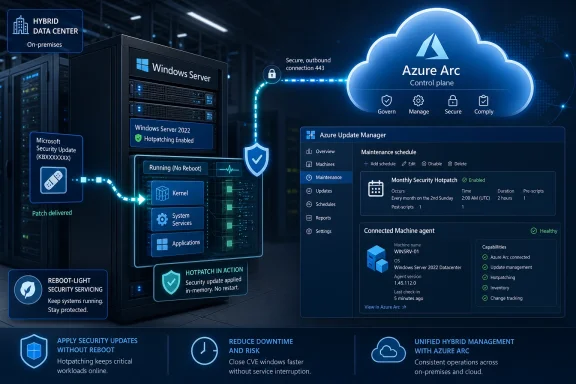 Microsoft Stops Charging for the Reboot It Wants to Eliminate
For decades, the Windows Server patch cycle has carried a grim little ritual: read the bulletin, test the update, schedule the window, warn the business, install the patch, reboot the machine, and hope the application stack comes back in the same mood it left. Virtualization, clustering, live migration, and better automation softened the blow, but they never removed the basic fact that Windows security servicing has often meant planned interruption.Hotpatching attacks that problem at the operating-system level. Instead of replacing files and waiting for a reboot to load the new code path, a hotpatch can modify running code in memory while the system stays online. It is the sort of feature that sounds mundane until you are responsible for a fleet of domain controllers, file servers, line-of-business application hosts, or database-adjacent systems whose owners insist there is no good time to restart.
Microsoft has had hotpatching in the Windows Server world before, most visibly for Azure Edition deployments. What changed here is reach. With Windows Server 2025, Microsoft is making the feature available to Standard and Datacenter servers outside Azure, as long as they are connected through Azure Arc and meet the technical prerequisites.
The important new development is cost. Microsoft’s own documentation and pricing pages now indicate that hotpatching for Arc-enabled Windows Server 2025 Standard and Datacenter machines is available at no additional cost. That reverses the earlier commercial posture, under which Arc-enabled hotpatching was framed as a subscription feature priced per CPU core per month.
That reversal matters because hotpatching was always easiest to defend technically and hardest to defend politically. Charging separately for fewer reboots turned an operational reliability improvement into a procurement debate. Removing that meter makes the feature much easier for infrastructure teams to propose, pilot, and standardize.
The Feature Is Free, but the Control Plane Is Not Neutral
There is a temptation to read “free” as “simple.” That would be a mistake. Microsoft has removed a direct hotpatching fee, but the feature still lives inside a larger Azure Arc architecture that has its own operational implications.To use hotpatching on non-Azure Windows Server 2025 machines, organizations need to onboard those servers to Azure Arc through the Azure Connected Machine agent. They also need an Azure subscription, the right Windows Server 2025 edition, and virtualization-based security support. In practical terms, the server must be modern enough to support the security model Microsoft now expects from the platform.
That makes hotpatching less like a local Windows Update toggle and more like a hybrid-management capability. Administrators enable it through Azure-facing tools, and updates are managed through Azure Update Manager. Microsoft’s pitch is consistency: the same management plane can cover servers in a data center, in Azure, and in other clouds.
For many enterprises, that is a feature rather than a burden. Hybrid infrastructure is already a fact of life, and Azure Arc has become Microsoft’s preferred answer to the question of how to manage Windows servers that do not physically live in Azure. If an organization is already using Arc for inventory, policy, Defender for Cloud, monitoring, or update orchestration, hotpatching becomes a useful extension of an existing management model.
For others, the calculus is less comfortable. Arc enrollment is not just a technical prerequisite; it is a strategic commitment. It means putting more server metadata, management state, and operational workflow into Microsoft’s cloud orbit. The hotpatching fee may be gone, but Microsoft still wins when more servers become Arc-connected resources.
That is the central tension of the announcement. Microsoft has made a genuinely useful Windows Server feature cheaper to adopt, but it has done so in a way that reinforces Azure as the administrative center of gravity. Free hotpatching is not a retreat from cloud strategy. It is a more persuasive version of it.
Hotpatching Shrinks the Reboot Problem Without Abolishing It
The most important thing for administrators to understand is that hotpatching does not mean “never reboot again.” Microsoft’s hotpatch model still depends on periodic baseline updates, and those baseline updates require restarts. In the typical cadence, a full cumulative update establishes a new baseline, followed by hotpatch releases in subsequent months.That design is not a loophole; it is the mechanism that keeps the servicing model sane. Some operating-system changes cannot be safely or cleanly applied only by modifying in-memory code. Kernel-level changes, component servicing, driver-related fixes, and broader cumulative-update payloads may still need the old-fashioned reboot path.
This is where Microsoft’s marketing and administrator reality can diverge. “No reboot” is the phrase everyone remembers. “Fewer reboots, with quarterly baselines and possible exceptions” is the version that belongs in a change-management document.
Even so, the practical improvement is real. If a server fleet can move from monthly restart expectations to a cadence where many security updates land without immediate downtime, that changes the politics of patching. Security teams can push critical fixes faster, application owners face fewer scheduled interruptions, and operations teams get back some of the time normally consumed by maintenance choreography.
There is also a risk-management angle. When patching requires downtime, some organizations delay it. They wait for the next maintenance window, negotiate with service owners, or batch changes in ways that increase exposure. Hotpatching does not solve poor patch governance, but it removes one of the most common excuses for hesitation.
That may be the most consequential part of the feature. The win is not merely uptime. The win is reducing the gap between update availability and update deployment.
Windows Server 2025 Becomes the Incentive, Not Just the Destination
Microsoft has spent years trying to move customers off older Windows Server releases, and the argument has usually been a blend of lifecycle pressure, security posture, and hardware enablement. Windows Server 2025 now has a sharper carrot: fewer reboots for the servers that qualify.That matters because server upgrades are rarely glamorous. They are expensive, application-bound, and often blocked by vendor certification or institutional fear. Many organizations still run older Windows Server versions not because they love them, but because they cannot justify the migration pain until the support clock or a security event forces the issue.
Hotpatching gives Microsoft a better modernization story. It lets the company say that Windows Server 2025 is not merely the next supported version but a platform with measurable operational advantages. For an IT manager trying to make the case for refresh funding, “we can reduce restart-driven downtime” is more concrete than “we should stay current.”
The catch is that this advantage applies only to eligible Windows Server 2025 machines. Earlier versions do not suddenly gain the same Arc-enabled hotpatching treatment. For estates heavy with Windows Server 2016, 2019, or 2022, the announcement is less an immediate benefit than a migration incentive.
That distinction will matter in real deployments. The servers that would benefit most from fewer restarts are often the ones hardest to upgrade. Legacy application hosts, fragile middleware stacks, and domain-joined systems with years of undocumented assumptions are rarely the first candidates for a new OS rollout.
Still, Microsoft has shifted the conversation. Windows Server 2025 is no longer just where customers must eventually go to remain current. It is where Microsoft is placing some of the operational niceties administrators have wanted for years.
Azure Arc Is Becoming the Tollbooth and the Bridge
Azure Arc has always been a strange product to describe because it is less a single feature than a connective tissue layer. It lets Microsoft represent non-Azure servers as Azure resources, apply policy and management controls, and attach cloud services to infrastructure that may sit in a corporate data center, at the edge, or in another public cloud.Hotpatching makes the Arc story more tangible. Instead of asking administrators to onboard servers for abstract “hybrid management,” Microsoft can point to a concrete payoff: fewer restarts for Windows Server 2025 security updates. That is the sort of benefit infrastructure teams can explain to application owners in one sentence.
It also changes the competitive texture of multicloud operations. A Windows Server 2025 VM running on VMware, Hyper-V, AWS, or Google Cloud can theoretically participate in the same hotpatching model if it is Arc-enabled and meets the requirements. Microsoft is not saying the server must run in Azure. It is saying Azure should manage it.
That is a clever boundary. It respects the reality that workloads are distributed while still giving Microsoft a control-plane relationship with those machines. In an enterprise world where the management plane is often as strategically important as the compute location, that is no small thing.
Administrators should therefore evaluate the announcement in two layers. At the servicing layer, free hotpatching is an obvious improvement. At the governance layer, it is another reason to standardize around Azure Arc, with all the identity, policy, networking, agent-management, and compliance implications that follow.
The best organizations will treat those implications seriously without letting them become paralysis. Arc is neither magic nor menace by default. It is an administrative surface that must be secured, monitored, documented, and owned like any other critical management system.
Security Teams Get a Faster Patch Path, Operations Teams Get a New Dependency
From a security perspective, the appeal of hotpatching is immediate. Vulnerability response is often constrained not by awareness but by deployment friction. If a high-severity fix can be applied without forcing a restart, defenders get a better chance of closing exposure before attackers industrialize an exploit.That does not mean every security update becomes instant or effortless. Hotpatch eligibility depends on the update payload, the server state, the baseline cadence, and Microsoft’s release decisions. There may still be months where a non-hotpatch update is necessary, and emergency updates can still disrupt tidy patch calendars.
But hotpatching changes the default posture. Instead of assuming that every meaningful Windows Server security update must negotiate with uptime, administrators can separate more updates from the reboot decision. That separation is valuable because reboots are not merely technical events; they are organizational events.
Operations teams, meanwhile, inherit a different kind of dependency. The update process now leans more heavily on Azure Update Manager, Arc connectivity, the Connected Machine agent, and the server’s ability to remain in a supported configuration. If those pieces are unhealthy, the hotpatching story weakens.
This is the part that should keep sysadmins honest. A feature designed to reduce maintenance overhead can create new maintenance responsibilities. Agents must be monitored. Arc enrollment must be governed. Azure permissions must be kept tight. Update rings and maintenance windows still need design.
The reward is worth pursuing, but it is not automatic. Hotpatching should be introduced as part of a patch-management program, not as a checkbox sprinkled across production machines on a Friday afternoon.
The VBS Requirement Makes This a Security Posture Test
One of the more revealing prerequisites is virtualization-based security. Microsoft is not merely asking for Windows Server 2025 and Azure Arc; it is also requiring that the underlying system support modern isolation features, including UEFI and Secure Boot expectations.That requirement will be unremarkable in some environments and painful in others. Newer Hyper-V Generation 2 virtual machines are a natural fit. Modern VMware and cloud-hosted instances may also be straightforward, depending on configuration. Older physical servers, legacy VM templates, and conservative virtualization standards may require more work.
In that sense, hotpatching becomes a quiet audit of infrastructure maturity. If an organization cannot enable the security substrate required for hotpatching, the problem is not just hotpatching. It may indicate deeper drift between the server estate and Microsoft’s assumptions about modern Windows security.
This is especially relevant for environments that have treated VBS as optional because of compatibility concerns, performance worries, or simple inertia. Microsoft has been moving steadily toward a world where virtualization-backed protections are part of the expected baseline. Hotpatching adds another incentive to get there.
Administrators should not dismiss those concerns. Security features can expose brittle drivers, old agents, and unsupported workloads. Testing remains essential, especially on servers that run low-level security tools, backup agents, storage components, or performance-sensitive applications.
But the direction of travel is unmistakable. Microsoft is tying advanced servicing, security, and management features to a more modern hardware and firmware posture. Hotpatching is one more sign that the old server baseline is being retired piece by piece.
The Economics Changed Because the Old Price Sent the Wrong Message
The earlier paid model for Arc-enabled hotpatching was defensible in a narrow product-management sense. Microsoft was delivering a cloud-managed capability to servers outside Azure, and charging per core fit the company’s broader consumption logic. But it landed awkwardly with the audience that most needed convincing.Administrators already pay for Windows Server. They already pay for Software Assurance in some cases, Azure services in others, and a thicket of security, backup, monitoring, and management tools around the operating system. Asking them to pay an additional per-core fee for a feature that reduces security-update disruption risked making hotpatching look like an upsell on responsible maintenance.
That optics problem was especially sharp because hotpatching serves Microsoft’s interests too. Faster patch adoption reduces the population of vulnerable Windows systems. Fewer delayed updates mean fewer incidents that damage trust in the platform. If Microsoft wants the ecosystem to patch faster, pricing the feature like a premium convenience was counterproductive.
Making it free reframes the feature as part of Windows Server 2025’s value proposition. It also reduces the burden on IT teams who otherwise would have had to forecast core counts, estimate monthly costs, justify the spend, and defend the difference between hotpatched and non-hotpatched servers.
The move does not make Arc free in the broadest sense. Azure management and security services can still carry their own charges, and organizations need to understand the costs of the surrounding Azure footprint. But removing the specific hotpatching fee simplifies the adoption story considerably.
This is Microsoft learning a familiar cloud-era lesson: sometimes the most valuable monetization path is not charging for the individual feature. It is making the feature so useful that customers accept the platform around it.
Patch Management Still Belongs to Adults
There is a dangerous version of this story in which hotpatching becomes a substitute for disciplined patch management. That would be exactly wrong. Hotpatching changes the mechanics of certain updates; it does not eliminate the need for testing, rings, rollback planning, inventory, compliance reporting, or business coordination.A server that can be patched without rebooting can still be broken by a bad update, an application interaction, a security-product conflict, or an environmental assumption Microsoft did not share. The absence of a restart does not guarantee the absence of risk. It simply removes one disruptive step from the servicing path.
Enterprises should still stage updates through pilot groups and representative workloads. They should still maintain clear exception processes. They should still know which servers are hotpatch-enabled, which are in baseline months, which are pending restart, and which have fallen out of compliance.
The feature also needs communication discipline. Application teams may hear “no reboot” and conclude that maintenance windows no longer matter. Infrastructure teams should resist that simplification. Hotpatching reduces the frequency and urgency of reboots, but it does not erase the lifecycle of cumulative updates.
There is also a cultural benefit if handled well. By making more updates less disruptive, hotpatching can help organizations move away from the unhealthy habit of treating patching as an occasional crisis. It can make security servicing feel more like routine hygiene and less like an outage disguised as maintenance.
That is the real prize. Not a world without reboots, but a world where reboots are planned exceptions rather than the monthly tax on being secure.
The Free Hotpatch Era Still Comes With Fine Print
Microsoft’s move is straightforward enough to summarize, but administrators should keep the exact boundaries in view. The announcement is generous by the standards of the earlier pricing model, yet it remains specific to a modern, Arc-managed Windows Server 2025 deployment pattern.- Hotpatching at no additional cost applies to eligible Windows Server 2025 Standard and Datacenter machines connected through Azure Arc.
- Servers still need to meet technical prerequisites, including Azure Arc onboarding, the Connected Machine agent, and virtualization-based security requirements.
- Hotpatching reduces reboot frequency, but baseline cumulative updates and some exceptional updates can still require restarts.
- Azure Update Manager becomes central to scheduling, deployment, and monitoring across hybrid and multicloud server estates.
- The change removes a direct hotpatching subscription barrier, but it also strengthens Azure Arc’s role as Microsoft’s preferred hybrid server control plane.
Microsoft’s Server Strategy Is Becoming Less About Where Windows Runs
The broader message is that Microsoft no longer needs every Windows Server workload to move into Azure for Azure to matter. If the server is Arc-enabled, governed through Azure tools, patched through Azure Update Manager, monitored through Azure services, and secured through Microsoft’s cloud stack, then Azure has become part of the server’s operating model regardless of where the workload physically runs.That is why hotpatching is such an effective wedge. It solves a problem administrators understand viscerally, and it does so in a way that nudges them toward Microsoft’s hybrid architecture. The feature is technically about applying security updates without immediate restarts; strategically, it is about making Azure the place where Windows Server fleets are controlled.
For WindowsForum readers, the right reaction is neither cynicism nor celebration. This is a meaningful improvement for Windows Server 2025, particularly for organizations that have struggled to reconcile uptime demands with timely security patching. It is also another reminder that the future of Windows Server is being designed around cloud-connected management, even when the server itself remains on-premises.
Microsoft has removed the price tag from Arc-enabled hotpatching because the real value is not the $1.50-per-core line item it once planned to collect. The real value is getting more Windows Server 2025 machines into a servicing model where patches land faster, reboots happen less often, and Azure Arc becomes the connective layer across the fleet. If Microsoft can make that bargain feel operationally indispensable rather than commercially coercive, hotpatching may become one of the rare server features that both security teams and application owners learn to ask for by name.
References
- Primary source: Petri IT Knowledgebase
Published: Thu, 28 May 2026 15:49:11 GMT
Microsoft Makes Azure Arc Hotpatching Free For Windows Server 2025
Microsoft makes hotpatching free for Azure Arc–enabled Windows Server 2025, allowing security updates without reboots. petri.com
- Official source: learn.microsoft.com
Hotpatch for Windows Server | Microsoft Learn
Learn how Hotpatch for Windows Server works and how to enable itlearn.microsoft.com - Official source: microsoft.com
Tired of all the restarts? Get hotpatching for Windows Server | Microsoft Windows Server Blog
Hotpatching for Windows Server 2025, made available in preview in 2024, will become generally available as a subscription service on July 1st, 2025.www.microsoft.com - Official source: support.microsoft.com
May 12, 2026—Hotpatch KB5087423 (OS Build 26100.32772) | Microsoft Support
May 12, 2026—Hotpatch KB5087423 (OS Build 26100.32772)support.microsoft.com - Official source: azure-int.microsoft.com
- Official source: azure.microsoft.com
Pricing – Azure Arc | Microsoft Azure
Bring Azure data services and management to any infrastructure. Gain insights and better management capabilities using Azure Arc delivered remotelyazure.microsoft.com
- Official source: download.microsoft.com
- Official source: cdn-dynmedia-1.microsoft.com
- Related coverage: thomas-krenn.com
- Related coverage: licensingschool.co.uk
