

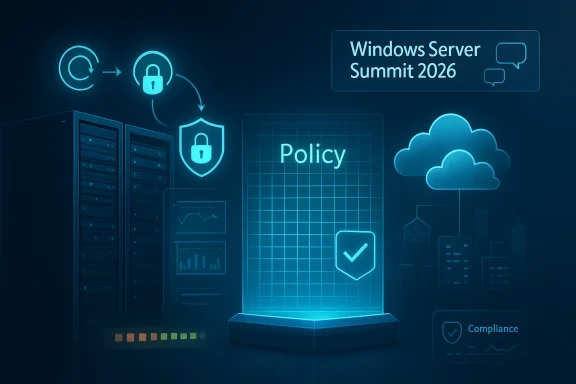
Microsoft is using Windows Server 2026’s planning season to make a very clear point: the next phase of server operations is less about chasing isolated features and more about reducing friction in the real world. In practice, that means faster patch-to-protect cycles, tighter control over configuration drift, and a more unified operating model across on-premises, Azure, and edge environments. The company’s Windows Server Summit 2026 is designed to turn those priorities into engineering guidance, not marketing slogans, with a strong emphasis on security, hybrid governance, and operational consistency.
Windows Server has always been the quiet infrastructure layer behind business-critical applications, but the operating assumptions around it have changed dramatically. Security teams now expect shorter exposure windows after Patch Tuesday, platform teams are asked to standardize images and baselines across mixed estates, and compliance teams want better proof that policy is being applied consistently everywhere. Microsoft’s latest messaging around Windows Server 2025 and the 2026 Summit reflects that shift: the question is no longer simply what the platform can do, but how reliably organizations can run it at scale.
That message is important because it places operational discipline above novelty. Microsoft’s own event materials describe three major focus areas: recent innovations and updates in Windows Server 2025, hybrid and multicloud scenarios enabled by Azure Arc, and best practices for a secure, resilient cloud-to-edge infrastructure. Those themes are not accidental; they align closely with what many enterprises are struggling to operationalize right now.
The company is also framing the Summit as a feedback loop, not a one-way broadcast. Microsoft says the sessions will feature live Q&A and scenario-based guidance, which suggests the product team is actively listening for pain points that might shape future investments. That is a notable signal in a server market where buyers often want less keynote theater and more practical advice about patching, recovery, and governance.
The timing matters too. Windows Server 2025 is Microsoft’s latest Long-Term Servicing Channel release, and organizations evaluating it in 2026 are doing so under real production constraints, not lab curiosity. The release already includes a set of modern operational features such as Azure Arc setup integration, WinGet, Windows Terminal, DTrace, Network ATC, GPU partitioning, and broader hybrid management capabilities, which makes it both a platform upgrade and a management-model change.
Microsoft’s summit agenda underscores that pressure. Sessions like “Everything you want to know about Azure Arc for Servers,” “Security baselines, benchmarks, posture, and scale,” and “From planning to push-button: Windows Server feature updates” point directly at the operational pain points customers are trying to solve. The subtext is clear: the platform is only as good as the processes that govern it.
Microsoft’s public guidance around Windows Server 2025 supports that direction. The platform’s newer capabilities are framed around reducing friction: network deployment automation with Network ATC, improved server tooling, modernized management experiences, and broader support for cloud-connected operations. These are not flashy consumer-style features; they are the kinds of improvements that matter when the goal is fewer exceptions and more repeatability.
The practical significance is that 2026 is the year many organizations begin treating Windows Server 2025 as the default modernization target, even if they do not move all workloads immediately. Microsoft’s own article about planning paths to Windows Server 2025 suggests customers are thinking about rollout sequencing, hotpatch strategy, compatibility validation, and minimizing disruption during upgrades. That is a very different conversation from “should we upgrade?”; it is “how do we upgrade safely, repeatedly, and with policy alignment?”
That convergence matters because it simplifies tooling and training. When administrators can use more familiar workflows, the overhead of managing servers drops. For larger organizations, that can translate into fewer support cases, less onboarding friction, and more consistent processes across teams. This is the kind of change that rarely gets applause but often saves money.
Microsoft’s guidance around hotpatching is especially relevant here. For Windows Server 2025, hotpatching is positioned as a way to reduce reboot frequency and keep systems protected with less operational disruption. Microsoft Learn states that Azure Arc-enabled Hotpatch for Windows Server 2025 is available for a monthly subscription fee, and that it can be enabled for supported editions and configurations.
Still, hotpatching is not a magic wand. Microsoft’s documentation shows that there are edition requirements, build requirements, Azure subscription prerequisites, and Azure Arc dependencies for many scenarios. That means adoption will depend on how well an organization has already standardized its platform and cloud-connected management processes. The technology is useful, but the prerequisites are part of the strategy.
Microsoft’s framing also suggests that organizations are expected to connect upgrade planning with wider operational standards. In other words, an upgrade should not just move an OS version forward; it should also reset baselines, simplify images, and improve patch automation. That is a stronger argument for modernization than “new version, newer features” alone.
The appeal is obvious: if a server can be managed through a common control plane, then policy, access, compliance, and update workflows become easier to standardize. Microsoft’s event description explicitly calls out hybrid and multicloud scenarios enabled by Azure Arc, while its planning article emphasizes a single operational model for inventory, policy, and access control.
Azure Arc does not eliminate local administration, but it can reduce the degree to which local practices diverge from corporate standards. That is especially useful in organizations with acquisitions, regional autonomy, or mixed hardware generations. Standardization is hard; visibility is the first win.
The competitive implication is that Microsoft is trying to turn Windows Server into a platform whose management plane is as important as the OS itself. That is a smart move in a market where customers increasingly judge infrastructure vendors by how well they unify distributed operations, not just by raw performance or feature density.
Microsoft’s Windows Server 2025 feature set also reinforces that direction. The platform includes improvements in management, identity-related support, and modern administration workflows, while the Summit agenda includes a dedicated session on security baselines, benchmarks, posture, and scale. That tells us the company expects customers to think about security as an estate-wide discipline.
There is also a governance upside. When patching is standardized, reporting becomes simpler and exceptions become easier to audit. That matters for compliance teams that want to prove not only that servers are secure, but that they are secure in a consistent and explainable way. Predictable patching is a control objective now.
A modern Windows Server program should therefore treat security posture as a chain of dependencies. Identity controls, baseline configuration, update automation, and monitoring all have to work together. If one layer lags, the others absorb the risk.
Microsoft’s messaging around repeatable baselines, clear alerting standards, and drift detection speaks directly to that problem. The company’s position is that operational posture should not depend on the history of individual servers or the habits of individual admins. In a mature enterprise, consistency itself is a security feature.
Windows Server 2025’s updated management and operational tooling helps here because it nudges teams toward more modern administrative patterns. Features like DTrace, Windows Terminal, and improved integration with newer operational workflows can make troubleshooting more coherent across environments.
The business impact is tangible. Drift makes troubleshooting slower, makes audits harder, and often increases the time needed to restore services after incidents. Reducing drift therefore pays off both in day-to-day efficiency and in resilience during outages.
Microsoft seems to understand that split. Its public Windows Server 2026 messaging is deliberately pragmatic, leaning on engineering sessions and scenario-driven guidance rather than flashy claims. That suggests the company knows enterprise buyers want fewer surprises and more confidence in execution.
The real enterprise value comes when those conveniences support broader operational goals. If a tool reduces support burden, shortens remediation times, or enables simpler automation, it becomes strategically meaningful. Usability matters because it improves consistency.
That is also why this planning cycle feels more mature than previous ones. The conversation is less about whether the platform has new toys and more about whether it can reduce operational entropy. In large estates, entropy is the enemy.
The competitive field is broader than traditional Windows Server alternatives. It includes Linux-based infrastructure, cloud-native services, virtualization platforms, and third-party management tools. Microsoft’s pitch is that organizations can keep Windows Server in the mix while still getting more cloud-consistent operations. That is a powerful message in heterogeneous environments.
For competitors, the challenge is that they must now compete not only on runtime efficiency but on operational simplification. If Microsoft can make patching, baselines, and policy easier, it can retain relevance even as workload placement becomes more diverse. That is a subtle but important advantage.
That does not eliminate competition, of course. But it does mean Microsoft is making the case that its ecosystem offers less operational fragmentation than assembling separate tools from multiple vendors. In the infrastructure market, that can be decisive.
Microsoft is also signaling that this is an ongoing conversation rather than a one-time launch cycle. The live Q&A format, the emphasis on engineering-led content, and the early visibility into Windows Server vNext all suggest the company wants customers to help shape the roadmap. That feedback loop could matter as much as any single feature.
What to watch next:
Source: Microsoft Planning your path to Windows Server 2025: What organizations are prioritizing in 2026 | Microsoft Windows Server Blog
 Overview
Windows Server has always been the quiet infrastructure layer behind business-critical applications, but the operating assumptions around it have changed dramatically. Security teams now expect shorter exposure windows after Patch Tuesday, platform teams are asked to standardize images and baselines across mixed estates, and compliance teams want better proof that policy is being applied consistently everywhere. Microsoft’s latest messaging around Windows Server 2025 and the 2026 Summit reflects that shift: the question is no longer simply what the platform can do, but how reliably organizations can run it at scale.That message is important because it places operational discipline above novelty. Microsoft’s own event materials describe three major focus areas: recent innovations and updates in Windows Server 2025, hybrid and multicloud scenarios enabled by Azure Arc, and best practices for a secure, resilient cloud-to-edge infrastructure. Those themes are not accidental; they align closely with what many enterprises are struggling to operationalize right now.
The company is also framing the Summit as a feedback loop, not a one-way broadcast. Microsoft says the sessions will feature live Q&A and scenario-based guidance, which suggests the product team is actively listening for pain points that might shape future investments. That is a notable signal in a server market where buyers often want less keynote theater and more practical advice about patching, recovery, and governance.
The timing matters too. Windows Server 2025 is Microsoft’s latest Long-Term Servicing Channel release, and organizations evaluating it in 2026 are doing so under real production constraints, not lab curiosity. The release already includes a set of modern operational features such as Azure Arc setup integration, WinGet, Windows Terminal, DTrace, Network ATC, GPU partitioning, and broader hybrid management capabilities, which makes it both a platform upgrade and a management-model change.
Why 2026 Is a Different Windows Server Planning Cycle
The biggest change in 2026 is not that Windows Server exists in a hybrid world; it is that hybrid has become the default operating assumption. Organizations are no longer asking whether a server is on-premises or cloud-connected, because many estates are both. That reality forces administrators to think in terms of identity, policy, patching, telemetry, and compliance across environments rather than within silos.Microsoft’s summit agenda underscores that pressure. Sessions like “Everything you want to know about Azure Arc for Servers,” “Security baselines, benchmarks, posture, and scale,” and “From planning to push-button: Windows Server feature updates” point directly at the operational pain points customers are trying to solve. The subtext is clear: the platform is only as good as the processes that govern it.
Operational priorities have moved up the stack
For years, server planning centered on capacity, compatibility, and lifecycle management. Those still matter, but the conversation has shifted toward operational resilience and standardization. Teams now want to know whether they can patch faster without breaking applications, whether they can enforce baseline configurations automatically, and whether they can detect drift before it becomes an incident.Microsoft’s public guidance around Windows Server 2025 supports that direction. The platform’s newer capabilities are framed around reducing friction: network deployment automation with Network ATC, improved server tooling, modernized management experiences, and broader support for cloud-connected operations. These are not flashy consumer-style features; they are the kinds of improvements that matter when the goal is fewer exceptions and more repeatability.
The enterprise lens is sharper than the consumer lens
Consumer technology tends to reward novelty, but enterprise infrastructure rewards predictability. That is why Microsoft’s emphasis on engineering-led sessions is sensible. In a server environment, a feature that lowers risk or reduces change-window duration can be more valuable than one that simply sounds impressive on a slide. That distinction is easy to miss if you only look at feature lists.- Security outcomes now drive platform decisions.
- Change management has become a strategic discipline.
- Configuration consistency is a board-level reliability issue.
- Hybrid tooling is increasingly a baseline requirement.
- Operational simplicity is now a competitive advantage.
Windows Server 2025 as the Baseline
Windows Server 2025 is the backdrop for nearly everything Microsoft is discussing in 2026. According to Microsoft Learn, it is the latest LTSC release, and its feature set makes clear that Microsoft is aiming for a more modern server management experience rather than simply iterating on older patterns. The release includes new capabilities for identity, management, automation, and connectivity that reflect how administrators actually work now.The practical significance is that 2026 is the year many organizations begin treating Windows Server 2025 as the default modernization target, even if they do not move all workloads immediately. Microsoft’s own article about planning paths to Windows Server 2025 suggests customers are thinking about rollout sequencing, hotpatch strategy, compatibility validation, and minimizing disruption during upgrades. That is a very different conversation from “should we upgrade?”; it is “how do we upgrade safely, repeatedly, and with policy alignment?”
New capabilities that matter operationally
A lot of the attention around Windows Server 2025 comes from features that improve daily administration rather than headline-grabbing innovation. Microsoft documents support for Windows Terminal, WinGet by default, modern Task Manager, Bluetooth, native DTrace, and improved compression formats. Those enhancements may sound incremental individually, but together they reduce the gap between the way people manage Windows client systems and the way they manage servers.That convergence matters because it simplifies tooling and training. When administrators can use more familiar workflows, the overhead of managing servers drops. For larger organizations, that can translate into fewer support cases, less onboarding friction, and more consistent processes across teams. This is the kind of change that rarely gets applause but often saves money.
What enterprises will care about first
Enterprises are likely to care less about the full breadth of new features and more about the subset that changes operating cost or risk. Hotpatching, Azure Arc integration, Network ATC, GPU partitioning, and broader management improvements are especially relevant because they connect directly to uptime and standardization goals. In an estate of thousands of servers, shaving complexity from patching or network configuration is not a convenience; it is a control mechanism.- Windows Server 2025 serves as the new operational baseline.
- Management tooling is becoming more cloud-aware.
- Administrator experience is getting more modern.
- Features are being evaluated for reliability impact, not novelty.
- Upgrade decisions are increasingly tied to governance goals.
Upgrade Planning and Rollout Strategy
One of Microsoft’s central themes in 2026 is how to upgrade without creating avoidable downtime. That is a familiar problem, but the bar is higher now because downtime tolerance is lower and security expectations are stricter. Organizations are being asked to modernize faster while also preserving service continuity, which makes careful sequencing essential.Microsoft’s guidance around hotpatching is especially relevant here. For Windows Server 2025, hotpatching is positioned as a way to reduce reboot frequency and keep systems protected with less operational disruption. Microsoft Learn states that Azure Arc-enabled Hotpatch for Windows Server 2025 is available for a monthly subscription fee, and that it can be enabled for supported editions and configurations.
Hotpatching changes the patch conversation
Hotpatching is important because it changes the way teams think about maintenance windows. Instead of treating every security update as a reboot event, organizations can reduce restart frequency for eligible systems, which helps preserve availability and reduces the amount of coordination required between infrastructure and application owners. That is not a trivial improvement in regulated or highly available environments.Still, hotpatching is not a magic wand. Microsoft’s documentation shows that there are edition requirements, build requirements, Azure subscription prerequisites, and Azure Arc dependencies for many scenarios. That means adoption will depend on how well an organization has already standardized its platform and cloud-connected management processes. The technology is useful, but the prerequisites are part of the strategy.
Sequencing matters more than speed
Many enterprises will likely phase upgrades by workload criticality rather than by server count. Core identity, infrastructure services, line-of-business applications, and edge systems do not all tolerate the same degree of change. A sensible rollout strategy will therefore combine compatibility testing, staged deployment, and post-upgrade verification instead of pursuing a single big-bang migration.Microsoft’s framing also suggests that organizations are expected to connect upgrade planning with wider operational standards. In other words, an upgrade should not just move an OS version forward; it should also reset baselines, simplify images, and improve patch automation. That is a stronger argument for modernization than “new version, newer features” alone.
Practical planning steps
- Map workloads by business criticality and reboot tolerance.
- Identify which systems can benefit from hotpatching.
- Validate hardware, virtualization, and edition compatibility.
- Phase upgrades across infrastructure tiers.
- Measure post-upgrade performance and application behavior.
- Minimize change during peak business periods.
- Keep rollback plans separate from deployment plans.
- Validate identity and management dependencies first.
- Use baselines to reduce image variation.
- Treat patching as an operating model, not a one-time task.
Hybrid Governance and Azure Arc
Azure Arc is at the center of Microsoft’s hybrid story, and that is no surprise. As organizations spread workloads across datacenters, public cloud, and edge locations, they want a consistent way to inventory, govern, and secure servers regardless of where those servers physically live. Azure Arc is Microsoft’s answer to that problem, and Windows Server 2026 planning makes clear that this model is becoming more central, not less.The appeal is obvious: if a server can be managed through a common control plane, then policy, access, compliance, and update workflows become easier to standardize. Microsoft’s event description explicitly calls out hybrid and multicloud scenarios enabled by Azure Arc, while its planning article emphasizes a single operational model for inventory, policy, and access control.
Why control-plane consistency matters
A fragmented toolset is one of the fastest paths to drift. Different teams start using different patch tools, different baseline standards, and different monitoring stacks, and before long no one can say with confidence how the estate is actually configured. A common control plane helps solve that by making governance more visible and more repeatable.Azure Arc does not eliminate local administration, but it can reduce the degree to which local practices diverge from corporate standards. That is especially useful in organizations with acquisitions, regional autonomy, or mixed hardware generations. Standardization is hard; visibility is the first win.
The edge and multicloud angle
Hybrid management also matters beyond the datacenter. Edge systems often operate with constrained maintenance windows, variable connectivity, and local service dependencies, which makes centralized governance useful but not always straightforward. Microsoft’s emphasis on cloud-to-edge infrastructure suggests the company is trying to provide a management story that survives those realities.The competitive implication is that Microsoft is trying to turn Windows Server into a platform whose management plane is as important as the OS itself. That is a smart move in a market where customers increasingly judge infrastructure vendors by how well they unify distributed operations, not just by raw performance or feature density.
Azure Arc priorities in practice
- Unified inventory and resource discovery
- Policy and compliance alignment
- Access control consistency
- Centralized lifecycle management
- Reduced administrative fragmentation
Security, Identity, and Patch Cadence
Security is the strongest thread running through Microsoft’s 2026 messaging. The company explicitly references tighter patch-to-protect cycles, and that language reflects the reality that patch management is now a security control, not an IT housekeeping task. Organizations are being measured on how quickly they can close exposure windows while keeping change risk under control.Microsoft’s Windows Server 2025 feature set also reinforces that direction. The platform includes improvements in management, identity-related support, and modern administration workflows, while the Summit agenda includes a dedicated session on security baselines, benchmarks, posture, and scale. That tells us the company expects customers to think about security as an estate-wide discipline.
Why patch cadence is now strategic
In the old model, patch cadence was often negotiated around maintenance windows and operational convenience. In the current model, those windows have become much smaller because threat actors exploit delays aggressively. As a result, automation and hotpatching are increasingly valued because they reduce the time between patch release and exposure reduction.There is also a governance upside. When patching is standardized, reporting becomes simpler and exceptions become easier to audit. That matters for compliance teams that want to prove not only that servers are secure, but that they are secure in a consistent and explainable way. Predictable patching is a control objective now.
Identity and access remain foundational
Microsoft is wise to keep identity and access in the conversation because server security rarely fails at the patch level alone. Mismanaged privileges, inconsistent admin access, and fragmented identity governance can undermine even well-patched systems. The company’s callout of security considerations across identity, access, and server management reflects that layered reality.A modern Windows Server program should therefore treat security posture as a chain of dependencies. Identity controls, baseline configuration, update automation, and monitoring all have to work together. If one layer lags, the others absorb the risk.
Security priorities that stand out
- Shorter patch-to-protect cycles
- Fewer emergency maintenance windows
- Better access control consistency
- More auditable security baselines
- Stronger automation around repeatable updates
Baselines, Drift Control, and Monitoring
If hybrid governance is about unified control, then drift control is about staying true to that control over time. This is one of the least glamorous but most important areas in infrastructure management. The larger and older an estate becomes, the more likely it is that small deviations accumulate into operational risk.Microsoft’s messaging around repeatable baselines, clear alerting standards, and drift detection speaks directly to that problem. The company’s position is that operational posture should not depend on the history of individual servers or the habits of individual admins. In a mature enterprise, consistency itself is a security feature.
Monitoring is more useful when it is standardized
Many organizations already have monitoring tools. The problem is that the signals are inconsistent, the thresholds vary, and the response process changes from team to team. Standardizing alerting and baselines does not make monitoring more exciting, but it makes it actionable.Windows Server 2025’s updated management and operational tooling helps here because it nudges teams toward more modern administrative patterns. Features like DTrace, Windows Terminal, and improved integration with newer operational workflows can make troubleshooting more coherent across environments.
Drift is a scale problem, not just a technology problem
Configuration drift usually begins as an exception, but it becomes a problem when exceptions are repeated. Mixed hardware, virtualization stacks, and decentralized teams all raise the odds that servers stop matching the intended baseline. That is why Microsoft’s article emphasizes “known good” configurations and repeatable operational patterns.The business impact is tangible. Drift makes troubleshooting slower, makes audits harder, and often increases the time needed to restore services after incidents. Reducing drift therefore pays off both in day-to-day efficiency and in resilience during outages.
What a modern baseline should include
- OS version and update level
- Identity and access policy
- Monitoring and alert thresholds
- Approved management tools
- Patch and reboot expectations
Enterprise Adoption Patterns vs. Consumer Expectations
Windows Server does not succeed because it feels polished in the consumer sense. It succeeds when it enables reliable operations at scale. That distinction matters because Windows Server 2025 includes a more modern user experience, but the real value for enterprises lies in better management, better security, and better alignment with hybrid operations.Microsoft seems to understand that split. Its public Windows Server 2026 messaging is deliberately pragmatic, leaning on engineering sessions and scenario-driven guidance rather than flashy claims. That suggests the company knows enterprise buyers want fewer surprises and more confidence in execution.
Consumer-style polish helps, but only indirectly
Features like a modern Task Manager, WinGet, and Windows Terminal improve usability, but their enterprise value is mostly indirect. They can reduce friction for administrators, standardize workflows, and make server management less alien to people accustomed to modern Windows tooling. That is useful, but it is not the core reason enterprises upgrade.The real enterprise value comes when those conveniences support broader operational goals. If a tool reduces support burden, shortens remediation times, or enables simpler automation, it becomes strategically meaningful. Usability matters because it improves consistency.
What enterprise buyers will ask
Enterprise teams evaluating Windows Server 2025 in 2026 are likely to focus on hard questions. Can the platform reduce reboot counts? Can it help standardize management across on-premises and cloud-connected servers? Can it improve security without adding administrative overhead? Those are the questions Microsoft is trying to answer through the Summit agenda and documentation.That is also why this planning cycle feels more mature than previous ones. The conversation is less about whether the platform has new toys and more about whether it can reduce operational entropy. In large estates, entropy is the enemy.
What enterprises value most
- Lower operational variance
- Reduced admin overhead
- Better policy enforcement
- Fewer reboots and disruptions
- Clearer governance across teams
Competitive Implications for Microsoft and Rivals
Microsoft’s Windows Server strategy in 2026 has implications that go beyond the product itself. By centering hybrid operations, Azure Arc, and repeatable governance, Microsoft is making the case that server value now includes the control plane, not just the operating system. That puts pressure on rivals to offer similarly integrated management stories.The competitive field is broader than traditional Windows Server alternatives. It includes Linux-based infrastructure, cloud-native services, virtualization platforms, and third-party management tools. Microsoft’s pitch is that organizations can keep Windows Server in the mix while still getting more cloud-consistent operations. That is a powerful message in heterogeneous environments.
Why control-plane integration is the real battleground
When vendors can manage not just workloads but lifecycle, policy, and compliance, they become much harder to displace. Azure Arc helps Microsoft argue that Windows Server can fit inside a larger, uniform management framework without forcing customers into a single-location architecture. That flexibility is strategically important in multicloud and edge-heavy organizations.For competitors, the challenge is that they must now compete not only on runtime efficiency but on operational simplification. If Microsoft can make patching, baselines, and policy easier, it can retain relevance even as workload placement becomes more diverse. That is a subtle but important advantage.
The upgrade as a retention mechanism
A successful Windows Server 2025 upgrade is not just a product win; it is a platform retention win. Once organizations standardize around Arc, hotpatching, and Microsoft’s management tooling, switching costs rise. The platform becomes embedded in process, not just installed on hardware.That does not eliminate competition, of course. But it does mean Microsoft is making the case that its ecosystem offers less operational fragmentation than assembling separate tools from multiple vendors. In the infrastructure market, that can be decisive.
Competitive pressure points
- Cloud management integration
- Patch automation and reboot reduction
- Policy and compliance consistency
- Hybrid and edge coverage
- Operational simplicity at scale
Strengths and Opportunities
Microsoft’s 2026 Windows Server message has several strengths. It is grounded in real operational pain points, it acknowledges the complexity of hybrid estates, and it offers a practical path forward through Azure Arc, hotpatching, and standardized baselines. The opportunity for organizations is to treat Windows Server 2025 not just as a software refresh, but as a way to reset their operating model around consistency and resilience.- Reduced reboot pressure through hotpatching where supported.
- Better governance with centralized hybrid management.
- Lower drift risk via repeatable baselines and standard tooling.
- Improved admin productivity from modern built-in tools.
- More predictable patching that supports tighter SLAs.
- Clearer security posture across identity, access, and server controls.
- Better fit for heterogeneous estates spanning on-premises, Azure, and edge.
Risks and Concerns
The biggest risk is assuming that the platform alone will solve operational problems that are really process problems. Hotpatching, Azure Arc, and Windows Server 2025 features can reduce friction, but they still require disciplined implementation, compatibility testing, and ongoing governance. There is also the risk that organizations adopt parts of the model without fully standardizing the rest, which can actually add complexity.- Prerequisite complexity may slow adoption of hotpatch and hybrid features.
- Fragmented tooling can persist if governance is not enforced.
- Partial rollout risk may create uneven operational standards.
- Dependency on Azure-connected workflows may not suit every environment.
- Configuration drift can reappear if baselines are not maintained.
- Security gains can be undermined by weak identity or access control.
- Change management fatigue may increase if upgrades are rushed.
Looking Ahead
The next phase of Windows Server adoption will be judged less by feature announcements and more by measurable operational outcomes. If Microsoft can help organizations patch faster, standardize more effectively, and manage hybrid estates with less friction, Windows Server 2025 will land as more than just a new release; it will become the foundation for a different way of running Windows infrastructure. That is the real story behind the 2026 Summit.Microsoft is also signaling that this is an ongoing conversation rather than a one-time launch cycle. The live Q&A format, the emphasis on engineering-led content, and the early visibility into Windows Server vNext all suggest the company wants customers to help shape the roadmap. That feedback loop could matter as much as any single feature.
What to watch next:
- How broadly hotpatching expands across editions and deployment models.
- Whether Azure Arc becomes the default management layer for more enterprises.
- How Microsoft balances innovation and stability in future Windows Server releases.
- Whether organizations use 2026 to reset patching and baseline standards.
- How competitors respond with their own hybrid management and update strategies.
Source: Microsoft Planning your path to Windows Server 2025: What organizations are prioritizing in 2026 | Microsoft Windows Server Blog
