

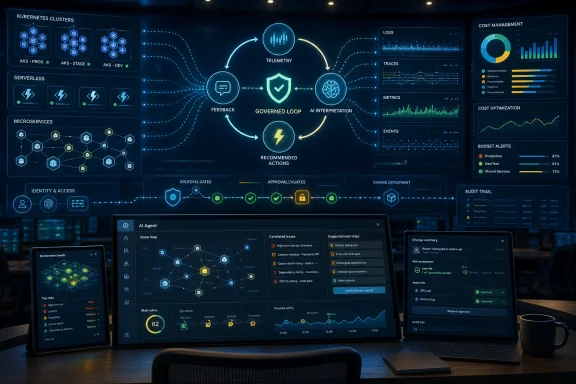
Microsoft is pushing Azure cloud management into an agent-driven operating model in 2026, with Azure Copilot observability capabilities generally available and cost-focused agent interfaces entering public preview for teams managing complex hybrid, microservices, and AI workloads. The company’s pitch is not merely that administrators will get better dashboards. It is that cloud operations should become a governed loop: telemetry becomes interpretation, interpretation becomes recommended action, and outcomes feed the next decision.
That is an ambitious claim, and it deserves more scrutiny than the usual “AI will reduce toil” packaging. The practical story for WindowsForum readers is simpler and more consequential: Microsoft wants Azure Copilot to become the connective tissue between monitoring, troubleshooting, cost control, and policy enforcement. If it works, operations teams get faster investigations and more continuous optimization. If it fails, they inherit a new layer of opaque automation sitting on top of systems that were already hard enough to reason about.
Cloud operations have spent the last decade accumulating consoles. There is a portal for infrastructure, another view for logs, a third system for incident response, a cost dashboard, a policy engine, a ticketing queue, and a chat channel where everyone argues about which signal matters. Microsoft’s new framing of agentic cloud operations is a direct response to that sprawl.
The company defines the model as AI-powered agents, guided by user intent, that continuously observe, reason, and assist with action across the cloud lifecycle. That wording matters. Microsoft is not claiming, at least in its public framing, that Azure will simply run itself while administrators go home early. It is claiming that the distance between signal and action can be shortened, governed, and made repeatable.
That is the right problem to attack. Modern Azure estates are no longer collections of neat virtual machines with a few storage accounts attached. They are mixed environments of Kubernetes clusters, managed databases, serverless functions, AI endpoints, identity dependencies, private networking, third-party services, and legacy Windows workloads that refuse to die because they still run something important on Tuesdays.
The old monitoring model was built around surfacing events. The newer observability model tried to add context. Microsoft’s agentic model goes a step further by asking whether the system can help decide what should happen next. That is where the promise becomes interesting—and where the risk begins.
Azure Copilot’s observability agent, now generally available, is positioned as an answer to that overload. Microsoft says it can analyze telemetry across application topology, dependencies, and baseline behavior, then identify emerging issues and provide context before teams begin manual investigation. In ordinary operations language, that means the agent is supposed to do some of the first-pass correlation work that humans currently do under pressure.
That is valuable because incident response is often lost in the opening minutes. Engineers jump between logs, traces, metrics, deployment histories, resource health, and chat threads while customers experience the outage in real time. The faster a team can determine whether an issue is caused by a bad deployment, a dependency failure, a quota problem, a regional incident, a configuration drift, or a sudden traffic pattern, the sooner it can stop guessing.
Microsoft’s case study language around reclaimed engineering time should be treated as vendor-selected evidence, not a universal benchmark. Still, the direction is plausible. If an observability agent can group related signals, trace dependencies, and explain likely root causes with enough accuracy, it can reduce the human cost of the first investigation pass.
The caveat is that observability agents are only as good as the telemetry, topology, and permissions they can see. An agent that lacks access to the right logs will hallucinate confidence. An agent that sees too much without understanding ownership boundaries may become an organizational hazard. The feature’s success will depend less on the Copilot brand and more on old-fashioned operational hygiene: consistent tagging, clean resource structure, mature identity controls, and useful instrumentation.
Azure already has the raw materials for that story: Azure Policy, role-based access control, Privileged Identity Management, resource locks, activity logs, and compliance tooling. Microsoft’s claim is that agents will operate within those existing boundaries rather than bypass them. That is the minimum viable promise for any credible enterprise agent product.
The hard part is not whether an agent can be told “do not delete production resources.” The hard part is whether organizations can express nuanced operational intent in a way the system can reliably enforce. A human SRE knows the difference between scaling a stateless service during a sales event and resizing a database tier during quarter-end reporting. Policy engines are less intuitive unless teams have invested the time to encode those boundaries.
This is why Microsoft’s “humans always in the loop” language is doing a lot of work. In the near term, the practical value of Azure Copilot agents will likely be recommendation, investigation, workflow assembly, and assisted execution—not unfettered remediation. Most serious IT shops will want approval gates for anything that changes production, alters network exposure, affects identity, increases spend, or modifies recovery posture.
That is not a weakness. It is the sane adoption path. The danger is not that enterprises will move too slowly; the danger is that executives will hear “agentic operations” and pressure teams to automate decisions before the governance model is ready.
Microsoft describes optimization as a continuous practice across cost, performance, resilience, and sustainability. That is polished language, but the operational shift is real. Cost management cannot remain a finance exercise performed after resources already exist. It has to move closer to design, deployment, and runtime decision-making.
That is where the Azure Resource Manager MCP Server, described as being in public preview, fits into the story. MCP, or Model Context Protocol, is becoming a common way for AI tools and agents to connect with external systems through standardized interfaces. In Microsoft’s Azure framing, the server allows agents to access cost and usage intelligence so that cost signals can appear inside developer tools, copilots, and custom workflows rather than only inside the Azure portal.
For developers, that could mean cost estimates appearing before infrastructure is deployed. For platform teams, it could mean reusable workflows that check policy, forecast spend, and flag risky configurations. For operations teams, it could mean natural-language investigation of anomalous consumption without manually slicing through multiple dashboards.
This is the part of agentic cloud operations that may deliver the fastest practical return. Many organizations already know they are wasting money in cloud environments; they simply lack the time, ownership clarity, and workflow integration to fix it consistently. If agents can surface cost impact where engineers are already working, optimization becomes less of a quarterly scolding and more of a daily design constraint.
Agentic operations make sense only if the agent can follow the work. A Copilot that requires users to stop, open a separate portal blade, search for a resource, and manually paste context into a chat box is a dressed-up help pane. A Copilot that can operate across natural language, CLI, console, and workflow integrations is closer to the product Microsoft is describing.
That distinction matters for Windows and Azure administrators. Many enterprise environments still depend heavily on scripting, runbooks, and change windows. The winning implementation will not be the flashiest chat interface; it will be the one that can slot into existing operational rituals without breaking audit trails or team responsibilities.
This is why reusable workflows are more important than the marketing suggests. Cloud teams do not need every engineer inventing a new prompt-based remediation path during an outage. They need approved procedures that agents can help execute consistently. The agent becomes useful when it reduces variance, not when it encourages improvisation at machine speed.
This is the same pattern enterprises saw with earlier automation waves. Configuration management helped disciplined teams scale their standards. It helped undisciplined teams replicate mistakes faster. Infrastructure as code made environments reproducible, but it also made bad templates durable. Agentic operations will follow the same rule.
For administrators, the preparation work is not glamorous. It means tightening identity boundaries, cleaning up resource organization, improving observability coverage, documenting service ownership, and making policy intent explicit. These are the foundations an agent needs before it can safely assist with operational decisions.
The irony is that some of the organizations most attracted to agentic operations may be the least ready for it. A company drowning in alerts and cloud waste will understandably want AI help. But if the underlying environment lacks structure, the first phase of adoption may feel less like automation and more like a painful audit.
That advantage does not make Microsoft unbeatable. Many enterprises are multi-cloud by necessity, acquisition history, or design. Their operations teams are already using Datadog, Dynatrace, Grafana, Splunk, ServiceNow, PagerDuty, Terraform, Kubernetes-native tooling, and internal developer platforms. Azure Copilot will have to coexist with those systems rather than pretend Azure is the only world that matters.
The “hybrid infrastructure” language in Microsoft’s announcement acknowledges this reality, but the center of gravity remains Azure. That is expected. Microsoft’s goal is not to become a neutral operations layer for every cloud. It is to make Azure feel like the place where agentic cloud management is most deeply integrated.
For WindowsForum’s audience, this raises a practical question: how much operational authority should be concentrated inside Azure Copilot? For Azure-heavy shops, the answer may be “quite a lot, eventually.” For multi-cloud or heavily regulated environments, the better answer may be “enough to assist, not enough to own the process.”
A good system will show why it reached a recommendation, what data it used, what action it proposes, what blast radius it expects, what policy permits it, and how to roll it back. A weak system will provide a confident paragraph and a button. The difference is not cosmetic; it is the difference between assisted operations and operational gambling.
Microsoft’s emphasis on auditable, repeatable actions is therefore essential. Enterprises need more than chat transcripts. They need change records, identity attribution, approval chains, policy evaluation results, and post-action outcomes that can be reviewed after the fact.
The industry should also be honest about accountability. If an agent recommends a bad action and a human approves it, the organization will still own the outage. Copilot may assist, but it will not sit in the incident review and accept responsibility. That means teams must treat agent recommendations as operational inputs, not commands from an oracle.
That makes periodic optimization feel obsolete. A monthly cloud cost review is too slow when a new AI feature can generate a major spend pattern in days. A weekly incident review is too slow when model-serving dependencies and downstream services are changing constantly. The operational loop has to tighten.
This is where Microsoft’s thesis is strongest. If cloud environments are becoming more dynamic, then operations must become more continuous. Observability cannot stop at “something changed.” Optimization cannot stop at “last month was expensive.” Governance cannot stop at “we wrote a policy once.” The system needs to keep interpreting, recommending, and learning from outcomes.
But the word “learning” should be handled carefully. Enterprises will want clarity about what data is retained, where conversation history and operational context live, how tenant boundaries are enforced, and whether sensitive operational information is used beyond the customer’s environment. Microsoft’s broader Azure Copilot messaging stresses enterprise safeguards and data ownership, but customers should still validate these details before expanding adoption.
To avoid that fate, Azure Copilot’s agents need to deliver measurable operational compression. They need to reduce time to triage, reduce duplicate investigations, shorten cost-analysis cycles, prevent policy drift, and make approved actions easier to execute safely. If the agent merely narrates what a skilled engineer can already see, it will become a demo feature rather than an operational dependency.
The public-preview status of cost and usage agent interfaces also matters. Preview features are not operational commitments. They are signals of direction. Enterprises should experiment, but they should avoid building critical governance or cost workflows on preview capabilities without an exit plan.
There is also a skills issue. Agentic operations do not eliminate the need for Azure expertise. They shift the skill mix toward policy design, workflow engineering, prompt evaluation, telemetry architecture, and automation review. The best operators will not be the people who blindly trust Copilot. They will be the people who know enough to ask better questions and recognize bad answers.
That is how it should be. Agentic operations are not a weekend migration. They are a gradual change in how teams relate to cloud systems. The first goal is not autonomy; it is better context at the moment of decision.
Over time, the line will move. Low-risk actions may become semi-automated. Recommendations with a strong track record may be approved more quickly. Cost guardrails may be enforced earlier in development. Incident workflows may begin with an agent assembling evidence before a human joins the bridge.
The operational winners will be the teams that treat agents as part of a disciplined system. They will define policy boundaries, measure outcomes, review agent behavior, and keep humans responsible for judgment. The losers will be the teams that treat agentic operations as a substitute for cloud architecture.
That is an ambitious claim, and it deserves more scrutiny than the usual “AI will reduce toil” packaging. The practical story for WindowsForum readers is simpler and more consequential: Microsoft wants Azure Copilot to become the connective tissue between monitoring, troubleshooting, cost control, and policy enforcement. If it works, operations teams get faster investigations and more continuous optimization. If it fails, they inherit a new layer of opaque automation sitting on top of systems that were already hard enough to reason about.
 Microsoft Is Selling a Loop, Not a Dashboard
Cloud operations have spent the last decade accumulating consoles. There is a portal for infrastructure, another view for logs, a third system for incident response, a cost dashboard, a policy engine, a ticketing queue, and a chat channel where everyone argues about which signal matters. Microsoft’s new framing of agentic cloud operations is a direct response to that sprawl.The company defines the model as AI-powered agents, guided by user intent, that continuously observe, reason, and assist with action across the cloud lifecycle. That wording matters. Microsoft is not claiming, at least in its public framing, that Azure will simply run itself while administrators go home early. It is claiming that the distance between signal and action can be shortened, governed, and made repeatable.
That is the right problem to attack. Modern Azure estates are no longer collections of neat virtual machines with a few storage accounts attached. They are mixed environments of Kubernetes clusters, managed databases, serverless functions, AI endpoints, identity dependencies, private networking, third-party services, and legacy Windows workloads that refuse to die because they still run something important on Tuesdays.
The old monitoring model was built around surfacing events. The newer observability model tried to add context. Microsoft’s agentic model goes a step further by asking whether the system can help decide what should happen next. That is where the promise becomes interesting—and where the risk begins.
The Alert Storm Finally Meets Its Natural Predator
The most credible part of Microsoft’s announcement is the observability argument. Anyone who has operated a serious cloud environment knows the problem is not a lack of telemetry. It is that telemetry becomes a second production system: expensive, noisy, difficult to query, and often understood only by the handful of engineers who built the dashboards.Azure Copilot’s observability agent, now generally available, is positioned as an answer to that overload. Microsoft says it can analyze telemetry across application topology, dependencies, and baseline behavior, then identify emerging issues and provide context before teams begin manual investigation. In ordinary operations language, that means the agent is supposed to do some of the first-pass correlation work that humans currently do under pressure.
That is valuable because incident response is often lost in the opening minutes. Engineers jump between logs, traces, metrics, deployment histories, resource health, and chat threads while customers experience the outage in real time. The faster a team can determine whether an issue is caused by a bad deployment, a dependency failure, a quota problem, a regional incident, a configuration drift, or a sudden traffic pattern, the sooner it can stop guessing.
Microsoft’s case study language around reclaimed engineering time should be treated as vendor-selected evidence, not a universal benchmark. Still, the direction is plausible. If an observability agent can group related signals, trace dependencies, and explain likely root causes with enough accuracy, it can reduce the human cost of the first investigation pass.
The caveat is that observability agents are only as good as the telemetry, topology, and permissions they can see. An agent that lacks access to the right logs will hallucinate confidence. An agent that sees too much without understanding ownership boundaries may become an organizational hazard. The feature’s success will depend less on the Copilot brand and more on old-fashioned operational hygiene: consistent tagging, clean resource structure, mature identity controls, and useful instrumentation.
Governance Is the Real Product Boundary
Microsoft’s blog spends considerable time on governance, and that is not incidental. Agentic operations without governance is just automation with a nicer user interface. For enterprises, the difference between a helpful assistant and a compliance incident is whether actions are constrained by policy, access control, auditability, and human review.Azure already has the raw materials for that story: Azure Policy, role-based access control, Privileged Identity Management, resource locks, activity logs, and compliance tooling. Microsoft’s claim is that agents will operate within those existing boundaries rather than bypass them. That is the minimum viable promise for any credible enterprise agent product.
The hard part is not whether an agent can be told “do not delete production resources.” The hard part is whether organizations can express nuanced operational intent in a way the system can reliably enforce. A human SRE knows the difference between scaling a stateless service during a sales event and resizing a database tier during quarter-end reporting. Policy engines are less intuitive unless teams have invested the time to encode those boundaries.
This is why Microsoft’s “humans always in the loop” language is doing a lot of work. In the near term, the practical value of Azure Copilot agents will likely be recommendation, investigation, workflow assembly, and assisted execution—not unfettered remediation. Most serious IT shops will want approval gates for anything that changes production, alters network exposure, affects identity, increases spend, or modifies recovery posture.
That is not a weakness. It is the sane adoption path. The danger is not that enterprises will move too slowly; the danger is that executives will hear “agentic operations” and pressure teams to automate decisions before the governance model is ready.
Cost Control Moves Into the Developer’s Line of Sight
The second half of Microsoft’s argument is about optimization, and here the timing is significant. AI workloads are making cloud cost behavior harder to predict. GPU-backed services, model inference, vector search, large-scale data movement, and bursty experimentation all create spending patterns that traditional monthly review cycles handle poorly.Microsoft describes optimization as a continuous practice across cost, performance, resilience, and sustainability. That is polished language, but the operational shift is real. Cost management cannot remain a finance exercise performed after resources already exist. It has to move closer to design, deployment, and runtime decision-making.
That is where the Azure Resource Manager MCP Server, described as being in public preview, fits into the story. MCP, or Model Context Protocol, is becoming a common way for AI tools and agents to connect with external systems through standardized interfaces. In Microsoft’s Azure framing, the server allows agents to access cost and usage intelligence so that cost signals can appear inside developer tools, copilots, and custom workflows rather than only inside the Azure portal.
For developers, that could mean cost estimates appearing before infrastructure is deployed. For platform teams, it could mean reusable workflows that check policy, forecast spend, and flag risky configurations. For operations teams, it could mean natural-language investigation of anomalous consumption without manually slicing through multiple dashboards.
This is the part of agentic cloud operations that may deliver the fastest practical return. Many organizations already know they are wasting money in cloud environments; they simply lack the time, ownership clarity, and workflow integration to fix it consistently. If agents can surface cost impact where engineers are already working, optimization becomes less of a quarterly scolding and more of a daily design constraint.
The Portal Is No Longer the Center of Gravity
Microsoft’s direction also reflects a broader shift away from the cloud portal as the main operational surface. The Azure portal remains important, but it is increasingly just one interface among many. Developers live in IDEs, terminals, GitHub workflows, Teams chats, incident tools, and internal platforms. Sysadmins and cloud engineers move between PowerShell, Azure CLI, infrastructure-as-code repositories, and service management systems.Agentic operations make sense only if the agent can follow the work. A Copilot that requires users to stop, open a separate portal blade, search for a resource, and manually paste context into a chat box is a dressed-up help pane. A Copilot that can operate across natural language, CLI, console, and workflow integrations is closer to the product Microsoft is describing.
That distinction matters for Windows and Azure administrators. Many enterprise environments still depend heavily on scripting, runbooks, and change windows. The winning implementation will not be the flashiest chat interface; it will be the one that can slot into existing operational rituals without breaking audit trails or team responsibilities.
This is why reusable workflows are more important than the marketing suggests. Cloud teams do not need every engineer inventing a new prompt-based remediation path during an outage. They need approved procedures that agents can help execute consistently. The agent becomes useful when it reduces variance, not when it encourages improvisation at machine speed.
Agentic Operations Will Expose Bad Cloud Hygiene
There is an uncomfortable implication in Microsoft’s pitch: agentic cloud operations will reward well-run environments and punish messy ones. If resources are untagged, ownership is unclear, environments are inconsistently named, logs are missing, permissions are overbroad, and policy exceptions are everywhere, an AI agent will not magically create order. It may simply make the disorder easier to query.This is the same pattern enterprises saw with earlier automation waves. Configuration management helped disciplined teams scale their standards. It helped undisciplined teams replicate mistakes faster. Infrastructure as code made environments reproducible, but it also made bad templates durable. Agentic operations will follow the same rule.
For administrators, the preparation work is not glamorous. It means tightening identity boundaries, cleaning up resource organization, improving observability coverage, documenting service ownership, and making policy intent explicit. These are the foundations an agent needs before it can safely assist with operational decisions.
The irony is that some of the organizations most attracted to agentic operations may be the least ready for it. A company drowning in alerts and cloud waste will understandably want AI help. But if the underlying environment lacks structure, the first phase of adoption may feel less like automation and more like a painful audit.
Microsoft’s Advantage Is Platform Gravity
Microsoft has an obvious advantage in this market: Azure Copilot sits close to the control plane. A third-party observability or FinOps tool can provide valuable intelligence, but Microsoft controls much of the platform context, identity model, policy fabric, and resource metadata. If Azure Copilot can combine those signals effectively, it has a privileged vantage point.That advantage does not make Microsoft unbeatable. Many enterprises are multi-cloud by necessity, acquisition history, or design. Their operations teams are already using Datadog, Dynatrace, Grafana, Splunk, ServiceNow, PagerDuty, Terraform, Kubernetes-native tooling, and internal developer platforms. Azure Copilot will have to coexist with those systems rather than pretend Azure is the only world that matters.
The “hybrid infrastructure” language in Microsoft’s announcement acknowledges this reality, but the center of gravity remains Azure. That is expected. Microsoft’s goal is not to become a neutral operations layer for every cloud. It is to make Azure feel like the place where agentic cloud management is most deeply integrated.
For WindowsForum’s audience, this raises a practical question: how much operational authority should be concentrated inside Azure Copilot? For Azure-heavy shops, the answer may be “quite a lot, eventually.” For multi-cloud or heavily regulated environments, the better answer may be “enough to assist, not enough to own the process.”
The Human-in-the-Loop Promise Will Be Tested Under Pressure
Every vendor says humans remain in control. The test comes during an incident at 2:00 a.m., when the agent recommends a fix, the service is down, executives are watching, and the engineer on call must decide whether to approve the action. That is when “human in the loop” stops being a principle and becomes a production workflow.A good system will show why it reached a recommendation, what data it used, what action it proposes, what blast radius it expects, what policy permits it, and how to roll it back. A weak system will provide a confident paragraph and a button. The difference is not cosmetic; it is the difference between assisted operations and operational gambling.
Microsoft’s emphasis on auditable, repeatable actions is therefore essential. Enterprises need more than chat transcripts. They need change records, identity attribution, approval chains, policy evaluation results, and post-action outcomes that can be reviewed after the fact.
The industry should also be honest about accountability. If an agent recommends a bad action and a human approves it, the organization will still own the outage. Copilot may assist, but it will not sit in the incident review and accept responsibility. That means teams must treat agent recommendations as operational inputs, not commands from an oracle.
AI Workloads Make the Old Operating Model Look Tired
The arrival of AI workloads is not just another scaling event. It changes the rhythm of cloud operations. Teams experiment more quickly, infrastructure requirements swing more dramatically, and cost-performance tradeoffs become harder to model. Inference workloads may be sensitive to latency, token volume, model selection, region capacity, and data movement in ways traditional web apps were not.That makes periodic optimization feel obsolete. A monthly cloud cost review is too slow when a new AI feature can generate a major spend pattern in days. A weekly incident review is too slow when model-serving dependencies and downstream services are changing constantly. The operational loop has to tighten.
This is where Microsoft’s thesis is strongest. If cloud environments are becoming more dynamic, then operations must become more continuous. Observability cannot stop at “something changed.” Optimization cannot stop at “last month was expensive.” Governance cannot stop at “we wrote a policy once.” The system needs to keep interpreting, recommending, and learning from outcomes.
But the word “learning” should be handled carefully. Enterprises will want clarity about what data is retained, where conversation history and operational context live, how tenant boundaries are enforced, and whether sensitive operational information is used beyond the customer’s environment. Microsoft’s broader Azure Copilot messaging stresses enterprise safeguards and data ownership, but customers should still validate these details before expanding adoption.
The Risk Is Automation Theater
The least useful version of agentic cloud operations is automation theater: a slick interface that summarizes alerts, repeats documentation, and generates plausible recommendations while humans still do the real work. The cloud industry has seen this movie before. Products that promised “single pane of glass” often became just another pane.To avoid that fate, Azure Copilot’s agents need to deliver measurable operational compression. They need to reduce time to triage, reduce duplicate investigations, shorten cost-analysis cycles, prevent policy drift, and make approved actions easier to execute safely. If the agent merely narrates what a skilled engineer can already see, it will become a demo feature rather than an operational dependency.
The public-preview status of cost and usage agent interfaces also matters. Preview features are not operational commitments. They are signals of direction. Enterprises should experiment, but they should avoid building critical governance or cost workflows on preview capabilities without an exit plan.
There is also a skills issue. Agentic operations do not eliminate the need for Azure expertise. They shift the skill mix toward policy design, workflow engineering, prompt evaluation, telemetry architecture, and automation review. The best operators will not be the people who blindly trust Copilot. They will be the people who know enough to ask better questions and recognize bad answers.
The Next Runbook May Start With an Agent
The immediate adoption path is likely to be conservative. Teams will use Azure Copilot observability to accelerate investigation. They will test cost intelligence in developer workflows. They will build a few reusable optimization patterns. They will keep production-changing actions behind approvals.That is how it should be. Agentic operations are not a weekend migration. They are a gradual change in how teams relate to cloud systems. The first goal is not autonomy; it is better context at the moment of decision.
Over time, the line will move. Low-risk actions may become semi-automated. Recommendations with a strong track record may be approved more quickly. Cost guardrails may be enforced earlier in development. Incident workflows may begin with an agent assembling evidence before a human joins the bridge.
The operational winners will be the teams that treat agents as part of a disciplined system. They will define policy boundaries, measure outcomes, review agent behavior, and keep humans responsible for judgment. The losers will be the teams that treat agentic operations as a substitute for cloud architecture.
Azure’s Agentic Bet Comes Down to These Operational Realities
Microsoft’s announcement is best read as a platform direction rather than a single product update. Azure Copilot is becoming the interface through which Microsoft wants cloud teams to observe, optimize, govern, and eventually act.- Azure Copilot’s observability agent is now generally available and is aimed at reducing the manual correlation work that slows incident response.
- Microsoft’s agentic operations model depends on governance being embedded into workflows rather than applied after an action is already taken.
- Cost optimization is moving closer to developers through agent-accessible cost and usage intelligence, including MCP-based interfaces now in public preview.
- The model will work best in Azure environments with strong tagging, clear ownership, mature telemetry, and disciplined access controls.
- Human approval remains essential for production-impacting actions, especially where remediation affects identity, networking, spending, or resilience.
- Agentic operations should be measured by operational outcomes, not by how convincingly a chatbot describes an outage.
References
- Primary source: Microsoft Azure
Published: 2026-06-23T17:30:08.446028
