

groundcover this week promoted an Azure-native version of its Agent Mode observability product, positioning the feature at Microsoft Build 2026 as an AI-assisted incident investigator that runs inside a customer’s own cloud environment. The pitch is simple: logs, metrics, and traces are no longer enough when production systems are built from microservices, Kubernetes clusters, and increasingly autonomous AI agents. The more interesting claim is that observability itself is becoming agentic — not merely a dashboard engineers consult, but a system that forms hypotheses, correlates evidence, and hands operators a narrower set of decisions. That is a promising idea, but also one that will live or die on boring enterprise proof: latency, cost, governance, and whether the tool can explain itself when the pager goes off.
The traditional observability workflow has always had a hidden bargain. Vendors collect as much telemetry as budgets and pipelines allow, then give engineers increasingly elaborate ways to search, chart, alert, and correlate it. The human still does the real investigative work: deciding which spike matters, which trace is misleading, and which symptom is merely collateral damage.
groundcover’s argument is that this bargain is breaking under the weight of modern production systems. Microservices already made incident response more distributed and less intuitive. AI agents make the problem stranger still, because a bad outcome may come from a chain of tool calls, retrieval decisions, reasoning steps, model outputs, or policy failures rather than a single crashed service.
That is where “agentic observability” enters the marketing vocabulary. The term is fashionable, but it points at a real shift: observability tools are trying to graduate from passive evidence stores into active participants in incident response. Instead of asking an engineer to assemble the timeline, the system tries to build one. Instead of waiting for a dashboard query, the system proposes a theory.
The risk, of course, is that observability vendors have been selling variations on “root cause analysis” for years. Every generation promises fewer false positives, smarter correlation, and less toil. What makes this round different is not the slogan; it is whether large language models, telemetry graphs, and cloud-native deployment patterns can make the promise operationally credible.
Enterprise Microsoft shops have spent years consolidating identity, policy, networking, logging, endpoint management, and developer workflows around Azure and Microsoft 365. A monitoring tool that exports sensitive production telemetry into a vendor-controlled SaaS plane may be acceptable for some teams, but it becomes harder to defend in regulated environments. Logs can contain customer identifiers, tokens, prompts, database fragments, internal hostnames, and enough operational context to make security teams nervous.
groundcover’s bring-your-own-cloud model is designed to exploit that anxiety. If the data plane stays in the customer’s environment, the vendor can argue that it reduces both governance friction and data movement cost. That is a compelling argument for organizations that already have Azure landing zones, private networking standards, key management practices, and procurement assumptions wrapped around Microsoft’s cloud.
It also aligns neatly with Microsoft’s own Build-era message. Microsoft Foundry has become the company’s production AI platform story: models, agents, evaluation, observability, governance, and developer tooling under one broad Azure umbrella. groundcover is positioning itself as a specialist layer inside that ecosystem rather than as an observability island sitting outside it.
That positioning is commercially smart. Azure customers do not want every AI-era tool to become another exception in their compliance model. If groundcover can make Agent Mode feel like part of an Azure-native operating pattern, it gets to sell against the operational sprawl created by conventional SaaS monitoring.
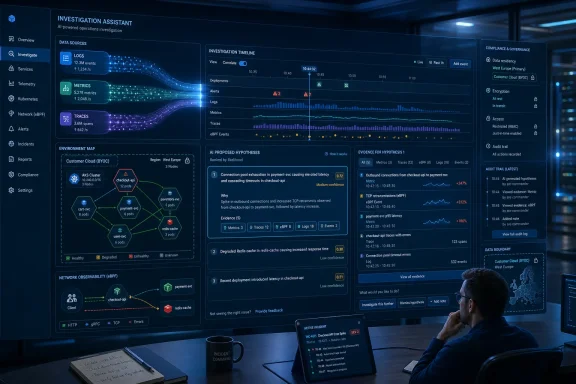
But the stronger version of groundcover’s claim is more specific. Agent Mode is framed as a conversational expert that can aggregate logs, correlate traces, analyze telemetry, and produce investigation-driven assets such as dashboards. That is different from a chatbot bolted onto a search box. The test is whether the agent can operate the observability platform as a domain-aware system rather than merely summarize whatever an API returns.
In production incidents, speed matters, but sequence matters more. The wrong early hypothesis can waste an hour. A convincing but false AI explanation can be worse than no explanation at all, because it adds confidence to confusion. For an observability agent to earn trust, it must show the path from signal to inference.
That means the useful agent is not the one that says, “The database is slow.” It is the one that says which service saw p95 latency first, which deployment or traffic shift preceded it, which downstream errors are secondary, and which logs contradict the initial theory. It should make the human faster without pretending the human has disappeared.
This is why groundcover’s “engineers remain in control” framing is more than a safety disclaimer. In serious operations teams, the goal is not full autonomy; it is controlled acceleration. The best incident tools narrow the blast radius of human attention.
That creates a perverse outcome. The systems are most observable when they are least affordable, and most affordable when they are least complete. In incident response, the missing data is often the data you needed most.
groundcover’s bring-your-own-cloud model tries to alter that equation by keeping the telemetry platform closer to the customer’s infrastructure economics. The company argues that avoiding SaaS markups can make high-fidelity collection more practical. Its eBPF-based collection story also matters here, because instrumentation fatigue is real in Kubernetes environments where services are created, refactored, and redeployed constantly.
For Azure customers, the appeal is not just lower invoices. It is the possibility of making observability procurement look less like an unpredictable metered SaaS contract and more like an internal cloud architecture decision. That may not make the spend small, but it can make the spend easier to govern.
Still, cost claims in observability deserve skepticism until customers validate them at scale. Running inside a customer cloud does not make compute, storage, model inference, indexing, or retention free. If Agent Mode leans heavily on Claude inference through Foundry, organizations will still need to understand model usage, token costs, caching behavior, and how often the agent is invoked during noisy incidents.
That creates a natural opening for vendors like groundcover. If enterprises build more agents on Azure, they will need more than conventional application telemetry. They will need visibility into agent behavior, tool usage, retrieval quality, latency, model outputs, cost, and failure modes that do not map cleanly onto classic service health checks.
In other words, Microsoft’s success at selling the agent platform creates demand for agent observability. The more companies trust AI systems with multi-step workflows, the more they need to know why those workflows fail. A customer support agent that chooses the wrong refund policy, a coding agent that triggers a bad deployment path, or an operations agent that calls the wrong remediation script is not just an uptime issue. It is a governance issue.
groundcover is trying to ride that platform wave while avoiding direct collision with Microsoft’s own observability ambitions. That will require careful positioning. Microsoft will continue building native monitoring, tracing, evaluation, and governance features into Foundry and Azure Monitor. Third-party vendors need to prove that they provide deeper operational context, better workflows, or more flexible economics than the default stack.
That is a familiar Microsoft ecosystem pattern. Partners thrive when they fill gaps faster than Microsoft closes them. They struggle when “good enough” becomes bundled, integrated, and already approved by procurement.
This is where groundcover’s Azure-native and BYOC message becomes important. Competing on “we have an AI assistant too” is weak, because everyone will have one. Competing on data residency, cost control, eBPF collection, and cloud-resident execution is more defensible, especially for enterprises that are tired of shipping sensitive telemetry into another vendor’s black box.
But defensibility depends on product maturity. A slick agent demo at a developer conference is one thing; surviving a messy enterprise environment is another. Production estates contain legacy services, half-instrumented workloads, noisy alerts, inconsistent naming conventions, multiple clusters, hybrid networks, and political boundaries between application, platform, security, and data teams.
The observability vendor that wins is not necessarily the one with the most elegant agent. It is the one that fits the ugly reality of operations. That means permission models, audit logs, integration with incident tools, controlled access to secrets, retention policies, and enough transparency for post-incident review.
For groundcover, the commercial opportunity is real, but so is the burden of proof. Incumbents can copy interface patterns quickly. They cannot as easily copy trust, but trust must be earned through incidents, not announcements.
Those engineers will judge an observability agent by how it behaves when the evidence is incomplete. Does it state uncertainty, or does it invent certainty? Does it separate symptoms from suspected causes? Does it cite the telemetry behind its conclusions inside the product workflow? Does it make reversible suggestions, or does it push the team toward premature remediation?
This matters especially for AI workloads. Agent failures may be nondeterministic, dependent on prompt context, external tool state, retrieval results, or model behavior that changes subtly over time. A conventional dashboard can show latency or error rates; it may not explain why an agent selected one tool path over another.
The promise of agentic observability is that the monitoring system understands enough of the agent workflow to investigate it. The danger is recursive opacity: using one AI system to explain another AI system without sufficient grounding in telemetry. That may be acceptable in a demo, but not during a Sev 1 incident.
The phrase “human in the loop” gets overused, but in operations it has a concrete meaning. The human must be able to inspect, challenge, and override the machine’s reasoning. If Agent Mode provides that, it could be useful. If it merely wraps telemetry in confident prose, it will become another pane of glass to distrust.
Telemetry is sensitive. AI telemetry is often more sensitive. Prompts, completions, tool calls, retrieved documents, embeddings, model evaluations, and agent reasoning artifacts can expose business logic and customer data in ways conventional application logs did not. Enterprises that were already cautious about log exports are likely to be even more cautious about AI-agent telemetry.
A cloud-resident model can simplify some of those conversations. If the observability data, agent execution, and model access sit within Azure governance boundaries, security teams may have a clearer path for review. They can apply existing policies around identity, network isolation, access control, audit, encryption, and regional deployment.
That does not eliminate risk. It changes the shape of risk. Customers still need to know what data is sent to models, how it is minimized, what retention applies, how access is logged, and whether any vendor support pathway exposes sensitive content. “Runs in your cloud” is a strong starting point, not a complete compliance answer.
For Microsoft-centric enterprises, though, it is a powerful starting point. Many organizations would rather extend an Azure control plane they already understand than approve another external SaaS data path. groundcover is betting that this preference will become stronger as AI observability moves from experimental dashboards to production governance.
How much faster are investigations in real customer incidents? What kinds of incidents does Agent Mode handle well, and where does it fail? How does performance vary across Kubernetes maturity levels, Azure architectures, and mixed observability estates? How much does Claude inference add to the operational cost model? How are hallucinations, stale context, and overbroad permissions controlled?
These are not nitpicks. They are the line between a promising product category and another AI feature that sounds better in a launch post than in an incident channel. Enterprise buyers have become more disciplined about AI claims because they have seen too many demos that collapse when confronted with real permissions, dirty data, and legacy constraints.
groundcover does not need to prove that agentic observability solves every production problem. It needs to prove that it reliably shortens a specific class of investigations without creating new ones. That is a narrower claim, but a much more valuable one.
The best version of this product would not replace existing observability practice. It would sit on top of it, using telemetry to produce better investigative starting points and durable operational artifacts. If it can turn recurring incidents into reusable dashboards, queries, and playbooks, then the agent becomes more than a chat interface. It becomes a mechanism for institutional memory.
That can help with awareness, especially among enterprises already evaluating Foundry, Copilot workflows, and AI-agent deployment patterns. It also places groundcover inside a crowded narrative. Every vendor at Build wants to be the missing layer in Microsoft’s agent ecosystem. The burden is to explain why this particular layer is indispensable.
For groundcover, the answer has to be operational specificity. The company should resist the temptation to make agentic observability sound like magic. It is more credible to say that complex production systems generate too much telemetry for humans to triage manually, and that a domain-aware agent can reduce the search space while preserving human control.
That is a grounded argument. It matches how IT teams actually adopt new tools: not by handing over authority, but by automating the repetitive first passes that slow down experts. If Agent Mode can handle the tedious correlation work while leaving judgment to engineers, it will find an audience.
The bigger strategic question is whether observability becomes a feature of AI platforms or remains a specialized market. Microsoft would prefer Foundry to include enough observability to make agents deployable by default. Vendors like groundcover must show that production operations require more depth than the platform baseline can provide.
 groundcover Wants to Move Observability From Search to Investigation
The traditional observability workflow has always had a hidden bargain. Vendors collect as much telemetry as budgets and pipelines allow, then give engineers increasingly elaborate ways to search, chart, alert, and correlate it. The human still does the real investigative work: deciding which spike matters, which trace is misleading, and which symptom is merely collateral damage.groundcover’s argument is that this bargain is breaking under the weight of modern production systems. Microservices already made incident response more distributed and less intuitive. AI agents make the problem stranger still, because a bad outcome may come from a chain of tool calls, retrieval decisions, reasoning steps, model outputs, or policy failures rather than a single crashed service.
That is where “agentic observability” enters the marketing vocabulary. The term is fashionable, but it points at a real shift: observability tools are trying to graduate from passive evidence stores into active participants in incident response. Instead of asking an engineer to assemble the timeline, the system tries to build one. Instead of waiting for a dashboard query, the system proposes a theory.
The risk, of course, is that observability vendors have been selling variations on “root cause analysis” for years. Every generation promises fewer false positives, smarter correlation, and less toil. What makes this round different is not the slogan; it is whether large language models, telemetry graphs, and cloud-native deployment patterns can make the promise operationally credible.
Azure Is Not Just a Hosting Target Here
The Azure angle matters because groundcover is not merely saying its software can monitor Azure workloads. It is saying Agent Mode can run natively in Azure, use Claude models through Microsoft Foundry, and keep observability data inside the customer’s own cloud environment. For WindowsForum’s audience, that distinction is not cosmetic.Enterprise Microsoft shops have spent years consolidating identity, policy, networking, logging, endpoint management, and developer workflows around Azure and Microsoft 365. A monitoring tool that exports sensitive production telemetry into a vendor-controlled SaaS plane may be acceptable for some teams, but it becomes harder to defend in regulated environments. Logs can contain customer identifiers, tokens, prompts, database fragments, internal hostnames, and enough operational context to make security teams nervous.
groundcover’s bring-your-own-cloud model is designed to exploit that anxiety. If the data plane stays in the customer’s environment, the vendor can argue that it reduces both governance friction and data movement cost. That is a compelling argument for organizations that already have Azure landing zones, private networking standards, key management practices, and procurement assumptions wrapped around Microsoft’s cloud.
It also aligns neatly with Microsoft’s own Build-era message. Microsoft Foundry has become the company’s production AI platform story: models, agents, evaluation, observability, governance, and developer tooling under one broad Azure umbrella. groundcover is positioning itself as a specialist layer inside that ecosystem rather than as an observability island sitting outside it.
That positioning is commercially smart. Azure customers do not want every AI-era tool to become another exception in their compliance model. If groundcover can make Agent Mode feel like part of an Azure-native operating pattern, it gets to sell against the operational sprawl created by conventional SaaS monitoring.
The Agentic Label Is Useful Only If It Changes the Work
There is a cynical reading of this announcement, and it is not entirely unfair. “Agentic” has become the 2026 version of “AI-powered”: a word attached to anything that performs more than one automated step. Observability already had anomaly detection, correlation engines, service maps, and alert enrichment before the current agent boom.But the stronger version of groundcover’s claim is more specific. Agent Mode is framed as a conversational expert that can aggregate logs, correlate traces, analyze telemetry, and produce investigation-driven assets such as dashboards. That is different from a chatbot bolted onto a search box. The test is whether the agent can operate the observability platform as a domain-aware system rather than merely summarize whatever an API returns.
In production incidents, speed matters, but sequence matters more. The wrong early hypothesis can waste an hour. A convincing but false AI explanation can be worse than no explanation at all, because it adds confidence to confusion. For an observability agent to earn trust, it must show the path from signal to inference.
That means the useful agent is not the one that says, “The database is slow.” It is the one that says which service saw p95 latency first, which deployment or traffic shift preceded it, which downstream errors are secondary, and which logs contradict the initial theory. It should make the human faster without pretending the human has disappeared.
This is why groundcover’s “engineers remain in control” framing is more than a safety disclaimer. In serious operations teams, the goal is not full autonomy; it is controlled acceleration. The best incident tools narrow the blast radius of human attention.
The BYOC Pitch Attacks Observability’s Cost Problem
Observability has a cost problem that the industry has spent years trying not to say too plainly. High-cardinality telemetry, verbose logs, distributed traces, Kubernetes churn, and now AI-agent event streams can generate eye-watering bills. Teams respond with sampling, retention cuts, dropped fields, open-source detours, and internal arguments over who owns the monitoring budget.That creates a perverse outcome. The systems are most observable when they are least affordable, and most affordable when they are least complete. In incident response, the missing data is often the data you needed most.
groundcover’s bring-your-own-cloud model tries to alter that equation by keeping the telemetry platform closer to the customer’s infrastructure economics. The company argues that avoiding SaaS markups can make high-fidelity collection more practical. Its eBPF-based collection story also matters here, because instrumentation fatigue is real in Kubernetes environments where services are created, refactored, and redeployed constantly.
For Azure customers, the appeal is not just lower invoices. It is the possibility of making observability procurement look less like an unpredictable metered SaaS contract and more like an internal cloud architecture decision. That may not make the spend small, but it can make the spend easier to govern.
Still, cost claims in observability deserve skepticism until customers validate them at scale. Running inside a customer cloud does not make compute, storage, model inference, indexing, or retention free. If Agent Mode leans heavily on Claude inference through Foundry, organizations will still need to understand model usage, token costs, caching behavior, and how often the agent is invoked during noisy incidents.
Microsoft’s AI Platform Strategy Gives groundcover a Tailwind
Microsoft has spent the past two years making agents the connective tissue of its developer and enterprise platform. Copilot is no longer just an assistant in a text box; it is increasingly a set of workflows across coding, operations, productivity, and business applications. Foundry extends that logic into the infrastructure layer, where enterprises can choose models, build agents, observe them, and govern their use.That creates a natural opening for vendors like groundcover. If enterprises build more agents on Azure, they will need more than conventional application telemetry. They will need visibility into agent behavior, tool usage, retrieval quality, latency, model outputs, cost, and failure modes that do not map cleanly onto classic service health checks.
In other words, Microsoft’s success at selling the agent platform creates demand for agent observability. The more companies trust AI systems with multi-step workflows, the more they need to know why those workflows fail. A customer support agent that chooses the wrong refund policy, a coding agent that triggers a bad deployment path, or an operations agent that calls the wrong remediation script is not just an uptime issue. It is a governance issue.
groundcover is trying to ride that platform wave while avoiding direct collision with Microsoft’s own observability ambitions. That will require careful positioning. Microsoft will continue building native monitoring, tracing, evaluation, and governance features into Foundry and Azure Monitor. Third-party vendors need to prove that they provide deeper operational context, better workflows, or more flexible economics than the default stack.
That is a familiar Microsoft ecosystem pattern. Partners thrive when they fill gaps faster than Microsoft closes them. They struggle when “good enough” becomes bundled, integrated, and already approved by procurement.
The Incumbents Will Not Stand Still
groundcover’s competitive target is not a static field. Datadog, Dynatrace, New Relic, Grafana Labs, Elastic, Splunk, and cloud-native monitoring stacks have all been moving toward AI-assisted investigation in one form or another. The big observability vendors understand that dashboards alone are not the future.This is where groundcover’s Azure-native and BYOC message becomes important. Competing on “we have an AI assistant too” is weak, because everyone will have one. Competing on data residency, cost control, eBPF collection, and cloud-resident execution is more defensible, especially for enterprises that are tired of shipping sensitive telemetry into another vendor’s black box.
But defensibility depends on product maturity. A slick agent demo at a developer conference is one thing; surviving a messy enterprise environment is another. Production estates contain legacy services, half-instrumented workloads, noisy alerts, inconsistent naming conventions, multiple clusters, hybrid networks, and political boundaries between application, platform, security, and data teams.
The observability vendor that wins is not necessarily the one with the most elegant agent. It is the one that fits the ugly reality of operations. That means permission models, audit logs, integration with incident tools, controlled access to secrets, retention policies, and enough transparency for post-incident review.
For groundcover, the commercial opportunity is real, but so is the burden of proof. Incumbents can copy interface patterns quickly. They cannot as easily copy trust, but trust must be earned through incidents, not announcements.
Engineers Will Judge the Agent by Its Mistakes
The most important audience for Agent Mode may not be executives excited about AI productivity. It may be the senior engineers who have learned, through painful repetition, that monitoring tools lie by omission. They know a green dashboard can coexist with a broken user journey. They know correlation is not causation. They know that the quietest service in a distributed system is sometimes the one that failed first.Those engineers will judge an observability agent by how it behaves when the evidence is incomplete. Does it state uncertainty, or does it invent certainty? Does it separate symptoms from suspected causes? Does it cite the telemetry behind its conclusions inside the product workflow? Does it make reversible suggestions, or does it push the team toward premature remediation?
This matters especially for AI workloads. Agent failures may be nondeterministic, dependent on prompt context, external tool state, retrieval results, or model behavior that changes subtly over time. A conventional dashboard can show latency or error rates; it may not explain why an agent selected one tool path over another.
The promise of agentic observability is that the monitoring system understands enough of the agent workflow to investigate it. The danger is recursive opacity: using one AI system to explain another AI system without sufficient grounding in telemetry. That may be acceptable in a demo, but not during a Sev 1 incident.
The phrase “human in the loop” gets overused, but in operations it has a concrete meaning. The human must be able to inspect, challenge, and override the machine’s reasoning. If Agent Mode provides that, it could be useful. If it merely wraps telemetry in confident prose, it will become another pane of glass to distrust.
Compliance Teams May Become the Surprise Buyer
The most obvious buyer for observability is engineering. The less obvious buyer for Azure-native Agent Mode may be compliance and security leadership. That is because the architecture claim — keep data in the customer’s own cloud — speaks to a different pain point than faster incident response.Telemetry is sensitive. AI telemetry is often more sensitive. Prompts, completions, tool calls, retrieved documents, embeddings, model evaluations, and agent reasoning artifacts can expose business logic and customer data in ways conventional application logs did not. Enterprises that were already cautious about log exports are likely to be even more cautious about AI-agent telemetry.
A cloud-resident model can simplify some of those conversations. If the observability data, agent execution, and model access sit within Azure governance boundaries, security teams may have a clearer path for review. They can apply existing policies around identity, network isolation, access control, audit, encryption, and regional deployment.
That does not eliminate risk. It changes the shape of risk. Customers still need to know what data is sent to models, how it is minimized, what retention applies, how access is logged, and whether any vendor support pathway exposes sensitive content. “Runs in your cloud” is a strong starting point, not a complete compliance answer.
For Microsoft-centric enterprises, though, it is a powerful starting point. Many organizations would rather extend an Azure control plane they already understand than approve another external SaaS data path. groundcover is betting that this preference will become stronger as AI observability moves from experimental dashboards to production governance.
The Product Story Still Needs Customer Evidence
The weakest part of the current narrative is not the strategy. It is the evidence. The claims are directionally plausible: lower toil, faster incident resolution, better cost control, and safer telemetry handling. But the public material leaves open the questions that serious buyers will ask first.How much faster are investigations in real customer incidents? What kinds of incidents does Agent Mode handle well, and where does it fail? How does performance vary across Kubernetes maturity levels, Azure architectures, and mixed observability estates? How much does Claude inference add to the operational cost model? How are hallucinations, stale context, and overbroad permissions controlled?
These are not nitpicks. They are the line between a promising product category and another AI feature that sounds better in a launch post than in an incident channel. Enterprise buyers have become more disciplined about AI claims because they have seen too many demos that collapse when confronted with real permissions, dirty data, and legacy constraints.
groundcover does not need to prove that agentic observability solves every production problem. It needs to prove that it reliably shortens a specific class of investigations without creating new ones. That is a narrower claim, but a much more valuable one.
The best version of this product would not replace existing observability practice. It would sit on top of it, using telemetry to produce better investigative starting points and durable operational artifacts. If it can turn recurring incidents into reusable dashboards, queries, and playbooks, then the agent becomes more than a chat interface. It becomes a mechanism for institutional memory.
The Microsoft Build Stage Raises Expectations
Showcasing the Azure release around Microsoft Build is a smart move, but it also raises the bar. Build is where Microsoft tells developers what it wants the next platform era to look like. Appearing in that orbit signals that groundcover wants to be understood as part of the production AI stack, not merely as another monitoring vendor with an Azure connector.That can help with awareness, especially among enterprises already evaluating Foundry, Copilot workflows, and AI-agent deployment patterns. It also places groundcover inside a crowded narrative. Every vendor at Build wants to be the missing layer in Microsoft’s agent ecosystem. The burden is to explain why this particular layer is indispensable.
For groundcover, the answer has to be operational specificity. The company should resist the temptation to make agentic observability sound like magic. It is more credible to say that complex production systems generate too much telemetry for humans to triage manually, and that a domain-aware agent can reduce the search space while preserving human control.
That is a grounded argument. It matches how IT teams actually adopt new tools: not by handing over authority, but by automating the repetitive first passes that slow down experts. If Agent Mode can handle the tedious correlation work while leaving judgment to engineers, it will find an audience.
The bigger strategic question is whether observability becomes a feature of AI platforms or remains a specialized market. Microsoft would prefer Foundry to include enough observability to make agents deployable by default. Vendors like groundcover must show that production operations require more depth than the platform baseline can provide.
The Real Test Will Come at 3 A.M.
The practical implications for WindowsForum readers are straightforward, even if the technology is wrapped in fashionable language.- Enterprises standardized on Azure now have another option for AI-assisted observability that claims to keep production telemetry inside their own cloud environment.
- Agent Mode’s value will depend less on conversational polish than on whether it can produce trustworthy incident hypotheses from logs, metrics, traces, and AI-agent telemetry.
- The bring-your-own-cloud model directly targets observability cost and data-governance concerns that have become more acute as telemetry volumes grow.
- Microsoft Foundry’s expanding agent platform gives groundcover a relevant ecosystem hook, but it also means Microsoft’s own native observability features will remain a competitive force.
- Buyers should ask for measured incident-response outcomes, model-cost transparency, permission controls, auditability, and examples from production environments before treating the claims as proven.
- Engineering teams should view agentic observability as a way to accelerate investigations, not as a replacement for disciplined instrumentation, postmortems, and human operational judgment.
References
- Primary source: TipRanks
Published: Sat, 06 Jun 2026 14:07:15 GMT
groundcover Pushes Agentic, Azure-Native AI Observability Strategy - TipRanks.com
groundcover focused this week on sharpening its positioning around what it calls “agentic observability,” arguing that traditional logs, metrics, and traces describ...www.tipranks.com
- Related coverage: businesswire.com
- Related coverage: groundcover.com
groundcover Agent Mode
The more data you have, the harder it is to find what matters. groundcover has more data than any other platform. The AI agent is built for exactly that.www.groundcover.com - Official source: devblogs.microsoft.com
Build 2026: From observability to ROI for AI agents on any framework | Microsoft Foundry Blog
9 min read · June 3, 2026 · Sebastian Kohlmeier Shipping an AI agent is the easy part. Keeping it accurate, safe, and accountable in production isdevblogs.microsoft.com - Official source: techcommunity.microsoft.com
Foundry Agent Service, Observability, and Foundry Portal Now Generally Available | Microsoft Foundry
Foundry Agent Service, Observability in Foundry Control Plane, and the Microsoft Foundry portal are now generally available. Build and operate secure,... techcommunity.microsoft.com
- Official source: learn.microsoft.com
Set Up Tracing for AI Agents in Microsoft Foundry - Microsoft Foundry | Microsoft Learn
Learn how to set up tracing in Microsoft Foundry to debug AI agent runs and monitor behavior by sending telemetry to Azure Monitor Application Insights with OpenTelemetry.learn.microsoft.com
- Official source: azure.microsoft.com
Observability in Foundry Control Plane | Microsoft Azure
Learn how Observability in Foundry Control Plane ensures transparency and governance, enabling reliable and responsible AI operations.azure.microsoft.com
- Related coverage: actian.com
