

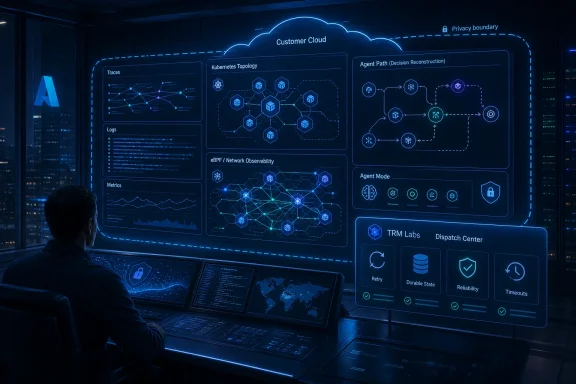
groundcover spent the week of June 20, 2026, sharpening its pitch for AI-native observability, highlighting a TRM Labs customer case study, Azure support for Agent Mode, and messaging around lower-cost monitoring for Kubernetes, LLM, and agentic workloads. The week was not about one blockbuster launch so much as a coordinated argument: production AI has turned observability from a logging problem into an infrastructure, privacy, and cost-control problem. For WindowsForum readers who live in Azure, Kubernetes, DevOps, and security operations, the interesting part is not the marketing cadence. It is the way groundcover is trying to define the next observability fight before the incumbents define it for them.
The observability market has spent years teaching engineers to collect more: more traces, more logs, more metrics, more dashboards, more retention, more correlation. That worked tolerably well when the main question was why a service got slow after a deployment. It works less cleanly when the thing being monitored is an LLM workflow that chains together prompts, tools, API calls, retrieval systems, model responses, and policy decisions.
groundcover’s week was built around that shift. Its messaging says that AI workloads are not merely another application tier to be dropped into the same dashboard estate. They are a new operational surface, and one that traditional APM tools may only partially understand.
That is a convenient argument for a vendor, of course. Every challenger in observability wants to declare a platform transition because platform transitions loosen incumbent lock-in. But the argument has teeth because AI workloads really do produce different operational failures. An agent can be available, fast, and technically “healthy” while still taking the wrong path, calling the wrong tool, consuming too many tokens, leaking context into the wrong workflow, or producing output that is syntactically valid and operationally useless.
That is why the phrase agentic observability is more than a fashionable adjective. It is an attempt to move the diagnostic center of gravity from infrastructure symptoms to decision-path reconstruction. In plainer English: it is not enough to know that something happened; teams need to know why the automated system behaved the way it did.
According to groundcover, TRM Labs is using its AI Observability product to monitor AI traffic while keeping prompts and responses away from third-party vendors. That is the sentence that matters. The operational metrics are useful, but the architectural claim is the real selling point: observability without exporting the most sensitive parts of the AI workflow into someone else’s SaaS environment.
The reported outcomes are exactly the sort of numbers observability vendors love to print: 85 percent faster troubleshooting, 72 percent fewer DevOps maintenance hours, and full developer self-sufficiency for root-cause analysis. Those numbers should be read as vendor-reported customer outcomes, not as universal benchmarks. Still, they reveal where groundcover thinks the budget conversation is going.
The message is not merely that engineers can debug faster. It is that AI operations cannot scale if every model issue becomes a DevOps ticket, every investigation requires a platform specialist, and every observability workflow depends on shipping sensitive context into another vendor’s control plane. That framing will resonate with regulated enterprises, security teams, and any organization that has watched AI pilots become production systems before the governance model caught up.
There is also a subtler point in the TRM Labs example. The company reportedly built four autonomous workflows handling about 10,000 interactions per month without adding headcount. That is the AI operations dream in miniature: more automated work, no proportional staffing increase, and fewer interruptions for the teams maintaining the platform. Whether that scales cleanly across larger environments is an open question, but the direction is clear.
groundcover’s bring-your-own-cloud posture is therefore central to its identity. The company is not simply saying that it can monitor AI systems. It is saying it can do so while keeping production data inside the customer’s cloud environment. In the current enterprise AI climate, that distinction is not a footnote.
The reason is simple: many organizations have already accepted that some AI workloads will run through managed model platforms. What they are less eager to accept is a secondary spread of AI-related operational data across every tool in the DevOps chain. If the application talks to a model through one approved cloud relationship but the observability layer ships traces, prompts, and outputs into a separate SaaS vendor, the compliance story becomes harder.
This is where groundcover is trying to turn architecture into sales leverage. If Agent Mode can run inside the customer cloud and query telemetry without moving sensitive data outside that boundary, the company can claim a cleaner governance path. That does not remove all risk. Customers still need identity controls, model access policies, retention rules, and human review of agent-generated recommendations. But it does reduce one obvious source of friction.
For Azure-heavy shops, the expansion of Agent Mode to Microsoft Azure is especially relevant. Microsoft has been positioning Foundry as a central platform for building and operating AI applications, and groundcover’s move lets it attach itself to that enterprise motion rather than remain framed as an AWS-native or Kubernetes-only story. The result is a pitch that sounds designed for CIOs and platform teams: use the model infrastructure you already negotiated, keep data where your policies say it should live, and add AI-aware investigation without rebuilding the whole observability stack.
Agent Mode running on Azure against Anthropic Claude models through Microsoft Foundry is a particularly telling configuration. It reflects the current enterprise AI reality: customers want model choice, but they also want that choice mediated through cloud platforms they already trust. The winning operational tools will not be the ones that pretend every customer has a greenfield AI stack. They will be the ones that fit into the awkward, negotiated, policy-heavy environments enterprises actually run.
There is also a competitive implication. If observability vendors are going to embed AI agents into incident response, those agents need a place to run, a model to call, and telemetry to inspect. A SaaS-only model centralizes those decisions inside the vendor’s platform. A bring-your-own-cloud model pushes more of that control back to the customer.
That trade-off will not appeal to everyone. SaaS observability became popular because it simplified operations, upgrades, retention, and scaling. Running more components inside a customer environment can shift responsibility back toward the platform team. groundcover’s bet is that for AI-era observability, privacy, cost control, and data locality are worth that added architectural complexity.
For large Azure estates, that may be a persuasive argument. Enterprises already accept complexity when the alternative is a governance exception. The question is whether groundcover can make the in-cloud experience feel as polished as the SaaS tools it wants to displace.
groundcover’s pitch is that Agent Mode works across these signals through a unified query layer and can produce artifacts that remain inside the platform. That matters because an incident investigation is not a conversation for its own sake. It needs reusable queries, dashboards, monitors, pipelines, and evidence that another engineer can inspect after the fact.
This is where AI observability will either become useful or turn into another layer of operational theater. If an agent tells an on-call engineer that latency is “likely related to recent deployment behavior,” but cannot show the exact data path, query, affected service, and confidence boundary, it is not reducing toil. It is creating a new debugging target.
The better version of this workflow is more concrete. An agent notices that a service changed its outbound calls after a deployment, correlates that with a spike in model latency, checks Kubernetes events for restarts or scheduling changes, compares token usage across workflows, and produces a monitor or query the team can keep. That is the kind of operational loop vendors are now racing to build.
The risk is that “agentic” becomes a label for automation that is not yet trustworthy. Observability systems are often used during outages, when teams are tired, executives are watching, and the cost of a wrong inference is high. In that environment, AI-generated analysis must be inspectable. The agent needs to show its work.
The AI angle makes eBPF more relevant, not less. Agentic workloads often cross service boundaries, call databases, invoke model gateways, hit vector stores, and trigger background jobs. Manual instrumentation can miss those paths, especially when teams are experimenting quickly. Kernel-level visibility can help reconstruct what actually talked to what, even when the application code did not neatly annotate the journey.
That does not make eBPF magic. It is excellent at seeing certain classes of infrastructure and communication behavior, but it does not automatically explain business logic, model reasoning, prompt quality, or user intent. The challenge for groundcover is to combine deep automatic telemetry with higher-level AI workflow context in a way that feels coherent rather than stitched together.
Still, the wedge is credible. Observability teams are exhausted by instrumentation drift. Developers forget to add spans. Services get rewritten. Sidecars and SDKs age badly. If groundcover can reduce the setup burden while improving AI investigation depth, it has a story that cuts across both platform engineering and application teams.
That story is especially relevant for Windows and Azure shops modernizing around Linux containers, AKS, hybrid estates, and cloud-native telemetry. The operating system loyalties of the old enterprise world matter less when the production surface is Kubernetes, managed databases, model endpoints, and identity-bound cloud services. In that world, visibility at the runtime and network layer becomes a shared concern.
An observability tool can have beautiful dashboards and clever AI analysis, but if alerts do not arrive reliably, arrive too late, or arrive without the right context, teams will route around it. Incident response depends on boring guarantees. Did the notification fire? Was it deduplicated? Did escalation work? Can the workflow survive retries, failures, and partial outages?
Temporal is a logical foundation for that kind of work because it is designed for durable, stateful workflow execution. By calling attention to Dispatch Center, groundcover is implicitly acknowledging that AI-native observability still has to satisfy old-fashioned reliability expectations. No amount of agentic analysis compensates for missed pages.
This is also where the market’s AI enthusiasm needs discipline. The best observability systems of the next few years will not simply bolt agents onto noisy alert pipelines. They will improve the pipeline itself, reduce false positives, preserve context, and make escalation more dependable. AI can help with correlation and prioritization, but the alert delivery substrate still has to be engineered like production software.
For sysadmins and SREs, that is the comforting part of the story. Beneath the model talk, the industry is rediscovering something operations teams already knew: the fundamentals still matter. Reliable workflows, clean ownership, accurate routing, and recoverable state are not legacy concerns. They are the rails on which AI-assisted operations must run.
groundcover’s weekly recap leaned into survey findings that many observability teams are overshooting budgets, with AI workloads consuming a significant share of spend. The exact numbers will vary by organization, but the direction is plausible. AI applications are often instrumented heavily during development and early production because teams do not yet know which signals matter.
This creates a painful loop. Teams need more visibility because AI behavior is harder to predict, but more visibility can make the observability bill harder to justify. If the answer is aggressive sampling, shorter retention, or reduced trace fidelity, the team may save money while losing the evidence needed to diagnose the next serious failure.
groundcover’s response is to position itself as a cost-optimized, AI-ready platform. The bring-your-own-cloud model is part of that answer because customers can avoid certain SaaS markups and use negotiated cloud pricing for model usage. But cost control is not only a pricing model. It also depends on how efficiently the platform queries data, how much raw context it moves into model prompts, and whether teams can set quotas or budgets for AI-assisted investigations.
That last point is important. An observability agent that reduces human toil but creates unpredictable model spend will eventually meet the finance department. The winning tools will give engineering leaders enough controls to let teams investigate freely without turning every incident into a token-budget surprise.
On one hand, Microsoft can provide native observability features for AI applications and agents. That means any third-party vendor integrating with Azure must justify why customers need more than the platform default. On the other hand, large enterprises rarely standardize on one telemetry surface for everything, and specialized operational tools can thrive when they solve a sharper problem than the general-purpose platform.
groundcover’s answer appears to be depth, data locality, and Kubernetes-aware production visibility. Rather than compete with Microsoft as a full AI platform, it can position itself as the observability layer for teams that need richer infrastructure and application context around AI workloads. That is a narrower claim, but potentially a stronger one.
There is a familiar pattern here. Cloud providers absorb broad categories of functionality over time, but third-party tools survive when they are cross-platform, deeper, faster to adapt, or better aligned with practitioner workflows. Observability is full of examples: native cloud monitoring exists everywhere, yet Datadog, New Relic, Grafana, Honeycomb, Dynatrace, and others continue to compete because operational reality rarely fits inside one provider’s console.
groundcover’s Azure move is therefore defensive and offensive at once. It prevents the company from being boxed out of Microsoft-centric AI estates, while giving it a way to tell Azure customers that they do not have to surrender observability depth or data residency to get AI-assisted investigation.
groundcover is not alone in chasing AI observability. Incumbents are adding AI assistants, cloud providers are expanding native monitoring, open-source ecosystems are adapting, and security vendors are folding prompt and model behavior into broader detection platforms. The phrase “AI-native observability” will be stretched until it means everything and nothing.
That is why customer evidence matters. TRM Labs gives groundcover a practical proof point. Azure support gives it enterprise relevance. Dispatch Center gives it operational seriousness. The thought leadership events give it market presence. None of these alone proves that groundcover will win the category, but together they show a company trying to assemble a complete argument.
The challenge will be execution. AI observability buyers will not be satisfied with slogans for long. They will ask whether the platform supports their clouds, their Kubernetes patterns, their model gateways, their identity model, their retention policies, their incident process, and their auditors. They will ask whether the agent can be trusted during a real outage. They will ask what happens when the model is wrong.
That scrutiny is healthy. Observability is too close to production reality for magical thinking. The vendors that survive the AI observability hype cycle will be the ones that make failure easier to understand without making the system harder to govern.
The practical question is how much operational gravity moves into Azure and adjacent cloud-native tooling. If AI applications are built through Microsoft Foundry, deployed into Azure environments, connected to enterprise identity, and monitored by third-party observability systems that run inside the customer cloud, then the old boundaries between “Microsoft infrastructure” and “cloud-native infrastructure” blur further.
That has consequences for administrators. Skills around telemetry, policy, identity, incident response, and data governance become more important than any one console. The administrator of the AI-era Microsoft shop may spend less time thinking about a single server and more time thinking about the path a request takes through identity, application code, Kubernetes, model gateways, databases, and observability pipelines.
It also changes the security conversation. Prompt and response data are not just application logs with a new format. They can carry secrets, regulated data, user intent, and internal reasoning. Monitoring them requires both technical visibility and careful boundaries. A tool that promises to keep that data inside the customer environment is speaking directly to this anxiety.
The larger lesson is that AI adoption is forcing infrastructure teams to revisit assumptions they made during the SaaS boom. Centralized SaaS tooling is convenient, but convenience is not always the winning argument when the data being exported is more sensitive, the workflows are more automated, and the cost curve is less predictable.
The TRM Labs case study gives the story credibility because it centers on automation and privacy in a security-sensitive environment. The Azure Agent Mode expansion gives the story reach because Microsoft’s enterprise AI footprint is too large to ignore. Dispatch Center gives the story operational ballast because reliable alerting is still the heart of production response.
The most interesting part is how groundcover links these pieces together. It is not saying simply, “We monitor AI.” It is saying that AI workloads require a different observability architecture: one that can see deep infrastructure behavior, correlate across signal types, reason through incidents, respect data boundaries, and control cost. That is a more ambitious claim, and therefore a more testable one.
For buyers, the right response is neither cynicism nor blind enthusiasm. The right response is to test the architecture against real incidents, real data policies, real cloud contracts, and real developer workflows. AI observability will not be proven in launch posts. It will be proven at 2 a.m., when an agentic workflow misbehaves and the team needs an explanation that is fast, accurate, auditable, and safe to act on.
 groundcover Is Selling a Different Kind of Observability War
The observability market has spent years teaching engineers to collect more: more traces, more logs, more metrics, more dashboards, more retention, more correlation. That worked tolerably well when the main question was why a service got slow after a deployment. It works less cleanly when the thing being monitored is an LLM workflow that chains together prompts, tools, API calls, retrieval systems, model responses, and policy decisions.groundcover’s week was built around that shift. Its messaging says that AI workloads are not merely another application tier to be dropped into the same dashboard estate. They are a new operational surface, and one that traditional APM tools may only partially understand.
That is a convenient argument for a vendor, of course. Every challenger in observability wants to declare a platform transition because platform transitions loosen incumbent lock-in. But the argument has teeth because AI workloads really do produce different operational failures. An agent can be available, fast, and technically “healthy” while still taking the wrong path, calling the wrong tool, consuming too many tokens, leaking context into the wrong workflow, or producing output that is syntactically valid and operationally useless.
That is why the phrase agentic observability is more than a fashionable adjective. It is an attempt to move the diagnostic center of gravity from infrastructure symptoms to decision-path reconstruction. In plainer English: it is not enough to know that something happened; teams need to know why the automated system behaved the way it did.
TRM Labs Gives the Pitch a Regulated-Industry Spine
The strongest element in groundcover’s weekly recap is the TRM Labs case study, because it moves the company’s AI observability story out of generic demo territory and into a security-sensitive environment. TRM Labs works in blockchain intelligence, a field where customer trust, investigative workflows, and data handling are not decorative concerns. If such an organization is monitoring AI traffic, the privacy boundary matters almost as much as the dashboard.According to groundcover, TRM Labs is using its AI Observability product to monitor AI traffic while keeping prompts and responses away from third-party vendors. That is the sentence that matters. The operational metrics are useful, but the architectural claim is the real selling point: observability without exporting the most sensitive parts of the AI workflow into someone else’s SaaS environment.
The reported outcomes are exactly the sort of numbers observability vendors love to print: 85 percent faster troubleshooting, 72 percent fewer DevOps maintenance hours, and full developer self-sufficiency for root-cause analysis. Those numbers should be read as vendor-reported customer outcomes, not as universal benchmarks. Still, they reveal where groundcover thinks the budget conversation is going.
The message is not merely that engineers can debug faster. It is that AI operations cannot scale if every model issue becomes a DevOps ticket, every investigation requires a platform specialist, and every observability workflow depends on shipping sensitive context into another vendor’s control plane. That framing will resonate with regulated enterprises, security teams, and any organization that has watched AI pilots become production systems before the governance model caught up.
There is also a subtler point in the TRM Labs example. The company reportedly built four autonomous workflows handling about 10,000 interactions per month without adding headcount. That is the AI operations dream in miniature: more automated work, no proportional staffing increase, and fewer interruptions for the teams maintaining the platform. Whether that scales cleanly across larger environments is an open question, but the direction is clear.
The Privacy Boundary Is Becoming the Product Boundary
Observability has always been a data business. The vendor that sees more can diagnose more, but the vendor that sees more also becomes a bigger repository of risk. AI intensifies that trade-off because prompts and responses may contain customer data, proprietary logic, investigative context, security findings, legal material, source code, or employee information.groundcover’s bring-your-own-cloud posture is therefore central to its identity. The company is not simply saying that it can monitor AI systems. It is saying it can do so while keeping production data inside the customer’s cloud environment. In the current enterprise AI climate, that distinction is not a footnote.
The reason is simple: many organizations have already accepted that some AI workloads will run through managed model platforms. What they are less eager to accept is a secondary spread of AI-related operational data across every tool in the DevOps chain. If the application talks to a model through one approved cloud relationship but the observability layer ships traces, prompts, and outputs into a separate SaaS vendor, the compliance story becomes harder.
This is where groundcover is trying to turn architecture into sales leverage. If Agent Mode can run inside the customer cloud and query telemetry without moving sensitive data outside that boundary, the company can claim a cleaner governance path. That does not remove all risk. Customers still need identity controls, model access policies, retention rules, and human review of agent-generated recommendations. But it does reduce one obvious source of friction.
For Azure-heavy shops, the expansion of Agent Mode to Microsoft Azure is especially relevant. Microsoft has been positioning Foundry as a central platform for building and operating AI applications, and groundcover’s move lets it attach itself to that enterprise motion rather than remain framed as an AWS-native or Kubernetes-only story. The result is a pitch that sounds designed for CIOs and platform teams: use the model infrastructure you already negotiated, keep data where your policies say it should live, and add AI-aware investigation without rebuilding the whole observability stack.
Azure Support Turns Agent Mode Into an Enterprise Signal
The Azure piece of groundcover’s week deserves more attention than a simple platform-support note. Native Azure support for Agent Mode means the company is trying to meet customers where their AI governance is already being centralized. For many WindowsForum readers, that means Microsoft tenants, Azure subscriptions, Entra ID policies, private networking, and procurement relationships that have accumulated over years.Agent Mode running on Azure against Anthropic Claude models through Microsoft Foundry is a particularly telling configuration. It reflects the current enterprise AI reality: customers want model choice, but they also want that choice mediated through cloud platforms they already trust. The winning operational tools will not be the ones that pretend every customer has a greenfield AI stack. They will be the ones that fit into the awkward, negotiated, policy-heavy environments enterprises actually run.
There is also a competitive implication. If observability vendors are going to embed AI agents into incident response, those agents need a place to run, a model to call, and telemetry to inspect. A SaaS-only model centralizes those decisions inside the vendor’s platform. A bring-your-own-cloud model pushes more of that control back to the customer.
That trade-off will not appeal to everyone. SaaS observability became popular because it simplified operations, upgrades, retention, and scaling. Running more components inside a customer environment can shift responsibility back toward the platform team. groundcover’s bet is that for AI-era observability, privacy, cost control, and data locality are worth that added architectural complexity.
For large Azure estates, that may be a persuasive argument. Enterprises already accept complexity when the alternative is a governance exception. The question is whether groundcover can make the in-cloud experience feel as polished as the SaaS tools it wants to displace.
The Agent Is Not a Chatbot Glued to a Dashboard
The most important conceptual distinction in groundcover’s messaging is between an AI assistant that comments on observability data and an agent that actively investigates it. Plenty of platforms can add a chat window. The harder problem is giving the AI enough structured access to logs, metrics, traces, Kubernetes events, topology, and historical context to produce useful answers without hallucinating over a thin slice of telemetry.groundcover’s pitch is that Agent Mode works across these signals through a unified query layer and can produce artifacts that remain inside the platform. That matters because an incident investigation is not a conversation for its own sake. It needs reusable queries, dashboards, monitors, pipelines, and evidence that another engineer can inspect after the fact.
This is where AI observability will either become useful or turn into another layer of operational theater. If an agent tells an on-call engineer that latency is “likely related to recent deployment behavior,” but cannot show the exact data path, query, affected service, and confidence boundary, it is not reducing toil. It is creating a new debugging target.
The better version of this workflow is more concrete. An agent notices that a service changed its outbound calls after a deployment, correlates that with a spike in model latency, checks Kubernetes events for restarts or scheduling changes, compares token usage across workflows, and produces a monitor or query the team can keep. That is the kind of operational loop vendors are now racing to build.
The risk is that “agentic” becomes a label for automation that is not yet trustworthy. Observability systems are often used during outages, when teams are tired, executives are watching, and the cost of a wrong inference is high. In that environment, AI-generated analysis must be inspectable. The agent needs to show its work.
eBPF Remains groundcover’s Technical Wedge
Under the AI messaging, groundcover’s older technical wedge is still visible: eBPF-based telemetry. eBPF has become a powerful foundation for modern observability because it can collect low-level runtime and network behavior from the kernel without requiring every application team to manually instrument every service. For Kubernetes-heavy environments, that promise is attractive because the estate changes faster than documentation can keep up.The AI angle makes eBPF more relevant, not less. Agentic workloads often cross service boundaries, call databases, invoke model gateways, hit vector stores, and trigger background jobs. Manual instrumentation can miss those paths, especially when teams are experimenting quickly. Kernel-level visibility can help reconstruct what actually talked to what, even when the application code did not neatly annotate the journey.
That does not make eBPF magic. It is excellent at seeing certain classes of infrastructure and communication behavior, but it does not automatically explain business logic, model reasoning, prompt quality, or user intent. The challenge for groundcover is to combine deep automatic telemetry with higher-level AI workflow context in a way that feels coherent rather than stitched together.
Still, the wedge is credible. Observability teams are exhausted by instrumentation drift. Developers forget to add spans. Services get rewritten. Sidecars and SDKs age badly. If groundcover can reduce the setup burden while improving AI investigation depth, it has a story that cuts across both platform engineering and application teams.
That story is especially relevant for Windows and Azure shops modernizing around Linux containers, AKS, hybrid estates, and cloud-native telemetry. The operating system loyalties of the old enterprise world matter less when the production surface is Kubernetes, managed databases, model endpoints, and identity-bound cloud services. In that world, visibility at the runtime and network layer becomes a shared concern.
Dispatch Center Shows the Less Glamorous Side of Reliability
The Dispatch Center announcement is less flashy than Agent Mode, but it may be more telling about groundcover’s maturity. Built on Temporal, the feature is meant to improve the reliability of production alert delivery. That sounds pedestrian until one remembers that alerting is where observability platforms become operational infrastructure rather than analytical software.An observability tool can have beautiful dashboards and clever AI analysis, but if alerts do not arrive reliably, arrive too late, or arrive without the right context, teams will route around it. Incident response depends on boring guarantees. Did the notification fire? Was it deduplicated? Did escalation work? Can the workflow survive retries, failures, and partial outages?
Temporal is a logical foundation for that kind of work because it is designed for durable, stateful workflow execution. By calling attention to Dispatch Center, groundcover is implicitly acknowledging that AI-native observability still has to satisfy old-fashioned reliability expectations. No amount of agentic analysis compensates for missed pages.
This is also where the market’s AI enthusiasm needs discipline. The best observability systems of the next few years will not simply bolt agents onto noisy alert pipelines. They will improve the pipeline itself, reduce false positives, preserve context, and make escalation more dependable. AI can help with correlation and prioritization, but the alert delivery substrate still has to be engineered like production software.
For sysadmins and SREs, that is the comforting part of the story. Beneath the model talk, the industry is rediscovering something operations teams already knew: the fundamentals still matter. Reliable workflows, clean ownership, accurate routing, and recoverable state are not legacy concerns. They are the rails on which AI-assisted operations must run.
The Cost Argument Is Moving From Storage to Tokens
Observability cost complaints are not new. Teams have been fighting ingestion bills, retention pricing, host-based licensing, and high-cardinality metrics for years. What is changing is the cost profile of AI workloads. Token usage, model calls, traces of reasoning paths, prompt chains, evaluation data, and agent tool histories can all expand the monitoring surface.groundcover’s weekly recap leaned into survey findings that many observability teams are overshooting budgets, with AI workloads consuming a significant share of spend. The exact numbers will vary by organization, but the direction is plausible. AI applications are often instrumented heavily during development and early production because teams do not yet know which signals matter.
This creates a painful loop. Teams need more visibility because AI behavior is harder to predict, but more visibility can make the observability bill harder to justify. If the answer is aggressive sampling, shorter retention, or reduced trace fidelity, the team may save money while losing the evidence needed to diagnose the next serious failure.
groundcover’s response is to position itself as a cost-optimized, AI-ready platform. The bring-your-own-cloud model is part of that answer because customers can avoid certain SaaS markups and use negotiated cloud pricing for model usage. But cost control is not only a pricing model. It also depends on how efficiently the platform queries data, how much raw context it moves into model prompts, and whether teams can set quotas or budgets for AI-assisted investigations.
That last point is important. An observability agent that reduces human toil but creates unpredictable model spend will eventually meet the finance department. The winning tools will give engineering leaders enough controls to let teams investigate freely without turning every incident into a token-budget surprise.
Microsoft’s Foundry Strategy Makes Room for Specialist Vendors
Microsoft’s role in this story is not simply that Azure is now supported. Foundry is becoming a gravitational center for enterprise AI development, evaluation, governance, and model access. That creates both opportunity and pressure for specialist vendors like groundcover.On one hand, Microsoft can provide native observability features for AI applications and agents. That means any third-party vendor integrating with Azure must justify why customers need more than the platform default. On the other hand, large enterprises rarely standardize on one telemetry surface for everything, and specialized operational tools can thrive when they solve a sharper problem than the general-purpose platform.
groundcover’s answer appears to be depth, data locality, and Kubernetes-aware production visibility. Rather than compete with Microsoft as a full AI platform, it can position itself as the observability layer for teams that need richer infrastructure and application context around AI workloads. That is a narrower claim, but potentially a stronger one.
There is a familiar pattern here. Cloud providers absorb broad categories of functionality over time, but third-party tools survive when they are cross-platform, deeper, faster to adapt, or better aligned with practitioner workflows. Observability is full of examples: native cloud monitoring exists everywhere, yet Datadog, New Relic, Grafana, Honeycomb, Dynatrace, and others continue to compete because operational reality rarely fits inside one provider’s console.
groundcover’s Azure move is therefore defensive and offensive at once. It prevents the company from being boxed out of Microsoft-centric AI estates, while giving it a way to tell Azure customers that they do not have to surrender observability depth or data residency to get AI-assisted investigation.
The Market Is Crowded Because the Pain Is Real
The observability market is noisy because the underlying pain is broad. Cloud-native systems are distributed, ephemeral, and expensive to monitor. AI systems add nondeterminism, hidden reasoning paths, third-party model dependencies, and new security risks. Every vendor now wants to be the one that turns this mess into a manageable workflow.groundcover is not alone in chasing AI observability. Incumbents are adding AI assistants, cloud providers are expanding native monitoring, open-source ecosystems are adapting, and security vendors are folding prompt and model behavior into broader detection platforms. The phrase “AI-native observability” will be stretched until it means everything and nothing.
That is why customer evidence matters. TRM Labs gives groundcover a practical proof point. Azure support gives it enterprise relevance. Dispatch Center gives it operational seriousness. The thought leadership events give it market presence. None of these alone proves that groundcover will win the category, but together they show a company trying to assemble a complete argument.
The challenge will be execution. AI observability buyers will not be satisfied with slogans for long. They will ask whether the platform supports their clouds, their Kubernetes patterns, their model gateways, their identity model, their retention policies, their incident process, and their auditors. They will ask whether the agent can be trusted during a real outage. They will ask what happens when the model is wrong.
That scrutiny is healthy. Observability is too close to production reality for magical thinking. The vendors that survive the AI observability hype cycle will be the ones that make failure easier to understand without making the system harder to govern.
Windows and Azure Shops Should Read This as an Operations Story
For WindowsForum’s audience, the groundcover recap is not a Windows desktop story, and it is not really a consumer AI story. It is an operations story for the Microsoft-centered enterprise as it absorbs Kubernetes, Linux containers, model platforms, and agentic automation into the same estate that still includes Active Directory histories, Windows Server dependencies, endpoint fleets, and compliance obligations.The practical question is how much operational gravity moves into Azure and adjacent cloud-native tooling. If AI applications are built through Microsoft Foundry, deployed into Azure environments, connected to enterprise identity, and monitored by third-party observability systems that run inside the customer cloud, then the old boundaries between “Microsoft infrastructure” and “cloud-native infrastructure” blur further.
That has consequences for administrators. Skills around telemetry, policy, identity, incident response, and data governance become more important than any one console. The administrator of the AI-era Microsoft shop may spend less time thinking about a single server and more time thinking about the path a request takes through identity, application code, Kubernetes, model gateways, databases, and observability pipelines.
It also changes the security conversation. Prompt and response data are not just application logs with a new format. They can carry secrets, regulated data, user intent, and internal reasoning. Monitoring them requires both technical visibility and careful boundaries. A tool that promises to keep that data inside the customer environment is speaking directly to this anxiety.
The larger lesson is that AI adoption is forcing infrastructure teams to revisit assumptions they made during the SaaS boom. Centralized SaaS tooling is convenient, but convenience is not always the winning argument when the data being exported is more sensitive, the workflows are more automated, and the cost curve is less predictable.
The Week’s Signal Is Bigger Than the Press Cycle
groundcover’s week should be read less as a sequence of announcements and more as a positioning exercise. The company is trying to occupy a specific lane: AI-aware, cloud-native, privacy-conscious observability that runs close to the customer’s infrastructure and uses agents for investigation rather than decoration. That lane is narrow enough to be intelligible and broad enough to matter.The TRM Labs case study gives the story credibility because it centers on automation and privacy in a security-sensitive environment. The Azure Agent Mode expansion gives the story reach because Microsoft’s enterprise AI footprint is too large to ignore. Dispatch Center gives the story operational ballast because reliable alerting is still the heart of production response.
The most interesting part is how groundcover links these pieces together. It is not saying simply, “We monitor AI.” It is saying that AI workloads require a different observability architecture: one that can see deep infrastructure behavior, correlate across signal types, reason through incidents, respect data boundaries, and control cost. That is a more ambitious claim, and therefore a more testable one.
For buyers, the right response is neither cynicism nor blind enthusiasm. The right response is to test the architecture against real incidents, real data policies, real cloud contracts, and real developer workflows. AI observability will not be proven in launch posts. It will be proven at 2 a.m., when an agentic workflow misbehaves and the team needs an explanation that is fast, accurate, auditable, and safe to act on.
The Practical Read for Teams Watching groundcover
The useful thing about groundcover’s week is that it exposes the checklist enterprises should apply to every AI observability pitch. The vendor names will change, and so will the model providers, but the operational questions are becoming stable. Teams need to know where the data goes, how the agent reasons, what the platform can actually see, and whether the cost model survives production scale.- Teams should treat AI observability as a production requirement, not a dashboard upgrade added after deployment.
- Organizations handling sensitive prompts and responses should scrutinize whether telemetry leaves their cloud boundary.
- Azure customers should watch how third-party observability vendors integrate with Foundry rather than assuming Microsoft’s native tools will cover every operational need.
- Reported customer metrics such as faster troubleshooting and reduced DevOps hours are useful signals, but they should be validated against each organization’s own workflows.
- Agentic investigation tools should be judged by whether they produce inspectable evidence, reusable queries, and durable operational artifacts.
- Cost controls for AI-assisted observability should be evaluated as carefully as ingestion, retention, and host-based pricing were in the previous observability cycle.
References
- Primary source: TipRanks
Published: 2026-06-20T14:30:16.251280
- Related coverage: groundcover.com
groundcover Agent Mode
The more data you have, the harder it is to find what matters. groundcover has more data than any other platform. The AI agent is built for exactly that.www.groundcover.com - Related coverage: businesswire.com
