

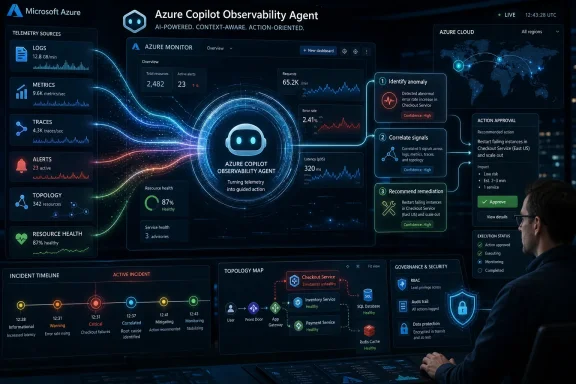
Microsoft announced on June 23, 2026, that Azure Copilot Observability Agent is generally available for Azure customers, adding an AI-driven troubleshooting layer to Azure Monitor that correlates logs, metrics, traces, topology, resource health and operational context across cloud environments. The announcement is less about one more Copilot-branded feature than about Microsoft’s emerging answer to a harder problem: what happens when the systems being operated are themselves increasingly autonomous. In that world, the old dashboard-and-alert model starts to look like a rear-view mirror. Microsoft is arguing that observability has to become an active participant in operations, not merely a place where telemetry goes to be searched after something breaks.
For years, observability has been sold as the antidote to distributed-systems chaos. Instrument enough code, collect enough telemetry, stitch together enough traces, and the promise was that engineers could reconstruct the story of a failure before customers, regulators or executives lost patience. That model has worked, imperfectly, because the human operator remained the final correlation engine.
Microsoft’s Azure Copilot Observability Agent changes the center of gravity. It is not just a new view over Azure Monitor data; it is an attempt to make the platform reason across that data in real time, summarize what it finds, and propose what an operator should do next. That is a meaningful step away from observability as passive evidence and toward observability as guided diagnosis.
The timing is not accidental. Cloud estates are already too large for most teams to understand completely, and the rise of AI agents makes the dependency graph more volatile. A web app that used to call a database and a handful of APIs may now call models, retrieval systems, vector stores, orchestration layers, policy services and other agents. When something fails, the incident is less likely to have a neat single cause.
That is the real target of Microsoft’s announcement. Azure Copilot Observability Agent is being positioned as the connective tissue between signals that already exist but are too scattered to interpret quickly. The pitch is simple: if cloud systems are becoming agentic, cloud operations must become agentic too.
Microsoft’s blog leans heavily on that pain. It cites a survey of 250 IT decision-makers conducted with Material in which 84 percent of organizations reported increased cloud complexity, while 69 percent said that complexity was outpacing their current operating model. Those numbers are vendor-supplied, but the sentiment will not surprise anyone running production services at scale.
The industry’s answer has been to add more tools. Application performance monitoring, log analytics, distributed tracing, service maps, security posture management, cost dashboards and deployment observability all arrived to solve pieces of the puzzle. The unintended result is that operators often spend incidents moving between consoles, copying timestamps, reconciling naming conventions and arguing about which signal matters most.
That fragmentation is exactly where Copilot-style systems are strongest in theory. They can ingest a messy body of context, produce a plausible narrative, and keep a human in the loop long enough to test it. The risk, of course, is that plausibility is not proof. In operations, a confident wrong answer can be worse than no answer at all.
That gives Microsoft a platform advantage. Azure Monitor already sits near the control plane, the telemetry plane and the identity model of Azure. If an AI agent is going to diagnose failures across infrastructure, applications and services, proximity to those systems matters. A model that can see the alert, the resource, the recent changes and the dependency signals has a better chance of producing something useful than a generic assistant receiving a pasted error message.
The Microsoft Learn documentation describes two major experiences: deep investigations launched from Azure Monitor alerts, and conversational exploration of observability data from resources such as Application Insights or Log Analytics workspaces. During an investigation, the agent can analyze metrics, logs, alert context, tracing data and resource health signals to identify changes, abnormal behavior, scope and likely impact. That is exactly the sort of cross-signal work humans do during a postmortem, compressed into an interactive workflow.
This also explains why Microsoft is tying the feature to Azure Copilot access controls and Azure role-based permissions. Observability data can include sensitive operational details, customer-impact clues, infrastructure topology and traces of business processes. An agent that can reason across those signals must be governed like an operator, not treated like a search box.
That is the sales case, and it is a powerful one. Incident response is one of the few areas where shaving minutes can have obvious business value. A faster diagnosis can reduce downtime, lower support load, limit cascading failures and keep senior engineers from spending half a day spelunking through telemetry.
But the more interesting point is that Microsoft is selling speed through context, not magic. The agent is not being described as an autonomous repair bot that silently rewrites production. It is described as a system that correlates signals, explains findings, surfaces likely root causes and recommends remediation. That distinction matters because enterprise IT will adopt agentic operations through advisory workflows before it trusts full automation.
There is also a cultural implication. If an agent can do the first pass of an incident investigation, the job of the human operator shifts from “find the needle” to “validate the story.” That can be a better use of scarce expertise, but it also requires engineers to understand enough about the underlying system to challenge the AI’s conclusion. A team that blindly accepts generated remediation advice is not modernizing operations; it is outsourcing judgment to a probabilistic narrator.
This is where the announcement slots into Microsoft’s larger Azure strategy. The company has spent years integrating governance, security, management and automation into Azure’s platform fabric. Copilot gives Microsoft a conversational and agentic interface over that fabric. Azure Monitor supplies the telemetry. Azure policy, role-based access control and audit trails provide the guardrails.
In that architecture, the Observability Agent becomes a beachhead. It is the relatively safe place to start because diagnosis is valuable even when action remains human-approved. Once customers trust the agent to explain an incident, the next step is to let it open tickets, suggest configuration changes, generate queries, update runbooks or trigger approved automation. Microsoft’s blog gestures in that direction without claiming the entire future has arrived today.
That gradualism is sensible. Production operations are conservative for good reason. A cloud provider can talk about autonomous remediation, but most enterprises will demand staged authority, approval gates and auditability. The more critical the workload, the more important it is that every agentic action can be explained after the fact.
Microsoft’s documentation makes some boundaries clear. The agent runs through Azure Copilot access controls, and if an organization restricts access to Azure Copilot, users cannot use the Observability Agent. In interactive scenarios, it operates under the user’s identity and Azure permissions, which means the agent should not become an accidental privilege-escalation path if access is configured properly.
There are also limitations that administrators should notice. Conversation continuity is limited, English is the main supported language, and customer-managed keys are not supported for Observability Agent conversation data at this time. Microsoft says investigation data may be retained for service operation, troubleshooting and quality assurance, and that it is not used to train foundation models. For regulated organizations, those details are not minor.
This is where the product’s general availability label should not be confused with universal readiness. GA means Microsoft is comfortable selling and supporting the capability as a production service. It does not mean every enterprise can enable it without privacy review, data-residency analysis, role design and incident-process updates. The agent may reduce toil, but it also creates a new operational actor that must be governed.
If an observability agent produces a convincing root-cause narrative, teams may shorten investigations prematurely. If it recommends remediation steps that usually work, operators may stop asking whether the current incident is the exception. If it summarizes signal relationships in plain English, less experienced engineers may lose opportunities to build the hard-won intuition that comes from tracing a failure manually.
None of this means the feature is a bad idea. It means agentic observability has to be introduced as a discipline, not merely enabled as a button. Teams need to decide when agent findings are advisory, when they are sufficient for action, and when they must be corroborated by direct evidence. They also need to capture cases where the agent was wrong, incomplete or overconfident.
The strongest version of this technology makes operators better. The weaker version makes them faster but more dependent. Microsoft’s framing acknowledges human oversight, but the real test will be how customers operationalize that oversight when the pressure of a live incident makes the fastest answer feel like the best one.
For Windows-heavy organizations, the practical question is not whether every workload is cloud-native. It is whether incidents increasingly cross boundaries that old tooling treats separately. A degraded application may involve Windows Server, Azure SQL, Entra ID, a containerized API, a third-party service and an AI model endpoint. The admin who owns only one slice of that stack still gets pulled into the incident.
Agentic observability is Microsoft’s attempt to make that cross-boundary diagnosis less dependent on tribal knowledge. If Azure Monitor can correlate infrastructure health, application telemetry and service dependencies, it becomes more valuable to the Windows administrator who needs to prove where the problem is not. In many incidents, ruling out the local estate quickly is as valuable as identifying the ultimate root cause.
There is also a skills angle. The next generation of Microsoft operations work will likely involve less time memorizing portal paths and more time interrogating systems through natural language, KQL, policy constraints and AI-generated explanations. That does not make fundamentals obsolete. It makes them the difference between an operator who can supervise automation and one who is supervised by it.
The downside is lock-in pressure. The more Microsoft turns Azure Monitor into the reasoning layer for operations, the more customers may feel nudged toward Azure-native telemetry, Azure-native workflows and Azure-native governance. That is not inherently bad, but it should be recognized as part of the strategic equation. Observability tools are not neutral once they become recommendation engines.
There is also the question of multi-cloud and heterogeneous environments. Microsoft says the agent connects context across environments, but the deepest reasoning will naturally occur where Microsoft has the richest signals and strongest permissions. Enterprises with serious AWS, Google Cloud, on-premises and SaaS dependencies will need to test whether the agent can explain their real operating model, not just the Azure-shaped portion of it.
The best customers will be skeptical without being dismissive. They will pilot the agent on known incident classes, compare its findings against human postmortems, measure time-to-triage improvements and document failure modes. If the tool consistently reduces noise and accelerates diagnosis, it earns trust. If it mostly paraphrases dashboards, it becomes another expensive pane of glass.
Microsoft’s own best-practice guidance points in that direction. Critical workflows need custom telemetry. Deployments and configuration changes need annotations. Application logs need to be collected at useful levels. Availability tests need to exist for the endpoints that matter. Those are not glamorous tasks, but they are what make agentic diagnosis possible.
This is the part of the story that may disappoint executives hoping AI will compensate for underfunded operations. The Observability Agent can reduce manual correlation, but it cannot invent an accurate topology for a system nobody has bothered to instrument. It can recommend next steps, but it cannot know an organization’s risk tolerance unless that tolerance is expressed through policy and process.
The practical path is incremental. Start with advisory use on non-catastrophic incidents. Compare agent findings with established human workflows. Build confidence around specific workloads. Only then should organizations consider deeper automation, and even then with approval gates and audit trails that can survive a post-incident review.
The larger claim is more ambitious. Microsoft is saying that as software systems become agentic, operations must evolve from reactive management to a continuous loop of observation, reasoning, action and learning. That claim is persuasive, but it also raises the bar for governance, instrumentation and human oversight.
For IT teams evaluating the feature, the most concrete lessons are straightforward:
 Microsoft Turns Observability Into an Operator, Not a Console
For years, observability has been sold as the antidote to distributed-systems chaos. Instrument enough code, collect enough telemetry, stitch together enough traces, and the promise was that engineers could reconstruct the story of a failure before customers, regulators or executives lost patience. That model has worked, imperfectly, because the human operator remained the final correlation engine.Microsoft’s Azure Copilot Observability Agent changes the center of gravity. It is not just a new view over Azure Monitor data; it is an attempt to make the platform reason across that data in real time, summarize what it finds, and propose what an operator should do next. That is a meaningful step away from observability as passive evidence and toward observability as guided diagnosis.
The timing is not accidental. Cloud estates are already too large for most teams to understand completely, and the rise of AI agents makes the dependency graph more volatile. A web app that used to call a database and a handful of APIs may now call models, retrieval systems, vector stores, orchestration layers, policy services and other agents. When something fails, the incident is less likely to have a neat single cause.
That is the real target of Microsoft’s announcement. Azure Copilot Observability Agent is being positioned as the connective tissue between signals that already exist but are too scattered to interpret quickly. The pitch is simple: if cloud systems are becoming agentic, cloud operations must become agentic too.
The Dashboard Era Was Already Cracking
The traditional incident workflow is familiar to anyone who has carried an on-call rotation. An alert fires, an engineer opens a dashboard, a war room forms, and the team starts assembling a timeline from metrics, logs, traces, deployment records and institutional memory. The expensive part is not always the fix. It is the period when nobody knows what is actually happening.Microsoft’s blog leans heavily on that pain. It cites a survey of 250 IT decision-makers conducted with Material in which 84 percent of organizations reported increased cloud complexity, while 69 percent said that complexity was outpacing their current operating model. Those numbers are vendor-supplied, but the sentiment will not surprise anyone running production services at scale.
The industry’s answer has been to add more tools. Application performance monitoring, log analytics, distributed tracing, service maps, security posture management, cost dashboards and deployment observability all arrived to solve pieces of the puzzle. The unintended result is that operators often spend incidents moving between consoles, copying timestamps, reconciling naming conventions and arguing about which signal matters most.
That fragmentation is exactly where Copilot-style systems are strongest in theory. They can ingest a messy body of context, produce a plausible narrative, and keep a human in the loop long enough to test it. The risk, of course, is that plausibility is not proof. In operations, a confident wrong answer can be worse than no answer at all.
Azure Monitor Becomes the Ground Microsoft Needs
The most important detail in the announcement is that the Observability Agent is built on Azure Monitor. That matters because Microsoft is not launching a detached chatbot that happens to know some cloud vocabulary. It is embedding the agent inside the place where many Azure customers already collect logs, metrics, alerts, traces and resource health data.That gives Microsoft a platform advantage. Azure Monitor already sits near the control plane, the telemetry plane and the identity model of Azure. If an AI agent is going to diagnose failures across infrastructure, applications and services, proximity to those systems matters. A model that can see the alert, the resource, the recent changes and the dependency signals has a better chance of producing something useful than a generic assistant receiving a pasted error message.
The Microsoft Learn documentation describes two major experiences: deep investigations launched from Azure Monitor alerts, and conversational exploration of observability data from resources such as Application Insights or Log Analytics workspaces. During an investigation, the agent can analyze metrics, logs, alert context, tracing data and resource health signals to identify changes, abnormal behavior, scope and likely impact. That is exactly the sort of cross-signal work humans do during a postmortem, compressed into an interactive workflow.
This also explains why Microsoft is tying the feature to Azure Copilot access controls and Azure role-based permissions. Observability data can include sensitive operational details, customer-impact clues, infrastructure topology and traces of business processes. An agent that can reason across those signals must be governed like an operator, not treated like a search box.
The Feature Microsoft Is Selling Is Speed
The customer quotes in Microsoft’s announcement all orbit the same word: speed. KPMG says the agent helped turn logs, metrics and traces into plain-English insights and claimed an estimated 250 engineering hours reclaimed monthly. PolicyVault describes a move from manual incident hunting to AI-guided investigation. Ontinue frames the value as moving faster from signal to insight.That is the sales case, and it is a powerful one. Incident response is one of the few areas where shaving minutes can have obvious business value. A faster diagnosis can reduce downtime, lower support load, limit cascading failures and keep senior engineers from spending half a day spelunking through telemetry.
But the more interesting point is that Microsoft is selling speed through context, not magic. The agent is not being described as an autonomous repair bot that silently rewrites production. It is described as a system that correlates signals, explains findings, surfaces likely root causes and recommends remediation. That distinction matters because enterprise IT will adopt agentic operations through advisory workflows before it trusts full automation.
There is also a cultural implication. If an agent can do the first pass of an incident investigation, the job of the human operator shifts from “find the needle” to “validate the story.” That can be a better use of scarce expertise, but it also requires engineers to understand enough about the underlying system to challenge the AI’s conclusion. A team that blindly accepts generated remediation advice is not modernizing operations; it is outsourcing judgment to a probabilistic narrator.
Agentic Operations Are Microsoft’s Bigger Azure Story
The phrase agentic operations is doing a lot of work here. Microsoft is not merely announcing a feature that helps diagnose alerts. It is describing a lifecycle in which systems generate signals, agents interpret those signals, actions are taken, and the results feed the next operational cycle. That is a much broader ambition than observability.This is where the announcement slots into Microsoft’s larger Azure strategy. The company has spent years integrating governance, security, management and automation into Azure’s platform fabric. Copilot gives Microsoft a conversational and agentic interface over that fabric. Azure Monitor supplies the telemetry. Azure policy, role-based access control and audit trails provide the guardrails.
In that architecture, the Observability Agent becomes a beachhead. It is the relatively safe place to start because diagnosis is valuable even when action remains human-approved. Once customers trust the agent to explain an incident, the next step is to let it open tickets, suggest configuration changes, generate queries, update runbooks or trigger approved automation. Microsoft’s blog gestures in that direction without claiming the entire future has arrived today.
That gradualism is sensible. Production operations are conservative for good reason. A cloud provider can talk about autonomous remediation, but most enterprises will demand staged authority, approval gates and auditability. The more critical the workload, the more important it is that every agentic action can be explained after the fact.
Governance Is Not a Footnote This Time
The announcement explicitly says governance is central to trust in agentic operations. That is not corporate boilerplate; it is the fault line that will determine whether these systems become operational assets or compliance headaches. Observability agents sit at the intersection of sensitive data, production decision-making and organizational accountability.Microsoft’s documentation makes some boundaries clear. The agent runs through Azure Copilot access controls, and if an organization restricts access to Azure Copilot, users cannot use the Observability Agent. In interactive scenarios, it operates under the user’s identity and Azure permissions, which means the agent should not become an accidental privilege-escalation path if access is configured properly.
There are also limitations that administrators should notice. Conversation continuity is limited, English is the main supported language, and customer-managed keys are not supported for Observability Agent conversation data at this time. Microsoft says investigation data may be retained for service operation, troubleshooting and quality assurance, and that it is not used to train foundation models. For regulated organizations, those details are not minor.
This is where the product’s general availability label should not be confused with universal readiness. GA means Microsoft is comfortable selling and supporting the capability as a production service. It does not mean every enterprise can enable it without privacy review, data-residency analysis, role design and incident-process updates. The agent may reduce toil, but it also creates a new operational actor that must be governed.
The Risk Is Not That the Agent Fails, but That It Half-Succeeds
The easiest criticism of AI operations tools is that they might hallucinate. That risk is real, but it is not the only one. A more subtle risk is that the agent is helpful enough to change behavior before organizations have adapted their processes around it.If an observability agent produces a convincing root-cause narrative, teams may shorten investigations prematurely. If it recommends remediation steps that usually work, operators may stop asking whether the current incident is the exception. If it summarizes signal relationships in plain English, less experienced engineers may lose opportunities to build the hard-won intuition that comes from tracing a failure manually.
None of this means the feature is a bad idea. It means agentic observability has to be introduced as a discipline, not merely enabled as a button. Teams need to decide when agent findings are advisory, when they are sufficient for action, and when they must be corroborated by direct evidence. They also need to capture cases where the agent was wrong, incomplete or overconfident.
The strongest version of this technology makes operators better. The weaker version makes them faster but more dependent. Microsoft’s framing acknowledges human oversight, but the real test will be how customers operationalize that oversight when the pressure of a live incident makes the fastest answer feel like the best one.
Windows Admins Should Care, Even If This Is an Azure Story
At first glance, this looks like cloud-native news for Azure architects, not a WindowsForum headline. But the boundary between Windows administration and cloud operations has been dissolving for years. Hybrid identity, Azure Arc, Intune, Defender, virtual desktop infrastructure, Windows Server workloads and line-of-business applications all tie traditional Microsoft estates into Azure’s management plane.For Windows-heavy organizations, the practical question is not whether every workload is cloud-native. It is whether incidents increasingly cross boundaries that old tooling treats separately. A degraded application may involve Windows Server, Azure SQL, Entra ID, a containerized API, a third-party service and an AI model endpoint. The admin who owns only one slice of that stack still gets pulled into the incident.
Agentic observability is Microsoft’s attempt to make that cross-boundary diagnosis less dependent on tribal knowledge. If Azure Monitor can correlate infrastructure health, application telemetry and service dependencies, it becomes more valuable to the Windows administrator who needs to prove where the problem is not. In many incidents, ruling out the local estate quickly is as valuable as identifying the ultimate root cause.
There is also a skills angle. The next generation of Microsoft operations work will likely involve less time memorizing portal paths and more time interrogating systems through natural language, KQL, policy constraints and AI-generated explanations. That does not make fundamentals obsolete. It makes them the difference between an operator who can supervise automation and one who is supervised by it.
Microsoft’s Advantage Is Integration, and Its Burden Is Trust
Microsoft has a credible path here because it owns so many layers of the stack. Azure Monitor, Application Insights, Log Analytics, Azure Resource Health, Azure Policy, Entra ID and Copilot can be woven into a single operational experience in a way that third-party tools often struggle to match. For customers already committed to Azure, that integration can reduce friction quickly.The downside is lock-in pressure. The more Microsoft turns Azure Monitor into the reasoning layer for operations, the more customers may feel nudged toward Azure-native telemetry, Azure-native workflows and Azure-native governance. That is not inherently bad, but it should be recognized as part of the strategic equation. Observability tools are not neutral once they become recommendation engines.
There is also the question of multi-cloud and heterogeneous environments. Microsoft says the agent connects context across environments, but the deepest reasoning will naturally occur where Microsoft has the richest signals and strongest permissions. Enterprises with serious AWS, Google Cloud, on-premises and SaaS dependencies will need to test whether the agent can explain their real operating model, not just the Azure-shaped portion of it.
The best customers will be skeptical without being dismissive. They will pilot the agent on known incident classes, compare its findings against human postmortems, measure time-to-triage improvements and document failure modes. If the tool consistently reduces noise and accelerates diagnosis, it earns trust. If it mostly paraphrases dashboards, it becomes another expensive pane of glass.
The New Runbook Starts With a Human in the Loop
The operational runbook for agentic observability should not begin with “ask Copilot.” It should begin with instrumentation, access design and decision rights. An AI agent cannot reason across signals that are missing, mislabeled or too noisy to interpret. Poor telemetry does not become good telemetry because a model is reading it.Microsoft’s own best-practice guidance points in that direction. Critical workflows need custom telemetry. Deployments and configuration changes need annotations. Application logs need to be collected at useful levels. Availability tests need to exist for the endpoints that matter. Those are not glamorous tasks, but they are what make agentic diagnosis possible.
This is the part of the story that may disappoint executives hoping AI will compensate for underfunded operations. The Observability Agent can reduce manual correlation, but it cannot invent an accurate topology for a system nobody has bothered to instrument. It can recommend next steps, but it cannot know an organization’s risk tolerance unless that tolerance is expressed through policy and process.
The practical path is incremental. Start with advisory use on non-catastrophic incidents. Compare agent findings with established human workflows. Build confidence around specific workloads. Only then should organizations consider deeper automation, and even then with approval gates and audit trails that can survive a post-incident review.
The Cloud Control Room Gets a New Seat at the Table
Microsoft’s announcement is concrete enough to matter, but early enough that customers should treat it as the beginning of an operational shift rather than the end state. The Observability Agent is now generally available, built into the Azure Monitor ecosystem, and aimed squarely at reducing the time between an alert and a plausible explanation. That alone will get attention from teams drowning in telemetry.The larger claim is more ambitious. Microsoft is saying that as software systems become agentic, operations must evolve from reactive management to a continuous loop of observation, reasoning, action and learning. That claim is persuasive, but it also raises the bar for governance, instrumentation and human oversight.
For IT teams evaluating the feature, the most concrete lessons are straightforward:
- Azure Copilot Observability Agent is a general-availability Azure capability announced on June 23, 2026, and it is built on Azure Monitor rather than being a standalone chatbot.
- The agent is designed to correlate logs, metrics, traces, alerts, topology, resource health and operational context to help operators move from detection to diagnosis faster.
- Microsoft is positioning the tool as part of a broader shift toward agentic operations, where AI systems help interpret signals and support operational decisions across the cloud lifecycle.
- Administrators should review access controls, retention behavior, language support, regional availability and encryption limitations before enabling the feature broadly.
- The agent’s usefulness will depend heavily on telemetry quality, deployment annotations, well-instrumented workflows and disciplined human validation.
- The safest near-term use is guided investigation and recommendation, not unsupervised remediation of production systems.
References
- Primary source: The Official Microsoft Blog
Published: Tue, 23 Jun 2026 15:46:10 GMT
Rethinking cloud operations with agentic observability - The Official Microsoft Blog
Cloud operations are entering a new era as AI-driven and autonomous agents become a larger part of modern software systems. As software becomes increasingly agentic, the challenge is no longer just managing greater scale and complexity. Operators must also contend with systems that evolve...blogs.microsoft.com
