

Modern enterprises can only convert cloud‑era promise into reliable outcomes when IT and business agree on one thing: whose numbers count — and why. Deploying enterprise data management and data governance on Microsoft Azure, combined with disciplined master data management (MDM) and integration services for Microsoft‑centric organizations, is the practical path from disputed reports to repeatable analytics, trustworthy dashboards, and AI that behaves predictably. The stakes are high: without governance, cloud migration amplifies ambiguity; with governance and MDM, Azure becomes a platform for trusted insights and scalable AI.
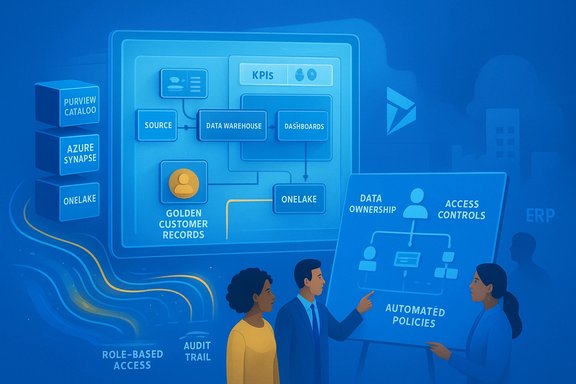
Enterprises are wrestling with a familiar tension: business leaders demand fast, actionable insights while IT teams are responsible for data integrity, compliance, and security. This tension manifests as conflicting reports, duplicated records, and stalled analytics projects. A governance‑first approach on Azure—anchored by Microsoft Purview, Azure Synapse Analytics (and broader Fabric/OneLake patterns), plus MDM and integration into Dynamics 365 and ERP systems—creates clear ownership, consistent semantics, and traceable lineage so that both sides can move forward together. Practical implementations combine metadata catalogs, role‑based access controls, data lineage, golden records, and automated policies to keep data accurate and auditable across systems.
The path is not trivial: governance demands people, policy‑as‑code, cost control, and an acceptance that governance is an ongoing operating discipline, not a one‑time project. But when done right, governance turns Azure from a complicated plumbing problem into the foundation of competitive advantage: reliable insights, faster decisions, and AI that earns, not erodes, stakeholder confidence.
Source: Youth Ki Awaaz Bridging IT And Business With Azure-Based Data Governance | Youth Ki Awaaz
 Background
Enterprises are wrestling with a familiar tension: business leaders demand fast, actionable insights while IT teams are responsible for data integrity, compliance, and security. This tension manifests as conflicting reports, duplicated records, and stalled analytics projects. A governance‑first approach on Azure—anchored by Microsoft Purview, Azure Synapse Analytics (and broader Fabric/OneLake patterns), plus MDM and integration into Dynamics 365 and ERP systems—creates clear ownership, consistent semantics, and traceable lineage so that both sides can move forward together. Practical implementations combine metadata catalogs, role‑based access controls, data lineage, golden records, and automated policies to keep data accurate and auditable across systems.The data divide: why business and IT disagree
Conflicting reports, duplicated entities, and lost time
When finance, sales, and operations each pull numbers from different systems, disagreements are inevitable. These differences are not just academic; they delay decisions, erode trust, and waste analyst hours reconciling spreadsheets. In many Microsoft‑centric estates, the same customer, product, or vendor exists in Dynamics 365, ERP, billing, and analytics environments with small but meaningful differences that cascade into inconsistent KPIs. The result: executives hesitate to act on dashboards because they can’t confidently explain the numbers.Governance as the bridge
Governance is not an IT checkbox — it is the mechanism that translates technical metadata and policies into business meaning. A properly implemented governance program establishes:- Shared definitions for key entities and metrics.
- Assigned ownership (data stewards and catalog owners).
- Controlled access and audit trails so stakeholders can see who changed what and when.
- Automated enforcement of classification and handling rules.
Master data management: the indispensable starting point
Resolving core data conflicts with MDM
Master data management (MDM) tackles the root cause: multiple versions of truth for core entities. Effective MDM creates a single source of authoritative “golden records” for customers, products, suppliers, and locations, reducing errors in billing, reporting, and analytics. For Microsoft‑centric organizations, integrating MDM with Dynamics 365 and ERP systems ensures canonical records feed operational systems and analytics pipelines alike, dramatically reducing reconciliation work and dispute resolution.Integration patterns: MDM meets Dynamics 365 and the data lake
MDM isn’t a stand‑alone project — it must integrate. Typical integration patterns include:- Synchronizing golden records back to Dynamics 365, ERP, and billing systems so operational apps consume the canonical view.
- Feeding cleansed and matched master data into Azure Data Lake / OneLake for analytics and ML model training.
- Using CDC (change data capture) and event streams to keep downstream consumers in sync without bulk reprocessing.
Azure tools that drive governance and analytics
Microsoft Purview: metadata, classification, and lineage
Microsoft Purview acts as the enterprise catalog and governance control plane on Azure. It provides metadata management, automated data classification (including trainable classifiers and pattern matching), and end‑to‑end data lineage so teams can trace a KPI back to its source tables and upstream systems. These capabilities are central to building trust in dashboards and compliance evidence for auditors. Organizations using Purview can map data owners to artifacts, automate sensitivity labeling, and integrate Purview policies with broader DLP and access controls.Azure Synapse Analytics and Fabric / OneLake: governed analytics at scale
Azure Synapse Analytics delivers a combined analytics runtime for data warehousing and big data, and increasingly Synapse concepts are being adopted inside Microsoft Fabric and OneLake architectures to provide a unified, governed data plane. These platforms enable large‑scale, governed analytics using familiar SQL semantics, Spark processing, and integrated security. In a governed architecture, Synapse (or Fabric) becomes the execution environment where data products are produced, cataloged, and consumed under policy guardrails.Role‑based access, managed identities, and audit trails
Azure governance frameworks allow granular role‑based access and the use of Entra (Azure AD) identities for humans and workloads. Managed identities and service principals can be scoped and monitored so automated pipelines and agents carry auditable identities. Audit trails—captured in Purview, Sentinel, and other logs—document who accessed or modified data, which is essential for compliance and incident investigations. These capabilities ensure accountability and limit blast radius for breaches.How governance accelerates analytics and AI
Trusted data for decision‑makers
When governance and MDM produce consistent, well‑documented datasets, executives stop asking whether the numbers are right and start asking what to do. The shift from debate to action shortens decision cycles: dashboards become instruments of execution rather than starting points for arguments. Enterprises that prioritize a small set of high‑value, governed datasets see faster time‑to‑insight and measurable reductions in reconciliation labor.AI and machine learning readiness
AI projects are especially sensitive to data quality. Garbage in leads to unreliable models, hallucinations, and operational risk. Accurate master data and transparent lineage mean ML models are fed predictable inputs, and traceability allows teams to debug model drift by following data provenance. Governance also enables controlled model access to sensitive data and supports compliance checks before models are deployed into production. Organizations that sequence governance before broad Copilot or agent rollouts avoid costly rework and dangerous outputs.Implementation playbook: practical steps to bridge IT and business
The following roadmap condenses field‑tested patterns into an achievable sequence.- Run a targeted data‑health sprint (0–3 months)
- Identify the top 2–3 datasets that drive critical KPIs.
- Create a minimal Purview catalog with owners and initial classification.
- Stand up an MDM pilot for the highest‑impact entity (e.g., customer).
- Harden identity: Enforce MFA, conditional access, and baseline roles.
- Build platform and governance foundations (3–9 months)
- Consolidate critical workloads into a governed Synapse/Fabric workspace or OneLake.
- Implement MLOps pipelines with test/validation gates.
- Automate data quality checks and lineage capture.
- Formalize data steward roles and operating model.
- Scale with assurance (9–18 months)
- Expand governed data products, automate periodic attestation, and run red‑team exercises for prompt injection and data exfiltration.
- Introduce FinOps practices and cost controls (budgets, policies).
- Measure operational KPIs: data‑quality index, time‑to‑insight, model drift rates.
Governance patterns that work in Microsoft‑centric environments
Catalog first, then enforce
Begin with a lightweight catalog that documents data owners, critical business definitions, and sensitivity labels. Once owners are assigned and semantics agreed, progressively enforce policies with Azure Policy, Purview DLP, and role‑based access. This catalog‑first approach keeps governance focused and business‑driven, avoiding heavy-handed denials that block legitimate work.Medallion architecture and semantic layers
Adopt a medallion (bronze/silver/gold) architecture in OneLake or ADLS Gen2, enforce schema in downstream layers, and expose governed semantic models (Power BI semantic layer or Fabric semantic models) to analysts. This pattern preserves raw data for flexibility while making governed, business‑ready data the default surface for reporting.Policy as code and IaC repeatability
Use Bicep or Terraform to codify guardrails and deployment patterns. Policy‑as‑code enforces deny/allow rules, tagging, and resource constraints as part of CI/CD so governance scales with the platform rather than ad hoc admin actions. Repeatable IaC artifacts reduce configuration drift that often undermines governance.Invest in people: data stewards, training, and runbooks
Tools won’t substitute for people. Data stewards, catalog owners, and trainer programs ensure governance becomes embedded in daily operations. Short, role‑specific workshops and documented runbooks translate policy into repeatable action, reducing single‑person dependency and improving resilience.Benefits and measurable outcomes
Organizations that combine Azure governance and MDM can expect:- Faster time‑to‑insight as analysts use governed datasets without repeated reconciliation.
- Reduced operational risk due to role‑based access and auditable trails.
- Improved model reliability and reduced AI hallucination by feeding models governance‑approved inputs.
- Lower friction during audits and legal discovery thanks to cataloged lineage and retention controls.
Risks, trade‑offs, and where to be cautious
While the benefits are real, there are practical trade‑offs and risks to manage.- Vendor lock‑in: Deep investment in Fabric/OneLake, proprietary connectors, and platform‑specific constructs can raise migration costs if future multi‑cloud flexibility is required. Design for portability (open table formats like Iceberg/Delta and abstraction layers) where multi‑cloud is a requirement.
- Cost complexity: Pay‑as‑you‑go consumption for storage, compute, and premium features (Copilot, reserved capacities) requires FinOps practices and capacity planning; otherwise costs can escalate unpredictably. Model expected workloads and run pilot billing scenarios.
- Governance is people + process: Tools enable governance, but sustainable outcomes require staffed roles—data stewards, catalog owners, and audit processes. Expect to invest in training and process design, not just technology.
- Model safety and data residency: GenAI and RAG patterns introduce risks around hallucination, exposure of sensitive data, and cross‑border data handling. Validate where model inference occurs, establish strict data access policies, and test retrieval quality rigorously.
- Unverifiable vendor metrics: Many published percentages on productivity or migration volumes originate from vendors or partners. These figures should be treated cautiously—request empirical proof points, agreed measurement methodologies, and pilot validation before adopting them as targets.
Realistic success factors: what separates pilots from production
- Business sponsorship and KPIs: Governance must tie to measurable business outcomes — reduced reconciliation time, shorter close cycles, or improved forecast accuracy.
- Clear ownership: Assign data product owners and stewards who are accountable for quality, lineage, and access.
- Minimal friction for users: Make governed data easy to consume (semantic layers, curated data products) and avoid blocking productivity with heavy-handed controls.
- Continuous verification: Automate data quality checks, sample lineage reviews, and periodic attestation of sensitive assets.
- Partner enablement where needed: Use accredited partners to accelerate implementation, but insist on deliverables: runbooks, architecture diagrams, and evidence of reproducible deployments.
Conclusion
Bridging the gap between IT and business requires more than cloud adoption; it requires trust in the data that drives decisions. Enterprise data management and governance on Microsoft Azure—led by tools like Microsoft Purview and Azure Synapse/Fabric, and grounded in disciplined master data management and integration with Dynamics 365 and ERP systems—creates that trust. The result is predictable analytics, defensible compliance, and AI initiatives that scale without surprising the organization.The path is not trivial: governance demands people, policy‑as‑code, cost control, and an acceptance that governance is an ongoing operating discipline, not a one‑time project. But when done right, governance turns Azure from a complicated plumbing problem into the foundation of competitive advantage: reliable insights, faster decisions, and AI that earns, not erodes, stakeholder confidence.
Source: Youth Ki Awaaz Bridging IT And Business With Azure-Based Data Governance | Youth Ki Awaaz
