

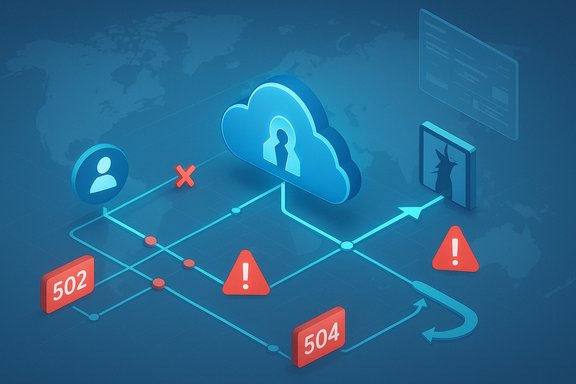
When Microsoft’s Azure cloud platform went dark on the afternoon of October 29, 2025, the interruption did not feel like a garden‑variety outage. It arrived as a vivid, global reminder that the internet — and modern business — now rides on a surprisingly small number of centralized control planes. Beginning around 16:00 UTC (12:00 p.m. Eastern), an inadvertent configuration change in Azure Front Door (AFD), Microsoft’s global edge and application delivery fabric, triggered cascading failures that left Microsoft 365, Xbox services, Minecraft, the Azure Portal and thousands of customer applications struggling or unreachable. The event, coming only nine days after a major AWS incident, forced a blunt question into the open: how resilient is a web that depends so heavily on a handful of hyperscalers?
Background / Overview
Azure is one of the world’s three hyperscale public clouds and hosts not only countless customer workloads but also many of Microsoft’s own management and identity surfaces. Azure Front Door (AFD) acts as both a content delivery network and a globally distributed Layer‑7 ingress fabric: it terminates TLS, performs global HTTP(S) load balancing and routing, enforces Web Application Firewall (WAF) rules, and proxies traffic to origin services. Microsoft Entra ID (formerly Azure AD) serves as the identity backbone for sign‑in flows across Microsoft 365, Xbox and many third‑party services.Because AFD occupies the crossroads between identity, routing and security, a localized misconfiguration can balloon into widespread, cross‑product disruption. That is precisely what unfolded on October 29: a configuration change created invalid or inconsistent state in parts of AFD, disrupting routing and TLS handshakes and starving token issuance paths. Microsoft’s engineers froze further AFD changes, deployed the “last known good” configuration and rerouted traffic away from affected infrastructure in an attempt to steady the fabric — mitigations that ultimately restored many services over the following hours, but not before the outage exposed design and operational fragilities that bear urgent attention.
What happened — concise timeline and technical trigger
Timeline (concise)
- Around 16:00 UTC (12:00 p.m. ET) on October 29, 2025, monitoring and external outage trackers reported elevated latencies, packet loss and routing errors for AFD frontends.
- Microsoft published operational advisories indicating an “inadvertent configuration change” to a portion of Azure infrastructure affecting AFD and related services.
- Engineers blocked further AFD changes, initiated a rollback to the last known good configuration, and rerouted portal and identity traffic off the impacted fabric.
- Progressive node recovery and traffic rebalancing led to visible restoration of many services within hours; tail‑end recovery continued as DNS caches and global routing converged.
The proximate technical trigger
The immediate cause reported internally was a configuration change applied to Azure Front Door that produced an inconsistent or invalid state across AFD nodes. Because AFD mediates TLS, routing and token exchanges for identity flows, the misconfiguration manifested as failed sign‑ins, 502/504 gateway errors and blank admin blades across Microsoft 365, the Azure Portal, Xbox Live, Minecraft authentication and numerous third‑party websites fronted by AFD. The global nature of the edge fabric meant that the blast radius was broad and cross‑product.Note on uncertainty: Microsoft described the root cause as an inadvertent configuration change; however, the precise content of that change, whether a human error or automated deployment was responsible, and the internal telemetry details remain subject to a formal post‑incident review. Any deeper reconstruction beyond official statements should be considered provisional until Microsoft publishes full findings.
Why Azure Front Door failures cascade: the technical anatomy
AFD is not a simple content cache. Its responsibilities and interactions with other control planes explain why its failure becomes many failures:- TLS termination and re‑encryption: AFD often terminates client TLS sessions at the edge and re‑encrypts to origin. When those edge points cannot complete handshakes, client requests stall statewide.
- Global HTTP(S) routing and origin selection: AFD makes real‑time decisions about which origin to route requests to (including adaptive failover). Erroneous routing rules or unhealthy PoPs (Points of Presence) can direct traffic to unreachable or misconfigured backends.
- Centralized security controls: WAF rules, ACLs and rate limits applied at AFD affect tenant traffic at scale. A misapplied rule can block legitimate traffic across many customers.
- Identity fronting: Entra ID and token issuance flows pass through the same edge surface. If token services are impaired, sign‑in reliant apps — Outlook Web, Teams, the Xbox store — fail in unison.
- Caching and DNS TTL friction: Global rollbacks and routing changes contend with cached DNS records and edge state; short‑term mitigation is slowed as DNS caches and client resolvers converge on the corrected routes.
The consumer and business impact
The outage was visible and immediate:- Productivity: Microsoft 365 web apps, authentication for Outlook and Teams, and Microsoft 365 Admin Center sign‑ins were affected, disrupting meetings, email access and administrative tasks for businesses worldwide.
- Gaming and entertainment: Xbox storefronts, Game Pass access and Minecraft authentication experienced sign‑in failures or storefront errors, leaving gamers unable to play, buy, or download.
- Platform management: The Azure Portal and certain management APIs were intermittently unavailable until Microsoft failed portal traffic away from AFD to restore admin access.
- Third‑party websites and apps: Retailers, airlines and other enterprises fronting traffic through AFD reported 502/504 gateway errors or degraded availability, affecting commerce, check‑in systems and customer experiences.
- Market and corporate timing: The outage occurred on the same day Microsoft prepared to publish quarterly earnings after market close, adding a reputational and investor‑relations wrinkle to the operational crisis.
Two high‑profile outages in quick succession: pattern or coincidence?
This Azure incident followed a major AWS outage earlier in October 2025 that began in the US‑EAST‑1 region and was traced to DNS and service‑discovery issues tied to DynamoDB and internal resolver faults. Across both events, a common theme emerges: control‑plane fragility. Whether it’s internal DNS, a global edge fabric, or centralized identity, failures in systems that coordinate traffic and authentication produce outsized, cross‑service disruption.That pattern — multiple, high‑impact hyperscaler incidents within days of each other — has renewed debate about systemic concentration risk. Enterprises and governments are now facing the same uncomfortable calculus: the economies of scale and feature richness hyperscalers provide come with elevated systemic risk when control planes fail.
What Microsoft did well — strengths in the response
- Rapid public acknowledgment: Microsoft issued operational advisories early, communicated mitigation actions and provided rolling updates via the Azure Service Health channel.
- Appropriate containment steps: Freezing further AFD changes and deploying a rollback to a last‑known‑good configuration are standard best practices for control‑plane emergencies; Microsoft executed these measures quickly.
- Failing management traffic away from the troubled fabric: Restoring Azure Portal accessibility for administrators enabled programmatic workarounds and administrative recovery actions, reducing downtime for many tenants.
- Progressive, cautious recovery: Engineers took a controlled approach to node recovery and traffic rebalancing to avoid repeat regressions, prioritizing stability over speed.
Weaknesses and systemic risks the incident exposed
- Centralized single‑points-of-failure: Placing routing, security, TLS termination and identity in a common fabric concentrates blast radius; when a shared control plane falters, many products fail together.
- Change‑control and validation gaps: An “inadvertent configuration change” implies weaknesses in pre‑deployment validation, automation safety nets or rollout gating. When a global change is issued, the absence of robust canaries, platform‑level health gates or automated rollback triggers raises the risk of widespread impact.
- Identity coupling multiplies damage: Centralized identity issuance (Entra ID) served as a common dependency across consumer and enterprise services, magnifying the outage’s surface area.
- Slow convergence due to caches and DNS TTLs: Even after a rollback, DNS caches, CDN edge state and client resolvers take time to converge, extending the perceived outage window.
- Lack of immediate, tenant‑level impact telemetry: Customers need clear per‑tenant insights during provider incidents; aggregated public advisories can leave enterprises scrambling to determine their exact exposure and remediation steps.
The economics and concentration question
The hyperscalers deliver immense value: scale, global presence, deep feature sets and rapidly evolving AI‑era services. At the same time, market share concentration — where the top three providers command a majority of cloud infrastructure spend — creates systemic dependencies. Different industry analyses place Azure’s share in the low‑to‑mid‑20s percentage and AWS’s share near the low‑to‑mid‑30s, with Google Cloud trailing behind; exact percentages vary by methodology and quarter. The practical effect is that a handful of providers underpin critical internet services, government platforms and private enterprise workloads.That concentration yields three uncomfortable truths:
- A single provider failure can cascade into multisector economic impacts.
- Vendor lock‑in decisions that looked justified for efficiency now carry macro systemic risk.
- Regulators and enterprise risk committees will increasingly scrutinize concentration, transparency and provider resilience.
What enterprises must do differently — practical resilience prescriptions
For IT leaders and architects, the Azure outage should refocus planning on where control‑plane failure will hurt the most. Practical steps include:- Map critical dependencies. Inventory which of your services depend on provider control planes (edge, identity, global DNS) and assess blast radius.
- Adopt multi‑region and multi‑provider patterns where practical. Not every workload needs multi‑cloud, but mission‑critical flows (payment systems, emergency services, identity proxies) should have independent failover paths.
- Design identity redundancy. Where feasible, implement local caching, alternative token issuance paths, or even secondary identity providers for critical sign‑in flows.
- Implement progressive rollouts and circuit breakers. Use canary deployments, health‑gated rollouts, and automated circuit breakers in pipelines to limit the impact of bad config changes.
- Use synthetic monitoring and active probes. Per‑region synthetic transactions that exercise sign‑in and critical APIs provide early warning and objective visibility across providers.
- Prepare runbooks and test them. Document step‑by‑step failover runbooks (DNS failover, traffic manager switching, local auth caches) and exercise them with tabletop and live drills.
- Negotiate SLA and contractual protections. Understand provider SLAs, their financial and operational remedies, and demand tenant‑level telemetry for incident triage.
- Practice chaos engineering at the app level. Regularly validate that fallbacks, retries, and degraded modes preserve core business functions during partial provider failures.
- Limit single‑provider cascading features. Avoid designs where a provider‑specific global service is the only way to implement a necessary capability for your business-critical path.
What cloud providers should improve — platform and operational reforms
Hyperscalers have incentives to invest in stability and transparency. Recommended provider actions include:- Stronger change‑control guardrails for control planes. Staged canaries, automatic health checks, and enforced rollback triggers should be mandatory for global routing or identity changes.
- Per‑tenant impact telemetry and transparent dashboards. Customers need fine‑grained impact slices, not just coarse public advisories.
- Faster, safer rollback primitives. Reduce reliance on manual rollbacks that contend with caches and TTLs; develop mechanisms to invalidate stale edge state quickly and safely.
- Control‑plane isolation and architectural compartmentalization. Reduce blast radius by decoupling identity token issuance, routing decisions and security enforcement where possible.
- Publishable post‑incident reviews and learning artifacts. Detailed, timely root‑cause analyses and concrete remediation roadmaps rebuild trust and help customers harden their systems.
- Regulated third‑party audits. Independent audits of control‑plane safety, change‑control policies and incident response readiness would increase accountability.
Policy, regulation and the public interest
The October outages make fertile ground for policy debate. Governments and regulators are increasingly attuned to digital infrastructure resilience, national security concerns, and economic systemic risk. Potential policy responses include:- Standards for incident transparency: Mandated timelines for post‑incident disclosures and unblockable, machine‑readable impact data for enterprise customers.
- Resilience requirements for critical services: Critical national infrastructure and public services could be required to maintain multi‑provider redundancy or independent fallback capabilities.
- Competition and interoperability enforcement: Encouraging open standards and easier data portability would reduce lock‑in and support a healthier supplier ecosystem.
- Regulator‑grade audits: Independent assessments of hyperscalers’ control‑plane architectures could be required for providers serving essential services.
Lessons for the next decade — architecture, economics and trust
The Augusts and Octobers of 2025 were not merely about technical failure; they were a collective stress test of a socio‑technical system that now underpins commerce, healthcare, education and entertainment. The most durable lessons include:- Architectural humility: Centralization buys speed and features — but it amplifies systemic failure modes. Architects must be explicit about which centralities they accept and prepare contingencies for the rest.
- Operational rigor and SRE culture: Staged rollouts, rigorous pre‑deployment checks and automated rollback gates are not optional for systems that mediate billions of interactions.
- Transparency as a stabilizer: The industry needs more timely, granular and standardized incident reporting; trust is rebuilt by openness and clear remediation commitments.
- Regulation will follow reality: As society delegates critical functions to private clouds, expectations about transparency, resilience and accountability will crystallize into policy.
- Customer readiness matters: Enterprises must budget for resilience: redundancy, testing, and the skillsets to execute under provider stress are effective insurance.
Conclusion
Azure’s October 29 outage was a visible, painful demonstration that the internet’s backbone now often depends on few control planes run by a handful of corporations. Microsoft’s rapid mitigations limited long‑term damage and restored many services, but the episode illuminated a brittle underside: centralized identity, routing and edge controls can multiply small errors into global outages. For enterprises, the takeaways are concrete: map dependencies, invest where failure would be catastrophic, and test fallbacks. For providers, the obligation is equally concrete: harden change controls, shorten reaction loops and publish the post‑incident details customers need to trust their platforms again.This is not a doom‑prophecy for the cloud era; it is, instead, a clear engineering and governance challenge. The cloud has transformed computing and enabled extraordinary innovation, but it also demands a renewed focus on architecture, operational discipline and public accountability. The choice before enterprises, providers and regulators is unambiguous: act now to decentralize the risks you can control, demand transparency where you cannot, and design for a world where the next big blackout is a matter of when, not if — but also where each incident leaves behind stronger systems, not merely headlines.
Source: Pune Mirror Cloudpocalypse Now: Microsoft Azure Disaster Exposes Terrifying Truth About the Web’s Survival! - Pune Times Mirror
