

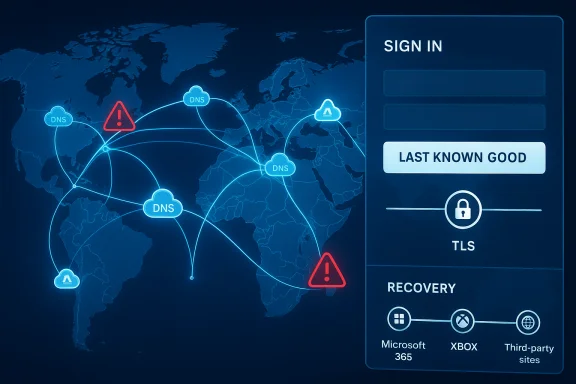
Microsoft has deployed a corrective rollback after a widespread outage tied to Azure Front Door disrupted Microsoft services and thousands of customer sites, leaving users with sign-in failures, blank management portal blades, and intermittent 502/504 gateway errors across Microsoft 365, Xbox, and a range of third‑party web properties.
Background
Azure Front Door (AFD) is Microsoft’s global Layer‑7 edge and application delivery fabric, providing TLS termination, global HTTP(S) routing, Web Application Firewall (WAF) enforcement, and DNS-level traffic steering for both Microsoft’s first‑party services and countless customer workloads. Because AFD often sits directly in front of identity issuance and management planes, a disruption in AFD’s control plane can produce broad, simultaneous failures that appear indistinguishable from backend outages.On October 29, engineers detected elevated latencies, DNS anomalies, and a spike in gateway timeouts beginning around 16:00 UTC. Microsoft’s operational messaging identified an inadvertent configuration change to Azure Front Door as the proximate trigger. In response, Microsoft blocked further AFD configuration changes, rolled back to a previously validated “last known good” configuration, and rerouted the Azure Portal away from affected AFD paths while recovering nodes and rebalancing traffic. Recovery progressed over several hours, though residual issues lingered for some tenants due to DNS caching and global routing convergence.
What broke, exactly
The nature of the failure
The outage was not a classic compute or storage crash — it was a control‑plane misconfiguration at the edge. In distributed edge fabrics like AFD, the control plane publishes routing, hostname and DNS directives that propagate to hundreds of Points‑of‑Presence (PoPs). A faulty change in that plane can cause:- DNS resolution failures or incorrect DNS responses;
- Misrouted or dropped HTTP(S) requests at the edge;
- TLS/hostname mismatches at PoPs that break secure handshakes;
- Authentication token issuance failures when identity endpoints are fronted by the same edge fabric.
Services and sectors affected
The blast radius was large because AFD is a common ingress point for many services. Visible impacts included:- Microsoft productivity surfaces: Microsoft 365 admin center, Outlook on the web, Teams web access.
- Azure management plane: Azure Portal and other portal‑driven admin consoles struggled or displayed incomplete resource lists.
- Gaming: Xbox Live storefront, Game Pass, and Minecraft authentication and Realms experienced interruptions.
- Third‑party customer sites: Retail mobile ordering and loyalty features, airline check‑in pages, and various municipal websites reported timeouts or gateway errors.
Timeline and Microsoft’s mitigation playbook
Concise timeline
- Detection (~16:00 UTC): Elevated latencies, packet loss and 502/504 gateway errors spike for AFD‑fronted endpoints.
- Acknowledgement: Microsoft names Azure Front Door and an inadvertent configuration change as likely triggers.
- Containment: Engineers block further AFD configuration rollouts to stop propagation.
- Remediation: Rollback to “last known good” configuration; recover affected nodes; rehome traffic to healthy PoPs.
- Portal failover: Azure Portal routing was failed away from AFD where possible to restore management plane access.
- Recovery: Progressive restoration across services over several hours; lingering issues for some tenants due to DNS/TTL propagation.
Why rollback and failover were the right immediate actions
Automated or manual rollbacks to a previously validated configuration are standard defensive moves for control‑plane incidents because they remove the agent of change while enabling verification and convergence. Failing the portal away from the implicated edge fabric is also a straightforward, pragmatic move: when an administrative UI depends on the fabric that’s failing, operators need an alternate path to regain visibility and remediation controls. These steps are textbook containment for such incidents, but they are operationally expensive and require careful orchestration across global PoPs.Technical analysis: why a single change can cause a global incident
Control plane vs. data plane — a concentrated risk
Edge services separate responsibilities into a control plane (where configuration is authored and pushed) and a data plane (the edge nodes that actually route traffic). That separation provides scale and centralized policy control, but it also concentrates risk: a control‑plane bug or a malformed configuration can be applied broadly and quickly, amplifying the blast radius.AFD’s responsibilities — TLS termination, DNS mapping, routing rules and WAF policies — make it both powerful and high‑impact. When a misapplied routing rule or hostname mapping is propagated, thousands of PoPs can begin returning incorrect DNS answers or misdirecting traffic nearly simultaneously, producing symptoms that look like a total service failure even when origin servers are healthy.
Cache and DNS convergence extend the pain
Even after the underlying configuration is corrected, external DNS caches and edge caches take time to converge. Public resolvers and client machines may continue to trust stale, incorrect records until TTLs expire or caches are flushed. That tail of residual impact is common in global CDN and DNS incidents and is why Microsoft’s status messages warned of lingering tenant‑specific problems after the rollback.Operational complexity: staged rollouts and automation risks
Modern cloud vendors push configuration changes through automated, staged rollouts to achieve scale and consistency. Those same automation pipelines, however, can amplify human mistakes or software defects by applying a bad configuration widely before operators can detect and isolate the issue. Improving canarying, more conservative rollout windows, and safer automatic rollback triggers are structural mitigation strategies cloud vendors and tenants must battle to implement effectively.Who pays the price? Real‑world consequences
This was not an abstract engineering exercise: the outage produced business and customer impact across sectors.- Airlines relying on Azure‑hosted check‑in or boarding systems reported customer delays and required staff to revert to manual processes, increasing queue times and operational overhead.
- Retailers and food‑service apps that rely on Azure‑fronted APIs saw mobile ordering and checkout interruptions, directly affecting revenue and customer satisfaction.
- Enterprise administrators were temporarily locked out of management consoles, complicating both the diagnosis of the issue and tenant-level mitigation.
Strengths of Microsoft’s response — and where it fell short
Notable strengths
- Rapid identification and candid messaging: Microsoft’s public status updates correctly identified Azure Front Door as the locus of the problem and described mitigation steps, which helped the industry quickly triangulate the root cause.
- Defensive containment: Freezing configuration rollouts and rolling back to a validated configuration were the right immediate actions to stop propagation.
- Alternate management paths: Failing the Azure Portal away from AFD was crucial to restoring administrative control to engineers and tenant administrators.
- Commitment to a post‑incident review: Microsoft signalled a Post Incident Review (PIR) process, which is vital for transparency and remedial engineering.
Persistent weaknesses and risk factors
- Concentrated control‑plane exposure: The fact that so many critical services and identities are fronted by the same fabric increases systemic risk.
- Insufficient multi‑path resilience for tenants: Many organizations discovered they lacked independent programmatic admin paths that didn’t rely on the primary portal, complicating remediation when the portal was affected.
- Rollout guardrails: The incident underscored the need for stricter canarying and safer automation guardrails for global control‑plane changes to reduce the chance of an inadvertent change going wide.
- Communication fragility: Microsoft’s own status surfaces can be affected by the incident, creating a single‑channel risk for status updates — a common problem for hyperscalers during high‑impact events.
Practical guidance for IT teams and platform owners
This outage is a case study for operational hardening. Practical steps that organizations should take now:- Validate which public endpoints are fronted by Azure Front Door and classify them by criticality.
- Ensure at least one independent administrative path exists (service principal, managed identity, PowerShell/CLI) that does not depend on the web portal being reachable.
- Publish and rehearse a DNS and traffic‑manager failover runbook that includes TTL considerations and cache‑flush strategies.
- Build and test multi‑path authentication flows where feasible; avoid a single identity issuance path that, if impaired, locks out all administrative access.
- Revisit contractual SLAs and collect evidence of impact (logs, timestamps, invoices) to support any contractual or compliance actions.
- Demand a vendor PIR that covers root cause, timeline, corrective actions, and measurable mitigation steps. If the PIR is insufficiently detailed, escalate for greater transparency.
- Map critical dependencies that rely on AFD or other single‑point edge fabrics.
- Add at least one non‑portal admin path for emergency operations.
- Reduce DNS TTLs on critical assets where safe to accelerate future recovery.
- Test failover paths in a controlled, scheduled window.
- Implement stricter deployment canaries and automated rollback criteria.
Vendor responsibilities and the regulatory lens
Hyperscale cloud outages increasingly attract attention from regulators, boards, and large enterprise customers. When a single misconfiguration causes cascade failures across retail, travel, public services, and communication platforms, policy questions follow about supplier risk, disclosure, and audits.Enterprises should expect more detailed vendor commitments around:
- Change governance and deployment transparency,
- Third‑party audits of control‑plane safety,
- Faster and more granular incident reporting mechanisms,
- Compensation and remediation protocols that account for real business losses.
Cross‑cloud and architectural lessons
Several architectural takeaways are worth repeating:- Design for partial failure: Systems should degrade gracefully, and there should be clearly tested fallback workflows that do not depend on a single global ingress fabric.
- Use multi‑cloud or multi‑region patterns for high‑impact services: While multi‑cloud is not a silver bullet, decoupling critical customer experiences across different ingress paths reduces correlated risk.
- Decouple identity issuance from public front doors: Wherever practical, ensure identity and token issuance paths have independent routings so authentication remains available even if one front door fails.
- Run regular failure drills: Simulated incidents that include edge/DNS failure modes will reveal brittle dependencies that tabletop exercises miss.
What we still don’t know — and what to watch in the PIR
Microsoft committed to a Post Incident Review (PIR). The high‑value items to look for in the PIR include:- Precise technical explanation of the configuration change that triggered the incident (what changed, why it was allowed, and which automated pipelines applied it).
- Why existing rollback or canary safeguards failed to prevent wide propagation.
- List of corrective engineering controls: short‑term fixes (fixes in AFD), mid‑term controls (deployment guardrails), and long‑term architectural changes (management plane isolation).
- Timeline with concrete timestamps showing detection, remediation actions, and service recovery metrics.
- Quantified impact by service and region, to help customers evaluate business exposure.
Risks moving forward
- Recurrent pattern risk: Edge and DNS incidents have produced repeated headlines across hyperscalers. Without demonstrable engineering changes, similar incidents can recur.
- Complacency in dependency mapping: Many organizations remain unaware of which public endpoints transit a provider’s edge fabric; if that mapping is incomplete, risk persists unseen.
- Erosion of vendor trust: High‑visibility outages erode the implicit trust organizations place in cloud providers, increasing the cost of cloud procurement and raising board‑level scrutiny.
Conclusion
The Azure Front Door incident and Microsoft’s subsequent rollback expose an enduring tension in cloud computing: the convenience and performance of centralized, global edge fabrics come with concentrated systemic risk. Microsoft’s mitigation — freezing rollouts, failing portals away from the edge, and rolling back to a known‑good configuration — was effective in restoring most services, but the event left a long tail of operational, commercial, and reputational consequences for customers and highlighted several structural weaknesses in control‑plane governance and tenant resilience.For IT leaders, the immediate takeaway is pragmatic: map your dependencies, harden administrative access paths, rehearse DNS and traffic failovers, and demand concrete PIR outcomes from vendors. For cloud vendors, the lesson is equally stark: tighten deployment guardrails, improve canary and rollback automation, and provide clear guidance and tooling that help tenants avoid becoming collateral damage in control‑plane incidents.
This outage will be remembered not as an isolated hiccup but as a case study — one that should accelerate enterprise resilience planning and force hyperscalers to make engineering changes that materially reduce the odds of the next global outage.
Source: WFMZ.com Microsoft deploys a fix to Azure cloud service that's hit with outage
