

Microsoft’s brief public attestation that “Azure Linux includes this open‑source library and is therefore potentially affected” is accurate — but it is a product‑scoped inventory statement, not a guarantee that no other Microsoft product can or does include the vulnerable netfilter code. Azure Linux (the distro formerly called CBL‑Mariner) is the only Microsoft product Microsoft has publicly attested as carrying the affected kernel component for CVE‑2025‑38201 so far, and Microsoft has said it will update its CSAF/VEX attestations if additional products are identified.
CVE‑2025‑38201 is a Linux‑kernel vulnerability in the netfilter nftables code — specifically the nft_set_pipapo implementation — that can cause kernel warnings and allocation failures when resizing certain internal hashtable structures. The upstream fix clamps the maximum map bucket size to INT_MAX to avoid triggering WARN_ON_ONCE in __kvmalloc_node_noprof due to unchecked allocations. The bug and the upstream patches are recorded in the kernel stable trees and distribution advisories. In plain terms:
Important distinctions to read into those lines:
Long answer: Azure Linux is the only Microsoft product Microsoft has publicly attested to include the affected nftables component for CVE‑2025‑38201 at the time of the advisory, but other Microsoft artifacts that ship a Linux kernel could also carry the vulnerable code depending on kernel version and build configuration.
Why this is true (technical reasoning):
However, because Microsoft ships other Linux artifacts (notably WSL2), customers should not assume that anything not listed in the VEX output is safe. The practical posture for risk management is to treat un‑attested Microsoft artifacts as unknown and verify them as described above.
Source: MSRC Security Update Guide - Microsoft Security Response Center
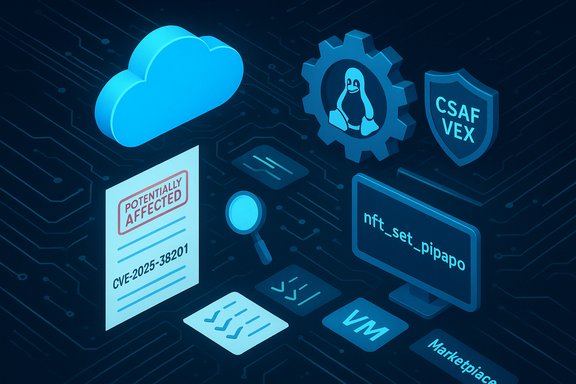 Background / Overview
CVE‑2025‑38201 is a Linux‑kernel vulnerability in the netfilter nftables code — specifically the nft_set_pipapo implementation — that can cause kernel warnings and allocation failures when resizing certain internal hashtable structures. The upstream fix clamps the maximum map bucket size to INT_MAX to avoid triggering WARN_ON_ONCE in __kvmalloc_node_noprof due to unchecked allocations. The bug and the upstream patches are recorded in the kernel stable trees and distribution advisories. In plain terms:- The defect lives in the pipapo set implementation for nftables (used for some kinds of IP range/bitmap matching).
- When the set’s mapping table is resized, an unchecked multiplication/allocation can exceed safe limits; the kernel’s allocator path used in that code does not use __GFP_NOWARN in the same way as earlier code, producing WARN_ON_ONCE and possible allocation failures.
- Upstream maintainers patched the hashtable resizing path to clamp bucket sizes and add overflow checks to prevent problematic allocations.
What Microsoft actually said — and why the wording matters
Microsoft’s Security Response Center (MSRC) wording for this and similar upstream CVEs has followed the same pattern in 2025: the company started publishing machine‑readable CSAF/VEX attestations for product families (beginning with Azure Linux), and for some CVEs it has mapped the upstream component to Azure Linux images and kernel artifacts and labelled them “potentially affected.” Microsoft has also stated it will update the CVE / VEX / CSAF records if additional Microsoft products are identified as carriers of the same component.Important distinctions to read into those lines:
- Attestation = inventory result for a named product. When Microsoft says Azure Linux “includes the open‑source library and is therefore potentially affected,” that is the vendor saying “we inspected this product family and found the upstream component in our builds; treat that product as in‑scope for remediation.”
- Not an exclusivity guarantee. The attestation does not assert that other Microsoft artifacts (WSL kernels, linux‑azure kernels, Marketplace images, third‑party or partner appliances, or other Microsoft‑shipped images) cannot include the same upstream code. Microsoft’s wording explicitly commits to updating the record if more products are discovered.
Is Azure Linux the only Microsoft product that could be affected?
Short answer: No — not necessarily.Long answer: Azure Linux is the only Microsoft product Microsoft has publicly attested to include the affected nftables component for CVE‑2025‑38201 at the time of the advisory, but other Microsoft artifacts that ship a Linux kernel could also carry the vulnerable code depending on kernel version and build configuration.
Why this is true (technical reasoning):
- The vulnerable code is upstream Linux kernel code (net/netfilter/nft_set_pipapo.c). Any Microsoft product that ships a Linux kernel binary built from an upstream commit range that predates the fix — and which has the relevant nftables/pipapo code compiled in — is potentially affected.
- Microsoft builds and ships multiple distinct Linux artifacts where upstream kernel code can appear:
- Azure Linux (CBL‑Mariner lineage / azl3) — explicitly attested by Microsoft.
- WSL2 kernel — Microsoft maintains and ships a WSL2 kernel source tree and prebuilt kernel images; customers can also build or run custom WSL kernels. If a WSL kernel build used by a Windows install contains the vulnerable netfilter code, that WSL instance could be affected.
- linux‑azure / Marketplace / VM images — Azure hosts many kernel variants and marketplace appliance images. Some Azure VM images use vendor kernels or Microsoft‑built kernels; each image is a separate artifact that must be inventoried.
- CBL‑Mariner lineage artifacts and container host images — Microsoft’s internal host images and container base images derive from the same build pipelines that produce Azure Linux; those artifacts may share kernel backports and should be included in inventory efforts.
- Any Microsoft product that bundles or deploys a Linux kernel binary (appliances, specialized devices, container host agents, etc..
Who should be concerned — practical exposure model
You only need to worry about this CVE for Microsoft artifacts if two independent conditions are true for each artifact:- The artifact ships or uses a Linux kernel built from an upstream tree/revision that falls into the vulnerable range (i.e., before the upstream fix commits).
- The kernel build includes the nftables pipapo code (built‑in or as a module). Kernel configuration flags and module packaging determine whether the code is present at runtime.
- An Azure Linux VM image that Microsoft attests as potentially affected is clearly in scope — apply Microsoft’s updated kernel images.
- A Windows machine running WSL2 that uses Microsoft’s published WSL kernel may be in scope if that WSL kernel version predates the fix and the pipapo code is enabled in its config file. Inspect the kernel version and config to confirm.
- A Marketplace appliance that bundles a vendor kernel may or may not be affected — check the appliance’s kernel version and modules. Market images are separate artifacts and require per‑image verification.
How to verify exposure — step‑by‑step checks
The correct operational posture is artifact‑level verification. For each Microsoft‑supplied image or kernel you run, perform the following checks.- Verify the kernel version / build
- Command: uname -r
- Check kernel package version and changelog to see whether the distribution/kernel build includes the upstream fix commits for CVE‑2025‑38201. Vendor advisories often list the fixed package versions (Debian/Ubuntu/Amazon/Red Hat trackers).
- Confirm whether the pipapo code is present (built‑in or modular)
- If modules are available: modinfo nft_pipapo || modinfo nft*pipapo** (module name may vary by tree)
- Check loaded modules: lsmod | grep pipapo
- Inspect kernel config: zgrep NFT_PIPAPO /proc/config.gz or grep NFT_PIPAPO /boot/config-$(uname -r)
- On systems without /proc/config.gz, look in /boot/config-* for the running kernel. If the pipapo set is not enabled in the configuration, the kernel will not be carrying that code and is not vulnerable from that vector.
- Offline artifact / image inspection
- For VM images or offline kernels, extract the kernel and inspect the config in /boot or the .config used to build it.
- For WSL2, check the kernel build tag and Microsoft’s WSL2 kernel repo to match commit/branch and config.
- Check distribution vendor advisories & kernel changelogs
- Use vendor security trackers to see whether your distribution and kernel branch are listed as affected and which package releases contain the fix. Distributions publishing mappings include Debian, Ubuntu and vendor advisories (AWS / Amazon Linux, Red Hat, etc.. Apply the vendor-supplied kernel update if your artifact matches an affected entry.
Remediation and mitigation guidance
- Apply vendor updates: For Azure Linux images Microsoft has attested as affected, apply the Microsoft‑published kernel updates or image replacements as soon as they are available. Treat Microsoft’s CSAF/VEX attestation as an authoritative remediation signal for those artifacts.
- Patch WSL2 if necessary: If your WSL2 instance uses Microsoft’s distributed kernel and its version is vulnerable and pipapo is enabled, update Windows/WSL kernel via Windows Update or follow Microsoft’s WSL kernel update guidance and rebuild or upgrade the WSL kernel as recommended. Microsoft publishes the WSL2 kernel source and release tags so you can confirm versions.
- Inventory and prioritize: Run artifact‑level inventory across your estate to find all images that ship Linux kernels (VM images, AKS node images, WSL kernels, Marketplace appliances). Prioritize remediation of images that Microsoft has attested as affected, then expand to un‑attested but plausible carriers.
- Temporary mitigations: If you cannot immediately patch, you can reduce risk by:
- Restricting who can create or modify nftables sets on the host (reduce local attack surface).
- Restricting access to multi‑tenant hosts where local users could craft the specific inputs that trigger the resizing code.
- Enforcing kernel module loading policies to prevent loading of untrusted modules.
These are stop‑gap mitigations; applying the upstream/distribution kernel fix is the correct long‑term remedy.
Why Microsoft began with Azure Linux — and why that makes sense
Large vendors must inventory huge numbers of products and artifacts before publishing product‑scoped attestations. Microsoft chose a pragmatic rollout: start with a single, high‑value product family that Microsoft builds and controls fully (Azure Linux / CBL‑Mariner lineage), publish deterministic machine‑readable CSAF/VEX attestations for that family, and expand the inventory to other products over time. That’s why Azure Linux appears first in Microsoft’s mappings for a number of kernel CVEs. The attestation is valuable because it gives operators an authoritative, automatable signal to act upon for Azure Linux images.However, because Microsoft ships other Linux artifacts (notably WSL2), customers should not assume that anything not listed in the VEX output is safe. The practical posture for risk management is to treat un‑attested Microsoft artifacts as unknown and verify them as described above.
Cross‑checking the technical facts (verification of claims)
To ensure technical accuracy for this report, these key facts were cross‑checked against multiple independent sources:- The CVE description and upstream patches are recorded in kernel stable commits / git.kernel.org and public CVE trackers (NVD, distribution trackers). The upstream commits that implement the clamp/overflow checks are referenced in the CVE metadata and distribution advisories.
- Major distributions (Debian and Ubuntu) and cloud vendors (Amazon Linux) have mapped and published the CVE in their trackers — showing the practical downstream impact and fixed package versions.
- Microsoft’s product attestation practice and the specific phrasing quoted by customers are present in MSRC guidance and in the vendor’s CSAF/VEX rollout documentation: Microsoft explicitly notes Azure Linux as an included product and commits to updating the CVE mapping if more products are discovered. The wording is a product‑scoped attestation and is the basis of the interpretations above.
Practical checklist for administrators (quick reference)
- Identify Microsoft‑provided Linux artifacts you run (Azure Linux VMs, WSL2, AKS node images, Marketplace appliances).
- For each artifact, run:
- uname -r
- zgrep NFT_PIPAPO /proc/config.gz or check /boot/config-$(uname -r)
- lsmod | grep pipapo ; modinfo nft_pipapo
- Cross‑reference the running kernel / package version with vendor CVE advisories and the upstream kernel patch commits to determine whether the build contains the fix.
- Apply vendor‑supplied kernel packages or replace images with patched images. If you run WSL2, ensure Windows Updates and WSL kernel updates are applied or rebuild the WSL kernel from an updated source tag.
- If immediate patching is impossible, reduce privileges for local users and restrict nftables operations and module loading as temporary mitigations.
Risks, strengths, and the transparency trade‑off
What’s strong about Microsoft’s approach:- Machine‑readable CSAF/VEX attestations provide automation-friendly inventory signals — valuable for large cloud customers to triage quickly. Microsoft’s decision to publish attestations is a positive step for software supply‑chain transparency.
- Partial coverage at publication. Starting the VEX rollout with Azure Linux means other product families may not be attested yet; customers and partners may misread the absence of attestations as a declaration of safety. That is a dangerous false‑negative risk.
- Artifact variability. Linux kernel features are a per‑artifact, build‑time property. Two Microsoft kernels with identical version numbers can differ in configuration and module set; this complicates blanket assurances.
- Long‑tail images and appliances. Marketplace images, partner appliances, and statically linked binaries distributed across a cloud estate can harbor vulnerable code that is not captured by a single product attestation. Inventory is the only reliable defense.
Conclusion
Microsoft’s message — that Azure Linux includes the open‑source library and is therefore potentially affected — is an accurate, product‑scoped attestation and a useful automation signal for Azure Linux customers. It does not mean Azure Linux is the only possible Microsoft carrier of the vulnerable nftables code. Any Microsoft artifact that ships a Linux kernel built from an upstream range prior to the fix and with the nftables pipapo code enabled could be affected; that includes WSL2 kernels, linux‑azure images, Marketplace appliances, and other kernel‑carrying artifacts until they are explicitly inventoried and attested by Microsoft or verified by the customer. Operators should:- Treat Microsoft’s Azure Linux attestation as definitive in‑scope for remediation and apply Microsoft’s updates.
- Run artifact‑level verification across all Microsoft‑supplied Linux kernels in their estate (use the commands in this guide), and patch or replace any image or kernel that matches the affected version and configuration.
- Monitor Microsoft’s VEX/CSAF updates — Microsoft has committed to expanding attestations if further products are found to ship the component — but do not wait for Microsoft to call out every artifact before performing your own inventory and triage.
Source: MSRC Security Update Guide - Microsoft Security Response Center
