

Microsoft’s short MSRC line — “Azure Linux includes this open‑source library and is therefore potentially affected” — is an authoritative, product-scoped inventory attestation, but it is not a technical guarantee that no other Microsoft product contains the same vulnerable code.
Microsoft’s Security Response Center (MSRC) has adopted a concise pattern on many Linux‑component CVE pages: when a product family has been inspected and the implicated upstream component is present in that product’s builds, MSRC publishes a brief statement to that effect and flags the product as “potentially affected.” For example, MSRC’s wording for several recent Linux kernel CVEs explicitly confirms Azure Linux as a known carrier while also noting Microsoft’s phased rollout of machine‑readable CSAF/VEX attestations and the company’s intention to update CVE product mappings if additional Microsoft products are found to ship the impacted component.
That operational model is straightforward and helpful: it gives Azure customers a clear, high‑confidence remediation target. At the same time, it creates an important distinction that many teams — and sometimes vendors themselves — gloss over: “attested present” does not equal “exclusive to.” MSRC’s Azure Linux attestation is a statement of what Microsoft has validated to date, not an exhaustive scan across every Microsoft artifact.
Source: MSRC Security Update Guide - Microsoft Security Response Center
 Background / Overview
Microsoft’s Security Response Center (MSRC) has adopted a concise pattern on many Linux‑component CVE pages: when a product family has been inspected and the implicated upstream component is present in that product’s builds, MSRC publishes a brief statement to that effect and flags the product as “potentially affected.” For example, MSRC’s wording for several recent Linux kernel CVEs explicitly confirms Azure Linux as a known carrier while also noting Microsoft’s phased rollout of machine‑readable CSAF/VEX attestations and the company’s intention to update CVE product mappings if additional Microsoft products are found to ship the impacted component.That operational model is straightforward and helpful: it gives Azure customers a clear, high‑confidence remediation target. At the same time, it creates an important distinction that many teams — and sometimes vendors themselves — gloss over: “attested present” does not equal “exclusive to.” MSRC’s Azure Linux attestation is a statement of what Microsoft has validated to date, not an exhaustive scan across every Microsoft artifact.
The technical truth behind “includes this open‑source library”
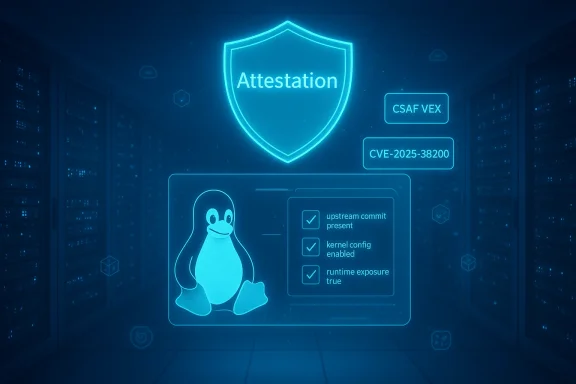
To determine whether a given Microsoft product includes a particular open‑source component (for example, the i40e driver and its associated MMIO handling code that the CVE tracks), three build‑time/runtime conditions must be true for practical exposure:- The upstream vulnerable commit or an unpatched equivalent must be present in the kernel sources used to build the artifact.
- The relevant code must be enabled in the kernel build (either built‑in or available as a module), determined by CONFIG_* flags and build-time configuration.
- The runtime environment must expose the code path to inputs that can trigger the flaw (hardware present, devices attached, or an input channel available to local code).
Why Azure Linux may be singled out — and why that doesn’t imply exclusivity
Microsoft began publishing machine‑readable CSAF/VEX attestations in a phased rollout (beginning October 2025), and Azure Linux was intentionally one of the early targets because it is a discrete, inventoryable product family with clear build outputs. The MSRC attestation therefore accomplishes two operational goals:- It tells Azure administrators what to patch immediately: Azure Linux images and kernel packages.
- It signals Microsoft’s commitment to publish more machine‑readable attestations and to expand mappings when further inventory work is completed.
Practical risk model for Microsoft customers
For IT teams asking “Do I need to worry about anything other than Azure Linux?” the honest answer is: maybe. The operational risk differs by artifact class.- High‑priority: Azure Linux images and kernel packages — MSRC attested these and they are the immediate remediation priority.
- Medium‑priority: Microsoft‑published WSL2 kernels and Windows images that rely on Microsoft’s kernel builds — these are plausible carriers and require verification of kernel config and commit provenance.
- Medium/low‑priority (depending on provisioning): Azure Marketplace images, AKS node images, or vendor‑curated marketplace appliances — may use upstream distribution kernels or Microsoft‑tuned kernels; verify the kernel version and applied patches.
- Low‑priority: Pure Windows components or closed‑source Windows services that do not ship Linux kernels — these are not relevant unless they embed or ship a Linux userland or kernel artifact.
How to verify whether a Microsoft-supplied artifact in your estate is affected
The path from uncertainty to evidence is straightforward but requires discipline and, sometimes, artifact access:- Inventory every Microsoft-provided Linux artifact you run.
- Azure Linux VMs and templates.
- Azure Marketplace image variants and golden images.
- WSL2 deployed kernels on developer machines.
- AKS/node pool images and managed node kernels.
- Any Microsoft-supplied container images that include kernel modules or initramfs artifacts.
- Appliance images and developer SDKs that may ship kernel artifacts.
- Capture exact build identifiers and kernel provenance.
- Record uname -a, package names and versions, and kernel package metadata.
- Where possible, obtain kernel build configs (the /proc/config.gz or the kernel .config distributed with the package) so you can verify CONFIG_* options.
- Map kernel versions to upstream fixing commits or stable backports.
- Identify the upstream commit(s) that fixed the CVE in question and check whether your kernel includes that commit or a backport. If you can’t locate the commit directly, consult the vendor/distro advisory for the fixed package version.
- Check whether the relevant driver/module is present and can be loaded.
- Use modinfo, lsmod, or examine /lib/modules/<version> for the module.
- If built‑in, a .config review will reveal that. Presence alone is insufficient — you must also confirm the code path can be exercised in the environment.
- Prioritize remediation based on exposure and exploitability.
- Local-only vectors or hardware‑exposed paths are lower risk in many cloud contexts, but still merit patching in multi‑tenant or unmanaged-host scenarios.
- Where a local or adjacent attacker can exercise the path, treat it as higher priority.
Concrete mitigation and remediation steps
- Patch first: Apply vendor‑provided kernel patches or deploy updated Azure Linux images as MSRC recommends. This is the fastest, most reliable remedy for attested Azure Linux images.
- For other artifacts, follow a triage workflow:
- Identify kernels that predate the upstream fix.
- Confirm whether the vulnerable driver is enabled and loadable.
- If the driver is not in use or can be blacklisted without impact, consider a temporary module blacklist as an interim mitigation.
- If disabling the driver is not feasible, schedule kernel updates or image rebuilds.
- Use SBOMs and machine‑readable VEX/CSAF where available to automate discovery. Microsoft’s phased VEX rollout aims to enable this automation over time; integrate those feeds into your vulnerability orchestration once they’re available.
- Monitor kernel logs and telemetry for symptom patterns described in upstream advisories (OOMs, WARN_ON traces, kernel oopses tied to specific drivers) to detect potential exploitation or instability early.
Why attackers might care — exploitability and realistic threat models
Most Linux kernel CVEs in device drivers are local in nature: they require either local code execution, privileged tooling, or direct access to device channels (for example, a NIC or USB modem). For the class of bugs that includes i40e MMIO miswrites, exploitation often requires:- A local process with access to the driver interface or
- A misconfigured virtualization or passthrough environment that exposes the vulnerable interface to tenant code, or
- An attacker-controlled peripheral (e.g., a malicious device that triggers an out‑of‑bounds MMIO write) in hosted or co‑located scenarios.
Strengths and limits of Microsoft’s current approach (critical analysis)
Strengths- Actionable attestation: Microsoft’s Azure Linux statement gives Azure customers a high‑confidence remediation target, which reduces ambiguity and improves response speed for a large class of users.
- Move toward automation: Publishing CSAF/VEX machine‑readable attestations is the right approach to scale inventory and allow automated orchestration of patching and mitigations. Microsoft’s public commitment to publish and expand these attestations is an important transparency win.
- Focused priorities: By attesting artifacts it has fully inventoried, Microsoft avoids making inaccurate broad claims and gives system owners a defensible action list.
- Phased coverage leaves gaps: The attestation program is necessarily phased; until it covers more artifacts, customers with mixed Microsoft‑supplied images or WSL deployments must do manual verification. The absence of an attestation is not proof of absence.
- Many artifact types to check: Microsoft ships kernels in multiple forms (Azure Linux, WSL2, Marketplace images, AKS node images, appliance kernels). Each is a distinct artifact and must be checked individually, creating a significant operational burden for large estates.
- Backport complexity: Vendors often backport fixes into older kernel branches; determining whether a specific kernel includes a backport requires more than just checking version numbers — it requires mapping to upstream commits or trusting vendor advisories. That mapping is non‑trivial and error‑prone if done manually.
Recommendations for defenders (priority checklist)
- Patch Azure Linux images and kernels immediately. Treat MSRC’s attestation as high‑priority actionable guidance.
- Create or refine an inventory specifically for Microsoft‑supplied artifacts:
- List WSL2 installations and which kernel binaries they use.
- Enumerate Azure Marketplace images and node images, including custom images your organization uses.
- Record kernel versions and build IDs for each artifact.
- Automate checks where possible:
- Use SBOMs and VEX/CSAF feeds as they become available.
- Integrate kernel version + commit mapping into vulnerability scanning tools.
- When immediate patching is not possible:
- Consider blacklisting modules or disabling interfaces, if safe.
- Apply host hardening to limit who can interact with device interfaces (capabilities, namespaces, seccomp).
- Insist on artifact attestations from vendors:
- If you rely on Marketplace or third‑party images, request SBOMs and vendor attestations that the images have been scanned and patched.
- Monitor logs and telemetry for driver‑specific failures and odd kernel traces that match upstream advisories.
Recommendations for vendors (what Microsoft and others should do next)
- Accelerate VEX/CSAF coverage: speed up the phased inventory to include WSL, Marketplace images, AKS node images, and any other artifacts that ship compiled kernels.
- Publish machine‑readable kernel provenance: where possible, include kernel config fragments, build IDs, and the exact upstream commit list for each distributed kernel binary.
- Offer pre‑baked “affected/not‑affected” checks for common artifacts: scripts or tooling customers can run to detect presence of known vulnerable commits or modules.
- Encourage marketplace publishers to supply SBOMs and attestations for any image that includes kernel packages or kernel modules.
- Provide clear mitigation recommendations in each CVE entry specific to the artifact classes Microsoft ships (Azure Linux vs WSL vs Marketplace).
A final, practical plain‑language answer to the user’s question
Is Azure Linux the only Microsoft product that includes the open‑source library and is therefore potentially affected by CVE‑2025‑38200 (i40e)? No — Azure Linux is the only Microsoft product Microsoft has publicly attested so far to include the implicated component, and that attestation is authoritative for Azure Linux images and kernels. However, that attestation is product‑scoped and not exclusive: other Microsoft artifacts (for example, WSL2 kernels, Marketplace VM images, AKS node images, and bespoke kernel images) could also include the same upstream code depending on build provenance and kernel configuration. Microsoft has committed to expanding CSAF/VEX attestations and to updating CVE mappings if more products are identified, but in the meantime defenders must perform artifact‑level discovery and remediation for any Microsoft‑provided artifacts they run.Conclusion
Microsoft’s attestation that “Azure Linux includes this open‑source library and is therefore potentially affected” is helpful, precise, and actionable — but it is not a universal safety guarantee for all Microsoft artifacts. The practical work for defenders is unchanged: patch Azure Linux now, inventory all Microsoft‑supplied Linux artifacts in your estate, verify kernel provenance and configuration, and remediate or mitigate any other artifacts that prove to carry the vulnerable code. Microsoft’s move to publish machine‑readable CSAF/VEX attestations is the right direction, and when the program matures it will materially reduce the manual burden on customers. Until then, treat the absence of an attestation as an operational unknown and prioritize evidence‑based verification across WSL, Marketplace images, AKS nodes, and any other Microsoft‑supplied kernels you run.Source: MSRC Security Update Guide - Microsoft Security Response Center
