

Microsoft’s brief MSRC advisory that “Azure Linux includes this open‑source library and is therefore potentially affected” is a precise, product‑scoped attestation — and it should be read as an authoritative signal for Azure Linux customers, not as proof that no other Microsoft product can include the same vulnerable code.
CVE‑2024‑43863 is a Linux kernel defect in the DRM vmwgfx driver that can produce a deadlock during dma‑buf fence polling. The upstream fix changes how fences are managed so that poll/wait callbacks and fence destruction do not deadlock while manipulating a shared pending‑fences list. The security impact is an availability problem (host or user‑space GPU‑using processes can hang), not a confidentiality or remote code‑execution primitive.
Microsoft’s MSRC entry for this CVE includes the sentence you quoted: it confirms that Microsoft has inspected the Azure Linux distribution build outputs and found the implicated open‑source component there, so Azure Linux images are potentially affected and should be remediated. Microsoft also announced a phased VEX/CSAF rollout that began in October 2025 to publish machine‑readable attestations of product status. That is the telemetry and attestation context behind the MSRC sentence.
That framing — useful and correct for Azure Linux operators — often prompts the operational question you asked: does Microsoft mean only Azure Linux can include the vulnerable library? The short, operational answer is: No — Azure Linux is the only Microsoft product Microsoft has publicly attested as a carrier for this CVE at the time of the advisory, but that attestation is product‑scoped and not a guarantee of exclusivity. Other Microsoft artifacts that ship or contain Linux kernels may still carry the same upstream code until they are individually inventoried and attested.
But that single phrase should not be read as a universal claim that Microsoft’s entire product portfolio is free of the component. Large vendors ship many distinct artifacts (WSL kernels, azure‑tuned kernels, Marketplace VM images, AKS node images, appliance kernels and so on), and each artifact is built separately and may include different kernel versions, configurations, and backports. Absence of a VEX/CSAF attestation for a given Microsoft artifact is therefore an absence of attestation, not proof of absence of the vulnerable code.
Action summary for defenders:
Source: MSRC Security Update Guide - Microsoft Security Response Center
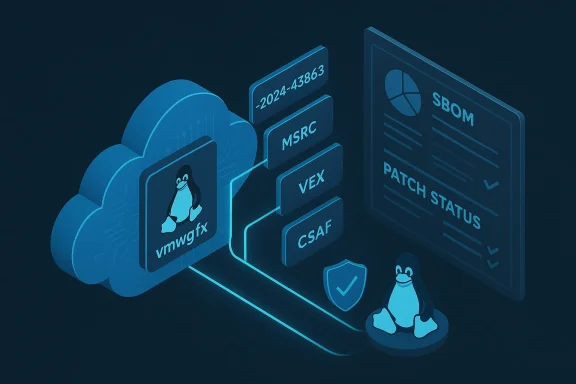 Background / Overview
CVE‑2024‑43863 is a Linux kernel defect in the DRM vmwgfx driver that can produce a deadlock during dma‑buf fence polling. The upstream fix changes how fences are managed so that poll/wait callbacks and fence destruction do not deadlock while manipulating a shared pending‑fences list. The security impact is an availability problem (host or user‑space GPU‑using processes can hang), not a confidentiality or remote code‑execution primitive.Microsoft’s MSRC entry for this CVE includes the sentence you quoted: it confirms that Microsoft has inspected the Azure Linux distribution build outputs and found the implicated open‑source component there, so Azure Linux images are potentially affected and should be remediated. Microsoft also announced a phased VEX/CSAF rollout that began in October 2025 to publish machine‑readable attestations of product status. That is the telemetry and attestation context behind the MSRC sentence.
That framing — useful and correct for Azure Linux operators — often prompts the operational question you asked: does Microsoft mean only Azure Linux can include the vulnerable library? The short, operational answer is: No — Azure Linux is the only Microsoft product Microsoft has publicly attested as a carrier for this CVE at the time of the advisory, but that attestation is product‑scoped and not a guarantee of exclusivity. Other Microsoft artifacts that ship or contain Linux kernels may still carry the same upstream code until they are individually inventoried and attested.
What the MSRC attestation actually means
Product‑scoped inventory, not universal exclusion
When MSRC says “Azure Linux includes this open‑source library and is therefore potentially affected,” they are describing the result of an inventory for a named product family — Azure Linux. In practice, that means Microsoft inspected Azure Linux build outputs (images, kernel packages, or both) and found the upstream vmwgfx code mapped to CVE‑2024‑43863. This is an authoritative, actionable signal for customers who run Azure Linux images.But that single phrase should not be read as a universal claim that Microsoft’s entire product portfolio is free of the component. Large vendors ship many distinct artifacts (WSL kernels, azure‑tuned kernels, Marketplace VM images, AKS node images, appliance kernels and so on), and each artifact is built separately and may include different kernel versions, configurations, and backports. Absence of a VEX/CSAF attestation for a given Microsoft artifact is therefore an absence of attestation, not proof of absence of the vulnerable code.
Why Microsoft started with Azure Linux
Microsoft deliberately began the machine‑readable VEX/CSAF rollout with Azure Linux (the distribution it maintains for some Azure images) because it is both a manageable, clearly scoped product and a high‑value target for customers who run Microsoft‑published images. The phased approach means Azure Linux gets early, high‑quality attestations and then Microsoft expands coverage to other products over time. That operational choice improves automation for Azure Linux customers while inventories for other product families are completed.Where the same vulnerable code could appear inside Microsoft’s ecosystem
Any Microsoft product that publishes or ships a Linux kernel binary or kernel‑based image can be a potential carrier if the kernel build used to create that artifact contains the vmwgfx driver and predates the upstream patch. Practical examples include:- Windows Subsystem for Linux (WSL2) kernel images distributed by Microsoft.
- Microsoft‑built or Azure‑tuned kernels (often packaged as linux‑azure) used for some VM SKUs.
- Azure Marketplace images and partner appliances distributed through Azure.
- AKS node images or curated container host images Microsoft supplies.
- Specialized platform services or VM images that embed or patch a kernel for compatibility/performance.
Technical summary of CVE‑2024‑43863 (brief, verifiable)
- Component: Linux kernel DRM driver vmwgfx (drivers/gpu/drm/vmwgfx).
- Vulnerability class: deadlock / improper locking between fence wait (poll) and fence destroy callbacks.
- Impact: local availability (system or GPU stalls/hangs), CVSS/impact ratings vary by tracker but the primary consequence is denial‑of‑service on affected hosts.
- Fix: upstream patch creates a fence ops variant that does not remove the fence from the pending list during release (avoids lock inversion) or otherwise adjusts lock ordering to eliminate the wait->destroy deadlock. Distributions and kernel vendors have backported or packaged those fixes.
Cross‑verification: what independent sources show
To ensure claims in this article are verifiable I cross‑checked the primary facts across multiple independent trackers and vendor pages:- Oracle Linux CVE entry summarises the defect, the deadlock scenario, severity and that vendor errata was produced.
- Aggregated vulnerability feeds (Feedly, Vulert and other CVE aggregators) record the same technical root cause and remediation posture.
- Microsoft’s VEX/CSAF blog post explains the October 2025 rollout and clarifies that Azure Linux is the starting product for machine‑readable attestations. That contextualizes the MSRC wording you quoted.
Practical risk assessment for defenders
Immediate priorities
- If you run Azure Linux images, treat them as confirmed in‑scope and apply Microsoft‑supplied kernel updates or vendor packages as soon as practicable. Microsoft’s attestation is an authoritative signal for those artifacts.
- For other Microsoft‑published artifacts in your environment (WSL images, Marketplace VMs, AKS nodes, linux‑azure kernels, etc.), assume “unknown until verified” and perform artifact‑level checks (see checklist below). Do not assume they are safe just because they are not yet attested in MSRC’s VEX records.
Likely blast radius and exposure model
- Hosts that expose GPU device nodes (/dev/dri/*) to multiple users, container workloads, or untrusted tenants are highest priority because dma‑buf fence polling is used in GPU sharing and some compositors.
- Single‑user desktops with a trusted user have lower operational priority, but server/workstation clusters used for CI, GPU training, or multi‑user desktops should be prioritized.
Artifact‑level verification checklist (practical steps)
- Inventory: enumerate all Microsoft‑supplied artifacts you run (Azure VM images, Marketplace appliances, WSL2 images, AKS node images, linux‑azure kernels). Use your asset inventory, cloud image manifests and orchestration metadata.
- SBOM / VEX consumption: ingest Microsoft’s CSAF/VEX attestations where available (start with the Azure Linux VEX files published after October 2025). Treat VEX as a prioritization tool, not the sole authority.
- Kernel version & config checks: on-a-host check /proc/version, uname -r, and /boot/config-* to identify kernel versions and whether vmwgfx or drm/vmwgfx code paths are present. If a kernel is older than the patched stable trees (or predates the specific upstream commit), mark it in‑scope.
- Module presence: check lsmod or modinfo vmwgfx; examine dmesg for vmwgfx lines. If the driver is not present or is explicitly compiled out, the artifact may be Not Affected for this CVE.
- Package mapping: for distro images, map the kernel package version to vendor advisories (Ubuntu USN, Red Hat CVE tracker, Oracle/ALAS) and install the vendor‑recommended package.
- Apply patches: follow vendor or Microsoft guidance to apply kernel updates or livepatches. Validate in staging workloads that GPU operations continue to function and monitor kernel logs for regressions.
Short‑term mitigations (when updates cannot be applied immediately)
- Restrict access to DRM device nodes (/dev/dri/*) through udev rules or permission changes to prevent untrusted processes from triggering the vulnerable path. This reduces attack surface but may break legitimate GPU workloads.
- Blacklist or unload the vmwgfx module on systems where GPU acceleration is not required. This prevents the code path from running but deprives the system of GPU functionality. Use with care.
- Use vendor livepatch services where available — some vendors provide kernel livepatches that avoid a full reboot. Validate the livepatch applies the correct upstream commit for CVE‑2024‑43863.
Detection guidance and indicators of compromise (availability‑focused)
- Monitor kernel logs (dmesg, journalctl) for DRM or vmwgfx‑related oopses, GPU resets, or repeated fence/wait traces. Those traces often include function names and backtraces that point to the DRM subsystem.
- Centralize kernel telemetry into your SIEM so you can query for vmwgfx / dma_buf / fence / poll keywords at scale and alert on repeated occurrences.
- Where feasible, schedule staged GPU workloads after patching to verify that workloads complete without new hangs or kernel oopses.
Strengths and limitations of Microsoft’s VEX/CSAF approach (analysis)
Strengths
- Machine‑readable attestations accelerate triage. VEX/CSAF enables automation: tools can ingest product‑level statements and mark images as Known Affected, Not Affected, Under Investigation, or Fixed — saving security teams time. Microsoft’s October 2025 VEX rollout is a positive step for transparency.
- Product‑level authoritativeness. When Microsoft says a product is affected, that is an authoritative signal that reduces guesswork for customers running that product (for example, Azure Linux).
Limitations and risks
- Phased rollout leaves blind spots. Microsoft began with Azure Linux; until other product families are inventoried and attested, many Microsoft artifacts will remain in the “unknown” state. That forces customers to do artifact‑level verification.
- Misinterpretation risk. Busy teams might read “Azure Linux includes this library” as “only Azure Linux includes this library.” That misreading delays necessary checks for WSL kernels, linux‑azure kernels, Marketplace images, and other artifacts.
- Operational complexity. Large organizations run many images and kernels; complete artifact inventory and SBOM correlation is nontrivial and requires investment in tooling and processes.
Recommended remediation playbook (step‑by‑step)
- Patch Azure Linux images immediately (follow Microsoft’s update guidance). Mark those images in your inventory as remediated when you deploy the update.
- Run an artifact discovery sweep across all Microsoft‑supplied artifacts in your environment: WSL kernels, Azure Marketplace images, linux‑azure kernels, AKS node images, partner appliances. Export kernel versions, config flags, and SBOMs where available.
- Cross‑reference discovered kernel builds with vendor advisories (Ubuntu USN, Oracle CVE pages, Red Hat advisories, etc.) to determine whether a fixed kernel package or backport exists for each artifact.
- Prioritize rollout: multi‑tenant and GPU‑attached hosts first, then shared workstations, then single‑user desktops. Use staged deployment and canary hosts to validate no regressions.
- Where immediate patching is impossible, deploy mitigations (device node restrictions, module blacklisting, or livepatch) and monitor for kernel oopses. Record compensating controls and timeline to full remediation.
- Consume Microsoft’s CSAF/VEX feed programmatically to update triage status when Microsoft publishes attestations for additional products. Use VEX to reduce false positives, but keep artifact verification as the guardrail.
What I could not verify and what to watch for
- Microsoft’s public attestation confirms Azure Linux as a carrier at the time the advisory was published. I cannot, from public attestations alone, prove whether other named Microsoft products (for example a specific Marketplace image SKU, a particular linux‑azure kernel build, or a given WSL2 kernel release) include the vulnerable vmwgfx code unless Microsoft publishes a VEX statement for those artifacts or the artifact is inspected directly. Treat those cases as “unknown until verified” and prioritize artifact‑level checks.
- Where vendors publish “Not Affected” or “Under Investigation” statuses in VEX, validate that the mapping was done against the exact artifact you run (same build ID, same package version or same signed kernel image). VEX statements are only as precise as the inventory they reference.
Conclusion
Microsoft’s sentence that “Azure Linux includes this open‑source library and is therefore potentially affected” is accurate and operationally valuable — it is an authoritative signal that Microsoft‑published Azure Linux images contain the vmwgfx code mapped to CVE‑2024‑43863 and should be patched. However, it is not a universal exclusion that other Microsoft products cannot contain the same vulnerable code. Any Microsoft artifact that ships a Linux kernel built from upstream sources predating the patch — and that enables or ships the vmwgfx driver — remains a potential carrier until Microsoft publishes a VEX attestation for it or you verify the artifact yourself.Action summary for defenders:
- Patch Azure Linux images immediately.
- Run artifact‑level discovery (SBOMs, kernel version and config checks) for all Microsoft‑distributed kernels and images in your environment.
- Use Microsoft’s CSAF/VEX feed to automate triage, but treat absence of a VEX attestation as unknown, not safe.
Source: MSRC Security Update Guide - Microsoft Security Response Center
