

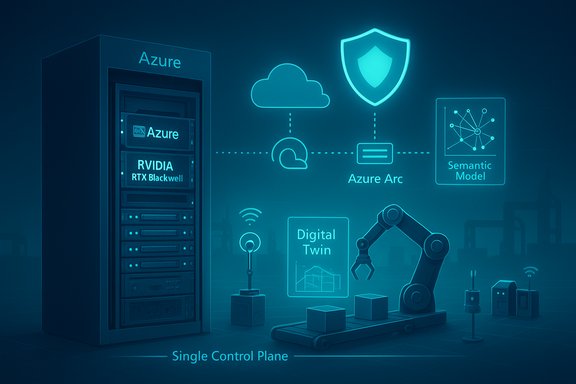
Microsoft’s latest push to bring AI, resiliency, and sovereignty together in a single, unified cloud story is more than incremental product updates — it’s a strategic pivot that gives organizations new choices for running mission‑critical systems where control, compliance, and uptime can't be sacrificed for innovation. The company’s expanded Azure Local offering, deeper Azure Arc controls, new IoT and Fabric integration points, and first‑party support for the latest NVIDIA Blackwell GPUs create a consistent platform for workloads that must remain under local operational control while still benefiting from Azure’s scale and services.
Background / Overview
Microsoft’s public messaging positions this work as an “adaptive cloud” approach: one platform that spans public regions, sovereign private clouds, and edge or disconnected footprints, giving customers flexible deployment models without the classic trade‑offs between innovation and governance. That means bringing advanced AI inference and GPU acceleration, unified management, and productivity tooling closer to customers’ physical environments — from factories and hospitals to government and defense installations — while preserving data residency, identity control, and continuity during network outages. The announcements cover three coordinated areas:- Localized infrastructure and sovereignty: Azure Local and Microsoft 365 Local for private, jurisdiction‑bound deployments.
- Edge and OT integration: improved Azure IoT Operations, Azure Device Registry, and Fabric integration for real‑time operational intelligence.
- Unified hybrid management: Azure Arc enhancements (site manager, multicloud connectors, workload identity, and fleet tooling) to operate a distributed estate from one control plane.
Azure Local and Microsoft 365 Local: sovereignty with scale
What Azure Local is delivering now
Azure Local consolidates Azure Stack HCI concepts into a flexible offering that Microsoft delivers and supports on customer‑owned hardware. Unlike classical “public cloud only” options, Azure Local lets organizations run Azure‑consistent APIs, selected Azure services, and Azure management tooling on premises — with options that expand from a few nodes on a factory floor up to large, multi‑rack clusters supporting hundreds of servers. Microsoft has also added SAN integration and multi‑rack support to increase scale and storage flexibility on Azure Local. Key operational updates announced or documented:- Increased Azure Local scale to support hundreds of servers in a single integrated instance (previously 16‑server clusters were typical).
- Storage Area Network (SAN) integration to let customers reuse on‑prem investments and meet local performance/residency needs.
- General Availability of Azure Migrate support for VMware → Azure Local migrations to streamline lift‑and‑shift projects and conserve networking, IP and compute settings during migration.
Microsoft 365 Local: productivity inside a private cloud
Microsoft announced Microsoft 365 Local to bring core productivity workloads (Exchange, SharePoint, Skype for Business Server) to Azure Local in a managed, sovereignty‑aware package. The intent is to allow organizations to run collaboration and communications inside a private cloud footprint — connected to Azure for management or fully disconnected for the strictest compliance scenarios — and to extend the same collaboration features without sending data outside controlled jurisdictional boundaries. Microsoft has characterized Microsoft 365 Local as generally available for connected modes and planning disconnected options for later rollouts. Why this matters- Government agencies and regulated enterprises can standardize on the same Microsoft productivity stack while maintaining local control.
- It simplifies modernization: instead of replatforming to new productivity tools, organizations can run familiar Microsoft workloads with Azure operational tooling.
GPU acceleration on premises — NVIDIA RTX PRO 6000 Blackwell Server Edition
A critical capability for on‑prem AI is modern GPU acceleration. Microsoft and NVIDIA’s partnership extends RTX PRO 6000 Blackwell Server Edition support into Azure Local, enabling high‑performance, local inferencing and rendering workloads in sovereign/private deployments. NVIDIA and ecosystem partners have published server‑grade Blackwell GPU specs and announced cloud provider availability; Microsoft’s Azure Local messaging and joint announcements indicate customers can access these GPUs (and validated OEM rack solutions) for local AI deployments. Implications:- Enables heavy AI inference and visual compute on‑site (e.g., real‑time video analysis in public safety, local model inferencing in healthcare or manufacturing).
- Makes it practical to keep sensitive data and inference inside a jurisdiction while still using modern accelerators.
Edge AI, IoT, and Fabric: bringing intelligence to physical operations
Azure IoT Operations and Device Registry
Microsoft is pushing deeper integration between IoT ingestion, device identity, and operational analytics:- Azure Device Registry (ADR) acts as a unified control plane for physical assets and device identities across IoT Hub and IoT Operations.
- Microsoft‑backed X.509 certificate management for ADR/IoT Hub (preview) gives teams an integrated, cloud‑hosted PKI to issue and rotate operational certificates at scale, removing a major on‑prem PKI operational burden. This feature is in preview and comes with region limits and preview caveats.
- WebAssembly‑powered data graphs for low‑latency, modular analytics close to the source.
- Expanded connectors for industrial protocols (OPC UA, ONVIF), REST, SSE and MQTT to simplify OT/IT integration.
- OpenTelemetry endpoint support for standardized telemetry pipelines and health monitoring, making operations observable and auditable.
Microsoft Fabric IQ and Digital Twin Builder
Microsoft Fabric’s new IQ semantic layer and the Digital Twin Builder are targeted at turning raw telemetry into context and actionable models. Fabric IQ supports ontology modeling and semantic graphs that give meaning to operational data, while Digital Twin Builder instantiates those models for simulation and “what‑if” analysis — a powerful combination when paired with IoT data for predictive maintenance, worker safety, and process simulation. These capabilities aim to shorten the gap between sensor data and decision‑ready intelligence. Practical benefits:- Operational teams can model assets and run agentic simulations before applying changes on the shop floor.
- Semantically consistent views help maintain a single source of truth across BI dashboards, agents, and control systems.
Azure Arc and the single control plane for distributed operations
Site manager, multicloud visibility, and management at scale
Azure Arc’s recent updates bring more physical‑site awareness into the Azure control plane. Azure Arc Site Manager (preview) allows administrators to group resources by physical site (store, factory, datacenter) to monitor connectivity, updates, and alerts across on‑prem and edge sites. This simplifies operations for teams managing large fleets of distributed infrastructure. Microsoft is also extending multicloud connectors so that Google Cloud Platform and other clouds can be projected into Azure management experiences for a single pane of glass — a familiar need for enterprises with heterogeneous cloud suppliers. Defender for Cloud and other Azure services already support GCP connectors; the Arc multicloud experience is the next logical step for unified governance.Identity, policies, and Kubernetes at scale
Several foundational features lower operational friction and harden security across hybrid estates:- Workload Identity for Azure Arc‑enabled Kubernetes lets clusters use Entra ID federated identities instead of local secrets, reducing secret sprawl and making policies auditable. This capability is documented and supports Entra‑federated workflows.
- AKS Fleet Manager (preview) provides centralized policy sync and multi‑cluster operations across AKS and Arc‑connected clusters, enabling controlled rollouts, inventory, and policy enforcement at fleet scale.
- Azure Key Vault Secret Store Extension (SSE) caches secrets from Key Vault into Arc‑enabled Kubernetes clusters for offline operation — critical for edge clusters that may be intermittently disconnected. SSE uses workload identity federation and is recommended for edge or semi‑disconnected clusters.
Migration, continuity, and disconnected operations
Azure Migrate support for Azure Local has reached GA for VMware migrations, enabling customers to lift and shift VMs into Azure Local with scripts to preserve IPs, PowerShell automation, and more. This significantly lowers migration friction for enterprises that must move entire datacenter workloads into Azure Local. Microsoft also emphasizes disconnected operations as a core capability for sovereign and critical workloads: customers can run fully disconnected Azure Local control planes and manage multiple local clusters from an on‑site control plane, which is being staged for GA in phased rollouts. This is essential for environments where network connectivity is either unreliable or intentionally severed for security reasons (e.g., defense, remote manufacturing sites). Operational takeaways:- Lift‑and‑shift migration tooling reduces upfront migration complexity and cost.
- Disconnected operations unlock business continuity and regulatory compliance use cases by enabling local control planes.
Strengths: what Microsoft is getting right
- Platform consistency: offering Azure APIs, management, and selected services across public cloud, Azure Local, and edge simplifies developer and operator experience. This reduces the need for separate tooling stacks and lowers integration risk.
- Sovereignty + AI acceleration: pairing NVIDIA Blackwell‑class GPUs with Azure Local gives regulated customers the ability to run advanced AI on premises without sacrificing performance. NVIDIA and Microsoft collaboration supports enterprise‑grade GPU hardware across OEM partners for validated solutions.
- Operational control and observability: Arc site manager, fleet controls, Workload Identity, and Secret Store extensions make it far easier to manage security, identity, and secrets across disconnected and hybrid estates.
- Bridging OT and IT: IoT Operations, ADR, and Fabric IQ bring industrial telemetry, semantic modeling and simulation into a flow that can deliver near‑real‑time decisions — a genuine advancement for asset‑intensive industries.
Risks, caveats, and what to validate before adoption
While the announcements are promising, practical adoption requires careful validation across several dimensions:- Preview feature constraints and region limits. Many capabilities (ADR certificate management, site manager, certain Fabric IQ features) are preview and have region or scale limitations today. Organizations must validate regional availability and the production readiness of preview features before relying on them for critical services. Do not assume preview = production ready.
- Operational ownership and support model. Azure Local runs on customer‑owned hardware with Microsoft‑supported software stacks. That model shifts day‑to‑day responsibilities to the customer or to a partner — clarity on SLA, on‑site support, and escalation paths is essential. Evaluate the vendor cataloged hardware configurations and the partner ecosystem for long‑term ops support.
- Hidden complexity in disconnected scenarios. Running fully disconnected local control planes solves sovereignty but introduces operational complexity (patching, backups, software updates, and incident response). Organizations must design robust operational playbooks, offline patch processes, and failover plans. Azure’s disconnected toolkit helps, but it does not remove operational discipline.
- Security surface and agentic automation. The move toward agent‑driven operations and fleet orchestration increases automation benefits — and the attack surface. Firms must enforce zero‑trust, least privilege for agents, short‑lived credentials, and robust audit trails to prevent automation from becoming a vector for escalation. Validate RBAC, logging, and evidence collection policies during pilots.
- Hardware procurement and lifecycle costs. Adding NVIDIA Blackwell GPUs to on‑prem deployments improves performance, but also raises power, cooling, and procurement complexity. Model TCO carefully: GPUs change refresh cycles and may require new rack designs and power provisioning. Consider cloud‑burstable patterns where appropriate.
- Third‑party integrations and vendor lock considerations. While Azure supports many OEM partners and connectors, integrating vendor management tools, OT systems, and local identity schemas requires careful planning to avoid lock‑in or a brittle dependency map.
Recommended adoption path for IT leaders
- Pilot in a constrained environment — choose a single site with clear SLAs (e.g., a factory line or a hospital imaging cluster). Validate Azure Local hardware, ADR + IoT Hub flows, and local inferencing with RTX PRO 6000 instances.
- Validate security and compliance controls — run compliance checks for data residency, review audit/logging retention, and simulate offline incident recovery with disconnected operations.
- Test migration and rollback — use Azure Migrate for VMware → Azure Local migration in a controlled sweep, validate IP retention, and test failback strategies.
- Scale incrementally with Arc management — add Azure Arc site manager and AKS Fleet Manager to centralize policies and fleet operations only after the first successful site go‑live.
- Engage partners for lifecycle ops — leverage validated hardware vendors and managed service partners for on‑site 24x7 coverage if internal teams lack expertise in GPU/datacenter lifecycle management.
The business case: when Azure’s adaptive cloud makes sense
Azure’s strategy is compelling where an organization needs:- Low latency and on‑site inferencing for safety or continuity (industrial control, public safety).
- Data residency and sovereignty combined with modern AI acceleration.
- Unified lifecycle and identity management across thousands of distributed sites with consistent policy enforcement.
- A migration path that avoids rearchitecting legacy workloads but modernizes management and observability.
Conclusion
Microsoft’s recent Azure updates stitch together three historically separate promises: on‑prem control, cloud‑scale AI, and single‑pane operations. The result is a practical, choice‑driven adaptive cloud that lets organizations modernize without surrendering sovereignty, continuity, or compliance. The engineering is real — from NVIDIA Blackwell GPU support in local clusters to richer IoT identity and Fabric IQ semantics — but successful adoption depends on rigorous pilots, attention to preview limits, careful operational design for disconnected scenarios, and realistic TCO modeling.For Windows and enterprise IT leaders, the new options mean a plausible path to bring advanced AI and modern cloud operations to the edge of the business — provided planning, governance, and partner selection are done with equal care.
Source: Microsoft Azure New options for AI-powered innovation, resiliency, and control with Microsoft Azure | Microsoft Azure Blog
