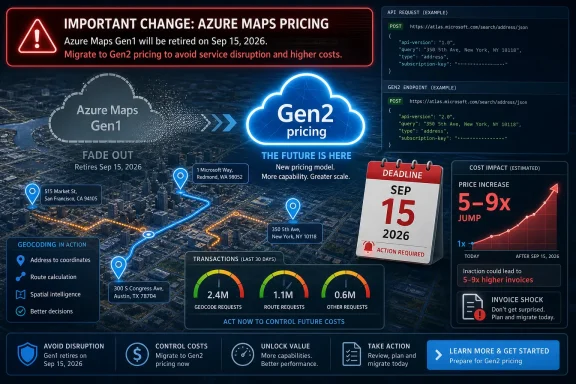
Microsoft will retire Azure Maps Gen1 pricing on September 15, 2026, automatically moving remaining Standard S0 and Standard S1 accounts to Gen2 pricing worldwide unless customers switch earlier, budget for the change, or migrate workloads to another mapping platform. The retirement is not new, but the bill shock is becoming real. For some low-volume and mid-volume customers, the move changes Azure Maps from a quiet utility line item into a budget conversation.
That is the uncomfortable part of this story: Microsoft is not shutting off Azure Maps, and Gen2 is not simply a price hike dressed as a product update. Gen2 also broadens access to Azure Maps features, simplifies the SKU model, and raises some query-per-second ceilings. But for organizations that adopted Gen1 S0 because it was cheap enough to disappear into the background, September 2026 is the date the background becomes foreground.
Azure Maps has always sat in a peculiar corner of Microsoft’s cloud portfolio. It is infrastructure, but it is not the infrastructure most Azure customers obsess over. It powers address lookup, routing, asset tracking, logistics dashboards, store locators, delivery tools, Power BI-style map experiences, and all the small pieces of location intelligence that tend to be built once and then forgotten.
That “forgotten” quality is exactly why this retirement matters. Pricing-tier changes are easy to miss when a service is not owned by a dedicated platform team. A web app may call a geocoding endpoint every time a user enters an address, a fleet app may calculate routes all day, or a customer portal may render map tiles without anyone thinking of it as a meaningful Azure dependency.
Microsoft’s Gen1 retirement schedule has been public for years. Gen1 was removed for new Azure Maps accounts in the Azure portal in September 2023, then removed from new ARM-template deployments in October 2023. The final step arrives on September 15, 2026, when remaining Gen1 accounts are automatically upgraded to Gen2.
That sequence matters because this is not a surprise deprecation dropped on customers with a 90-day fuse. It is a long runway. But a long runway does not prevent a hard landing if nobody in procurement, engineering, or finance knows the aircraft is still in the air.
That framing is powerful because it maps cleanly to simple workloads. A customer doing 100,000 geocoding-style transactions a month could move from about $50 monthly to about $450 monthly. A customer doing 1 million transactions a month could move from about $500 monthly to about $4,500 monthly before any discounts, credits, negotiated terms, or architectural changes are considered.
But cloud pricing is rarely a pure multiplication table. Azure Maps Gen2 uses volume-based pricing for some services, and Azure customers may sit under enterprise agreements, consumption commitments, private offers, or reseller arrangements that change the final bill. Gen2 also includes access to capabilities and limits that were not identical to Gen1 S0.
That does not make the warning alarmist. It makes it specific. The customers most exposed are not necessarily the largest enterprises with cloud-finance teams and negotiated Azure estates. The exposed group is the quiet middle: municipalities, SaaS vendors, logistics departments, insurance tools, facilities-management apps, and internal business systems that made a rational choice years ago and then stopped revisiting it.
That is understandable. It is also vendor logic. Customers do not experience simplification as an architectural diagram; they experience it as a bill.
The Gen1 S0 tier served an important purpose precisely because it was limited. It let developers and organizations add basic mapping capabilities without signing up for enterprise-grade geospatial economics. If the app needed simple geocoding, basic map rendering, or modest search usage, S0 could feel like the sensible bargain tier.
Gen2 collapses some of that distinction. Microsoft is effectively saying that Azure Maps should be consumed through the newer, more capable model. That may be cleaner for the platform, but it also means the old low-cost niche is closing.
This is a familiar cloud pattern. Providers launch approachable services, customers wire them into workflows, and years later the platform matures into fewer SKUs, newer APIs, stronger governance, and higher minimum economic expectations. The service gets better. The entry ramp gets steeper.
Cloud estates accumulate location calls in odd places. A CRM customization may validate addresses. A field-service tool may calculate travel distances. A retail site may show nearby stores. A reporting dashboard may render maps through embedded components. A data-quality job may geocode new customer records overnight.
Those workloads are easy to miss because they often do not break. They simply run. They consume transactions, generate Azure billing entries, and only become urgent when cost anomaly alerts start firing.
Administrators should treat this less like a pricing notice and more like a dependency-discovery exercise. The question is not merely, “Do we have Azure Maps accounts on Gen1?” It is, “Which business processes assume the old price of location intelligence?”
That distinction changes the timeline. If the answer is only a pricing-tier toggle, September 2026 is still comfortably far away. If the answer involves vendor evaluation, API translation, data-retention review, front-end map-control changes, regression testing, and procurement approval, the deadline is much closer than it looks.
Mapping platforms differ in obvious ways, such as price per geocode or route. They also differ in less obvious ways: rate limits, caching terms, data-retention rules, regional coverage, address-quality behavior, map styling, routing assumptions, fleet features, licensing restrictions, uptime guarantees, and the maturity of SDKs.
A geocoder is not just a geocoder when the business process depends on how it handles apartment numbers, rural routes, incomplete addresses, transliteration, or rooftop-level precision. A routing API is not interchangeable when delivery windows, toll avoidance, truck restrictions, or traffic models affect real-world operations.
That is why the least useful migration plan is the one that begins with a price table and ends with a vendor logo. The right evaluation begins with workload shape. Are calls interactive or batch? Are addresses stored permanently or only used transiently? Is the application global or regional? Does the customer need maps, geocoding, routing, traffic, weather, spatial analytics, or all of the above?
Some organizations may discover that Azure Maps Gen2 remains the best answer despite the higher bill. Others may find that a specialist provider fits better. Still others may decide the right fix is not a provider switch, but caching, batching, throttling, or redesigning a user flow that currently burns transactions unnecessarily.
Azure Maps is often part of the Microsoft stack by gravity. A .NET application, SQL-backed workflow, Power Platform project, Windows-based dispatch system, or Azure-hosted line-of-business app may use Azure Maps because procurement, identity, monitoring, and deployment were already in Microsoft’s orbit. The choice may have been less “we selected a mapping vendor” than “we used the map service that was already there.”
That is exactly why the retirement deserves attention from sysadmins and IT managers rather than only developers. The people who maintain Windows Server workloads, Azure subscriptions, Entra access, and departmental apps may be the only ones positioned to notice the dependency before finance notices the bill.
There is also a security and governance angle. Location data can be sensitive. Switching providers may change where data is processed, how long it can be stored, which contractual terms apply, and which compliance reviews are needed. A hasty migration in August 2026 could create more risk than simply accepting the Gen2 bill.
The better path is inventory first, architecture second, procurement third. Reversing that order is how organizations end up with emergency rewrites and awkward exception approvals.
The old model of service lifecycle management was built around operating systems, Office versions, server products, and hardware refresh cycles. The cloud model is more granular. A pricing tier can retire. An API version can retire. A software development kit can retire. A map-rendering endpoint can retire. None of those events feels as dramatic as end of support for Windows, but each can break an assumption inside a production system.
This is where Microsoft’s own tooling and notifications help, but they do not replace ownership. Azure Advisor-style retirement recommendations, service health notices, and portal warnings are useful only if someone is responsible for reading them, routing them, and turning them into funded work.
The governance question for Azure customers is no longer “Are our servers patched?” It is “Do we know which managed-service assumptions expire this year?” Azure Maps Gen1 is a clean example because the service continues to exist after the deadline. The failure mode is not outage. It is surprise cost.
That makes it harder to prioritize. Outages win attention immediately. Silent cost increases require discipline.
The first step is to export usage data and understand transaction mix. A workload dominated by geocoding may have a different answer from one dominated by map tiles, routing, weather, or search autocomplete. Monthly averages are useful, but peak behavior matters too because rate limits and user experience can matter as much as total spend.
The second step is to build a Gen2 cost model using actual usage rather than guesses. That model should include free monthly allowances, volume discounts where applicable, enterprise agreement effects, and expected growth through 2027. A cost increase that looks tolerable today may look different if the product team plans to double usage next year.
The third step is to identify technical coupling. If Azure Maps is accessed through a clean abstraction layer, switching providers may be manageable. If Azure Maps calls are scattered through front-end code, server functions, stored procedures, and reporting jobs, the migration cost rises quickly.
Only then does vendor evaluation become meaningful. The cheapest provider on paper may be expensive if its API semantics force a rewrite. The incumbent may be expensive per transaction but cheaper overall if staying avoids risk.
If an organization needs to secure 2027 budget, the analysis cannot wait until September. If it needs to run a procurement process, legal review, data-protection assessment, or pilot migration, the practical deadline may be late spring or early summer. If it ships software to customers, the deployment window may be narrower still.
There is also a communications problem. A department owner may see no issue with a $400 monthly increase. A SaaS provider with thousands of tenants may see a material margin change. A public-sector customer may need formal approval for a new vendor even if the technical migration is simple. The same pricing change can be trivial, painful, or strategic depending on who pays and who owns the application.
That is why OnTerra’s warning lands even though it is also vendor marketing. The company has a commercial interest in consulting and migration work, but the underlying message is sound: doing nothing is the one option that guarantees the least control.
That is the uncomfortable part of this story: Microsoft is not shutting off Azure Maps, and Gen2 is not simply a price hike dressed as a product update. Gen2 also broadens access to Azure Maps features, simplifies the SKU model, and raises some query-per-second ceilings. But for organizations that adopted Gen1 S0 because it was cheap enough to disappear into the background, September 2026 is the date the background becomes foreground.
 Microsoft’s Map Cleanup Has Reached the Invoice
Azure Maps has always sat in a peculiar corner of Microsoft’s cloud portfolio. It is infrastructure, but it is not the infrastructure most Azure customers obsess over. It powers address lookup, routing, asset tracking, logistics dashboards, store locators, delivery tools, Power BI-style map experiences, and all the small pieces of location intelligence that tend to be built once and then forgotten.That “forgotten” quality is exactly why this retirement matters. Pricing-tier changes are easy to miss when a service is not owned by a dedicated platform team. A web app may call a geocoding endpoint every time a user enters an address, a fleet app may calculate routes all day, or a customer portal may render map tiles without anyone thinking of it as a meaningful Azure dependency.
Microsoft’s Gen1 retirement schedule has been public for years. Gen1 was removed for new Azure Maps accounts in the Azure portal in September 2023, then removed from new ARM-template deployments in October 2023. The final step arrives on September 15, 2026, when remaining Gen1 accounts are automatically upgraded to Gen2.
That sequence matters because this is not a surprise deprecation dropped on customers with a 90-day fuse. It is a long runway. But a long runway does not prevent a hard landing if nobody in procurement, engineering, or finance knows the aircraft is still in the air.
The 9x Number Is Real Enough to Hurt, Even If It Is Not the Whole Story
The headline figure being pushed by OnTerra Systems is stark: geocoding under Gen1 S0 at about $0.50 per 1,000 transactions versus roughly $4.50 per 1,000 under Gen2. On the narrow comparison of certain transaction types, that is a ninefold per-unit increase. In percentage language, it is an 800 percent increase over the old unit price.That framing is powerful because it maps cleanly to simple workloads. A customer doing 100,000 geocoding-style transactions a month could move from about $50 monthly to about $450 monthly. A customer doing 1 million transactions a month could move from about $500 monthly to about $4,500 monthly before any discounts, credits, negotiated terms, or architectural changes are considered.
But cloud pricing is rarely a pure multiplication table. Azure Maps Gen2 uses volume-based pricing for some services, and Azure customers may sit under enterprise agreements, consumption commitments, private offers, or reseller arrangements that change the final bill. Gen2 also includes access to capabilities and limits that were not identical to Gen1 S0.
That does not make the warning alarmist. It makes it specific. The customers most exposed are not necessarily the largest enterprises with cloud-finance teams and negotiated Azure estates. The exposed group is the quiet middle: municipalities, SaaS vendors, logistics departments, insurance tools, facilities-management apps, and internal business systems that made a rational choice years ago and then stopped revisiting it.
Gen2 Is Microsoft’s Simplification Play, Not a Gift
Microsoft’s stated argument for Gen2 is straightforward: one newer pricing tier, broader feature availability, better flexibility, and higher QPS limits than the constrained S0 tier in several areas. From a product-management point of view, this is the classic cloud-service cleanup. Fewer legacy tiers mean easier documentation, easier support, easier capacity planning, and fewer edge cases.That is understandable. It is also vendor logic. Customers do not experience simplification as an architectural diagram; they experience it as a bill.
The Gen1 S0 tier served an important purpose precisely because it was limited. It let developers and organizations add basic mapping capabilities without signing up for enterprise-grade geospatial economics. If the app needed simple geocoding, basic map rendering, or modest search usage, S0 could feel like the sensible bargain tier.
Gen2 collapses some of that distinction. Microsoft is effectively saying that Azure Maps should be consumed through the newer, more capable model. That may be cleaner for the platform, but it also means the old low-cost niche is closing.
This is a familiar cloud pattern. Providers launch approachable services, customers wire them into workflows, and years later the platform matures into fewer SKUs, newer APIs, stronger governance, and higher minimum economic expectations. The service gets better. The entry ramp gets steeper.
The Real Risk Is Not Migration, It Is Discovery
The obvious response is to tell Azure Maps customers to check their pricing tier. That is correct, but insufficient. The harder task is finding every application, script, integration, dashboard, and internal workflow that depends on Azure Maps in the first place.Cloud estates accumulate location calls in odd places. A CRM customization may validate addresses. A field-service tool may calculate travel distances. A retail site may show nearby stores. A reporting dashboard may render maps through embedded components. A data-quality job may geocode new customer records overnight.
Those workloads are easy to miss because they often do not break. They simply run. They consume transactions, generate Azure billing entries, and only become urgent when cost anomaly alerts start firing.
Administrators should treat this less like a pricing notice and more like a dependency-discovery exercise. The question is not merely, “Do we have Azure Maps accounts on Gen1?” It is, “Which business processes assume the old price of location intelligence?”
That distinction changes the timeline. If the answer is only a pricing-tier toggle, September 2026 is still comfortably far away. If the answer involves vendor evaluation, API translation, data-retention review, front-end map-control changes, regression testing, and procurement approval, the deadline is much closer than it looks.
The Alternatives Are Not Drop-In Clones
OnTerra’s release points customers toward alternatives such as Google Maps Platform, HERE Technologies, and other geospatial providers. That is fair advice, but “evaluate alternatives” can sound easier than it is.Mapping platforms differ in obvious ways, such as price per geocode or route. They also differ in less obvious ways: rate limits, caching terms, data-retention rules, regional coverage, address-quality behavior, map styling, routing assumptions, fleet features, licensing restrictions, uptime guarantees, and the maturity of SDKs.
A geocoder is not just a geocoder when the business process depends on how it handles apartment numbers, rural routes, incomplete addresses, transliteration, or rooftop-level precision. A routing API is not interchangeable when delivery windows, toll avoidance, truck restrictions, or traffic models affect real-world operations.
That is why the least useful migration plan is the one that begins with a price table and ends with a vendor logo. The right evaluation begins with workload shape. Are calls interactive or batch? Are addresses stored permanently or only used transiently? Is the application global or regional? Does the customer need maps, geocoding, routing, traffic, weather, spatial analytics, or all of the above?
Some organizations may discover that Azure Maps Gen2 remains the best answer despite the higher bill. Others may find that a specialist provider fits better. Still others may decide the right fix is not a provider switch, but caching, batching, throttling, or redesigning a user flow that currently burns transactions unnecessarily.
The Windows Angle Is the Boring Software Nobody Budgets For
For WindowsForum readers, the temptation is to file this under “Azure billing,” not Windows. That would miss where these services actually show up.Azure Maps is often part of the Microsoft stack by gravity. A .NET application, SQL-backed workflow, Power Platform project, Windows-based dispatch system, or Azure-hosted line-of-business app may use Azure Maps because procurement, identity, monitoring, and deployment were already in Microsoft’s orbit. The choice may have been less “we selected a mapping vendor” than “we used the map service that was already there.”
That is exactly why the retirement deserves attention from sysadmins and IT managers rather than only developers. The people who maintain Windows Server workloads, Azure subscriptions, Entra access, and departmental apps may be the only ones positioned to notice the dependency before finance notices the bill.
There is also a security and governance angle. Location data can be sensitive. Switching providers may change where data is processed, how long it can be stored, which contractual terms apply, and which compliance reviews are needed. A hasty migration in August 2026 could create more risk than simply accepting the Gen2 bill.
The better path is inventory first, architecture second, procurement third. Reversing that order is how organizations end up with emergency rewrites and awkward exception approvals.
Microsoft’s Retirement Calendar Is Becoming a Governance Test
Azure Maps Gen1 is not retiring in isolation. September 2026 is crowded with Azure and Microsoft service retirements, API changes, and legacy component deadlines. That is normal for a cloud platform at Microsoft’s scale, but it changes the job of IT governance.The old model of service lifecycle management was built around operating systems, Office versions, server products, and hardware refresh cycles. The cloud model is more granular. A pricing tier can retire. An API version can retire. A software development kit can retire. A map-rendering endpoint can retire. None of those events feels as dramatic as end of support for Windows, but each can break an assumption inside a production system.
This is where Microsoft’s own tooling and notifications help, but they do not replace ownership. Azure Advisor-style retirement recommendations, service health notices, and portal warnings are useful only if someone is responsible for reading them, routing them, and turning them into funded work.
The governance question for Azure customers is no longer “Are our servers patched?” It is “Do we know which managed-service assumptions expire this year?” Azure Maps Gen1 is a clean example because the service continues to exist after the deadline. The failure mode is not outage. It is surprise cost.
That makes it harder to prioritize. Outages win attention immediately. Silent cost increases require discipline.
The Smart Move Is to Model Before You Migrate
Organizations should resist the reflex to treat this as an automatic reason to leave Azure Maps. A ninefold unit-price increase is dramatic, but a migration has its own cost. Engineering time, testing, procurement, vendor risk, legal review, and operational retraining all belong in the comparison.The first step is to export usage data and understand transaction mix. A workload dominated by geocoding may have a different answer from one dominated by map tiles, routing, weather, or search autocomplete. Monthly averages are useful, but peak behavior matters too because rate limits and user experience can matter as much as total spend.
The second step is to build a Gen2 cost model using actual usage rather than guesses. That model should include free monthly allowances, volume discounts where applicable, enterprise agreement effects, and expected growth through 2027. A cost increase that looks tolerable today may look different if the product team plans to double usage next year.
The third step is to identify technical coupling. If Azure Maps is accessed through a clean abstraction layer, switching providers may be manageable. If Azure Maps calls are scattered through front-end code, server functions, stored procedures, and reporting jobs, the migration cost rises quickly.
Only then does vendor evaluation become meaningful. The cheapest provider on paper may be expensive if its API semantics force a rewrite. The incumbent may be expensive per transaction but cheaper overall if staying avoids risk.
September 15 Is a Deadline, But the Invoice Arrives Later
One subtle danger in this kind of retirement is psychological. September 15, 2026 sounds like the action date. In practice, the meaningful date for many organizations is earlier, because budgeting and approval cycles will decide what is possible.If an organization needs to secure 2027 budget, the analysis cannot wait until September. If it needs to run a procurement process, legal review, data-protection assessment, or pilot migration, the practical deadline may be late spring or early summer. If it ships software to customers, the deployment window may be narrower still.
There is also a communications problem. A department owner may see no issue with a $400 monthly increase. A SaaS provider with thousands of tenants may see a material margin change. A public-sector customer may need formal approval for a new vendor even if the technical migration is simple. The same pricing change can be trivial, painful, or strategic depending on who pays and who owns the application.
That is why OnTerra’s warning lands even though it is also vendor marketing. The company has a commercial interest in consulting and migration work, but the underlying message is sound: doing nothing is the one option that guarantees the least control.
The Calendar Gives Azure Maps Customers One Last Quiet Quarter
There is still enough time for a disciplined response, but not enough time for complacency. The organizations that handle this well will treat the retirement as a forcing function to understand their location workloads, not merely as a Microsoft price change.- Azure Maps Gen1 Standard S0 and Standard S1 pricing is scheduled to retire on September 15, 2026.
- Remaining Gen1 accounts are expected to move automatically to Gen2 if customers do not act before the deadline.
- Some Gen1 S0 geocoding-style workloads may see per-transaction pricing rise from about $0.50 to about $4.50 per 1,000 transactions.
- Gen2 may still be the right choice for customers that need broader Azure Maps features, higher limits, Microsoft ecosystem integration, or volume discounts.
- Migration decisions should account for API behavior, licensing terms, caching rules, address quality, routing needs, compliance, and engineering cost.
- The most urgent task is to inventory actual Azure Maps usage and model the Gen2 bill before procurement and migration windows close.
References
- Primary source: The Manila Times
Published: Mon, 22 Jun 2026 12:09:24 GMT
Azure Maps Gen1 Pricing Customers To Be Migrated To Gen2 Pricing in September 2026, A 9x Cost Increase | The Manila Times
OnTerra Systems Urges Organizations to Evaluate Options Now Before the September 15 Auto-Migration Deadline www.manilatimes.net
- Official source: learn.microsoft.com
Retirement Announcement -- Azure Maps Gen1 Price Tier - Microsoft Q&A
Azure Maps Gen1 (Standard S0 and Standard S1) Price Tier will be retired on 15 September 2026, please transition to Azure Maps Gen2 Price Tier by that date. Gen2 Price Tier, which offers simplified pricing, better flexibility in accessing all Azure…learn.microsoft.com - Official source: azure.microsoft.com
- Related coverage: epcgroup.net
Azure Maps Pricing 2026: Free Tier Limits + PAYG Real Costs
Azure Maps pricing, features, real-time mapping, geospatial services, route + traffic + weather APIs — enterprise decision guide.www.epcgroup.net - Official source: azure-int.microsoft.com
- Official source: techcommunity.microsoft.com
- Related coverage: onterrasystems.com
Azure Maps Price Increase Options | OnTerra Systems
Explore Azure Maps Price Increase Options re the Sept 2026 Gen1 to Gen2 pricing change. OnTerra Systems offers consulting and migration services. www.onterrasystems.com
- Related coverage: location.arcgis.com
Pricing | ArcGIS Location Platform
location.arcgis.com
- Related coverage: oreateai.com
- Related coverage: syncfusion.com
Getting Started with Azure Maps | Azure Maps Using Blazor Succinctly
Explore Getting Started with Azure Maps from the free Azure Maps Using Blazor Succinctly ebook, featuring instant online access for a seamless reading experience.www.syncfusion.com - Related coverage: whitepaperb2b.com