

Microsoft’s recent partner activity points to a familiar enterprise strategy: make Azure, Microsoft 365, Entra and Fabric the control plane beneath industry-specific AI deployments rather than treating Copilot as a standalone product.
A Simply Wall St report published July 13 grouped several recent integrations spanning identity, workplace management, health products, channel delivery and telecom. The individual announcements are more useful than the investor framing: they show where Microsoft services are being embedded into business workflows that IT teams will ultimately have to secure, govern and support.
1Kosmos said on July 9 that it had expanded its Microsoft relationship as an Entra Verified ID services and solution partner. Its platform uses identity-document checks and biometric verification to issue verifiable credentials through Microsoft Entra Verified ID, with use cases including remote onboarding, account recovery and anti-fraud controls.
For Entra administrators, that is a reminder that identity proofing is becoming part of the access stack, not merely an HR process. Bringing third-party verification into onboarding can reduce manual checks, but it also adds a vendor, credential lifecycle and privacy review to the process. Organizations should establish who can approve identity-proofing policy changes, where biometric data is processed, and how failed or disputed verifications are handled.
In workplace operations, Microsoft lists VergeSense as a Microsoft Places integration partner. VergeSense combines real-time occupancy signals with Microsoft Places data, enabling room-booking automations and space-use analytics. That can improve the accuracy of office availability shown to employees, but workplace sensor data needs the same governance attention as other employee-related telemetry.
The practical significance is less about another licensing channel and more about implementation capacity. Microsoft’s agentic AI pitch increasingly depends on partners that can connect productivity data, identity, endpoint security and line-of-business systems, then operate the result. That work is where deployment projects can become difficult: agents need scoped permissions, auditable actions, data-loss controls and a clear owner when an automated workflow fails.
Haleon’s five-year collaboration with Microsoft, announced June 29, follows the same pattern. The consumer-health company plans to expand its Microsoft 365 Copilot use alongside agentic AI, security and identity services for functions including research, marketing, supply chain and commercial operations. Haleon said its program includes governance and threat protection for AI-enabled workflows.
That is a useful example of Fabric’s role in the current Microsoft stack: not just reporting, but a data foundation for vertical applications that can feed AI systems. It also raises familiar operational questions around data residency, access boundaries and whether a vendor-built model has sufficient monitoring before it is allowed to influence production decisions.
None of these deals changes the day-to-day Windows client roadmap, and most are partner announcements rather than new Microsoft product releases. But they reinforce that Windows and Microsoft 365 environments are increasingly the endpoint layer for AI systems whose control, identity and data planes sit in Microsoft’s cloud.
Admins should expect more requests to connect third-party AI services to Entra, Microsoft 365 and Fabric, and should require architecture and governance reviews before those connections reach production.
A Simply Wall St report published July 13 grouped several recent integrations spanning identity, workplace management, health products, channel delivery and telecom. The individual announcements are more useful than the investor framing: they show where Microsoft services are being embedded into business workflows that IT teams will ultimately have to secure, govern and support.
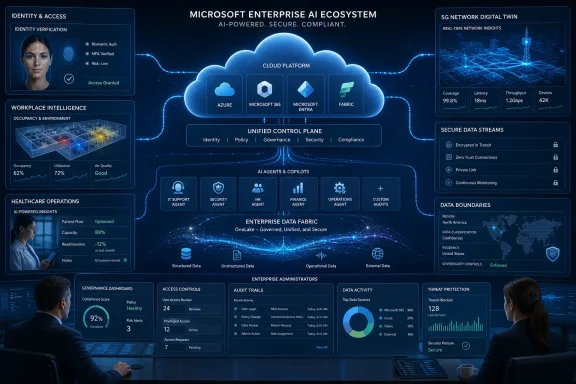 Identity and workplace data move closer to the tenant
1Kosmos said on July 9 that it had expanded its Microsoft relationship as an Entra Verified ID services and solution partner. Its platform uses identity-document checks and biometric verification to issue verifiable credentials through Microsoft Entra Verified ID, with use cases including remote onboarding, account recovery and anti-fraud controls.For Entra administrators, that is a reminder that identity proofing is becoming part of the access stack, not merely an HR process. Bringing third-party verification into onboarding can reduce manual checks, but it also adds a vendor, credential lifecycle and privacy review to the process. Organizations should establish who can approve identity-proofing policy changes, where biometric data is processed, and how failed or disputed verifications are handled.
In workplace operations, Microsoft lists VergeSense as a Microsoft Places integration partner. VergeSense combines real-time occupancy signals with Microsoft Places data, enabling room-booking automations and space-use analytics. That can improve the accuracy of office availability shown to employees, but workplace sensor data needs the same governance attention as other employee-related telemetry.
Partners are the deployment engine
Insight Enterprises announced July 1 that it will sell Microsoft 365 E7, Microsoft’s Frontier Suite, and deploy it internally across its workforce of more than 14,000 people. The company is also a launch partner for Microsoft Agent 365.The practical significance is less about another licensing channel and more about implementation capacity. Microsoft’s agentic AI pitch increasingly depends on partners that can connect productivity data, identity, endpoint security and line-of-business systems, then operate the result. That work is where deployment projects can become difficult: agents need scoped permissions, auditable actions, data-loss controls and a clear owner when an automated workflow fails.
Haleon’s five-year collaboration with Microsoft, announced June 29, follows the same pattern. The consumer-health company plans to expand its Microsoft 365 Copilot use alongside agentic AI, security and identity services for functions including research, marketing, supply chain and commercial operations. Haleon said its program includes governance and threat protection for AI-enabled workflows.
Azure and Fabric broaden beyond office work
Microsoft’s telecommunications blog highlighted Tech Mahindra’s 5G Network Digital Twin, built on Azure and Fabric. The system is intended to unify network data, simulate scenarios and support optimization, service assurance and autonomous operations.That is a useful example of Fabric’s role in the current Microsoft stack: not just reporting, but a data foundation for vertical applications that can feed AI systems. It also raises familiar operational questions around data residency, access boundaries and whether a vendor-built model has sufficient monitoring before it is allowed to influence production decisions.
None of these deals changes the day-to-day Windows client roadmap, and most are partner announcements rather than new Microsoft product releases. But they reinforce that Windows and Microsoft 365 environments are increasingly the endpoint layer for AI systems whose control, identity and data planes sit in Microsoft’s cloud.
Admins should expect more requests to connect third-party AI services to Entra, Microsoft 365 and Fabric, and should require architecture and governance reviews before those connections reach production.
References
- Primary source: simplywall.st
Published: 2026-07-13T14:30:06.360000+00:00
Microsoft (MSFT) Is Turning Partner Integrations Into A Bigger Enterprise AI Footprint - Simply Wall St News
Microsoft is expanding its enterprise AI ecosystem through recent integrations with partners including RESAAS, 1Kosmos, and VergeSense. New collaborations with Insight Enterprises and Haleon aim to bring Microsoft's agentic AI and productivity tools to more corporate users. A partnership...simplywall.st - Related coverage: investor.insight.com
Insight Enterprises, Inc. - Insight to Offer Microsoft 365 E7 AI-Powered Frontier Suite to Market, Leading by Example with Its Own Enterprise-Wide Deployment
With 91% Microsoft 365 Copilot adoption across its global workforce, Insight is deploying Microsoft’s Frontier Suite enterprise-wide while simultaneously offering clients its AI, Security and agent solutions Insight Enterprises (NASDAQ: NSIT) today announced it has signed an agreement to...investor.insight.com
