

Microsoft has added public-preview Pre-Upgrade Validation Checks to Azure Database for PostgreSQL flexible server, giving administrators a way to test major-version upgrade readiness in the Azure portal before committing to the actual upgrade operation. That sounds like a small workflow improvement. It is really Microsoft admitting that the scariest part of managed database upgrades is not the button press, but the uncertainty that surrounds it. For production PostgreSQL estates, the new feature turns a once-reactive failure point into a planning artifact.
The promise of a managed database has always carried an awkward footnote: the cloud provider can operate the platform, but it cannot fully understand the application sitting on top of it. Azure can patch the host, manage backups, expose high availability, and orchestrate an in-place upgrade. It cannot magically know whether a particular extension, replication slot, trigger, object dependency, or stale configuration choice will behave nicely when PostgreSQL crosses a major-version boundary.
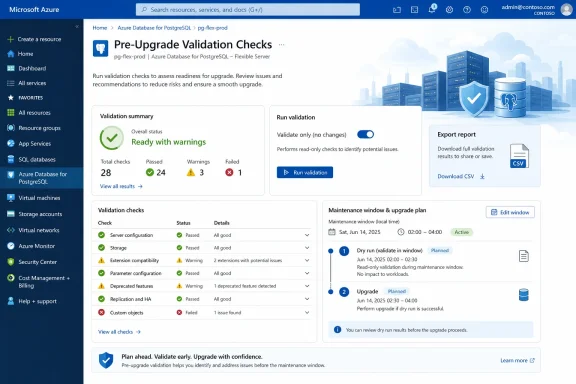
Pre-Upgrade Validation Checks are Microsoft’s attempt to move that reckoning out of the maintenance window. Instead of discovering upgrade blockers after a production workflow has already begun, administrators can run checks independently, review the results, fix the issues, and run them again. The actual upgrade remains a separate step.
That separation matters. In enterprise IT, a failed upgrade is rarely just a technical inconvenience. It can mean an application outage, a missed change window, a rollback scramble, and a bruising postmortem in which the database team gets asked why a known incompatibility was not known sooner.
The new Azure feature does not eliminate those risks. It does something more modest and more useful: it makes some of them visible before the clock starts.
Major releases can change internal catalogs, planner behavior, extension compatibility, authentication expectations, and assumptions baked into application-side SQL. Even if the database engine itself is healthy, the surrounding ecosystem can turn a routine upgrade into a delicate operation. Extensions are especially important because PostgreSQL’s strength — its extensibility — is also one of the things that complicates upgrades.
Azure Database for PostgreSQL flexible server already performs prechecks during the in-place major-version upgrade workflow. The problem was timing. If the meaningful diagnostic step occurs only after the upgrade process begins, then the administrator has already entered the most expensive part of the change: the reserved window, the coordinated teams, the business expectation that downtime will be short, and the pressure to decide quickly whether to remediate or abandon.
The public-preview validation feature changes that posture. It lets teams run many of the same readiness checks without starting the upgrade itself. In practical terms, Microsoft is giving database administrators a dry run that is not merely a checklist but a service-aware inspection of the actual server.
For a small shop, this may just mean one fewer unpleasant surprise. For a larger organization, it changes how upgrade governance can work. A database team can produce validation results ahead of a change advisory board meeting. Application owners can be told exactly which blockers need remediation. Security and compliance teams can see that a production upgrade is not being approached as an act of faith.
That is the real operational value. Cloud consoles often compress complex infrastructure decisions into cheerful buttons, but enterprises run on evidence. A validation report that can be reviewed, exported, compared, and rerun is more useful than a generic assurance that the managed service knows what it is doing.
Microsoft’s addition of downloadable validation results also points in that direction. A CSV is not glamorous, but it fits the way real IT organizations work. It can be attached to a ticket, archived for audit, compared across environments, or handed to the application team that owns the incompatible object.
On the Azure side, the server must be in a suitable state, with no conflicting operation already in progress. The service also needs enough room and connectivity to perform the work it orchestrates around the engine. Azure’s major-version upgrade guidance has long warned that free storage matters, because upgrade activity can generate temporary files and metadata churn.
On the PostgreSQL side, the familiar upgrade hazards appear. Unsupported extensions can block the process. Logical replication slots may need to be removed and recreated. Event triggers can reference internals that change between versions. Views, large objects, PostGIS settings, and object dependencies can all introduce their own brand of fragility.
The feature also incorporates engine-level validation using PostgreSQL’s own upgrade-checking capabilities. That is important because Microsoft’s managed-service logic should not be treated as a substitute for PostgreSQL’s native understanding of its catalog and upgrade mechanics. The stronger approach is the layered one: Azure checks what Azure controls, and PostgreSQL checks what PostgreSQL knows best.
This matters because the feature is aimed squarely at production planning while not yet carrying the psychological weight of a mature, generally available control. Teams should use it, but they should not confuse a clean validation result with a full upgrade guarantee. A preflight check can reduce uncertainty; it cannot abolish it.
Microsoft’s own limitations reinforce the point. Validation checks are not supported on read replicas. They cannot run while another server operation is already underway. They require connectivity to all databases on the server, and inaccessible databases can cause validation failures. Microsoft also recommends running them during lower-activity periods even though they do not initiate downtime or restart the server.
Those constraints are not disqualifying. They are a reminder that validation is itself an operational action. It belongs in the runbook, not as an afterthought fired off five minutes before the maintenance window begins.
But PostgreSQL itself remains PostgreSQL. Applications still depend on schemas, extensions, triggers, custom functions, authentication assumptions, and operational habits that the provider cannot simply abstract away. A managed service can remove some categories of work, but it cannot remove accountability for application compatibility.
Pre-Upgrade Validation Checks make that bargain more honest. Microsoft is not pretending that major-version upgrades are risk-free because the service is managed. It is instead acknowledging that customers need a structured way to surface blockers before the provider-led workflow reaches the point of no easy return.
That is a healthier posture for cloud infrastructure. The best managed services do not hide complexity so thoroughly that it reappears only during an outage. They expose the right complexity at the right time, with enough context for customers to act.
Azure Database for PostgreSQL flexible server currently spans multiple PostgreSQL generations, and Microsoft’s documentation emphasizes that major releases bring features while minor releases deliver backward-compatible fixes. In practice, enterprises often delay major upgrades until security pressure, vendor support timelines, or application modernization forces the issue. The longer they wait, the more intimidating the leap becomes.
A validation-only workflow helps lower that psychological barrier. Teams can test readiness months ahead of a deadline. They can discover that an extension must be removed, a configuration parameter needs attention, or an application dependency has to be rewritten while there is still time to negotiate the change.
This is not merely convenience. It is a form of lifecycle management. The easier Microsoft makes it to understand upgrade readiness, the harder it becomes for customers to justify indefinite version drift.
For administrators, that means validation results should not be read as a scolding from Azure. They are a map of technical debt. If a production workload depends on an extension that complicates upgrades, the organization needs to decide whether that dependency is worth the operational cost.
That decision is not always obvious. Extensions such as PostGIS can be central to the application’s value. Others may have been introduced years ago for a migration, a reporting workaround, or a performance experiment and then forgotten. Pre-upgrade validation has a way of revealing which parts of a database estate are actively designed and which parts are archaeological.
The feature’s best use may be in non-production environments first. Running validation against development, test, staging, and then production servers can reveal whether environments have drifted apart. If staging validates cleanly but production does not, the upgrade conversation has already uncovered a governance problem that extends beyond PostgreSQL.
Azure’s in-place upgrade model is attractive because it retains the server name and avoids changing application connection strings. Compared with migration-based approaches, it can be faster and operationally simpler. But the process still has downtime, and administrators still need a maintenance window that reflects the size and complexity of the database.
Large databases, many objects, heavy extension usage, long-running transactions, and high workload before the upgrade can all affect the duration. High availability configurations add their own orchestration concerns because the service must manage the primary and standby topology around the upgrade process. A validation check can identify blockers, but it cannot turn a complex estate into a simple one.
That distinction matters for how IT teams communicate with the business. The right message is not “Azure checked it, so there is no risk.” The right message is “Azure checked for known blockers, we remediated them, and the remaining risk is understood and bounded.”
Large Azure estates do not run by portal clicks alone. They run through infrastructure-as-code pipelines, deployment gates, ticketing workflows, and operational dashboards. If pre-upgrade validation remains only a manual portal step, it will still help. If it becomes a repeatable control in broader upgrade automation, it becomes more powerful.
Even without turning this announcement into a tooling forecast, the direction is clear. Cloud providers are increasingly expected to expose operational readiness signals as machine-readable artifacts, not just human-readable warnings. A downloadable result is a start; policy-driven upgrade readiness is where mature organizations will want to end up.
For WindowsForum’s audience of sysadmins and IT pros, this is the familiar arc of management tooling. First a console adds a button. Then teams discover they need the same capability in scripts, pipelines, reports, and governance gates. The button is the announcement; the operational pattern is the story.
That makes Azure Database for PostgreSQL an increasingly relevant service for Windows-centric administrators. The application might be built by a cloud-native team, deployed through GitHub or Azure DevOps, monitored in Azure Monitor, authenticated through Microsoft Entra, and consumed by users who only see a Windows desktop client or a browser. The database is still part of the operational blast radius.
For sysadmins, the lesson is not that everyone must become a PostgreSQL internals expert overnight. It is that managed open-source services still need lifecycle discipline. Version upgrades, extension audits, replication dependencies, and backup strategies are not optional just because the server lives behind an Azure resource blade.
The validation feature gives Windows-heavy IT departments a more approachable handle on that discipline. It translates PostgreSQL upgrade complexity into Azure-native checks and actionable recommendations. That is exactly the kind of bridge mixed-platform teams need.
That instinct is understandable and sometimes rational. But it is also how estates drift into unsupported versions, missed security improvements, and increasingly painful modernization projects. The longer an organization avoids routine upgrades, the more each upgrade becomes a major event.
Pre-Upgrade Validation Checks are designed to reduce that fear by replacing unknowns with findings. An unsupported extension is not good news, but it is better news on a Tuesday afternoon than during a Saturday night outage window. A blocked validation result is not a failure of the upgrade plan; it is the plan doing its job early.
This is where Microsoft’s feature is more strategic than it looks. It does not merely improve one Azure portal workflow. It encourages a healthier upgrade culture: validate early, remediate deliberately, and treat the final maintenance window as execution rather than discovery.
 Microsoft Moves the Failure Earlier in the Calendar
The promise of a managed database has always carried an awkward footnote: the cloud provider can operate the platform, but it cannot fully understand the application sitting on top of it. Azure can patch the host, manage backups, expose high availability, and orchestrate an in-place upgrade. It cannot magically know whether a particular extension, replication slot, trigger, object dependency, or stale configuration choice will behave nicely when PostgreSQL crosses a major-version boundary.Pre-Upgrade Validation Checks are Microsoft’s attempt to move that reckoning out of the maintenance window. Instead of discovering upgrade blockers after a production workflow has already begun, administrators can run checks independently, review the results, fix the issues, and run them again. The actual upgrade remains a separate step.
That separation matters. In enterprise IT, a failed upgrade is rarely just a technical inconvenience. It can mean an application outage, a missed change window, a rollback scramble, and a bruising postmortem in which the database team gets asked why a known incompatibility was not known sooner.
The new Azure feature does not eliminate those risks. It does something more modest and more useful: it makes some of them visible before the clock starts.
PostgreSQL Upgrades Are Simple Until They Are Not
PostgreSQL’s major-version upgrades have a reputation for being both mature and unforgiving. The underlyingpg_upgrade tooling is well established, and in many environments it works cleanly. But the gulf between “the engine supports this upgrade path” and “this specific production server can be upgraded safely tonight” is where administrators earn their salaries.Major releases can change internal catalogs, planner behavior, extension compatibility, authentication expectations, and assumptions baked into application-side SQL. Even if the database engine itself is healthy, the surrounding ecosystem can turn a routine upgrade into a delicate operation. Extensions are especially important because PostgreSQL’s strength — its extensibility — is also one of the things that complicates upgrades.
Azure Database for PostgreSQL flexible server already performs prechecks during the in-place major-version upgrade workflow. The problem was timing. If the meaningful diagnostic step occurs only after the upgrade process begins, then the administrator has already entered the most expensive part of the change: the reserved window, the coordinated teams, the business expectation that downtime will be short, and the pressure to decide quickly whether to remediate or abandon.
The public-preview validation feature changes that posture. It lets teams run many of the same readiness checks without starting the upgrade itself. In practical terms, Microsoft is giving database administrators a dry run that is not merely a checklist but a service-aware inspection of the actual server.
The New Button Is Less Important Than the New Boundary
The Azure portal workflow is deliberately simple. Administrators open the flexible server, navigate to the upgrade experience, choose a target PostgreSQL version, and select the option to validate only. That phrasing is important because it draws a hard boundary between assessing readiness and changing the system.For a small shop, this may just mean one fewer unpleasant surprise. For a larger organization, it changes how upgrade governance can work. A database team can produce validation results ahead of a change advisory board meeting. Application owners can be told exactly which blockers need remediation. Security and compliance teams can see that a production upgrade is not being approached as an act of faith.
That is the real operational value. Cloud consoles often compress complex infrastructure decisions into cheerful buttons, but enterprises run on evidence. A validation report that can be reviewed, exported, compared, and rerun is more useful than a generic assurance that the managed service knows what it is doing.
Microsoft’s addition of downloadable validation results also points in that direction. A CSV is not glamorous, but it fits the way real IT organizations work. It can be attached to a ticket, archived for audit, compared across environments, or handed to the application team that owns the incompatible object.
The Checks Target the Places Upgrades Usually Bleed
The validation process looks at both Azure-specific and PostgreSQL-specific readiness. That dual lens is necessary because a managed database upgrade can fail for reasons that belong to the cloud platform, the database engine, or the customer’s own configuration.On the Azure side, the server must be in a suitable state, with no conflicting operation already in progress. The service also needs enough room and connectivity to perform the work it orchestrates around the engine. Azure’s major-version upgrade guidance has long warned that free storage matters, because upgrade activity can generate temporary files and metadata churn.
On the PostgreSQL side, the familiar upgrade hazards appear. Unsupported extensions can block the process. Logical replication slots may need to be removed and recreated. Event triggers can reference internals that change between versions. Views, large objects, PostGIS settings, and object dependencies can all introduce their own brand of fragility.
The feature also incorporates engine-level validation using PostgreSQL’s own upgrade-checking capabilities. That is important because Microsoft’s managed-service logic should not be treated as a substitute for PostgreSQL’s native understanding of its catalog and upgrade mechanics. The stronger approach is the layered one: Azure checks what Azure controls, and PostgreSQL checks what PostgreSQL knows best.
Public Preview Means Useful, Not Finished
There is a temptation to treat any preview feature in Azure as either a production gift or a production warning. The better reading is more boring: public preview means the capability is available for real evaluation, but administrators should still pay attention to support boundaries, regional availability, documentation changes, and edge-case behavior.This matters because the feature is aimed squarely at production planning while not yet carrying the psychological weight of a mature, generally available control. Teams should use it, but they should not confuse a clean validation result with a full upgrade guarantee. A preflight check can reduce uncertainty; it cannot abolish it.
Microsoft’s own limitations reinforce the point. Validation checks are not supported on read replicas. They cannot run while another server operation is already underway. They require connectivity to all databases on the server, and inaccessible databases can cause validation failures. Microsoft also recommends running them during lower-activity periods even though they do not initiate downtime or restart the server.
Those constraints are not disqualifying. They are a reminder that validation is itself an operational action. It belongs in the runbook, not as an afterthought fired off five minutes before the maintenance window begins.
The Managed Database Bargain Gets More Honest
Azure Database for PostgreSQL is sold, reasonably, as a way to run PostgreSQL without managing the underlying servers. Microsoft handles infrastructure operations such as backups, maintenance, scaling options, security integrations, and platform availability. That is the managed-service bargain.But PostgreSQL itself remains PostgreSQL. Applications still depend on schemas, extensions, triggers, custom functions, authentication assumptions, and operational habits that the provider cannot simply abstract away. A managed service can remove some categories of work, but it cannot remove accountability for application compatibility.
Pre-Upgrade Validation Checks make that bargain more honest. Microsoft is not pretending that major-version upgrades are risk-free because the service is managed. It is instead acknowledging that customers need a structured way to surface blockers before the provider-led workflow reaches the point of no easy return.
That is a healthier posture for cloud infrastructure. The best managed services do not hide complexity so thoroughly that it reappears only during an outage. They expose the right complexity at the right time, with enough context for customers to act.
The Feature Also Nudges Customers Toward Staying Current
There is another layer to this announcement: Microsoft has an interest in making upgrades feel less dangerous. PostgreSQL’s release cadence keeps moving, and cloud providers do not want large populations of customers lingering on older major versions because the upgrade process feels like a trap.Azure Database for PostgreSQL flexible server currently spans multiple PostgreSQL generations, and Microsoft’s documentation emphasizes that major releases bring features while minor releases deliver backward-compatible fixes. In practice, enterprises often delay major upgrades until security pressure, vendor support timelines, or application modernization forces the issue. The longer they wait, the more intimidating the leap becomes.
A validation-only workflow helps lower that psychological barrier. Teams can test readiness months ahead of a deadline. They can discover that an extension must be removed, a configuration parameter needs attention, or an application dependency has to be rewritten while there is still time to negotiate the change.
This is not merely convenience. It is a form of lifecycle management. The easier Microsoft makes it to understand upgrade readiness, the harder it becomes for customers to justify indefinite version drift.
Extension Compatibility Remains the Sharp Edge
PostgreSQL extensions deserve special attention because they are often where Azure’s managed-service polish meets the messy reality of open-source database ecosystems. An extension may be perfectly valid for normal operation and still block an in-place major-version upgrade. Others may need to be dropped and recreated. Some may not be supported on a target version at all.For administrators, that means validation results should not be read as a scolding from Azure. They are a map of technical debt. If a production workload depends on an extension that complicates upgrades, the organization needs to decide whether that dependency is worth the operational cost.
That decision is not always obvious. Extensions such as PostGIS can be central to the application’s value. Others may have been introduced years ago for a migration, a reporting workaround, or a performance experiment and then forgotten. Pre-upgrade validation has a way of revealing which parts of a database estate are actively designed and which parts are archaeological.
The feature’s best use may be in non-production environments first. Running validation against development, test, staging, and then production servers can reveal whether environments have drifted apart. If staging validates cleanly but production does not, the upgrade conversation has already uncovered a governance problem that extends beyond PostgreSQL.
The Downtime Story Is About Predictability, Not Magic
Microsoft’s message naturally emphasizes reduced failed upgrades and fewer unexpected disruptions. That is fair, but it should not be oversold. Pre-Upgrade Validation Checks do not make a major-version upgrade online, invisible, or inherently reversible. They make it more predictable.Azure’s in-place upgrade model is attractive because it retains the server name and avoids changing application connection strings. Compared with migration-based approaches, it can be faster and operationally simpler. But the process still has downtime, and administrators still need a maintenance window that reflects the size and complexity of the database.
Large databases, many objects, heavy extension usage, long-running transactions, and high workload before the upgrade can all affect the duration. High availability configurations add their own orchestration concerns because the service must manage the primary and standby topology around the upgrade process. A validation check can identify blockers, but it cannot turn a complex estate into a simple one.
That distinction matters for how IT teams communicate with the business. The right message is not “Azure checked it, so there is no risk.” The right message is “Azure checked for known blockers, we remediated them, and the remaining risk is understood and bounded.”
The Portal Workflow Is Only the Front Door
The Petri report frames the Azure portal path because that is where many administrators will first encounter the feature. The portal experience is important, especially for teams that need a quick and visible way to start validating upgrade readiness. But the deeper value will come when this kind of preflight thinking becomes part of automation.Large Azure estates do not run by portal clicks alone. They run through infrastructure-as-code pipelines, deployment gates, ticketing workflows, and operational dashboards. If pre-upgrade validation remains only a manual portal step, it will still help. If it becomes a repeatable control in broader upgrade automation, it becomes more powerful.
Even without turning this announcement into a tooling forecast, the direction is clear. Cloud providers are increasingly expected to expose operational readiness signals as machine-readable artifacts, not just human-readable warnings. A downloadable result is a start; policy-driven upgrade readiness is where mature organizations will want to end up.
For WindowsForum’s audience of sysadmins and IT pros, this is the familiar arc of management tooling. First a console adds a button. Then teams discover they need the same capability in scripts, pipelines, reports, and governance gates. The button is the announcement; the operational pattern is the story.
Windows Shops Should Care Even If PostgreSQL Is Not Their First Language
PostgreSQL may not have the same historical gravity in Windows environments as SQL Server, but that distinction has been eroding for years. Modern Microsoft shops routinely run mixed database estates across Azure SQL, SQL Server, PostgreSQL, Cosmos DB, and open-source components pulled in by application teams. The old one-vendor database monoculture is not the default anymore.That makes Azure Database for PostgreSQL an increasingly relevant service for Windows-centric administrators. The application might be built by a cloud-native team, deployed through GitHub or Azure DevOps, monitored in Azure Monitor, authenticated through Microsoft Entra, and consumed by users who only see a Windows desktop client or a browser. The database is still part of the operational blast radius.
For sysadmins, the lesson is not that everyone must become a PostgreSQL internals expert overnight. It is that managed open-source services still need lifecycle discipline. Version upgrades, extension audits, replication dependencies, and backup strategies are not optional just because the server lives behind an Azure resource blade.
The validation feature gives Windows-heavy IT departments a more approachable handle on that discipline. It translates PostgreSQL upgrade complexity into Azure-native checks and actionable recommendations. That is exactly the kind of bridge mixed-platform teams need.
The Real Competitor Is Fear of Change
Cloud platforms often compete on performance, price, availability zones, and feature checklists. For database services, there is another competitor that rarely appears in marketing copy: the fear of touching a working production system. Every experienced administrator knows the instinct. If the database is stable, and the upgrade might break it, the upgrade can wait.That instinct is understandable and sometimes rational. But it is also how estates drift into unsupported versions, missed security improvements, and increasingly painful modernization projects. The longer an organization avoids routine upgrades, the more each upgrade becomes a major event.
Pre-Upgrade Validation Checks are designed to reduce that fear by replacing unknowns with findings. An unsupported extension is not good news, but it is better news on a Tuesday afternoon than during a Saturday night outage window. A blocked validation result is not a failure of the upgrade plan; it is the plan doing its job early.
This is where Microsoft’s feature is more strategic than it looks. It does not merely improve one Azure portal workflow. It encourages a healthier upgrade culture: validate early, remediate deliberately, and treat the final maintenance window as execution rather than discovery.
The New Preflight Checklist for Azure PostgreSQL Teams
The practical message for administrators is straightforward: do not wait until a forced upgrade deadline or a support lifecycle cliff to try this. Treat validation as an early signal and rerun it whenever the environment changes materially. A clean report today is useful; a pattern of clean reports across time is better.- Administrators can now run major-version upgrade readiness checks for Azure Database for PostgreSQL flexible server without starting the actual upgrade.
- The checks look for Azure service conditions and PostgreSQL compatibility issues that commonly block or complicate in-place upgrades.
- The feature is in public preview, so teams should use it as a planning aid while still respecting documented limitations and support boundaries.
- Validation results should be attached to change records and used to drive remediation before production maintenance windows are scheduled.
- A successful validation reduces known risk, but it does not eliminate the need for backups, testing, performance planning, and rollback strategy.
- The most mature use of the feature will be repeated validation across non-production and production environments, not a single last-minute portal click.
References
- Primary source: Petri IT Knowledgebase
Published: Wed, 10 Jun 2026 15:03:38 GMT
Azure Database for PostgreSQL Adds Pre-Upgrade Validation Checks
Microsoft introduces pre‑upgrade validation checks for Azure Database for PostgreSQL to detect compatibility/configuration issues before upgrades. petri.com
- Official source: azure.microsoft.com
Azure Database for PostgreSQL | Microsoft Azure
Explore Azure Database for PostgreSQL, an AI-ready fully managed service to build, scale, and secure intelligent apps with open-source PostgreSQL.azure.microsoft.com
- Official source: learn.microsoft.com
Major Version Upgrades - Azure Database for PostgreSQL | Microsoft Learn
Learn how to use Azure Database for PostgreSQL to do in-place major version upgrades of PostgreSQL on a server.learn.microsoft.com - Related coverage: redmondmag.com
Microsoft Adds Pre-Upgrade Validation Checks for Azure Database for PostgreSQL -- Redmondmag.com
New capability aims to help organizations identify issues before database upgrades and reduce deployment risk.redmondmag.com - Official source: techcommunity.microsoft.com
Major Version Upgrade in Azure PostgreSQL Flexible Server - Generally Available | Microsoft Community Hub
Today, we are proud to announce General Availability of major version upgrade feature, making it easier for customers to upgrade their... techcommunity.microsoft.com
- Related coverage: docs.azure.cn
Major Version Upgrades - Azure Database for PostgreSQL | Azure Docs
Learn how to use Azure Database for PostgreSQL to do in-place major version upgrades of PostgreSQL on a server.docs.azure.cn
- Related coverage: azurelook.com
[In preview] Public Preview: In-place major version upgrade to PostgreSQL 17 on Azure Database for PostgreSQL flexible server - Azure Look
You can now upgrade your Azure Database for PostgreSQL flexible server instance to PostgreSQL 17 using a simple, in-place upgrade—now available in public preview. This release allows you to move from previous PostgreSQL versions (14, 15, or 16) to Postgreazurelook.com - Related coverage: azure-rbac-catalog.org
Microsoft.DBforPostgreSQL/flexibleServers/majorVersionUpgradePrecheck/read - Azure RBAC Control Plane Operation | Permissions
Microsoft.DBforPostgreSQL/flexibleServers/majorVersionUpgradePrecheck/read Azure RBAC action. Lists the Major Version Upgrade Precheck Operations Performed. See all Azure built-in roles that grant this permission.azure-rbac-catalog.org - Official source: cdn-dynmedia-1.microsoft.com
1153537012
A young doctor and an elderly patient are indoors at the woman's home. The doctor is talking to the woman while holding a tablet computer. They're both smiling.cdn-dynmedia-1.microsoft.com
