

Microsoft’s latest push turns PostgreSQL on Azure from a reliable cloud RDBMS into a full-fledged platform for AI-ready applications — and it’s doing so across three fronts: developer ergonomics, in-database AI capabilities, and a new, scale-out service aimed at AI-native workloads. The announcements at Ignite and accompanying documentation deliver a coherent vision: bring models, vectors, and agent tooling closer to where your data lives so teams can build smarter apps faster — but they also raise questions about security, operational complexity, and vendor trade-offs that every engineering leader should weigh before committing mission-critical systems.
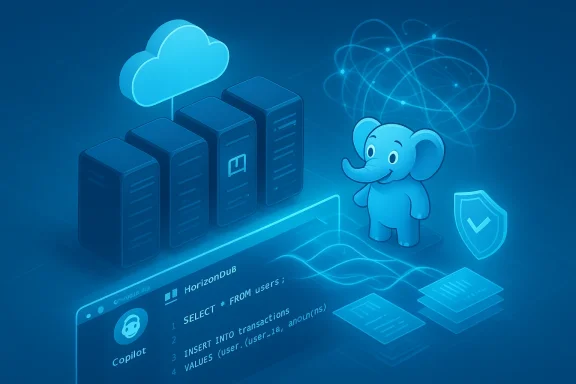
PostgreSQL has been the default choice for many developers for years thanks to its extensibility and predictable behavior. Microsoft is amplifying that momentum on Azure by combining upstream open-source contributions, new managed-service capabilities, and tighter integration with its AI ecosystem — notably Microsoft Foundry and GitHub Copilot in the IDE. These changes span incremental service improvements (PostgreSQL 18 support, new V6 compute SKUs, Parquet support) and a bolder product: Azure HorizonDB, a PostgreSQL-compatible, cloud-native database designed for scale-out, ultra‑low latency, and built-in AI features.
Why this matters: developers can scaffold schema changes, generate queries, and test model-driven flows inside the same environment where they write application code. That reduces context switching and shortens the loop from idea to prototype.
However, if your team requires strict model portability, likes to control every layer of ML infra, or operates under conservative regulatory constraints where agentic access is risky, you should proceed deliberately: prototype, measure, and validate security postures before broad adoption. The feature set is powerful, but power demands governance.
Microsoft’s vision for PostgreSQL on Azure is ambitious and developer-friendly: tightly integrating AI primitives, provisioning, and agent protocols into the data layer removes architectural friction and accelerates use-case delivery. The work is already tangible — from Parquet support and DiskANN in flexible servers to MCP-based Foundry integrations and the HorizonDB preview — and it aligns with real customer scenarios like Nasdaq’s Boardvantage modernization. But this is also a moment for careful engineering judgment. As teams welcome reduced latency and fewer components, they must simultaneously harden governance, validate performance claims against representative loads, and design for portability where business risk requires it.
Postgres remains the place to build — and Microsoft is betting that bringing AI into the database will make that choice even more compelling. The immediate takeaway for engineers: experiment now, gate agent access strictly, and benchmark broadly — because the tools to build the future of intelligent apps are finally arriving inside the database itself.
Source: Microsoft Azure PostgreSQL on Azure supercharged for AI | Microsoft Azure Blog
 Background
PostgreSQL has been the default choice for many developers for years thanks to its extensibility and predictable behavior. Microsoft is amplifying that momentum on Azure by combining upstream open-source contributions, new managed-service capabilities, and tighter integration with its AI ecosystem — notably Microsoft Foundry and GitHub Copilot in the IDE. These changes span incremental service improvements (PostgreSQL 18 support, new V6 compute SKUs, Parquet support) and a bolder product: Azure HorizonDB, a PostgreSQL-compatible, cloud-native database designed for scale-out, ultra‑low latency, and built-in AI features. What Microsoft announced — the essentials
- A renewed emphasis on Azure as a first-class place to run PostgreSQL, with managed PostgreSQL and a new service, Azure HorizonDB, aimed at AI workloads. HorizonDB is being offered in a limited preview with scale-out compute and promises of sub-millisecond commit latency for multi-zone deployments.
- Deeper developer tooling: a PostgreSQL extension for Visual Studio Code that can provision managed instances, plus tighter GitHub Copilot integration that surfaces schema-aware SQL help and performance diagnostics in the IDE.
- In-database AI building blocks: native connections to Microsoft Foundry via a Model Context Protocol (MCP) server, built-in vector indexing (DiskANN), SQL access to embeddings and LLM invocations, and direct read/write support for Parquet using the azure_storage extension for zero‑ETL analytics.
- Performance and scale improvements on the managed PostgreSQL service: GA support for PostgreSQL 18 (bringing asynchronous I/O, faster vacuuming, and smarter planning), new V6 compute SKUs, and Elastic Clusters for horizontal scaling.
- Continuing open-source investment: Microsoft highlights its position as a major upstream contributor to PostgreSQL, citing hundreds of commits to the latest release as part of a broader community commitment. Independent Microsoft posts document substantial authoring and review activity during the Postgres‑18 development cycle.
Overview: a developer-first stack for AI on Postgres
Start in the IDE: VS Code + Copilot + Postgres extension
Microsoft is betting that developers will prefer to provision and manage cloud databases directly from their editor. The PostgreSQL extension for Visual Studio Code now supports provisioning of managed Azure PostgreSQL instances, with built-in Entra ID authentication and Azure Monitor integration. Paired with GitHub Copilot, which Microsoft says can use schema context to generate and optimize SQL, the idea is to collapse several friction points: code, schema, and performance feedback — all in a single workflow. This is explicitly presented as a way to reduce “portal hopping” and speed iteration for AI-enabled features.Why this matters: developers can scaffold schema changes, generate queries, and test model-driven flows inside the same environment where they write application code. That reduces context switching and shortens the loop from idea to prototype.
In-database intelligence: embeddings, vector search, and LLM calls
One of the most important shifts is enabling AI primitives inside PostgreSQL itself:- Embeddings and LLM invocations in SQL — Azure exposes APIs and SQL functions that let developers create embeddings, perform semantic ranking, and even call pre-provisioned LLMs directly from the database layer. That simplifies architectures that would otherwise require separate model-serving infra.
- DiskANN vector indexing — For large-scale similarity search, Azure’s DiskANN implementation (available on flexible server offerings) provides a scalable approximate nearest neighbor index optimized for high recall, high QPS, and low latency even for billion‑row workloads. Microsoft documentation gives usage examples and tuning knobs for DiskANN in Postgres.
- Zero‑ETL analytics — With the azure_storage extension supporting Parquet, teams can read/write Parquet files in blob storage directly via SQL COPY commands, bypassing traditional ETL pipelines and reducing time-to-insight. Microsoft also highlights mirroring to Microsoft Fabric for real-time analytics as another path to low-latency reporting.
Azure HorizonDB: technical profile and implications
Azure HorizonDB is Microsoft’s new, fully managed PostgreSQL-compatible service built specifically for AI-native and mission‑critical workloads. Its headline claims include:- A scale‑out compute architecture supporting up to 3,072 vCores and auto-scaling shared storage up to 128 TB.
- Sub-millisecond multi‑zone commit latencies and throughput up to 3× higher than vanilla PostgreSQL for transactional workloads (claims vary by workload and filter complexity).
- Built-in AI features such as DiskANN with advanced filtering and model management integration so semantic operators can be executed without external orchestration.
Real-world use: Nasdaq’s Boardvantage case
At Ignite, Nasdaq demonstrated using Azure Database for PostgreSQL and Microsoft Foundry to bring AI into Boardvantage — a governance platform used by thousands of organizations and many Fortune 500 companies. The use case centers on:- Summarizing long board packets and minutes.
- Surfacing anomalies and relevant decisions.
- Maintaining strict tenant isolation and compliance while enabling agents to reason over secure data.
Strengths — what’s compelling for teams
- Fewer moving parts for AI workflows. By embedding vectors, model calls, and even some agent orchestration hooks in the data layer, teams can reduce latency and operational overhead associated with separate vector stores and model infra. The Parquet azure_storage extension and Fabric mirroring provide practical zero‑ETL options for analytics.
- Developer productivity baked in. VS Code provisioning, Copilot’s schema-aware suggestions, and MCP integration lower the barrier for building model-backed features — especially for teams that already use the Microsoft developer ecosystem.
- Enterprise-first feature set. HorizonDB’s architecture targets multi‑zone durability, very large storage, and scale-out compute, addressing classic objections to running data-intensive, mission-critical workloads on managed cloud Postgres. Microsoft’s open-source contributions to Postgres also reduce migration risk for organizations that care about upstream compatibility.
- Performance improvements in base Postgres. Support for PostgreSQL 18 (with asynchronous I/O and vacuum improvements) and new V6 SKUs give immediate, measurable gains to many workloads without re-architecting the app.
Risks, limitations, and what audits should cover
- Security and agent risk surface area. MCP and agent frameworks make it easy for AI agents to access data and services — but they also expand the attack surface. Threats include token theft, privilege escalation, and prompt injection leading to data exfiltration. Microsoft and others have flagged these risks publicly and are implementing controlled previews and stricter inclusion standards, but engineering teams must still implement hardened boundaries, least privilege, and runtime monitoring. Treat MCP as a high‑power capability that requires gating, auditing, and proactive threat modeling.
- Vendor-specific model plumbing and lock-in. The convenience of in-database LLM calls and model management is compelling, but it also couples you to Microsoft’s model catalog and Foundry orchestration. If your strategy requires model portability (on-prem, other clouds, or multi‑model frameworks), you should architect abstractions that allow swapping model endpoints without refactoring core data schemas.
- Performance claims need independent verification. Promises like “3× throughput vs. open-source Postgres” or “sub‑millisecond multi-zone commits” depend heavily on workload, read/write mix, and index/filtering strategies. Benchmarks should be run using representative production data and fault scenarios (zone failover, maintenance, cold caches). Microsoft’s previews and partner reports are helpful but not a substitute for customer-specific testing.
- Complexity and skill requirements. Moving to an AI‑native data stack demands new skills: understanding vector indexing tradeoffs (DiskANN vs. HNSW), embedding model choices and drift, model‑aware SQL patterns, and agent security. Operational teams must add unfamiliar telemetry and runbooks to traditional Postgres monitoring practices.
- Cost and tenancy considerations. Scale-out compute and continuous model hosting can increase costs dramatically compared to traditional OLTP instances. Elastic clusters and HorizonDB’s scale are attractive for growth, but cost controls, quota policies, and tenant isolation patterns should be defined early.
Practical guidance — when and how to adopt
- Start small and measure: Prototype RAG and vector-search features on a dev copy before lifting production workloads. Use the Flexible Server + DiskANN for experimentation and run canonical queries to measure latency and recall tradeoffs.
- Validate security posture: If you plan to enable MCP or Foundry agents, run a dedicated security review that includes token lifecycle management, role scoping for managed identities, and a plan for logging and anomaly detection. Microsoft’s MCP docs detail managed identity flows as a recommended pattern.
- Benchmark HorizonDB claims against representative workloads: If HorizonDB is in scope for mission‑critical systems, conduct performance and failover benchmarks under simulated contention and multi‑zone failure to validate latency and throughput claims in your environment.
- Design for portability from the start: Encapsulate model calls in a service or adapter layer so you can switch model backends if pricing, latency, or policy demands change. Avoid hard-binding business logic to provider-specific SQL model functions unless you accept the trade-off.
- Monitor model performance and data drift: Embeddings and LLM responses change over time. Implement drift detection, automatic retraining triggers, and feedback loops (human-in-the-loop) for high-stakes outcomes.
The PostgreSQL community angle: contribution vs. influence
Microsoft’s contribution metrics to the Postgres core (hundreds of commits and hundreds of reviews reported during the Postgres‑18 cycle) demonstrate a tangible investment in upstream development. That is important: corporate contributors help fund long-term maintenance and performance investment in open-source projects. At the same time, some community members will scrutinize any cloud vendor’s attempt to bundle proprietary features around an open-source core — especially when those features — like DiskANN filters or model-management hooks — are tightly integrated with a single cloud provider’s ecosystem. The ideal outcome is healthy cooperation: upstream performance wins that benefit everyone, combined with optional cloud features for those who need them. Microsoft’s community posts and conference materials make that case; independent observers should watch how much innovation remains purely upstream versus Azure‑specific.Final verdict — who should care and why
For product teams building conversational interfaces, agentic features, or real-time semantic search, Microsoft’s updates make PostgreSQL on Azure a strong candidate: you can store embeddings alongside relational state, run similarity search with DiskANN, call LLMs from SQL, and orchestrate agents with Foundry — all inside a controlled, enterprise-grade environment. The developer ergonomics (VS Code + Copilot) lower the friction, while HorizonDB points to a future where scale-out transactional databases are designed with AI workloads in mind.However, if your team requires strict model portability, likes to control every layer of ML infra, or operates under conservative regulatory constraints where agentic access is risky, you should proceed deliberately: prototype, measure, and validate security postures before broad adoption. The feature set is powerful, but power demands governance.
What to watch next
- HorizonDB’s performance and pricing details once the preview expands — these will determine if the architecture is compelling for large transactional platforms.
- Independent benchmarks that compare DiskANN and HorizonDB filtering against other vector solutions and scale-out databases in production-like scenarios.
- Community reaction to Microsoft’s upstream contributions: will the net effect push more features into the open PostgreSQL core, or will some optimizations remain cloud‑specific extensions?
- Operational stories from early adopters beyond marketing case studies — especially around cost, observability, and incident response when agents interact with sensitive data.
Microsoft’s vision for PostgreSQL on Azure is ambitious and developer-friendly: tightly integrating AI primitives, provisioning, and agent protocols into the data layer removes architectural friction and accelerates use-case delivery. The work is already tangible — from Parquet support and DiskANN in flexible servers to MCP-based Foundry integrations and the HorizonDB preview — and it aligns with real customer scenarios like Nasdaq’s Boardvantage modernization. But this is also a moment for careful engineering judgment. As teams welcome reduced latency and fewer components, they must simultaneously harden governance, validate performance claims against representative loads, and design for portability where business risk requires it.
Postgres remains the place to build — and Microsoft is betting that bringing AI into the database will make that choice even more compelling. The immediate takeaway for engineers: experiment now, gate agent access strictly, and benchmark broadly — because the tools to build the future of intelligent apps are finally arriving inside the database itself.
Source: Microsoft Azure PostgreSQL on Azure supercharged for AI | Microsoft Azure Blog
