

Microsoft Azure’s Private Endpoint and Private Link DNS behavior can be weaponized — intentionally or accidentally — to produce a stealthy, high-impact denial‑of‑service condition that breaks otherwise‑working public endpoints and disrupts services such as Azure Storage, Key Vault, Cosmos DB, Container Registry, Function Apps and other Private Link‑enabled resources.
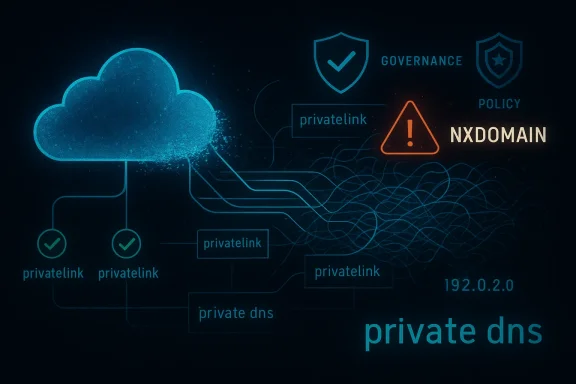
Azure Private Link and Private Endpoints were designed to let customers access PaaS services over Microsoft’s backbone, avoiding the public internet and reducing attack surface. The feature accomplishes this by creating service‑specific private DNS zones (for example, privatelink.blob.core.windows.net) and then using DNS magic — CNAMEs and A records — to map a service’s public FQDN to a private IP assigned to a Private Endpoint. That DNS‑first behavior is intentional: it guarantees that workloads which should use the private path consistently get private addresses for the service name. When multiple virtual networks (VNets) are involved, Azure creates or links Private DNS zones to those VNets so name resolution returns private addresses where Private Endpoints exist. This is where the brittle interaction lies: when a VNet is linked to a privatelink. zone, Azure’s resolution logic prefers* the private zone for the service type. If the private zone contains a matching A record for the specific resource, resolution returns the private IP and everything works. If, however, the private zone is present but no A record exists for that specific resource from the perspective of that VNet, Azure’s DNS returns an authoritative negative (NXDOMAIN) and resolution fails — the client never falls back to the public endpoint unless fallback behavior is explicitly enabled. Microsoft documents this priority/override behavior and the operational consequences for hybrid and multi‑VNet deployments.
Treat the statistic as a meaningful warning: a non‑trivial fraction of deployments have hybrid DNS/ACL configurations that can break unexpectedly when private zones are linked or when Private Endpoints are added. Defenders should act on the underlying mechanics (governance, DNS discovery, RBAC limits) rather than fixating on the exact percentage.
Actionable one‑page summary (for posting to admin channels)
Source: Cyber Press https://cyberpress.org/azure-privat...ose-cloud-resources-to-potential-dos-attacks/
 Background
Azure Private Link and Private Endpoints were designed to let customers access PaaS services over Microsoft’s backbone, avoiding the public internet and reducing attack surface. The feature accomplishes this by creating service‑specific private DNS zones (for example, privatelink.blob.core.windows.net) and then using DNS magic — CNAMEs and A records — to map a service’s public FQDN to a private IP assigned to a Private Endpoint. That DNS‑first behavior is intentional: it guarantees that workloads which should use the private path consistently get private addresses for the service name. When multiple virtual networks (VNets) are involved, Azure creates or links Private DNS zones to those VNets so name resolution returns private addresses where Private Endpoints exist. This is where the brittle interaction lies: when a VNet is linked to a privatelink. zone, Azure’s resolution logic prefers* the private zone for the service type. If the private zone contains a matching A record for the specific resource, resolution returns the private IP and everything works. If, however, the private zone is present but no A record exists for that specific resource from the perspective of that VNet, Azure’s DNS returns an authoritative negative (NXDOMAIN) and resolution fails — the client never falls back to the public endpoint unless fallback behavior is explicitly enabled. Microsoft documents this priority/override behavior and the operational consequences for hybrid and multi‑VNet deployments. What the researchers found (summary of the disclosure)
Palo Alto Networks Unit 42 documented this DNS‑induced DoS condition and described three realistic triggers: internal accidental deployments, vendor/third‑party deployments, and deliberate malicious actors who can create Private Endpoints or Private DNS links. Unit 42’s analysis highlights that the condition is not a classic network flood or resource exhaustion attack — it is a design/opy caused by the DNS precedence rules for Private Link. Their investigation also reports that more than 5% of Azure storage accounts appear to be in hybrid configurations that make them susceptible to this exact failure mode. Two important clarifications from the research and from Microsoft documentation:- This is a DNS resolution failure that prevents clients from ever reaching the public endpoint (because the private zone claims the namespace but lacks a matching record). The target service itself is typically still online and unchanged.
- Microsoft provides two practical mitigationstions: enable NxDomainRedirect (fallback to internet) for virtual network links so Azure’s recursive resolvers will retry public resolution on NXDOMAIN, or manually create and maintain A/CNAME records in the Private DNS zone. Both options come with tradeoffs.
Technical anatomy — how a Private Endpoint creates an NXDOMAIN DoS
DNS flow without Private Link
- Client resolves mystorage.blob.core.windows.net via public DNS.
- Resolver returns a public IP (possibly via a CNAME chain).
- Client connects to the public endpoint and the storage account evaluates the connection against its Network ACLs. If allowed, the connection succeeds.
DNS flow with Private Link (the intended, private‑only case)
- Client resolves mystorage.blob.core.windows.net.
- Azure’s DNS configuration (CNAME → privatelink.blob.core.windows.net) and linked private zone return the private endpoint A record.
- Client connects to the private IP over Azure’s backbone and the storage account services the request over the Private Endpoint.
DNS flow that causes NXDOMAIN (the vulnerable hybrid pattern)
- A Private DNS zone for the service (privatelink.blob.core.windows.net) is linked to VNet A, but the A record for mystorage.blob.core.windows.net is only present in another private zone instance or is missing entirely.
- Because the private zone is authoritative for that namespace in VNet A, the resolver returns NXDOMAIN when the specific name is not present.
- The client does not attempt public resolution (unless NxDomainRedirect is enabled) and the request fails despite the public endpoint and ACLs being unchanged.
Services and dependencies at risk
Any Azure PaaS service that supports Private Link and uses the privatelink.* naming convention can be affected. In practice, Unit 42 and operator reports call out:- Azure Storage (blob, queue, file) — widely used and often behind Network ACLs.
- Azure Key Vault — breaks secret retrieval and interrupts authentication flows.
- Azure Cosmos DB — application data becomes unreachable.
- Azure Container Registry — image pulls and deployments fail.
- Function Apps/App Services — can break startup, binding to storage, or config updates.
- Azure OpenAI and other AI services that support Private Link in some deployments.
Attack and accident vectors — how this gets triggered
- Accidental internal deployment: Administrators harden a resource by adding a Private Endpoint and let Azure create the Private DNS zone and links without inventorying all VNets that rely on the public endpoint. A downstream app in another VNet then experiences NXDOMAIN failures.
- Accidental vendor deployment: Managed‑service vendors or scanning tools that provision Private Endpoints for customer resources can create Private DNS zones and links across multiple VNets, inadvertently breaking customer DNS resolution.
- Malicious actor: If an attacker gains RBAC permwork resources (service principal, compromised admin, weak governance), they can intentionally create Private Endpoints or private DNS links to force NXDOMAIN responses in target VNets — an attractive, low‑effort internal DoS vector that requires no traffic amplification or volumetric attack.
Verification and caveats: how confident are we in the “>5%” claim?
Unit 42 reported that more than 5% of Azure storage accounts were operating in hybrid configurations that make them potentially etelemetry and analysis of their datasets; it is a credible directional indicator that the pattern is widespread enough to be operationally significant. However, the exact percentage is telemetry‑dependent and should not be treated as a universal or absolute metric for all Azure tenants.Treat the statistic as a meaningful warning: a non‑trivial fraction of deployments have hybrid DNS/ACL configurations that can break unexpectedly when private zones are linked or when Private Endpoints are added. Defenders should act on the underlying mechanics (governance, DNS discovery, RBAC limits) rather than fixating on the exact percentage.
Microsoft’s documented mitigations — and why they’re not a silver bullet
Microsoft documents two primary mitigations:- Enable NxDomainRedirect (Enable fallback to internet) on the Virtual Network Link for the Private DNS zone. When set, Azure’s recursive resolver will retry failed private zone queries against public DNS and return the public endpoint when a private record is missing. This restores availability quickly for many hybrid scenarios but relaxes the “private‑backbone only” guarantee and routes name resolution via public DNS in failure cases.
- Manually create A or CNAME records in the Private DNS zone that point at the public IP or canonical name for the public endpoint. This preserves private resolution inside Azure without falling back to the internet, but it introduces unsustainable operational overhead: public IPs can change and manual record maintenance scales poorly for large fleets. Microsoft explicitly warns against manual record creation at scale.
Detection and remediation playbook for defenders
A practical, prioritized playbook to find and fix vulnerable configurations:- Inventory and discovivate DNS zones with names matching privatelink.* and list their virtual network links and resolutionPolicy settings (look for Default vs NxDomainRedirect). Microsoft documents how to query this via Azure Resource Graph and the Azure CLI.
- Use Resource Graph to find storage accounts, Key Vaults, ACRs and other PaaS services that have publicNetworkAccess enabled but no privateEndpointConnections and that rely on Network ACLs or vNetRules to permit selected VNets. These are classic high‑risk resources.
- Hunt for symptomatic telemetry
- Search DNS logs and application error telemetry for spikes in NXDOMAIN responsesmes, or application stacks logging “unable to resolve [resource]” after previously working behavior. If DNS logging isn’t enabled, instrument VMs or deploy Azure Private Resolver logging to capture failing queries.
- Short‑term emergency fixes
- Enable NxDomainRedirect on affected virtual network links to restore resolution quickly, but document and limit which VNets are allowed fallback because this relaxes the private‑only model.
- For very high‑sensitivity VNets where fallback is unacceptable, consider adding manual records only after careful change control; label and automate detection for stale records.
- Medium‑term architecture changes
- Treat Private Link as a binary design decision for a given resource: either fully private‑only (deploy Private Endpoints for every consumer VNet) orblic access and do not link privatelink.* zones into VNets that must resolve public endpoints.
- Deploy Azure Private Resolver and conditional forwarding rules where a central resolver can make intelligent decisions and avoid blind private zone overrides.
- Governance and automation
- Enforce Azure Policy to audit or deny creation of privatelink.* Private DNS zones and virtual network links unless they are pre‑approved.
- Restrict RBAC capabilities: limit who (users, service principals) can create Private Endpoints, network interfaces, or link private DNS zones.
- Integrate Resource Graph queries into scheduled automation and alerting; escalate unexpected Private Endpoint creations and DNS link changes to security operations.
- Monitoring and runtime controls
- Add alerts for NXDOMAIN spikes and integrate those with incident response runbooks.
- Log and monitor private endpoint creation events and link changes in Activity Logs for rapid detection of accidental or malicious changes.
Practical governance examples and hints
- Use centralized platform teams to manage Private DNS lifecycle. Don’t allow ad‑hoc creation and linking from multiple application teams.
- If third‑party vendors require Private Endpoints, require an approved change process and explicit documentation of which VNets will be linked.
- For large fleets, prefer automated, authoritative approaches (Azure Policy, scripted Resource Graph scans + remediation) to ad hoc manual DNS edits.
- Where possible, convert hybrid patterns into explicit architecture choices: either full Private Endpoint adoption for all consumer networks or keep services public‑access and rely on ACLs and perimeter controls.
Defensive tool coverage and vendor options
- CSPM / cloud posture tools can detect risky configurations (publicNetworkAccess enabled + defaultAction Deny + missing privateEndpointConnections) using the Resource Graph queries Unit 42 provides as examples.
- Runtime protection (agents, ingress filtering) and change‑monitoring can help detect malicious creation of Private Endpoints and budget anomalies thaer trying to weaponize this vector.
- Palo Alto Networks’ Unit 42 described detection and assessment services (Cortex Cloud, Unit 42 assessments) as practical options to scan for misconfigurations and detect suspicious deployment activity; consider such vendor capabilities as part of a layered strategy but do not defer governance to a single product.
Risk analysis — strengths of the finding and where to be cautious
Strengths- High‑impact, low‑effort vector: This is an elegant example of how DNS precedence can create systemic outages without touching service‑level config or relying on volumetric attacks.
- Realistic threat model: The attack and accident vectors (internal, vendor, malicious) are practical and have already occurred in operational settings.
- Actionable mitigations: Microsoft already provides technical knobs (NxDomainRedirect) and an ecosystem of Azure features (Private Resolver, Resource Graph, Azure Policy) that allow defenders to both detect and remediate exposures.
- The >5% figure is telemetry‑driven: it’s a credible warning sign but not an absolute measure for every tenant. Treat it as directional.
- Enabling fallback undermines the original security posture of Private Link by allowing public recursion when private zones fail — that tradeoff may be unacceptable in highly regulated or zero‑trust environments.
- Manual record creation is brittle at scale and risks stale records; it is a pragmatic emergency step, not a long‑term architecture.
Recommended immediate actions (operator checklist)
- Run Azure Resource Graph queries to list:
- privatelink.* Private DNS zones and their VNet links and resolutionPolicy values.
- Storage accounts / Key Vaults / ACRs with publicNetworkAccess == Enan == Deny AND no privateEndpointConnections.
- Audit Activity Logs for unexpected Private Endpoint / Private DNS virtual network link creations in the last 90 days.
- For any VNets experiencing resolution failures, enable NxDomainRedirect as a fast emergency mitigation (document and limit its use).
- Inventory and freeze RBAC permissions for Private Endpoint and private DNS management; require change approvals for any new creations.
- Add DNS‑resolution health checks and NXDOMAIN spike detection to your SRE and securitympliance allows, plan a migration to binary models: either private‑only with Private Endpoints in each consumer VNet or explicit public access without linking privatelink.* zones.
Conclusion
The Azure Private Link DNS interaction that produces NXDOMAIN‑driven outages is not a theoretical corner case — it is a practical, operationally exploitable failure mode with real consequences for availability and resilience. The root cause is not a buggy packet handling routine but a deceptively simple DNS precedence model that was designed for security and determinism but becomes brittle in hybrid, multi‑subscription, and multi‑vendor environments. Microsoft documents both the behavior and partiait 42’s analysis underscores the urgency of treating Private Endpoint creation as a privileged, controlled operation rather than a routine provisioning step. Operationally, the right posture is twofold: tPrivate Endpoint and private DNS lifecycle is centrally managed, and instrument DNS and activity telemetry so resolution failures and unauthorized changes are detected immediately. Where necessary, apply emergency fallbacks like NxDomainRedirect, but plan longer‑term architectural choices that avoid ambiguous hybrid states. The path from discovery to durable remediation runs through inventory, policy, and disciplined change control — not ad hoc fixes.Actionable one‑page summary (for posting to admin channels)
- Inventory: Run Resource Graph queries to find linked privatelink.* zones and risky public + ACLed resources.
- Emergency: Enable NxDomainRedirect for affected VNet links if resolution outages are causing immediate incidents.
- Governance: Deny/approve creation of privatelink.* Private DNS zones via Azure Policy; restrict RBAC for endpoint creation.
- Remediation: Where feasible, deploy Private Endpoints in each consumer VNet or adopt a clear public‑only model; avoid mixing without explicit DNS design.
- Monitoring: Add NXDOMAIN spike alerts for privatelink.* names and watch Activity Logs for Private Endpoint/DNS link changes.
Source: Cyber Press https://cyberpress.org/azure-privat...ose-cloud-resources-to-potential-dos-attacks/
