

Bangladesh’s government said on June 16, 2026, that it plans to give electronics and consumer-electronics manufacturers decade-long incentives modeled on the garment industry, including duty and tax concessions, as part of a budget strategy to make the country a global tech hub by 2030. The announcement is not merely another industrial-policy flourish. It is a wager that Bangladesh can repeat one of the great export-manufacturing stories of the late twentieth century in a far less forgiving twenty-first-century technology market. The prize is enormous, but so is the execution risk.
The most revealing phrase in the government’s pitch is not “AI,” “5G,” or “digital wallet.” It is the promise that electronics and consumer electronics will receive “every single benefit” that helped the garment sector grow from a modest export base into Bangladesh’s defining industrial engine.
That comparison does a lot of political work. Ready-made garments gave Bangladesh jobs, foreign exchange, factory know-how, and a place in global supply chains. Electronics is being positioned as the next ladder up: higher-value production, deeper technical skills, and a route away from overdependence on low-margin apparel.
But the garment analogy can also mislead. Apparel manufacturing scaled in a world where labor arbitrage, quota systems, and buyer-driven supply chains created an opening for countries with abundant workers and improving logistics. Electronics manufacturing is more capital-intensive, more standards-driven, and more exposed to platform control by a handful of global giants.
The government is right to recognize the moment. Global hardware supply chains are being redistributed as companies look for redundancy beyond China, and South Asia is trying to convert demographic scale into manufacturing leverage. Yet Bangladesh is entering a crowded race in which Vietnam, India, Malaysia, Thailand, and Indonesia are already competing for assembly, components, testing, and design work.
The semiconductor provisions run even longer. Raw materials used for chip design, testing, and packaging are slated to be exempt from regulatory duty, supplementary duty, VAT, and advance tax, with only a one percent import duty applicable until June 30, 2031. For a country still building its technology-manufacturing identity, that is a notable attempt to reach beyond final assembly and into higher-value segments.
The budget also extends conditional VAT exemptions for mobile phone manufacturing and assembly, computers, and technology products until June 30, 2030. VAT on locally manufactured refrigerators, freezers, air conditioners, and compressors is being reduced from 15 percent to 7.5 percent for the same period. Advance Income Tax on 22 raw materials used in mobile phone manufacturing is being cut to one percent, while an additional 5 percent import duty on key smart-card and bank-card materials is being waived.
This is the technocratic core of the announcement: not a slogan, but a set of fiscal levers aimed at reducing input costs and extending planning certainty. Investors do not build factories on speeches alone. They build them when tariff schedules, tax treatment, logistics, energy availability, and regulatory permissions appear stable enough to survive a board meeting.
The connectivity pillar centers on a robust 5G rollout and international-standard Wi-Fi facilities. That is the most conventional part of the plan, but it remains indispensable. A digital economy cannot run on aspirational bandwidth, and manufacturers will not view a market as a serious technology base if wireless coverage, spectrum policy, and backhaul remain uneven.
The digital public infrastructure pillar is more ambitious. The government says it intends to introduce a digital ID and digital wallet for every citizen under a “one citizen, one digital ID, one digital wallet” framework, with work reportedly beginning next month. If implemented well, that could become a foundation for payments, benefits delivery, e-government services, credentialing, and startup innovation.
The data center and AI pillar is the bridge between the domestic market and the global technology services economy. Local data centers can reduce latency, strengthen data sovereignty, and support regulated services. Open API access could allow startups to build on public platforms rather than endlessly re-create identity, payments, and verification systems from scratch.
Together, the four pillars suggest a more coherent strategy than a tax break for factories alone. Bangladesh wants devices made locally, citizens connected digitally, public services delivered through common rails, and startups building on top of shared infrastructure. That is the right conceptual stack. The hard part is that each layer has its own failure modes.
The phrase “global tech hub” can mean many things, and governments often use it loosely. It might mean a country with a large domestic technology market. It might mean a competitive export-manufacturing base. It might mean a software and services center. It might mean semiconductor design talent, consumer-electronics assembly, AI data infrastructure, or all of the above.
Bangladesh’s announcement bundles these meanings together. That helps build a grand narrative, but it also creates measurement problems. By 2030, success should not be judged by whether the country has achieved the branding of a global hub. It should be judged by more concrete indicators: export growth in electronics, local value addition, job quality, foreign direct investment, supplier depth, startup usage of public APIs, data center capacity, and the share of public services delivered through secure digital rails.
The risk is that “global tech hub” becomes a slogan broad enough to survive any outcome. The opportunity is that the slogan forces ministries, regulators, telecom operators, manufacturers, and investors to organize around a shared industrial deadline.
Bangladesh already has advantages. It has a large population, a growing consumer market, a proven history of export manufacturing, and a diaspora with technical expertise. Local consumer demand for phones, home appliances, cameras, computers, and digital services gives manufacturers a domestic base before they chase exports.
But electronics margins can be unforgiving. If the incentive regime mainly encourages import of parts for low-value assembly, Bangladesh may capture jobs and some learning but miss the deeper value chain. If local firms become dependent on perpetual concessions, the sector could look successful on paper while remaining fragile underneath.
The government’s reference to “zero value addition” options is striking in this context. As a transitional measure, it may help bring production lines into the country quickly. As a permanent operating model, it would limit the industrial upgrade that the policy is supposed to deliver. The garment industry became transformative because it embedded capabilities, not merely because goods passed through the country.
But semiconductor value chains contain more than fabs. Design services, verification, testing, packaging, embedded systems, and specialized engineering support are all more plausible entry points. The budget language around chip design, testing, and packaging suggests officials understand that distinction.
This is where Bangladesh’s engineering talent and diaspora may matter. A country does not need to own the entire chip stack to participate meaningfully in it. It can build niches around design support, outsourced testing, packaging services, electronics engineering, and integration for devices assembled locally.
Still, the semiconductor story should be treated with disciplined optimism. Tax exemptions can attract attention, but semiconductor clients demand reliability, traceability, intellectual-property discipline, clean processes, and quality certifications. If Bangladesh wants to be taken seriously, it will need institutions and technical standards as much as exemptions.
A national digital ID can reduce friction in onboarding, banking, benefits delivery, telecom registration, healthcare, education, and business compliance. A digital wallet can bring more citizens into formal payments and create transaction rails that startups can use. Open APIs can turn public infrastructure into a platform rather than a closed government database.
But digital public infrastructure is also where trust becomes decisive. Identity systems can improve inclusion, but they can also concentrate risk. Poorly governed digital ID programs can enable surveillance, exclusion, data leaks, and bureaucratic lock-in. A wallet system can expand access, but it can also become a choke point if interoperability, privacy, and consumer protection are weak.
For WindowsForum readers, the parallel to enterprise IT is obvious. The architecture matters less than the governance model if the identity layer is compromised. Bangladesh’s digital foundation will need security-by-design, independent oversight, strong authentication, clear redress mechanisms, and realistic plans for people who lack consistent connectivity or formal documentation.
For Bangladesh, the practical questions are less glamorous. Will spectrum pricing allow operators to invest? Will rural coverage be economically viable? Will fiber backhaul keep up? Will power availability support network densification? Will device affordability match the policy ambition?
International-standard Wi-Fi facilities could help in public spaces, education, transport, and industrial zones. But the country’s connectivity strategy must be measured by reliability and affordability, not by technology branding. A patchy 5G network with expensive devices will not do much for freelancers, small manufacturers, or startups trying to build services for ordinary citizens.
There is also a manufacturing feedback loop. If Bangladesh can produce or assemble more affordable devices locally, connectivity adoption improves. If connectivity improves, demand for devices and services rises. The government is trying to create that loop deliberately.
The danger is that “ecosystem” becomes a polite word for fragmentation. Telecom operators, vendors, investors, regulators, banks, startups, and ministries all have different incentives. Without clear standards and coordination, the result can be overlapping platforms, inconsistent APIs, data silos, and licensing bottlenecks.
The government’s consultations with freelancers, content creators, investors, innovators, vendors, and regulators suggest an attempt to widen the policy lens. That matters because a digital economy is not only made of large factories and telecom towers. It is also made of independent workers, small software firms, creators, repair technicians, logistics providers, and service businesses that live or die by platform access.
The strongest version of the policy would use the state to reduce common friction while letting private firms compete on products and services. The weakest version would use incentives to create a protected club of incumbents. Bangladesh’s challenge is to make the first path more attractive than the second.
Garments allowed Bangladesh to absorb large numbers of workers into export production relatively quickly. Electronics can create jobs too, but many of the better jobs require technical training, process control, quality assurance, engineering, logistics, firmware knowledge, or equipment maintenance. That shifts the burden onto education and vocational systems.
The buyer landscape is also different. Global apparel brands could source from factories based on cost, capacity, and compliance. Electronics companies must worry about component sourcing, intellectual property, software integration, cybersecurity, warranties, after-sales service, and regulatory certifications across markets.
This does not mean the garment analogy is useless. It means the lesson should be policy consistency, not policy duplication. Bangladesh’s apparel success shows what can happen when incentives, export orientation, labor availability, and global demand align over decades. Electronics will require a more technical version of that alignment.
Bangladesh is offering long-term concessions across electronics, digital devices, consumer appliances, smart cards, and semiconductors. The strategy may be defensible if it produces durable capacity and export competitiveness. It becomes harder to defend if concessions mainly lower costs for firms that would have operated anyway or encourage assembly with limited local value.
The policy therefore needs milestones. Not slogans, not ribbon-cuttings, but measurable conditions attached to benefits over time. Firms receiving support should be expected to increase local skills, improve value addition, meet quality standards, export where feasible, and participate in supplier development.
Industrial policy works best when it is generous but not naive. The state can share risk with investors, but it should not absorb risk indefinitely while private actors capture the upside. Bangladesh’s budget has opened the door; the next challenge is designing the accountability that walks through it.
If Bangladesh becomes a larger producer of computers, peripherals, cameras, smart cards, networking equipment, or embedded devices, IT buyers may eventually see more regional sourcing options. That could matter for schools, government agencies, small businesses, and enterprises looking to diversify procurement beyond established manufacturing centers.
There is also a cybersecurity dimension. As more countries move into device manufacturing, firmware integrity, secure boot processes, component provenance, driver support, and update pipelines become more important. A new manufacturing hub cannot win only on cost if buyers worry about quality or trust.
Bangladesh’s policy should therefore treat security and standards as export infrastructure. For devices that end up in offices, homes, banks, factories, and public institutions, security is not a premium feature. It is a condition of market access.
The risk is not that the strategy is conceptually wrong. The risk is that implementation becomes uneven, ministries pull in different directions, concessions outlive their purpose, and infrastructure projects move slower than private-sector expectations. Industrial strategy is usually won or lost in the dull middle: procurement rules, customs processing, utility reliability, certification capacity, dispute resolution, and regulatory predictability.
Policy consistency is especially important because investors will compare Bangladesh with countries that already have deeper electronics ecosystems. A decade-long incentive promise helps, but only if firms believe it will be administered consistently and transparently. Sudden reversals, opaque approvals, or arbitrary enforcement would weaken the very certainty the budget is trying to create.
Bangladesh’s opportunity is real because global supply chains are looking for options. Its constraint is also real because options are abundant. The country has to prove not only that it is cheaper, but that it is dependable.
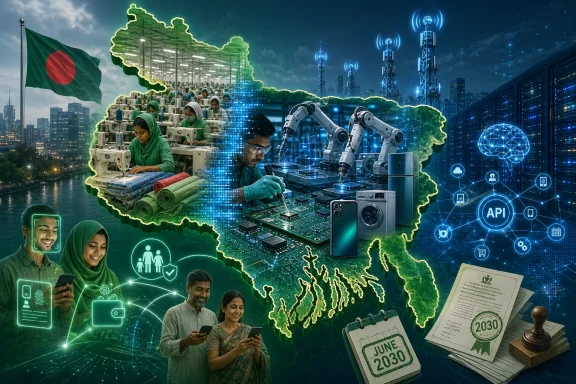 Bangladesh Wants a Second Garment Miracle, This Time With Circuit Boards
The most revealing phrase in the government’s pitch is not “AI,” “5G,” or “digital wallet.” It is the promise that electronics and consumer electronics will receive “every single benefit” that helped the garment sector grow from a modest export base into Bangladesh’s defining industrial engine.That comparison does a lot of political work. Ready-made garments gave Bangladesh jobs, foreign exchange, factory know-how, and a place in global supply chains. Electronics is being positioned as the next ladder up: higher-value production, deeper technical skills, and a route away from overdependence on low-margin apparel.
But the garment analogy can also mislead. Apparel manufacturing scaled in a world where labor arbitrage, quota systems, and buyer-driven supply chains created an opening for countries with abundant workers and improving logistics. Electronics manufacturing is more capital-intensive, more standards-driven, and more exposed to platform control by a handful of global giants.
The government is right to recognize the moment. Global hardware supply chains are being redistributed as companies look for redundancy beyond China, and South Asia is trying to convert demographic scale into manufacturing leverage. Yet Bangladesh is entering a crowded race in which Vietnam, India, Malaysia, Thailand, and Indonesia are already competing for assembly, components, testing, and design work.
The Budget Turns Industrial Policy Into a Timetable
The FY2026-27 budget gives the plan a calendar, and that matters. The incentives are not pitched as temporary election-year sweeteners but as long-horizon signals to manufacturers, investors, and suppliers. Duty exemptions on raw materials for mobile phones, refrigerators, air conditioners, washing machines, CCTV cameras, computers, and other digital devices have been extended until June 30, 2030.The semiconductor provisions run even longer. Raw materials used for chip design, testing, and packaging are slated to be exempt from regulatory duty, supplementary duty, VAT, and advance tax, with only a one percent import duty applicable until June 30, 2031. For a country still building its technology-manufacturing identity, that is a notable attempt to reach beyond final assembly and into higher-value segments.
The budget also extends conditional VAT exemptions for mobile phone manufacturing and assembly, computers, and technology products until June 30, 2030. VAT on locally manufactured refrigerators, freezers, air conditioners, and compressors is being reduced from 15 percent to 7.5 percent for the same period. Advance Income Tax on 22 raw materials used in mobile phone manufacturing is being cut to one percent, while an additional 5 percent import duty on key smart-card and bank-card materials is being waived.
This is the technocratic core of the announcement: not a slogan, but a set of fiscal levers aimed at reducing input costs and extending planning certainty. Investors do not build factories on speeches alone. They build them when tariff schedules, tax treatment, logistics, energy availability, and regulatory permissions appear stable enough to survive a board meeting.
The Electronics Push Is Really a Platform Strategy
The manufacturing incentives are only one of four pillars in the government’s stated ICT and telecom roadmap. The others are connectivity, digital public infrastructure, and data centers with artificial intelligence. That framing is important because Bangladesh is not simply trying to assemble more consumer devices; it is trying to create demand, data flows, identity rails, and cloud-adjacent infrastructure that make the local market more useful to technology firms.The connectivity pillar centers on a robust 5G rollout and international-standard Wi-Fi facilities. That is the most conventional part of the plan, but it remains indispensable. A digital economy cannot run on aspirational bandwidth, and manufacturers will not view a market as a serious technology base if wireless coverage, spectrum policy, and backhaul remain uneven.
The digital public infrastructure pillar is more ambitious. The government says it intends to introduce a digital ID and digital wallet for every citizen under a “one citizen, one digital ID, one digital wallet” framework, with work reportedly beginning next month. If implemented well, that could become a foundation for payments, benefits delivery, e-government services, credentialing, and startup innovation.
The data center and AI pillar is the bridge between the domestic market and the global technology services economy. Local data centers can reduce latency, strengthen data sovereignty, and support regulated services. Open API access could allow startups to build on public platforms rather than endlessly re-create identity, payments, and verification systems from scratch.
Together, the four pillars suggest a more coherent strategy than a tax break for factories alone. Bangladesh wants devices made locally, citizens connected digitally, public services delivered through common rails, and startups building on top of shared infrastructure. That is the right conceptual stack. The hard part is that each layer has its own failure modes.
The 2030 Goal Is Ambitious Enough to Be Useful and Dangerous
The government’s 2030 target gives the plan urgency. It also invites skepticism. Four years is a short runway for moving from incentives to industrial transformation, especially in a sector where supplier qualification, factory certification, workforce development, export-market access, and component ecosystems take time.The phrase “global tech hub” can mean many things, and governments often use it loosely. It might mean a country with a large domestic technology market. It might mean a competitive export-manufacturing base. It might mean a software and services center. It might mean semiconductor design talent, consumer-electronics assembly, AI data infrastructure, or all of the above.
Bangladesh’s announcement bundles these meanings together. That helps build a grand narrative, but it also creates measurement problems. By 2030, success should not be judged by whether the country has achieved the branding of a global hub. It should be judged by more concrete indicators: export growth in electronics, local value addition, job quality, foreign direct investment, supplier depth, startup usage of public APIs, data center capacity, and the share of public services delivered through secure digital rails.
The risk is that “global tech hub” becomes a slogan broad enough to survive any outcome. The opportunity is that the slogan forces ministries, regulators, telecom operators, manufacturers, and investors to organize around a shared industrial deadline.
Tax Breaks Can Start a Factory, but They Cannot Finish an Ecosystem
The incentives are meaningful because they lower costs and reduce uncertainty. They are insufficient because electronics manufacturing is a systems business. A phone, refrigerator, or laptop plant needs predictable imports, skilled technicians, reliable power, testing facilities, quality control, repair networks, export compliance, and a supplier base that can move beyond screwdriver assembly.Bangladesh already has advantages. It has a large population, a growing consumer market, a proven history of export manufacturing, and a diaspora with technical expertise. Local consumer demand for phones, home appliances, cameras, computers, and digital services gives manufacturers a domestic base before they chase exports.
But electronics margins can be unforgiving. If the incentive regime mainly encourages import of parts for low-value assembly, Bangladesh may capture jobs and some learning but miss the deeper value chain. If local firms become dependent on perpetual concessions, the sector could look successful on paper while remaining fragile underneath.
The government’s reference to “zero value addition” options is striking in this context. As a transitional measure, it may help bring production lines into the country quickly. As a permanent operating model, it would limit the industrial upgrade that the policy is supposed to deliver. The garment industry became transformative because it embedded capabilities, not merely because goods passed through the country.
Semiconductors Are the Stretch Goal With the Biggest Upside
The semiconductor incentives are the most strategically interesting part of the package because they point beyond consumer-electronics assembly. Bangladesh is not about to become a leading-edge chip fabrication power. That would require capital, water, power, process expertise, and ecosystem maturity on a scale that only a few countries can sustain.But semiconductor value chains contain more than fabs. Design services, verification, testing, packaging, embedded systems, and specialized engineering support are all more plausible entry points. The budget language around chip design, testing, and packaging suggests officials understand that distinction.
This is where Bangladesh’s engineering talent and diaspora may matter. A country does not need to own the entire chip stack to participate meaningfully in it. It can build niches around design support, outsourced testing, packaging services, electronics engineering, and integration for devices assembled locally.
Still, the semiconductor story should be treated with disciplined optimism. Tax exemptions can attract attention, but semiconductor clients demand reliability, traceability, intellectual-property discipline, clean processes, and quality certifications. If Bangladesh wants to be taken seriously, it will need institutions and technical standards as much as exemptions.
Digital ID and Wallets Could Become the Hidden Engine of the Plan
The proposed digital ID and wallet framework may prove more consequential than the hardware incentives. In many emerging markets, the biggest technology leap does not come from factories first; it comes from interoperable public infrastructure that lowers the cost of building services.A national digital ID can reduce friction in onboarding, banking, benefits delivery, telecom registration, healthcare, education, and business compliance. A digital wallet can bring more citizens into formal payments and create transaction rails that startups can use. Open APIs can turn public infrastructure into a platform rather than a closed government database.
But digital public infrastructure is also where trust becomes decisive. Identity systems can improve inclusion, but they can also concentrate risk. Poorly governed digital ID programs can enable surveillance, exclusion, data leaks, and bureaucratic lock-in. A wallet system can expand access, but it can also become a choke point if interoperability, privacy, and consumer protection are weak.
For WindowsForum readers, the parallel to enterprise IT is obvious. The architecture matters less than the governance model if the identity layer is compromised. Bangladesh’s digital foundation will need security-by-design, independent oversight, strong authentication, clear redress mechanisms, and realistic plans for people who lack consistent connectivity or formal documentation.
5G Is a Necessary Ingredient, Not a Development Strategy
The connectivity pillar is easy to understand and easy to oversell. 5G rollout can improve capacity, reduce latency, and support industrial use cases, but it does not automatically create those use cases. Many countries have learned that faster networks do not by themselves produce digital transformation.For Bangladesh, the practical questions are less glamorous. Will spectrum pricing allow operators to invest? Will rural coverage be economically viable? Will fiber backhaul keep up? Will power availability support network densification? Will device affordability match the policy ambition?
International-standard Wi-Fi facilities could help in public spaces, education, transport, and industrial zones. But the country’s connectivity strategy must be measured by reliability and affordability, not by technology branding. A patchy 5G network with expensive devices will not do much for freelancers, small manufacturers, or startups trying to build services for ordinary citizens.
There is also a manufacturing feedback loop. If Bangladesh can produce or assemble more affordable devices locally, connectivity adoption improves. If connectivity improves, demand for devices and services rises. The government is trying to create that loop deliberately.
The Private Sector Gets the Steering Wheel, but the State Still Builds the Road
Prime Minister’s Adviser Rehan Asif Asad framed the government’s role as ecosystem builder rather than application developer. That is the right instinct. Governments are usually poor at predicting the exact services that citizens and businesses will want, but they can create standards, infrastructure, legal certainty, and procurement demand.The danger is that “ecosystem” becomes a polite word for fragmentation. Telecom operators, vendors, investors, regulators, banks, startups, and ministries all have different incentives. Without clear standards and coordination, the result can be overlapping platforms, inconsistent APIs, data silos, and licensing bottlenecks.
The government’s consultations with freelancers, content creators, investors, innovators, vendors, and regulators suggest an attempt to widen the policy lens. That matters because a digital economy is not only made of large factories and telecom towers. It is also made of independent workers, small software firms, creators, repair technicians, logistics providers, and service businesses that live or die by platform access.
The strongest version of the policy would use the state to reduce common friction while letting private firms compete on products and services. The weakest version would use incentives to create a protected club of incumbents. Bangladesh’s challenge is to make the first path more attractive than the second.
The Garment Model Cannot Simply Be Copied
The government’s explicit comparison to garment-sector policy since 1978 is politically powerful because Bangladesh knows that model worked. But electronics is not apparel with chips. The production economics, supply chains, compliance standards, and technological upgrade paths are different.Garments allowed Bangladesh to absorb large numbers of workers into export production relatively quickly. Electronics can create jobs too, but many of the better jobs require technical training, process control, quality assurance, engineering, logistics, firmware knowledge, or equipment maintenance. That shifts the burden onto education and vocational systems.
The buyer landscape is also different. Global apparel brands could source from factories based on cost, capacity, and compliance. Electronics companies must worry about component sourcing, intellectual property, software integration, cybersecurity, warranties, after-sales service, and regulatory certifications across markets.
This does not mean the garment analogy is useless. It means the lesson should be policy consistency, not policy duplication. Bangladesh’s apparel success shows what can happen when incentives, export orientation, labor availability, and global demand align over decades. Electronics will require a more technical version of that alignment.
The Revenue Trade-Off Will Become Harder to Ignore
Every tax concession has a public-finance cost. Governments often justify industrial incentives by arguing that they create jobs, exports, investment, and future tax revenue. That logic can be sound, but it depends on execution and discipline.Bangladesh is offering long-term concessions across electronics, digital devices, consumer appliances, smart cards, and semiconductors. The strategy may be defensible if it produces durable capacity and export competitiveness. It becomes harder to defend if concessions mainly lower costs for firms that would have operated anyway or encourage assembly with limited local value.
The policy therefore needs milestones. Not slogans, not ribbon-cuttings, but measurable conditions attached to benefits over time. Firms receiving support should be expected to increase local skills, improve value addition, meet quality standards, export where feasible, and participate in supplier development.
Industrial policy works best when it is generous but not naive. The state can share risk with investors, but it should not absorb risk indefinitely while private actors capture the upside. Bangladesh’s budget has opened the door; the next challenge is designing the accountability that walks through it.
Windows, Devices, and the Quiet Relevance for IT Buyers
For a Windows-focused audience, Bangladesh’s electronics push may seem distant from everyday concerns about updates, endpoint security, licensing, and fleet management. It is not. Device supply chains shape price, availability, repairability, and procurement resilience.If Bangladesh becomes a larger producer of computers, peripherals, cameras, smart cards, networking equipment, or embedded devices, IT buyers may eventually see more regional sourcing options. That could matter for schools, government agencies, small businesses, and enterprises looking to diversify procurement beyond established manufacturing centers.
There is also a cybersecurity dimension. As more countries move into device manufacturing, firmware integrity, secure boot processes, component provenance, driver support, and update pipelines become more important. A new manufacturing hub cannot win only on cost if buyers worry about quality or trust.
Bangladesh’s policy should therefore treat security and standards as export infrastructure. For devices that end up in offices, homes, banks, factories, and public institutions, security is not a premium feature. It is a condition of market access.
The Real Race Is Against Institutional Drift
The government’s plan has the advantage of coherence. Manufacturing incentives, connectivity, digital ID, wallets, APIs, data centers, and AI all point in roughly the same direction. That is not always true of national technology strategies, many of which read like lists of fashionable nouns.The risk is not that the strategy is conceptually wrong. The risk is that implementation becomes uneven, ministries pull in different directions, concessions outlive their purpose, and infrastructure projects move slower than private-sector expectations. Industrial strategy is usually won or lost in the dull middle: procurement rules, customs processing, utility reliability, certification capacity, dispute resolution, and regulatory predictability.
Policy consistency is especially important because investors will compare Bangladesh with countries that already have deeper electronics ecosystems. A decade-long incentive promise helps, but only if firms believe it will be administered consistently and transparently. Sudden reversals, opaque approvals, or arbitrary enforcement would weaken the very certainty the budget is trying to create.
Bangladesh’s opportunity is real because global supply chains are looking for options. Its constraint is also real because options are abundant. The country has to prove not only that it is cheaper, but that it is dependable.
The 2030 Tech-Hub Promise Comes Down to These Tests
The announcement should be read as a serious industrial-policy signal, not as proof that Bangladesh has already arrived. The budget gives manufacturers and digital-infrastructure players a longer planning horizon, but the next four years will determine whether the policy becomes a platform or a press release.- Bangladesh is offering electronics and consumer-electronics manufacturers long-term benefits modeled on the garment sector, with key exemptions extended to 2030.
- The semiconductor package is narrower but strategically important, targeting chip design, testing, and packaging inputs with concessions running to June 30, 2031.
- The government’s four-pillar strategy links manufacturing to 5G connectivity, digital ID, digital wallets, data centers, APIs, and AI infrastructure.
- The plan will succeed only if incentives lead to skills, standards, supplier depth, exports, and local value addition rather than low-margin assembly alone.
- Digital public infrastructure could become the most powerful part of the strategy if it is secure, interoperable, privacy-conscious, and open enough for private innovation.
- Bangladesh’s biggest competitive test will be execution consistency, because rival manufacturing hubs already have scale, suppliers, and investor familiarity.
References
- Primary source: Bangladesh Sangbad Sangstha (BSS)
Published: Tue, 16 Jun 2026 05:53:51 GMT
Govt plans electronics manufacturing incentives to make Bangladesh global tech hub | News
DHAKA, June 16, 2026 (BSS) - The government has announced plans to provide the electronics and consumer electronics manufacturing sectorwww.bssnews.net
- Related coverage: thedailystar.net
Govt eyes chip industry growth with extended tax concessions until 2031
The Bangladesh government has proposed sweeping tax concessions for the semiconductor industry, including reducing import duties on key raw materials to 1 percent until mid-2031, as part of its fiscal year 2026-27 budget.www.thedailystar.net - Related coverage: newagebd.net
New Age | Govt to provide 5-yr tax waiver for semiconductor industry
Finance minister Amir Khosru Mahmud Chowdhury on Thursday proposed a five-year tax exemption until June 30, 2031, for the country’s emerging semiconductor industry, aiming to attract investment, create high-skilled jobs and position the country as a player in the global technology value chain.www.newagebd.net - Related coverage: tbsnews.net
Budget FY27: Govt set to offer major tax incentives for semiconductor sector
According to a finance ministry source, the proposed measure includes a long-term preferential import regime for machinery and equipment used in semiconductor and chip-related industries. Under the proposal, such equipment will enjoy a concessional 1% import duty until 30 June 2031.www.tbsnews.net
- Related coverage: dhakastream.net
Locally-assembled electronics, EVs likely to be cheaper; cigarettes, luxury goods more expensive
Metro rail services may remain VAT-exempt until 2028.www.dhakastream.net
- Related coverage: pwc.com
