

A high‑profile online clash that began as a heated argument about policing and football has escalated into a reputational and regulatory headache for a practising barrister, after the exchange produced an abusive slur that was deleted but widely shared — an incident reported exclusively by RollOnFriday and now folded into a much larger conversation about AI, public trust and professional conduct.
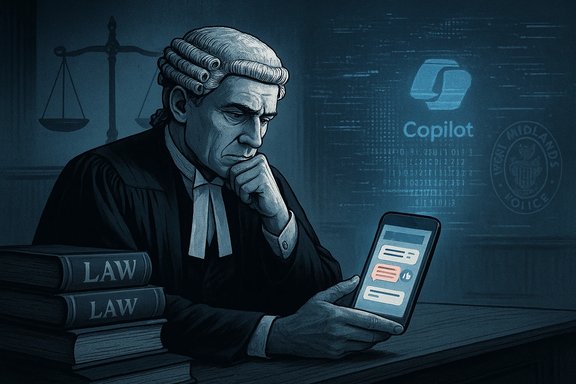
The row started on X (formerly Twitter) during a debate over West Midlands Police’s decision relating to Maccabi Tel Aviv supporters and a Europa League fixture. The debate turned personal between barrister Francis Hoar and fellow X user Juwayriyyah Alam, with an exchange that included strong accusations about the motivations and behaviour of fans and critics. In the heat of that exchange Hoar posted a pair of replies — “Go and fuck yourself” and “Ugly whore” — which he then deleted. Screenshots of the messages were circulated and the episode was reported by RollOnFriday; Hoar has told the outlet he has self‑referred to the Bar Standards Board (BSB) and will make no further comment. This personal confrontation occurred against the backdrop of a separate but related public scandal: West Midlands Police’s use of AI tools in compiling intelligence material that later proved to contain fabricated information, including a non‑existent football fixture that was said to have been generated by Microsoft’s Copilot. That police error became the central grievance in the social media debate and has since prompted political and institutional fallout, including public apologies from senior officers and intense press scrutiny. The AI dimension substantially increased the visibility and political heat around the entire discussion.
Source: RollOnFriday https://www.rollonfriday.com/news-content/exclusive-goaded-barrister-calls-x-opponent-ugly-whore]
 Background
The row started on X (formerly Twitter) during a debate over West Midlands Police’s decision relating to Maccabi Tel Aviv supporters and a Europa League fixture. The debate turned personal between barrister Francis Hoar and fellow X user Juwayriyyah Alam, with an exchange that included strong accusations about the motivations and behaviour of fans and critics. In the heat of that exchange Hoar posted a pair of replies — “Go and fuck yourself” and “Ugly whore” — which he then deleted. Screenshots of the messages were circulated and the episode was reported by RollOnFriday; Hoar has told the outlet he has self‑referred to the Bar Standards Board (BSB) and will make no further comment. This personal confrontation occurred against the backdrop of a separate but related public scandal: West Midlands Police’s use of AI tools in compiling intelligence material that later proved to contain fabricated information, including a non‑existent football fixture that was said to have been generated by Microsoft’s Copilot. That police error became the central grievance in the social media debate and has since prompted political and institutional fallout, including public apologies from senior officers and intense press scrutiny. The AI dimension substantially increased the visibility and political heat around the entire discussion. What happened in short
- A public X debate over the policing decision became personal and abusive.
- Barrister Francis Hoar used explicit language in replies that he deleted soon afterwards.
- Screenshots were circulated by the other party, amplifying the exchange.
- Hoar says he has self‑referred to the Bar Standards Board (BSB).
- The immediate cause of the original debate — the police intelligence that informed the fan ban — was later traced to an AI‑generated error attributed to Microsoft Copilot, further inflaming online reactions to the policing decision.
Overview: why this matters beyond a single insult
At first glance the episode looks like yet another social‑media spat. Its significance is multiple and cumulative.- Professional duty and public trust: Barristers are members of a regulated profession whose conduct — including outside courtroom hours — is subject to oversight when it affects public confidence in the Bar. The BSB’s updated guidance on‑professional conduct makes explicit that seriously offensive language online can be a matter for regulators. That regulatory framework is the mechanism through which a momentary outburst can have career consequences.
- Amplification by platforms: Deletions do not erase speech once screenshots exist; the viral dynamics of X mean that the reputational impact is immediate and persistent. The exchange became public almost instantly and was reported in specialist press and forum threads, increasing reputational pressure.
- Context matters: The insult did not occur in a vacuum. It took place within a fraught public dispute about policing, allegations of community harm, and a now‑documented AI failure at the centre of a politically sensitive decision. The political stakes heighten the consequences for professional actors engaging on social media.
The facts: verified claims and where they came from
- The abusive replies — the texts reported by RollOnFriday — appear in screenshots that were circulated on X and were described in the RollOnFriday exclusive; Hoar confirmed the exchange to RollOnFriday and said he had self‑referred to the BSB.
- West Midlands Police’s intelligence error — the fabricated reference to a West Ham–Maccabi Tel Aviv match — has been publicly acknowledged by the force’s senior leadership, who attributed the error to outputs produced by Microsoft Copilot in documents compiled for inspection and parliamentary scrutiny. Major outlets and parliamentary reporting corroborate this sequence.
- The BSB has recently updated and republished guidance on the regulation of non‑professional conduct and social media, emphasising that language that is seriously offensive, discriminatory, bullying or harassing may be of regulatory concern. That guidance explicitly balances freedom of expression with the profession’s need to preserve public trust.
The regulation angle: what the Bar Standards Board says and what it can do
The Bar Standards Board’s recent guidance clarifies where online conduct intersects with regulatory rules. Two central principles are relevant:- The BSB emphasises that barristers must not behave in a way likely to diminish the trust and confidence the public places in them or in the profession. The guidance singles out seriously offensive, discriminatory, bullying or harassing language as conduct of regulatory interest.
- The regulator explicitly acknowledges the need to balance professional rules with human rights protections for freedom of expression, and it states that context — including the public impact of the message and its connection to the barrister’s professional role — will guide any enforcement decision. Self‑referral can be a mitigating factor but does not guarantee leniency.
The free‑speech tension and precedent
The tension between free expression and professional standards is not new. Recent, high‑profile cases involving barristers and social media underline the difficulty of drawing consistent lines.- Critics of strict enforcement warn that public debate — particularly on politicised topics — should not be chilled by over‑broad regulatory intervention. Defenders of robust oversight argue that the Bar carries a public‑interest duty to maintain trust, and that abusive, misogynistic or discriminatory language damages that trust irrespective of political content. The BSB guidance is an attempt to articulate that balance.
- Past controversies demonstrate inconsistency in outcomes and persistent complaints about unequal application of regulation. Those disputes complicate any suggestion that a single tweet equates automatically to sanction. The BSB’s approach is contextual and case‑by‑case; its new guidance clarifies standards but does not change the fundamental need for discretionary judgment.
Platform dynamics and the illusion of deletion
Two practical realities make social‑media disputes uniquely dangerous for professionals:- Permanent screenshots: Deleting a post does not remove it from circulation. Screenshots and reposts preserve the content, and a deleted tweet can still be amplified widely. That is exactly what happened here.
- Context collapse: Social media flattens audience boundaries. What would have been a private or narrowly targeted comment becomes readable by bar associations, regulators, clients and employers. The more polarised the underlying political moment, the more likely ordinary disagreements will escalate into reputational crises.
The policing‑AI context: why the underlying debate exploded
Understanding why the personal exchange escalated so quickly requires revisiting the police controversy.- West Midlands Police produced intelligence used to recommend a ban on Maccabi Tel Aviv supporters at a fixture in Birmingham. That intelligence included a reference to a match that never occurred — a detail later attributed to an AI “hallucination” produced by Microsoft’s Copilot. Senior officers acknowledged the error to MPs and have faced sharp political criticism. The AI angle turned an already sensitive policing decision into a headline national controversy, mobilising activists and commentators on both sides.
- The underlying factual dispute — about whether fans were a threat or whether the intelligence process failed — is what animated the online debate. That the error stemmed from an AI tool added fuel: citizens and commentators now have both a grievance (the ban) and a symbolic target (the perceived unreliability of AI in official decision‑making). The X debate therefore became a focal point for anger on both sides.
Risks and wider implications
- For the individual barrister: Even self‑referral may not prevent regulatory censure. The BSB will weigh aggravating and mitigating factors; the use of sexist or demeaning language aimed at an identifiable person increases the risk of disciplinary action. Reputational damage among clients and chambers is immediate and often longer lasting than formal sanctions.
- For the legal profession: High‑profile incidents of offensive language by regulated practitioners feed public narratives about elitism and lack of accountability. Unequal application of enforcement — or perceptions thereof — risks eroding the Bar’s legitimacy. The profession’s response will need to combine clear rule enforcement with visible steps to protect members from targeted online abuse.
- For public institutions and AI governance: The West Midlands Police revelation underlines the hazards of integrating generative AI outputs into decision‑making without robust verification and audit trails. The reputational and political costs of such errors ripple outward and create volatile environments in which personal disputes inflame public anger. The governance failure remains the central policy story.
Practical recommendations — what should barristers, chambers and regulators do next?
- For practising barristers:
- Pause before replying. Allow cooling‑off time on heated threads.
- Use private channels to raise concerns or, if public comment is necessary, adopt measured language.
- Document and report any doxxing, threats or abusive conduct you receive in response.
- For chambers and employers:
- Publish clear social‑media conduct policies aligned with BSB guidance.
- Provide training on online de‑escalation, platform dynamics and personal security.
- Establish rapid‑response counsel to advise on incidents and assist with self‑referral if needed.
- For the Bar Standards Board and regulators:
- Continue to publish clear, accessible guidance and exemplars of behaviour that will and will not attract enforcement.
- Improve transparency around procedural timelines when self‑referrals are made, without compromising investigatory integrity.
- Consider restorative pathways (apology, mediation) for single‑incident breaches where appropriate.
- For policing and public bodies using AI:
- Insist on human‑in‑the‑loop verification and provenance tracing for any AI outputs that inform operational decisions.
- Publish clear audit logs and decision‑making rationales when AI is used in intelligence to allow external review and rebuild public trus)
Critical analysis: strengths, weaknesses and the line between governance and censorship
This episode exposes an uncomfortable truth for modern professional life: instant publicness means that private temper and public duty now collide regularly. The BSB’s guidance is a strength — it acknowledges nuance and tries to balance free expression with public trust. Its renewed emphasis on context and discretion is sensible and legally sound. Yet risks remain. Regulators face difficult judgment calls when political debate turns heated and when allegations of bias or unequal enforcement are raised. Excessive or inconsistent punishment risks being perceived as censorship; too little enforcement risks normalising abusive behaviour. The equilibrium is fragile and contingent on transparent, proportionate decisions by the regulator. The BSB’s recent consultation process and iterative guidance are a constructive response, but the regulator will be tested by cases like this one. At the intersection of AI and public policy, the West Midlands Police episode shows the perils of offloading information‑gathering to generative systems without auditability. That failure is not only a technological lesson — it is a governance and cultural one. Institutions must not only adopt better technical checks but also recognise the human cost when AI errors reverberate into polarised public debates.Conclusion
A single, deleted insult on X has triggered a chain reaction that touches on professional ethics, platform dynamics and AI governance. The immediate facts are straightforward and reported: the abusive replies were posted and deleted, screenshots circulated, the barrister says he has self‑referred to the BSB, and the debate that birthed the exchange was fuelled by an institutional error traced back to Microsoft Copilot. The larger lesson is systemic. In an ecosystem where AI‑driven mistakes can suddenly make local decisions national news, professionals must exercise extraordinary restraint in public forums. Regulators must continue to provide clear, balanced guidance that protects public confidence while respecting legitimate political expression. And public institutions must stop treating AI as a black box: provenance, verification and accountability are not optional when lives, reputations and community trust are on the line. This episode will test the BSB’s updated guidance in a highly visible way and stands as a warning to any professional tempted to meet provocation with insult. The immediate regulatory outcome will be watched closely; the broader debates about AI, trust and the public square will continue to shape how institutions and individuals navigate a fraught, hyper‑connected world.Source: RollOnFriday https://www.rollonfriday.com/news-content/exclusive-goaded-barrister-calls-x-opponent-ugly-whore]
