

BCC Group said on June 24, 2026, that its German and UK businesses, BCC GmbH in Eschborn and BCC Ltd in London, have achieved ISO/IEC 27001:2022 certification for software, SaaS, consulting, operations, support, and migration services. That sentence reads like a routine compliance announcement, but in the Microsoft 365 market it lands in a more interesting place. BCC is not merely selling tools into the governance and security layer of Microsoft’s cloud; it is now trying to prove that its own operating model can survive the same scrutiny it urges customers to adopt. For IT buyers staring down Copilot rollouts, cross-tenant migrations, legacy data estates, and EU regulatory pressure, that distinction matters.
ISO/IEC 27001 certification is often treated as procurement wallpaper: a logo on a vendor page, a checkbox in a tender response, a paragraph in a security questionnaire. In BCC Group’s case, the certification deserves a little more attention because of where the company sits in the Microsoft 365 ecosystem. It is not selling a generic productivity add-on; it works in the awkward layer where identity, collaboration sprawl, migration history, compliance evidence, and now Copilot data exposure all collide.
The company’s announcement says the certified scope covers the design, development, operation, and support of software and SaaS solutions, plus associated service and migration projects. That is a broad claim. It means BCC is not presenting certification as a narrow back-office exercise limited to corporate IT, but as a statement about the core processes behind its products and customer-facing work.
That breadth is the point. Microsoft 365 specialists increasingly operate inside sensitive customer environments, sometimes with delegated permissions, migration tooling, data mapping responsibilities, and insight into legacy systems that organizations barely understand themselves. A governance vendor that cannot document its own controls has a credibility problem before the first workshop begins.
BCC’s certification covers both BCC GmbH in Eschborn and BCC Ltd in London. That detail also matters. In a market where software development, consulting delivery, and support often span legal entities and national borders, a single-entity certificate can leave buyers asking whether the practical delivery chain is really covered. BCC is making the stronger argument that its core group processes, not just one office, have been audited under the new 2022 version of the standard.
That difference is not semantic. In enterprise procurement, the question is rarely “can this vendor promise security?” Everyone can promise security. The better question is “can this vendor show how security decisions are governed, measured, reviewed, and corrected when reality misbehaves?” ISO/IEC 27001 is one of the more widely recognized ways of answering that question in a language customers, auditors, and regulators understand.
The 2022 revision of the standard is especially relevant because it reflects a changed security environment. The modern information security problem is no longer only about perimeter defense, endpoint antivirus, or password policy. It is about cloud services, suppliers, access governance, operational resilience, privacy protection, threat intelligence, secure development, configuration control, and evidence.
That evidence burden is growing heavier. Customers buying SaaS and consulting services increasingly need to prove not only that they have chosen reputable vendors, but that vendor selection itself was risk-based and defensible. A certificate does not end due diligence, but it can shorten the distance between marketing language and audit-ready proof.
For BCC, the timing is useful. The company’s business sits directly in Microsoft 365, where customers are simultaneously trying to rationalize legacy estates, govern Teams and guests, control information lifecycle, and evaluate how much organizational knowledge Copilot should be allowed to touch. Those are not abstract governance themes. They are operational issues with security consequences.
That shift creates a vendor opportunity, but it also creates a vendor obligation. Any company offering migration, governance, automation, or Copilot enablement services in Microsoft 365 is effectively participating in the customer’s risk model. A poorly governed migration can preserve years of bad permissions. A rushed Teams rollout can turn guest access into a permanent shadow directory. A Copilot connector can make obscure business data suddenly discoverable in natural language.
BCC’s product set maps neatly onto these anxieties. Affirmatic is positioned around Microsoft 365 governance, Teams lifecycle, guest access, approvals, and evidence. MigrationEngine speaks to the long tail of organizations still extracting mail, calendars, and business history from older or alternate platforms. The BCC Copilot Connector is aimed at making information from business applications available to Microsoft Copilot in a controlled way.
The common thread is not productivity. It is containment. BCC is selling customers the idea that Microsoft 365 value arrives only when collaboration, migration, and AI access are wrapped in governance. ISO/IEC 27001 certification strengthens that pitch because it lets BCC say that containment is not merely product copy; it is also part of the company’s own management system.
That is a subtle but important distinction in the partner ecosystem. Microsoft’s platform provides native security, compliance, and administrative controls, but customers rarely live in a clean native-only world. They have Domino histories, third-party archives, custom workflows, old business applications, unmanaged Teams, external collaborators, and departments that treat SharePoint as a file dump with better branding. Partners make that world usable. They can also make it riskier.
Copilot changes the perceived blast radius of poor information governance. Before generative AI, overshared files and stale permissions were already dangerous, but discovery often required a user to know where to search and what to search for. With AI-assisted retrieval, summarization, and conversational querying, long-buried access problems can become easier to exploit accidentally or deliberately.
Microsoft’s model is that Copilot should respect existing permissions. That is necessary, but it is not sufficient comfort for administrators. If the permissions are wrong, stale, excessive, inherited from a migration, or granted to a guest account that nobody owns anymore, respecting them faithfully can still produce bad outcomes. The AI did not create the governance failure; it made the failure easier to observe.
That is why vendors in this space are rushing to frame themselves around “secure Copilot adoption.” The phrase can be overused, but the underlying problem is real. Organizations want the productivity upside of AI over their internal knowledge base, yet many have spent years tolerating chaotic access models because the consequences were diffuse and hard to measure. Copilot compresses that ambiguity into a board-level question: what exactly will the assistant be able to see?
Connectors amplify the issue. Microsoft 365 Copilot connectors are designed to bring content from external systems into Microsoft 365 and Copilot experiences. Done well, that can make AI useful across knowledge bases, ticketing platforms, wikis, file stores, CRM tools, and older business applications. Done poorly, it can bridge years of messy permissions into a single conversational surface.
BCC’s Copilot Connector pitch therefore lives or dies on trust. Customers need to believe that the connector will not flatten authorization models, ignore source-system permissions, mishandle indexing, or create opaque data flows that administrators cannot explain later. ISO/IEC 27001 certification does not certify a connector’s architecture by itself, but it does add weight to the vendor’s claim that security management is embedded in the organization behind the product.
Administrators still need to ask how support access is granted and revoked. They still need to understand where logs are retained, how incidents are reported, how data is segregated, how development pipelines are secured, and whether subcontractors touch production systems. They still need architecture diagrams, data processing terms, vulnerability management details, and clarity on service boundaries.
What certification changes is the quality of that conversation. A vendor with a functioning information security management system should be able to answer those questions coherently and consistently. It should have documented risk treatment decisions rather than improvisations. It should be able to show how controls are assigned, monitored, reviewed, and improved.
For public sector customers and regulated industries, that can be decisive. Procurement teams do not merely want technical assurances; they need defensible vendor governance. If an authority, auditor, or board asks why a particular Microsoft 365 partner was selected for a migration or Copilot enablement project, an ISO/IEC 27001 certificate does not prove the choice was perfect, but it supports the argument that the vendor met a recognized baseline.
BCC’s reference to a UKAS-accredited process through Tempo Audits Ltd is part of that same trust-building exercise. Accreditation does not make a certification magical, but it signals that the certification body itself is operating within a recognized oversight framework. In a crowded compliance market, where “certified” can sometimes hide more than it reveals, that distinction is worth noting.
NIS2 raises expectations around cybersecurity risk management and incident reporting across a wider set of essential and important entities. DORA, meanwhile, focuses the financial sector on ICT risk, resilience, third-party management, and the ability to withstand disruptions. These frameworks are not identical, but they share a direction of travel: outsourcing does not outsource accountability.
That is uncomfortable for Microsoft 365 customers because the platform is inherently ecosystem-driven. Few enterprises run the tenant alone. They rely on migration specialists, managed service providers, backup vendors, governance tools, security platforms, identity consultants, app developers, and increasingly AI integration partners. Each dependency becomes part of the organization’s operational risk story.
For a vendor like BCC, ISO/IEC 27001 certification becomes a passport into more serious conversations. It does not guarantee a sale, but it reduces friction in environments where supplier assurance is no longer optional. If a bank, public agency, healthcare organization, or critical infrastructure supplier wants help governing Microsoft 365 or enabling Copilot against sensitive data, a certified ISMS becomes a practical requirement rather than a nice-to-have.
This is also where mid-market customers should pay attention. Smaller and mid-sized companies may not have the same procurement machinery as global enterprises, but they face similar exposure. They adopt Microsoft 365, invite guests, migrate mailboxes, connect business systems, and turn on AI features with fewer internal specialists watching the blast radius. A partner’s security maturity can matter more, not less, when the customer’s own team is stretched.
Migration work is risky because it deals with the sediment of organizational history. Old access models are copied forward. Data that should have been deleted becomes searchable. Business-critical workflows are rediscovered only when they break. Permissions that made sense in 2009 become indefensible in 2026.
BCC’s MigrationEngine is therefore more than a transport tool in this context. A migration vendor’s processes affect data integrity, confidentiality, chain of custody, cutover reliability, rollback planning, and customer trust. If the work involves mail, calendars, archives, or business applications, the vendor may touch material that is commercially sensitive, legally relevant, or personally identifiable.
That is why certification scope matters. If BCC had certified only a corporate management function, the relevance to migration delivery would be weaker. By saying the certified scope includes planning and delivery of service and migration projects, the company is pointing directly at one of the highest-risk parts of its business.
The same logic applies to support. SaaS products are not static artifacts. They are operated, patched, monitored, configured, and supported over time. A vendor’s helpdesk workflow, escalation process, privileged access model, and incident handling can matter as much as the original code. Certification that includes operation and support is therefore more meaningful than a certificate that leaves production reality outside the frame.
That does not make these tools bad. It makes them important. The more a product promises to automate governance, the more buyers should care about how the product is developed, operated, and audited. Automation can enforce good policy at scale; it can also replicate a bad assumption at machine speed.
BCC’s Affirmatic pitch centers on structure: request templates, delegated approvals, lifecycle rules, external user management, and evidence trails. Those are precisely the areas where Microsoft 365 environments often become politically messy. Business users want self-service. IT wants control. Security wants least privilege. Compliance wants evidence. Nobody wants to become the department of “no.”
A credible governance platform has to make that compromise operational. It must give users enough speed to avoid shadow IT, while giving administrators enough visibility to avoid blind trust. That balance is difficult in any tenant, and harder in organizations with multiple business units, legacy structures, or external collaboration requirements.
ISO/IEC 27001 certification does not prove that Affirmatic solves every governance problem. It does, however, reinforce a broader message: the company building governance tooling has submitted its own processes to external scrutiny. In a market full of dashboards and slogans, that is a useful signal.
The inclusion of both group entities in the certification is therefore more than a corporate housekeeping note. It tells customers that the audited scope follows the group’s actual delivery model. For buyers, that is easier to work with than a fragmented assurance picture where one entity sells, another develops, a third supports, and only one of them appears on the certificate.
The UK angle is also interesting after Brexit because UK and EU assurance ecosystems remain deeply interconnected but no longer politically identical. A UKAS-accredited process can carry weight, particularly for UK customers and international buyers familiar with the accreditation system. German customers, meanwhile, will care about the Eschborn entity and the company’s proximity to heavily regulated European industries.
For Microsoft 365 partners, geography is increasingly part of trust. Customers want to know who can access their environment, where support staff operate, which legal entity contracts with them, and how incident obligations flow. Certification does not answer every jurisdictional question, but a group-wide scope makes the answers easier to organize.
Microsoft can build the AI layer, define the connector model, enforce identity permissions, and expand admin controls. But it cannot clean every customer’s data estate or explain every legacy workflow. That job falls partly to partners. If those partners mishandle security, the customer may blame the vendor, but the bad feeling often attaches to the platform too.
That is why partner maturity matters in the Copilot era. A connector that brings external business data into Microsoft 365 is only as trustworthy as its design, implementation, and operating discipline. A migration that dumps poorly classified content into SharePoint can undermine confidence in Microsoft’s security model even if Microsoft’s own controls behave as designed. A governance tool that mismanages approvals can create tenant-wide skepticism about automation.
BCC’s certification gives it a stronger partner story. It can say, in effect, that its internal security program has been audited against an internationally recognized standard while it helps customers manage Microsoft 365 risk. That is the kind of message that resonates with enterprise customers and platform alliances alike.
It also reflects a broader shift in the partner market. Technical capability is no longer enough. The winners will be vendors that can combine domain expertise, secure engineering, operational maturity, compliance fluency, and credible AI governance. That is a higher bar than “we know SharePoint.”
Customers should ask for the certificate details, including scope, locations, legal entities, certification body, validity period, and exclusions. They should map the certified scope against the actual services they plan to buy. If the project involves a Copilot connector, they should ask how permissions are preserved, how source data is indexed, how deletion and revocation are handled, and how administrators can audit what has been exposed.
They should also ask how BCC separates customer environments, manages privileged access, handles support sessions, and reports incidents. If migration services are involved, they should request details on data handling, temporary storage, encryption, logging, retry behavior, and cleanup. If SaaS products are involved, they should review hosting architecture, identity integration, monitoring, backup, change management, and vulnerability disclosure processes.
None of that undermines the certification. It is the proper use of it. ISO/IEC 27001 should make due diligence more efficient, not unnecessary. The best vendors will welcome that kind of questioning because the answers already exist inside the management system.
For WindowsForum readers, this is the practical lesson. A Microsoft 365 partner’s security posture is not peripheral. It is part of the tenant’s risk surface. The more deeply a vendor integrates with governance, migration, and AI, the more attention its own controls deserve.
That tension is the future of Microsoft 365 administration. The old admin job was to keep mail flowing, identities synchronized, devices compliant, and collaboration available. The new job is to decide what an AI assistant should be allowed to know, how it should discover that knowledge, and how the organization can prove the answer was governed.
In that world, a vendor like BCC has a plausible role. It knows migration. It sells governance. It is building around Copilot connectors. It is now carrying ISO/IEC 27001:2022 certification across its German and UK entities. That does not make it uniquely qualified, but it does move the company into a more credible category for customers who need Microsoft 365 help and cannot afford casual security.
The hard part is execution. Customers will judge BCC not by the announcement, but by how its tools behave in complicated tenants, how its consultants handle messy realities, and how transparent the company is when tradeoffs appear. Certification can establish trust; it cannot spend that trust carelessly.
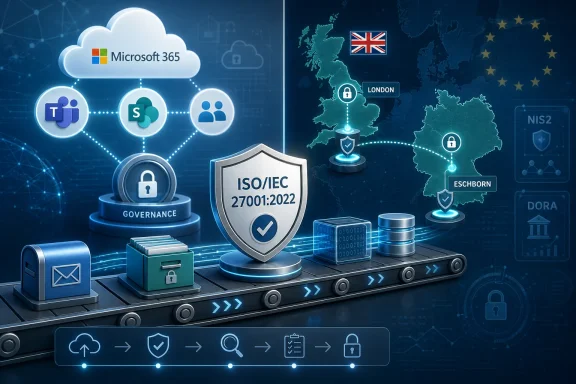 BCC Turns a Compliance Badge Into a Microsoft 365 Trust Argument
ISO/IEC 27001 certification is often treated as procurement wallpaper: a logo on a vendor page, a checkbox in a tender response, a paragraph in a security questionnaire. In BCC Group’s case, the certification deserves a little more attention because of where the company sits in the Microsoft 365 ecosystem. It is not selling a generic productivity add-on; it works in the awkward layer where identity, collaboration sprawl, migration history, compliance evidence, and now Copilot data exposure all collide.The company’s announcement says the certified scope covers the design, development, operation, and support of software and SaaS solutions, plus associated service and migration projects. That is a broad claim. It means BCC is not presenting certification as a narrow back-office exercise limited to corporate IT, but as a statement about the core processes behind its products and customer-facing work.
That breadth is the point. Microsoft 365 specialists increasingly operate inside sensitive customer environments, sometimes with delegated permissions, migration tooling, data mapping responsibilities, and insight into legacy systems that organizations barely understand themselves. A governance vendor that cannot document its own controls has a credibility problem before the first workshop begins.
BCC’s certification covers both BCC GmbH in Eschborn and BCC Ltd in London. That detail also matters. In a market where software development, consulting delivery, and support often span legal entities and national borders, a single-entity certificate can leave buyers asking whether the practical delivery chain is really covered. BCC is making the stronger argument that its core group processes, not just one office, have been audited under the new 2022 version of the standard.
ISO 27001 Is Boring Until the Auditor Asks About Your SaaS Vendor
The reason ISO/IEC 27001 keeps appearing in security conversations is not that it guarantees perfection. It does not. Certification does not mean a company cannot suffer a breach, misconfigure a tenant, mishandle support access, or ship a bug. What it does mean is that an independent certification process has assessed whether the organization has an information security management system designed to identify risks, assign controls, monitor performance, and improve over time.That difference is not semantic. In enterprise procurement, the question is rarely “can this vendor promise security?” Everyone can promise security. The better question is “can this vendor show how security decisions are governed, measured, reviewed, and corrected when reality misbehaves?” ISO/IEC 27001 is one of the more widely recognized ways of answering that question in a language customers, auditors, and regulators understand.
The 2022 revision of the standard is especially relevant because it reflects a changed security environment. The modern information security problem is no longer only about perimeter defense, endpoint antivirus, or password policy. It is about cloud services, suppliers, access governance, operational resilience, privacy protection, threat intelligence, secure development, configuration control, and evidence.
That evidence burden is growing heavier. Customers buying SaaS and consulting services increasingly need to prove not only that they have chosen reputable vendors, but that vendor selection itself was risk-based and defensible. A certificate does not end due diligence, but it can shorten the distance between marketing language and audit-ready proof.
For BCC, the timing is useful. The company’s business sits directly in Microsoft 365, where customers are simultaneously trying to rationalize legacy estates, govern Teams and guests, control information lifecycle, and evaluate how much organizational knowledge Copilot should be allowed to touch. Those are not abstract governance themes. They are operational issues with security consequences.
Microsoft 365 Has Become the New Control Plane for Organizational Risk
The phrase “Microsoft 365 environment” used to sound like shorthand for Exchange Online, SharePoint, Teams, and Office apps. That view is now too small. For many organizations, Microsoft 365 has become a control plane for identity-adjacent collaboration, document lifecycle, external sharing, records exposure, meeting culture, endpoint access, compliance signals, search, and AI grounding.That shift creates a vendor opportunity, but it also creates a vendor obligation. Any company offering migration, governance, automation, or Copilot enablement services in Microsoft 365 is effectively participating in the customer’s risk model. A poorly governed migration can preserve years of bad permissions. A rushed Teams rollout can turn guest access into a permanent shadow directory. A Copilot connector can make obscure business data suddenly discoverable in natural language.
BCC’s product set maps neatly onto these anxieties. Affirmatic is positioned around Microsoft 365 governance, Teams lifecycle, guest access, approvals, and evidence. MigrationEngine speaks to the long tail of organizations still extracting mail, calendars, and business history from older or alternate platforms. The BCC Copilot Connector is aimed at making information from business applications available to Microsoft Copilot in a controlled way.
The common thread is not productivity. It is containment. BCC is selling customers the idea that Microsoft 365 value arrives only when collaboration, migration, and AI access are wrapped in governance. ISO/IEC 27001 certification strengthens that pitch because it lets BCC say that containment is not merely product copy; it is also part of the company’s own management system.
That is a subtle but important distinction in the partner ecosystem. Microsoft’s platform provides native security, compliance, and administrative controls, but customers rarely live in a clean native-only world. They have Domino histories, third-party archives, custom workflows, old business applications, unmanaged Teams, external collaborators, and departments that treat SharePoint as a file dump with better branding. Partners make that world usable. They can also make it riskier.
The Copilot Era Raises the Price of Bad Governance
The most consequential line in BCC’s announcement is not the certificate itself. It is the explicit connection between ISO/IEC 27001 and the “secure use of Microsoft 365, Microsoft Copilot, Copilot Agents and Copilot Connectors.” That is where the announcement becomes more than a compliance milestone.Copilot changes the perceived blast radius of poor information governance. Before generative AI, overshared files and stale permissions were already dangerous, but discovery often required a user to know where to search and what to search for. With AI-assisted retrieval, summarization, and conversational querying, long-buried access problems can become easier to exploit accidentally or deliberately.
Microsoft’s model is that Copilot should respect existing permissions. That is necessary, but it is not sufficient comfort for administrators. If the permissions are wrong, stale, excessive, inherited from a migration, or granted to a guest account that nobody owns anymore, respecting them faithfully can still produce bad outcomes. The AI did not create the governance failure; it made the failure easier to observe.
That is why vendors in this space are rushing to frame themselves around “secure Copilot adoption.” The phrase can be overused, but the underlying problem is real. Organizations want the productivity upside of AI over their internal knowledge base, yet many have spent years tolerating chaotic access models because the consequences were diffuse and hard to measure. Copilot compresses that ambiguity into a board-level question: what exactly will the assistant be able to see?
Connectors amplify the issue. Microsoft 365 Copilot connectors are designed to bring content from external systems into Microsoft 365 and Copilot experiences. Done well, that can make AI useful across knowledge bases, ticketing platforms, wikis, file stores, CRM tools, and older business applications. Done poorly, it can bridge years of messy permissions into a single conversational surface.
BCC’s Copilot Connector pitch therefore lives or dies on trust. Customers need to believe that the connector will not flatten authorization models, ignore source-system permissions, mishandle indexing, or create opaque data flows that administrators cannot explain later. ISO/IEC 27001 certification does not certify a connector’s architecture by itself, but it does add weight to the vendor’s claim that security management is embedded in the organization behind the product.
A Certificate Does Not Replace Architecture, but It Changes the Procurement Conversation
There is a temptation, especially in press releases, to treat certification as a finish line. For buyers, it should be treated as an opening bid. ISO/IEC 27001 tells customers that an audited management system exists, but it does not answer every practical question about a SaaS platform, migration project, or Copilot connector.Administrators still need to ask how support access is granted and revoked. They still need to understand where logs are retained, how incidents are reported, how data is segregated, how development pipelines are secured, and whether subcontractors touch production systems. They still need architecture diagrams, data processing terms, vulnerability management details, and clarity on service boundaries.
What certification changes is the quality of that conversation. A vendor with a functioning information security management system should be able to answer those questions coherently and consistently. It should have documented risk treatment decisions rather than improvisations. It should be able to show how controls are assigned, monitored, reviewed, and improved.
For public sector customers and regulated industries, that can be decisive. Procurement teams do not merely want technical assurances; they need defensible vendor governance. If an authority, auditor, or board asks why a particular Microsoft 365 partner was selected for a migration or Copilot enablement project, an ISO/IEC 27001 certificate does not prove the choice was perfect, but it supports the argument that the vendor met a recognized baseline.
BCC’s reference to a UKAS-accredited process through Tempo Audits Ltd is part of that same trust-building exercise. Accreditation does not make a certification magical, but it signals that the certification body itself is operating within a recognized oversight framework. In a crowded compliance market, where “certified” can sometimes hide more than it reveals, that distinction is worth noting.
European Regulation Is Turning Vendor Security Into a Shared Liability Problem
BCC’s announcement name-checks NIS2 and DORA, and that is not accidental. European cybersecurity and operational resilience rules are pushing organizations to look beyond their own perimeter and into supplier risk. The modern compliance question is increasingly not “are we secure?” but “can we prove that our digital supply chain is governed?”NIS2 raises expectations around cybersecurity risk management and incident reporting across a wider set of essential and important entities. DORA, meanwhile, focuses the financial sector on ICT risk, resilience, third-party management, and the ability to withstand disruptions. These frameworks are not identical, but they share a direction of travel: outsourcing does not outsource accountability.
That is uncomfortable for Microsoft 365 customers because the platform is inherently ecosystem-driven. Few enterprises run the tenant alone. They rely on migration specialists, managed service providers, backup vendors, governance tools, security platforms, identity consultants, app developers, and increasingly AI integration partners. Each dependency becomes part of the organization’s operational risk story.
For a vendor like BCC, ISO/IEC 27001 certification becomes a passport into more serious conversations. It does not guarantee a sale, but it reduces friction in environments where supplier assurance is no longer optional. If a bank, public agency, healthcare organization, or critical infrastructure supplier wants help governing Microsoft 365 or enabling Copilot against sensitive data, a certified ISMS becomes a practical requirement rather than a nice-to-have.
This is also where mid-market customers should pay attention. Smaller and mid-sized companies may not have the same procurement machinery as global enterprises, but they face similar exposure. They adopt Microsoft 365, invite guests, migrate mailboxes, connect business systems, and turn on AI features with fewer internal specialists watching the blast radius. A partner’s security maturity can matter more, not less, when the customer’s own team is stretched.
Migration Is Still the Place Where Old Risk Learns New Tricks
The Microsoft 365 story is often told as a cloud adoption story, but for many customers it is really a migration story that never quite ends. Mail systems move. Archives linger. Shared drives become SharePoint sites. Domino applications survive longer than anyone expected. Teams sprawl. Tenant consolidations follow mergers. Departures leave behind orphaned ownership models.Migration work is risky because it deals with the sediment of organizational history. Old access models are copied forward. Data that should have been deleted becomes searchable. Business-critical workflows are rediscovered only when they break. Permissions that made sense in 2009 become indefensible in 2026.
BCC’s MigrationEngine is therefore more than a transport tool in this context. A migration vendor’s processes affect data integrity, confidentiality, chain of custody, cutover reliability, rollback planning, and customer trust. If the work involves mail, calendars, archives, or business applications, the vendor may touch material that is commercially sensitive, legally relevant, or personally identifiable.
That is why certification scope matters. If BCC had certified only a corporate management function, the relevance to migration delivery would be weaker. By saying the certified scope includes planning and delivery of service and migration projects, the company is pointing directly at one of the highest-risk parts of its business.
The same logic applies to support. SaaS products are not static artifacts. They are operated, patched, monitored, configured, and supported over time. A vendor’s helpdesk workflow, escalation process, privileged access model, and incident handling can matter as much as the original code. Certification that includes operation and support is therefore more meaningful than a certificate that leaves production reality outside the frame.
Governance Tools Must Be Governed Too
There is an irony at the heart of the Microsoft 365 governance market: customers often buy tools to control sprawl, only to add another privileged system that itself requires governance. A lifecycle-management product may need permissions across Teams, groups, users, guests, mailboxes, labels, policies, or audit data. A migration engine may need temporary but powerful access. A connector may mediate between source systems and AI experiences.That does not make these tools bad. It makes them important. The more a product promises to automate governance, the more buyers should care about how the product is developed, operated, and audited. Automation can enforce good policy at scale; it can also replicate a bad assumption at machine speed.
BCC’s Affirmatic pitch centers on structure: request templates, delegated approvals, lifecycle rules, external user management, and evidence trails. Those are precisely the areas where Microsoft 365 environments often become politically messy. Business users want self-service. IT wants control. Security wants least privilege. Compliance wants evidence. Nobody wants to become the department of “no.”
A credible governance platform has to make that compromise operational. It must give users enough speed to avoid shadow IT, while giving administrators enough visibility to avoid blind trust. That balance is difficult in any tenant, and harder in organizations with multiple business units, legacy structures, or external collaboration requirements.
ISO/IEC 27001 certification does not prove that Affirmatic solves every governance problem. It does, however, reinforce a broader message: the company building governance tooling has submitted its own processes to external scrutiny. In a market full of dashboards and slogans, that is a useful signal.
The UK-Germany Footprint Is a Feature, Not a Footnote
BCC’s structure — BCC GmbH in Eschborn and BCC Ltd in London — gives the announcement a cross-border character that mirrors the market it serves. Microsoft 365 deployments are rarely confined neatly within one jurisdiction, especially for European businesses operating across subsidiaries, partners, and regulatory regimes. Data protection, contractual obligations, public-sector procurement requirements, and operational resilience expectations all travel with the work.The inclusion of both group entities in the certification is therefore more than a corporate housekeeping note. It tells customers that the audited scope follows the group’s actual delivery model. For buyers, that is easier to work with than a fragmented assurance picture where one entity sells, another develops, a third supports, and only one of them appears on the certificate.
The UK angle is also interesting after Brexit because UK and EU assurance ecosystems remain deeply interconnected but no longer politically identical. A UKAS-accredited process can carry weight, particularly for UK customers and international buyers familiar with the accreditation system. German customers, meanwhile, will care about the Eschborn entity and the company’s proximity to heavily regulated European industries.
For Microsoft 365 partners, geography is increasingly part of trust. Customers want to know who can access their environment, where support staff operate, which legal entity contracts with them, and how incident obligations flow. Certification does not answer every jurisdictional question, but a group-wide scope makes the answers easier to organize.
The Announcement Is Also a Signal to Microsoft
Vendor certifications are aimed at customers, but they also speak to platform owners. Microsoft’s partner ecosystem depends on specialists who can extend, migrate, govern, and operationalize Microsoft 365 in the real world. As Microsoft pushes Copilot deeper into business workflows, the quality of that ecosystem becomes part of the platform’s reputation.Microsoft can build the AI layer, define the connector model, enforce identity permissions, and expand admin controls. But it cannot clean every customer’s data estate or explain every legacy workflow. That job falls partly to partners. If those partners mishandle security, the customer may blame the vendor, but the bad feeling often attaches to the platform too.
That is why partner maturity matters in the Copilot era. A connector that brings external business data into Microsoft 365 is only as trustworthy as its design, implementation, and operating discipline. A migration that dumps poorly classified content into SharePoint can undermine confidence in Microsoft’s security model even if Microsoft’s own controls behave as designed. A governance tool that mismanages approvals can create tenant-wide skepticism about automation.
BCC’s certification gives it a stronger partner story. It can say, in effect, that its internal security program has been audited against an internationally recognized standard while it helps customers manage Microsoft 365 risk. That is the kind of message that resonates with enterprise customers and platform alliances alike.
It also reflects a broader shift in the partner market. Technical capability is no longer enough. The winners will be vendors that can combine domain expertise, secure engineering, operational maturity, compliance fluency, and credible AI governance. That is a higher bar than “we know SharePoint.”
Buyers Should Still Read the Small Print
The danger with certifications is that they can induce procurement laziness. A badge can become a substitute for understanding. That would be a mistake here, as it is with any vendor.Customers should ask for the certificate details, including scope, locations, legal entities, certification body, validity period, and exclusions. They should map the certified scope against the actual services they plan to buy. If the project involves a Copilot connector, they should ask how permissions are preserved, how source data is indexed, how deletion and revocation are handled, and how administrators can audit what has been exposed.
They should also ask how BCC separates customer environments, manages privileged access, handles support sessions, and reports incidents. If migration services are involved, they should request details on data handling, temporary storage, encryption, logging, retry behavior, and cleanup. If SaaS products are involved, they should review hosting architecture, identity integration, monitoring, backup, change management, and vulnerability disclosure processes.
None of that undermines the certification. It is the proper use of it. ISO/IEC 27001 should make due diligence more efficient, not unnecessary. The best vendors will welcome that kind of questioning because the answers already exist inside the management system.
For WindowsForum readers, this is the practical lesson. A Microsoft 365 partner’s security posture is not peripheral. It is part of the tenant’s risk surface. The more deeply a vendor integrates with governance, migration, and AI, the more attention its own controls deserve.
The Real Test Will Come When Copilot Meets Legacy Data
BCC’s announcement arrives at a moment when enterprises are trying to reconcile two opposing instincts. On one side, Microsoft and its partners are encouraging organizations to connect more data, automate more decisions, and let AI become a working interface to institutional knowledge. On the other side, security teams are discovering that institutional knowledge is often misclassified, over-permissioned, duplicated, stale, and politically hard to delete.That tension is the future of Microsoft 365 administration. The old admin job was to keep mail flowing, identities synchronized, devices compliant, and collaboration available. The new job is to decide what an AI assistant should be allowed to know, how it should discover that knowledge, and how the organization can prove the answer was governed.
In that world, a vendor like BCC has a plausible role. It knows migration. It sells governance. It is building around Copilot connectors. It is now carrying ISO/IEC 27001:2022 certification across its German and UK entities. That does not make it uniquely qualified, but it does move the company into a more credible category for customers who need Microsoft 365 help and cannot afford casual security.
The hard part is execution. Customers will judge BCC not by the announcement, but by how its tools behave in complicated tenants, how its consultants handle messy realities, and how transparent the company is when tradeoffs appear. Certification can establish trust; it cannot spend that trust carelessly.
The Certificate Moves BCC From Pitching Control to Proving Discipline
BCC’s ISO/IEC 27001:2022 certification is best understood as a trust accelerant, not a victory lap. It strengthens the company’s claim that its Microsoft 365 governance, migration, SaaS, and Copilot-related work is backed by audited internal security discipline.- BCC Group says the certification covers both BCC GmbH in Eschborn and BCC Ltd in London, rather than only one legal entity.
- The certified scope includes software and SaaS design, development, operation, support, and associated service and migration projects.
- The announcement is especially relevant to customers evaluating Affirmatic, MigrationEngine, and the BCC Copilot Connector.
- The certification supports, but does not replace, detailed customer due diligence on architecture, permissions, support access, incident handling, and data flows.
- The timing is significant because Microsoft 365 Copilot and connectors make old access-governance problems more visible and potentially more consequential.
- For regulated, public-sector, and security-conscious buyers, the certificate may reduce procurement friction by providing a recognized assurance baseline.
References
- Primary source: openpr.com
Published: 2026-06-26T08:50:08.862429
BCC Group Achieves ISO/IEC 27001:2022 Certification
Press release - BCC - The Business Collaboration Company - BCC Group Achieves ISO/IEC 27001:2022 Certification - published on openPR.comwww.openpr.com - Related coverage: bcchub.com
BCC Group Achieves ISO/IEC 27001 Certification with UKAS Accreditation
With ISO 27001 certification, BCC confirms the highest standards for information security, compliance, and trustworthy Microsoft 365 products and services.www.bcchub.com
