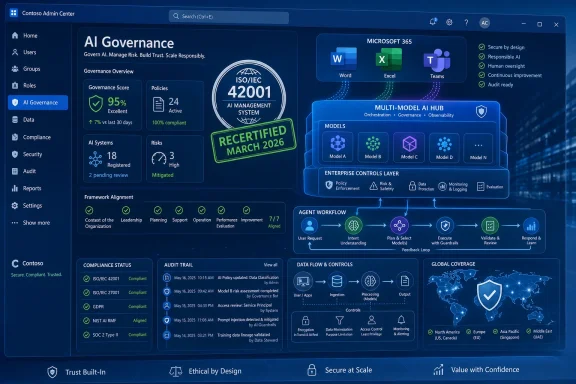
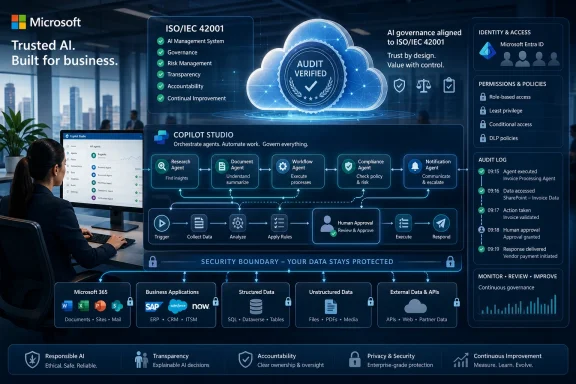
Microsoft 365 Copilot was recertified in March 2026 against ISO/IEC 42001:2023 with what Microsoft describes as zero non-conformities and zero improvement observations, extending a certification first awarded in March 2025 to its enterprise AI assistant across Microsoft 365. The result gives Redmond a useful proof point at exactly the moment customers are asking whether generative AI can be governed as more than a productivity experiment. But the more important story is not that Copilot passed another audit. It is that Microsoft is trying to turn auditability itself into a competitive moat.
For the first wave of enterprise AI, the sales pitch was speed. Summarize meetings, draft emails, query spreadsheets, write presentations, automate the boring parts of office life. That was enough to get pilots approved, budgets carved out, and executive demos scheduled.
The second wave is different. Once a tool is allowed to read mailboxes, Teams chats, SharePoint files, OneDrive folders, calendars, and business documents, the question stops being “does it work?” and becomes “who is accountable when it works badly?” That is where ISO/IEC 42001 matters.
ISO/IEC 42001:2023 is not a badge saying an AI model is brilliant, unbiased, or immune to failure. It is a management-system standard for how organizations govern AI: risk assessment, data management, transparency, oversight, supplier controls, monitoring, and continual improvement. In plainer English, it asks whether an organization has a disciplined operating system for AI risk rather than a pile of promises.
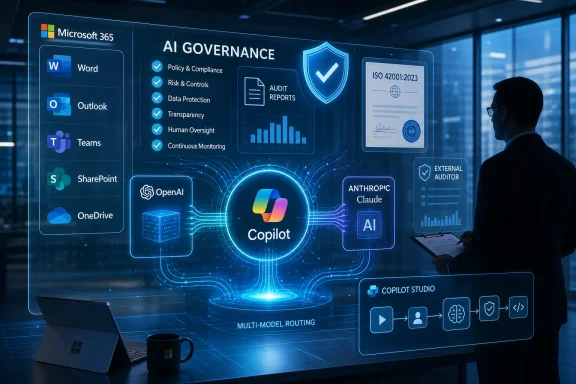
Microsoft’s message is that Copilot is not merely an app bolted onto Office. It is an AI system run through a formal governance machine, audited by an external body and recertified after the system had changed. That distinction matters because Copilot is no longer a single-model assistant sitting neatly inside a 2023-era product diagram.
By 2026, the product had widened. Microsoft has added Anthropic’s Claude models in parts of the Copilot estate, giving enterprise customers more model choice and reducing the appearance — and perhaps the risk — of dependence on one model supplier. Microsoft has also expanded the ISO 42001 scope to include Copilot Studio, the agent-building platform that lets organizations create custom copilots and workflow automations.
That expansion is where the audit becomes more meaningful. A chatbot that drafts text is one governance problem. A platform that lets departments create agents which connect to internal data, trigger business processes, and use different model providers is another. The risk surface moves from “the assistant gave me a bad answer” to “an AI-driven workflow made a bad decision using sensitive data at scale.”
Microsoft says the recertification produced no non-conformities and no improvement observations. In audit language, that is unusually tidy. In enterprise-sales language, it is a slide executives can bring to risk committees, procurement teams, and regulators who increasingly want proof that AI deployments are governed before they are expanded.
This distinction is especially important for Microsoft 365 Copilot because the product inherits the permission reality of the customer’s Microsoft 365 environment. If a SharePoint site has been overshared for years, Copilot can make that mess more visible. If labels, retention policies, and access reviews are weak, the assistant may become the fastest way to discover that the organization’s information architecture was never ready for AI.
Microsoft has tried to answer this by pointing customers toward SharePoint Advanced Management, Restricted SharePoint Search, Purview controls, audit logs, sensitivity labels, and lifecycle governance. Those tools matter. But they also shift part of the burden back to the customer.
That is the quiet bargain behind enterprise AI compliance. Microsoft can certify the system it provides, document the controls it runs, and make governance tooling available. It cannot certify that every customer has cleaned up a decade of permissions sprawl before licensing Copilot to thousands of users.
But model choice also complicates trust. Once an enterprise AI system can route work through multiple model providers, customers need to know not only what the AI assistant does, but who processes what, where, under which terms, and with which regional limitations. Microsoft’s documentation around Anthropic as a subprocessor reflects exactly that reality, including availability limits, administrative controls, and regional exclusions.
For administrators, this is not an academic distinction. European customers, regulated industries, public-sector tenants, and organizations with data residency commitments cannot treat every model option as interchangeable. The shiny feature may arrive with a footnote that matters more than the demo.
That is why including a more complex Copilot estate in a clean ISO 42001 recertification is useful for Microsoft. It lets the company argue that its governance process has scaled with the product. The harder question is whether customer understanding has scaled at the same pace.
That is where governance becomes less like software compliance and more like process control. A poorly governed agent is not just a bad chatbot. It can become an unreliable interface to HR workflows, customer service systems, finance approvals, or operational data.
Microsoft wants Copilot Studio to be the safe enterprise path into that world. The pitch is straightforward: build agents inside the Microsoft cloud, inherit Microsoft identity and compliance controls, use familiar admin surfaces, and avoid the chaos of unsanctioned AI tools stitched together by departments without central oversight.
The counterargument is just as straightforward. The easier Microsoft makes it to create agents, the more organizations need inventory, approval workflows, testing, monitoring, rollback processes, and owners who understand the systems being automated. ISO 42001 can validate Microsoft’s governance framework. It cannot replace internal discipline inside every tenant.
Earlier this year, Microsoft said Microsoft 365 Copilot had reached 15 million paid seats. Subsequent reporting around Microsoft’s earnings suggested the number had grown beyond that, but the larger context remains important: Microsoft 365 has hundreds of millions of commercial users. Even millions of paid Copilot seats can represent both impressive growth and a relatively small slice of the addressable base.
That is why certifications matter commercially. They do not prove ROI, but they reduce friction. A CIO trying to expand from a pilot to a company-wide deployment needs answers for legal, security, privacy, compliance, procurement, records management, and works council stakeholders. A clean external audit gives those groups something more concrete than a keynote.
It also gives Microsoft a way to differentiate Copilot from a crowded field of AI tools that may be faster to adopt but harder to defend in regulated environments. In consumer AI, the best answer often wins. In enterprise AI, the answer that can survive a procurement review has a serious advantage.
Microsoft’s argument is that automated validation can expand coverage while humans remain in the loop for judgment, escalation, and accountability. That is probably the only realistic path for a company shipping AI across Microsoft 365, Security, GitHub, healthcare, developer tooling, and business applications.
Still, this deserves scrutiny. Using AI to test AI is powerful, but it can also create a false sense of assurance if the tests are narrow, the metrics are gamed, or the validation process misses emergent behavior in real customer environments. The enterprise buyer should welcome automation while asking what it measures, what it misses, and how exceptions are handled.
In other words, Microsoft’s internal tooling may help explain how Copilot achieved a clean recertification. It should not end the conversation about how organizations validate their own use cases once Copilot is deployed into messy, political, permission-heavy workplaces.
That advantage is enormous. It is also why the stakes are higher. A standalone AI writing app that mishandles a prompt is a problem. An AI layer embedded across the productivity suite used by an entire enterprise is infrastructure.
Microsoft knows this, which is why the company is increasingly selling trust as much as intelligence. ISO 42001, CSA STAR for AI recognition, Service Trust Portal artifacts, transparency notes, Purview integrations, and administrator controls all serve the same strategic purpose: to make Copilot feel like a governable enterprise platform rather than another generative AI gamble.
The danger for Microsoft is overclaiming. If customers hear “certified” and later discover that Copilot exposed poorly permissioned content, produced low-quality answers, or required more data cleanup than expected, the trust story weakens. The audit certifies Microsoft’s management system. The deployment experience will certify — or undermine — Microsoft’s reputation.
Copilot’s value depends heavily on the quality and governance of the data it can reach. If the Microsoft Graph contains stale documents, abandoned Teams, loosely governed SharePoint sites, and files shared broadly “just to get something done,” Copilot will surface that reality with uncomfortable efficiency.
The multi-model architecture adds another administrative layer. Organizations will need to decide whether Anthropic models are enabled, which users or scenarios can use them, how regional constraints affect policy, and how to communicate model choice to employees without turning every prompt into a compliance seminar.
Copilot Studio raises the bar again. Agent creation should not become the new shadow IT. If business units can build agents faster than central IT can review them, the organization may recreate the old macro, Access database, and Power Automate governance problem — only now with generative AI attached.
That story is now stronger than it was a year ago. Microsoft can say that Copilot passed an external AI management-system audit before and after major product evolution. It can say the scope is broader, the architecture is more complex, and the governance process still held.
But enterprise customers should treat that as a starting point. The right response is not blind trust; it is structured adoption. Start with data hygiene. Define high-risk use cases. Control agent creation. Document model-provider choices. Monitor outputs. Train users that Copilot is an assistant, not an authority.
If Microsoft’s certification helps organizations have that conversation earlier, it will be more than marketing. If it becomes a checkbox used to rush deployments, it will be another example of compliance language being asked to do operational work it was never designed to do.
 Microsoft Turns Compliance Into Product Strategy
For the first wave of enterprise AI, the sales pitch was speed. Summarize meetings, draft emails, query spreadsheets, write presentations, automate the boring parts of office life. That was enough to get pilots approved, budgets carved out, and executive demos scheduled.The second wave is different. Once a tool is allowed to read mailboxes, Teams chats, SharePoint files, OneDrive folders, calendars, and business documents, the question stops being “does it work?” and becomes “who is accountable when it works badly?” That is where ISO/IEC 42001 matters.
ISO/IEC 42001:2023 is not a badge saying an AI model is brilliant, unbiased, or immune to failure. It is a management-system standard for how organizations govern AI: risk assessment, data management, transparency, oversight, supplier controls, monitoring, and continual improvement. In plainer English, it asks whether an organization has a disciplined operating system for AI risk rather than a pile of promises.
Microsoft’s message is that Copilot is not merely an app bolted onto Office. It is an AI system run through a formal governance machine, audited by an external body and recertified after the system had changed. That distinction matters because Copilot is no longer a single-model assistant sitting neatly inside a 2023-era product diagram.
The Clean Audit Arrives After Copilot Got More Complicated
The timing is the point. Microsoft’s original 2025 certification covered a Copilot architecture that was easier to describe: Microsoft 365 Copilot and Copilot Chat powered principally through Microsoft’s partnership with OpenAI, wrapped in Microsoft Graph permissions, compliance controls, and enterprise identity.By 2026, the product had widened. Microsoft has added Anthropic’s Claude models in parts of the Copilot estate, giving enterprise customers more model choice and reducing the appearance — and perhaps the risk — of dependence on one model supplier. Microsoft has also expanded the ISO 42001 scope to include Copilot Studio, the agent-building platform that lets organizations create custom copilots and workflow automations.
That expansion is where the audit becomes more meaningful. A chatbot that drafts text is one governance problem. A platform that lets departments create agents which connect to internal data, trigger business processes, and use different model providers is another. The risk surface moves from “the assistant gave me a bad answer” to “an AI-driven workflow made a bad decision using sensitive data at scale.”
Microsoft says the recertification produced no non-conformities and no improvement observations. In audit language, that is unusually tidy. In enterprise-sales language, it is a slide executives can bring to risk committees, procurement teams, and regulators who increasingly want proof that AI deployments are governed before they are expanded.
ISO 42001 Is Not a Security Blanket
There is a temptation to read “certified” as “safe.” That would be a mistake, and Microsoft’s own documentation effectively says as much. ISO 42001 validates a management framework, not the absence of hallucinations, prompt-injection risk, oversharing, data-quality problems, or poor tenant hygiene.This distinction is especially important for Microsoft 365 Copilot because the product inherits the permission reality of the customer’s Microsoft 365 environment. If a SharePoint site has been overshared for years, Copilot can make that mess more visible. If labels, retention policies, and access reviews are weak, the assistant may become the fastest way to discover that the organization’s information architecture was never ready for AI.
Microsoft has tried to answer this by pointing customers toward SharePoint Advanced Management, Restricted SharePoint Search, Purview controls, audit logs, sensitivity labels, and lifecycle governance. Those tools matter. But they also shift part of the burden back to the customer.
That is the quiet bargain behind enterprise AI compliance. Microsoft can certify the system it provides, document the controls it runs, and make governance tooling available. It cannot certify that every customer has cleaned up a decade of permissions sprawl before licensing Copilot to thousands of users.
The Multi-Model Era Makes Supplier Trust a Front-Line Issue
The addition of Anthropic models gives Microsoft an obvious product advantage. Different models behave differently, and some customers want choice for reasoning quality, cost, latency, language support, or internal policy reasons. A single “best model” story was always going to age badly in a market changing every quarter.But model choice also complicates trust. Once an enterprise AI system can route work through multiple model providers, customers need to know not only what the AI assistant does, but who processes what, where, under which terms, and with which regional limitations. Microsoft’s documentation around Anthropic as a subprocessor reflects exactly that reality, including availability limits, administrative controls, and regional exclusions.
For administrators, this is not an academic distinction. European customers, regulated industries, public-sector tenants, and organizations with data residency commitments cannot treat every model option as interchangeable. The shiny feature may arrive with a footnote that matters more than the demo.
That is why including a more complex Copilot estate in a clean ISO 42001 recertification is useful for Microsoft. It lets the company argue that its governance process has scaled with the product. The harder question is whether customer understanding has scaled at the same pace.
Copilot Studio Pulls the Audit Into the Agent Economy
Copilot Studio is the most consequential part of the expanded scope because it represents Microsoft’s bet that AI will move from assistant to agent. In the assistant phase, Copilot sits beside the worker. In the agent phase, Copilot is increasingly expected to take action across systems, retrieve data, use connectors, and become part of business operations.That is where governance becomes less like software compliance and more like process control. A poorly governed agent is not just a bad chatbot. It can become an unreliable interface to HR workflows, customer service systems, finance approvals, or operational data.
Microsoft wants Copilot Studio to be the safe enterprise path into that world. The pitch is straightforward: build agents inside the Microsoft cloud, inherit Microsoft identity and compliance controls, use familiar admin surfaces, and avoid the chaos of unsanctioned AI tools stitched together by departments without central oversight.
The counterargument is just as straightforward. The easier Microsoft makes it to create agents, the more organizations need inventory, approval workflows, testing, monitoring, rollback processes, and owners who understand the systems being automated. ISO 42001 can validate Microsoft’s governance framework. It cannot replace internal discipline inside every tenant.
The Enterprise Buyer Wants Evidence, Not Evangelism
Microsoft’s AI marketing has often moved faster than customer confidence. Copilot has been positioned as the next interface for work, the natural evolution of Office, and the productivity layer that justifies a new generation of Microsoft 365 spending. Yet enterprise adoption has been uneven enough that every hard number is scrutinized.Earlier this year, Microsoft said Microsoft 365 Copilot had reached 15 million paid seats. Subsequent reporting around Microsoft’s earnings suggested the number had grown beyond that, but the larger context remains important: Microsoft 365 has hundreds of millions of commercial users. Even millions of paid Copilot seats can represent both impressive growth and a relatively small slice of the addressable base.
That is why certifications matter commercially. They do not prove ROI, but they reduce friction. A CIO trying to expand from a pilot to a company-wide deployment needs answers for legal, security, privacy, compliance, procurement, records management, and works council stakeholders. A clean external audit gives those groups something more concrete than a keynote.
It also gives Microsoft a way to differentiate Copilot from a crowded field of AI tools that may be faster to adopt but harder to defend in regulated environments. In consumer AI, the best answer often wins. In enterprise AI, the answer that can survive a procurement review has a serious advantage.
The Audit Also Shows Microsoft Learning From Its Own AI
One of the more interesting parts of Microsoft’s framing is the claim that it is using AI to improve AI governance. That sounds like a slogan until you consider the scale of the problem. Large AI systems require repeated validation across prompts, behaviors, data flows, policies, documentation, and product changes. Manual review alone does not scale cleanly.Microsoft’s argument is that automated validation can expand coverage while humans remain in the loop for judgment, escalation, and accountability. That is probably the only realistic path for a company shipping AI across Microsoft 365, Security, GitHub, healthcare, developer tooling, and business applications.
Still, this deserves scrutiny. Using AI to test AI is powerful, but it can also create a false sense of assurance if the tests are narrow, the metrics are gamed, or the validation process misses emergent behavior in real customer environments. The enterprise buyer should welcome automation while asking what it measures, what it misses, and how exceptions are handled.
In other words, Microsoft’s internal tooling may help explain how Copilot achieved a clean recertification. It should not end the conversation about how organizations validate their own use cases once Copilot is deployed into messy, political, permission-heavy workplaces.
Redmond’s Strongest Argument Is Also Its Weakness
Microsoft’s core advantage in enterprise AI is distribution. Copilot lives where work already happens: Word, Excel, PowerPoint, Outlook, Teams, SharePoint, OneDrive, and the Microsoft Graph. It can be governed through familiar administrative systems and sold through relationships that already exist.That advantage is enormous. It is also why the stakes are higher. A standalone AI writing app that mishandles a prompt is a problem. An AI layer embedded across the productivity suite used by an entire enterprise is infrastructure.
Microsoft knows this, which is why the company is increasingly selling trust as much as intelligence. ISO 42001, CSA STAR for AI recognition, Service Trust Portal artifacts, transparency notes, Purview integrations, and administrator controls all serve the same strategic purpose: to make Copilot feel like a governable enterprise platform rather than another generative AI gamble.
The danger for Microsoft is overclaiming. If customers hear “certified” and later discover that Copilot exposed poorly permissioned content, produced low-quality answers, or required more data cleanup than expected, the trust story weakens. The audit certifies Microsoft’s management system. The deployment experience will certify — or undermine — Microsoft’s reputation.
The Fine Print Is Where Admins Will Live
For WindowsForum readers, especially sysadmins and Microsoft 365 administrators, the practical consequences are less glamorous than the certification announcement. The audit does not remove the need to prepare tenants, review permissions, classify data, define acceptable use, train users, and monitor adoption.Copilot’s value depends heavily on the quality and governance of the data it can reach. If the Microsoft Graph contains stale documents, abandoned Teams, loosely governed SharePoint sites, and files shared broadly “just to get something done,” Copilot will surface that reality with uncomfortable efficiency.
The multi-model architecture adds another administrative layer. Organizations will need to decide whether Anthropic models are enabled, which users or scenarios can use them, how regional constraints affect policy, and how to communicate model choice to employees without turning every prompt into a compliance seminar.
Copilot Studio raises the bar again. Agent creation should not become the new shadow IT. If business units can build agents faster than central IT can review them, the organization may recreate the old macro, Access database, and Power Automate governance problem — only now with generative AI attached.
The Real Win Is Permission to Keep Expanding
Microsoft’s clean recertification is best understood as permission to keep expanding Copilot, not proof that the hard part is over. The company wants Copilot to become the interface for enterprise work and Copilot Studio to become the factory for workplace agents. Neither ambition is possible without a credible governance story.That story is now stronger than it was a year ago. Microsoft can say that Copilot passed an external AI management-system audit before and after major product evolution. It can say the scope is broader, the architecture is more complex, and the governance process still held.
But enterprise customers should treat that as a starting point. The right response is not blind trust; it is structured adoption. Start with data hygiene. Define high-risk use cases. Control agent creation. Document model-provider choices. Monitor outputs. Train users that Copilot is an assistant, not an authority.
If Microsoft’s certification helps organizations have that conversation earlier, it will be more than marketing. If it becomes a checkbox used to rush deployments, it will be another example of compliance language being asked to do operational work it was never designed to do.
The Copilot Audit Gives Buyers a Better Checklist
The clean ISO 42001 result gives Microsoft a stronger hand, but it also gives customers a sharper set of demands. The useful lesson is not that every organization should now deploy Copilot everywhere. It is that AI adoption should be judged by governance maturity as much as feature velocity.- Microsoft 365 Copilot’s March 2026 ISO/IEC 42001 recertification strengthens Microsoft’s argument that its enterprise AI systems are governed through an externally audited management framework.
- The expanded scope matters because Copilot now includes a more complex multi-model architecture and brings Copilot Studio into the certification conversation.
- The certification does not guarantee that a customer’s tenant permissions, SharePoint structure, data labels, or user practices are ready for broad AI deployment.
- Anthropic model support gives enterprises more choice, but it also makes subprocessor, regional, and administrative policy decisions more important.
- Copilot Studio should be governed like an enterprise automation platform, not treated as a harmless chatbot builder.
- The strongest buying case for Copilot is not just productivity, but the ability to combine AI features with identity, compliance, audit, and data-governance controls already present in Microsoft 365.
References
- Primary source: Neowin
Published: 2026-05-28T02:04:08.578813
Microsoft 365 Copilot clears AI security audit once again - Neowin
Microsoft 365 Copilot has passed another external ISO 42001 audit with zero issues as Microsoft highlights major AI governance changes. www.neowin.net
- Official source: directionsonmicrosoft.com
Microsoft Claims 15 Million Paid M365 Copilot Seats - Directions on Microsoft
Microsoft has released for the first time an AI adoption number about which many had been curious. During its Q2 FY26 earnings call on January 28, officials said the company now has 15 million paid seats of Microsoft 365 Copilot among its 450 million Microsoft 365 commercial...www.directionsonmicrosoft.com - Official source: learn.microsoft.com
Anthropic models in Microsoft Online Services | Microsoft Learn
Learn about Anthropic models in Microsoft Online Services.learn.microsoft.com - Related coverage: computerworld.com
Microsoft touts M365 Copilot momentum, claims 15M paid users – Computerworld
Although the company is boasting about the popularity of its genAI tools, one analyst labeled the latest numbers a ‘disappointing uptake.’ www.computerworld.com
- Related coverage: techcrunch.com
Microsoft says it has over 20M paid Copilot users, and they really are using it | TechCrunch
Despite the lingering perception that no one really uses Copilot, Microsoft said on Wednesday that the number of users and engagement is growing.techcrunch.com - Related coverage: aitoolsbee.com
Microsoft 365 Copilot adoption hits 15 million paid seats - Aitoolsbee
Microsoft 365 Copilot adoption reached 15 million paid seats during the fiscal Q2 2026 earnings callWork IQ grounds Copilot on user emails, files, meetings, chats, and org context, excluding included chatAn Andreesen-Horowitz CIO survey found modest LLM ROI as enterprises learn deployment and... aitoolsbee.com
- Official source: anthropic.com
Claude is now available in Microsoft 365 Copilot | Claude
Today, Microsoft announced that Claude models are now available in Microsoft 365 Copilot, bringing Claude to millions of enterprise users through Microsoft's productivity platform. www.anthropic.com
- Official source: microsoft.com
Microsoft 365 Copilot Plans and Pricing—AI for Enterprise | Microsoft 365
Explore Copilot plans and pricing for enterprise. Learn how AI for business can boost productivity and streamline workflows across your organization.www.microsoft.com
- Official source: techcommunity.microsoft.com
Microsoft 365 Copilot Achieves ISO/IEC 42001:2023 Certification | Microsoft Community Hub
Another certification milestone for Microsoft 365 Copilot! techcommunity.microsoft.com
- Related coverage: majormatters.co
Microsoft Copilot Studio: The Enterprise AI Agent Platform With 450 Million Users Behind It | Review · Major Matters
Microsoft Copilot Studio is the enterprise AI agent platform backed by 450 million Microsoft 365 users, 1,400+ connectors, and a new Copilot Cowork feature built with Anthropic's Claude. We scored it 4/5 in our AI Agent Platforms review.majormatters.co - Official source: cdn-dynmedia-1.microsoft.com
- Official source: pulse.microsoft.com