

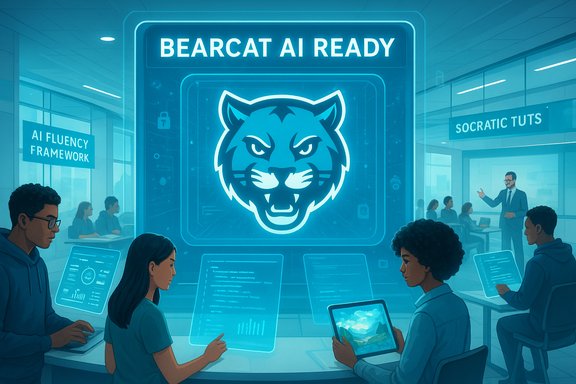
The University of Cincinnati has launched a coordinated, campus-wide push to become “AI-ready,” rolling together tenant-contained model hosting, faculty training, classroom pilots and operational automations under a program branded Bearcat AI Ready!. The initiative expands the campus BearcatGPT pilot into an enterprise-grade, Azure-hosted gateway for supervised generative AI use, pairs a four-tier AI Fluency Framework with applied workshops and certifications, and will introduce AI-driven Socratic Tutors into high‑impact math and statistics courses this November — all framed by governance, procurement controls and a community-of-practice model intended to scale AI responsibly across academics, research and administration.
The Bearcat AI Ready! program represents a deliberate shift from ad hoc, consumer-oriented AI use to institutionally provisioned and governed AI services. University communications describe the effort as a move from being “AI‑fluent” to becoming AI‑ready — an operational posture that pairs managed infrastructure, literacy training and governance to support widespread use without surrendering control over institutional data or pedagogy. The initiative is led by UC’s Digital Technology Solutions (DTS) and the AI Enablement Community of Practice, and is explicitly positioned to cover teaching, learning, research and administrative functions. At the technical center of that strategy is BearcatGPT: a UC‑hosted, Microsoft Azure OpenAI deployment originally run as a pilot and now being expanded to enterprise access for the full campus community via BearcatGPT.uc.edu. The service is described as a private environment that keeps inference and telemetry within UC’s tenant, offering both interactive chat and text-to-image capabilities (DALL·E), plus governed API endpoints and departmental/custom GPT agents. The academic side of Bearcat AI Ready! is anchored by a four‑tier AI Fluency Framework with a Tier 1 “AI Essentials” self‑paced primer already online, progressing through applied workshops and responsible‑AI deep dives to technical certifications and sprint weeks. Pedagogically notable is the planned deployment of Socratic Tutors — agents designed not to give answers but to ask scaffolded questions that promote problem solving and metacognition — slated to enter ten large math/stat courses in mid‑November.
Source: ohiotechnews.com Inside UC’s AI push: From classroom tutors to BearcatGPT, Cincinnati goes all-in on AI — OhioTechNews.com
 Background / Overview
The Bearcat AI Ready! program represents a deliberate shift from ad hoc, consumer-oriented AI use to institutionally provisioned and governed AI services. University communications describe the effort as a move from being “AI‑fluent” to becoming AI‑ready — an operational posture that pairs managed infrastructure, literacy training and governance to support widespread use without surrendering control over institutional data or pedagogy. The initiative is led by UC’s Digital Technology Solutions (DTS) and the AI Enablement Community of Practice, and is explicitly positioned to cover teaching, learning, research and administrative functions. At the technical center of that strategy is BearcatGPT: a UC‑hosted, Microsoft Azure OpenAI deployment originally run as a pilot and now being expanded to enterprise access for the full campus community via BearcatGPT.uc.edu. The service is described as a private environment that keeps inference and telemetry within UC’s tenant, offering both interactive chat and text-to-image capabilities (DALL·E), plus governed API endpoints and departmental/custom GPT agents. The academic side of Bearcat AI Ready! is anchored by a four‑tier AI Fluency Framework with a Tier 1 “AI Essentials” self‑paced primer already online, progressing through applied workshops and responsible‑AI deep dives to technical certifications and sprint weeks. Pedagogically notable is the planned deployment of Socratic Tutors — agents designed not to give answers but to ask scaffolded questions that promote problem solving and metacognition — slated to enter ten large math/stat courses in mid‑November. What UC is actually rolling out
A centralized AI hub and resources
UC launched an AI at UC website to centralize governance resources, training modules, tool lists (BearcatGPT, Microsoft Copilot, Adobe Firefly, Zoom AI Companion), and a prompt library. The hub also highlights campus “AI Champions” and committees within the AI Enablement Community of Practice to coordinate cross-campus pilots and policy. This creates a single point of engagement for faculty, staff and students to learn about approved tools and their appropriate use.BearcatGPT — pilot to enterprise
BearcatGPT began as a controlled pilot using Microsoft Azure OpenAI tooling. University messaging claims the pilot included access to advanced models (references include GPT‑4.x and GPT‑5 in recent press messaging) and DALL·E for image generation, and that the pilot environment did not feed campus prompts into public model training. The expansion to enterprise access promises governed API capabilities, departmental/custom GPT agents, and a UC-hosted gateway intended to keep data within the university tenancy. Note: public UC pages describing the pilot sometimes list available model versions differently across updates (for example GPT‑4o and GPT‑3.5 are explicitly listed on the OpenAI pilot page), so specific model availability may vary by pilot stage and will be finalized in the enterprise rollout. Where UC has used model-version labels in public statements, those are institutional claims tied to vendor offerings and can change with backend upgrades; readers should treat precise model-version statements as contingent on vendor provisioning and contractual terms.AI Fluency Framework and training
The Bearcats AI Ready Fluency Framework is a structured ladder:- Tier 1 — AI Essentials: a mandatory, self-paced module teaching core concepts, responsible use, and the university-supported platforms.
- Tier 2 — Applied workshops: hands-on sessions with Microsoft and other partners.
- Tier 3 — Responsible AI & ethics: deep dives into governance and ethical decision-making.
- Tier 4 — Technical certifications & labs: developer-focused labs, certifications, and sprint weeks for advanced learners.
AI-driven Socratic Tutors
The Socratic Tutors are pedagogically significant: rather than producing answers, the tutors will use structured questions to guide students through reasoning steps in targeted math and statistics courses. This model aims to preserve cognitive skill development while increasing access to formative practice. UC plans a mid‑November launch for the first cohort of ten courses, co-led by Dr. Valentine Johns and DTS.Operational AI use cases
DTS is piloting administrative and operational automations, including:- Credential certification with Enrollment Management.
- Synthesizing and analyzing student feedback for the College of Engineering & Applied Science.
- Accounts payable invoice processing with Administration & Finance.
Why this matters: strategic and institutional implications
Higher education faces three simultaneous pressures: student demand for AI tools, operational efficiency needs across increasingly strained administrative services, and sectoral guidance that makes responsible adoption feasible. UC’s program is a case study in the managed‑adoption approach: providing sanctioned, tenant-contained tools and pairing them with pedagogy and policy to avoid uncontrolled consumer‑tool use that exposes sensitive data or amplifies inequity. Benefits UC aims to realize include:- Improved student outcomes through personalized tutoring and increased formative feedback.
- Operational efficiency in administrative workflows, freeing staff for higher‑value work.
- Research acceleration via private model environments that preserve research confidentiality.
- Workforce readiness by embedding AI competencies in curricular and co‑curricular offerings.
Technical and governance choices that matter
Deploying generative AI at scale in a university setting requires explicit technical and contractual decisions. UC’s public materials indicate it is pursuing the following patterns — and these choices will determine how well the program balances innovation and risk.- Tenant-contained model hosting and private endpoints: running inference inside the university’s Azure tenant reduces public egress and improves traceability, but it does not eliminate vendor telemetry or contractual obligations unless procurement specifies non-training and deletion guarantees.
- Identity and role-based access control (RBAC): integrating campus SSO (Entra ID) and strict RBAC gates is necessary before large-scale publication of agents or departmental GPTs.
- Comprehensive logging and auditable trails: immutable logs of prompts, outputs and retention decisions are essential to investigate incidents, support reproducible research, and satisfy compliance needs.
- Contractual guarantees: marketing claims about non-use of prompts for model training are helpful only when backed by enforceable contract language, audit rights and telemetry visibility. Procurement must codify these commitments.
- Tiered deployment model: separate tiers for open experimentation, enterprise productivity, and sensitive‑research deployments allow different technical baselines and governance controls for each use case.
Strengths: what UC has done right so far
- Organizational alignment and leadership. The program ties together DTS, a vice president-level digital officer, and a cross-functional Community of Practice — the governance posture needed to prevent fragmented, inconsistent AI adoptions across departments. That structure supports consistent policy, procurement discipline and coordinated pedagogy.
- Tenant-contained hosting as a pragmatic default. Hosting BearcatGPT inside UC’s Azure tenancy demonstrates attention to data governance and institutional control — a practical tradeoff that keeps data flows within a contractually governed environment.
- Pedagogy-first orientation. The AI Fluency Framework and the Socratic Tutors pilot indicate UC understands that tool provisioning alone is insufficient; adoption must be paired with faculty development, assessment redesign and student literacy to preserve learning outcomes.
- Practical operational pilots. Targeting administrative workflows like credentialing and invoice processing for early automation produces measurable operational ROI opportunities that can help justify continued investment if cost and consumption are managed.
Risks, blind spots and open questions
No campus‑scale AI program is risk‑free. UC’s approach reduces many risks but leaves several unresolved areas that will demand focused attention.- Contractual detail vs. marketing claims. Tenant-contained deployment reduces exposure, but it does not by itself eliminate telemetry or secondary use unless vendor contracts explicitly prohibit prompt retention or model training on customer data. Procurement must insist on auditable contractual clauses and not rely on marketing language alone.
- Model-version ambiguity and upgrade governance. UC messaging references multiple model versions across communications (e.g., GPT‑4.x, GPT‑5 in news coverage vs. GPT‑4o and GPT‑3.5 on pilot pages). This variance suggests model availability may change with vendor updates. Clear change control processes are necessary so faculty know which models power which agents and when behaviors may change. Flagging model upgrades and documenting model provenance is essential for reproducibility in research and pedagogical integrity.
- Hallucination and accuracy risk in learning and advising. Generative models remain fallible. When used for tutoring, advising, or administrative decision support, outputs must be confirmed by humans. Failure to require verification could propagate misinformation or misadvice.
- Vendor lock‑in and curricular conditioning. Heavy reliance on a single cloud and model stack risks making curricula and student competencies less portable. UC should emphasize vendor-agnostic core competencies (verification, prompt literacy, model skepticism) in curricula.
- Cost and consumption management. Cloud-based inference at scale can generate unpredictable bills. Institutions must implement consumption caps, tagging, chargeback mechanisms and budget oversight before broad rollouts.
- Equity and accessibility. Central provisioning alone does not eliminate device, bandwidth, or assistive‑technology gaps. Accessibility testing and device-lending programs are needed to prevent AI rollouts from widening existing disparities.
- Sustained governance bandwidth. Creating policies is the easy step; enforcing them across decentralized academic units and auditing deployments is the ongoing challenge that requires sustained funding and staff capacity.
How to evaluate success — measurable KPIs UC should publish
A credible, accountable rollout requires transparent KPIs that map to the program’s stated goals. Useful metrics include:- Student-learning KPIs:
- Reduction in DFW (drop/fail/withdraw) rates for courses using Socratic Tutors.
- Increase in formative feedback frequency and student satisfaction scores for tutoring interventions.
- Operational KPIs:
- Mean time saved per automated process (e.g., average time to process an invoice before vs. after automation).
- Percentage of routine queries handled by agents without human escalation.
- Governance and safety KPIs:
- Volume and retention profile of auditable prompts and responses.
- Percentage of deployments covered by contractual non‑training guarantees and audit rights.
- Equity KPIs:
- Disaggregated usage and outcome measures by demographic groups to surface disparities.
- Cost and operations:
- Monthly inference spend per unit, number of API calls, and incidence of cost overruns versus budgeted allowances.
Practical recommendations and next steps (for UC and peer institutions)
- Require enforceable vendor clauses for non‑training of customer prompts, deletion guarantees, and audit access before granting broad access to enterprise GPT services.
- Integrate identity and RBAC gating as a hard prerequisite: no departmental GPT or agent publishing without SSO/Entra ID integration, MFA and least-privilege controls.
- Implement prompt/response logging with retention policies aligned to university data classification, and ensure logs are auditable.
- Adopt tiered deployment baselines: sandbox, enterprise productivity, and research‑sensitive tiers with escalating controls.
- Make Tier 1 AI Essentials mandatory for incoming students and new staff; require discipline‑specific AI guidance and course-level AI policies in syllabi.
- Fund longitudinal evaluation studies (A/B testing, randomized rollouts where possible) to measure learning impacts beyond novelty effects.
- Set cost governance around APIs: per-user caps, departmental budgets and consumption dashboards to avoid surprise bills.
- Prioritize accessibility testing and device-lending programs to avoid privilege gaps.
The classroom test: Socratic Tutors and academic integrity
The Socratic Tutors pilot is a high‑value litmus test for UC’s approach because it touches the hardest part of integrating AI: preserving skill formation. The design — tutors that ask rather than tell — is pedagogically defensible and reduces the likelihood of simple outsourcing. To preserve learning gains, instructors should require process artifacts (prompts, draft logs, reflections), staged assessments, and oral components where mastery is essential. These practices discourage misuse while enabling the tutors to scale formative practice in large courses. However, classrooms remain vulnerable to model hallucination and the temptation to rely on polished outputs. The university should implement safeguards such as instructor review quotas, randomized viva voce checks for high‑stakes assessments, and mandatory disclosure statements describing AI use on submitted work. Detection tools alone are insufficient; structural assessment redesign is the most durable answer.A critical lens: regional and sectoral responsibilities
As a public research institution with over 50,000 students, UC’s choices will ripple beyond its campus. Public universities bear a stewardship obligation: to provide equitable access, to train a workforce prepared for AI‑augmented workplaces, and to protect the public interest through transparent governance. UC’s combination of centrally provided tools, literacy programs and governance is a promising model — but the long arc will be judged by how transparently outcomes and tradeoffs are reported and whether contractual safeguards protect institutional data and research IP.Conclusion
Bearcat AI Ready! is a purposeful and well-structured attempt by the University of Cincinnati to scale generative AI responsibly across a large public research campus. By centering tenant-contained hosting (BearcatGPT), a tiered fluency framework, pedagogically mindful pilots (Socratic Tutors), and applied operational use cases, UC has aligned technical design with governance and faculty development in ways recommended by sector frameworks. The initiative’s long-term value will depend on follow-through: enforceable procurement terms that protect data and IP, sustained investment in faculty and staff capacity, careful cost governance, and rigorous, transparent measurement of learning and operational outcomes. If UC sustains both the technical guardrails and the pedagogical commitment — and publishes measurable, independently verifiable KPIs — Bearcat AI Ready! can become a practical model for responsibly scaling AI in higher education. If it does not, familiar risks (vendor lock‑in, privacy gaps, uneven pedagogy) could blunt the promise. The next 12–24 months will reveal whether UC’s program is a pilot‑era success or a durable institutional transformation.Source: ohiotechnews.com Inside UC’s AI push: From classroom tutors to BearcatGPT, Cincinnati goes all-in on AI — OhioTechNews.com
