

Five IoT cloud platforms stand out in 2026 for businesses trying to scale connected devices across Western and international markets: AWS IoT Core, Microsoft Azure IoT, Kilo IoT, ThingsBoard, and Particle, each serving a different mix of enterprise scale, industrial governance, open-source control, or hardware-to-cloud integration. The harder truth is that “best” is less a ranking than a fit test. IoT projects rarely fail because a sensor cannot send data; they fail because the cloud layer becomes too costly, too brittle, or too operationally opaque once the fleet grows.
Every IoT program has a honeymoon phase. A prototype board reports temperature, a dashboard lights up, and the business suddenly sees a future in which assets, factories, buildings, vehicles, and products all describe themselves in real time. Then the pilot escapes the lab.
At that point, the problem changes from connectivity to governance. Ten devices can be handled with manual enrollment, ad hoc firmware updates, and a spreadsheet of credentials. Ten thousand devices require identity, lifecycle management, bulk provisioning, observability, failover, and a sane way to ship changes without turning the field into a graveyard of bricked endpoints.
That is why the cloud platform decision matters more than many procurement teams admit. The IoT platform is not merely a place where telemetry lands. It is the control plane for a distributed computing system that happens to be bolted to trucks, meters, pumps, appliances, or factory lines.
Those differences are not cosmetic. They shape who must be hired, how incidents are handled, how compliance is proven, and how expensive each additional device becomes.
The most important question is not, “Which IoT platform has the most features?” It is, “Which platform lets this organization safely operate a growing fleet with the people, budget, and risk tolerance it actually has?”
That makes AWS compelling for engineering-heavy companies that treat IoT as another distributed cloud workload. If your team already understands IAM, event-driven architecture, managed databases, observability stacks, and infrastructure-as-code, AWS IoT Core can be extraordinarily powerful.
The catch is that power arrives as components, not as a finished operating model. AWS gives teams many excellent building blocks, but it does not remove the need to design the architecture. Device identity, routing, rules, storage, alerting, analytics, and fleet operations can become a sophisticated system — or a sprawling one.
For large enterprises and cloud-native product companies, that trade-off is acceptable. For a mid-market business trying to connect assets quickly without building an internal cloud platform team, AWS can feel like buying an aircraft carrier to cross a river.
That makes Azure a particularly logical fit for manufacturing, energy, logistics, utilities, and industrial environments where governance and integration matter as much as raw developer flexibility. Azure IoT Central, in particular, is designed to simplify the creation and operation of IoT applications with a ready-made user experience and APIs for managing fleets at scale.
But Azure shares the classic hyperscaler burden. It can be elegant when operated by people who understand it and frustrating when owned by teams that expected a turnkey appliance. Debugging device connectivity, message routing, edge deployment, and identity issues can still require serious platform fluency.
For enterprises already invested in Microsoft, Azure IoT is often the conservative choice. That is not an insult. In industrial IoT, conservative choices are frequently the ones that survive procurement, compliance review, and the first major outage.
Its pitch is clear: businesses should not have to become cloud infrastructure companies just to monitor assets, automate alerts, and scale device fleets. Kilo’s documentation describes a modular model in which customers can use the full stack or adopt only parts of it, including cloud, connectivity, or hardware sourcing.
That modularity matters. Many IoT vendors wrap customers in a bundle and call it convenience. Kilo’s more attractive claim is that it can reduce friction without necessarily forcing every buyer into a single locked stack.
The key question for prospective buyers is verification. Claims about AI-assisted configuration, rollback workflows, pricing predictability, and deployment speed should be tested in a proof of concept with real devices, real data volumes, and realistic operational scenarios. If those claims hold up, Kilo is most compelling for organizations that want business outcomes faster than they want architectural purity.
The appeal is obvious in regulated environments. If data residency, customization, source visibility, or on-premises deployment are central requirements, an open-source platform can be easier to justify than a fully managed cloud service. It also gives developers room to tailor workflows and rule chains without waiting for a vendor’s roadmap.
But open source does not repeal operations. If a company self-hosts ThingsBoard to reduce subscription costs, it takes on patching, scaling, backups, monitoring, incident response, and security hardening. That can be the right choice for capable teams. It can also become a false economy for organizations that underestimate the cost of running production infrastructure.
ThingsBoard is best understood as a platform for teams that value sovereignty and are prepared to pay for it in engineering time. The software may be open; the responsibility is not.
That makes Particle especially attractive for startups and product teams moving from prototype to production. A hardware founder does not necessarily want to assemble device firmware, provisioning, connectivity, fleet management, and cloud ingestion from scratch. Particle reduces that early friction by controlling more of the stack.
The trade-off is dependency. The same integration that makes Particle pleasant can make migration harder later. If a product’s firmware, module choice, device management, and cloud workflows are tightly coupled to Particle, changing direction after deployment can be painful.
That does not make Particle a bad choice. It makes it a choice for companies that value time-to-market and developer experience enough to accept a more opinionated ecosystem.
Can a bad firmware update be halted before it spreads? Can devices be segmented by region, model, customer, or risk profile? Can a rules change be tested before it affects live operations? Can the platform show which devices failed, why they failed, and whether they can recover without a truck roll?
Rollback is especially underappreciated. In conventional cloud software, a failed deployment is painful but usually recoverable. In IoT, a failed deployment may be attached to a device on a rooftop, inside a shipping container, below a street, or across a border. Recovery is not just a software procedure; it can become a logistics bill.
That is why testing environments, staged rollouts, device grouping, and remote recovery deserve more weight than glossy dashboards. A platform that makes deployment safe may save more money than one that makes demos beautiful.
Hyperscalers can be cost-effective at scale, but only when architecture is disciplined. Poorly designed ingestion, chatty devices, unfiltered telemetry, and careless retention policies can turn a clever IoT project into a recurring invoice surprise. Smaller managed platforms may offer more predictable pricing, but buyers need to examine limits, overage terms, connectivity assumptions, and support tiers.
Total cost of ownership should include engineering hours. A platform that appears cheaper on a subscription line may be more expensive if it requires specialists to keep it healthy. Conversely, a higher platform fee may be rational if it reduces DevOps labor, shortens deployment time, and prevents outages.
The correct financial model is not price per device in isolation. It is cost per successfully managed device over its useful life.
This is where IoT differs from ordinary cloud applications. The attack surface includes physical devices that may be stolen, tampered with, cloned, or left unpatched for years. A weak device identity model can undermine an otherwise strong cloud platform. A careless update process can create downtime. A poorly segmented fleet can let one compromised device become a broader operational risk.
Enterprise buyers should ask vendors uncomfortable questions. How are devices authenticated? What happens when a certificate expires? Can compromised devices be quarantined? How are updates signed? Can permissions be scoped by tenant, region, device class, and operator role?
Security should not be treated as a slide in the sales deck. It is a daily operating discipline.
If the organization wants hardware modules, certifications, and cloud tooling in one package, Particle deserves attention. If it wants broad device compatibility, global connectivity options, and a more managed IoT stack, Kilo becomes more relevant. If it wants to build deep custom infrastructure around existing cloud investments, AWS and Azure are stronger candidates. If it wants self-hosting and open-source control, ThingsBoard stands apart.
This is why generic rankings are dangerous. They flatten different business models into one artificial leaderboard. IoT is not a single market; it is a set of markets that share protocols, acronyms, and failure modes.
The right platform is the one that matches the device lifecycle from procurement to retirement.
European deployments tend to put sharper emphasis on privacy, data location, and vendor accountability. U.S. deployments often vary more by industry, with healthcare, utilities, transportation, defense-adjacent suppliers, and critical infrastructure all carrying different expectations. Multinational fleets need a platform and connectivity model that can handle both worlds without turning every country launch into a bespoke engineering project.
This is where the boring details become decisive. Where is data stored? Which regions are supported? How are tenants separated? What certifications exist? How does the platform handle roaming, SIM management, or low-power wide-area networks?
A platform that looks elegant in one country can become awkward when the deployment crosses borders.
None of those bets is foolish. Each reflects a real segment of the IoT market.
The danger is choosing the platform that matches an aspiration rather than an operating reality. A company may admire AWS architecture diagrams but lack AWS expertise. It may want open-source freedom but lack the staff to run infrastructure. It may want fast deployment but later discover it needs deeper customization. It may want hardware simplicity but later regret ecosystem dependence.
The best procurement process is brutally honest about internal capability.
The test should include failure. Disconnect devices. Rotate credentials. Push a flawed configuration to a test group. Simulate a region outage. Increase message volume. Add a new tenant. Export data into the systems the business actually uses.
Vendors that shine only in the happy path should be treated with caution. IoT value appears in normal operations, but IoT cost appears during exceptions.
A mature platform should help teams understand both.
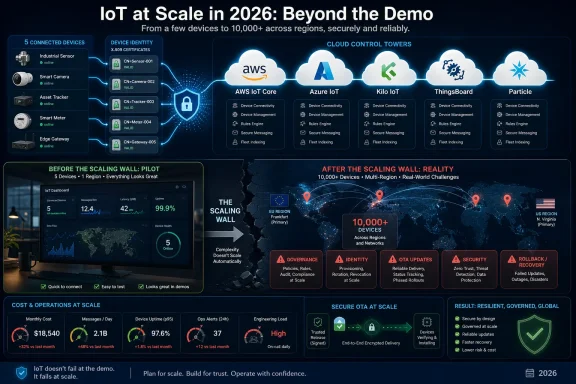 The Scaling Wall Arrives After the Demo Works
Every IoT program has a honeymoon phase. A prototype board reports temperature, a dashboard lights up, and the business suddenly sees a future in which assets, factories, buildings, vehicles, and products all describe themselves in real time. Then the pilot escapes the lab.At that point, the problem changes from connectivity to governance. Ten devices can be handled with manual enrollment, ad hoc firmware updates, and a spreadsheet of credentials. Ten thousand devices require identity, lifecycle management, bulk provisioning, observability, failover, and a sane way to ship changes without turning the field into a graveyard of bricked endpoints.
That is why the cloud platform decision matters more than many procurement teams admit. The IoT platform is not merely a place where telemetry lands. It is the control plane for a distributed computing system that happens to be bolted to trucks, meters, pumps, appliances, or factory lines.
The Best Platform Is the One That Matches Your Operating Model
The market still encourages buyers to compare IoT platforms as feature grids. That is useful up to a point, but it can hide the real trade-off. AWS and Azure offer vast cloud ecosystems, but they assume serious cloud engineering maturity. ThingsBoard offers control and flexibility, but self-hosting means owning the operational burden. Particle reduces hardware-to-cloud friction, but at the price of tighter ecosystem dependence. Kilo IoT positions itself around simplicity, connectivity, and faster deployment.Those differences are not cosmetic. They shape who must be hired, how incidents are handled, how compliance is proven, and how expensive each additional device becomes.
The most important question is not, “Which IoT platform has the most features?” It is, “Which platform lets this organization safely operate a growing fleet with the people, budget, and risk tolerance it actually has?”
AWS IoT Core Remains the Hyperscaler Default for Cloud-Native Teams
AWS IoT Core is the obvious candidate for organizations already living inside Amazon Web Services. Its biggest strength is not just device connectivity, but adjacency. Once telemetry enters AWS, it can feed Lambda, Kinesis, S3, Timestream, SageMaker, analytics pipelines, storage tiers, and security services.That makes AWS compelling for engineering-heavy companies that treat IoT as another distributed cloud workload. If your team already understands IAM, event-driven architecture, managed databases, observability stacks, and infrastructure-as-code, AWS IoT Core can be extraordinarily powerful.
The catch is that power arrives as components, not as a finished operating model. AWS gives teams many excellent building blocks, but it does not remove the need to design the architecture. Device identity, routing, rules, storage, alerting, analytics, and fleet operations can become a sophisticated system — or a sprawling one.
For large enterprises and cloud-native product companies, that trade-off is acceptable. For a mid-market business trying to connect assets quickly without building an internal cloud platform team, AWS can feel like buying an aircraft carrier to cross a river.
Azure IoT Is the Enterprise Bet for Microsoft-Centric Shops
Microsoft Azure IoT occupies a different kind of default position. It is strongest where enterprise IT is already organized around Microsoft identity, governance, analytics, and business applications. Azure IoT Hub and Azure IoT Central speak naturally to companies that also depend on Entra ID, Power BI, Dynamics, Defender, and the broader Azure estate.That makes Azure a particularly logical fit for manufacturing, energy, logistics, utilities, and industrial environments where governance and integration matter as much as raw developer flexibility. Azure IoT Central, in particular, is designed to simplify the creation and operation of IoT applications with a ready-made user experience and APIs for managing fleets at scale.
But Azure shares the classic hyperscaler burden. It can be elegant when operated by people who understand it and frustrating when owned by teams that expected a turnkey appliance. Debugging device connectivity, message routing, edge deployment, and identity issues can still require serious platform fluency.
For enterprises already invested in Microsoft, Azure IoT is often the conservative choice. That is not an insult. In industrial IoT, conservative choices are frequently the ones that survive procurement, compliance review, and the first major outage.
Kilo IoT Sells Speed Where Hyperscalers Sell Possibility
Kilo IoT is the interesting contender because it argues against the hidden cost of hyperscaler flexibility. Rather than asking customers to assemble an IoT stack from a giant menu of services, Kilo presents itself as a full-stack IoT provider spanning devices, connectivity, and cloud platform operations.Its pitch is clear: businesses should not have to become cloud infrastructure companies just to monitor assets, automate alerts, and scale device fleets. Kilo’s documentation describes a modular model in which customers can use the full stack or adopt only parts of it, including cloud, connectivity, or hardware sourcing.
That modularity matters. Many IoT vendors wrap customers in a bundle and call it convenience. Kilo’s more attractive claim is that it can reduce friction without necessarily forcing every buyer into a single locked stack.
The key question for prospective buyers is verification. Claims about AI-assisted configuration, rollback workflows, pricing predictability, and deployment speed should be tested in a proof of concept with real devices, real data volumes, and realistic operational scenarios. If those claims hold up, Kilo is most compelling for organizations that want business outcomes faster than they want architectural purity.
ThingsBoard Is What Control Looks Like When You Also Accept the Pager
ThingsBoard remains one of the most respected open-source IoT platforms because it gives engineering teams a substantial amount of control. It supports device connectivity, data collection, processing, visualization, dashboards, alarms, and device management. For teams that want to host their own platform or avoid hyperscaler lock-in, that is a serious proposition.The appeal is obvious in regulated environments. If data residency, customization, source visibility, or on-premises deployment are central requirements, an open-source platform can be easier to justify than a fully managed cloud service. It also gives developers room to tailor workflows and rule chains without waiting for a vendor’s roadmap.
But open source does not repeal operations. If a company self-hosts ThingsBoard to reduce subscription costs, it takes on patching, scaling, backups, monitoring, incident response, and security hardening. That can be the right choice for capable teams. It can also become a false economy for organizations that underestimate the cost of running production infrastructure.
ThingsBoard is best understood as a platform for teams that value sovereignty and are prepared to pay for it in engineering time. The software may be open; the responsibility is not.
Particle Wins When the Product Starts at the Circuit Board
Particle approaches IoT from the hardware-product side of the problem. Its value is not just that it offers a cloud platform, but that it pairs cloud services with connectivity modules, development tools, and hardware designed to get physical products online quickly.That makes Particle especially attractive for startups and product teams moving from prototype to production. A hardware founder does not necessarily want to assemble device firmware, provisioning, connectivity, fleet management, and cloud ingestion from scratch. Particle reduces that early friction by controlling more of the stack.
The trade-off is dependency. The same integration that makes Particle pleasant can make migration harder later. If a product’s firmware, module choice, device management, and cloud workflows are tightly coupled to Particle, changing direction after deployment can be painful.
That does not make Particle a bad choice. It makes it a choice for companies that value time-to-market and developer experience enough to accept a more opinionated ecosystem.
The Hidden Test Is Not Ingestion, It Is Recovery
Many platform comparisons obsess over how fast data can enter the cloud. That matters, but it is not the point at which most IoT operations become ugly. The more revealing test is what happens when something goes wrong.Can a bad firmware update be halted before it spreads? Can devices be segmented by region, model, customer, or risk profile? Can a rules change be tested before it affects live operations? Can the platform show which devices failed, why they failed, and whether they can recover without a truck roll?
Rollback is especially underappreciated. In conventional cloud software, a failed deployment is painful but usually recoverable. In IoT, a failed deployment may be attached to a device on a rooftop, inside a shipping container, below a street, or across a border. Recovery is not just a software procedure; it can become a logistics bill.
That is why testing environments, staged rollouts, device grouping, and remote recovery deserve more weight than glossy dashboards. A platform that makes deployment safe may save more money than one that makes demos beautiful.
Pricing Transparency Beats Cheap Entry Pricing
IoT pricing is often deceptively friendly at the pilot stage. A small device count and modest message volume can make almost any platform look affordable. The real cost emerges as telemetry frequency rises, storage retention grows, analytics workloads expand, and more staff are needed to operate the system.Hyperscalers can be cost-effective at scale, but only when architecture is disciplined. Poorly designed ingestion, chatty devices, unfiltered telemetry, and careless retention policies can turn a clever IoT project into a recurring invoice surprise. Smaller managed platforms may offer more predictable pricing, but buyers need to examine limits, overage terms, connectivity assumptions, and support tiers.
Total cost of ownership should include engineering hours. A platform that appears cheaper on a subscription line may be more expensive if it requires specialists to keep it healthy. Conversely, a higher platform fee may be rational if it reduces DevOps labor, shortens deployment time, and prevents outages.
The correct financial model is not price per device in isolation. It is cost per successfully managed device over its useful life.
Security Is a Shared Responsibility, Not a Vendor Checkbox
Every serious IoT platform now talks about security. That is necessary, but not sufficient. Device identity, encryption, access control, certificate management, secure provisioning, over-the-air updates, and audit logs all matter. Yet the customer still has to configure policies, maintain firmware, rotate secrets, and monitor suspicious behavior.This is where IoT differs from ordinary cloud applications. The attack surface includes physical devices that may be stolen, tampered with, cloned, or left unpatched for years. A weak device identity model can undermine an otherwise strong cloud platform. A careless update process can create downtime. A poorly segmented fleet can let one compromised device become a broader operational risk.
Enterprise buyers should ask vendors uncomfortable questions. How are devices authenticated? What happens when a certificate expires? Can compromised devices be quarantined? How are updates signed? Can permissions be scoped by tenant, region, device class, and operator role?
Security should not be treated as a slide in the sales deck. It is a daily operating discipline.
The Hardware Question Comes Before the Cloud Question
The best IoT cloud platform may be the wrong choice if it does not match the hardware strategy. Companies building their own embedded devices have different needs from companies buying off-the-shelf sensors. A fleet-tracking business has different constraints from a smart-home manufacturer. A factory modernization project has different realities from a consumer product launch.If the organization wants hardware modules, certifications, and cloud tooling in one package, Particle deserves attention. If it wants broad device compatibility, global connectivity options, and a more managed IoT stack, Kilo becomes more relevant. If it wants to build deep custom infrastructure around existing cloud investments, AWS and Azure are stronger candidates. If it wants self-hosting and open-source control, ThingsBoard stands apart.
This is why generic rankings are dangerous. They flatten different business models into one artificial leaderboard. IoT is not a single market; it is a set of markets that share protocols, acronyms, and failure modes.
The right platform is the one that matches the device lifecycle from procurement to retirement.
Europe and the United States Add Different Pressures
For businesses operating across Europe and the United States, platform choice also carries regulatory and operational implications. Data residency, privacy obligations, customer contracts, sector-specific compliance, and regional connectivity all shape the architecture.European deployments tend to put sharper emphasis on privacy, data location, and vendor accountability. U.S. deployments often vary more by industry, with healthcare, utilities, transportation, defense-adjacent suppliers, and critical infrastructure all carrying different expectations. Multinational fleets need a platform and connectivity model that can handle both worlds without turning every country launch into a bespoke engineering project.
This is where the boring details become decisive. Where is data stored? Which regions are supported? How are tenants separated? What certifications exist? How does the platform handle roaming, SIM management, or low-power wide-area networks?
A platform that looks elegant in one country can become awkward when the deployment crosses borders.
Five Platforms, Five Different Bets
The short version is that these platforms are not trying to solve the same problem in the same way. AWS bets that developers want a vast programmable cloud. Azure bets that enterprises want governed integration with Microsoft’s business and security stack. Kilo bets that many buyers want IoT outcomes without hyperscaler complexity. ThingsBoard bets that control and open-source flexibility still matter. Particle bets that hardware-to-cloud integration wins product teams.None of those bets is foolish. Each reflects a real segment of the IoT market.
The danger is choosing the platform that matches an aspiration rather than an operating reality. A company may admire AWS architecture diagrams but lack AWS expertise. It may want open-source freedom but lack the staff to run infrastructure. It may want fast deployment but later discover it needs deeper customization. It may want hardware simplicity but later regret ecosystem dependence.
The best procurement process is brutally honest about internal capability.
The Buying Decision Should Survive the First 10,000 Devices
Before signing a long-term contract, buyers should run a proof of concept that resembles production rather than a staged demo. That means real device types, realistic message frequency, expected connectivity failures, planned update workflows, user roles, alerting needs, and cost projections at multiple fleet sizes.The test should include failure. Disconnect devices. Rotate credentials. Push a flawed configuration to a test group. Simulate a region outage. Increase message volume. Add a new tenant. Export data into the systems the business actually uses.
Vendors that shine only in the happy path should be treated with caution. IoT value appears in normal operations, but IoT cost appears during exceptions.
A mature platform should help teams understand both.
The Practical Shortlist for a Market That Hates Surprises
The useful conclusion is not that one platform beats all others. It is that each platform belongs to a particular buyer profile, and the wrong match will punish the project later.- AWS IoT Core is the strongest fit for cloud-native teams that already know how to build, secure, and operate complex AWS architectures.
- Microsoft Azure IoT is the most natural choice for enterprises standardized on Microsoft identity, analytics, security, and business applications.
- Kilo IoT is best suited to organizations that want faster deployment, broad IoT stack support, and less day-to-day infrastructure assembly.
- ThingsBoard is the right candidate for teams that need open-source control, self-hosting, customization, or stricter data-sovereignty options.
- Particle is the clearest fit for product teams that want integrated hardware, connectivity, developer tooling, and cloud services from prototype through production.
References
- Primary source: NoHo Arts District
Published: 2026-06-11T07:30:09.654445
5 Best IoT Cloud Platforms for Scaling Your Business in 2026
Looking for the best IoT cloud platforms? Compare AWS, Azure, ThingsBoard, Particle and KiloIoT for scalability, security and growth. nohoartsdistrict.com
- Related coverage: docs.kiloiot.io
Kilo IoT Platform | Kilo IoT
AI-first IoT Platform with an AI assistant that works like an experienced IoT integrator for your devices and data.docs.kiloiot.io
