

Gizmodo’s June 2026 “Best VPN for OnlyFans” guide names NordVPN, ExpressVPN, Private Internet Access, Proton VPN, and Surfshark as its top choices for accessing OnlyFans from restricted regions or privacy-sensitive networks. The more important story is not which subscription wins a speed test, but how quickly VPN marketing has moved into the gray zone created by age-verification laws. OnlyFans is now sitting at the collision point between privacy, adult-content regulation, payments, censorship, and platform trust. A VPN can be a useful privacy tool, but treating it as a universal escape hatch is exactly the kind of simplification that gets users, platforms, and regulators into trouble.
The Gizmodo piece is framed like a buying guide, but its real hook is age verification. It does not merely say that VPNs can protect browsing on public Wi-Fi or help users reach services from restrictive networks. It argues that an OnlyFans VPN can help users avoid submitting ID in places where adult-content access is now tied to age checks.
That framing is a sign of where the consumer VPN industry has landed in 2026. The old selling points were privacy, streaming libraries, torrenting, and hotel Wi-Fi. The new selling point is regulatory friction: laws requiring age assurance, platforms responding with identity checks, and users looking for the least invasive route through the maze.
There is a legitimate privacy argument here. Many adults are uncomfortable uploading identity documents, selfies, credit-card metadata, or biometric estimates to third-party age-assurance providers simply to access legal adult content. Data breaches in adjacent identity-verification systems have made that anxiety rational rather than paranoid.
But there is also a legal and ethical boundary that reputable publications should not blur. A VPN is not an age-verification product. It does not prove a user is an adult, it does not make a prohibited user eligible, and it does not erase a platform’s terms of service. It changes the apparent network location of a device, and sometimes that is enough to alter what a website asks for. That technical fact is not the same thing as a clean compliance strategy.
That makes the “unblock it anywhere” language more brittle than it looks. In a conventional streaming test, success means the video plays. On a platform like OnlyFans, success can involve logging in, maintaining account trust, paying creators, avoiding mistaken fraud flags, and staying within the rules that govern adult content in the user’s country.
The Gizmodo guide reports that a Canadian VPN location worked in its testing and that payment also worked. That is useful as a snapshot, but it should not be mistaken for a guarantee. Platforms can and do adjust anti-fraud systems, age gates, VPN detection, and payment checks without warning. What worked on a test account in June 2026 may fail for a longtime account next month, or may behave differently for creators than for fans.
This matters more for creators than fans. A creator account can be tied to identity verification, tax documentation, banking rails, regional content rules, and platform compliance reviews. A VPN that appears harmless for casual browsing can look suspicious if it creates impossible travel patterns or mismatched account signals.
The problem is that “best VPN for OnlyFans” is not a purely technical category. It smuggles in assumptions about legality, platform enforcement, and user intent. A VPN can encrypt traffic between a device and the VPN server, conceal browsing from a local network operator, and make traffic appear to originate from another region. It cannot make an underage user lawful, cannot guarantee payment acceptance, and cannot promise immunity from account enforcement.
That distinction should be front and center in any serious analysis. For adults in countries where OnlyFans is legal but blocked by a workplace, hotel, campus, or ISP filter, a VPN may be a privacy-preserving access tool. For adults facing intrusive age checks, a VPN may reduce the amount of sensitive identity material they are asked to hand over, depending on how the platform implements checks. For users in jurisdictions where adult-content access is restricted or criminalized, the risk profile changes dramatically.
The safer advice is narrower and less marketable: know the law where you are, understand the platform’s rules, and do not confuse network privacy with legal permission. That sentence will never convert as well as a “73 percent off” button, but it is the part users most need to hear.
That was predictable. Location-based enforcement is only as strong as the assumption that users will present themselves honestly to the network. VPNs break that assumption by design. They are not a loophole accidentally discovered by users; they are a mainstream privacy technology whose core function is to decouple physical location from network location.
The regulatory response has been uneven. Some policymakers have floated the idea of applying age checks to VPNs themselves, a move that would create its own privacy paradox. If the cure for age checks on adult sites is identity checks on privacy tools, then the state risks pushing sensitive browsing data into even more centralized identity systems.
For Windows users, the practical effect is that VPNs are no longer niche utilities. They are becoming part of the ordinary consumer-security stack, sitting beside password managers, tracker blockers, and browser privacy settings. That is good news for privacy literacy, but it also means VPN companies now carry more responsibility for how they market themselves.
Server counts are especially slippery. A provider can add or remove virtual locations, shift infrastructure partners, change ownership of servers, or alter how it counts locations. A larger fleet does not automatically mean better performance, better privacy, or better access to a specific platform. One reliable nearby server can matter more than thousands of irrelevant ones.
Country count is also not the same as jurisdictional confidence. A VPN location may be physically hosted in a country, virtually represented there, or operated through infrastructure arrangements that users never see. For everyday browsing this may be fine. For users trying to understand legal exposure, sanctions risk, censorship pressure, or payment behavior, the marketing map is not enough.
The audit line is more meaningful, but still not magic. A no-logs audit can increase confidence that a provider’s systems match its privacy claims at the time of review. It does not mean the provider is invulnerable, incapable of future policy changes, or immune to legal pressure. Audits are snapshots, not force fields.
That does not mean NordVPN is a bad recommendation. For many Windows users, it is one of the easiest VPNs to install, configure, and leave running without needing to understand tunneling protocols. Its large network and obfuscation tools are meaningful advantages in restrictive environments. Its apps are mature enough that the average user is less likely to misconfigure the basics.
But NordVPN’s strength also illustrates the broader problem. The more polished the VPN pitch becomes, the easier it is for users to assume the product has solved every part of the problem. It has not. A fast tunnel does not settle age-assurance policy, adult-content law, payment trust, or account-risk signals.
The real value of NordVPN in this context is not that it makes OnlyFans “safe anywhere.” It is that it offers a competent privacy layer for adults who already understand the limits of what a privacy layer can do. That is a less exciting claim, but it is the honest one.
The Gizmodo guide emphasizes ExpressVPN’s speed and automatic obfuscation. That is a plausible reason to recommend it for users on restrictive networks, especially where crude VPN blocking is part of the censorship stack. ExpressVPN’s Lightway protocol and TrustedServer architecture have also given the company a strong privacy story, reinforced by external reviews and audits over the years.
The trade-off is cost and control. ExpressVPN is not usually the cheapest option, and power users may prefer the configurability of rivals. In a scenario involving OnlyFans, that might not matter much to the average fan, but it can matter to users who want more transparent control over protocols, DNS behavior, split tunneling, or router-level deployments.
ExpressVPN’s biggest advantage is that it reduces the number of decisions a user must make. Its biggest weakness is that the same simplicity can make the policy problem feel smaller than it is. The app can make the connection easy; it cannot make the surrounding regulatory environment simple.
The Gizmodo guide presents PIA as the budget choice for OnlyFans, with particular emphasis on its large server footprint and Shadowsocks support. That makes sense for users who care about price and flexibility. PIA’s apps can be more technical than the one-button rivals, but that is not necessarily a flaw for WindowsForum readers.
The United States jurisdiction will bother some privacy purists. PIA’s defenders point to its no-logs claims and past legal episodes where it reportedly had no useful logs to provide. Its critics will still prefer providers based outside the U.S. legal system. Both positions are understandable, and the right answer depends on the user’s threat model.
For most adult users simply trying to keep browsing private from a local network or ISP, PIA is likely more than capable. For users in high-risk countries or situations involving legal jeopardy, the decision should not be made on price alone.
Proton VPN also has a free tier, which changes the conversation. A free plan from a reputable provider is very different from the sketchier free VPNs that monetize through advertising, tracking, data sharing, or opaque ownership. For users who cannot pay, Proton’s model is a safer starting point than the random VPN extension sitting at the top of a browser-store search.
The limitation is that free tiers are usually constrained by speed, location choice, or server load. For media-heavy adult platforms, those constraints can be frustrating. The user who wants stable high-resolution video and reliable regional choice will probably end up on a paid plan.
Proton’s best argument is not that it is the fastest OnlyFans VPN. It is that it treats privacy as more than a coupon funnel. In a category crowded with aggressive marketing, that distinction still matters.
For the OnlyFans use case, unlimited devices may be less important than it looks. Most people do not need adult-platform access on a dozen devices. But the broader household-security value is real. A VPN subscription that covers every device is easier to justify than one attached to a single narrow use case.
Surfshark also appeals to users who want a cheaper alternative to NordVPN without abandoning mainstream polish. Its apps are approachable, its feature list is broad, and its pricing often undercuts more premium rivals. That makes it a natural pick in comparison articles.
The caution is the same as with every provider here: a VPN subscription should be bought for privacy and security properties, not merely because it promises to make an age gate disappear. If the only value proposition is evasion, the user is depending on an unstable cat-and-mouse game.
Some free VPNs impose strict data caps or limited locations. Others inject ads, collect telemetry, sell aggregated data, or operate with ownership structures that are difficult to trace. A few are outright dangerous, especially browser extensions that ask for broad permissions and then route traffic through questionable infrastructure.
That matters especially for adult-content browsing. The sensitivity of the activity raises the cost of a bad privacy choice. A VPN that logs heavily or leaks DNS requests may be worse than no VPN at all because it gives the user a false sense of safety.
There are exceptions, and Proton VPN is the obvious example. A reputable free tier funded by paid customers is very different from a no-name free app promising unlimited everything. But as a rule, anyone using a VPN for sensitive browsing should treat “free, unlimited, and private” as a warning label rather than a feature set.
The kill switch is especially important. If a VPN connection drops and traffic silently falls back to the regular ISP connection, the user may expose the very activity they meant to shield. A kill switch is not glamorous, but it is one of the few VPN features that can turn a marketing claim into a concrete privacy protection.
DNS behavior is just as important. If the tunnel carries web traffic but DNS queries leak to the ISP or local network, the user’s browsing destinations may still be visible. Modern VPN clients usually handle this better than older ones, but Windows network configuration, third-party security suites, and custom DNS tools can complicate the picture.
Split tunneling deserves caution. It is convenient to route only some apps through the VPN while leaving others on the normal connection, but it also creates room for mistakes. If the browser used for sensitive browsing is not actually inside the tunnel, the VPN icon in the taskbar becomes decorative.
On a managed Windows device, the employer may still have endpoint telemetry, browser controls, EDR agents, DNS filtering, certificate inspection, or acceptable-use monitoring. A personal VPN cannot necessarily hide activity from software running on the device itself. It may even trigger security alerts.
On a corporate network, using a VPN to bypass content filters can violate policy even if the destination is legal. That is not a moral judgment; it is a practical employment-risk statement. The same goes for schools and shared institutions where network rules are part of the access agreement.
The safer rule is simple: do not use someone else’s managed device or network for adult content. If privacy matters, use a personal device, a network you control, and a VPN provider you understand. The VPN is one layer, not a permission slip.
That matters for OnlyFans because payments are central to the experience. A user may be able to load the site through a VPN but still fail a transaction, trip a fraud review, or encounter account friction when payment metadata conflicts with network location. The same tension can apply to creators whose payout information anchors them to a jurisdiction.
VPN marketing tends to focus on access because access is easy to demonstrate. Payments are harder. They involve risk scoring that users cannot see and platforms rarely explain. A one-time successful test does not tell us how the system behaves after repeated logins, travel changes, chargebacks, or compliance updates.
For administrators and security-minded users, this is the important lesson: in 2026, identity is distributed across the stack. IP address is only one signal. Device fingerprints, payment rails, account history, cookies, phone numbers, and behavioral patterns all contribute to platform trust.
In heavily censored countries, adult content may be blocked as part of a broader system of political, religious, or moral control. Using privacy tools in those environments can carry real personal risk. Obfuscation features matter because the adversary may not merely block a site but punish attempts to circumvent controls.
In age-verification jurisdictions, the state may not be blocking adult content outright. Instead, it is requiring platforms to verify that users are adults. Adults may object to the privacy cost, but the legal framework is different from a censorship firewall. Conflating the two weakens the analysis.
That distinction should shape VPN advice. A user in a country with severe internet censorship needs threat-model guidance, not just a discount code. A user in the UK or parts of the U.S. dealing with age checks needs privacy and compliance guidance. These are not the same problem, even if the same app appears in both workflows.
The recurring pattern is familiar: a top pick, a limited-time discount, a risk-free refund period, and a comparison table that compresses complicated trade-offs into tidy rows. The user is encouraged to act quickly, not think carefully. That is great for conversions and mediocre for privacy literacy.
Gizmodo is a recognizable media brand, which gives the article more weight than a throwaway affiliate site. But the genre still shapes the message. The focus lands on provider selection, pricing, and unblocking performance, while the messier questions — law, platform rules, identity risk, minors, workplace policy — sit in the background.
Readers should not reject VPN recommendations simply because affiliate links exist. They should ask whether the article explains what the product cannot do. In privacy tools, the omissions are often more revealing than the rankings.
The strongest reasons to use a VPN in this context are mundane. It can hide browsing destinations from a local network operator. It can reduce ISP-level visibility. It can protect traffic on hostile Wi-Fi. It can help adults maintain privacy when accessing legal content from a personal device.
The weakest reason is the one that attracts the most clicks: bypassing age checks. That may work in some cases, but it is unstable, jurisdiction-dependent, and potentially contrary to platform rules or local law. It also invites regulators to treat VPNs themselves as part of the problem, which could harm users who rely on VPNs for journalism, activism, security research, travel, and ordinary privacy.
The better consumer framing is not “best VPN for OnlyFans.” It is “how to protect privacy when accessing sensitive legal content.” That wording is less sensational, but it puts the user’s actual risk where it belongs.
NordVPN is the mainstream all-rounder, ExpressVPN is the simplicity-and-speed premium option, Private Internet Access is the budget tinkerer’s tool, Proton VPN is the privacy-brand choice, and Surfshark is the household-value play. None of those descriptions should be read as a guarantee of platform access. They are starting points for evaluating a privacy service.
What users should avoid is choosing a VPN solely because a guide says it “unblocks” one adult platform. Unblocking claims expire quickly. Privacy architecture, client reliability, transparent audits, and sensible defaults age better.
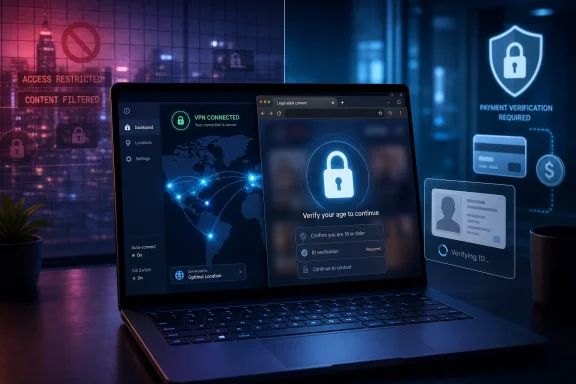 The VPN Pitch Has Caught Up With the Age-Check Era
The Gizmodo piece is framed like a buying guide, but its real hook is age verification. It does not merely say that VPNs can protect browsing on public Wi-Fi or help users reach services from restrictive networks. It argues that an OnlyFans VPN can help users avoid submitting ID in places where adult-content access is now tied to age checks.That framing is a sign of where the consumer VPN industry has landed in 2026. The old selling points were privacy, streaming libraries, torrenting, and hotel Wi-Fi. The new selling point is regulatory friction: laws requiring age assurance, platforms responding with identity checks, and users looking for the least invasive route through the maze.
There is a legitimate privacy argument here. Many adults are uncomfortable uploading identity documents, selfies, credit-card metadata, or biometric estimates to third-party age-assurance providers simply to access legal adult content. Data breaches in adjacent identity-verification systems have made that anxiety rational rather than paranoid.
But there is also a legal and ethical boundary that reputable publications should not blur. A VPN is not an age-verification product. It does not prove a user is an adult, it does not make a prohibited user eligible, and it does not erase a platform’s terms of service. It changes the apparent network location of a device, and sometimes that is enough to alter what a website asks for. That technical fact is not the same thing as a clean compliance strategy.
OnlyFans Is Not Just Another Streaming Site
OnlyFans complicates the normal VPN review template because it is not Netflix with fewer regional licensing deals. It is a creator-payment platform with adult content, fan messaging, creator verification, payment processing, chargeback risk, and national rules that can vary sharply by jurisdiction. A user’s location matters not just for content access, but for fraud controls and legal exposure.That makes the “unblock it anywhere” language more brittle than it looks. In a conventional streaming test, success means the video plays. On a platform like OnlyFans, success can involve logging in, maintaining account trust, paying creators, avoiding mistaken fraud flags, and staying within the rules that govern adult content in the user’s country.
The Gizmodo guide reports that a Canadian VPN location worked in its testing and that payment also worked. That is useful as a snapshot, but it should not be mistaken for a guarantee. Platforms can and do adjust anti-fraud systems, age gates, VPN detection, and payment checks without warning. What worked on a test account in June 2026 may fail for a longtime account next month, or may behave differently for creators than for fans.
This matters more for creators than fans. A creator account can be tied to identity verification, tax documentation, banking rails, regional content rules, and platform compliance reviews. A VPN that appears harmless for casual browsing can look suspicious if it creates impossible travel patterns or mismatched account signals.
The Best VPN Is Not the Same as the Safest Advice
NordVPN, ExpressVPN, Private Internet Access, Proton VPN, and Surfshark are credible names in the consumer VPN market. They offer polished apps, broad platform support, no-logs claims, modern protocols, and in several cases independent audits. If the narrow question is which VPNs are likely to offer reliable speeds and broad server choice, the list is not surprising.The problem is that “best VPN for OnlyFans” is not a purely technical category. It smuggles in assumptions about legality, platform enforcement, and user intent. A VPN can encrypt traffic between a device and the VPN server, conceal browsing from a local network operator, and make traffic appear to originate from another region. It cannot make an underage user lawful, cannot guarantee payment acceptance, and cannot promise immunity from account enforcement.
That distinction should be front and center in any serious analysis. For adults in countries where OnlyFans is legal but blocked by a workplace, hotel, campus, or ISP filter, a VPN may be a privacy-preserving access tool. For adults facing intrusive age checks, a VPN may reduce the amount of sensitive identity material they are asked to hand over, depending on how the platform implements checks. For users in jurisdictions where adult-content access is restricted or criminalized, the risk profile changes dramatically.
The safer advice is narrower and less marketable: know the law where you are, understand the platform’s rules, and do not confuse network privacy with legal permission. That sentence will never convert as well as a “73 percent off” button, but it is the part users most need to hear.
Age Verification Turned VPNs Into Political Infrastructure
The UK’s Online Safety Act is the clearest example of how age assurance has changed the VPN conversation. When enforcement of age checks for adult content arrived, VPN demand surged, and the political conversation quickly moved from “how do we keep children away from adult sites?” to “what happens when adults route around the entire system?”That was predictable. Location-based enforcement is only as strong as the assumption that users will present themselves honestly to the network. VPNs break that assumption by design. They are not a loophole accidentally discovered by users; they are a mainstream privacy technology whose core function is to decouple physical location from network location.
The regulatory response has been uneven. Some policymakers have floated the idea of applying age checks to VPNs themselves, a move that would create its own privacy paradox. If the cure for age checks on adult sites is identity checks on privacy tools, then the state risks pushing sensitive browsing data into even more centralized identity systems.
For Windows users, the practical effect is that VPNs are no longer niche utilities. They are becoming part of the ordinary consumer-security stack, sitting beside password managers, tracker blockers, and browser privacy settings. That is good news for privacy literacy, but it also means VPN companies now carry more responsibility for how they market themselves.
The Numbers in VPN Guides Deserve More Skepticism
VPN comparison tables often look precise: server counts, country counts, device limits, monthly prices, refund windows, and audit labels. The Gizmodo guide follows that convention, listing NordVPN with more than 9,400 servers, ExpressVPN with more than 3,000, Private Internet Access with a much larger fleet, Proton VPN with a large network, and Surfshark as an unlimited-device option. Those numbers are useful, but they can also create a false sense of measurement.Server counts are especially slippery. A provider can add or remove virtual locations, shift infrastructure partners, change ownership of servers, or alter how it counts locations. A larger fleet does not automatically mean better performance, better privacy, or better access to a specific platform. One reliable nearby server can matter more than thousands of irrelevant ones.
Country count is also not the same as jurisdictional confidence. A VPN location may be physically hosted in a country, virtually represented there, or operated through infrastructure arrangements that users never see. For everyday browsing this may be fine. For users trying to understand legal exposure, sanctions risk, censorship pressure, or payment behavior, the marketing map is not enough.
The audit line is more meaningful, but still not magic. A no-logs audit can increase confidence that a provider’s systems match its privacy claims at the time of review. It does not mean the provider is invulnerable, incapable of future policy changes, or immune to legal pressure. Audits are snapshots, not force fields.
NordVPN Wins the Marketing Moment Because It Sells Certainty
NordVPN is the obvious top pick in the Gizmodo ranking because it occupies the center of the modern VPN market. It has speed branding in NordLynx, censorship branding in NordWhisper, threat-blocking branding in Threat Protection, and audit branding around its no-logs claims. It is the provider most likely to appear in this kind of recommendation because it has built a product narrative that speaks to both casual users and privacy-conscious buyers.That does not mean NordVPN is a bad recommendation. For many Windows users, it is one of the easiest VPNs to install, configure, and leave running without needing to understand tunneling protocols. Its large network and obfuscation tools are meaningful advantages in restrictive environments. Its apps are mature enough that the average user is less likely to misconfigure the basics.
But NordVPN’s strength also illustrates the broader problem. The more polished the VPN pitch becomes, the easier it is for users to assume the product has solved every part of the problem. It has not. A fast tunnel does not settle age-assurance policy, adult-content law, payment trust, or account-risk signals.
The real value of NordVPN in this context is not that it makes OnlyFans “safe anywhere.” It is that it offers a competent privacy layer for adults who already understand the limits of what a privacy layer can do. That is a less exciting claim, but it is the honest one.
ExpressVPN Remains the Premium Simplicity Play
ExpressVPN’s appeal has always been that it feels less like a dashboard and more like a switch. Open the app, choose a location, connect, and get on with your day. For users who do not want to compare protocol acronyms, that simplicity has value.The Gizmodo guide emphasizes ExpressVPN’s speed and automatic obfuscation. That is a plausible reason to recommend it for users on restrictive networks, especially where crude VPN blocking is part of the censorship stack. ExpressVPN’s Lightway protocol and TrustedServer architecture have also given the company a strong privacy story, reinforced by external reviews and audits over the years.
The trade-off is cost and control. ExpressVPN is not usually the cheapest option, and power users may prefer the configurability of rivals. In a scenario involving OnlyFans, that might not matter much to the average fan, but it can matter to users who want more transparent control over protocols, DNS behavior, split tunneling, or router-level deployments.
ExpressVPN’s biggest advantage is that it reduces the number of decisions a user must make. Its biggest weakness is that the same simplicity can make the policy problem feel smaller than it is. The app can make the connection easy; it cannot make the surrounding regulatory environment simple.
Private Internet Access Is the Tinkerer’s Bargain
Private Internet Access occupies a different lane. It is cheaper, more configurable, and more appealing to users who want knobs to turn. Its unlimited-device positioning is attractive for households, and its long history in the VPN market gives it credibility among users who have watched providers come and go.The Gizmodo guide presents PIA as the budget choice for OnlyFans, with particular emphasis on its large server footprint and Shadowsocks support. That makes sense for users who care about price and flexibility. PIA’s apps can be more technical than the one-button rivals, but that is not necessarily a flaw for WindowsForum readers.
The United States jurisdiction will bother some privacy purists. PIA’s defenders point to its no-logs claims and past legal episodes where it reportedly had no useful logs to provide. Its critics will still prefer providers based outside the U.S. legal system. Both positions are understandable, and the right answer depends on the user’s threat model.
For most adult users simply trying to keep browsing private from a local network or ISP, PIA is likely more than capable. For users in high-risk countries or situations involving legal jeopardy, the decision should not be made on price alone.
Proton VPN Brings the Civil-Liberties Brand
Proton VPN’s inclusion is notable because it carries a different reputation than the mainstream affiliate-heavy VPN brands. Proton’s broader ecosystem — mail, calendar, storage, and VPN — is built around privacy as a civil-liberties proposition rather than just a streaming and discount proposition. That matters in a debate where adult-content access, identity documents, and state regulation are intertwined.Proton VPN also has a free tier, which changes the conversation. A free plan from a reputable provider is very different from the sketchier free VPNs that monetize through advertising, tracking, data sharing, or opaque ownership. For users who cannot pay, Proton’s model is a safer starting point than the random VPN extension sitting at the top of a browser-store search.
The limitation is that free tiers are usually constrained by speed, location choice, or server load. For media-heavy adult platforms, those constraints can be frustrating. The user who wants stable high-resolution video and reliable regional choice will probably end up on a paid plan.
Proton’s best argument is not that it is the fastest OnlyFans VPN. It is that it treats privacy as more than a coupon funnel. In a category crowded with aggressive marketing, that distinction still matters.
Surfshark Sells the Household VPN Dream
Surfshark’s unlimited-device model remains its clearest pitch. In a household with multiple Windows PCs, phones, tablets, streaming boxes, and travel laptops, per-device limits can be annoying. Surfshark removes that friction and competes aggressively on price.For the OnlyFans use case, unlimited devices may be less important than it looks. Most people do not need adult-platform access on a dozen devices. But the broader household-security value is real. A VPN subscription that covers every device is easier to justify than one attached to a single narrow use case.
Surfshark also appeals to users who want a cheaper alternative to NordVPN without abandoning mainstream polish. Its apps are approachable, its feature list is broad, and its pricing often undercuts more premium rivals. That makes it a natural pick in comparison articles.
The caution is the same as with every provider here: a VPN subscription should be bought for privacy and security properties, not merely because it promises to make an age gate disappear. If the only value proposition is evasion, the user is depending on an unstable cat-and-mouse game.
Free VPNs Are Where Privacy Claims Go to Die
The Gizmodo guide is right to warn against most free VPNs. This is one of the few areas where the standard consumer advice remains blunt because the market remains messy. Running a VPN service costs money, and if the user is not paying, the business model deserves scrutiny.Some free VPNs impose strict data caps or limited locations. Others inject ads, collect telemetry, sell aggregated data, or operate with ownership structures that are difficult to trace. A few are outright dangerous, especially browser extensions that ask for broad permissions and then route traffic through questionable infrastructure.
That matters especially for adult-content browsing. The sensitivity of the activity raises the cost of a bad privacy choice. A VPN that logs heavily or leaks DNS requests may be worse than no VPN at all because it gives the user a false sense of safety.
There are exceptions, and Proton VPN is the obvious example. A reputable free tier funded by paid customers is very different from a no-name free app promising unlimited everything. But as a rule, anyone using a VPN for sensitive browsing should treat “free, unlimited, and private” as a warning label rather than a feature set.
Windows Users Should Care About the Boring Settings
For the WindowsForum audience, the practical layer is in the client behavior. A VPN app can have a great reputation and still be misused. The boring settings — kill switch, DNS leak protection, auto-connect, split tunneling, protocol choice, and startup behavior — determine whether the privacy promise survives normal use.The kill switch is especially important. If a VPN connection drops and traffic silently falls back to the regular ISP connection, the user may expose the very activity they meant to shield. A kill switch is not glamorous, but it is one of the few VPN features that can turn a marketing claim into a concrete privacy protection.
DNS behavior is just as important. If the tunnel carries web traffic but DNS queries leak to the ISP or local network, the user’s browsing destinations may still be visible. Modern VPN clients usually handle this better than older ones, but Windows network configuration, third-party security suites, and custom DNS tools can complicate the picture.
Split tunneling deserves caution. It is convenient to route only some apps through the VPN while leaving others on the normal connection, but it also creates room for mistakes. If the browser used for sensitive browsing is not actually inside the tunnel, the VPN icon in the taskbar becomes decorative.
The Corporate Network Is Not the Place to Test This
One point often missing from consumer VPN guides is workplace risk. Many users encounter blocked adult sites not because of national censorship, but because they are on a corporate, school, hotel, or public network. A VPN may technically bypass some of those filters, but that does not make it wise.On a managed Windows device, the employer may still have endpoint telemetry, browser controls, EDR agents, DNS filtering, certificate inspection, or acceptable-use monitoring. A personal VPN cannot necessarily hide activity from software running on the device itself. It may even trigger security alerts.
On a corporate network, using a VPN to bypass content filters can violate policy even if the destination is legal. That is not a moral judgment; it is a practical employment-risk statement. The same goes for schools and shared institutions where network rules are part of the access agreement.
The safer rule is simple: do not use someone else’s managed device or network for adult content. If privacy matters, use a personal device, a network you control, and a VPN provider you understand. The VPN is one layer, not a permission slip.
The Payment Layer May Be the Real Enforcement Point
Adult platforms are often constrained less by web blocking than by payment processing. Credit-card networks, banks, anti-fraud vendors, sanctions rules, and local regulations all influence what a platform can allow. A VPN can change apparent location, but it cannot change the billing identity attached to a card, bank account, or creator payout method.That matters for OnlyFans because payments are central to the experience. A user may be able to load the site through a VPN but still fail a transaction, trip a fraud review, or encounter account friction when payment metadata conflicts with network location. The same tension can apply to creators whose payout information anchors them to a jurisdiction.
VPN marketing tends to focus on access because access is easy to demonstrate. Payments are harder. They involve risk scoring that users cannot see and platforms rarely explain. A one-time successful test does not tell us how the system behaves after repeated logins, travel changes, chargebacks, or compliance updates.
For administrators and security-minded users, this is the important lesson: in 2026, identity is distributed across the stack. IP address is only one signal. Device fingerprints, payment rails, account history, cookies, phone numbers, and behavioral patterns all contribute to platform trust.
Censorship and Age Assurance Are Different Problems Wearing the Same Mask
The Gizmodo guide groups restricted countries and age-verification jurisdictions into one practical problem: OnlyFans is harder to reach, so use a VPN. Technically, that may be how it feels to the user. Politically and legally, those are very different cases.In heavily censored countries, adult content may be blocked as part of a broader system of political, religious, or moral control. Using privacy tools in those environments can carry real personal risk. Obfuscation features matter because the adversary may not merely block a site but punish attempts to circumvent controls.
In age-verification jurisdictions, the state may not be blocking adult content outright. Instead, it is requiring platforms to verify that users are adults. Adults may object to the privacy cost, but the legal framework is different from a censorship firewall. Conflating the two weakens the analysis.
That distinction should shape VPN advice. A user in a country with severe internet censorship needs threat-model guidance, not just a discount code. A user in the UK or parts of the U.S. dealing with age checks needs privacy and compliance guidance. These are not the same problem, even if the same app appears in both workflows.
Affiliate Economics Make the Category Hard to Trust
VPN journalism has a credibility problem because the affiliate incentives are obvious. Search results are crowded with “best VPN” pages that look independent but monetize through subscription referrals. That does not automatically make them wrong, but it does mean readers should evaluate the structure of the recommendation.The recurring pattern is familiar: a top pick, a limited-time discount, a risk-free refund period, and a comparison table that compresses complicated trade-offs into tidy rows. The user is encouraged to act quickly, not think carefully. That is great for conversions and mediocre for privacy literacy.
Gizmodo is a recognizable media brand, which gives the article more weight than a throwaway affiliate site. But the genre still shapes the message. The focus lands on provider selection, pricing, and unblocking performance, while the messier questions — law, platform rules, identity risk, minors, workplace policy — sit in the background.
Readers should not reject VPN recommendations simply because affiliate links exist. They should ask whether the article explains what the product cannot do. In privacy tools, the omissions are often more revealing than the rankings.
The OnlyFans VPN Claim That Actually Holds Up
Strip away the hype, and the defensible claim is this: a good VPN can improve privacy and sometimes restore access to OnlyFans for adult users on networks or in regions where the site is blocked, filtered, or subjected to location-based friction. That is true enough to be useful. It is also narrow enough to avoid pretending the VPN solves every legal and identity problem around adult content.The strongest reasons to use a VPN in this context are mundane. It can hide browsing destinations from a local network operator. It can reduce ISP-level visibility. It can protect traffic on hostile Wi-Fi. It can help adults maintain privacy when accessing legal content from a personal device.
The weakest reason is the one that attracts the most clicks: bypassing age checks. That may work in some cases, but it is unstable, jurisdiction-dependent, and potentially contrary to platform rules or local law. It also invites regulators to treat VPNs themselves as part of the problem, which could harm users who rely on VPNs for journalism, activism, security research, travel, and ordinary privacy.
The better consumer framing is not “best VPN for OnlyFans.” It is “how to protect privacy when accessing sensitive legal content.” That wording is less sensational, but it puts the user’s actual risk where it belongs.
The Five-Provider Race Hides the Bigger Decision
The practical buying decision is real, but it should come after the user understands the boundary conditions. If an adult user wants a reputable VPN for general privacy, travel, public Wi-Fi, and occasional access to lawful services, the providers named in the Gizmodo guide are reasonable candidates. The choice depends less on OnlyFans and more on how the VPN behaves across daily Windows use.NordVPN is the mainstream all-rounder, ExpressVPN is the simplicity-and-speed premium option, Private Internet Access is the budget tinkerer’s tool, Proton VPN is the privacy-brand choice, and Surfshark is the household-value play. None of those descriptions should be read as a guarantee of platform access. They are starting points for evaluating a privacy service.
What users should avoid is choosing a VPN solely because a guide says it “unblocks” one adult platform. Unblocking claims expire quickly. Privacy architecture, client reliability, transparent audits, and sensible defaults age better.
The Claims Windows Users Should Take Away Before Clicking Buy
The useful lesson from this OnlyFans VPN guide is not that one provider has won adult content forever. It is that age-verification laws have turned VPNs into mainstream consumer infrastructure while making their marketing more legally and ethically fraught.- A VPN can improve privacy and sometimes restore access, but it does not prove age, override law, or guarantee compliance with OnlyFans rules.
- Adults using VPNs for sensitive browsing should prioritize kill switches, DNS leak protection, audited no-logs claims, and trustworthy ownership over raw server counts.
- Free VPNs are usually a poor fit for adult-content privacy unless they come from a reputable provider with a clear funding model.
- Managed work or school devices remain risky even with a VPN because endpoint monitoring can see more than the network tunnel hides.
- Payment systems, account history, and device signals can still affect OnlyFans access even when the VPN connection itself works.
- VPN marketing around age verification may invite regulatory backlash that affects privacy tools far beyond adult-content browsing.
References
- Primary source: Gizmodo
Published: 2026-06-08T10:22:07.222409
Best VPN for OnlyFans 2026: Unblock OnlyFans Anywhere
Get the best VPN for OnlyFans and access the site anywhere. Unblock OnlyFans and use it securely with a VPN. Our top options are right here. gizmodo.com
- Related coverage: techradar.com
The best VPN service 2026 | TechRadar
Rigorously tested and independently verified — find the right VPN for security, streaming and privacy.www.techradar.com - Related coverage: vpnoverview.com
- Related coverage: supercreator.app
OnlyFans VPNs That Creators Can Use in 2026
Learn which VPNs work with OnlyFans in 2026, how they improve privacy, unblock access, and solve issues like OnlyFans VPN not working.www.supercreator.app
