

Bidgely’s presence in Valencia this week puts a familiar message at the center of a fast-maturing debate: turn smart meter data into an AI-powered layer of operational and customer intelligence, and utilities can manage electrification, dynamic pricing, and grid complexity with far greater precision than with legacy tools alone.
Bidgely — an AI-first energy analytics vendor from Silicon Valley — is delivering a keynote and a series of executive sessions at the IDC European Utilities Xchange (Valencia, March 2–3, 2026). The company is using the forum to showcase UtilityAI Pro, its verticalized AI stack for utilities, a set of behind-the-meter analytics and agentic workflows it says can convert raw AMI/smart‑meter reads into appliance-level profiles, grid insights, and customer-facing recommendations. The public messaging positions Bidgely as pushing utilities beyond “horizontal AI” pilots into what it calls vertical AI — models trained and optimized specifically for the utility domain and intended for enterprise deployment inside a utility’s own cloud environment.
In short, Bidgely’s pitch to CXOs and grid planners at IDC: convert smart meter data into a unified layer of intelligence, use it to manage time-of-use (TOU) tariffs and dynamic pricing, and operationalize behind-the-meter visibility to reduce peak load, improve customer engagement, and defer infrastructure spend.
This architecture has three practical implications:
But success is not guaranteed by product claims or awards alone. The key questions for utilities are technical, regulatory and operational: do the models perform reliably across diverse meter populations; can the solution operate within strict governance boundaries; and do pilots produce auditor‑friendly evidence of grid value? Utilities should treat vertical AI vendors as strategic partners and demand production-grade evidence, transparent governance, and clear remediation paths for inaccuracies.
If those conditions are met, vendors like Bidgely can accelerate grid modernization with AI‑powered energy intelligence that moves utilities from reactive operators to proactive energy advisors — but only when the analytics are proven, explainable, and governed with the same rigor as the grid assets they aim to protect.
Source: Fox21Online Bidgely to Showcase AI-Powered Energy Intelligence at IDC European Utilities Xchange - Fox21Online
 Background
Bidgely — an AI-first energy analytics vendor from Silicon Valley — is delivering a keynote and a series of executive sessions at the IDC European Utilities Xchange (Valencia, March 2–3, 2026). The company is using the forum to showcase UtilityAI Pro, its verticalized AI stack for utilities, a set of behind-the-meter analytics and agentic workflows it says can convert raw AMI/smart‑meter reads into appliance-level profiles, grid insights, and customer-facing recommendations. The public messaging positions Bidgely as pushing utilities beyond “horizontal AI” pilots into what it calls vertical AI — models trained and optimized specifically for the utility domain and intended for enterprise deployment inside a utility’s own cloud environment.In short, Bidgely’s pitch to CXOs and grid planners at IDC: convert smart meter data into a unified layer of intelligence, use it to manage time-of-use (TOU) tariffs and dynamic pricing, and operationalize behind-the-meter visibility to reduce peak load, improve customer engagement, and defer infrastructure spend.
What Bidgely is Showcasing in Valencia
The sessions and the sales narrative
- Day 1 (March 2): “The ‘Energy Advisor’ Pivot: Leading the Age of Volatility & AI” — framed around TOU adoption, customer trust, and appliance-level personalization.
- Day 2 (March 3): “Aligning on the Future: UtilityAI Pro, Data Fabric and the AI-Powered Utility” — positioned as a CIO‑level roadmap for eliminating technical debt and unlocking deeper data granularity.
Core product claims (what Bidgely says it delivers)
- Zero‑hardware disaggregation (appliance-level NILM) to build personalized energy profiles without in-home devices.
- UtilityAI Pro as a vertical AI stack that can be deployed in a utility’s cloud, delivering 10x data granularity over conventional analytics.
- Integrations with major cloud and AI ecosystems (Azure/Microsoft Copilot, AWS Bedrock demos) and white-labeled GenAI copilots for call centers and customers.
- Intellectual property: the company cites a portfolio of energy/AI patents as a differentiator.
- Scale claims: the company’s materials have referenced tens of millions of homes served — numbers that vary across different communications.
Why the timing matters: electrification, volatility and regulatory pressure
European utilities face a compressed timeline. Rapid electrification (heat pumps, EVs), an increasingly distributed generation mix, and new regulatory pushes toward dynamic tariffs are converging. Add to that price volatility and the political demand for affordability, and the industry needs tools that can:- Identify where behind-the-meter load increases are occurring (EVs, heat pumps).
- Target customers for TOU migration and behavioral nudges.
- Provide regulators defensible measurement for program outcomes.
- Reduce call center load by offering explainable, personalized bill guidance.
Technical profile: what “vertical AI” and UtilityAI Pro mean in practice
From horizontal models to verticalized AI
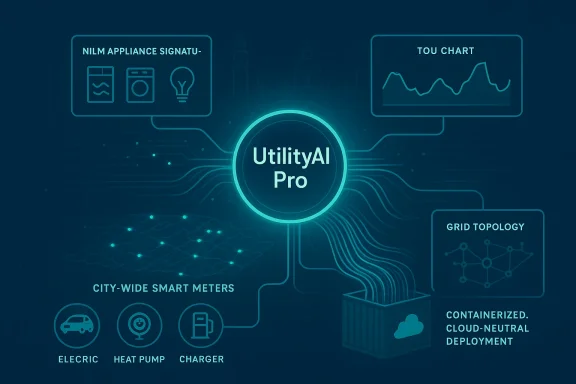
“Horizontal AI” refers to generic models or cloud-hosted LLMs adapted to many industries. Vertical AI as presented by Bidgely means models trained on utility-specific telemetry (AMI reads, DER metadata), augmented with domain features (metering cadence, tariff structures, residential appliance signatures), and packaged with deployment controls a utility expects (containerized, cloud‑neutral bundles, data fabric connectors).This architecture has three practical implications:
- It reduces need for onerous feature engineering by utilities because models are domain-aware.
- It enables deployment inside a utility’s environment, which helps with data governance and compliance.
- It allows for specialized outputs (appliance-level disaggregation confidence scores, transformer stress alerts, TOU adoption forecasts) that are meaningful to regulatory and operational stakeholders.
Appliance-level disaggregation (NILM) — promise and limits
Bidgely emphasizes zero‑hardware disaggregation, also known as Non-Intrusive Load Monitoring (NILM). NILM uses aggregated meter reads to infer appliance usage patterns. When successful, NILM can empower:- Targeting for electrification programs (finding households with gas water heaters or electric resistance heat).
- EV detection and managed charging programs.
- Highly personalized customer recommendations for load shifting.
Data fabric, deployment and integration claims
Bidgely positions UtilityAI Pro as a containerized, deployable stack compatible with common data clouds (Azure, AWS, Databricks, Snowflake) and with LLM/GenAI connectors (Copilot/OpenAI, AWS Bedrock). The deployment options address common CIO concerns:- Keep sensitive AMI data within the utility boundary.
- Avoid vendor lock-in by offering standard integration points (APIs, connectors).
- Integrate AI outputs into existing operational systems (SCADA/ADMS via workbench APIs; CRM and contact center via Copilot or agentic workflows).
Verifying the numbers: scale, patents and awards — cross‑checked realities
In public materials, Bidgely highlights several credibility markers: industry awards, a patent portfolio, volume of meter reads processed, and the number of homes served. A careful cross-check finds variation in the specific figures that vendors commonly present as milestones:- Patent counts appear in company materials as mid‑teens (statements have referenced 16 or 17 patents across releases). Treat patent counts as real but minor: patents can protect specific methods but do not automatically guarantee superiority; independent technical evaluation still matters.
- Scale metrics vary: Bidgely’s event and product pages mention utilities serving 30–35 million homes, while the press release tied to the IDC event references “over 50 million homes”. Variance like this is not unusual in marketing copy as numbers are updated or rounded; however, utilities and regulators should insist on precise, auditable figures (for example, number of meter points under contract, broken down by region and meter cadence).
- Awards and recognition — inclusion on reputable lists and industry awards is a useful signal of market traction and innovation recognition, but awards do not substitute for operational references or third‑party performance verification.
Strengths: where Bidgely’s pitch genuinely advances utility capabilities
- Domain specialization. A vertical AI system reduces the gap between generic LLM-like outputs and utility‑grade insights. Vertically trained models can generate outputs that are directly actionable for grid planners and program managers.
- Behind-the-meter intelligence without hardware. If NILM reaches a high-enough, auditable level of accuracy, utilities can avoid the cost and logistics of deploying in-home sensors at scale.
- Deployment flexibility. Containerized models and cloud-agnostic connectors ease governance and regulatory compliance, enabling utilities to keep sensitive AMI data within their own cloud tenancy.
- Integrated customer engagement. Pairing analytics with generative assistants — for call centers and customer portals — can reduce call volumes and improve perceived fairness in tariffs by giving customers personalized, explainable guidance.
- Program outcomes focus. The promise of measurable load-shift and demand flexibility outcomes (TOU, managed EV charging) aligns analytics with tangible grid value, not just dashboards.
Risks and blind spots utilities must weigh
- Accuracy limits of NILM and the cost of errors. False positives/negatives in appliance detection can mis-target customers for programs or misattribute savings to interventions. Utilities should require per-premise confidence scores, independent accuracy validation, and a plan for handling incorrect model outputs in customer communications.
- Model drift and operations. Appliance behavior changes over time (new EV charger patterns, different heat pump cycles). Maintaining model accuracy requires ongoing retraining and a robust model‑ops pipeline — not a one-time implementation.
- Regulatory and privacy exposure. High-resolution energy fingerprints can be sensitive under privacy regimes like GDPR. Utilities must have clear data governance, minimization, and consent frameworks before rolling out fine-grained customer profiling.
- Explainability and consumer trust. Using GenAI to explain bills or recommend tariff changes can backfire if explanations are inconsistent or non-actionable. Explanations must be deterministic and auditable.
- Vendor claims vs. verifiable outcomes. Marketing language such as “first vertical AI platform” or “10x granularity” should be treated as vendor positioning until verified by independent third parties or utility pilots with public evaluation metrics.
- Potential for technical debt. Introducing a new AI layer without a clear integration and maintenance plan can create more complexity. The promise to "eliminate technical debt" is attractive but requires careful governance, migration plans, and a utility commitment to operationalizing AI.
Procurement checklist: what utilities should demand
When evaluating UtilityAI Pro or similar vertical AI offerings, utilities should require the following — a mix of technical, legal and business deliverables:- Demonstrable, auditable accuracy metrics for NILM and DER detection (sampled across meter types and customer segments).
- Third‑party validation of key claims (independent lab or academic study; regulator‑accepted measurement protocols).
- Clear deployment options that keep AMI data within the utility’s cloud tenancy, including a security and compliance dossier (SOC2/ISO27001 evidence, GDPR/UK data processing terms).
- Per-premise confidence scores, error budgets, and remediation workflows for false detections.
- A model‑ops plan: schedule for retraining, versioning, rollback procedures, and a team commitment to operational maintenance.
- Open integration APIs and data contract standards to avoid long-term vendor lock-in.
- A pilot program with clear KPIs: measured load-shift, call volume reduction, TOU adoption rates, and regulator‑grade M&V methodology.
- Pricing transparency, including costs for scaling to full meter populations and charges for model retraining or additional datasets.
- Legal clarity on IP and derivative data rights: who owns aggregated insights and models trained on the utility’s data?
- Customer communications templates and a consent roadmap, especially where profile-based recommendations could be perceived as intrusive.
Practical deployment patterns and success metrics
- Short pilot (3–6 months): validate NILM accuracy in a statistically significant sample (diverse meter cadence and customer types), measure call center AHT (average handling time) before and after GenAI assistance, and track early TOU opt-ins.
- Scale rollout (12–24 months): expand to full AMI population for non-critical use cases (customer engagement), then integrate grid planning use cases (transformer stress, feeder-level forecasts).
- Mature, production (24+ months): embed AI outputs into DSO/ADMS workflows for preemptive planning and integrate agentic AI assistants for program orchestration and billing troubleshooting.
- Measured MWs shifted during TOU events.
- Rate of customer opt-in and retention for TOU tariffs.
- Reduction in call center volume and improved CSAT scores.
- Deferred capital expenditure (months/years) due to targeted demand reductions.
- Percent accuracy on EV detection and other DER signatures with documented confidence intervals.
Privacy, ethics and regulation — a non-negotiable layer
Behind-the-meter intelligence sits at the intersection of operational necessity and consumer privacy. Utilities and vendors must:- Apply strong data minimization: only use signals necessary for the declared purpose.
- Provide transparent consumer opt-in and easy opt-out for profiling-based programs.
- Ensure outputs are explainable: customers must be able to get an understandable rationale for any recommended tariff or behavioral nudges.
- Build audit trails for regulatory review: every inference used for billing explanations, tariff allocation or program eligibility must be auditable.
Independent validation and proof points — what to ask for now
Given the stakes, utilities should ask vendors for independent evidence:- Third-party verification studies that measure disaggregation accuracy at different meter cadences (e.g., 15‑minute vs hourly).
- Customer outcomes from live programs (measured load shift, energy savings in kWh, and persistence of behavior change).
- Case studies where model outputs were used in grid planning decisions that demonstrably deferred investments.
- A maturity roadmap for AI governance, model monitoring, and retraining cadence.
Conclusion
Bidgely’s IDC appearances and the UtilityAI Pro narrative crystallize a central utilities industry shift: AI must be domain-aware, deployable within regulated environments, and judged by measurable grid and customer outcomes. The idea of converting AMI reads into a unified intelligence layer is compelling — appliance-level insights, targeted TOU recruitment, and GenAI assistants offer a credible path to both improved customer outcomes and grid resilience.But success is not guaranteed by product claims or awards alone. The key questions for utilities are technical, regulatory and operational: do the models perform reliably across diverse meter populations; can the solution operate within strict governance boundaries; and do pilots produce auditor‑friendly evidence of grid value? Utilities should treat vertical AI vendors as strategic partners and demand production-grade evidence, transparent governance, and clear remediation paths for inaccuracies.
If those conditions are met, vendors like Bidgely can accelerate grid modernization with AI‑powered energy intelligence that moves utilities from reactive operators to proactive energy advisors — but only when the analytics are proven, explainable, and governed with the same rigor as the grid assets they aim to protect.
Source: Fox21Online Bidgely to Showcase AI-Powered Energy Intelligence at IDC European Utilities Xchange - Fox21Online
