

Bill Gates appeared in a Microsoft promotional video shown at the company’s “Judgment Day” event on October 30, 1995, where he was composited into a Doom-like scene to sell Windows 95 and DirectX as the future of PC gaming. The clip resurfaced online in May 2026 because it looks absurd by modern standards: Microsoft’s co-founder in a trench coat, holding a shotgun, blasting a demon, and closing on the line, “Who do you want to execute today?” But the stunt was not just a piece of 1990s executive cringe. It was Microsoft saying, in the loudest possible language available to developers at the time, that DOS gaming had to die so Windows gaming could become the default.
The temptation is to treat the video as a novelty: Gates, normally cast in public memory as the sweater-wearing software monopolist, briefly cosplaying as Doomguy for a room full of developers. That is the meme version, and it is not wrong. But it misses why Doom was the weapon Microsoft chose.
In 1995, Doom was not merely a popular game. It was a technical argument. id Software’s shooter had become shorthand for what a PC could do when developers bypassed the polite layers of consumer computing and spoke directly to hardware. If a machine could run Doom well, it was a machine worth respecting.
That mattered because Windows, despite its commercial momentum, was not yet the natural home of serious PC games. Gamers booted into DOS because DOS gave them the control, speed, and predictability that Windows often did not. Windows had productivity apps, solitaire, Minesweeper, and the office future; DOS had the games people cared enough to tune memory managers for.
So Microsoft’s decision to put Gates inside Doom’s world was unsubtle but strategically sharp. The company was not merely borrowing a recognizable cultural artifact. It was trying to seize the authority of the most important PC game of the decade and transfer that authority to Windows 95.
The shotgun gag is funny because Gates looks so ill-suited to it. The business message underneath it was deadly serious: Microsoft wanted developers to stop treating Windows as the thing users returned to after gaming and start treating it as the place games belonged.
That distinction matters because it changes the story from prediction to reaction. In 1993, Doom helped define the DOS gaming peak. In 1995, Microsoft was trying to absorb that peak into Windows before DOS could remain the permanent center of gravity for PC games.
Windows 95 arrived with one of the biggest consumer software launches of its era, complete with the Start button, a new shell, and a marketing campaign designed to make an operating system feel like a cultural event. Yet the technical problem beneath the gloss remained stubborn. Windows had to convince developers that it could deliver performance without making them surrender too much control.
That was the purpose of DirectX, originally introduced as Microsoft’s answer to a messy multimedia landscape. The pitch was simple in outline but hard in practice: developers would get a set of APIs for graphics, sound, input, and related game functions, while users would get less configuration pain and fewer excursions into driver hell.
The Gates video is therefore a historical artifact from the awkward hinge between eras. It belongs after Doom had already proven DOS’s power and before Windows had proven it could own PC gaming. The absurdity of the clip is part of its value: it shows Microsoft campaigning for legitimacy in a market it did not yet command.
Anyone who played PC games in that period remembers the rituals. Sound card setup was its own initiation ceremony. IRQs, DMA channels, AUTOEXEC.BAT, CONFIG.SYS, and memory constraints were not abstract technical terms; they were the price of admission. Some players loved that tinkering culture, but it was a terrible basis for mass-market computing.
Microsoft’s argument was that Windows could make games easier to install, easier to configure, easier to support, and easier to sell to a wider audience. That was not just a consumer convenience claim. It was a platform-control claim.
If games stayed in DOS, Microsoft’s shiny new operating environment remained partially bypassed by one of the most technically demanding and culturally influential categories of software. If games moved to Windows, Microsoft could place gaming inside the same platform logic that already governed office suites, utilities, hardware support, and OEM distribution.
That is why Gates’ line about cleaning up the “DOS mess” lands as more than marketing copy. Microsoft was not pretending DOS had failed. It was saying DOS had become strategically inconvenient.
The company needed developers to believe that the pain of moving to Windows would pay off. It also needed them to believe that Microsoft was serious enough about gaming to sit down with the people making hits, not merely with spreadsheet vendors and printer manufacturers. Doom gave the company a dramatic shortcut to that credibility.
DirectX was not born glamorous. APIs rarely are. Its importance was that it gave Windows a way to speak the language of game development without forcing every studio through slow, general-purpose abstractions that would have made serious action games impractical.
The central challenge was performance. Developers who had grown up squeezing frames out of DOS were not going to move voluntarily to a platform that made their games slower, buggier, or less predictable. They needed access to graphics, audio, and input in a way that felt close enough to the metal to be viable.
At the same time, Microsoft needed to avoid the chaos that made DOS gaming so difficult for normal users. That was the balancing act: enough low-level access for developers, enough standardization for Windows to become the platform rather than just a launcher.
This is where the Doom port becomes more than trivia. Microsoft’s work on Doom95 was a proof-of-seriousness project. If Windows could host Doom, Windows could plausibly host the next generation of PC games. If DirectX could make that transition tolerable, Microsoft had a path to move developers from begrudging curiosity to active support.
Gates’ performance, odd as it looks now, was the skin wrapped around a platform strategy. Microsoft was not asking developers to believe in a trench coat. It was asking them to believe that Windows could become the default runtime for entertainment software.
That does not make the Doom95 story less Microsoft-centric. It makes it more revealing. The people who understood gaming as a platform business were already working through questions that would define the next three decades: Who owns the developer relationship? Who controls distribution? Who reduces friction for users? Who becomes the layer everyone else has to support?
In 1995, Microsoft’s answer was Windows. By the 2000s, Valve’s answer was Steam. By the 2010s and 2020s, the answers multiplied across consoles, mobile stores, cloud services, subscription catalogs, anti-cheat systems, and launcher ecosystems. But the underlying fight was familiar: the company that reduces the most pain for developers and users gets to tax the flow of attention.
Newell’s presence in the Windows 95 gaming push is also a reminder that Microsoft’s success was not inevitable. It required internal champions who understood that games were not peripheral fluff. They were among the most demanding tests of a consumer computing platform.
That lesson has echoed through Microsoft’s later gaming history, from DirectX’s maturation to Xbox, Game Pass, and the company’s enormous investment in game studios. The Doom promo looks like a joke; the institutional instinct behind it was anything but.
In 1995, that dominance was still being negotiated. Windows 95 had the marketing budget and the consumer mindshare, but PC gaming’s prestige lived elsewhere. The most exciting games were not exciting because they were Windows applications. They were exciting because they made PCs feel dangerous, fast, and technically alive.
That is why the “Judgment Day” framing worked. It staged the platform transition as a kind of ritual execution. DOS was not being politely retired; it was being hunted down in the corridors of the very game that had made it glorious.
There is a brutality to that symbolism that only Microsoft could make corporate. The company was asking developers to stop optimizing for the old reality and commit to the new one. It wanted them to bring their games, their engines, and eventually their customers into the Windows ecosystem.
The claim that Windows 95 would offer better setup and integration was not trivial. For developers, support costs mattered. For publishers, retail returns and consumer frustration mattered. For hardware vendors, standardized APIs promised a larger and more predictable market. Microsoft’s strongest argument was not that Windows was cooler than DOS. It was that Windows could make the business of PC gaming scale.
That scaling argument won. Not instantly, not cleanly, and not without years of compatibility pain, but decisively enough that the DOS-versus-Windows question eventually stopped being a live debate for mainstream PC games.
The line works as a developer-room joke because it collapses operating-system marketing into Doom’s vocabulary. It also works because it is so plainly engineered for the audience in front of it. Microsoft was not trying to reassure parents, school boards, or enterprise procurement officers with this clip. It was trying to make game developers laugh and, more importantly, listen.
Still, the tagline is the part least likely to survive a modern corporate review. A CEO with a shotgun, dead demons, and an execution joke would now be filtered through legal, brand safety, social media risk, internal comms, and probably a few crisis-response templates before anyone got near a stage. The fact that it happened says something about the looser promotional culture of the era.
But the line’s awkwardness should not distract from the sophistication of the underlying message. Microsoft understood that developers did not want another abstract assurance that Windows was important. They wanted to see the company invade their world on their terms.
The clip is cringey because Gates is not a natural action hero. It is effective because Microsoft knew exactly which game world to borrow. Doom was a credential, and Microsoft used it like one.
The old Microsoft wanted to pull games out of DOS and into Windows. The modern Microsoft wants to keep Windows relevant in a world where gaming increasingly flows across devices, services, and ecosystems. That includes Xbox consoles, Game Pass, Battle.net assets after the Activision Blizzard deal, cloud streaming, and Windows handhelds trying to answer the Steam Deck’s challenge.
In that context, the Doom clip is not merely retro content. It is a reminder of the last time Microsoft had to persuade the games industry that Windows was the future rather than just the installed base. The company succeeded then because it combined marketing theater with developer plumbing.
That second part is the one that matters. Developers do not move because a CEO performs commitment. They move when tools, APIs, distribution, hardware support, and customer demand line up. The Gates video was memorable, but DirectX did the work.
The same standard applies now. Microsoft can brand Windows as the home of PC gaming as loudly as it wants, but users will judge the platform by latency, compatibility, driver stability, store friction, handheld usability, anti-cheat behavior, mod support, and whether the games they buy remain easy to access years later.
That is the lesson hiding inside the trench coat. Platform power is never permanent. It has to be renewed at the level where developers and users actually feel it.
Microsoft’s Windows 95 gaming campaign was also an exercise in consolidation. The company was using the gravitational pull of Windows to absorb another domain of computing. Better APIs and easier setup were real benefits, but they also advanced Microsoft’s broader control over the PC software stack.
That is not a conspiracy; it is platform strategy. Every successful platform reduces some chaos in exchange for becoming the new chokepoint. DOS gaming was fragmented and often miserable for users, but it was also a space where developers had unusual freedom to work around the operating environment. Windows promised order, and order came with Microsoft at the center.
For users, the trade was mostly worth it. PC gaming became easier, broader, and more commercially viable. For developers, DirectX eventually became a common target with enormous reach. For Microsoft, gaming helped make Windows feel indispensable beyond the office.
But the tension never disappeared. Today’s complaints about store lock-in, launcher sprawl, kernel-level anti-cheat, forced updates, telemetry, and platform fees are modern versions of the same old negotiation. Users want convenience without surrender. Developers want reach without dependence. Platform owners want both sides to forget that alternatives exist.
That is why the Doom promo still feels alive. It captures the moment before one settlement hardened into common sense.
Microsoft’s genius was to make fragmentation look old-fashioned. Windows 95 did not merely promise a new user interface. It promised that the PC could become more appliance-like without losing its openness. DirectX was the gaming-specific form of that promise.
The promise was imperfect, and anyone who lived through early Windows gaming knows it. Driver crashes did not vanish. Compatibility problems persisted. DOS games remained relevant for years. Some titles ran better outside Windows, and many users kept boot disks around long after Microsoft would have preferred them to stop.
Yet direction matters more than instantaneous victory in platform shifts. Microsoft did not need every game to move at once. It needed developers to believe the future work should target Windows first, or at least seriously. Once that belief took hold, the feedback loop did the rest.
More Windows games meant more gamers using Windows. More gamers using Windows meant more reason for hardware vendors to optimize for Windows. Better hardware support meant more reason for developers to trust Windows. That is how a platform becomes the weather.
The Doom promo was a weather report from the beginning of the storm.
That is why the “75 new games” claim associated with the event mattered. Microsoft was not selling a lone port. It was selling momentum. Developers needed to believe they would not be stranded if they bet on Windows.
Momentum is often the most important product in a platform transition. A single technical demo can impress a room, but a pipeline of games changes planning assumptions. Publishers start asking about Windows support. Hardware makers start tuning drivers. Retail boxes start wearing compatibility badges. Consumers start expecting the new thing to work.
The Gates video was designed to compress that momentum into a few minutes of spectacle. It said: the CEO knows your world, the company is investing, the API is real, the games are coming, and the old DOS mess is on borrowed time.
Of course, the CEO did not really know Doom in the way players knew Doom. That is part of the charm and the awkwardness. But he did not need to be a credible marine. He needed Microsoft to look like a credible platform owner for games.
On that score, the stunt did its job.
That history matters for today’s users and administrators because platform transitions are easier to understand after they happen than while they are happening. Windows 95 and DirectX look obvious in retrospect. At the time, they were bets against entrenched habits.
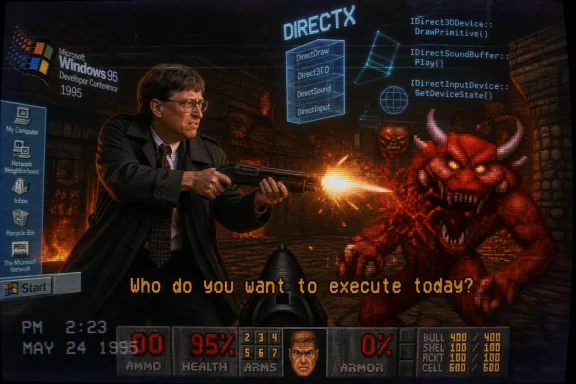 Microsoft Did Not Use Doom by Accident
The temptation is to treat the video as a novelty: Gates, normally cast in public memory as the sweater-wearing software monopolist, briefly cosplaying as Doomguy for a room full of developers. That is the meme version, and it is not wrong. But it misses why Doom was the weapon Microsoft chose.In 1995, Doom was not merely a popular game. It was a technical argument. id Software’s shooter had become shorthand for what a PC could do when developers bypassed the polite layers of consumer computing and spoke directly to hardware. If a machine could run Doom well, it was a machine worth respecting.
That mattered because Windows, despite its commercial momentum, was not yet the natural home of serious PC games. Gamers booted into DOS because DOS gave them the control, speed, and predictability that Windows often did not. Windows had productivity apps, solitaire, Minesweeper, and the office future; DOS had the games people cared enough to tune memory managers for.
So Microsoft’s decision to put Gates inside Doom’s world was unsubtle but strategically sharp. The company was not merely borrowing a recognizable cultural artifact. It was trying to seize the authority of the most important PC game of the decade and transfer that authority to Windows 95.
The shotgun gag is funny because Gates looks so ill-suited to it. The business message underneath it was deadly serious: Microsoft wanted developers to stop treating Windows as the thing users returned to after gaming and start treating it as the place games belonged.
The Wrong Year Tells the Right Story
The resurfaced clip is sometimes described loosely as a Windows 95 promo from 1993, but that framing collapses two different moments. Doom launched in 1993; Microsoft’s “Judgment Day” event and the Gates video belong to 1995, after Windows 95 had shipped and Microsoft was trying to make its new operating system credible as a gaming platform.That distinction matters because it changes the story from prediction to reaction. In 1993, Doom helped define the DOS gaming peak. In 1995, Microsoft was trying to absorb that peak into Windows before DOS could remain the permanent center of gravity for PC games.
Windows 95 arrived with one of the biggest consumer software launches of its era, complete with the Start button, a new shell, and a marketing campaign designed to make an operating system feel like a cultural event. Yet the technical problem beneath the gloss remained stubborn. Windows had to convince developers that it could deliver performance without making them surrender too much control.
That was the purpose of DirectX, originally introduced as Microsoft’s answer to a messy multimedia landscape. The pitch was simple in outline but hard in practice: developers would get a set of APIs for graphics, sound, input, and related game functions, while users would get less configuration pain and fewer excursions into driver hell.
The Gates video is therefore a historical artifact from the awkward hinge between eras. It belongs after Doom had already proven DOS’s power and before Windows had proven it could own PC gaming. The absurdity of the clip is part of its value: it shows Microsoft campaigning for legitimacy in a market it did not yet command.
DOS Was the Enemy Microsoft Could Not Name Too Softly
By the mid-1990s, DOS was both Microsoft’s foundation and its obstacle. It had helped build the PC software economy, but it also represented the fragmentation and friction Windows 95 was supposed to overcome. For games in particular, DOS was the familiar old battlefield: fast, direct, configurable, and frequently hostile to ordinary users.Anyone who played PC games in that period remembers the rituals. Sound card setup was its own initiation ceremony. IRQs, DMA channels, AUTOEXEC.BAT, CONFIG.SYS, and memory constraints were not abstract technical terms; they were the price of admission. Some players loved that tinkering culture, but it was a terrible basis for mass-market computing.
Microsoft’s argument was that Windows could make games easier to install, easier to configure, easier to support, and easier to sell to a wider audience. That was not just a consumer convenience claim. It was a platform-control claim.
If games stayed in DOS, Microsoft’s shiny new operating environment remained partially bypassed by one of the most technically demanding and culturally influential categories of software. If games moved to Windows, Microsoft could place gaming inside the same platform logic that already governed office suites, utilities, hardware support, and OEM distribution.
That is why Gates’ line about cleaning up the “DOS mess” lands as more than marketing copy. Microsoft was not pretending DOS had failed. It was saying DOS had become strategically inconvenient.
The company needed developers to believe that the pain of moving to Windows would pay off. It also needed them to believe that Microsoft was serious enough about gaming to sit down with the people making hits, not merely with spreadsheet vendors and printer manufacturers. Doom gave the company a dramatic shortcut to that credibility.
DirectX Was Microsoft’s Real Shotgun
The video gives Gates the shotgun, but DirectX was the actual weapon. Without it, Windows 95’s gaming pitch would have been mostly vibes: a new interface, broader hardware support, and a promise that the future would be friendlier. With DirectX, Microsoft could offer developers a concrete path away from DOS.DirectX was not born glamorous. APIs rarely are. Its importance was that it gave Windows a way to speak the language of game development without forcing every studio through slow, general-purpose abstractions that would have made serious action games impractical.
The central challenge was performance. Developers who had grown up squeezing frames out of DOS were not going to move voluntarily to a platform that made their games slower, buggier, or less predictable. They needed access to graphics, audio, and input in a way that felt close enough to the metal to be viable.
At the same time, Microsoft needed to avoid the chaos that made DOS gaming so difficult for normal users. That was the balancing act: enough low-level access for developers, enough standardization for Windows to become the platform rather than just a launcher.
This is where the Doom port becomes more than trivia. Microsoft’s work on Doom95 was a proof-of-seriousness project. If Windows could host Doom, Windows could plausibly host the next generation of PC games. If DirectX could make that transition tolerable, Microsoft had a path to move developers from begrudging curiosity to active support.
Gates’ performance, odd as it looks now, was the skin wrapped around a platform strategy. Microsoft was not asking developers to believe in a trench coat. It was asking them to believe that Windows could become the default runtime for entertainment software.
Gabe Newell’s Role Foreshadowed the Next Platform War
One of the richest historical details is the involvement of Gabe Newell, then a Microsoft employee, in the effort to bring Doom to Windows 95. Newell would later leave Microsoft, co-found Valve, help create Half-Life, and eventually build Steam into the dominant distribution layer for PC games. The irony is almost too neat: one of the people helping Microsoft pull games into Windows later helped build a platform that partially sat above Windows.That does not make the Doom95 story less Microsoft-centric. It makes it more revealing. The people who understood gaming as a platform business were already working through questions that would define the next three decades: Who owns the developer relationship? Who controls distribution? Who reduces friction for users? Who becomes the layer everyone else has to support?
In 1995, Microsoft’s answer was Windows. By the 2000s, Valve’s answer was Steam. By the 2010s and 2020s, the answers multiplied across consoles, mobile stores, cloud services, subscription catalogs, anti-cheat systems, and launcher ecosystems. But the underlying fight was familiar: the company that reduces the most pain for developers and users gets to tax the flow of attention.
Newell’s presence in the Windows 95 gaming push is also a reminder that Microsoft’s success was not inevitable. It required internal champions who understood that games were not peripheral fluff. They were among the most demanding tests of a consumer computing platform.
That lesson has echoed through Microsoft’s later gaming history, from DirectX’s maturation to Xbox, Game Pass, and the company’s enormous investment in game studios. The Doom promo looks like a joke; the institutional instinct behind it was anything but.
Windows 95 Needed Games More Than Games Needed Windows
The strangest thing about the clip, viewed from 2026, is how hard Microsoft is selling. Modern Windows is so deeply associated with PC gaming that the reverse seems natural. Developers release on Windows because that is where the PC audience is. GPU vendors optimize for it. Peripheral makers support it. Players expect it.In 1995, that dominance was still being negotiated. Windows 95 had the marketing budget and the consumer mindshare, but PC gaming’s prestige lived elsewhere. The most exciting games were not exciting because they were Windows applications. They were exciting because they made PCs feel dangerous, fast, and technically alive.
That is why the “Judgment Day” framing worked. It staged the platform transition as a kind of ritual execution. DOS was not being politely retired; it was being hunted down in the corridors of the very game that had made it glorious.
There is a brutality to that symbolism that only Microsoft could make corporate. The company was asking developers to stop optimizing for the old reality and commit to the new one. It wanted them to bring their games, their engines, and eventually their customers into the Windows ecosystem.
The claim that Windows 95 would offer better setup and integration was not trivial. For developers, support costs mattered. For publishers, retail returns and consumer frustration mattered. For hardware vendors, standardized APIs promised a larger and more predictable market. Microsoft’s strongest argument was not that Windows was cooler than DOS. It was that Windows could make the business of PC gaming scale.
That scaling argument won. Not instantly, not cleanly, and not without years of compatibility pain, but decisively enough that the DOS-versus-Windows question eventually stopped being a live debate for mainstream PC games.
The Tagline Aged Worse Than the Strategy
“Who do you want to execute today?” is a pitch-black parody of Windows 95’s famous “Where do you want to go today?” campaign line. It is also a reminder that the 1990s tech industry often treated violent game imagery with a breeziness that now feels culturally radioactive.The line works as a developer-room joke because it collapses operating-system marketing into Doom’s vocabulary. It also works because it is so plainly engineered for the audience in front of it. Microsoft was not trying to reassure parents, school boards, or enterprise procurement officers with this clip. It was trying to make game developers laugh and, more importantly, listen.
Still, the tagline is the part least likely to survive a modern corporate review. A CEO with a shotgun, dead demons, and an execution joke would now be filtered through legal, brand safety, social media risk, internal comms, and probably a few crisis-response templates before anyone got near a stage. The fact that it happened says something about the looser promotional culture of the era.
But the line’s awkwardness should not distract from the sophistication of the underlying message. Microsoft understood that developers did not want another abstract assurance that Windows was important. They wanted to see the company invade their world on their terms.
The clip is cringey because Gates is not a natural action hero. It is effective because Microsoft knew exactly which game world to borrow. Doom was a credential, and Microsoft used it like one.
The Clip Resurfaced Because Today’s Microsoft Is Still Fighting the Same War
The video’s renewed circulation in May 2026 hits differently because Microsoft is again in a period of platform anxiety, though the terrain has changed. Windows remains central to PC gaming, but the meaning of a gaming platform is no longer limited to an operating system. Storefronts, subscriptions, launchers, anti-cheat frameworks, cloud saves, handheld compatibility, GPU features, and cross-platform identity all now compete for the user’s loyalty.The old Microsoft wanted to pull games out of DOS and into Windows. The modern Microsoft wants to keep Windows relevant in a world where gaming increasingly flows across devices, services, and ecosystems. That includes Xbox consoles, Game Pass, Battle.net assets after the Activision Blizzard deal, cloud streaming, and Windows handhelds trying to answer the Steam Deck’s challenge.
In that context, the Doom clip is not merely retro content. It is a reminder of the last time Microsoft had to persuade the games industry that Windows was the future rather than just the installed base. The company succeeded then because it combined marketing theater with developer plumbing.
That second part is the one that matters. Developers do not move because a CEO performs commitment. They move when tools, APIs, distribution, hardware support, and customer demand line up. The Gates video was memorable, but DirectX did the work.
The same standard applies now. Microsoft can brand Windows as the home of PC gaming as loudly as it wants, but users will judge the platform by latency, compatibility, driver stability, store friction, handheld usability, anti-cheat behavior, mod support, and whether the games they buy remain easy to access years later.
That is the lesson hiding inside the trench coat. Platform power is never permanent. It has to be renewed at the level where developers and users actually feel it.
Nostalgia Should Not Sand Off the Sharp Edges
There is an understandable affection around artifacts like this. They come from a time when software launches were theatrical, executives were less media-trained, and the PC felt like a frontier where a weird demo could plausibly alter the direction of an industry. But nostalgia can make the past look more innocent than it was.Microsoft’s Windows 95 gaming campaign was also an exercise in consolidation. The company was using the gravitational pull of Windows to absorb another domain of computing. Better APIs and easier setup were real benefits, but they also advanced Microsoft’s broader control over the PC software stack.
That is not a conspiracy; it is platform strategy. Every successful platform reduces some chaos in exchange for becoming the new chokepoint. DOS gaming was fragmented and often miserable for users, but it was also a space where developers had unusual freedom to work around the operating environment. Windows promised order, and order came with Microsoft at the center.
For users, the trade was mostly worth it. PC gaming became easier, broader, and more commercially viable. For developers, DirectX eventually became a common target with enormous reach. For Microsoft, gaming helped make Windows feel indispensable beyond the office.
But the tension never disappeared. Today’s complaints about store lock-in, launcher sprawl, kernel-level anti-cheat, forced updates, telemetry, and platform fees are modern versions of the same old negotiation. Users want convenience without surrender. Developers want reach without dependence. Platform owners want both sides to forget that alternatives exist.
That is why the Doom promo still feels alive. It captures the moment before one settlement hardened into common sense.
The Demon Microsoft Really Shot Was Fragmentation
If the clip has a villain, it is not actually the Doom monster Gates blasts mid-sentence. It is fragmentation: the tangle of drivers, hardware quirks, installation scripts, memory limitations, and support nightmares that made DOS gaming both powerful and painful.Microsoft’s genius was to make fragmentation look old-fashioned. Windows 95 did not merely promise a new user interface. It promised that the PC could become more appliance-like without losing its openness. DirectX was the gaming-specific form of that promise.
The promise was imperfect, and anyone who lived through early Windows gaming knows it. Driver crashes did not vanish. Compatibility problems persisted. DOS games remained relevant for years. Some titles ran better outside Windows, and many users kept boot disks around long after Microsoft would have preferred them to stop.
Yet direction matters more than instantaneous victory in platform shifts. Microsoft did not need every game to move at once. It needed developers to believe the future work should target Windows first, or at least seriously. Once that belief took hold, the feedback loop did the rest.
More Windows games meant more gamers using Windows. More gamers using Windows meant more reason for hardware vendors to optimize for Windows. Better hardware support meant more reason for developers to trust Windows. That is how a platform becomes the weather.
The Doom promo was a weather report from the beginning of the storm.
The Windows Gaming Victory Was Built on Developer Persuasion
Microsoft’s current reputation can make it easy to forget how much persuasion the company had to do in the 1990s. It had market power, certainly, but power alone did not make Windows a credible gaming platform. Developers had to be courted, tools had to improve, and flagship examples had to demonstrate that the shift would not ruin performance.That is why the “75 new games” claim associated with the event mattered. Microsoft was not selling a lone port. It was selling momentum. Developers needed to believe they would not be stranded if they bet on Windows.
Momentum is often the most important product in a platform transition. A single technical demo can impress a room, but a pipeline of games changes planning assumptions. Publishers start asking about Windows support. Hardware makers start tuning drivers. Retail boxes start wearing compatibility badges. Consumers start expecting the new thing to work.
The Gates video was designed to compress that momentum into a few minutes of spectacle. It said: the CEO knows your world, the company is investing, the API is real, the games are coming, and the old DOS mess is on borrowed time.
Of course, the CEO did not really know Doom in the way players knew Doom. That is part of the charm and the awkwardness. But he did not need to be a credible marine. He needed Microsoft to look like a credible platform owner for games.
On that score, the stunt did its job.
The Trench Coat Still Has a Message for Windows Users
The most concrete lesson from the resurfaced clip is that Windows’ place in gaming was made, not ordained. Microsoft had to fight for it with APIs, compatibility promises, developer outreach, and a willingness to look ridiculous in public if that helped the campaign. The company that now talks about gaming across Windows, Xbox, and cloud services once had to convince people that its flagship OS could run Doom without missing the point.That history matters for today’s users and administrators because platform transitions are easier to understand after they happen than while they are happening. Windows 95 and DirectX look obvious in retrospect. At the time, they were bets against entrenched habits.
- Microsoft’s “Judgment Day” Doom video was a 1995 Windows 95 and DirectX developer pitch, not a 1993-era Doom launch artifact.
- The stunt used Doom because Doom represented the performance and cultural legitimacy that Windows gaming still needed to win.
- DirectX, not the video itself, was the mechanism that made Microsoft’s anti-DOS argument credible to developers.
- Gabe Newell’s involvement in the Windows Doom effort foreshadowed how central developer ecosystems and distribution layers would become to PC gaming.
- The clip’s violent joke has aged awkwardly, but its strategic message about platform control has aged remarkably well.
- Windows became the default home of PC gaming because Microsoft paired marketing spectacle with practical developer infrastructure.
References
- Primary source: Tom's Hardware
Published: 2026-05-31T11:00:12.335867
Bill Gates once starred in a bizarre Doom promo to push Windows 95 back in 1993 — tech mogul wore a trench coat, wielded a shotgun, and shot a demon, saying 'Who do you want to execute today?' | Tom's Hardware
This was a time in the mid-90s when it was estimated that more PCs had Doom installed than had Windows 95 installed.www.tomshardware.com - Related coverage: doom.fandom.com
Doom95 | Doom Wiki | Fandom
Doom95 is a port of Doom to Win9x operating systems included in some releases of the Doom games. This port was developed by Microsoft to serve as a flagship for their DirectX technology, and was released on August 20, 1996. It supports four screen resolutions; 320x200, 320x240, 640x400 and...doom.fandom.com
- Official source: news.microsoft.com
Unparalleled Industry Support for Gaming on Windows 95 Makes It the Gaming Platform of Choice for 1996 - Source
At the Electronic Entertainment Expo (E3) here, Microsoft Corp. today announced the availability in retail outlets of more than 100 titles developed for the Microsoft(r) Windows(r) 95 operating system by third-party developers. news.microsoft.com
- Related coverage: games.slashdot.org
Bill Gates' Doom Video From 1995 - Slashdot
Ant writes "ReelSplatter.com has a copy of the video showing Bill Gates, dressed in a black trench coat and carrying a shotgun, within id software's Doom. The downloadable 11 MB 3.25 minute Windows Media Video (WMV) file (Putfile has a streaming copy) was used to introduce Windows 95 and...games.slashdot.org - Related coverage: gamingroom.net
Doom 95
Doom 95 é basicamente port do Doom para Windows desenvolvido pela Microsoft com o qual basta você copiar todos os arquivos .WAD pro diretório do Doom 95 para ele gerenciá-los e rodar o jogo no Windows.www.gamingroom.net
- Related coverage: everything.explained.today
DirectX explained
DirectX is a collection of application programming interface s for handling tasks related to multimedia, especially game ...everything.explained.today
- Related coverage: wired.com
1995, When CD-ROMs and Microsoft Ruled | WIRED
The Windows 95 launch was the iPhone launch of its day. On August 24, 1995, crowds lined up to purchase what Microsoft promised was the biggest transformation yet in desktop computing.www.wired.com - Related coverage: retrogamer.biz
