

Black Duck’s May 2026 Polaris update expands the platform’s CI, source-control, AI-scanning, license-governance, reporting, and static-analysis capabilities, with Bridge CLI 4.1.2 and 4.2.1 bringing Signal results, automated SCA fix pull requests, and language detection into developer workflows. The headline is not merely that Polaris gained more integrations. It is that Black Duck is trying to turn application security from a separate review gate into a management plane that follows code from repository to pipeline to policy report. That is the right direction for enterprise AppSec, but it also raises the bar for how honestly vendors distinguish automation from actual risk reduction.
The modern application-security stack has a familiar failure mode: every tool finds something, every team sees a different slice of the truth, and every release meeting becomes an argument about whether the dashboard reflects reality. Black Duck’s latest Polaris release is best understood as an attempt to make Polaris the system of record for that sprawl, not just another scanner in the pile.
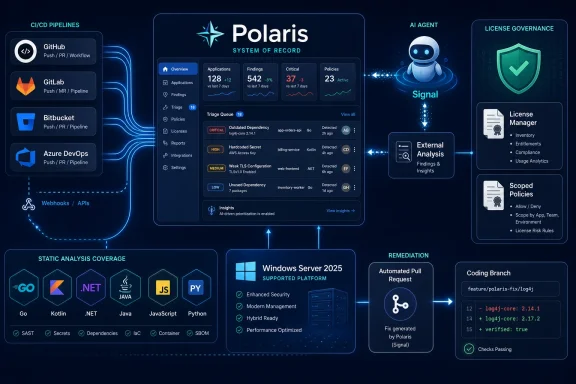
That ambition shows up most clearly in the way Black Duck positions Signal, its agentic AI AppSec scanner. Signal is not being folded into Polaris as a native scan engine in the same sense as fAST Static, fAST SCA, or fAST Dynamic. Instead, Signal runs independently and sends findings into Polaris through External Analysis, where those findings can be triaged, evaluated against policies, and reported alongside other application-security data.
That distinction matters. The industry is currently full of AI-security product language that blurs the line between detection, prioritization, remediation, and governance. Black Duck is at least drawing a boundary: Signal is the agentic scanner, Polaris is the visibility and management layer. For customers, that means the operational question becomes less “Which scanner found this?” and more “Can the organization make consistent decisions from the findings it receives?”
The value proposition is strongest in enterprises where security teams already struggle to keep up with developer velocity. AI-generated code has made that mismatch more visible, but it did not create it. The real problem is that repository creation, dependency changes, secrets exposure, license obligations, and remediation work now happen continuously, while many security processes still assume a slower, checkpoint-driven development model.
Polaris is trying to meet that reality by centralizing evidence without pretending that all evidence comes from one engine. That is a pragmatic architectural bet. It also makes Polaris more important, because a platform that absorbs external findings becomes a governance layer whose accuracy, policy model, and integration reliability can shape what teams are allowed to ship.
That may sound like a handful of workflow niceties, but CI is where AppSec promises either survive contact with development or die quietly. If a tool requires developers to leave their pull request, inspect a separate portal, interpret a separate security vocabulary, and then manually assemble a fix, it will be treated as a tax. If the same tool opens a remediation pull request and exposes scan context in logs developers already read, it has a chance of becoming part of the work.
The automated SCA fix pull request is particularly important because open-source risk is often more remediable than it looks. A dependency vulnerability may require a version bump, a transitive dependency adjustment, or a policy exception when no safe upgrade path exists. Automating the pull request does not remove the need for testing and review, but it removes the blank-page problem that slows remediation.
Language detection in CI logs is less flashy and arguably just as useful. Security teams often discover too late that a scan did not cover what they thought it covered, or that a repository’s mixed-language composition caused gaps in analysis. Surfacing detected languages earlier in the pipeline gives developers and security engineers a more immediate way to validate coverage before a release candidate reaches a formal gate.
The Signal import capability in Bridge 4.2.1 is more strategic. It gives teams with the right Polaris External Analysis entitlement a way to bring AI-oriented scanning results into the same triage and policy machinery as other findings. That is exactly where such results need to live if they are going to influence enterprise decisions rather than sit as an interesting side report.
There are two models in play. The Polaris SCM integration is a security-led approach, managed from the Polaris UI, designed for bulk onboarding, continuous repository monitoring, and event-based scanning. The Black Duck Security Scan onboarding flow is CI-led, aimed more directly at DevSecOps teams that want pipeline configuration changes introduced through pull or merge requests.
That split reflects a real organizational divide. Security teams often want central visibility and persistent coverage across a changing repository estate. Platform and DevOps teams often want changes to be represented as code, reviewed in the same systems that govern other pipeline modifications. Black Duck is not choosing one model over the other; it is trying to serve both.
The practical consequence is that coverage becomes less dependent on heroic manual onboarding. In large organizations, the security problem is rarely limited to the flagship repositories everyone knows about. It is the renamed project, the newly created service, the experimental repo that becomes production-adjacent, or the team that migrated from one SCM to another without updating its security plumbing.
This is where the “single pane of glass” trope either earns its keep or collapses. A platform that can see GitHub, GitLab, Azure DevOps, and Bitbucket estates, then help inject scans into CI workflows, is not merely collecting findings. It is trying to close the distance between inventory and enforcement.
There is still a governance catch. Automated onboarding can widen scan coverage, but it can also create noise at scale if policies are not tuned and ownership is unclear. The enterprises most likely to benefit are those that pair onboarding automation with disciplined application ownership, risk thresholds, and exception processes. Without that, more coverage can simply mean more unresolved findings.
That is not glamorous AppSec, but it is enterprise reality. Open-source license obligations can block releases, complicate M&A diligence, and create downstream product-distribution risk. For companies that ship software to customers, license governance is not a legal afterthought; it is part of supply-chain control.
Deep License Data is meant to give teams more evidence-backed insight into what licenses are present and how they are used. The License Manager adds a more centralized view of license terms, organizational fields, usage across projects and applications, and status in dashboards and project views. In plain English, Black Duck is trying to make license decisions less dependent on spreadsheet archaeology.
The most important piece may be scoped license policies. Polaris can evaluate shallow licenses, deep licenses, or both, with different rules and enforcement actions, including notifications and build breaks based on license risk status. That gives organizations a path to distinguish routine license visibility from policy violations that should actually interrupt delivery.
This is where security and legal governance converge. A developer may experience a license policy as just another failed build, but the organization needs that failure to reflect a real, explainable rule. If the policy engine can show evidence and scope, the conversation becomes less subjective.
License governance also matters because AI-assisted development may increase dependency churn. Developers using AI coding tools often move quickly through libraries, snippets, and generated scaffolding. The more code and dependencies flow into repositories at speed, the more important it becomes to have license evidence that can survive audit pressure.
The deeper point is that security teams are under pressure to prove that their tools reduce risk rather than merely generate findings. A platform that can show triage status, policy outcomes, scan coverage, license posture, and remediation movement has a better chance of answering the executive question: are we safer, or are we just busier?
For WindowsForum’s IT-pro audience, the parallel with endpoint and patch management is obvious. Administrators have spent years learning that the difference between a tool and a program is reporting discipline. You can deploy an agent everywhere and still not know whether exposure is shrinking unless your data model can connect coverage, exceptions, severity, ownership, and time.
Application security is now undergoing the same maturation. It is no longer enough to say that code was scanned. Teams need to know which repositories were onboarded, which scan engines ran, which languages were detected, which findings are policy-relevant, which fixes were proposed, and which risks were accepted.
The risk, of course, is dashboard theater. Any platform can make a large program look more coherent than it is. The test for Polaris will be whether its reports help teams make better release and governance decisions, not merely produce cleaner slides for steering committees.
Hardcoded secrets are not new. What is new is the economic and operational blast radius of exposed AI credentials. A leaked LLM API key can lead to unauthorized usage, unexpected cost, data exposure, or abuse of a company’s AI infrastructure. It is not just a secret-management issue; it is a cloud-spend and data-governance issue.
Detecting AI credentials in Rapid Scan Static also fits the way these mistakes happen. Secrets are often introduced during experimentation, prototyping, or integration testing, then accidentally committed. If scans catch them before merge or release, the remediation path is far cleaner than if the key is discovered after public exposure.
This is also a useful reminder that “AI security” is not one problem. Signal is aimed at analyzing AI-generated code and guiding remediation through agentic scanning. AI credential detection is about finding sensitive tokens that connect applications to AI services. Those are adjacent concerns, but they require different controls.
Black Duck is smart to position both under the broader AI-era security umbrella while preserving the operational distinction. Enterprises do not need one mystical AI-security product. They need a set of controls that address how AI changes code creation, dependency use, secret exposure, review velocity, and policy enforcement.
For developers, updated language and platform support is table stakes. Static analysis tools lose relevance quickly if they lag behind the frameworks and compilers teams actually use. For security leaders, the more interesting promise is deeper detection with fewer false positives, because false positives are where developer trust goes to die.
But there is an important operational caveat: better detection often looks like a sudden risk spike. Teams scanning Go or Scala code, for example, may see new findings after upgrading not because the code became less secure overnight, but because the scanner became more capable. That distinction needs to be communicated before a release dashboard lights up red.
This is one of the hardest parts of running mature AppSec programs. Tool improvements can break trend lines. A month-over-month increase in findings may represent genuine regression, expanded coverage, new detection rules, or simply a better understanding of existing risk. Reporting systems need enough context to explain those differences.
The same logic applies to Rapid Scan Static’s new and modified checks. Black Duck says the update includes new Go checks, Java/Kotlin/Scala checks, Scala checks, a properties check, and modified checks that expand detection across JVM and Go ecosystems. That is good news, but it requires change management.
Security teams should treat scanner upgrades like any other production-affecting change. They need release notes, pilot projects, expected-delta analysis, and a plan for triaging newly surfaced findings. Otherwise, developers will experience better detection as unpredictable gatekeeping.
This is the kind of feature that rarely makes marketing headlines but matters enormously to enterprise IT. Uncoordinated scanner updates can introduce new findings mid-release, shift severity patterns, or change build outcomes. For teams with strict release governance, that unpredictability can be unacceptable.
Version locking gives organizations a way to separate discovery from enforcement. A team can decide when to absorb new detection logic, test the impact, and update policies accordingly. That does not mean freezing security forever; it means making scanner evolution part of change control.
There is a tension here. Security vendors want customers to benefit from new checks as quickly as possible, especially when emerging vulnerability classes or secret patterns appear. Enterprises want stability, reproducibility, and predictable gates. The right answer is rarely pure immediacy or pure stasis.
Polaris’ improved locking model is an acknowledgement that AppSec tooling now participates in the release process deeply enough to require operational discipline. When a scanner can fail a build, open a pull request, update a ticket, and influence executive reporting, its version becomes part of the software-delivery environment.
The attractive promise is obvious. AI-generated code increases the volume of code that needs review, and human security experts are not scaling at the same rate. If agentic systems can identify exploitable issues, reduce noise, and propose useful remediation, they can relieve pressure on both development and security teams.
The danger is also obvious. “Agentic” can become a way to overstate autonomy and understate accountability. A scanner may guide remediation, but organizations still need policies that define acceptable risk, reviewers who understand business context, and audit trails that explain why a finding was fixed, deferred, or accepted.
That is why the External Analysis model matters. If Signal findings land in Polaris for triage, policy evaluation, and reporting, they enter a governance workflow rather than floating as AI-generated advice. The value of the agent is bounded by the quality of the management layer around it.
This is a healthier model than pretending AI can simply replace AppSec process. Enterprises do not need autonomous security theater. They need automation that is visible, governable, and reversible when it gets something wrong.
The addition of Windows Server 2025 support in Full Static Scan is a reminder that application security is not detached from platform modernization. As organizations move server baselines forward and adopt newer .NET and C# versions, their security tooling must keep pace. A static-analysis platform that cannot understand current frameworks becomes a drag on modernization.
For sysadmins and IT pros, the more important lesson is procedural. Application-security platforms are starting to resemble the management planes familiar from endpoint protection, vulnerability management, and patch compliance. They ingest telemetry, apply policy, trigger workflows, generate reports, and expose exceptions.
That convergence has consequences. Security teams that once focused mainly on infrastructure now need to understand how code moves through CI/CD. Developers who once treated security as an external audit now face policy decisions inside pull requests. Compliance teams that once asked for periodic evidence now expect near-real-time posture.
Polaris is not alone in pushing this model, but the update captures the direction of travel. AppSec is becoming less a specialized checkpoint and more a continuous operating layer across software delivery.
The weaker version is that enterprises get more findings, more dashboards, more AI-branded analysis, and more policy knobs without a corresponding increase in resolution capacity. That is the trap every AppSec platform must avoid. Visibility is necessary, but unresolved visibility becomes a morale problem.
Automated SCA fix pull requests are therefore more than a convenience feature. They are a sign that the market has realized detection alone is not enough. The scarce resource is not the ability to find problems; it is the organizational capacity to fix the right problems quickly and prove that the risk changed.
The same standard should be applied to AI-assisted scanning. If Signal helps teams prioritize exploitable findings and produce better remediation guidance, it can improve throughput. If it merely adds another category of results to already crowded dashboards, its agentic branding will not matter.
Enterprise buyers should evaluate this release through workflow outcomes rather than feature checkboxes. How many repositories can be onboarded without manual work? How many findings receive owner-aware routing? How many dependency issues result in usable pull requests? How often do scanner upgrades disrupt release gates? How quickly can license questions be answered with evidence?
Those are the questions that separate platform maturity from tool accumulation.
Black Duck’s latest Polaris release points toward the AppSec platform enterprises increasingly need: one that follows developers into CI, absorbs specialized AI-scanning results, treats license obligations as first-class governance data, and gives security teams more control over scanner change. The risk is that centralization becomes another layer of abstraction over unresolved work. The opportunity is better: if Polaris can make security evidence timely, explainable, and actionable where code is actually built, AppSec may finally move from periodic inspection to continuous software governance.
 Polaris Is Becoming the Place Where AppSec Evidence Gets Normalized
The modern application-security stack has a familiar failure mode: every tool finds something, every team sees a different slice of the truth, and every release meeting becomes an argument about whether the dashboard reflects reality. Black Duck’s latest Polaris release is best understood as an attempt to make Polaris the system of record for that sprawl, not just another scanner in the pile.That ambition shows up most clearly in the way Black Duck positions Signal, its agentic AI AppSec scanner. Signal is not being folded into Polaris as a native scan engine in the same sense as fAST Static, fAST SCA, or fAST Dynamic. Instead, Signal runs independently and sends findings into Polaris through External Analysis, where those findings can be triaged, evaluated against policies, and reported alongside other application-security data.
That distinction matters. The industry is currently full of AI-security product language that blurs the line between detection, prioritization, remediation, and governance. Black Duck is at least drawing a boundary: Signal is the agentic scanner, Polaris is the visibility and management layer. For customers, that means the operational question becomes less “Which scanner found this?” and more “Can the organization make consistent decisions from the findings it receives?”
The value proposition is strongest in enterprises where security teams already struggle to keep up with developer velocity. AI-generated code has made that mismatch more visible, but it did not create it. The real problem is that repository creation, dependency changes, secrets exposure, license obligations, and remediation work now happen continuously, while many security processes still assume a slower, checkpoint-driven development model.
Polaris is trying to meet that reality by centralizing evidence without pretending that all evidence comes from one engine. That is a pragmatic architectural bet. It also makes Polaris more important, because a platform that absorbs external findings becomes a governance layer whose accuracy, policy model, and integration reliability can shape what teams are allowed to ship.
Bridge CLI Moves the Argument Into the Pipeline
Bridge CLI 4.1.2 and 4.2.1 are the most developer-facing part of this update, and they carry the most immediate operational impact. The new versions extend Polaris support inside CI workflows by importing Signal scan results as External Analysis issues, creating automated SCA fix pull requests, and showing SAST language-detection data in CI logs.That may sound like a handful of workflow niceties, but CI is where AppSec promises either survive contact with development or die quietly. If a tool requires developers to leave their pull request, inspect a separate portal, interpret a separate security vocabulary, and then manually assemble a fix, it will be treated as a tax. If the same tool opens a remediation pull request and exposes scan context in logs developers already read, it has a chance of becoming part of the work.
The automated SCA fix pull request is particularly important because open-source risk is often more remediable than it looks. A dependency vulnerability may require a version bump, a transitive dependency adjustment, or a policy exception when no safe upgrade path exists. Automating the pull request does not remove the need for testing and review, but it removes the blank-page problem that slows remediation.
Language detection in CI logs is less flashy and arguably just as useful. Security teams often discover too late that a scan did not cover what they thought it covered, or that a repository’s mixed-language composition caused gaps in analysis. Surfacing detected languages earlier in the pipeline gives developers and security engineers a more immediate way to validate coverage before a release candidate reaches a formal gate.
The Signal import capability in Bridge 4.2.1 is more strategic. It gives teams with the right Polaris External Analysis entitlement a way to bring AI-oriented scanning results into the same triage and policy machinery as other findings. That is exactly where such results need to live if they are going to influence enterprise decisions rather than sit as an interesting side report.
The Integration Race Is Really a Coverage Race
Black Duck’s February Polaris push emphasized native integrations across GitHub, GitLab, Azure DevOps, and Bitbucket. The May update extends that story by adding Black Duck Security Scan bulk CI onboarding for GitLab and Bitbucket, alongside the earlier GitHub app experience. Azure DevOps support for this CI-led onboarding path is described as coming later.There are two models in play. The Polaris SCM integration is a security-led approach, managed from the Polaris UI, designed for bulk onboarding, continuous repository monitoring, and event-based scanning. The Black Duck Security Scan onboarding flow is CI-led, aimed more directly at DevSecOps teams that want pipeline configuration changes introduced through pull or merge requests.
That split reflects a real organizational divide. Security teams often want central visibility and persistent coverage across a changing repository estate. Platform and DevOps teams often want changes to be represented as code, reviewed in the same systems that govern other pipeline modifications. Black Duck is not choosing one model over the other; it is trying to serve both.
The practical consequence is that coverage becomes less dependent on heroic manual onboarding. In large organizations, the security problem is rarely limited to the flagship repositories everyone knows about. It is the renamed project, the newly created service, the experimental repo that becomes production-adjacent, or the team that migrated from one SCM to another without updating its security plumbing.
This is where the “single pane of glass” trope either earns its keep or collapses. A platform that can see GitHub, GitLab, Azure DevOps, and Bitbucket estates, then help inject scans into CI workflows, is not merely collecting findings. It is trying to close the distance between inventory and enforcement.
There is still a governance catch. Automated onboarding can widen scan coverage, but it can also create noise at scale if policies are not tuned and ownership is unclear. The enterprises most likely to benefit are those that pair onboarding automation with disciplined application ownership, risk thresholds, and exception processes. Without that, more coverage can simply mean more unresolved findings.
License Governance Finally Gets Treated Like Security Work
The Polaris update’s license-governance changes deserve more attention than they will probably get. Expanded SCA license capabilities include Deep License Data and a centralized License Manager, with visibility at global, application, and project levels and supporting evidence available at the project and branch level.That is not glamorous AppSec, but it is enterprise reality. Open-source license obligations can block releases, complicate M&A diligence, and create downstream product-distribution risk. For companies that ship software to customers, license governance is not a legal afterthought; it is part of supply-chain control.
Deep License Data is meant to give teams more evidence-backed insight into what licenses are present and how they are used. The License Manager adds a more centralized view of license terms, organizational fields, usage across projects and applications, and status in dashboards and project views. In plain English, Black Duck is trying to make license decisions less dependent on spreadsheet archaeology.
The most important piece may be scoped license policies. Polaris can evaluate shallow licenses, deep licenses, or both, with different rules and enforcement actions, including notifications and build breaks based on license risk status. That gives organizations a path to distinguish routine license visibility from policy violations that should actually interrupt delivery.
This is where security and legal governance converge. A developer may experience a license policy as just another failed build, but the organization needs that failure to reflect a real, explainable rule. If the policy engine can show evidence and scope, the conversation becomes less subjective.
License governance also matters because AI-assisted development may increase dependency churn. Developers using AI coding tools often move quickly through libraries, snippets, and generated scaffolding. The more code and dependencies flow into repositories at speed, the more important it becomes to have license evidence that can survive audit pressure.
Reporting Is Being Recast as an Executive Control Surface
Black Duck is also expanding reporting flexibility, including more ways to show risk posture, license exposure, and operational progress. That part of the release is easy to dismiss as dashboard polish, but reporting is where AppSec programs justify themselves to budget holders and where operational reality becomes visible to leaders who do not live in Jira or CI logs.The deeper point is that security teams are under pressure to prove that their tools reduce risk rather than merely generate findings. A platform that can show triage status, policy outcomes, scan coverage, license posture, and remediation movement has a better chance of answering the executive question: are we safer, or are we just busier?
For WindowsForum’s IT-pro audience, the parallel with endpoint and patch management is obvious. Administrators have spent years learning that the difference between a tool and a program is reporting discipline. You can deploy an agent everywhere and still not know whether exposure is shrinking unless your data model can connect coverage, exceptions, severity, ownership, and time.
Application security is now undergoing the same maturation. It is no longer enough to say that code was scanned. Teams need to know which repositories were onboarded, which scan engines ran, which languages were detected, which findings are policy-relevant, which fixes were proposed, and which risks were accepted.
The risk, of course, is dashboard theater. Any platform can make a large program look more coherent than it is. The test for Polaris will be whether its reports help teams make better release and governance decisions, not merely produce cleaner slides for steering committees.
AI Credential Detection Is the Most Concrete AI-Security Move Here
The release also adds AI credential exposure detection in Rapid Scan Static, with patterns for hardcoded API keys associated with major AI providers such as OpenAI, Anthropic, Perplexity AI, and Gemini. In a market flooded with grand claims about securing AI-generated code, this is one of the more concrete and immediately useful changes.Hardcoded secrets are not new. What is new is the economic and operational blast radius of exposed AI credentials. A leaked LLM API key can lead to unauthorized usage, unexpected cost, data exposure, or abuse of a company’s AI infrastructure. It is not just a secret-management issue; it is a cloud-spend and data-governance issue.
Detecting AI credentials in Rapid Scan Static also fits the way these mistakes happen. Secrets are often introduced during experimentation, prototyping, or integration testing, then accidentally committed. If scans catch them before merge or release, the remediation path is far cleaner than if the key is discovered after public exposure.
This is also a useful reminder that “AI security” is not one problem. Signal is aimed at analyzing AI-generated code and guiding remediation through agentic scanning. AI credential detection is about finding sensitive tokens that connect applications to AI services. Those are adjacent concerns, but they require different controls.
Black Duck is smart to position both under the broader AI-era security umbrella while preserving the operational distinction. Enterprises do not need one mystical AI-security product. They need a set of controls that address how AI changes code creation, dependency use, secret exposure, review velocity, and policy enforcement.
Static Analysis Gets Broader, but Better Detection Will Feel Like New Risk
The Full Static Scan updates expand support for newer platforms and languages, including Windows Server 2025, .NET 10 with C# 14, FreeBSD 15, Bazel 9 for C/C++, and Kotlin 2.3.0. Black Duck also highlights Go and Scala coverage, new injection-focused dataflow analysis, and lower false-positive rates.For developers, updated language and platform support is table stakes. Static analysis tools lose relevance quickly if they lag behind the frameworks and compilers teams actually use. For security leaders, the more interesting promise is deeper detection with fewer false positives, because false positives are where developer trust goes to die.
But there is an important operational caveat: better detection often looks like a sudden risk spike. Teams scanning Go or Scala code, for example, may see new findings after upgrading not because the code became less secure overnight, but because the scanner became more capable. That distinction needs to be communicated before a release dashboard lights up red.
This is one of the hardest parts of running mature AppSec programs. Tool improvements can break trend lines. A month-over-month increase in findings may represent genuine regression, expanded coverage, new detection rules, or simply a better understanding of existing risk. Reporting systems need enough context to explain those differences.
The same logic applies to Rapid Scan Static’s new and modified checks. Black Duck says the update includes new Go checks, Java/Kotlin/Scala checks, Scala checks, a properties check, and modified checks that expand detection across JVM and Go ecosystems. That is good news, but it requires change management.
Security teams should treat scanner upgrades like any other production-affecting change. They need release notes, pilot projects, expected-delta analysis, and a plan for triaging newly surfaced findings. Otherwise, developers will experience better detection as unpredictable gatekeeping.
Version Locking Is a Small Feature With a Large Governance Shadow
One of the subtler updates is improved version locking for static analysis. Previously, locking into a recommended SAST version fixed the full scan while Rapid Scan Static could update independently. The new model allows Full Static Scan and Rapid Scan Static to be locked together, giving teams more control over upgrades during release cycles.This is the kind of feature that rarely makes marketing headlines but matters enormously to enterprise IT. Uncoordinated scanner updates can introduce new findings mid-release, shift severity patterns, or change build outcomes. For teams with strict release governance, that unpredictability can be unacceptable.
Version locking gives organizations a way to separate discovery from enforcement. A team can decide when to absorb new detection logic, test the impact, and update policies accordingly. That does not mean freezing security forever; it means making scanner evolution part of change control.
There is a tension here. Security vendors want customers to benefit from new checks as quickly as possible, especially when emerging vulnerability classes or secret patterns appear. Enterprises want stability, reproducibility, and predictable gates. The right answer is rarely pure immediacy or pure stasis.
Polaris’ improved locking model is an acknowledgement that AppSec tooling now participates in the release process deeply enough to require operational discipline. When a scanner can fail a build, open a pull request, update a ticket, and influence executive reporting, its version becomes part of the software-delivery environment.
The Agentic Scanner Still Needs Human Governance
Signal’s positioning as an agentic AI AppSec scanner is timely and deliberately ambitious. Black Duck describes it as using specialized AI security agents powered by ContextAI to analyze code, assess exploitability, and guide remediation in real time. That is the kind of language every security buyer now has to parse carefully.The attractive promise is obvious. AI-generated code increases the volume of code that needs review, and human security experts are not scaling at the same rate. If agentic systems can identify exploitable issues, reduce noise, and propose useful remediation, they can relieve pressure on both development and security teams.
The danger is also obvious. “Agentic” can become a way to overstate autonomy and understate accountability. A scanner may guide remediation, but organizations still need policies that define acceptable risk, reviewers who understand business context, and audit trails that explain why a finding was fixed, deferred, or accepted.
That is why the External Analysis model matters. If Signal findings land in Polaris for triage, policy evaluation, and reporting, they enter a governance workflow rather than floating as AI-generated advice. The value of the agent is bounded by the quality of the management layer around it.
This is a healthier model than pretending AI can simply replace AppSec process. Enterprises do not need autonomous security theater. They need automation that is visible, governable, and reversible when it gets something wrong.
The Windows Angle Is the Enterprise Angle
At first glance, this Polaris release may seem like developer-tooling news rather than WindowsForum territory. But Windows shops increasingly live in the same hybrid reality as everyone else: .NET services, Windows Server workloads, Azure DevOps pipelines, GitHub repositories, containerized components, and open-source dependencies sitting behind business-critical applications.The addition of Windows Server 2025 support in Full Static Scan is a reminder that application security is not detached from platform modernization. As organizations move server baselines forward and adopt newer .NET and C# versions, their security tooling must keep pace. A static-analysis platform that cannot understand current frameworks becomes a drag on modernization.
For sysadmins and IT pros, the more important lesson is procedural. Application-security platforms are starting to resemble the management planes familiar from endpoint protection, vulnerability management, and patch compliance. They ingest telemetry, apply policy, trigger workflows, generate reports, and expose exceptions.
That convergence has consequences. Security teams that once focused mainly on infrastructure now need to understand how code moves through CI/CD. Developers who once treated security as an external audit now face policy decisions inside pull requests. Compliance teams that once asked for periodic evidence now expect near-real-time posture.
Polaris is not alone in pushing this model, but the update captures the direction of travel. AppSec is becoming less a specialized checkpoint and more a continuous operating layer across software delivery.
The Real Test Is Whether Automation Reduces the Queue
The strongest version of Black Duck’s story is that Polaris reduces friction without reducing scrutiny. Bulk onboarding gets more repositories under management. Bridge CLI makes scan context and remediation available in the pipeline. Signal findings flow into central triage. License evidence becomes easier to govern. Static analysis expands coverage while version locking protects release stability.The weaker version is that enterprises get more findings, more dashboards, more AI-branded analysis, and more policy knobs without a corresponding increase in resolution capacity. That is the trap every AppSec platform must avoid. Visibility is necessary, but unresolved visibility becomes a morale problem.
Automated SCA fix pull requests are therefore more than a convenience feature. They are a sign that the market has realized detection alone is not enough. The scarce resource is not the ability to find problems; it is the organizational capacity to fix the right problems quickly and prove that the risk changed.
The same standard should be applied to AI-assisted scanning. If Signal helps teams prioritize exploitable findings and produce better remediation guidance, it can improve throughput. If it merely adds another category of results to already crowded dashboards, its agentic branding will not matter.
Enterprise buyers should evaluate this release through workflow outcomes rather than feature checkboxes. How many repositories can be onboarded without manual work? How many findings receive owner-aware routing? How many dependency issues result in usable pull requests? How often do scanner upgrades disrupt release gates? How quickly can license questions be answered with evidence?
Those are the questions that separate platform maturity from tool accumulation.
Polaris’ May Update Gives Buyers a Shorter Checklist and a Harder Benchmark
The practical readout from this release is fairly concrete, even if the marketing language is expansive. Black Duck is giving Polaris customers more ways to bring code, scan results, license data, and remediation activity into a common control plane. That makes the platform more useful, but also makes its governance responsibilities heavier.- Bridge CLI 4.2.1 can import Signal scan results into Polaris as External Analysis issues for centralized triage, policy evaluation, and reporting when the required entitlements are in place.
- Bridge CLI 4.1.2 adds automated SCA fix pull requests and SAST language detection in CI logs, pushing remediation and scan transparency closer to developers.
- Black Duck Security Scan bulk CI onboarding now extends beyond GitHub to GitLab and Bitbucket, while Azure DevOps support for that CI-led path is still expected later.
- Polaris’ expanded license governance gives organizations deeper license evidence, centralized license management, and scoped policy enforcement across shallow and deep license data.
- Rapid Scan Static’s AI credential detection is a concrete control for exposed LLM provider keys, not just a broad claim about securing AI-generated code.
- Static-analysis updates widen platform and language support, but teams should expect some newly surfaced findings as scanner coverage improves.
Black Duck’s latest Polaris release points toward the AppSec platform enterprises increasingly need: one that follows developers into CI, absorbs specialized AI-scanning results, treats license obligations as first-class governance data, and gives security teams more control over scanner change. The risk is that centralization becomes another layer of abstraction over unresolved work. The opportunity is better: if Polaris can make security evidence timely, explainable, and actionable where code is actually built, AppSec may finally move from periodic inspection to continuous software governance.
References
- Primary source: Security Boulevard
Published: 2026-05-19T01:40:07.102795
Polaris release update: Expanded integrations, deeper detection, complete license governance - Security Boulevard
Black Duck Polaris May 2026 updates: bulk GitLab/Bitbucket repo onboarding, AI credential detection, license governance improvements, and expanded Go/Scala SAST coverage.The post Polaris release update: Expanded integrations, deeper detection, complete license governance appeared first on Blog.securityboulevard.com - Related coverage: blackduck.com
Black Duck Polaris April–May 2026: AI Security, SCA & SAST Platform Updates | Black Duck Blog
Black Duck Polaris May 2026 updates: bulk GitLab/Bitbucket repo onboarding, AI credential detection, license governance improvements, and expanded Go/Scala SAST coverage.www.blackduck.com - Related coverage: prnewswire.com
Black Duck Expands Polaris Integrations to Deliver Frictionless DevSecOps at Enterprise Scale
/PRNewswire/ -- Black Duck®, the leader in AI-powered application security, today announced the immediate availability of a powerful set of enhanced Black Duck... www.prnewswire.com
- Related coverage: helpnetsecurity.com
Black Duck expands Polaris platform with unified, automated security across all major SCMs - Help Net Security
Black Duck expands Polaris with native SCM integrations, enabling instant onboarding, AI-powered AppSec, and continuous security.www.helpnetsecurity.com - Related coverage: itsecurityguru.org
Black Duck Expands Polaris Integrations to Streamline Enterprise DevSecOps Across Major SCM Platforms
Black Duck has expanded the integration capabilities of its Polaris Platform to help enterprises embed automated, frictionless application security across largewww.itsecurityguru.org - Related coverage: devopsdigest.com
Black Duck Expands Polaris Integrations | DEVOPSdigest
Black Duck announced the immediate availability of a set of enhanced Black Duck Polaris Platform integrations across all major source code management (SCM) platforms — including GitHub, GitLab, Azure DevOps, and Bitbucket.www.devopsdigest.com
- Related coverage: dbta.com
Black Duck Delivers Frictionless DevSecOp with Expanded Polaris Integrations
Black Duck, a leader in AI-powered application security, is offering a powerful set of enhanced Black Duck Polaris Platform integrations across all major source code management (SCM) platforms-including GitHub, GitLab, Azure DevOps, and Bitbucket.www.dbta.com - Related coverage: poc.polaris.blackduck.com

Black Duck Documentation Portal
poc.polaris.blackduck.com
- Related coverage: cioinfluence.com
Black Duck Expands Polaris Integrations to Deliver Frictionless DevSecOps at Enterprise Scale
Black Duck, the leader in AI-powered application security, announced the immediate availability of a powerful set of enhanced Black Duck PolarisTM Platform integrations across all major source code management (SCM) platforms — including GitHub, GitLab, Azure DevOps, and Bitbucket.cioinfluence.com - Related coverage: martechedge.com
- Related coverage: whipsolutions.com.mx
