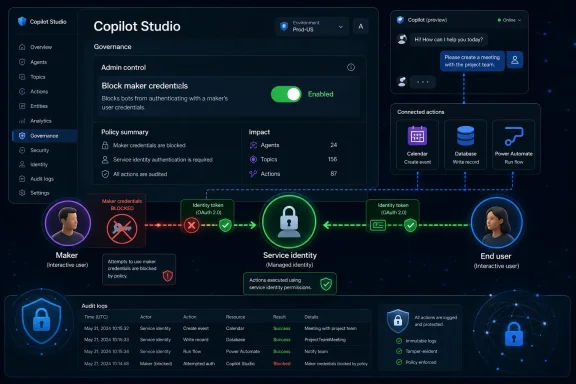
Microsoft added Roadmap ID 566873 on July 1, 2026, for Microsoft Copilot Studio safe-sharing enforcement that detects credential oversharing, enters public preview in July 2026, and is scheduled for worldwide general availability in September 2026. The feature is small in roadmap language but large in implication: Microsoft is moving from warning makers about risky agent identity choices toward blocking unsafe sharing at the moment those choices become organizational exposure. For IT teams already nervous about citizen-built agents, this is the kind of guardrail that decides whether Copilot Studio remains a controlled platform or becomes another shadow-automation sprawl.
The important word in Microsoft’s roadmap entry is not “Copilot.” It is “credentials.”
Copilot Studio has been marketed as a place where business users can build agents and flows without waiting for a traditional development cycle. That promise depends on connectors, automations, knowledge sources, and delegated actions. The problem is that every one of those capabilities eventually resolves to identity: whose account is being used, what that account can reach, and whether the person invoking the agent should inherit that reach.
Microsoft’s new safe-sharing enforcement is aimed squarely at that gap. The company says the feature will prevent agents and flows from being shared when they rely on unsafe identities, including maker credentials. In plain English, if a maker builds an agent that authenticates to a system as the maker rather than as the end user, Copilot Studio will be able to catch that pattern and enforce policy before the agent is published or shared too broadly.
That is a meaningful change in posture. A warning says, “You may be doing something dangerous.” Enforcement says, “You cannot distribute this until the identity model is safe enough.” For administrators, that difference is the line between governance theater and governance that actually changes outcomes.
The security issue is familiar to anyone who has lived through the Power Platform era. Low-code tools make it easy for business users to wire together systems they understand better than central IT does. They also make it easy for well-intentioned makers to accidentally turn a personal permission set into a shared capability.
From a security point of view, that may be exactly the problem.
If the agent runs actions or retrieves data using the maker’s credentials, the agent can become a proxy for the maker’s access. A user who could not normally see a record or perform an operation might be able to do so indirectly through the agent. The risk is not that the model becomes magically malicious; it is that the surrounding automation faithfully executes with the wrong principal.
This is one of the least glamorous but most important truths about enterprise AI. The spectacular failure mode is hallucination, where the system invents an answer. The operational failure mode is authorization drift, where the system does something real with permissions the user should not have.
Microsoft has already documented related safeguards in Copilot Studio, including security scans that warn makers when they change secure defaults. Those warnings cover risky settings such as unauthenticated access, maker-provided credentials, and organization-wide sharing. The new roadmap item suggests Microsoft is tightening that loop by detecting oversharing across design, publish, and share stages and by enforcing safe-sharing policy when distribution would otherwise expand the blast radius.
That matters because the dangerous moment is not when a maker experiments alone. It is when a working prototype becomes a shared tool.
A traditional flow may run quietly in the background. An agent invites use. It sits in a chat surface, responds to natural language, and can be shared with groups or the entire organization. The interface lowers friction not only for builders but also for consumers.
That creates a subtle risk. Users may not understand whether an answer came from their own access, the maker’s access, a service principal, an environment-level connection, or a connector configured months earlier by someone who has since changed roles. The agent feels like an assistant, but behind the curtain it is a bundle of identity decisions.
In a conventional application, identity architecture is usually part of the design review. In citizen development, identity architecture can emerge accidentally as a side effect of getting the connector to authenticate. The maker’s goal is not to bypass controls; it is to finish the workflow. But a platform that lets “it works for me” become “it works for everyone as me” is carrying a built-in privilege escalation hazard.
This is why Microsoft’s roadmap language is unusually direct. The company is not merely promising better visibility. It specifically calls out identity leakage, privilege escalation, and unintended access. Those are security outcomes, not productivity inconveniences.
Security controls that arrive after adoption face a political problem. Once a department depends on an agent, disabling it looks like IT breaking the business. The maker becomes the local hero, the users become stakeholders, and the administrator becomes the villain explaining why a helpful tool cannot keep running as designed.
By enforcing safe-sharing policies at publish and share time, Microsoft is putting the brake earlier in the lifecycle. That is when the maker can still change the authentication model, narrow the audience, adjust connector behavior, or ask for a sanctioned identity pattern. It is also when the platform can give more useful feedback because the security decision is tied to the action the maker is trying to take.
This is preferable to relying on retrospective audits. Logs and reports are necessary, but they are poor substitutes for preventative controls. A report can tell you that a sensitive workflow has been shared too widely. A publish-time block can prevent the workflow from becoming a widely shared sensitive workflow in the first place.
There is also a cultural benefit. Makers learn the platform’s boundaries through the build process rather than through after-the-fact reprimands. If the rule is visible and consistent, it becomes part of the maker’s mental model: certain identities are not safe to redistribute, and broad sharing requires cleaner authentication.
That is the best version of low-code governance. It does not ask every business user to become an identity architect. It makes the safer path the path that survives publication.
For Microsoft 365 Copilot, the familiar warning has been that Copilot can surface content a user already has permission to access, including content that was overshared long before AI entered the room. For Copilot Studio, the issue extends beyond surfacing data. Agents can be configured to call tools, run flows, and interact with external systems. That makes identity hygiene even more central.
In that context, credential oversharing is one of the more concrete agent risks Microsoft can address. It is easier to reason about than broad concerns over “AI safety” and more actionable than vague calls for responsible adoption. Either an agent is using an identity pattern that policy allows for its sharing scope, or it is not.
The roadmap also sits near other Copilot Studio governance work, including controls around maker-provided credentials. Microsoft’s direction is clear: the platform is being reshaped so that administrators can restrict how makers authenticate tools and so that risky identity choices are surfaced or blocked earlier.
That will not satisfy organizations that want Copilot Studio locked down by default. But it does show Microsoft acknowledging the central contradiction of enterprise agents: the very people best placed to design useful automations are often not the people best placed to judge their security model.
If the control is too permissive, administrators will see it as another checkbox that fails under real-world pressure. If it is too aggressive, makers will learn to route around it, abandon supported connectors, or flood IT with exception requests. The practical success of this feature will depend on how clearly Copilot Studio explains what is unsafe, how easily makers can remediate it, and how flexibly administrators can tune policy by environment, audience, connector, and use case.
False positives will be especially painful in organizations that have legitimate shared-service patterns. Some agents should run with a managed identity, service principal, or approved environment-level connection. Others should require end-user authentication. The platform needs to distinguish a sanctioned non-human identity from a maker’s personal credentials being reused as a convenience layer.
The wording in Microsoft’s release materials suggests the focus is not a blanket ban on all shared identities. It is on unsafe identities and oversharing detection. That distinction is important. Enterprise automation often needs shared operational identities, but those identities must be deliberately provisioned, scoped, monitored, and owned. A maker’s day-to-day account is not the same thing.
This is where Copilot Studio’s integration with Power Platform governance becomes decisive. Administrators will expect controls that align with existing environment strategies: development, test, production, departmental sandboxes, and tightly governed shared environments. A safety feature that cannot be expressed through those boundaries will be harder to operationalize.
The September 2026 general availability target gives Microsoft a short runway to prove that the preview is more than a policy banner. IT teams should use the preview to test ordinary maker behavior, not just idealized demos. The relevant question is whether the platform catches the messy configurations people actually create when they are trying to solve a business problem before lunch.
Citizen developers operate inside the affordances vendors give them. If the fastest way to make a connector work is to use the maker’s own credentials, many users will do exactly that. If the sharing dialog makes it simple to publish to a broad audience, broad publication will happen. If the platform treats identity design as an advanced concern, identity mistakes will show up in production.
The burden is therefore partly on Microsoft. Copilot Studio has to make safe choices understandable at the moment of creation. It must also avoid burying identity risk under generic warning language that users click through because everything in modern software comes with warnings.
The best security UX is specific. It should tell a maker that this agent cannot be shared with a given audience because a particular connector or flow would run as the maker. It should explain that the end users may gain access to data or actions beyond their own permissions. It should then offer a route to fix the problem: require end-user authentication, use an approved service principal, change the connection, narrow sharing, or ask an administrator to approve a different pattern.
That kind of intervention respects makers rather than blaming them. It treats them as capable builders who need guardrails, not as hazards to be contained.
It also protects IT from becoming the department of “no.” When the platform itself enforces the rule, administrators can spend less time adjudicating obvious risks and more time designing approved patterns for high-value agents.
One agent summarizes a sales pipeline using a maker’s access. Another checks inventory through a connector configured by a departmental power user. A third opens tickets in a system where the maker has elevated rights. A fourth combines SharePoint knowledge with a flow that can send messages or update records. None of these is necessarily dramatic. Together, they create an identity fog.
That fog is where privilege escalation becomes difficult to spot. Users are not logging into forbidden systems directly. They are asking an approved-looking agent to help them do work. The agent may have been built by a trusted colleague and shared through familiar Microsoft 365 surfaces. The line between collaboration and unauthorized delegation becomes blurry.
Safe-sharing enforcement is a partial antidote because it focuses on distribution. An experimental agent with risky credentials is contained if it remains in the maker’s hands. The same agent becomes a governance incident when it is published to a group, embedded in a workflow, or shared across the organization.
This is also why administrators should resist the urge to treat the feature as a substitute for broader access cleanup. It can reduce one class of agent-specific risk, but it cannot repair every overshared SharePoint site, overprivileged account, stale group membership, or poorly scoped connector. Copilot governance still depends on the unglamorous work of permissions hygiene.
The difference is that agents make the cost of neglect more visible. A bad permission model that once required users to browse for sensitive content may now be exposed through a conversational interface or automated action. That does not mean the agent created the underlying weakness. It means the agent turned the weakness into a more usable product.
Many Windows shops already have Power Platform footprints, whether or not central IT asked for them. Power Automate flows move approvals, forms, files, alerts, and help desk processes. SharePoint and Teams serve as informal application platforms. Copilot Studio sits naturally on top of that world, giving departments a way to wrap workflows and knowledge in conversational interfaces.
That makes identity enforcement relevant to sysadmins, not just AI program managers. The users building agents are often the same users who have accumulated access through years of group membership and project work. Their credentials may carry more reach than anyone remembers. If those credentials become the runtime identity behind an agent, old access debt becomes new automation risk.
Administrators should therefore treat the preview as a prompt to inventory how Copilot Studio is being used today. Which environments allow makers to build agents? Which connectors are available? Are maker-provided credentials allowed? Are agents being shared with security groups or the whole organization? Are there approved patterns for service principals and environment-level connections?
Those are not abstract governance questions. They determine whether the new enforcement feature will arrive as a helpful safety net or as a disruptive surprise that breaks popular prototypes.
The most mature organizations will use the preview window to create standard operating procedures. They will define which agent types require end-user credentials, which can use approved shared identities, which must stay in restricted environments, and which require production review before broad sharing. Less mature organizations will wait for the first blocked share and then discover that their agent estate is larger than they thought.
Safe-sharing enforcement serves both constituencies. For makers, it preserves the promise that they can build and iterate within approved guardrails. For IT, it suggests that Microsoft understands agents need controls at the point of publication, not merely dashboards after the fact.
This is especially important as the industry moves from chatbots that answer questions to agents that take actions. Once agents can retrieve information, update systems, trigger workflows, and coordinate across services, governance cannot be bolted on as a compliance afterthought. It has to be part of the agent lifecycle.
Microsoft’s challenge is that its ecosystem is both its advantage and its risk. Copilot Studio can reach into the Microsoft 365 and Power Platform universe that many enterprises already depend on. That makes it powerful. It also means a misconfigured agent can sit close to sensitive operational data and processes.
The company’s roadmap messaging acknowledges that tension without quite saying the quiet part aloud: agent adoption will stall if administrators conclude that every maker is one share button away from leaking privileged access. Enforcement is not just a security feature. It is a sales enabler for the entire Copilot platform.
What happens when a maker’s agent is blocked two days before a department launch? Who owns the remediation? Is there a fast path to request an approved service identity? Can the maker see exactly which connector caused the problem? Can admins simulate the impact of policy changes before enforcing them? Can security teams audit exceptions and expired approvals?
These operational details will decide how the feature is received. A technically sound control can still fail if it creates opaque delays. Business users will tolerate guardrails when they are predictable. They will resent them when the platform simply says no and leaves them to decode the security architecture.
Microsoft should also expect tension between local productivity and central policy. A sales operations team may argue that a maker-run connection is fine because the agent is only shared with a small group. Security may argue that any runtime use of personal credentials is unacceptable. Compliance may care less about the group size than about the data category. Platform admins may care about supportability and ownership when the maker changes roles or leaves the company.
The best policy systems give organizations room to express those differences without forcing every case into a single global rule. Copilot Studio’s safe-sharing enforcement will need that nuance if it is going to survive contact with real tenants.
This is where the preview should be watched closely. If Microsoft exposes enough policy detail and remediation guidance, the feature could become a practical cornerstone of agent governance. If it remains a narrow behind-the-scenes check with limited transparency, it will still help, but it will not fully solve the administrative problem it identifies.
The concrete lesson is simple: every useful agent has an authority model. Someone needs to know what it can access, whose permissions it uses, how widely it is shared, and what happens when the owner changes.
Microsoft’s credential-oversharing enforcement is not the final answer to Copilot Studio governance, but it is a useful admission about where the real risk lives. The next phase of enterprise AI will be judged less by how cleverly agents talk and more by whether they act with the right authority, at the right scope, for the right user; if Microsoft can make that discipline native to Copilot Studio rather than an after-market administrative ritual, the platform will be far easier for cautious Windows and Microsoft 365 shops to trust.
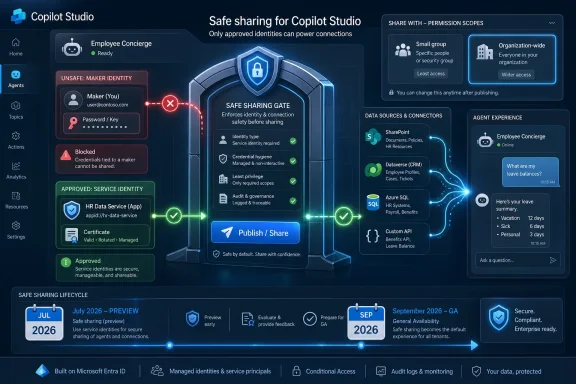 Microsoft Is Treating Agent Sharing as an Identity Problem, Not a Chatbot Problem
The important word in Microsoft’s roadmap entry is not “Copilot.” It is “credentials.”Copilot Studio has been marketed as a place where business users can build agents and flows without waiting for a traditional development cycle. That promise depends on connectors, automations, knowledge sources, and delegated actions. The problem is that every one of those capabilities eventually resolves to identity: whose account is being used, what that account can reach, and whether the person invoking the agent should inherit that reach.
Microsoft’s new safe-sharing enforcement is aimed squarely at that gap. The company says the feature will prevent agents and flows from being shared when they rely on unsafe identities, including maker credentials. In plain English, if a maker builds an agent that authenticates to a system as the maker rather than as the end user, Copilot Studio will be able to catch that pattern and enforce policy before the agent is published or shared too broadly.
That is a meaningful change in posture. A warning says, “You may be doing something dangerous.” Enforcement says, “You cannot distribute this until the identity model is safe enough.” For administrators, that difference is the line between governance theater and governance that actually changes outcomes.
The security issue is familiar to anyone who has lived through the Power Platform era. Low-code tools make it easy for business users to wire together systems they understand better than central IT does. They also make it easy for well-intentioned makers to accidentally turn a personal permission set into a shared capability.
Maker Credentials Were Always the Convenience Trap
Maker-provided credentials are useful because they make things work. A maker has access to a spreadsheet, a SharePoint site, a CRM record, a ticketing queue, a database connector, or an internal service. The maker adds that connection to an agent, tests the experience, and sees the right result. From the maker’s point of view, the system is functioning.From a security point of view, that may be exactly the problem.
If the agent runs actions or retrieves data using the maker’s credentials, the agent can become a proxy for the maker’s access. A user who could not normally see a record or perform an operation might be able to do so indirectly through the agent. The risk is not that the model becomes magically malicious; it is that the surrounding automation faithfully executes with the wrong principal.
This is one of the least glamorous but most important truths about enterprise AI. The spectacular failure mode is hallucination, where the system invents an answer. The operational failure mode is authorization drift, where the system does something real with permissions the user should not have.
Microsoft has already documented related safeguards in Copilot Studio, including security scans that warn makers when they change secure defaults. Those warnings cover risky settings such as unauthenticated access, maker-provided credentials, and organization-wide sharing. The new roadmap item suggests Microsoft is tightening that loop by detecting oversharing across design, publish, and share stages and by enforcing safe-sharing policy when distribution would otherwise expand the blast radius.
That matters because the dangerous moment is not when a maker experiments alone. It is when a working prototype becomes a shared tool.
The Agent Boom Makes Old Access Mistakes Faster and Stranger
Enterprise IT has seen this movie before. Macros, Access databases, SharePoint workflows, Power Automate flows, Teams apps, browser extensions, and SaaS integrations have all moved useful work closer to users while creating new governance headaches. Copilot Studio agents are the latest chapter, but the stakes are different because agents make automation conversational and discoverable.A traditional flow may run quietly in the background. An agent invites use. It sits in a chat surface, responds to natural language, and can be shared with groups or the entire organization. The interface lowers friction not only for builders but also for consumers.
That creates a subtle risk. Users may not understand whether an answer came from their own access, the maker’s access, a service principal, an environment-level connection, or a connector configured months earlier by someone who has since changed roles. The agent feels like an assistant, but behind the curtain it is a bundle of identity decisions.
In a conventional application, identity architecture is usually part of the design review. In citizen development, identity architecture can emerge accidentally as a side effect of getting the connector to authenticate. The maker’s goal is not to bypass controls; it is to finish the workflow. But a platform that lets “it works for me” become “it works for everyone as me” is carrying a built-in privilege escalation hazard.
This is why Microsoft’s roadmap language is unusually direct. The company is not merely promising better visibility. It specifically calls out identity leakage, privilege escalation, and unintended access. Those are security outcomes, not productivity inconveniences.
Publish Time Is the Right Place to Say No
The best place to catch unsafe sharing is before the agent becomes popular.Security controls that arrive after adoption face a political problem. Once a department depends on an agent, disabling it looks like IT breaking the business. The maker becomes the local hero, the users become stakeholders, and the administrator becomes the villain explaining why a helpful tool cannot keep running as designed.
By enforcing safe-sharing policies at publish and share time, Microsoft is putting the brake earlier in the lifecycle. That is when the maker can still change the authentication model, narrow the audience, adjust connector behavior, or ask for a sanctioned identity pattern. It is also when the platform can give more useful feedback because the security decision is tied to the action the maker is trying to take.
This is preferable to relying on retrospective audits. Logs and reports are necessary, but they are poor substitutes for preventative controls. A report can tell you that a sensitive workflow has been shared too widely. A publish-time block can prevent the workflow from becoming a widely shared sensitive workflow in the first place.
There is also a cultural benefit. Makers learn the platform’s boundaries through the build process rather than through after-the-fact reprimands. If the rule is visible and consistent, it becomes part of the maker’s mental model: certain identities are not safe to redistribute, and broad sharing requires cleaner authentication.
That is the best version of low-code governance. It does not ask every business user to become an identity architect. It makes the safer path the path that survives publication.
Microsoft’s Bigger Copilot Control System Is Taking Shape One Guardrail at a Time
This feature should not be viewed in isolation. Microsoft has been building a broader governance story around Copilot, agents, Purview, Power Platform administration, sensitivity labels, data loss prevention, and access controls. The theme is consistent: Copilot does not eliminate the need for permissions hygiene; it amplifies the consequences of poor hygiene.For Microsoft 365 Copilot, the familiar warning has been that Copilot can surface content a user already has permission to access, including content that was overshared long before AI entered the room. For Copilot Studio, the issue extends beyond surfacing data. Agents can be configured to call tools, run flows, and interact with external systems. That makes identity hygiene even more central.
In that context, credential oversharing is one of the more concrete agent risks Microsoft can address. It is easier to reason about than broad concerns over “AI safety” and more actionable than vague calls for responsible adoption. Either an agent is using an identity pattern that policy allows for its sharing scope, or it is not.
The roadmap also sits near other Copilot Studio governance work, including controls around maker-provided credentials. Microsoft’s direction is clear: the platform is being reshaped so that administrators can restrict how makers authenticate tools and so that risky identity choices are surfaced or blocked earlier.
That will not satisfy organizations that want Copilot Studio locked down by default. But it does show Microsoft acknowledging the central contradiction of enterprise agents: the very people best placed to design useful automations are often not the people best placed to judge their security model.
The Preview Will Test Whether Enforcement Is Precise Enough
The public preview in July 2026 will matter because enforcement features live or die on precision.If the control is too permissive, administrators will see it as another checkbox that fails under real-world pressure. If it is too aggressive, makers will learn to route around it, abandon supported connectors, or flood IT with exception requests. The practical success of this feature will depend on how clearly Copilot Studio explains what is unsafe, how easily makers can remediate it, and how flexibly administrators can tune policy by environment, audience, connector, and use case.
False positives will be especially painful in organizations that have legitimate shared-service patterns. Some agents should run with a managed identity, service principal, or approved environment-level connection. Others should require end-user authentication. The platform needs to distinguish a sanctioned non-human identity from a maker’s personal credentials being reused as a convenience layer.
The wording in Microsoft’s release materials suggests the focus is not a blanket ban on all shared identities. It is on unsafe identities and oversharing detection. That distinction is important. Enterprise automation often needs shared operational identities, but those identities must be deliberately provisioned, scoped, monitored, and owned. A maker’s day-to-day account is not the same thing.
This is where Copilot Studio’s integration with Power Platform governance becomes decisive. Administrators will expect controls that align with existing environment strategies: development, test, production, departmental sandboxes, and tightly governed shared environments. A safety feature that cannot be expressed through those boundaries will be harder to operationalize.
The September 2026 general availability target gives Microsoft a short runway to prove that the preview is more than a policy banner. IT teams should use the preview to test ordinary maker behavior, not just idealized demos. The relevant question is whether the platform catches the messy configurations people actually create when they are trying to solve a business problem before lunch.
Citizen Developers Are Not the Villains Here
It is tempting to frame credential oversharing as a maker mistake. That is too easy and mostly unhelpful.Citizen developers operate inside the affordances vendors give them. If the fastest way to make a connector work is to use the maker’s own credentials, many users will do exactly that. If the sharing dialog makes it simple to publish to a broad audience, broad publication will happen. If the platform treats identity design as an advanced concern, identity mistakes will show up in production.
The burden is therefore partly on Microsoft. Copilot Studio has to make safe choices understandable at the moment of creation. It must also avoid burying identity risk under generic warning language that users click through because everything in modern software comes with warnings.
The best security UX is specific. It should tell a maker that this agent cannot be shared with a given audience because a particular connector or flow would run as the maker. It should explain that the end users may gain access to data or actions beyond their own permissions. It should then offer a route to fix the problem: require end-user authentication, use an approved service principal, change the connection, narrow sharing, or ask an administrator to approve a different pattern.
That kind of intervention respects makers rather than blaming them. It treats them as capable builders who need guardrails, not as hazards to be contained.
It also protects IT from becoming the department of “no.” When the platform itself enforces the rule, administrators can spend less time adjudicating obvious risks and more time designing approved patterns for high-value agents.
The Enterprise Risk Is Not One Bad Agent, It Is a Thousand Almost-Good Ones
The scariest Copilot Studio scenario is not a single rogue agent that everyone recognizes as reckless. It is a fleet of useful, partially governed agents that each seem reasonable in isolation.One agent summarizes a sales pipeline using a maker’s access. Another checks inventory through a connector configured by a departmental power user. A third opens tickets in a system where the maker has elevated rights. A fourth combines SharePoint knowledge with a flow that can send messages or update records. None of these is necessarily dramatic. Together, they create an identity fog.
That fog is where privilege escalation becomes difficult to spot. Users are not logging into forbidden systems directly. They are asking an approved-looking agent to help them do work. The agent may have been built by a trusted colleague and shared through familiar Microsoft 365 surfaces. The line between collaboration and unauthorized delegation becomes blurry.
Safe-sharing enforcement is a partial antidote because it focuses on distribution. An experimental agent with risky credentials is contained if it remains in the maker’s hands. The same agent becomes a governance incident when it is published to a group, embedded in a workflow, or shared across the organization.
This is also why administrators should resist the urge to treat the feature as a substitute for broader access cleanup. It can reduce one class of agent-specific risk, but it cannot repair every overshared SharePoint site, overprivileged account, stale group membership, or poorly scoped connector. Copilot governance still depends on the unglamorous work of permissions hygiene.
The difference is that agents make the cost of neglect more visible. A bad permission model that once required users to browse for sensitive content may now be exposed through a conversational interface or automated action. That does not mean the agent created the underlying weakness. It means the agent turned the weakness into a more usable product.
Windows Shops Should See This as a Power Platform Governance Story
For WindowsForum.com readers, the Copilot Studio roadmap can look like cloud-SaaS news until it lands on the desktop. In practice, Microsoft’s agent push is woven through Microsoft 365, Teams, Edge, Power Platform, Entra ID, SharePoint, and the administrative habits of Windows-centric organizations.Many Windows shops already have Power Platform footprints, whether or not central IT asked for them. Power Automate flows move approvals, forms, files, alerts, and help desk processes. SharePoint and Teams serve as informal application platforms. Copilot Studio sits naturally on top of that world, giving departments a way to wrap workflows and knowledge in conversational interfaces.
That makes identity enforcement relevant to sysadmins, not just AI program managers. The users building agents are often the same users who have accumulated access through years of group membership and project work. Their credentials may carry more reach than anyone remembers. If those credentials become the runtime identity behind an agent, old access debt becomes new automation risk.
Administrators should therefore treat the preview as a prompt to inventory how Copilot Studio is being used today. Which environments allow makers to build agents? Which connectors are available? Are maker-provided credentials allowed? Are agents being shared with security groups or the whole organization? Are there approved patterns for service principals and environment-level connections?
Those are not abstract governance questions. They determine whether the new enforcement feature will arrive as a helpful safety net or as a disruptive surprise that breaks popular prototypes.
The most mature organizations will use the preview window to create standard operating procedures. They will define which agent types require end-user credentials, which can use approved shared identities, which must stay in restricted environments, and which require production review before broad sharing. Less mature organizations will wait for the first blocked share and then discover that their agent estate is larger than they thought.
Microsoft Is Also Protecting Its Own Copilot Narrative
There is a vendor strategy angle here that should not be ignored. Microsoft wants Copilot Studio to be the enterprise agent-building platform, not just another low-code tool. To get there, it needs business users to move quickly and administrators to believe the platform will not create an unmanageable security mess.Safe-sharing enforcement serves both constituencies. For makers, it preserves the promise that they can build and iterate within approved guardrails. For IT, it suggests that Microsoft understands agents need controls at the point of publication, not merely dashboards after the fact.
This is especially important as the industry moves from chatbots that answer questions to agents that take actions. Once agents can retrieve information, update systems, trigger workflows, and coordinate across services, governance cannot be bolted on as a compliance afterthought. It has to be part of the agent lifecycle.
Microsoft’s challenge is that its ecosystem is both its advantage and its risk. Copilot Studio can reach into the Microsoft 365 and Power Platform universe that many enterprises already depend on. That makes it powerful. It also means a misconfigured agent can sit close to sensitive operational data and processes.
The company’s roadmap messaging acknowledges that tension without quite saying the quiet part aloud: agent adoption will stall if administrators conclude that every maker is one share button away from leaking privileged access. Enforcement is not just a security feature. It is a sales enabler for the entire Copilot platform.
The Hard Part Comes After the Block
Blocking unsafe sharing is the clean part. Everything after that is workflow.What happens when a maker’s agent is blocked two days before a department launch? Who owns the remediation? Is there a fast path to request an approved service identity? Can the maker see exactly which connector caused the problem? Can admins simulate the impact of policy changes before enforcing them? Can security teams audit exceptions and expired approvals?
These operational details will decide how the feature is received. A technically sound control can still fail if it creates opaque delays. Business users will tolerate guardrails when they are predictable. They will resent them when the platform simply says no and leaves them to decode the security architecture.
Microsoft should also expect tension between local productivity and central policy. A sales operations team may argue that a maker-run connection is fine because the agent is only shared with a small group. Security may argue that any runtime use of personal credentials is unacceptable. Compliance may care less about the group size than about the data category. Platform admins may care about supportability and ownership when the maker changes roles or leaves the company.
The best policy systems give organizations room to express those differences without forcing every case into a single global rule. Copilot Studio’s safe-sharing enforcement will need that nuance if it is going to survive contact with real tenants.
This is where the preview should be watched closely. If Microsoft exposes enough policy detail and remediation guidance, the feature could become a practical cornerstone of agent governance. If it remains a narrow behind-the-scenes check with limited transparency, it will still help, but it will not fully solve the administrative problem it identifies.
The July Preview Is a Governance Drill, Not a Calendar Note
Organizations should not treat this roadmap item as something to remember in September. The July 2026 preview is an opportunity to rehearse the identity conversations that agent platforms force into the open.The concrete lesson is simple: every useful agent has an authority model. Someone needs to know what it can access, whose permissions it uses, how widely it is shared, and what happens when the owner changes.
- Organizations should identify Copilot Studio environments where makers can currently publish or share agents and flows.
- Administrators should review whether maker-provided credentials are allowed and where end-user authentication should be required.
- Security teams should test the preview with realistic agents that use connectors, flows, SharePoint knowledge, and external systems.
- Platform owners should define approved patterns for service principals, environment-level connections, and narrowly scoped shared identities.
- Makers should be given plain-language guidance before enforcement reaches general availability in September 2026.
- Broad sharing should be treated as a production event, not as a casual extension of a prototype.
Microsoft’s credential-oversharing enforcement is not the final answer to Copilot Studio governance, but it is a useful admission about where the real risk lives. The next phase of enterprise AI will be judged less by how cleverly agents talk and more by whether they act with the right authority, at the right scope, for the right user; if Microsoft can make that discipline native to Copilot Studio rather than an after-market administrative ritual, the platform will be far easier for cautious Windows and Microsoft 365 shops to trust.
References
- Primary source: Microsoft 365 Roadmap
Published: 2026-07-01T23:03:18.2442931Z
Microsoft 365 Roadmap | Microsoft 365
The Microsoft 365 Roadmap lists updates that are currently planned for applicable subscribers. Check here for more information on the status of new features and updates.www.microsoft.com
- Official source: learn.microsoft.com
Enforce safe sharing by detecting credential oversharing | Microsoft Learn
Prevents unsafe agent sharing by detecting the use of maker credentials and enforcing safe‑sharing policies before publishing or sharing.learn.microsoft.com - Official source: releaseplans.microsoft.com
Microsoft Release Planner · Microsoft Release Planner
Find out what's new in Dynamics 365 (including Sales, Service, Marketing, Finance, Supply Chain Management, Human Resources, Business Central, and Commerce apps) and Power Platform (including Power BI, Power Apps, Power Automate, and Power Virtual Agents)releaseplans.microsoft.com - Official source: cdn-dynmedia-1.microsoft.com