

Microsoft President Brad Smith used a June 10, 2026, essay on Microsoft’s official blog to argue that artificial intelligence will reshape work over decades, not overnight, and that students entering the labor market should demand human agency rather than accept automation as destiny. The piece is not a product announcement. It is a political document in the older sense of the word: an attempt to define the bargain between a technology company, a workforce, and the society that must absorb the consequences of invention.
That matters because Microsoft is no neutral spectator in this argument. It is one of the companies spending, selling, and reorganizing most aggressively around AI. When Smith says the next generation is right to push back, he is also trying to keep Microsoft inside the room where the backlash is being translated into policy, purchasing decisions, campus norms, and workplace rules.
Smith’s essay begins with an historical analogy: early photography did not kill painting, even though some contemporaries thought it might. It changed the economics of portraiture, then helped provoke new artistic movements that valued interpretation over mechanical accuracy. The intended lesson is plain enough. AI may automate some work, but human creativity will reappear in new forms.
The more interesting part is not the analogy. It is the audience Microsoft is suddenly treating as strategically important. Smith points to recent commencement ceremonies where graduates reportedly booed or grimaced at mentions of AI, and he frames that reaction not as ignorance but as a signal the technology industry should heed.
That is a notable shift in tone from the boosterism that has dominated much of the AI cycle. The industry has spent three years telling workers to adapt, reskill, prompt, automate, and embrace the future. Smith is saying something slightly different: if the people most fluent in the technology are also among the people most suspicious of its deployment, the suspicion deserves attention.
Microsoft has a reason to care. Its own adoption research, according to the company, suggests that U.S. counties with large college-town populations and many 18-to-24-year-olds show especially high AI adoption. In other words, the student skepticism Smith describes is not coming from the technologically left behind. It is coming from people already using the tools.
That distinction undercuts the laziest version of the AI backlash narrative. The graduates rejecting AI-generated class designs or booing executive optimism are not necessarily rejecting technology. They are rejecting a version of technology adoption in which efficiency is treated as the only serious value.
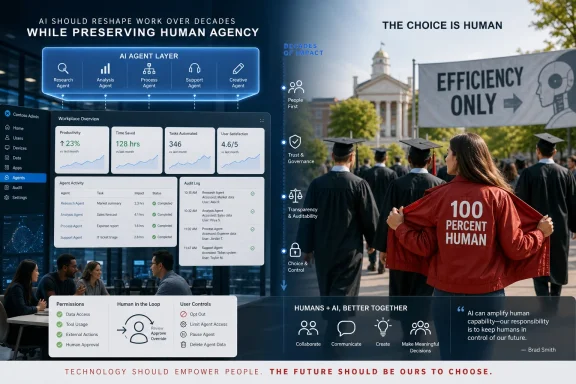
That is where the campus examples become more than cultural color. At Princeton, Smith describes a controversy over a graduating class “beer jacket” design that had been created with AI assistance. Students petitioned, the design was rejected, and graduates instead wore jackets labeled “100 percent cotton” and “100 percent human.”
It is easy to mock that as symbolic politics. It is also exactly how markets work. People do not only buy the cheapest or most efficient object. They buy provenance, authorship, taste, authenticity, scarcity, and the social meaning attached to the thing.
The AI industry has often spoken as if any task that can be automated therefore should be automated. The reaction Smith describes is a reminder that many users will draw boundaries that are economically irrational only if one assumes labor has no moral or cultural value. A handmade object, a human-written note, a locally produced design, or a teacher’s own feedback may retain value precisely because a machine could have generated a cheaper approximation.
That does not mean the labor market will politely preserve every job category out of sentiment. It means vendors and employers should stop pretending that technical feasibility settles the question. There is a difference between a tool that expands a worker’s reach and a system deployed to erase the worker from the process.
Smith’s essay is most persuasive when it treats the student reaction as a demand for agency. Young people are not merely worried that AI will take jobs. They are worried that decisions about their work, education, creative output, and futures are being made elsewhere by people who experience automation primarily as a balance-sheet improvement.
But the analogy has limits, and those limits are instructive. Photography did not merely “free” painters. It also changed livelihoods, markets, institutions, and status. Some skills became less commercially valuable. Some artists adapted. Others did not.
AI is broader than photography because it does not target one medium. It reaches into text, code, research, customer support, design, translation, analysis, tutoring, administration, and management itself. It is not one camera in the studio. It is a general-purpose layer being inserted into the tools through which white-collar work is assigned, measured, produced, and judged.
Smith acknowledges this by calling AI a likely general-purpose technology, the economist’s term for a technology that diffuses across sectors and changes how other work is organized. Electricity, machine tools, and digital computing did not simply create new gadgets. They changed production systems.
That is why the camera analogy should comfort only so much. The better comparison is not between AI and photography, but between AI and the long installation of computing into office work. Word processors did not end writing, spreadsheets did not end finance, and email did not end communication. But they did change the number of people needed for certain tasks, the pace of work, the expectations placed on employees, and the surveillance possibilities available to managers.
The question is not whether work survives. Work always survives because institutions keep inventing more of it. The question is whether the new work is better, whether it is broadly available, and whether workers have leverage inside the systems that now mediate their productivity.
It is also an uncomfortable account for Microsoft itself. The company is not merely selling AI software into a stable labor market. It is participating in an industry-wide capital reallocation toward chips, data centers, model development, and agentic systems. Those investments create jobs, but not necessarily for the same people whose first-rung office jobs are being compressed.
The entry-level problem deserves more attention than it often gets. A labor market can look healthy at the aggregate level while becoming hostile to new entrants. If junior employees once learned by drafting memos, checking work, writing first-pass code, preparing research, handling support tickets, or producing routine analysis, then automating those tasks may remove the apprenticeship layer that produced future senior employees.
Smith’s answer is to think in terms of tasks rather than job titles. Workers should sort their responsibilities into tasks AI can do, tasks they can do with AI, and tasks humans must do alone. That is useful advice at the individual level. It is also incomplete as a social answer.
A 22-year-old cannot redesign the structure of entry-level work alone. If employers eliminate the training ground and then complain that candidates lack judgment, the market has not become more efficient. It has eaten its seed corn.
Smith leans on an argument associated with Princeton’s Arvind Narayanan and Sayash Kapoor: diffusion is constrained not just by technical capability, but by the speed of human, organizational, and institutional change. That should be printed and taped above every enterprise AI dashboard.
Technology demos collapse time. A model can summarize a document in seconds, generate code in seconds, produce images in seconds, and answer a customer query in seconds. But deploying that capability into a real organization requires permissions, compliance, integration, training, auditing, procurement, support, workflow redesign, labor negotiation, customer acceptance, and failure handling.
That is why “AI can do this” and “AI is doing this safely at scale inside a business” are radically different claims. The first is a demo. The second is an operating model.
Microsoft benefits from both sides of this argument. Urgency sells Copilot subscriptions, Azure capacity, GitHub tooling, and enterprise AI services. Patience reassures governments, workers, and customers that the company is not asking society to swallow a labor shock in one gulp.
The correct reading is probably that both are true. AI adoption is moving quickly by historical consumer-software standards, but transformation of work will be uneven, contested, and slower than the most feverish forecasts suggest. The job market can still suffer serious dislocation long before the economy reaches anything like full AI maturity.
The first wave of generative AI in the workplace was a text box. Employees asked it to draft, summarize, brainstorm, translate, or explain. The next wave is more operational: agents that file tickets, query databases, update records, schedule actions, monitor exceptions, and coordinate across applications.
That shift changes the risk profile. A chatbot that gives a bad answer is a problem. An agent that takes a bad action inside a production workflow can become a business incident.
Smith’s phrase “cognitive coverage,” attributed to Microsoft colleague Ryan Nadel, is useful here. Even when AI automates multiple tasks, people still need to understand and oversee what was generated. In a world of agentic workflows, oversight becomes less like proofreading and more like operations management.
This is where WindowsForum readers should pay attention. The AI story is not only happening in web apps and cloud consoles. It is moving into identity, endpoint management, productivity suites, developer environments, help desks, security operations, and the everyday administrative fabric of Windows-heavy organizations.
An AI agent that can act across Microsoft 365, GitHub, Azure, Dynamics, Teams, and local endpoints is powerful precisely because it sits near the nervous system of the enterprise. That makes governance, logging, permissions, rollback, and human approval paths more important than any prompt-engineering trick.
This is Microsoft speaking to nervous enterprise buyers in their own language. The pitch is not only “AI will make you productive.” It is “you need an AI system that learns from your organization without surrendering your organization.”
That is a much more serious business argument than consumer AI hype. For most companies, competitive advantage is not found in public information. It lives in messy process knowledge, customer context, engineering decisions, proprietary datasets, compliance experience, and the undocumented judgment of employees who know why the official workflow is not the real workflow.
If that knowledge leaks into a vendor-controlled model or becomes too dependent on a vendor-controlled platform, the productivity gain may come with strategic dependence. Smith reaches for the language of sovereignty, applying it not only to countries but to companies. That is a revealing move.
The next phase of enterprise AI will not be fought only over model quality. It will be fought over who owns the context. Microsoft wants to be the platform on which companies build their own “hill-climbing machine,” continually improving internal AI systems against internal objectives. Customers will want the benefits without lock-in, leakage, or loss of institutional memory.
Those interests overlap, but they are not identical. IT leaders should treat data boundaries, model training terms, retention policies, evaluation methods, and auditability as board-level concerns, not implementation details.
There is truth in that, but it can also become a corporate escape hatch. Telling workers to develop soft skills is useful only if organizations reward those skills and design jobs that require them. Otherwise, it becomes another way to individualize a structural problem.
Curiosity does not help much in a workplace that measures only ticket closure. Compassion does not survive in a support operation tuned exclusively for deflection. Courage is not rewarded in a culture where employees are punished for slowing down a flawed automation project.
The best version of Smith’s argument is that AI fluency should sit on top of real expertise, not replace it. Study the thing you care about. Master a domain. Then use AI to apply that expertise more effectively.
That advice is particularly relevant to students who are being told, implicitly or explicitly, that the only safe future is computer science plus prompting. The labor market probably needs more nurses, electricians, teachers, planners, analysts, engineers, auditors, cybersecurity practitioners, and public administrators who understand AI than it needs a generation of generic AI whisperers.
The danger is producing workers who know how to ask a model for an answer but cannot tell whether the answer is any good. That is not augmentation. That is dependency with a nice interface.
The technology industry has a habit of discovering stakeholders after deployment. Social media platforms scaled first and asked civic questions later. Gig-economy companies rewrote labor expectations first and negotiated consequences later. AI vendors are at risk of repeating the pattern at enterprise speed.
A serious public conversation would not be limited to abstract principles. It would address whether workers must be notified when AI evaluates them, whether students can opt out of AI-mediated instruction, whether customers can demand human review, whether unions can bargain over automation, whether public agencies can use opaque systems, and whether entry-level jobs should be protected or redesigned as part of workforce development.
Microsoft is positioning itself as a responsible actor in that conversation. It has more credibility than some because it has spent decades selling tools into institutions rather than only disrupting them from the outside. But responsibility cannot be self-certified.
The test will be whether Microsoft and its peers accept constraints that slow deployment when deployment threatens trust. That means product design choices, contractual commitments, compliance tooling, and sometimes a willingness to say that a technically possible automation should not be shipped as a default.
That will create real gains. Admins may get better summarization of incidents, faster scripting help, richer documentation, and more intelligent triage. Developers may move from boilerplate to review and architecture. Knowledge workers may spend less time formatting, searching, and rewriting.
It will also create new failure modes. AI-generated PowerShell needs review. AI-assisted configuration changes need approval paths. AI summaries of security incidents need evidentiary links. AI agents acting across tenant data need least-privilege boundaries that are actually enforced.
The operational question is not whether an organization “uses AI.” Many already do, formally or informally. The question is whether use is governed, observable, reversible, and aligned with the business’s tolerance for error.
That is where Microsoft’s human-agency rhetoric becomes concrete. A user who cannot tell when AI is involved has less agency. An administrator who cannot audit an agent’s actions has less agency. A worker whose output is scored by an opaque model has less agency. A company whose proprietary knowledge improves a vendor’s system without clear consent has less agency.
If Microsoft wants to meet the next generation’s demand, it should treat agency not as a theme for speeches but as a product requirement.
The compact he sketches has three parts. Individuals should build expertise and AI fluency. Organizations should use AI to strengthen internal knowledge rather than hollow it out. Society should create broader forums where workers and communities help decide how the technology is deployed.
The missing piece is enforcement. Compacts are easy to describe and hard to sustain when quarterly cost targets arrive. If AI systems make layoffs easier, some firms will use them that way. If AI agents allow management to intensify work without raising pay, some firms will do that too. If vendors can capture more customer data under vague improvement terms, the temptation will remain.
This is why the next phase of AI governance will be less glamorous than model launches. It will involve procurement language, retention defaults, audit logs, works councils, union contracts, classroom rules, professional standards, cyber insurance requirements, and regulatory definitions of automated decision-making.
For IT departments, that means AI policy cannot live only in innovation teams. It belongs in security, compliance, legal, HR, procurement, architecture review, and endpoint administration. The organizations that handle this well will not be the ones with the most pilots. They will be the ones that know which pilots should graduate into production.
That is the underappreciated power of the “100 percent human” slogan. It is not a comprehensive economic program. It is a market signal and a political signal. It says there will be domains where human authorship matters, and where hiding or minimizing machine involvement will be treated as a breach of trust.
For Microsoft, the path forward is delicate. The company must keep selling AI as transformative while insisting transformation will be paced by institutions. It must promise productivity without sounding indifferent to job loss. It must build agents that act more autonomously while arguing that humans remain in charge.
Those tensions are not hypocrisy by themselves. They are the structure of the AI business. Microsoft is both the accelerant and, increasingly, the party asking everyone not to panic about the fire.
That matters because Microsoft is no neutral spectator in this argument. It is one of the companies spending, selling, and reorganizing most aggressively around AI. When Smith says the next generation is right to push back, he is also trying to keep Microsoft inside the room where the backlash is being translated into policy, purchasing decisions, campus norms, and workplace rules.
 Microsoft Hears the Booing and Tries to Reframe It
Smith’s essay begins with an historical analogy: early photography did not kill painting, even though some contemporaries thought it might. It changed the economics of portraiture, then helped provoke new artistic movements that valued interpretation over mechanical accuracy. The intended lesson is plain enough. AI may automate some work, but human creativity will reappear in new forms.The more interesting part is not the analogy. It is the audience Microsoft is suddenly treating as strategically important. Smith points to recent commencement ceremonies where graduates reportedly booed or grimaced at mentions of AI, and he frames that reaction not as ignorance but as a signal the technology industry should heed.
That is a notable shift in tone from the boosterism that has dominated much of the AI cycle. The industry has spent three years telling workers to adapt, reskill, prompt, automate, and embrace the future. Smith is saying something slightly different: if the people most fluent in the technology are also among the people most suspicious of its deployment, the suspicion deserves attention.
Microsoft has a reason to care. Its own adoption research, according to the company, suggests that U.S. counties with large college-town populations and many 18-to-24-year-olds show especially high AI adoption. In other words, the student skepticism Smith describes is not coming from the technologically left behind. It is coming from people already using the tools.
That distinction undercuts the laziest version of the AI backlash narrative. The graduates rejecting AI-generated class designs or booing executive optimism are not necessarily rejecting technology. They are rejecting a version of technology adoption in which efficiency is treated as the only serious value.
The Next Generation Is Not Anti-AI; It Is Anti-Disposability
The strongest claim in Smith’s essay is that young workers want AI kept “in its proper place.” That phrase does a lot of work. It accepts that AI has a place, but refuses to let vendors define that place unilaterally.That is where the campus examples become more than cultural color. At Princeton, Smith describes a controversy over a graduating class “beer jacket” design that had been created with AI assistance. Students petitioned, the design was rejected, and graduates instead wore jackets labeled “100 percent cotton” and “100 percent human.”
It is easy to mock that as symbolic politics. It is also exactly how markets work. People do not only buy the cheapest or most efficient object. They buy provenance, authorship, taste, authenticity, scarcity, and the social meaning attached to the thing.
The AI industry has often spoken as if any task that can be automated therefore should be automated. The reaction Smith describes is a reminder that many users will draw boundaries that are economically irrational only if one assumes labor has no moral or cultural value. A handmade object, a human-written note, a locally produced design, or a teacher’s own feedback may retain value precisely because a machine could have generated a cheaper approximation.
That does not mean the labor market will politely preserve every job category out of sentiment. It means vendors and employers should stop pretending that technical feasibility settles the question. There is a difference between a tool that expands a worker’s reach and a system deployed to erase the worker from the process.
Smith’s essay is most persuasive when it treats the student reaction as a demand for agency. Young people are not merely worried that AI will take jobs. They are worried that decisions about their work, education, creative output, and futures are being made elsewhere by people who experience automation primarily as a balance-sheet improvement.
The Camera Analogy Works Until It Doesn’t
The photography analogy has obvious appeal because it lets Microsoft tell a hopeful story. The camera disrupted certain forms of visual labor, but painting survived and evolved. Impressionism, Post-Impressionism, Cubism, and Surrealism were not signs of artistic defeat. They were signs that human expression had moved into territory where mechanical reproduction was beside the point.But the analogy has limits, and those limits are instructive. Photography did not merely “free” painters. It also changed livelihoods, markets, institutions, and status. Some skills became less commercially valuable. Some artists adapted. Others did not.
AI is broader than photography because it does not target one medium. It reaches into text, code, research, customer support, design, translation, analysis, tutoring, administration, and management itself. It is not one camera in the studio. It is a general-purpose layer being inserted into the tools through which white-collar work is assigned, measured, produced, and judged.
Smith acknowledges this by calling AI a likely general-purpose technology, the economist’s term for a technology that diffuses across sectors and changes how other work is organized. Electricity, machine tools, and digital computing did not simply create new gadgets. They changed production systems.
That is why the camera analogy should comfort only so much. The better comparison is not between AI and photography, but between AI and the long installation of computing into office work. Word processors did not end writing, spreadsheets did not end finance, and email did not end communication. But they did change the number of people needed for certain tasks, the pace of work, the expectations placed on employees, and the surveillance possibilities available to managers.
The question is not whether work survives. Work always survives because institutions keep inventing more of it. The question is whether the new work is better, whether it is broadly available, and whether workers have leverage inside the systems that now mediate their productivity.
Microsoft’s Optimism Comes With a Balance Sheet
Smith is careful not to dismiss the anxiety facing graduates. He names automation of entry-level tasks, pressure in the tech sector to reduce headcount, corporate spending on AI infrastructure, geopolitical uncertainty, trade tensions, and the hangover from pandemic-era overhiring. That is a fuller account than the standard “AI will create more jobs than it destroys” line.It is also an uncomfortable account for Microsoft itself. The company is not merely selling AI software into a stable labor market. It is participating in an industry-wide capital reallocation toward chips, data centers, model development, and agentic systems. Those investments create jobs, but not necessarily for the same people whose first-rung office jobs are being compressed.
The entry-level problem deserves more attention than it often gets. A labor market can look healthy at the aggregate level while becoming hostile to new entrants. If junior employees once learned by drafting memos, checking work, writing first-pass code, preparing research, handling support tickets, or producing routine analysis, then automating those tasks may remove the apprenticeship layer that produced future senior employees.
Smith’s answer is to think in terms of tasks rather than job titles. Workers should sort their responsibilities into tasks AI can do, tasks they can do with AI, and tasks humans must do alone. That is useful advice at the individual level. It is also incomplete as a social answer.
A 22-year-old cannot redesign the structure of entry-level work alone. If employers eliminate the training ground and then complain that candidates lack judgment, the market has not become more efficient. It has eaten its seed corn.
The Slow Diffusion Argument Is Microsoft’s Most Important Hedge
One of the most consequential parts of Smith’s essay is his insistence that AI diffusion will take time. He cites Microsoft’s own estimates that 17.8 percent of the world’s working-age population currently uses generative AI, with the United States higher at 31.3 percent. Those numbers are large for a young technology, but they are not saturation.Smith leans on an argument associated with Princeton’s Arvind Narayanan and Sayash Kapoor: diffusion is constrained not just by technical capability, but by the speed of human, organizational, and institutional change. That should be printed and taped above every enterprise AI dashboard.
Technology demos collapse time. A model can summarize a document in seconds, generate code in seconds, produce images in seconds, and answer a customer query in seconds. But deploying that capability into a real organization requires permissions, compliance, integration, training, auditing, procurement, support, workflow redesign, labor negotiation, customer acceptance, and failure handling.
That is why “AI can do this” and “AI is doing this safely at scale inside a business” are radically different claims. The first is a demo. The second is an operating model.
Microsoft benefits from both sides of this argument. Urgency sells Copilot subscriptions, Azure capacity, GitHub tooling, and enterprise AI services. Patience reassures governments, workers, and customers that the company is not asking society to swallow a labor shock in one gulp.
The correct reading is probably that both are true. AI adoption is moving quickly by historical consumer-software standards, but transformation of work will be uneven, contested, and slower than the most feverish forecasts suggest. The job market can still suffer serious dislocation long before the economy reaches anything like full AI maturity.
The Agent Layer Moves the Fight From Chatbots to Workflows
Smith’s discussion of organizations is where the essay most clearly aligns with Microsoft’s current product strategy. He argues that companies can move beyond chat-based assistants toward networks of AI agents that reason, make decisions, and run workflows across enterprise data and systems. That is not a philosophical aside. It is the enterprise AI roadmap.The first wave of generative AI in the workplace was a text box. Employees asked it to draft, summarize, brainstorm, translate, or explain. The next wave is more operational: agents that file tickets, query databases, update records, schedule actions, monitor exceptions, and coordinate across applications.
That shift changes the risk profile. A chatbot that gives a bad answer is a problem. An agent that takes a bad action inside a production workflow can become a business incident.
Smith’s phrase “cognitive coverage,” attributed to Microsoft colleague Ryan Nadel, is useful here. Even when AI automates multiple tasks, people still need to understand and oversee what was generated. In a world of agentic workflows, oversight becomes less like proofreading and more like operations management.
This is where WindowsForum readers should pay attention. The AI story is not only happening in web apps and cloud consoles. It is moving into identity, endpoint management, productivity suites, developer environments, help desks, security operations, and the everyday administrative fabric of Windows-heavy organizations.
An AI agent that can act across Microsoft 365, GitHub, Azure, Dynamics, Teams, and local endpoints is powerful precisely because it sits near the nervous system of the enterprise. That makes governance, logging, permissions, rollback, and human approval paths more important than any prompt-engineering trick.
The New Corporate Moat Is Knowledge the Model Hasn’t Swallowed
Smith makes another argument that deserves more scrutiny: companies should build internal AI capabilities while protecting their data, expertise, and intellectual property. He warns that AI benefits can be short-lived if the hidden cost is training someone else’s model on a firm’s unique knowledge.This is Microsoft speaking to nervous enterprise buyers in their own language. The pitch is not only “AI will make you productive.” It is “you need an AI system that learns from your organization without surrendering your organization.”
That is a much more serious business argument than consumer AI hype. For most companies, competitive advantage is not found in public information. It lives in messy process knowledge, customer context, engineering decisions, proprietary datasets, compliance experience, and the undocumented judgment of employees who know why the official workflow is not the real workflow.
If that knowledge leaks into a vendor-controlled model or becomes too dependent on a vendor-controlled platform, the productivity gain may come with strategic dependence. Smith reaches for the language of sovereignty, applying it not only to countries but to companies. That is a revealing move.
The next phase of enterprise AI will not be fought only over model quality. It will be fought over who owns the context. Microsoft wants to be the platform on which companies build their own “hill-climbing machine,” continually improving internal AI systems against internal objectives. Customers will want the benefits without lock-in, leakage, or loss of institutional memory.
Those interests overlap, but they are not identical. IT leaders should treat data boundaries, model training terms, retention policies, evaluation methods, and auditability as board-level concerns, not implementation details.
Soft Skills Are Being Rebranded Because Hard Skills Are Being Repriced
Smith approvingly cites LinkedIn leaders Ryan Roslansky and Aneesh Raman on five human attributes: curiosity, creativity, compassion, communication, and courage. The point is familiar but increasingly important. As AI absorbs more routine cognitive production, human differentiation shifts toward judgment, context, ethics, persuasion, taste, and responsibility.There is truth in that, but it can also become a corporate escape hatch. Telling workers to develop soft skills is useful only if organizations reward those skills and design jobs that require them. Otherwise, it becomes another way to individualize a structural problem.
Curiosity does not help much in a workplace that measures only ticket closure. Compassion does not survive in a support operation tuned exclusively for deflection. Courage is not rewarded in a culture where employees are punished for slowing down a flawed automation project.
The best version of Smith’s argument is that AI fluency should sit on top of real expertise, not replace it. Study the thing you care about. Master a domain. Then use AI to apply that expertise more effectively.
That advice is particularly relevant to students who are being told, implicitly or explicitly, that the only safe future is computer science plus prompting. The labor market probably needs more nurses, electricians, teachers, planners, analysts, engineers, auditors, cybersecurity practitioners, and public administrators who understand AI than it needs a generation of generic AI whisperers.
The danger is producing workers who know how to ask a model for an answer but cannot tell whether the answer is any good. That is not augmentation. That is dependency with a nice interface.
The Public Conversation Cannot Be Outsourced to the Vendors
Smith calls for a broader public conversation involving governments, employers, nonprofits, students, religious organizations, labor leaders, and workers themselves. He quotes AFL-CIO President Liz Schuler to the effect that workers know how workplaces actually function. That inclusion is not ornamental. It is the difference between AI governance as legitimacy and AI governance as theater.The technology industry has a habit of discovering stakeholders after deployment. Social media platforms scaled first and asked civic questions later. Gig-economy companies rewrote labor expectations first and negotiated consequences later. AI vendors are at risk of repeating the pattern at enterprise speed.
A serious public conversation would not be limited to abstract principles. It would address whether workers must be notified when AI evaluates them, whether students can opt out of AI-mediated instruction, whether customers can demand human review, whether unions can bargain over automation, whether public agencies can use opaque systems, and whether entry-level jobs should be protected or redesigned as part of workforce development.
Microsoft is positioning itself as a responsible actor in that conversation. It has more credibility than some because it has spent decades selling tools into institutions rather than only disrupting them from the outside. But responsibility cannot be self-certified.
The test will be whether Microsoft and its peers accept constraints that slow deployment when deployment threatens trust. That means product design choices, contractual commitments, compliance tooling, and sometimes a willingness to say that a technically possible automation should not be shipped as a default.
Windows Users Will Feel This as a Platform Shift, Not a Speech
For Windows enthusiasts and IT pros, the blog post’s cultural framing should not obscure the practical direction of travel. Microsoft is building AI into the operating environment of work. Copilot, agents, cloud identity, endpoint management, developer tools, and productivity apps are converging into a platform where AI is not an add-on but an expected layer.That will create real gains. Admins may get better summarization of incidents, faster scripting help, richer documentation, and more intelligent triage. Developers may move from boilerplate to review and architecture. Knowledge workers may spend less time formatting, searching, and rewriting.
It will also create new failure modes. AI-generated PowerShell needs review. AI-assisted configuration changes need approval paths. AI summaries of security incidents need evidentiary links. AI agents acting across tenant data need least-privilege boundaries that are actually enforced.
The operational question is not whether an organization “uses AI.” Many already do, formally or informally. The question is whether use is governed, observable, reversible, and aligned with the business’s tolerance for error.
That is where Microsoft’s human-agency rhetoric becomes concrete. A user who cannot tell when AI is involved has less agency. An administrator who cannot audit an agent’s actions has less agency. A worker whose output is scored by an opaque model has less agency. A company whose proprietary knowledge improves a vendor’s system without clear consent has less agency.
If Microsoft wants to meet the next generation’s demand, it should treat agency not as a theme for speeches but as a product requirement.
The Real AI Compact Will Be Written in Admin Consoles and HR Policies
Smith’s essay is deliberately optimistic, but it is not naïve. He knows the backlash is real. He also knows that Microsoft’s AI future depends on convincing both workers and employers that automation will not become a synonym for disposability.The compact he sketches has three parts. Individuals should build expertise and AI fluency. Organizations should use AI to strengthen internal knowledge rather than hollow it out. Society should create broader forums where workers and communities help decide how the technology is deployed.
The missing piece is enforcement. Compacts are easy to describe and hard to sustain when quarterly cost targets arrive. If AI systems make layoffs easier, some firms will use them that way. If AI agents allow management to intensify work without raising pay, some firms will do that too. If vendors can capture more customer data under vague improvement terms, the temptation will remain.
This is why the next phase of AI governance will be less glamorous than model launches. It will involve procurement language, retention defaults, audit logs, works councils, union contracts, classroom rules, professional standards, cyber insurance requirements, and regulatory definitions of automated decision-making.
For IT departments, that means AI policy cannot live only in innovation teams. It belongs in security, compliance, legal, HR, procurement, architecture review, and endpoint administration. The organizations that handle this well will not be the ones with the most pilots. They will be the ones that know which pilots should graduate into production.
The Microsoft Blog Post Is a Warning Disguised as Reassurance
Smith’s essay reassures graduates that they were made for this moment, but it also warns the tech sector that legitimacy is not guaranteed. Young workers may be the earliest adopters of AI, but that does not make them passive customers. They can reject AI-generated artifacts, pressure institutions, shape workplace norms, and demand a different bargain.That is the underappreciated power of the “100 percent human” slogan. It is not a comprehensive economic program. It is a market signal and a political signal. It says there will be domains where human authorship matters, and where hiding or minimizing machine involvement will be treated as a breach of trust.
For Microsoft, the path forward is delicate. The company must keep selling AI as transformative while insisting transformation will be paced by institutions. It must promise productivity without sounding indifferent to job loss. It must build agents that act more autonomously while arguing that humans remain in charge.
Those tensions are not hypocrisy by themselves. They are the structure of the AI business. Microsoft is both the accelerant and, increasingly, the party asking everyone not to panic about the fire.
The Class of 2026 Has Already Changed the AI Debate
Smith’s post gives Windows users, admins, developers, and tech workers several concrete signals about where Microsoft wants the AI conversation to go next.- Microsoft is acknowledging that student resistance to AI is coming from a generation that already uses the technology, not simply from people who fail to understand it.
- The company is framing AI adoption as a decades-long institutional transition rather than an overnight replacement of human labor.
- Microsoft’s enterprise pitch is moving from chatbots toward agentic systems that operate across company data, workflows, and applications.
- The protection of organizational knowledge, intellectual property, and data sovereignty is becoming central to the business case for private or enterprise-controlled AI systems.
- The most practical worker strategy is not to become a generic prompt operator, but to combine domain expertise with enough AI fluency to supervise and improve machine output.
- The hardest governance questions will appear in ordinary places: HR policies, admin consoles, procurement contracts, classroom rules, and audit logs.
References
- Primary source: The Official Microsoft Blog
Published: Wed, 10 Jun 2026 13:03:10 GMT
AI, jobs, and the next generation - Microsoft On the Issues
Artificial intelligence is reshaping jobs and the future of work. Explore how the next generation can harness AI’s potential while preserving human creativity, dignity, and opportunity.blogs.microsoft.com - Related coverage: techfastforward.com
17.8 Percent: Microsoft's New Data Reveals the Real Fault... | TechFastForward
Microsoft data: AI adoption hit 17.8% of global workers in Q1 2026, but the developed gap widened by 1.5 points and 82% have never used an AI tool.techfastforward.com - Official source: microsoft.com
- Official source: microsoft.ai
Pre-Training | Microsoft AI
 microsoft.ai
- Related coverage: morningoverview.com
- Related coverage: windowscentral.com
Microsoft AI CEO says AI will replace white-collar jobs | Windows Central
Microsoft AI CEO Mustafa Suleyman predicts most white-collar tasks will be automated within 18 months, potentially reshaping the future of work as we know it.www.windowscentral.com

- Related coverage: tomsguide.com
Biggest Microsoft Build 2026 announcements — agentic AI, RTX Spark Dev Box, GitHub Copilot app, new MAI models, and more | Tom's Guide
All the big news from Microsoft's AI-focused eventwww.tomsguide.com - Related coverage: appalach.ai
AI Adoption Hits 17.8% — and the Gap Is Widening Fast - Appalach.AI Blog
Appalach.AI - AI solutions for Appalachian small businesses. Custom AI that transforms your workflows. appalach.ai
- Related coverage: techradar.com
From code-first to intent-first: Microsoft Build 2026 could be the end of programming as we know it | TechRadar
Redefining what it means to be a developer with agentic AIwww.techradar.com - Official source: news.microsoft.com
What’s next in AI: 7 trends to watch in 2026
Seven AI trends to watch in 2026 will make AI a true partner — boosting teamwork, security, research momentum and infrastructure efficiency.news.microsoft.com
