

Brave Origin became a stable Brave Software product on June 4, 2026, offering a stripped-down version of the Chromium-based Brave browser for Windows, macOS, Linux, Android, and iOS, with Linux users getting it free and most others paying $59.99. Its arrival turns a familiar complaint about modern browsers into a product: users no longer merely want privacy features, they want fewer business models living inside the toolbar. That is why Jack Wallen’s ZDNET hands-on matters less as a browser review than as a market signal. Brave has discovered that minimalism is now valuable enough to sell back to the people who once expected it by default.
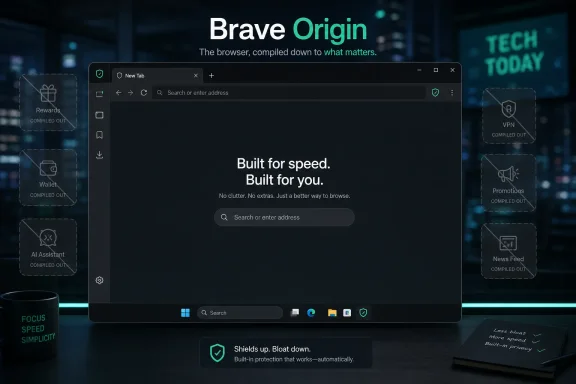
The awkward genius of Brave Origin is that it is not trying to be a new browser. It is Brave with the loudest appendages removed or disabled: Rewards, Wallet, Leo AI, VPN promotions, News, Talk, Tor integration, Speedreader, Wayback Machine hooks, analytics features, and other add-ons that accumulated around the core browsing experience.
That makes Origin both easy to understand and hard to defend in the usual product-marketing language. It is not faster because of a revolutionary engine. It is not safer because of a novel sandbox. It is attractive because it subtracts, and subtraction is increasingly rare in consumer software.
Wallen’s conclusion is telling: he did not find a life-changing new experience. He found a browser that felt cleaner, faster, and less burdened by things he did not ask for. In 2026, that may be enough to make a Chromium-based browser stand out.
The larger irony is that Brave’s original pitch was already about not being Chrome. Brave blocked ads and trackers by default, promised a more private web, and wrapped Chromium in a privacy-first identity. Over time, however, Brave became not just an anti-Chrome but a platform company with its own advertising system, crypto wallet, AI assistant, VPN upsells, news feed, and communications tools.
Origin is an admission that for some users, the old promise was stronger than the new ecosystem.
That pricing model changes the conversation from “Is this browser good?” to “What exactly am I buying?” On desktop, users can already go into Brave settings and disable many of the same visible features. The standard Brave browser remains free, and no one is required to use Rewards, Wallet, Leo, or the VPN.
Brave’s answer appears to be convenience, certainty, and support. In the standalone desktop version, several features are reportedly compiled out rather than merely hidden behind toggles. In the upgrade path, Origin functions more like a controlled configuration that turns off the extras for users who do not want to hunt through settings.
That distinction matters, but it will not matter equally to everyone. A privacy hobbyist may prefer a build where unwanted components are simply not present. A casual user may only care that the sidebar is quieter and the menus less cluttered. A sysadmin may ask whether the same result can be achieved through policy, packaging, or existing configuration management.
The price also exposes a tension at the heart of privacy software. People say they want products that do not monetize them. But when a company asks them to pay directly for a product that strips away monetization hooks, the reaction is often disbelief. We have been trained to expect browsers to be free, even when “free” has usually meant subsidized by search deals, advertising systems, data-driven services, or platform lock-in.
Brave Origin is not merely selling a browser. It is testing whether users will pay for a browser that has fewer ways to pay for itself.
Linux users are more likely to notice unwanted services, inspect packages, object to telemetry, and abandon software that violates their expectations. They are also more likely to be comfortable compiling, configuring, or replacing their browser. Charging that audience $60 for a stripped-down build would have been a public-relations bonfire.
So Linux gets Brave Origin free, and Wallen’s experience on Pop!_OS fits the pattern. He switched into Origin, relaunched, and found a browser closer to what he wanted: the same core Brave experience, less clutter, and a somewhat snappier feel.
There is a practical reason this matters for WindowsForum readers even if they live primarily on Windows. Linux often acts as the early-warning system for desktop software excess. What Linux users complain about first — bundled services, telemetry, package opacity, background processes — eventually becomes a mainstream complaint once the same software lands on managed Windows fleets.
The fact that Brave made a special pricing carveout for Linux suggests the company knows which audience is most likely to scrutinize the difference between real removal and cosmetic hiding. That scrutiny will eventually shape expectations elsewhere.
The technical debate is more complicated than the slogan. Manifest V3 does not eliminate all ad blocking, and Chrome still supports content-blocking extensions under the new rules. But the perception among enthusiasts is blunt: Google’s browser is becoming less friendly to user-controlled filtering, and browsers with built-in blocking are becoming more attractive.
That is Brave’s opportunity. Brave Shields does not depend on the Chrome Web Store in the same way a third-party extension does. Its blocking is built into the browser itself, which lets Brave position its privacy stack as more resilient than whatever Google permits extensions to do next.
Origin keeps that part. That is the key. Brave did not strip the browser down to generic Chromium. It removed the controversial ecosystem features while preserving the one feature class that many users actually came for: aggressive, built-in protection against ads, trackers, fingerprinting techniques, and unwanted web noise.
For users who see Chrome as increasingly aligned with the ad industry, Brave Origin offers a simple emotional proposition: Chromium compatibility without Chrome’s priorities, and Brave’s blocking without Brave’s extra businesses.
That is why Wallen’s “top Chromium-based pick” framing is significant. The browser market is no longer just Chrome versus Firefox versus Safari. For many users, the real decision is which Chromium derivative imposes the fewest compromises.
That does not make Brave hypocritical. It makes Brave a browser company trying to survive in a market where the dominant browser is funded by one of the world’s largest advertising businesses. But it does create a messaging problem. Users who arrive for privacy are often the same users least interested in crypto wallets, reward tokens, AI assistants, or promotional surfaces for paid services.
Brave Origin is the product form of that contradiction. It tells users: you can have the browser without the platform.
That may help Brave with skeptics who never doubted Shields but disliked the surrounding furniture. It may also help in professional contexts where crypto-related features are a nonstarter. Even a disabled wallet can be a red flag in a regulated environment if it appears in menus, policy reviews, user training, or incident-response documentation.
Wallen’s concern about crypto is personal rather than institutional, but it reflects a broader unease. Many users do not want a browser that even looks like it is adjacent to digital assets. They do not want to explain to a finance department why a wallet exists. They do not want to wonder whether an unused feature increases attack surface. They simply want it gone.
Origin is Brave’s way of saying: fine, gone.
A disabled feature may still exist in the codebase, appear in preferences, expose policy surfaces, or become available again through configuration changes. A hidden feature may disappear from the interface while remaining present under the hood. A compiled-out feature is a stronger claim: the component is not included in the build in the first place.
Brave’s own positioning has differentiated between standalone Origin apps and upgraded existing Brave installations. On desktop, the standalone Origin build is the cleaner concept, because the unwanted pieces are absent rather than merely switched off. The in-app upgrade is more convenient for existing users, but it naturally raises the question of how much is removal and how much is managed configuration.
That distinction matters more to enterprises than to individuals. A home user may not care whether Leo AI is absent or merely unreachable. An administrator packaging browsers for thousands of machines absolutely might.
Attack surface is not just about active features. It is about code paths, dependencies, update behavior, network calls, user confusion, and the support burden created when a feature appears in documentation but not in policy. If Origin reduces those surfaces in the standalone build, it has a stronger technical case than “we changed the defaults.”
But Brave should expect scrutiny here. A paid minimalist browser cannot survive on vibes alone. If the value proposition is absence, users will eventually ask for a precise inventory of what is absent, what is merely disabled, and how that differs across platforms.
Origin could be attractive in smaller organizations that want Chromium compatibility and built-in blocking without the optics of crypto, AI, or consumer services. It could also appeal to managed environments where users should not be invited into rewards programs or wallet workflows from inside a work browser.
But the value depends on manageability. If Brave Origin can be deployed, updated, licensed, and locked down with the same discipline as standard Brave or Chrome, it becomes a plausible option for privacy-conscious shops. If it is mostly a consumer license wrapped around a cleaner UI, it remains a nice browser for enthusiasts.
The $59.99 one-time purchase complicates procurement as well. A one-time fee sounds friendly to individuals, but organizations tend to ask different questions. How are activations tracked? What happens when devices are reimaged? How does licensing work across shared machines, VDI, contractors, and departed employees? What does support look like when the product is neither the free browser nor a traditional enterprise SKU?
There is also the bigger issue of standardization. Many companies already live with Edge because it is built into Windows, tied into Microsoft 365, and manageable through existing policy infrastructure. Others choose Chrome because web apps are tested against it first. Brave Origin has to be not merely cleaner, but worth introducing as another supported browser.
For enthusiasts, the decision can be emotional. For IT, it is operational.
Brave’s standard browser lets users disable many extras. That is true, and it is important. But the existence of a toggle does not erase the power of the default. Most users never search settings for features they do not understand, and many do not know which browser components have privacy, security, or performance implications.
Origin turns “I changed the settings” into “the product was designed this way.” That is a meaningful shift. It removes the burden from the user and places it on the vendor.
This is also why minimalist browsers have a cultural pull far beyond their market share. Zen Browser, which Wallen mentions as his daily driver, appeals partly because it rethinks workflow with workspaces and theming rather than bolting on monetization services. Firefox continues to attract users who want a non-Chromium engine, even as its own strategic position remains difficult. Safari wins by being the low-friction default on Apple hardware.
Brave Origin’s pitch is different: it says the mainstream Chromium web can be made tolerable if the browser vendor gets out of the way. That may not sound ambitious, but in the current browser market, restraint is a differentiator.
Operating systems, browsers, office suites, chat apps, and even utilities have become surfaces for subscriptions, AI prompts, identity nudges, cloud sync offers, news widgets, and engagement loops. The result is a creeping distrust of every update. Users increasingly ask not “what did I get?” but “what did they sneak in?”
In that environment, paying for less starts to look less absurd. People already pay for distraction-free writing apps, privacy-focused email providers, password managers, note-taking tools, and VPNs, even when free alternatives exist. They are not always paying for raw functionality. They are paying for alignment.
That is the best argument for Origin. A user who pays Brave directly for a clean browser is giving the company a financial reason to maintain the clean browser. In theory, that is healthier than relying on auxiliary services the user does not want.
The worst argument for Origin is convenience. If the product is merely a paid shortcut to flip settings, it will be hard to justify. But if Origin becomes a separate line with a durable promise — no new revenue-generating features, no crypto wallet, no AI assistant, no promotional clutter, fewer bundled components — then the fee starts to resemble a contract.
Not a legal contract, perhaps. A product promise.
That is a useful ceiling for Brave. Minimalism removes objections, but it does not automatically create delight. A clean browser can be preferable to a cluttered one and still not be the most powerful workflow tool.
Workspaces matter because browsers are no longer just page viewers. They are operating environments for work, research, messaging, writing, administration consoles, dashboards, documentation, and entertainment. Users who live in tabs need organization as much as privacy.
If Brave Origin remains simply “Brave without extras,” it will appeal to people who already wanted Brave but disliked the baggage. If it evolves into a cleaner power-user browser with thoughtful workflow tools that do not compromise its minimalist premise, it could become something more interesting.
That is a difficult balance. Add too little, and Origin is a paid settings preset. Add too much, and it repeats the standard Brave arc: the minimalist product becomes another platform.
The most disciplined version of Origin would add only features that help users manage the web they already use, not features that create new Brave-controlled ecosystems. Tab management, profiles, workspaces, policy clarity, and performance transparency fit that philosophy. Wallets, tokens, assistants, and feeds do not.
If you already use Brave on Windows and have manually disabled the extras, Origin may feel redundant unless you specifically value the cleaner standalone build or want to support Brave directly. If you are privacy-conscious but allergic to crypto and AI branding, Origin may remove enough friction to make Brave viable. If you manage machines, the decision should wait on deployment clarity, policy behavior, update mechanics, and licensing details.
If you are simply angry about Chrome’s direction, Origin is one of several possible exits. Firefox remains the obvious non-Chromium alternative. Edge remains the pragmatic Windows default for Microsoft-heavy organizations, even with its own clutter problems. Vivaldi, Opera, Zen, and other niche browsers each solve different workflow problems while introducing their own trade-offs.
The browser choice in 2026 is no longer about finding perfection. It is about choosing which compromises you can tolerate.
Brave Origin’s compromise is unusually explicit. You pay, or on Linux do not pay, for a Brave that promises to stop trying to be so many other things. For some users, that will feel like sanity. For others, it will feel like a protection racket against bloat.
Both reactions are understandable.
 Brave Sells the Absence of Everything It Added
The awkward genius of Brave Origin is that it is not trying to be a new browser. It is Brave with the loudest appendages removed or disabled: Rewards, Wallet, Leo AI, VPN promotions, News, Talk, Tor integration, Speedreader, Wayback Machine hooks, analytics features, and other add-ons that accumulated around the core browsing experience.That makes Origin both easy to understand and hard to defend in the usual product-marketing language. It is not faster because of a revolutionary engine. It is not safer because of a novel sandbox. It is attractive because it subtracts, and subtraction is increasingly rare in consumer software.
Wallen’s conclusion is telling: he did not find a life-changing new experience. He found a browser that felt cleaner, faster, and less burdened by things he did not ask for. In 2026, that may be enough to make a Chromium-based browser stand out.
The larger irony is that Brave’s original pitch was already about not being Chrome. Brave blocked ads and trackers by default, promised a more private web, and wrapped Chromium in a privacy-first identity. Over time, however, Brave became not just an anti-Chrome but a platform company with its own advertising system, crypto wallet, AI assistant, VPN upsells, news feed, and communications tools.
Origin is an admission that for some users, the old promise was stronger than the new ecosystem.
The Minimal Browser Is Now a Premium Product
The most provocative detail is not that Brave Origin exists. It is that Windows and macOS users are asked to pay $59.99 for it, while Linux users get it free.That pricing model changes the conversation from “Is this browser good?” to “What exactly am I buying?” On desktop, users can already go into Brave settings and disable many of the same visible features. The standard Brave browser remains free, and no one is required to use Rewards, Wallet, Leo, or the VPN.
Brave’s answer appears to be convenience, certainty, and support. In the standalone desktop version, several features are reportedly compiled out rather than merely hidden behind toggles. In the upgrade path, Origin functions more like a controlled configuration that turns off the extras for users who do not want to hunt through settings.
That distinction matters, but it will not matter equally to everyone. A privacy hobbyist may prefer a build where unwanted components are simply not present. A casual user may only care that the sidebar is quieter and the menus less cluttered. A sysadmin may ask whether the same result can be achieved through policy, packaging, or existing configuration management.
The price also exposes a tension at the heart of privacy software. People say they want products that do not monetize them. But when a company asks them to pay directly for a product that strips away monetization hooks, the reaction is often disbelief. We have been trained to expect browsers to be free, even when “free” has usually meant subsidized by search deals, advertising systems, data-driven services, or platform lock-in.
Brave Origin is not merely selling a browser. It is testing whether users will pay for a browser that has fewer ways to pay for itself.
Linux Gets the Clean Build Because Linux Already Demanded It
The Linux exception is not a throwaway detail. It says something about the constituency Brave is trying not to alienate.Linux users are more likely to notice unwanted services, inspect packages, object to telemetry, and abandon software that violates their expectations. They are also more likely to be comfortable compiling, configuring, or replacing their browser. Charging that audience $60 for a stripped-down build would have been a public-relations bonfire.
So Linux gets Brave Origin free, and Wallen’s experience on Pop!_OS fits the pattern. He switched into Origin, relaunched, and found a browser closer to what he wanted: the same core Brave experience, less clutter, and a somewhat snappier feel.
There is a practical reason this matters for WindowsForum readers even if they live primarily on Windows. Linux often acts as the early-warning system for desktop software excess. What Linux users complain about first — bundled services, telemetry, package opacity, background processes — eventually becomes a mainstream complaint once the same software lands on managed Windows fleets.
The fact that Brave made a special pricing carveout for Linux suggests the company knows which audience is most likely to scrutinize the difference between real removal and cosmetic hiding. That scrutiny will eventually shape expectations elsewhere.
Chrome’s Extension Crackdown Gives Brave Its Opening
Brave Origin lands at a moment when Chromium-based browsers are under renewed suspicion from power users. Google’s transition away from the older extension model has been framed by critics as a threat to full-powered content blockers, especially uBlock Origin-style filtering on Chrome.The technical debate is more complicated than the slogan. Manifest V3 does not eliminate all ad blocking, and Chrome still supports content-blocking extensions under the new rules. But the perception among enthusiasts is blunt: Google’s browser is becoming less friendly to user-controlled filtering, and browsers with built-in blocking are becoming more attractive.
That is Brave’s opportunity. Brave Shields does not depend on the Chrome Web Store in the same way a third-party extension does. Its blocking is built into the browser itself, which lets Brave position its privacy stack as more resilient than whatever Google permits extensions to do next.
Origin keeps that part. That is the key. Brave did not strip the browser down to generic Chromium. It removed the controversial ecosystem features while preserving the one feature class that many users actually came for: aggressive, built-in protection against ads, trackers, fingerprinting techniques, and unwanted web noise.
For users who see Chrome as increasingly aligned with the ad industry, Brave Origin offers a simple emotional proposition: Chromium compatibility without Chrome’s priorities, and Brave’s blocking without Brave’s extra businesses.
That is why Wallen’s “top Chromium-based pick” framing is significant. The browser market is no longer just Chrome versus Firefox versus Safari. For many users, the real decision is which Chromium derivative imposes the fewest compromises.
Brave’s Privacy Brand Has Always Had a Monetization Problem
Brave has spent years walking a narrow ledge. Its privacy posture is strong enough to attract users who distrust the ad-tech web, yet its business model has included its own privacy-preserving ad system, tokenized rewards, crypto tooling, paid services, and now AI.That does not make Brave hypocritical. It makes Brave a browser company trying to survive in a market where the dominant browser is funded by one of the world’s largest advertising businesses. But it does create a messaging problem. Users who arrive for privacy are often the same users least interested in crypto wallets, reward tokens, AI assistants, or promotional surfaces for paid services.
Brave Origin is the product form of that contradiction. It tells users: you can have the browser without the platform.
That may help Brave with skeptics who never doubted Shields but disliked the surrounding furniture. It may also help in professional contexts where crypto-related features are a nonstarter. Even a disabled wallet can be a red flag in a regulated environment if it appears in menus, policy reviews, user training, or incident-response documentation.
Wallen’s concern about crypto is personal rather than institutional, but it reflects a broader unease. Many users do not want a browser that even looks like it is adjacent to digital assets. They do not want to explain to a finance department why a wallet exists. They do not want to wonder whether an unused feature increases attack surface. They simply want it gone.
Origin is Brave’s way of saying: fine, gone.
Disabled Is Not the Same as Removed
The most important technical distinction in the Origin debate is whether features are disabled, hidden, policy-blocked, or compiled out. Those words sound interchangeable to casual users. They are not.A disabled feature may still exist in the codebase, appear in preferences, expose policy surfaces, or become available again through configuration changes. A hidden feature may disappear from the interface while remaining present under the hood. A compiled-out feature is a stronger claim: the component is not included in the build in the first place.
Brave’s own positioning has differentiated between standalone Origin apps and upgraded existing Brave installations. On desktop, the standalone Origin build is the cleaner concept, because the unwanted pieces are absent rather than merely switched off. The in-app upgrade is more convenient for existing users, but it naturally raises the question of how much is removal and how much is managed configuration.
That distinction matters more to enterprises than to individuals. A home user may not care whether Leo AI is absent or merely unreachable. An administrator packaging browsers for thousands of machines absolutely might.
Attack surface is not just about active features. It is about code paths, dependencies, update behavior, network calls, user confusion, and the support burden created when a feature appears in documentation but not in policy. If Origin reduces those surfaces in the standalone build, it has a stronger technical case than “we changed the defaults.”
But Brave should expect scrutiny here. A paid minimalist browser cannot survive on vibes alone. If the value proposition is absence, users will eventually ask for a precise inventory of what is absent, what is merely disabled, and how that differs across platforms.
Enterprise IT Will Care Less About the Toolbar Than the Policy Story
For Windows administrators, Brave Origin is interesting but not automatically compelling. Most enterprises do not choose browsers because one writer found the UI cleaner for a few days. They choose browsers based on update cadence, policy control, compatibility, support posture, vulnerability response, identity integration, and how much help-desk noise a browser creates.Origin could be attractive in smaller organizations that want Chromium compatibility and built-in blocking without the optics of crypto, AI, or consumer services. It could also appeal to managed environments where users should not be invited into rewards programs or wallet workflows from inside a work browser.
But the value depends on manageability. If Brave Origin can be deployed, updated, licensed, and locked down with the same discipline as standard Brave or Chrome, it becomes a plausible option for privacy-conscious shops. If it is mostly a consumer license wrapped around a cleaner UI, it remains a nice browser for enthusiasts.
The $59.99 one-time purchase complicates procurement as well. A one-time fee sounds friendly to individuals, but organizations tend to ask different questions. How are activations tracked? What happens when devices are reimaged? How does licensing work across shared machines, VDI, contractors, and departed employees? What does support look like when the product is neither the free browser nor a traditional enterprise SKU?
There is also the bigger issue of standardization. Many companies already live with Edge because it is built into Windows, tied into Microsoft 365, and manageable through existing policy infrastructure. Others choose Chrome because web apps are tested against it first. Brave Origin has to be not merely cleaner, but worth introducing as another supported browser.
For enthusiasts, the decision can be emotional. For IT, it is operational.
The Browser Wars Have Become a Fight Over Defaults
What Brave Origin really exposes is how much modern computing is governed by defaults. The default browser, the default search engine, the default extension rules, the default telemetry settings, the default sidebar, the default AI assistant — all of these shape user behavior long before anyone opens a settings page.Brave’s standard browser lets users disable many extras. That is true, and it is important. But the existence of a toggle does not erase the power of the default. Most users never search settings for features they do not understand, and many do not know which browser components have privacy, security, or performance implications.
Origin turns “I changed the settings” into “the product was designed this way.” That is a meaningful shift. It removes the burden from the user and places it on the vendor.
This is also why minimalist browsers have a cultural pull far beyond their market share. Zen Browser, which Wallen mentions as his daily driver, appeals partly because it rethinks workflow with workspaces and theming rather than bolting on monetization services. Firefox continues to attract users who want a non-Chromium engine, even as its own strategic position remains difficult. Safari wins by being the low-friction default on Apple hardware.
Brave Origin’s pitch is different: it says the mainstream Chromium web can be made tolerable if the browser vendor gets out of the way. That may not sound ambitious, but in the current browser market, restraint is a differentiator.
Paying for Less Is Irrational Until the Alternatives Are Worse
The backlash writes itself: Brave added features, then charged users to remove them. That summary is not entirely fair, but it is emotionally potent because it captures how many people feel about software now.Operating systems, browsers, office suites, chat apps, and even utilities have become surfaces for subscriptions, AI prompts, identity nudges, cloud sync offers, news widgets, and engagement loops. The result is a creeping distrust of every update. Users increasingly ask not “what did I get?” but “what did they sneak in?”
In that environment, paying for less starts to look less absurd. People already pay for distraction-free writing apps, privacy-focused email providers, password managers, note-taking tools, and VPNs, even when free alternatives exist. They are not always paying for raw functionality. They are paying for alignment.
That is the best argument for Origin. A user who pays Brave directly for a clean browser is giving the company a financial reason to maintain the clean browser. In theory, that is healthier than relying on auxiliary services the user does not want.
The worst argument for Origin is convenience. If the product is merely a paid shortcut to flip settings, it will be hard to justify. But if Origin becomes a separate line with a durable promise — no new revenue-generating features, no crypto wallet, no AI assistant, no promotional clutter, fewer bundled components — then the fee starts to resemble a contract.
Not a legal contract, perhaps. A product promise.
Wallen’s Hands-On Shows the Best Case and the Ceiling
Wallen’s review is most persuasive because it is not breathless. He liked Brave Origin. He found it cleaner and a bit faster. He made it his top Chromium-based alternative. But he did not abandon his default browser, largely because Zen Browser gives him theming and workspace features Brave Origin lacks.That is a useful ceiling for Brave. Minimalism removes objections, but it does not automatically create delight. A clean browser can be preferable to a cluttered one and still not be the most powerful workflow tool.
Workspaces matter because browsers are no longer just page viewers. They are operating environments for work, research, messaging, writing, administration consoles, dashboards, documentation, and entertainment. Users who live in tabs need organization as much as privacy.
If Brave Origin remains simply “Brave without extras,” it will appeal to people who already wanted Brave but disliked the baggage. If it evolves into a cleaner power-user browser with thoughtful workflow tools that do not compromise its minimalist premise, it could become something more interesting.
That is a difficult balance. Add too little, and Origin is a paid settings preset. Add too much, and it repeats the standard Brave arc: the minimalist product becomes another platform.
The most disciplined version of Origin would add only features that help users manage the web they already use, not features that create new Brave-controlled ecosystems. Tab management, profiles, workspaces, policy clarity, and performance transparency fit that philosophy. Wallets, tokens, assistants, and feeds do not.
Windows Users Should Treat Origin as a Signal, Not a Default Recommendation
For WindowsForum readers, Brave Origin is worth watching, but not because everyone should immediately spend $59.99. The smarter move is to treat it as a signal about where browser dissatisfaction is heading.If you already use Brave on Windows and have manually disabled the extras, Origin may feel redundant unless you specifically value the cleaner standalone build or want to support Brave directly. If you are privacy-conscious but allergic to crypto and AI branding, Origin may remove enough friction to make Brave viable. If you manage machines, the decision should wait on deployment clarity, policy behavior, update mechanics, and licensing details.
If you are simply angry about Chrome’s direction, Origin is one of several possible exits. Firefox remains the obvious non-Chromium alternative. Edge remains the pragmatic Windows default for Microsoft-heavy organizations, even with its own clutter problems. Vivaldi, Opera, Zen, and other niche browsers each solve different workflow problems while introducing their own trade-offs.
The browser choice in 2026 is no longer about finding perfection. It is about choosing which compromises you can tolerate.
Brave Origin’s compromise is unusually explicit. You pay, or on Linux do not pay, for a Brave that promises to stop trying to be so many other things. For some users, that will feel like sanity. For others, it will feel like a protection racket against bloat.
Both reactions are understandable.
The Cleanest Brave Is Also the Most Revealing One
Brave Origin leaves users with a handful of unusually concrete lessons about the modern browser market. The product is small in concept, but the implications are larger than its download page.- Brave Origin keeps the core Brave privacy proposition intact while removing or disabling many of the ecosystem features that made some users distrust the standard browser.
- The $59.99 price on Windows and macOS is less about new functionality than about convenience, cleaner packaging, and a direct-payment model for users who do not want monetization features.
- Linux users getting Origin free reflects both community expectations and the reality that technically demanding users are harder to charge for configuration they can reproduce themselves.
- The standalone desktop build is the version to watch because compiled-out components make a stronger privacy and security argument than ordinary settings toggles.
- Brave Origin is not automatically an enterprise browser, but it could become attractive if Brave makes deployment, policy, licensing, and support as clean as the interface.
- The product’s success will depend on whether Brave can resist turning its minimalist edition into another feature platform over time.
References
- Primary source: ZDNET
Published: 2026-07-02T10:52:07.416456
- Related coverage: techtimes.com
Brave Origin Browser Launches at $60: Compile-Out Build Removes Leo, Tor, Wallet
Brave Origin browser launched June 4 at $59.99, stripping Leo AI, Tor, and crypto wallet from Brave’s Chromium core. The standalone build compiles features out of the binary entirely; upgrade modewww.techtimes.com - Related coverage: techspot.com
Brave is charging $60 for a version of its browser that removes the features you probably never wanted | TechSpot
Brave says its new "Origin" package delivers a premium web experience, but the one-time fee applies to all supported platforms except Linux. The San Francisco-based company developed...www.techspot.com - Related coverage: brave.com
Brave Origin on Linux | Brave
The Brave browser is a fast, private and secure web browser for PC, Mac and mobile. Download now to enjoy a faster ad-free browsing experience that saves data and battery life by blocking tracking software.brave.com - Related coverage: digitaltrends.com
Brave Origin is a minimalist browser that strips all the jargon, but you must pay $60 for that luxury - Digital Trends
Brave has launched Origin, a $59.99 browser that strips out several features, but critics argue the features it removes can already be disabled for free.www.digitaltrends.com - Related coverage: privacyguides.org
Brave Launches Paid, "Minimalist" Brave Origin Browser
Brave has officially released Brave Origin, a minimal version of the regular Brave browser without a lot of the optional features such as Rewards, Leo AI, and Brave's VPN, for a one-time fee. www.privacyguides.org
- Related coverage: linuxiac.com
Brave Gives Linux Users Its Stripped Down Origin Browser for Free
Brave Origin is a minimalist Brave edition that costs $59.99 on other platforms but is free for Linux users.linuxiac.com - Related coverage: how2shout.com
What Is Brave Origin? Minimalist Privacy Browser Launches at $59.99
Brave Origin is a paid, stripped-down privacy browser at a one-time $59.99 — no AI, VPN, or crypto wallet. Here's what's included, what's removed, and who it's for.www.how2shout.com - Related coverage: thetoolpicker.com
Brave Origin Launches as a Paid, Minimalist Browser…
Brave introduces Brave Origin, a $60 minimalist paid browser removing AI, rewards, and VPN. It focuses on core privacy features like ad blocking with…www.thetoolpicker.com - Related coverage: linux.org

News - [Linuxiac] Brave Gives Linux Users Its Stripped Down Origin Browser for Free | Linux.org
News - [Linuxiac] Brave Gives Linux Users Its Stripped Down Origin Browser for Free - Linux.org - Friendly Linux Forum
www.linux.org
- Related coverage: thechainpost.com
Brave’s Origin browser charges $60 by stripping features you can disable for free | TheChainPost
Brave’s Origin browser removes ads, AI, and crypto for a $60 fee, even though those features can reportedly be disabled for free.www.thechainpost.com
