

On May 27, 2026, Broadcom announced three integrated Wi-Fi 8 systems-on-chip — the BCM6772, BCM6774, and BCM6776 — for next-generation mesh systems, Ethernet routers, extenders, and repeaters, with sampling now under way to early access partners. The announcement is not just another silicon roadmap entry; it is the moment Wi-Fi 8 starts looking less like a lab standard and more like a product category. Broadcom’s bet is that the next home-networking upgrade cycle will be won not by peak speed claims alone, but by integration, thermals, reliability, and cost. That matters because the router market has spent years selling bigger numbers while households have mostly experienced the same old weak spots: dead zones, jitter, bad roaming, and devices that fail at the edge of coverage.
Wi-Fi generations usually arrive first as a marketing argument. The chipmaker announces a high-end platform, router vendors build halo products around it, and consumers see a handful of expensive boxes promising a theoretical speed nobody in a normal house will reproduce. Broadcom’s new BCM677x family is different because it aims directly at the unglamorous part of the transition: making the technology practical for mainstream mesh and Ethernet router designs.
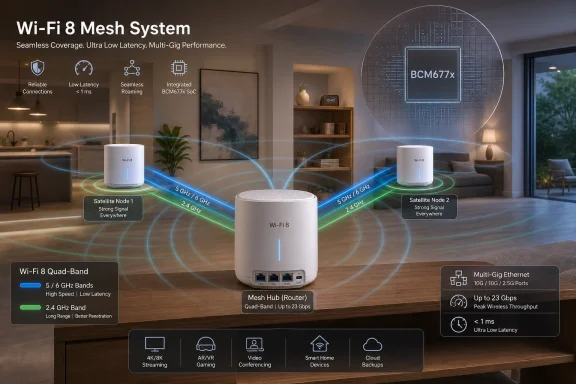
The company says the new chips fold the application processor, network processor, 2.4 GHz and 5 GHz Wi-Fi 8 radios, and multi-gigabit Ethernet PHY onto a single die. That sentence is easy to glide past, but it is the whole story. A multi-chip design can deliver impressive capability, but it also raises board complexity, heat, power draw, and bill-of-materials pressure. Those costs eventually show up in router prices, enclosure size, fanless thermal limits, or delayed product schedules.
For WindowsForum readers, the significance is not that your next laptop will suddenly download Steam games at impossible speeds. The significance is that home and small-office networks are increasingly expected to behave like managed infrastructure while being sold as consumer appliances. A router now has to juggle fiber broadband, Wi-Fi backhaul, video calls, cloud gaming, security cameras, phones, tablets, laptops, IoT clutter, and sometimes work-from-home VPN traffic. Broadcom is trying to make the underlying platform compact and cheap enough that OEMs can ship Wi-Fi 8 in boxes that look like normal home networking gear rather than science projects.
That is why this announcement deserves more attention than the usual “new chip, faster router” cycle. It signals that Wi-Fi 8 is entering the design phase where product managers begin deciding what the 2027 mainstream shelf will look like. Standards debates still matter, certification timelines still matter, and client support will lag. But router silicon is where the market starts taking shape.
That makes Wi-Fi 8 a harder sell. “More reliable under congestion” does not fit neatly on a retail box next to a giant speed number. Yet it is closer to what users actually complain about. The modern home is full of overlapping networks, mesh nodes, Bluetooth devices, microwave ovens, wireless cameras, and cheap IoT hardware with indifferent radio behavior. The problem is no longer simply whether the router can move a large file in ideal conditions; it is whether it can maintain latency, coordination, and usable throughput when the RF environment gets ugly.
Broadcom’s release leans into that shift without abandoning the familiar multi-gigabit pitch. The chips are designed for high-performance Ethernet routers and mesh systems, which means they sit at the junction between faster wired broadband and messier wireless reality. Fiber-to-the-home connections have made 1 Gbps service less exotic, while 2.5 GbE ports have begun appearing in gear that no longer counts as ultra-premium. The bottleneck is moving around the house, and the wireless side is where consumers notice it most.
The most interesting part of Broadcom’s framing is the admission, implicit but obvious, that the home networking industry cannot keep adding radios and processors forever. If reliability is the point, the platform has to be deployable in the places mesh nodes actually live: shelves, hallways, bedrooms, kitchens, and entertainment centers. That means small boxes, quiet operation, and tolerable heat. Integrated silicon is not glamorous, but it is exactly how a standard moves from spec-sheet theater to household infrastructure.
That segmentation matters because it gives OEMs a way to build a product stack without reinventing the platform at every price point. A vendor can imagine an entry router, a higher-end mesh node, and a premium tri-band system using related silicon and software assumptions. That is how router lines become real, not just announced. It also means Wi-Fi 8 can trickle down faster than it would if every implementation required a bespoke board design and a pile of companion chips.
The BCM6772 and BCM6774 come in compact 15x15 mm FCBGA packages, while the BCM6776 uses a 19x19 mm package. Those measurements will not stir the average buyer, but they matter to hardware designers trying to fit radios, antennas, shielding, memory, Ethernet, power delivery, and cooling into attractive plastic. Mesh systems are especially constrained because aesthetics are not optional. The box has to sit in a living room without looking like a data-center appliance.
Broadcom also calls out on-chip 2.4 GHz power amplifiers and third-generation digital pre-distortion technology, both aimed at reducing component count and improving power behavior. This is the quiet engineering layer behind the marketing. Fewer external RF components can mean lower cost, fewer board-layout headaches, and fewer places for a design to go wrong. Better power efficiency can mean less heat, and less heat often means more consistent performance over time.
The industry’s first integrated claim should still be read carefully. Semiconductor vendors love firsts, and the precise boundaries of “integrated,” “Wi-Fi 8,” “router SoC,” and “sampling” can be narrower than the headline implies. But even with that caveat, the direction is clear. Broadcom is not merely showing that it can make Wi-Fi 8 silicon; it is trying to define the reference architecture for how home-networking vendors should package it.
Mesh also exposes the limits of peak-speed marketing faster than standalone routers do. A single router can win benchmarks in a favorable room. A mesh system has to survive walls, floors, backhaul tradeoffs, roaming decisions, and the awkward fact that users place nodes where they look good rather than where RF engineers would prefer. Wi-Fi 8’s reliability focus maps neatly onto this reality because the home is increasingly a multi-access-point environment whether consumers know the term or not.
Broadcom’s BCM677x line is aimed at the point where mesh vendors need enough intelligence and radio capability to coordinate traffic without building every node like a flagship router. The dedicated network processing engine is part of that story. Offloading intensive packet handling from the general CPU is not new, but it becomes more important as home routers take on security filtering, QoS, parental controls, VPN features, and app-driven management while still being expected to route multi-gigabit traffic without drama.
There is also a Windows angle here that rarely appears in router announcements. Many PC users now experience network quality through latency-sensitive applications rather than raw downloads. Cloud gaming, remote desktops, video conferencing, OneDrive sync, local NAS access, Windows Update delivery, and game patching all stress the network differently. A better mesh system does not just raise speed-test numbers; it reduces the number of moments when Windows looks broken because the network underneath it is inconsistent.
The coming Wi-Fi 8 pitch, if vendors handle it honestly, should be less “your laptop becomes faster” and more “your whole house becomes less annoying.” That is a less flashy promise, but it is a more valuable one.
That is an important shift because broadband speeds have outpaced many home networks’ internal designs. A household can pay for fast fiber and still lose the benefit through a weak router CPU, limited Ethernet ports, congested Wi-Fi, or a mesh node using a compromised wireless backhaul. Native support for multi-gigabit WAN and LAN interfaces is therefore not just a bullet point. It is a recognition that the router can no longer assume the internet connection is the slowest part of the system.
The BCM677x family also lands at a moment when 2.5 GbE is becoming ordinary and 10 GbE is slowly creeping downmarket. Most consumers do not need every port to run at 10 Gbps, but they increasingly need at least one fast WAN port and one fast LAN path for a desktop, NAS, gaming PC, or wired backhaul. If Wi-Fi 8 routers arrive with impressive wireless claims but anaemic Ethernet, they will repeat one of the more frustrating mistakes of earlier generations.
Broadcom’s emphasis on Ethernet routers, extenders, repeaters, and mesh systems suggests it sees the whole home network as a hybrid wired-wireless fabric. That is the right view. Serious home networks already use Ethernet where possible and wireless where necessary. The best consumer gear of the next few years will not pretend Wi-Fi replaces wires; it will make the two cooperate more intelligently.
For small offices, that cooperation matters even more. A five-person business does not always have a sysadmin, a rack, or a managed WLAN controller. It may have a fiber connection, several Windows laptops, a shared printer, a NAS, VoIP phones, and a few security cameras. Integrated Wi-Fi 8 silicon could make that environment easier to support — if vendors expose enough configuration and do not bury everything under a glossy mobile app.
Wi-Fi 8’s reliability ambitions depend on devices understanding the RF environment, traffic patterns, congestion, and quality-of-service needs with more nuance. In a dense home, the router has to make constant decisions about channel use, steering, scheduling, and coexistence. The value is not that your mesh node is “intelligent” in a vague marketing sense. The value is that it can observe conditions and adjust before the user notices the network degrading.
This is where integration can help again. A platform that combines CPU resources, networking offload, radios, Ethernet, and telemetry hooks gives vendors a more coherent base for firmware. That does not guarantee good software — router firmware history is littered with evidence to the contrary — but it lowers the difficulty of building consistent behavior across a product line. The best silicon in the world can still be undermined by poor updates, bad defaults, or abandoned devices.
Security will be part of this story whether vendors foreground it or not. Routers are long-lived, internet-facing devices that many consumers rarely patch manually. If Wi-Fi 8 systems become more complex and more adaptive, the update model matters. Windows users have learned, sometimes painfully, that automatic updates are both necessary and controversial. Router vendors face the same tradeoff: leave updates to users and many devices remain vulnerable, force updates too aggressively and outages become support incidents.
Broadcom can provide the platform, but OEMs will decide whether Wi-Fi 8 routers are trustworthy appliances or disposable gadgets with premium launch prices. That distinction will matter more than whether a box says AI on the front.
This is a familiar pattern. Wi-Fi 7 was announced, previewed, shipped in expensive early routers, and only gradually became useful as phones, laptops, and operating systems caught up. Wi-Fi 8 will likely follow a similar path, though the experience may be subtler because reliability improvements are harder to demonstrate in a quick retail comparison. The first wave will probably be expensive, the second wave will be better, and the third wave will be the one most people should buy.
Windows PC owners should be especially careful about early adoption. A Wi-Fi 8 router may improve the network for existing Wi-Fi 6, 6E, or 7 clients through better backhaul, routing, and radio management, but the full client-side benefits require compatible adapters. Laptops turn over slowly, desktops often rely on add-in cards or motherboard radios, and enterprise fleets can take years to refresh. Buying a first-generation Wi-Fi 8 router for a house full of older clients may still make sense if the mesh and Ethernet design is strong, but it should not be confused with an instant end-to-end upgrade.
There is also the matter of certification and branding. Consumers tend to trust the Wi-Fi logo more than draft-standard nuance, and enterprise buyers care even more about interoperability. Early silicon often supports a developing feature set, but the final standard and certification program determine what vendors can claim cleanly. That does not make early products bad, but it does make precise wording important.
The prudent reading is this: Broadcom’s announcement is a strong signal to the hardware ecosystem, not a command for users to replace routers this summer. If your Wi-Fi 6E or Wi-Fi 7 system is working well, there is no emergency. If your network is already failing under multi-gig broadband, dense clients, or awkward mesh placement, Wi-Fi 8 is worth watching — but not yet worth panic-buying.
That split will be especially important because Broadcom’s new integrated SoCs focus on 2.4 GHz and 5 GHz radios, with premium tri-band designs involving a companion chip. Consumers have been trained to associate recent Wi-Fi progress with 6 GHz, but the new BCM677x family’s mainstream integration story is not simply “more 6 GHz everywhere.” It is about making reliable dual-band and extensible tri-band designs easier to build.
There is nothing inherently wrong with that. The 2.4 GHz and 5 GHz bands remain critical for compatibility, range, and everyday use. Many households still have devices that will never speak 6 GHz, and many IoT products barely manage modern security expectations, let alone advanced radio features. A well-designed dual-band Wi-Fi 8 router may be more useful to a typical home than a poorly executed tri-band model with a bigger number on the box.
Still, buyers will need to read specifications carefully. The Wi-Fi generation will not be enough. Ethernet port speeds, number of spatial streams, 6 GHz support, backhaul design, memory, firmware update policy, and whether advanced features require a subscription will all shape the real product. The more integrated the platform becomes, the more vendors may be tempted to differentiate through software locks and cloud services rather than hardware alone.
That is where reviewers and communities like WindowsForum will have work to do. The right question will not be “Is it Wi-Fi 8?” The right question will be whether the product behaves better in the messy environments where people actually use Wi-Fi.
That could shape the consumer market more than retail routers do. Many households use whatever gateway their provider supplies, especially when fiber or cable service bundles equipment into the monthly bill. If Wi-Fi 8 reaches ISP gateways quickly, millions of users may experience the new generation without ever shopping for a router. The upside is faster deployment. The downside is less user control.
ISP gateways have improved, but they remain a mixed bag for enthusiasts. Some offer decent mesh extensions, app management, and automatic updates. Others restrict configuration, hide advanced settings, or steer users toward rental hardware. If Broadcom’s integrated platform makes Wi-Fi 8 cheap enough for operator deployment, the technology may arrive first as a managed service rather than a retail upgrade.
For IT-minded households, that raises a familiar decision. Do you accept the ISP gateway and its support model, or do you bridge it and run your own network? Wi-Fi 8 will not change that tradeoff, but it may make the ISP option more competent. A reliable provider-supplied mesh system could be good enough for many users, while enthusiasts still gravitate toward gear with better controls, VLAN support, local management, and transparent update policies.
The irony is that the most advanced Wi-Fi generation may make home networking feel less visible. If Broadcom and its customers succeed, users will think less about routers because fewer things break. That is exactly what infrastructure should do.
Wi-Fi 8’s reliability focus is therefore highly relevant to Windows users even before Wi-Fi 8 client adapters become common. A better router can improve airtime management, reduce congestion effects, and make mesh backhaul more stable. It cannot overcome every bad client driver or poor ISP route, but it can remove one large variable from the troubleshooting chain.
This matters for administrators supporting hybrid workers. The weakest link in a remote-work setup is often the unmanaged home network. Corporate IT can secure the endpoint, enforce VPN rules, manage updates, and monitor cloud services, but it usually cannot control the consumer router sitting behind the employee’s couch. If next-generation mesh systems become meaningfully more reliable, they may reduce a class of support tickets that currently masquerade as endpoint problems.
Developers and power users will care for similar reasons. Local AI workloads, cloud development environments, remote repositories, NAS-backed media libraries, and game streaming all benefit from consistent latency and fewer packet-loss spikes. Throughput still matters, but consistency increasingly defines whether a workflow feels professional or fragile.
The best case for Wi-Fi 8 is not that it makes a benchmark screenshot more impressive. It is that it makes wireless feel less wireless.
That is a competitive move as much as a technical one. Router vendors do not choose chips in isolation; they choose ecosystems, software support, reference designs, regulatory assistance, supply assurances, and roadmap confidence. If Broadcom can make Wi-Fi 8 product development faster and cheaper, it can influence which features become common and which remain premium.
The risk is that platform consolidation can also narrow differentiation. If many routers share similar silicon foundations, vendors may compete through enclosure design, app experience, cloud services, subscriptions, and artificial feature segmentation. Some of that can be useful. Much of it can be irritating. The home-networking market already has too many products that reserve basic security or parental controls for paid tiers.
Competition is the antidote. Wi-Fi 8 needs multiple silicon suppliers pushing each other on performance, openness, Linux support, power efficiency, and long-term updates. Enthusiast communities should pay attention not only to who announces first, but to who supports devices well after launch. A router that ships with excellent hardware and receives poor firmware maintenance is not a bargain.
Broadcom’s announcement raises the bar. Now the rest of the market has to show whether Wi-Fi 8 will be a broad ecosystem or a collection of vendor-specific interpretations wrapped in the same logo.
There is also the draft-standard problem. Wi-Fi 8 is still part of a developing standards process, and early silicon roadmaps often run ahead of final certification. That is normal in networking, but it means first-generation products should be evaluated with care. Support for eventual certified features, interoperability with future clients, and firmware upgrade paths will matter more than launch-day claims.
The BCM677x chips also show that “Wi-Fi 8” will not automatically mean every band, every feature, or every maximum channel width in every product. The family is designed to let vendors build different classes of devices. That is good for affordability, but it creates room for confusion. A cheap Wi-Fi 8 extender may be useful; it may also be far less capable than a premium Wi-Fi 7 mesh system in a particular home.
This is where the consumer networking industry needs to grow up. A generation logo should not be treated as a complete specification. Vendors should publish clear radio configurations, Ethernet capabilities, processor details, memory, update commitments, and mesh backhaul behavior. Reviewers should test latency under load, roaming, obstruction, and mixed-client environments rather than relying on best-case throughput alone.
If Wi-Fi 8 is really about reliability, the testing culture has to follow. Otherwise the market will turn a reliability standard into another speed-number arms race, and users will be right to shrug.
 Broadcom Moves Wi-Fi 8 From Showcase Silicon to Router Economics
Wi-Fi generations usually arrive first as a marketing argument. The chipmaker announces a high-end platform, router vendors build halo products around it, and consumers see a handful of expensive boxes promising a theoretical speed nobody in a normal house will reproduce. Broadcom’s new BCM677x family is different because it aims directly at the unglamorous part of the transition: making the technology practical for mainstream mesh and Ethernet router designs.The company says the new chips fold the application processor, network processor, 2.4 GHz and 5 GHz Wi-Fi 8 radios, and multi-gigabit Ethernet PHY onto a single die. That sentence is easy to glide past, but it is the whole story. A multi-chip design can deliver impressive capability, but it also raises board complexity, heat, power draw, and bill-of-materials pressure. Those costs eventually show up in router prices, enclosure size, fanless thermal limits, or delayed product schedules.
For WindowsForum readers, the significance is not that your next laptop will suddenly download Steam games at impossible speeds. The significance is that home and small-office networks are increasingly expected to behave like managed infrastructure while being sold as consumer appliances. A router now has to juggle fiber broadband, Wi-Fi backhaul, video calls, cloud gaming, security cameras, phones, tablets, laptops, IoT clutter, and sometimes work-from-home VPN traffic. Broadcom is trying to make the underlying platform compact and cheap enough that OEMs can ship Wi-Fi 8 in boxes that look like normal home networking gear rather than science projects.
That is why this announcement deserves more attention than the usual “new chip, faster router” cycle. It signals that Wi-Fi 8 is entering the design phase where product managers begin deciding what the 2027 mainstream shelf will look like. Standards debates still matter, certification timelines still matter, and client support will lag. But router silicon is where the market starts taking shape.
The Speed Race Is Giving Way to the Reliability Argument
Wi-Fi 8, formally tied to IEEE 802.11bn and the Ultra High Reliability effort, is not being framed as a clean-sheet speed revolution in the same way Wi-Fi 6E opened 6 GHz or Wi-Fi 7 brought wider channels and multi-link operation into the consumer vocabulary. The industry’s more subtle claim is that wireless networking has reached the point where peak throughput is a poor proxy for user experience. In plain terms: the fastest router in the world is still a failure if your Teams call freezes when someone walks between rooms.That makes Wi-Fi 8 a harder sell. “More reliable under congestion” does not fit neatly on a retail box next to a giant speed number. Yet it is closer to what users actually complain about. The modern home is full of overlapping networks, mesh nodes, Bluetooth devices, microwave ovens, wireless cameras, and cheap IoT hardware with indifferent radio behavior. The problem is no longer simply whether the router can move a large file in ideal conditions; it is whether it can maintain latency, coordination, and usable throughput when the RF environment gets ugly.
Broadcom’s release leans into that shift without abandoning the familiar multi-gigabit pitch. The chips are designed for high-performance Ethernet routers and mesh systems, which means they sit at the junction between faster wired broadband and messier wireless reality. Fiber-to-the-home connections have made 1 Gbps service less exotic, while 2.5 GbE ports have begun appearing in gear that no longer counts as ultra-premium. The bottleneck is moving around the house, and the wireless side is where consumers notice it most.
The most interesting part of Broadcom’s framing is the admission, implicit but obvious, that the home networking industry cannot keep adding radios and processors forever. If reliability is the point, the platform has to be deployable in the places mesh nodes actually live: shelves, hallways, bedrooms, kitchens, and entertainment centers. That means small boxes, quiet operation, and tolerable heat. Integrated silicon is not glamorous, but it is exactly how a standard moves from spec-sheet theater to household infrastructure.
Integration Is the Feature Router Vendors Will Actually Buy
Broadcom’s three new chips target different rungs of the same ladder. The BCM6772 is the foundation part, with integrated 2x2 2.4 GHz and 2x2 5 GHz radios. The BCM6774 steps up to 2x2 at 2.4 GHz and 4x4 at 5 GHz. The BCM6776 keeps that 2.4 GHz and 5 GHz arrangement but adds dual PCIe Gen3 controllers and broader memory support, positioning it for premium tri-band routers and extenders when paired with the BCM6718.That segmentation matters because it gives OEMs a way to build a product stack without reinventing the platform at every price point. A vendor can imagine an entry router, a higher-end mesh node, and a premium tri-band system using related silicon and software assumptions. That is how router lines become real, not just announced. It also means Wi-Fi 8 can trickle down faster than it would if every implementation required a bespoke board design and a pile of companion chips.
The BCM6772 and BCM6774 come in compact 15x15 mm FCBGA packages, while the BCM6776 uses a 19x19 mm package. Those measurements will not stir the average buyer, but they matter to hardware designers trying to fit radios, antennas, shielding, memory, Ethernet, power delivery, and cooling into attractive plastic. Mesh systems are especially constrained because aesthetics are not optional. The box has to sit in a living room without looking like a data-center appliance.
Broadcom also calls out on-chip 2.4 GHz power amplifiers and third-generation digital pre-distortion technology, both aimed at reducing component count and improving power behavior. This is the quiet engineering layer behind the marketing. Fewer external RF components can mean lower cost, fewer board-layout headaches, and fewer places for a design to go wrong. Better power efficiency can mean less heat, and less heat often means more consistent performance over time.
The industry’s first integrated claim should still be read carefully. Semiconductor vendors love firsts, and the precise boundaries of “integrated,” “Wi-Fi 8,” “router SoC,” and “sampling” can be narrower than the headline implies. But even with that caveat, the direction is clear. Broadcom is not merely showing that it can make Wi-Fi 8 silicon; it is trying to define the reference architecture for how home-networking vendors should package it.
Mesh Networking Has Become the Real Battleground
The router used to be a single box under a desk. Now the premium home network is a distributed system, and that changes the economics of every chip decision. A mesh kit may include two or three nodes, sometimes more, so every dollar and watt in the design is multiplied across the system. If Wi-Fi 8 mesh is going to reach beyond enthusiasts, integration is not a nice-to-have. It is the difference between a product category and a luxury demo.Mesh also exposes the limits of peak-speed marketing faster than standalone routers do. A single router can win benchmarks in a favorable room. A mesh system has to survive walls, floors, backhaul tradeoffs, roaming decisions, and the awkward fact that users place nodes where they look good rather than where RF engineers would prefer. Wi-Fi 8’s reliability focus maps neatly onto this reality because the home is increasingly a multi-access-point environment whether consumers know the term or not.
Broadcom’s BCM677x line is aimed at the point where mesh vendors need enough intelligence and radio capability to coordinate traffic without building every node like a flagship router. The dedicated network processing engine is part of that story. Offloading intensive packet handling from the general CPU is not new, but it becomes more important as home routers take on security filtering, QoS, parental controls, VPN features, and app-driven management while still being expected to route multi-gigabit traffic without drama.
There is also a Windows angle here that rarely appears in router announcements. Many PC users now experience network quality through latency-sensitive applications rather than raw downloads. Cloud gaming, remote desktops, video conferencing, OneDrive sync, local NAS access, Windows Update delivery, and game patching all stress the network differently. A better mesh system does not just raise speed-test numbers; it reduces the number of moments when Windows looks broken because the network underneath it is inconsistent.
The coming Wi-Fi 8 pitch, if vendors handle it honestly, should be less “your laptop becomes faster” and more “your whole house becomes less annoying.” That is a less flashy promise, but it is a more valuable one.
Multi-Gigabit Broadband Is Forcing Routers to Grow Up
The home router market has been squeezed from both ends. At the low end, ISP-provided gateways have improved enough that many users never buy their own routers. At the high end, enthusiasts have moved toward prosumer gear, wired backhaul, dedicated access points, and multi-gig switches. Broadcom’s integrated Wi-Fi 8 SoCs appear designed for the contested middle: consumer-friendly gear that can handle multi-gigabit WAN and LAN without becoming expensive hobbyist equipment.That is an important shift because broadband speeds have outpaced many home networks’ internal designs. A household can pay for fast fiber and still lose the benefit through a weak router CPU, limited Ethernet ports, congested Wi-Fi, or a mesh node using a compromised wireless backhaul. Native support for multi-gigabit WAN and LAN interfaces is therefore not just a bullet point. It is a recognition that the router can no longer assume the internet connection is the slowest part of the system.
The BCM677x family also lands at a moment when 2.5 GbE is becoming ordinary and 10 GbE is slowly creeping downmarket. Most consumers do not need every port to run at 10 Gbps, but they increasingly need at least one fast WAN port and one fast LAN path for a desktop, NAS, gaming PC, or wired backhaul. If Wi-Fi 8 routers arrive with impressive wireless claims but anaemic Ethernet, they will repeat one of the more frustrating mistakes of earlier generations.
Broadcom’s emphasis on Ethernet routers, extenders, repeaters, and mesh systems suggests it sees the whole home network as a hybrid wired-wireless fabric. That is the right view. Serious home networks already use Ethernet where possible and wireless where necessary. The best consumer gear of the next few years will not pretend Wi-Fi replaces wires; it will make the two cooperate more intelligently.
For small offices, that cooperation matters even more. A five-person business does not always have a sysadmin, a rack, or a managed WLAN controller. It may have a fiber connection, several Windows laptops, a shared printer, a NAS, VoIP phones, and a few security cameras. Integrated Wi-Fi 8 silicon could make that environment easier to support — if vendors expose enough configuration and do not bury everything under a glossy mobile app.
The AI Branding Is Less Important Than the Telemetry Underneath
Broadcom, like nearly every infrastructure vendor in 2026, has attached some of its Wi-Fi 8 messaging to the AI era. That is predictable, and readers should bring the usual skepticism. A home router does not become revolutionary because someone says “AI-ready” over it. But beneath the branding is a legitimate technical direction: networks need more telemetry and more adaptive behavior because static rules are increasingly inadequate.Wi-Fi 8’s reliability ambitions depend on devices understanding the RF environment, traffic patterns, congestion, and quality-of-service needs with more nuance. In a dense home, the router has to make constant decisions about channel use, steering, scheduling, and coexistence. The value is not that your mesh node is “intelligent” in a vague marketing sense. The value is that it can observe conditions and adjust before the user notices the network degrading.
This is where integration can help again. A platform that combines CPU resources, networking offload, radios, Ethernet, and telemetry hooks gives vendors a more coherent base for firmware. That does not guarantee good software — router firmware history is littered with evidence to the contrary — but it lowers the difficulty of building consistent behavior across a product line. The best silicon in the world can still be undermined by poor updates, bad defaults, or abandoned devices.
Security will be part of this story whether vendors foreground it or not. Routers are long-lived, internet-facing devices that many consumers rarely patch manually. If Wi-Fi 8 systems become more complex and more adaptive, the update model matters. Windows users have learned, sometimes painfully, that automatic updates are both necessary and controversial. Router vendors face the same tradeoff: leave updates to users and many devices remain vulnerable, force updates too aggressively and outages become support incidents.
Broadcom can provide the platform, but OEMs will decide whether Wi-Fi 8 routers are trustworthy appliances or disposable gadgets with premium launch prices. That distinction will matter more than whether a box says AI on the front.
Early Sampling Means Patience, Not Preorders
Broadcom says the BCM677x family is currently sampling to early access partners and customers. That is not the same thing as retail availability. Sampling means router vendors can design, validate, tune, certify, and eventually manufacture products around the chips. Consumers should expect a lag between this announcement and store shelves, especially because Wi-Fi standards, regulatory approvals, firmware readiness, and client support all move on their own timelines.This is a familiar pattern. Wi-Fi 7 was announced, previewed, shipped in expensive early routers, and only gradually became useful as phones, laptops, and operating systems caught up. Wi-Fi 8 will likely follow a similar path, though the experience may be subtler because reliability improvements are harder to demonstrate in a quick retail comparison. The first wave will probably be expensive, the second wave will be better, and the third wave will be the one most people should buy.
Windows PC owners should be especially careful about early adoption. A Wi-Fi 8 router may improve the network for existing Wi-Fi 6, 6E, or 7 clients through better backhaul, routing, and radio management, but the full client-side benefits require compatible adapters. Laptops turn over slowly, desktops often rely on add-in cards or motherboard radios, and enterprise fleets can take years to refresh. Buying a first-generation Wi-Fi 8 router for a house full of older clients may still make sense if the mesh and Ethernet design is strong, but it should not be confused with an instant end-to-end upgrade.
There is also the matter of certification and branding. Consumers tend to trust the Wi-Fi logo more than draft-standard nuance, and enterprise buyers care even more about interoperability. Early silicon often supports a developing feature set, but the final standard and certification program determine what vendors can claim cleanly. That does not make early products bad, but it does make precise wording important.
The prudent reading is this: Broadcom’s announcement is a strong signal to the hardware ecosystem, not a command for users to replace routers this summer. If your Wi-Fi 6E or Wi-Fi 7 system is working well, there is no emergency. If your network is already failing under multi-gig broadband, dense clients, or awkward mesh placement, Wi-Fi 8 is worth watching — but not yet worth panic-buying.
The Router Market Is About to Split Again
One underappreciated consequence of Broadcom’s segmentation is that Wi-Fi 8 branding will cover a wide range of products. A BCM6772-based router and a BCM6776-plus-BCM6718 premium tri-band system may both live under the Wi-Fi 8 umbrella, but they will not deliver the same experience. This is not new. Wi-Fi 7 already taught buyers that a generation name can hide major differences in band support, spatial streams, Ethernet ports, CPU power, and firmware quality.That split will be especially important because Broadcom’s new integrated SoCs focus on 2.4 GHz and 5 GHz radios, with premium tri-band designs involving a companion chip. Consumers have been trained to associate recent Wi-Fi progress with 6 GHz, but the new BCM677x family’s mainstream integration story is not simply “more 6 GHz everywhere.” It is about making reliable dual-band and extensible tri-band designs easier to build.
There is nothing inherently wrong with that. The 2.4 GHz and 5 GHz bands remain critical for compatibility, range, and everyday use. Many households still have devices that will never speak 6 GHz, and many IoT products barely manage modern security expectations, let alone advanced radio features. A well-designed dual-band Wi-Fi 8 router may be more useful to a typical home than a poorly executed tri-band model with a bigger number on the box.
Still, buyers will need to read specifications carefully. The Wi-Fi generation will not be enough. Ethernet port speeds, number of spatial streams, 6 GHz support, backhaul design, memory, firmware update policy, and whether advanced features require a subscription will all shape the real product. The more integrated the platform becomes, the more vendors may be tempted to differentiate through software locks and cloud services rather than hardware alone.
That is where reviewers and communities like WindowsForum will have work to do. The right question will not be “Is it Wi-Fi 8?” The right question will be whether the product behaves better in the messy environments where people actually use Wi-Fi.
ISP Gateways May Be the Sleeper Target
Broadcom’s announcement talks about residential connectivity, routers, mesh, extenders, and multi-gigabit Ethernet. It also fits neatly into the world of operator gateways. ISPs want hardware that is cheap enough to deploy at scale, reliable enough to avoid truck rolls, and powerful enough to support premium broadband tiers. An integrated Wi-Fi 8 SoC that lowers component count and power draw is exactly the kind of platform operators will study closely.That could shape the consumer market more than retail routers do. Many households use whatever gateway their provider supplies, especially when fiber or cable service bundles equipment into the monthly bill. If Wi-Fi 8 reaches ISP gateways quickly, millions of users may experience the new generation without ever shopping for a router. The upside is faster deployment. The downside is less user control.
ISP gateways have improved, but they remain a mixed bag for enthusiasts. Some offer decent mesh extensions, app management, and automatic updates. Others restrict configuration, hide advanced settings, or steer users toward rental hardware. If Broadcom’s integrated platform makes Wi-Fi 8 cheap enough for operator deployment, the technology may arrive first as a managed service rather than a retail upgrade.
For IT-minded households, that raises a familiar decision. Do you accept the ISP gateway and its support model, or do you bridge it and run your own network? Wi-Fi 8 will not change that tradeoff, but it may make the ISP option more competent. A reliable provider-supplied mesh system could be good enough for many users, while enthusiasts still gravitate toward gear with better controls, VLAN support, local management, and transparent update policies.
The irony is that the most advanced Wi-Fi generation may make home networking feel less visible. If Broadcom and its customers succeed, users will think less about routers because fewer things break. That is exactly what infrastructure should do.
Windows Users Should Care About Latency More Than Link Speed
Windows networking complaints often get misdiagnosed because the visible symptom appears on the PC while the cause lives elsewhere. A game stutters, a video call drops, a file copy crawls, a remote desktop session lags, or Windows Update saturates the connection. Users then blame the laptop, the driver, the VPN, the app, or Windows itself. Sometimes they are right. Often, the network is the culprit.Wi-Fi 8’s reliability focus is therefore highly relevant to Windows users even before Wi-Fi 8 client adapters become common. A better router can improve airtime management, reduce congestion effects, and make mesh backhaul more stable. It cannot overcome every bad client driver or poor ISP route, but it can remove one large variable from the troubleshooting chain.
This matters for administrators supporting hybrid workers. The weakest link in a remote-work setup is often the unmanaged home network. Corporate IT can secure the endpoint, enforce VPN rules, manage updates, and monitor cloud services, but it usually cannot control the consumer router sitting behind the employee’s couch. If next-generation mesh systems become meaningfully more reliable, they may reduce a class of support tickets that currently masquerade as endpoint problems.
Developers and power users will care for similar reasons. Local AI workloads, cloud development environments, remote repositories, NAS-backed media libraries, and game streaming all benefit from consistent latency and fewer packet-loss spikes. Throughput still matters, but consistency increasingly defines whether a workflow feels professional or fragile.
The best case for Wi-Fi 8 is not that it makes a benchmark screenshot more impressive. It is that it makes wireless feel less wireless.
Broadcom’s Platform Play Raises the Stakes for Competitors
Broadcom is not alone in Wi-Fi silicon, and the Wi-Fi 8 race will not be decided by one announcement. Qualcomm, MediaTek, Intel, and others all have roles across routers, client devices, enterprise access points, and PCs. What Broadcom has done here is plant a flag in the integrated home-router SoC space, where platform completeness can matter as much as individual radio performance.That is a competitive move as much as a technical one. Router vendors do not choose chips in isolation; they choose ecosystems, software support, reference designs, regulatory assistance, supply assurances, and roadmap confidence. If Broadcom can make Wi-Fi 8 product development faster and cheaper, it can influence which features become common and which remain premium.
The risk is that platform consolidation can also narrow differentiation. If many routers share similar silicon foundations, vendors may compete through enclosure design, app experience, cloud services, subscriptions, and artificial feature segmentation. Some of that can be useful. Much of it can be irritating. The home-networking market already has too many products that reserve basic security or parental controls for paid tiers.
Competition is the antidote. Wi-Fi 8 needs multiple silicon suppliers pushing each other on performance, openness, Linux support, power efficiency, and long-term updates. Enthusiast communities should pay attention not only to who announces first, but to who supports devices well after launch. A router that ships with excellent hardware and receives poor firmware maintenance is not a bargain.
Broadcom’s announcement raises the bar. Now the rest of the market has to show whether Wi-Fi 8 will be a broad ecosystem or a collection of vendor-specific interpretations wrapped in the same logo.
The Fine Print Behind the First Wave
The industry’s first integrated Wi-Fi 8 SoC claim is useful shorthand, but buyers should not confuse it with a guarantee of final product quality. Silicon is necessary, not sufficient. Router performance depends on antenna design, thermal engineering, firmware maturity, memory configuration, Ethernet switching, regulatory tuning, and the vendor’s willingness to patch issues after launch.There is also the draft-standard problem. Wi-Fi 8 is still part of a developing standards process, and early silicon roadmaps often run ahead of final certification. That is normal in networking, but it means first-generation products should be evaluated with care. Support for eventual certified features, interoperability with future clients, and firmware upgrade paths will matter more than launch-day claims.
The BCM677x chips also show that “Wi-Fi 8” will not automatically mean every band, every feature, or every maximum channel width in every product. The family is designed to let vendors build different classes of devices. That is good for affordability, but it creates room for confusion. A cheap Wi-Fi 8 extender may be useful; it may also be far less capable than a premium Wi-Fi 7 mesh system in a particular home.
This is where the consumer networking industry needs to grow up. A generation logo should not be treated as a complete specification. Vendors should publish clear radio configurations, Ethernet capabilities, processor details, memory, update commitments, and mesh backhaul behavior. Reviewers should test latency under load, roaming, obstruction, and mixed-client environments rather than relying on best-case throughput alone.
If Wi-Fi 8 is really about reliability, the testing culture has to follow. Otherwise the market will turn a reliability standard into another speed-number arms race, and users will be right to shrug.
The Useful Truth Hidden Inside Broadcom’s Launch
Broadcom’s BCM677x announcement is important because it tells us how Wi-Fi 8 is likely to enter real homes: through integrated, lower-complexity router platforms rather than exotic standalone hardware. The details are still early, but the practical direction is already visible.- Broadcom announced the BCM6772, BCM6774, and BCM6776 on May 27, 2026, and says the chips are sampling to early access partners and customers.
- The new SoCs integrate application processing, network processing, 2.4 GHz and 5 GHz Wi-Fi 8 radios, and multi-gigabit Ethernet PHY on a single die.
- The BCM6772 targets mass-market routers, extenders, and repeaters, while the BCM6774 moves up to a stronger 5 GHz radio configuration.
- The BCM6776 is positioned for premium tri-band designs when paired with Broadcom’s BCM6718, with dual PCIe Gen3 controllers and broader memory support.
- Wi-Fi 8’s most important promise is not a simple peak-speed leap, but more reliable wireless behavior in congested, multi-device, multi-access-point environments.
- Consumers should treat this as an ecosystem milestone, not an immediate reason to replace a working Wi-Fi 6E or Wi-Fi 7 network.
References
- Primary source: HPCwire
Published: 2026-05-29T22:40:34.293631
BigDATAwire - Data Science • AI • Advanced Analytics
PALO ALTO, Calif., May 27, 2026 — Broadcom Inc., a global technology leader that designs, develops, and supplies semiconductor and infrastructure software solutions, today announced the expansion of its Wi-Fi […]www.hpcwire.com - Related coverage: tomshardware.com
TP-Link announces its first consumer Wi-Fi 8 roadmap — Archer 8 routers scheduled to arrive in October 2026, pending FCC approval | Tom's Hardware
TP-Link announces a roadmap for its Wi-Fi 8 network families, but it has yet to secure FCC approval for their release in the United Stateswww.tomshardware.com - Related coverage: globenewswire.com
Broadcom Delivers Industry’s First Integrated Wi-Fi 8 SoCs
PALO ALTO, Calif., May 27, 2026 (GLOBE NEWSWIRE) -- Broadcom Inc. (NASDAQ: AVGO), a global technology leader that designs, develops, and supplies...www.globenewswire.com - Related coverage: broadcom.com
Wi-Fi 8 | Access Point Chip | Residential
Learn about Broadcom’s Wi-Fi 8 next gen 802.11bn (UHR) access points, ideally suited for residential gateways, routers, extenders. www.broadcom.com
- Related coverage: investors.broadcom.com

Broadcom Introduces Industry’s First Wi-Fi 8 Silicon Ecosystem Powering the AI Era | Broadcom Inc.
The Investor Relations website contains information about Broadcom Inc. 's business for stockholders, potential investors, and financial analysts.
investors.broadcom.com
- Related coverage: streetinsider.com
Broadcom launches three integrated Wi-Fi 8 chips for mesh routers
Broadcom Inc. (NASDAQ: AVGO) announced three new systems-on-chip devices designed for Wi-Fi 8 routers and mesh networks. The BCM6772, BCM6774, and BCM6776 chips integrate application processors, network processors, Wi-Fi radios, and...www.streetinsider.com
- Related coverage: zonebourse.com
Broadcom Inc. dévoile des SoC Wi-Fi 8 intégrés pour les routeurs Mesh et multi-gigabit de nouvelle génération
Broadcom Inc. a annoncé l'extension de son portefeuille Wi-Fi 8 avec un nouveau trio de systèmes sur puce hautement intégrés : les BCM6772, BCM6774 et BCM6776. Conçues spécifiquement pour les...www.zonebourse.com
- Related coverage: stocktitan.net
New Broadcom Wi‑Fi 8 chips power faster home mesh, multi‑gig routers
Three new BCM677x Wi‑Fi 8 SoCs fold CPU, network engine, radios and multi‑gig Ethernet into one chip for smaller mesh nodes and FTTH‑ready routers; sampling.www.stocktitan.net - Related coverage: br.investing.com
Broadcom expands sua linha Wi-Fi 8 com três novos chips para roteadores Por Investing.com
Broadcom expands sua linha Wi-Fi 8 com três novos chips para roteadoresbr.investing.com - Related coverage: docs.broadcom.com
- Related coverage: techradar.com
Broadcom introduces its new Wi-Fi 8 chip family, driving reliability, low latency, and intelligent coordination | TechRadar
The chipmaker is opening its Wi-Fi 8 platform to drive broader AI edge adoptionwww.techradar.com - Related coverage: tomsguide.com
Wi-Fi 8 just got its first ever demo — here's what makes it different | Tom's Guide
Wi-Fi 8 has just been prototyped and tested by TP-Link, and it looks to bring huge upgrades to reliability.www.tomsguide.com
