

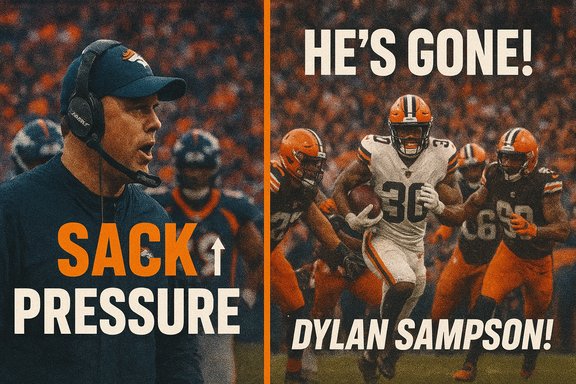
Sean Payton’s short, matter‑of‑fact briefing after the Broncos’ bye — “We are in a position to compete for seeding” — set the tone for a franchise that has remade itself around relentless defensive pressure, while a rising rookie highlight from Cleveland — the team’s “Call of the Game” exclaiming, “He’s gone! Dylan Sampson!” — underscored how quickly a single explosive play can change a locker room and a fan narrative. Both clips, produced by their respective clubs and distributed as short-form video, do what modern team media is designed to do: summarize a mood, advance a storyline, and give coaches and fans shareable, teachable moments to rally around.
The two team-produced videos arrive at very different moments. For the Broncos, the post‑bye message from head coach Sean Payton follows a stretch of sustained success driven largely by Denver’s defensive unit; the team has posted a multi‑game winning streak and sits near the top of the AFC standings, a fact teams and national outlets have confirmed in game recaps and statistical roundups. For the Browns, the short “Call of the Game” clip captures an individual highlight — the stadium announcer and broadcast team moment that becomes a micro‑narrative: a rookie making a splash, a bench erupting, a fan moment that then lives on social platforms and highlight reels. The Browns’ own roster pages and mainstream rosters identify Dylan Sampson as a 2025 fourth‑round rookie running back out of Tennessee who has immediately drawn attention in Cleveland’s backfield rotation. This feature unpacks both pieces of team content, explains the factual load‑bearing claims that can be verified independently, assesses the tactical and roster implications, and flags the caveats — what the clips show well and what they’re not designed to prove.
Use the clips the way coaches use practice film: isolate the teachable part, convert it to drills, track the metrics that matter, and verify the big claims with independent data feeds. When team video and external analytics point in the same direction, the narrative is credible; when they diverge, treat the highlight as a coaching moment, not an immutable truth.
Source: Denver Broncos HC Sean Payton after Broncos' bye: 'We are in a position to compete for seeding'
Source: Cleveland Browns "He's Gone! Dylan Sampson!" Call of the Game - Week 12 vs. Raiders
 Background / Overview
The two team-produced videos arrive at very different moments. For the Broncos, the post‑bye message from head coach Sean Payton follows a stretch of sustained success driven largely by Denver’s defensive unit; the team has posted a multi‑game winning streak and sits near the top of the AFC standings, a fact teams and national outlets have confirmed in game recaps and statistical roundups. For the Browns, the short “Call of the Game” clip captures an individual highlight — the stadium announcer and broadcast team moment that becomes a micro‑narrative: a rookie making a splash, a bench erupting, a fan moment that then lives on social platforms and highlight reels. The Browns’ own roster pages and mainstream rosters identify Dylan Sampson as a 2025 fourth‑round rookie running back out of Tennessee who has immediately drawn attention in Cleveland’s backfield rotation. This feature unpacks both pieces of team content, explains the factual load‑bearing claims that can be verified independently, assesses the tactical and roster implications, and flags the caveats — what the clips show well and what they’re not designed to prove.Broncos: “We are in a position to compete for seeding” — what Payton’s message actually means
The short version
Sean Payton’s public posture after the bye — framed in team video as confidence about playoff seeding — is a predictable, disciplined message from a coach whose team has surged by leaning on defense, situational special teams and game‑management offense. The underlying justification is clear: Denver has translated pressure and sacks into wins at a historically high rate this season, and the team’s recent film‑room and highlight packages make a deliberate case for that identity.The context: wins, timing, and seeding math
- The Broncos’ recent stretch of victories — including narrow, late‑game finishes — has placed them in control of the AFC West and on the cusp of one of the top seeds in the AFC. Independent game recaps document late‑game field‑goal winners and comeback drives that show the team winning a variety of close games, the kind of outcomes that matter for tiebreakers and playoff seeding.
- Payton’s phrase “compete for seeding” is not a promise of home‑field; it’s a positioning statement that acknowledges the work left to do. In practice this signals the front office and players that the coach expects focus on incremental gains (winning the next game, staying healthy) rather than public scoreboard crowing.
The defensive case that supports Payton’s claim
Two measurable trends anchor Payton’s optimism:- Elite pressure and sack production. Multiple independent trackers and team compilations place Denver at or near the league lead in sacks and pressures; team highlight reels have even stitched an “All 49” montage for the season’s first 11 games, using 49 sacks as an attention‑grabbing metric. That production has real, measurable effect on opponent efficiency.
- Situational defense and red‑zone toughness. Film breakdowns and game recaps repeatedly point to goal‑line stops, third‑down denials and late‑game field‑position plays that turn pressure into points saved — arguably as valuable as points scored in a season of close margins.
Why the claim is credible (and supported)
- Multiple independent outlets track the Broncos’ pressure metrics, and most show Denver among league leaders in pressure rate and sack totals; those numbers align with what team video is dramatizing.
- Game recaps confirm the on‑field results Payton points to: late wins built on defensive stops and special‑teams reliability.
Why the claim needs cautious reading
- Small‑sample risk: high sack and pressure totals through the first third of a season are powerful indicators, but opponents will adapt. Quick game plans, max‑protect looks, rollouts and high‑percentage quick passing are standard countermeasures to sustained pressure; sustainable success requires rotation depth and strategic counter‑adjustments.
- Injuries and workload: pass‑rush production is fragile to injuries, and heavy snap loads create late‑season fatigue risks. The qualitative film work that teams publish (showing a handful of highlight sacks) is pedagogical rather than definitive about long‑term resilience.
Tactical implication for opponents and the Broncos
- Opponents: expect more quick throws, RPO counters, and schematic adjustments to blunt edge timing; teams will also test Denver’s interior gap discipline by attacking the run and using motion to create protection confusion.
- Broncos: must demonstrate adaptability — mixing stunt packages with disguise, rotating rushers to keep legs fresh, and leveraging turnovers created by pressure into sustainable scoring margins.
The Broncos’ media play: teaching moments and fan messaging
Film rooms as content and coaching tool
The Broncos’ short film segments (Atwater breakdowns, “All 49” montages) function on three levels:- Fan engagement: high‑energy highlight reels keep a narrative — “this team gets after the quarterback” — alive across casual social feeds and highlight pages.
- Coaching shorthand: freeze frames, schematic overlays and frame‑by‑frame commentary convert an emotional highlight into drillable technique.
- Narrative framing for the front office: packaging a season’s worth of sacks visually strengthens a public case that defensive personnel (and coordinators) are delivering measurable results, which has roster and contract implications.
What the team videos do well
- They isolate repeatable mechanics (stunt timing, interior push, edge bend) and pair them with data-based claims, converting spectacle into teachable content.
- They provide a shareable narrative that helps sustain fan attention during bye weeks and between tough travel stretches.
What they don’t prove
- Team highlights are selective: they present success, not failure. Analysts should pair film with snap‑by‑snap metrics (pressure rate, clean‑pocket percentage, snap rotation) before pronouncing season‑long dominance.
Cleveland Browns: “He’s gone! Dylan Sampson!” — rookie moment, public storytelling
The clip and the player
The Browns’ short “Call of the Game” piece celebrates a single explosive play called “He’s Gone! Dylan Sampson!” on the Week 12 highlight reel. That exclamation is classic broadcast theater — a single play designed to punctuate a narrative arc: rookie makes big play, fans roar, bench erupts. Cleveland’s roster pages and major outlets confirm Dylan Sampson’s background: a Tennessee product, selected in the 2025 fourth round (No. 126) and immediately integrated into Cleveland’s rotation.Why short highlights matter for rookies
- Roster cachet: a nationally played highlight instantly raises a rookie’s profile, which matters for how coaches distribute snaps and for local marketing.
- Confidence and chemistry: a single big play can alter in‑game decisionmaking, encouraging coaches to trust a player in high‑leverage situations.
- Fan perception: teams that showcase rookie flashes accelerate fan attachment and social sharing.
What we can verify independently
- Sampson’s draft pedigree and team status are publicly listed on the Browns’ official roster page and mainstream stat pages, confirming he is an active member of the Browns’ backfield mix.
- Pre‑draft scouting reports and post‑draft analysis characterize Sampson as a compact, powerful runner with high contact balance and strong stop‑start ability — traits that explain why a single long run or cutback highlight generates an “He’s gone!” call.
The limitations of a highlight reel as evidence
- A single play does not prove consistent NFL effectiveness. Rookies require volume, multi‑game context, pass‑proficiency in protection, and ball security to earn a long‑term role.
- Teams often package highlight calls for maximum shareability; they’re a promotional tool as much as an analytic artifact.
Cross‑cut: what both clubs’ videos reveal about modern team media and roster strategy
Shared patterns
- Both teams use short, high‑production video to narrativize technical football moments. Whether it’s Payton’s measured playoff framing or the Browns’ ecstatic “He’s gone!” call, the videos compress a complex reality into a digestible emotional or instructional takeaway.
- Teams link performance narratives to measurable data points: Denver displays sack totals and pressure metrics; Cleveland highlights a standout play and a rookie’s pedigree. This combination of film and metric is designed to satisfy both fan emotion and analytical curiosity.
Tactical and editorial strengths
- For coaches: short, annotated clips are excellent drill blueprints — they isolate the “what” and the “why” and allow quick translation to practice reps.
- For editors: these clips are low‑cost, high‑engagement content that feed social timelines and keep team narratives current.
Risks and fragilities (both teams)
- Highlight bias: clips show success, not the missing reps or failed variations.
- Data‑snapping: relying on a single provider’s pressure or sack definition can exaggerate a claim; cross‑provider checks are necessary for firm editorial conclusions.
- Market impact: team content that strongly markets individual players (or defensive dominance) can affect public perception and even contract negotiations in subtle ways if not grounded in balanced metrics.
Practical takeaways for fans, analysts, and coaches
- For fans searching keywords or snippets: use team video as a starting point — it’s a concise, entertaining primer — but verify with box scores and play‑by‑play if you want accurate stat context. Example searches that will get useful hits: “Broncos pass rush 49 sacks Week 11,” “Bo Nix game‑winning drive vs Texans,” “Dylan Sampson Browns rookie highlight.”
- For beat writers and podcasters: treat team video as a primary source for quotes and posture, but corroborate load‑bearing numbers (sacks, pressure rates, game outcomes) with at least two independent analytics providers.
- For coaches and position‑room staff: convert the film snippets into 10‑rep practice blocks (protection clarity, stem vs linebacker, contested‑catch drills, edge finish mechanics) and track results with a metrics dashboard that includes protection grade, contested‑catch success, and pressure‑to‑sack conversion.
Verification, caveats, and unresolved claims
- The Broncos’ defensive surge (listed as 49 sacks through 11 games) is corroborated by team compilations and independent outlets and is a major load‑bearing fact supporting Payton’s seeding claim. Multiple independent write‑ups place Denver among league leaders in pressure and sack totals.
- Payton’s exact phrase “We are in a position to compete for seeding” originates in the Broncos’ official post‑bye video; a team’s own footage is authoritative for what the coach said, but independent national wire coverage did not spotlight that specific line as a standalone headline in the same way it highlighted game outcomes and stats. Treat direct manufacturer quotes from team videos as primary material; if pressing for wider confirmation, request the team or a league transcript publication.
- The Browns’ “He’s Gone! Dylan Sampson!” call reflects a discrete broadcast moment and the team’s highlight edit; it is an excellent public relations and fan‑engagement artifact, but it should not be used to imply season‑long production until Sampson’s usage and snap rate are evaluated across games. Roster pages and draft coverage confirm his background and rookie status.
Conclusion
Team videos — Sean Payton’s post‑bye optimism for Denver and Cleveland’s exuberant “He’s gone!” call for Dylan Sampson — do two things well: they capture the emotional condition of a team and package technical football into a narrative that is easy to share and act on. For Broncos fans, Payton’s message is defensible: the team has produced elite pressure metrics and game outcomes that place it squarely in the playoff seeding conversation. For Browns fans, the Sampson highlight is the kind of rookie splash that accelerates attention and can influence usage. Both forms of content should be read as evidence not proof — useful starting points for analysis, not the final say.Use the clips the way coaches use practice film: isolate the teachable part, convert it to drills, track the metrics that matter, and verify the big claims with independent data feeds. When team video and external analytics point in the same direction, the narrative is credible; when they diverge, treat the highlight as a coaching moment, not an immutable truth.
Source: Denver Broncos HC Sean Payton after Broncos' bye: 'We are in a position to compete for seeding'
Source: Cleveland Browns "He's Gone! Dylan Sampson!" Call of the Game - Week 12 vs. Raiders
