

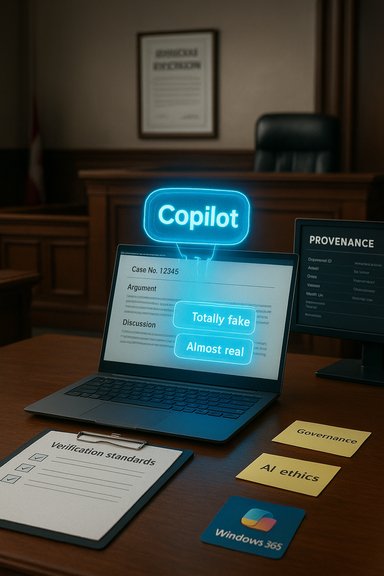
Buchalter escaped formal court sanctions after a federal judge in Oregon concluded the firm’s remedial steps were sufficient when one of its associates filed a brief that included two AI‑generated — or “hallucinated” — case citations, one of which the judge called “totally fake” and the other “almost real.” The episode crystallizes a fast‑moving collision between generative AI assistants and the legal profession’s obligations of competence, candor and document verification, and it offers a practical cautionary tale for any organization adopting AI copilots in regulated, high‑stakes workflows.
Generative AI tools such as Microsoft 365 Copilot and other large‑language‑model assistants are now integrated into mainstream drafting environments, and lawyers increasingly use them for wordsmithing, summarization and ideation. Those features speed routine work but can also produce convincing yet fabricated content — hallucinations — that mimic legal authorities and citations. Courts across the U.S. and abroad have already confronted filings that included AI‑invented cases, and judges are responding by testing whether firms exercised appropriate supervision, verification, and governance. The Buchalter episode involves Green Building Initiative Inc. (GBI) and its trademark dispute with Green Globe Limited. A filing supporting interim attorney fees included two problematic citations; in an October 27 order the court ordered the attorneys to show cause why sanctions should not be imposed for the inclusion of the erroneous authorities. One citation was characterized by the court as entirely fabricated and the other as mischaracterized; the judge asked the attorneys to explain the mistake and propose an appropriate remedy.
Recent legal incidents — from the B.C. tribunal that found nine of ten AI‑generated precedents were false to U.S. cases where judges were nearly misled by fabricated citations — show a pattern. Organizations that treat AI as a productivity hack without governance are exposing themselves to reputational, ethical and legal harms.
Generative AI will continue to reshape productivity. The professional response must be to capture the efficiency benefits while hardening verification and governance so that a helping hand doesn’t become a liability. The Buchalter case is a useful example of the remedy path — immediate transparency, process remediation, verified technical controls, and focused training — but it should also be a warning: courts are watching, and verification remains the lawyer’s last and most important duty.
Source: ABA Journal Buchalter escapes sanctions after associate who used AI for 'wordsmithing' takes blame for hallucinations
 Background
Generative AI tools such as Microsoft 365 Copilot and other large‑language‑model assistants are now integrated into mainstream drafting environments, and lawyers increasingly use them for wordsmithing, summarization and ideation. Those features speed routine work but can also produce convincing yet fabricated content — hallucinations — that mimic legal authorities and citations. Courts across the U.S. and abroad have already confronted filings that included AI‑invented cases, and judges are responding by testing whether firms exercised appropriate supervision, verification, and governance. The Buchalter episode involves Green Building Initiative Inc. (GBI) and its trademark dispute with Green Globe Limited. A filing supporting interim attorney fees included two problematic citations; in an October 27 order the court ordered the attorneys to show cause why sanctions should not be imposed for the inclusion of the erroneous authorities. One citation was characterized by the court as entirely fabricated and the other as mischaracterized; the judge asked the attorneys to explain the mistake and propose an appropriate remedy. What happened at Buchalter: the facts the court relied on
- Senior associate David Bernstein prepared the filing and acknowledged that he used an AI assistant — identified in briefs as Microsoft Copilot — for wordsmithing after performing his own legal research. He says he pasted portions of his brief into the tool and asked it to improve the writing; the tool returned an edited draft in which two citations appeared that he had not verified before filing. Bernstein accepted responsibility and informed the court he had failed to conduct a full review of the final product.
- The court explained that one of the cited authorities “is totally fake” and the other is “almost real” because a case with a similar caption exists but not in the federal reporter or with the legal holdings attributed in the filing. The judge issued an order to show cause and invited proposed sanctions.
- In response, Buchalter described internal policy that already restricts generative AI use, pledged steps to strengthen verification and training, offered to write off attorney fees attributable to the faulty filing, blocked unauthorized AI products on firm computers, and proposed continuing legal education and a donation of $5,000 to a local legal‑aid campaign. The judge found those remedial actions sufficient and declined to impose formal sanctions.
Why this matters: the legal and professional stakes
The episode is important for three reasons:- Courts treat citations and authorities as core elements of a lawyer’s duty of candor and competence. Submitting false authorities — even inadvertently — can trigger Rule 11 show‑cause proceedings, monetary sanctions, or professional discipline when the failure reflects poor verification rather than a genuine, isolated clerical mistake. Recent precedents show courts will not hesitate to sanction when verification was plainly lacking.
- AI hallucinations are not edge cases. Generative systems are designed to produce plausible, fluent text, and when asked to polish or rewrite legal language they can invent citations or attribute holdings to cases that do not exist. The result is uniquely dangerous in legal filings, where opposing counsel and judges reasonably expect verifiable sources. The B.C. condo decision and earlier U.S. sanctions against attorneys for AI‑generated fabrications demonstrate the recurring nature of this risk.
- The remedy the court accepted — remediation, training, and process changes — highlights a practical path for firms to avoid the worst consequences, but it does not remove the underlying risk. Courts will look at both the error and the adequacy of the firm’s response when deciding whether to punish. That means firms cannot treat governance as optional or performative.
How AI produced the error (technical mechanics, explained plainly)
Generative language models are statistical pattern predictors, not databases of verified facts. When asked to rewrite, edit or “improve” a passage, an assistant predicts words and phrasings likely to follow, using training data that includes legal texts. That prediction process can produce:- Completely fabricated case names and reporters that look genuine because the model has learned citation patterns (party names, reporters, year), and it blends fragments from training examples into plausible but false citations.
- Mis‑attribution of holdings: the model may pair a correct case name with an incorrect holding or quote.
- Overconfident outputs: the assistant often produces authoritative language without flagging uncertainty or provenance, so a human editor may not suspect a problem if the output appears credible.
What Buchalter did right — and why the court accepted it
The judge’s decision to decline formal sanctions rested on several responsive actions by Buchalter:- Immediate acceptance of responsibility by the drafting attorney and a transparent explanation to the court that the insertion of the citations occurred during use of an AI editing tool.
- A commitment to firm‑level governance: the firm pledged to block unauthorized AI on firm devices, educate attorneys on the proper use of generative AI, and require supervisory verification of AI‑sourced content.
- Concrete remediation: writing off attorney fees tied to the defective filing, requiring the associate to undertake CLE focused on AI, and a small charitable donation as an expression of accountability.
Notable strengths in the firm’s response — lessons for others
- Transparency and accountability. The attorney’s immediate admission and the firm’s open remedial plan reduced the court’s need to deploy punitive tools to secure corrective behavior.
- Operational fixes targeted at root causes. Blocking unauthorized AI endpoints, rewriting policy, and mandating human verification address the vector that produced the error: shadow AI use without verification.
- Education and deterrence, not just punishment. Requiring CLE and internal training recognizes that the risk is behavioral and procedural; remediation must change habits, not merely write a check.
The limits and risks of the court’s approach — why caution remains necessary
While the court declined to impose sanctions, the decision is not a blanket comfort for careless AI use. Key caveats:- Remediation today does not immunize tomorrow. A future filing with similar errors — especially after a prior show‑cause — could prompt a court to impose sanctions or refer matters for disciplinary investigation. Courts will weigh repeat behavior and the rigor of implemented safeguards.
- Verification burden is real and costly. Mandating that lawyers verify every AI‑suggested citation or factual assertion imposes a time and manpower cost that can erode the productivity gains sought through AI adoption. If firms do not redesign workflows to absorb verification effort efficiently, the risk of errors may increase due to rushed checks.
- Shadow AI persists. Banning Copilot on managed devices does not stop staff from using personal devices or consumer tools; governance must be paired with culture, monitoring and consequences for noncompliance.
Practical checklist: how law firms and Windows‑centric IT teams should respond now
The Buchalter episode provides a concrete checklist that firms and enterprise Windows administrators should adopt immediately.- Policy and procurement
- Require written policy that defines permitted AI tools and forbids consumer tools for matter content unless expressly authorized.
- Insist on contractual protections from vendors (no‑retrain/no‑use clauses for matter data, exportable logs, deletion guarantees, SOC/ISO attestations).
- Technical controls (Windows + Microsoft 365 environments)
- Enforce Conditional Access and Multi‑Factor Authentication for Copilot features.
- Deploy Endpoint Data Loss Prevention (DLP) to block paste actions from secure documents into public model endpoints.
- Configure tenant grounding and Purview retention so Copilot processes tenant data under enterprise control and with auditable logs.
- Workflow and supervision
- Mandatory human‑in‑the‑loop verification checklists for any output that will be filed externally.
- Role‑based training and competency attestations for signatories.
- Audit trails: capture prompts, model version, user ID, timestamp for high‑stakes outputs.
- Training and culture
- Mandatory CLE modules on prompt hygiene, hallucination recognition and verification standards.
- Encourage junior lawyers to run independent research and treat AI outputs as first drafts only.
- Incident playbook
- Predefine remediation steps: notifications, fee write‑offs, client communications, vendor incident reporting and internal discipline thresholds.
- Maintain an escalation path to GC and ethics counsel for show‑cause orders or disciplinary inquiries.
Technical options to reduce hallucination risk in practice
- Use grounded retrieval‑augmented generation (RAG) workflows that require the assistant to cite documents from a firm‑controlled, indexed corpus rather than generating citations from pattern completion alone.
- Require the assistant to display provenance metadata (source document, snippet location, trustworthy reporter) inline before any citation may be used in a filing.
- Only permit AI editing features that produce non‑authoritative language (e.g., grammar or clarity suggestions) rather than aggressive rephrasing that can introduce new factual claims or citations.
- Lock integrations: do not permit external web grounding or non‑tenant connectors for matters involving PII or privileged information.
Broader context: this is not just a law‑firm problem
Courts, regulators and standards bodies are increasingly focused on provenance, audit trails and responsible AI use. Public sector agencies, universities and corporations operating within Microsoft ecosystems face comparable risks: Copilot features integrated into Windows and Office can surface incorrect facts into official documents or policy work if left unchecked. The law‑firm experience is a leading indicator: where accuracy matters, organizations must adopt verifiable AI architectures and enforce human checkpoints before external dissemination.Recent legal incidents — from the B.C. tribunal that found nine of ten AI‑generated precedents were false to U.S. cases where judges were nearly misled by fabricated citations — show a pattern. Organizations that treat AI as a productivity hack without governance are exposing themselves to reputational, ethical and legal harms.
What to watch next: regulatory and professional trends
- Bar authorities and courts will continue to update guidance on acceptable AI use in legal practice. Expect mandatory verification rules, disclosure obligations and possible reporting requirements for AI‑assisted filings.
- Standards efforts (for provenance, watermarking and auditability) are accelerating; adoption of machine‑readable provenance may become a de facto requirement for high‑stakes legal drafting.
- Vendors will compete on governance features (tenant grounding, no‑retrain guarantees, exportable logs). Procurement teams should make these a core selection criterion.
- Firms that meaningfully invest in training, human verification and engineering controls will preserve productivity gains while reducing sanction risk. Those that don’t will face increasing regulatory and judicial scrutiny.
Conclusion
The Buchalter order — a judge declining formal sanctions after remedial commitments — is a pragmatic outcome that recognizes the difference between a single human error and systemic misconduct. But it is not a technical endorsement of free‑wheeling AI use in legal work. The episode should prompt every law firm and Windows‑based enterprise to move from permissive experimentation to disciplined operation: define permitted AI tools, enforce tenant and endpoint controls, require human verification, log prompts and responses, and invest in training.Generative AI will continue to reshape productivity. The professional response must be to capture the efficiency benefits while hardening verification and governance so that a helping hand doesn’t become a liability. The Buchalter case is a useful example of the remedy path — immediate transparency, process remediation, verified technical controls, and focused training — but it should also be a warning: courts are watching, and verification remains the lawyer’s last and most important duty.
Source: ABA Journal Buchalter escapes sanctions after associate who used AI for 'wordsmithing' takes blame for hallucinations
