

Microsoft used BUILD 2012 to drive a single message home: the company is reshaping Windows — from kernel to store to devices — and it will pay developers to come along for the ride.
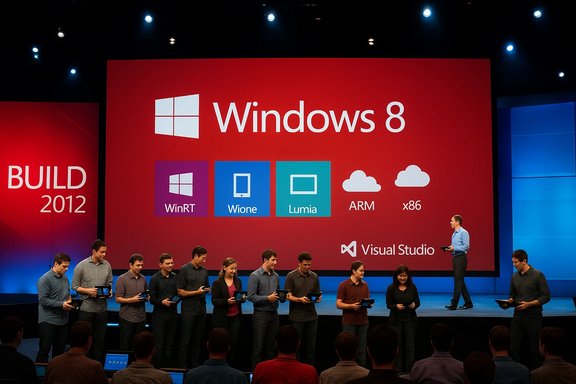
Microsoft staged BUILD 2012 on its Redmond campus in late October 2012 as the company’s big developer push around a wave of product launches: Windows 8 had reached consumers, Office 2013 was moving to release-to-manufacturing, and Windows Phone 8 was being introduced as the mobile sibling to the new desktop OS. BUILD’s Day 1 keynote emphasized platform convergence — a shared developer model (Visual Studio + new SDKs), a new Windows Runtime (WinRT) app model, the Windows Store as a commercial channel, and hardware that would demonstrate the vision (Surface RT, partner phones). BUILD’s headline “giveaway” was literal: conference attendees received a 32 GB Surface RT with Touch Cover and a Nokia Lumia 920, plus 100 GB of SkyDrive storage — an expensive incentive intended to seed devices into developer hands. Microsoft also temporarily cut the Windows Phone developer registration fee from the standard $99 to a promotional $8 for a limited window following the event. Those moves were designed to remove friction for developers and accelerate early app development and testing on the new Windows and Windows Phone platforms.
Microsoft’s advantages were and remain:
Source: BetaNews BUILD is back!
 Background / Overview
Microsoft staged BUILD 2012 on its Redmond campus in late October 2012 as the company’s big developer push around a wave of product launches: Windows 8 had reached consumers, Office 2013 was moving to release-to-manufacturing, and Windows Phone 8 was being introduced as the mobile sibling to the new desktop OS. BUILD’s Day 1 keynote emphasized platform convergence — a shared developer model (Visual Studio + new SDKs), a new Windows Runtime (WinRT) app model, the Windows Store as a commercial channel, and hardware that would demonstrate the vision (Surface RT, partner phones). BUILD’s headline “giveaway” was literal: conference attendees received a 32 GB Surface RT with Touch Cover and a Nokia Lumia 920, plus 100 GB of SkyDrive storage — an expensive incentive intended to seed devices into developer hands. Microsoft also temporarily cut the Windows Phone developer registration fee from the standard $99 to a promotional $8 for a limited window following the event. Those moves were designed to remove friction for developers and accelerate early app development and testing on the new Windows and Windows Phone platforms. What changed at BUILD 2012 — the technical essentials
WinRT, Modern UI, and a new app model
- WinRT (Windows Runtime) introduced a new, language-agnostic API surface that Microsoft intended to support development in C++, C#, Visual Basic and HTML/JavaScript. WinRT’s object model, metadata, and projections were built to let developers reuse skills across devices and enable richer apps that fit the Modern UI (formerly Metro) design language. WinRT was presented as the fundamental building block for the Windows Store app ecosystem.
- The Windows Store replaced traditional distribution channels for consumer-facing apps, and Microsoft positioned it as a primary route to monetization — with simplified terms and broad reach across Windows 8 and Windows RT devices. Visual Studio tooling and the developer SDKs were the gate to build and submit to that store.
Kernel, hardware and platform hardening
- Windows 8 introduced several platform-level changes that affect developers and IT pros: UEFI/Secure Boot requirements for certified devices, stronger driver-signing expectations, and an emphasis on app sandboxing for Store apps. Together, these moves tighten the platform’s chain of trust and limit the vectors by which low-level code can alter the system, which is often characterized as a more locked-down kernel. While “locked down” is a simplification, Secure Boot plus stricter driver signing and sandboxed Store apps did raise the bar for attackers — and for developers who need low-level access.
ARM and Windows RT
- For the first time Microsoft shipped an ARM-based Windows variant — Windows RT — accompanied by Surface RT hardware. WinRT-style apps ran across ARM and x86 devices, but many traditional Win32 desktop apps would not run on ARM, creating a split: desktop Windows (x86/x64) and Windows RT (ARM) with different app compatibility. That forced developers and enterprises to re-evaluate how to target multiple device classes.
Cloud integration: Office 365, Skype and services-first thinking
- Microsoft used the moment to emphasize cloud-connected scenarios. Office 2013 and Office 365, Skype integration and SkyDrive (100 GB offers for attendees) were presented as hooks into service-based workflows. The aim was to bind productivity, communications, and storage into the OS and app model so developers could build experiences that span devices and the cloud. Office 2013 itself had reached release-to-manufacturing by October 2012 and was being staged to wide availability in early 2013.
Why Microsoft doubled down on developer incentives
BUILD 2012’s giveaways, discounted developer registrations and early-device distribution were not marketing theater alone — they were tactical responses to market realities.- The smartphone and tablet ecosystem had already shifted developer attention away from Windows-only strategies. IDC and Gartner research at the time pointed to rapidly rising mobile web usage and multi‑OS enterprise realities: mobile devices were expected to become the primary web access point in many markets, and enterprises were preparing to support multiple OSes. Microsoft needed to reframe Windows as a viable cross-device platform to retain developer mindshare.
- Free hardware in developer hands accelerates early app creation and gives developers physical platforms to test device-specific scenarios (camera, sensors, touch, connectivity). Cutting the barriers to Dev Center (temporary $8 registration) made it dramatically cheaper for hobbyists and small shops to publish — a classic “bootstrap the catalog” tactic to populate the Store early.
The business case for developers — opportunity and reality
Steve Guggenheimer’s core pitch at BUILD was blunt: Windows still represents a huge addressable market because of existing PC shipments and enterprise reach, and the Windows Store’s economics can be attractive. The company argued developers could reuse skills and, in some cases, code between Windows 8 and Windows Phone 8, shortening time-to-market. Strengths for developers:- Large installed base of Windows users on desktops and laptops — a viable audience for paid productivity and enterprise apps.
- Unified tooling in Visual Studio and shared API surfaces (where possible) to reduce porting effort.
- Store-driven monetization for consumer apps with Microsoft handling payments, updates, and some degree of discoverability.
- Platform fragmentation between Win32 desktop apps, WinRT Store apps and Windows RT ARM devices complicated product planning. Not all app types were suitable for the Store model; some system-level tooling still required desktop capabilities that the Store sandbox forbade.
- Ecosystem competition: iOS and Android already had strong consumer storefronts, established developer communities, and monetization models. Microsoft’s late arrival meant it had to incentivize migration and overcome developer inertia.
Enterprise and IT implications
BYOD, multi-OS support and manageability
Analysts and Microsoft both stressed that enterprises were moving toward environments where multiple OSes would be supported simultaneously. Gartner and IDC forecasts cited at the time suggested that by mid‑decade many organizations would support several platforms, and mobile-first access patterns would force IT to adopt new management and security tools. Microsoft’s argument: Windows’ enterprise management heritage and integration with server products gave it advantage when it came to manageability and data-protection scenarios.Security and compliance trade-offs
- Secure Boot, driver policies, and sandboxing were security wins but also operational changes. Imaging, driver deployment, and firmware updates for Surface/Windows RT demanded new processes and careful testing — firmware changes are not easily rolled back. Enterprises needed to update deployment playbooks and revalidate hardware compatibility for specialized peripherals.
The PR play: free hardware, cheap publishing and the optics of momentum
Giving developers Surface RT tablets and Lumia 920 phones was expensive — and intentional. It created immediate buzz, illustrated Microsoft’s belief in its hardware partners, and ensured developers could prototype on the very devices Microsoft wanted in market. Analysts and attendees called it a huge recruitment play; Redmond absorbed the cost of incentivizing developer mindshare in the short term to build a catalog and marketplace that could pay dividends later. The temporary $8 developer registration was more than a PR stunt: it removed a psychological and financial barrier for developers evaluating the ROI of publishing to a new store. That limited-time discount was explicitly promotional and time‑boxed, designed to convert attendees and early adopters into published apps quickly.Critical analysis — strengths, blind spots and risks
Strengths
- Coherent long-term narrative: Microsoft tied client, cloud, and server together — Windows 8/Phone 8 + Office 2013 + Windows Server 2012 — and framed development as an opportunity to reach users across scenarios.
- Strong tooling: Visual Studio, established Windows development patterns and Microsoft’s enterprise relationships gave developers a familiar, productive toolchain.
- Immediate device availability: Putting hardware in developers’ hands solved a real friction point: if developers couldn’t access devices, they couldn’t build native apps that took advantage of sensors and OEM capabilities.
Blind spots and risks
- Fragmentation still real: The split between Win32 desktop apps and WinRT Store apps left many developers uncertain which path to prioritize. Not all desktop code could be easily ported to WinRT; certain enterprise-class apps would never fit into the Store sandbox. The promise of “reuse” was real in limited scenarios but not universal.
- Platform perception lag: Many developers had already invested heavily in iOS/Android ecosystems; persuading them to build for a still‑nascent Windows Store required more than free devices. The limited availability of consumer apps early on reduced perceived value for users and developers alike.
- Hardware dependency and update complexity: UEFI/Secure Boot, firmware updates and driver-signing introduced new deployment complexity. Enterprises and ISVs that relied on specialized drivers or boot-time customizations faced additional validation and support burden.
- Temporary incentives are temporary: Discounts and giveaways accelerate early catalog growth but create a risk of short-termist behavior: a flood of low-effort apps to capture initial downloads, followed by poor retention if consumer demand doesn’t meet expectations.
Market reality checks
- IDC’s forecasts about mobile web usage and the broader “Great PC Exodus” were accurate in trend (mobile access rose sharply), but the enterprise space proved more resistant: many business workflows still relied on desktop software, and corporate inertia slowed full mobile migration. That mixed reality meant Microsoft’s bet on hybrid desktop-cloud-device scenarios had both upside and real operational friction.
For developers: practical playbook
- Prioritize target scenarios. Decide whether your app is a consumer Store app, a desktop productivity tool, an enterprise management utility, or a combination. Each class maps to different technical constraints and distribution channels.
- Use Visual Studio and the SDKs to prototype WinRT apps where the app can benefit from touch, live tiles and cloud integration; use shared libraries and RESTful services to maximize reuse between Windows 8 and Windows Phone 8.
- Test on real hardware early. If your users will be on ARM/Windows RT devices, validate behavior early — not all native code or drivers are compatible with ARM.
- Design for store discoverability and retention. Promotions and featured placement can be fleeting; product-led growth depends on quality, updates, and analytics-driven improvement.
- Plan enterprise deployment carefully. If targeting corporate customers, ensure your packaging, install/management story (MDM, SCCM, volume licensing) matches IT expectations and test firmware/UEFI interactions.
How to evaluate Microsoft’s claims and what to watch
Microsoft’s message at BUILD — platform commonality and a monetizable Store — was supported by concrete actions (tooling, device distribution, temporary registration discounts). Independent reporting and Microsoft’s own press materials validate the central facts: Windows 8’s consumer launch on October 26, 2012; Windows Phone 8’s unveiling on October 29, 2012 with devices shipping in November; Office 2013’s release-to-manufacturing milestone in October 2012; and the BUILD attendee device and registration incentives. Those facts are verifiable in contemporaneous press releases and reporting. Caveat: when Microsoft framed the developer opportunity as “reusable code and common APIs,” that was accurate for certain workloads (HTML/JS apps, C#/XAML scenarios) but not universal — some system-level and legacy desktop apps remained outside WinRT’s remit. Developers should verify technical fit with the available SDK docs and the Windows Runtime Q&A coverage from Build sessions.Longer-term implications (retrospective and strategy)
BUILD 2012 represents a textbook example of platform vendor strategy: align tooling, seed hardware, reduce friction to attract developers, and then hope store economics plus enterprise reach deliver sustained developer revenue. The event also underscores a fundamental truth of platform transitions — they are expensive, noisy, and long-running.Microsoft’s advantages were and remain:
- Deep enterprise relationships and deployment expertise.
- A massive legacy desktop install base that creates near-term demand for compatibility solutions and migration tooling.
- Ability to bundle cloud services (Office 365, Skype, OneDrive) into a coherent developer story.
- Convincing a generation of mobile-first developers to invest time in a platform that was late to the consumer app storefront party.
- Managing the complexity of multiple device architectures (ARM vs x86) and app models (Win32 vs WinRT).
- Ensuring the Store and discovery mechanics mature to a level that sustains paid developer businesses.
Conclusion
BUILD 2012 was less a single-day keynote than a multi-pronged strategy deployment: product cadence (Windows 8, Windows Phone 8, Office 2013), developer outreach (giveaways and discounted publishing), and a reimagined platform architecture (WinRT, Windows Store, ARM support). Those moves were intended to jump-start an ecosystem that had begun to fragment under the combined pressure of iOS, Android and cloud-first architectures. The incentives — free Surface RT tablets and Lumia 920 phones, temporary low-cost developer registration — were bold, costly and effective at generating short-term attention. The longer-term test, however, lay in whether the Store, tooling, and enterprise scenarios would produce durable developer economics and deliver the kind of user reach that turns initial curiosity into sustained app ecosystems. Microsoft provided the scaffolding; the developer community and enterprise buyers would decide if the structure was worth inhabiting.Source: BetaNews BUILD is back!
