

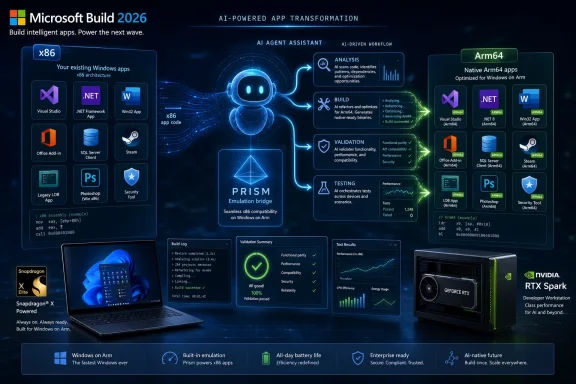
Microsoft will use a June 3, 2026 Build session to show developers how AI agents can help convert and validate x86 Windows applications for native Arm64 execution on Windows on Arm PCs, including Qualcomm Snapdragon X systems and NVIDIA’s new RTX Spark platform. The pitch is not merely that Arm PCs are getting faster; it is that Microsoft wants software migration to become less of a bespoke engineering project and more of an assisted workflow. That is a meaningful shift, because Windows on Arm has never failed mainly on silicon. It has failed whenever users hit the one app, driver, plug-in, anticheat layer, or enterprise dependency that turns “mostly compatible” into “not for me.”
For most of Windows history, the application platform and the processor architecture were effectively fused in users’ minds. Windows meant x86, and x86 meant the enormous back catalog of Win32 software, commercial utilities, drivers, plug-ins, and IT glue that made the PC the PC. Windows on Arm has always asked the market to separate those things.
Microsoft’s Build 2026 session is therefore more than a developer talk about compilers, profilers, and validation tools. It is a statement of strategy: the company believes AI agents can reduce the friction that has kept many developers from treating Arm64 Windows builds as a normal release target. Instead of waiting for every software vendor to prioritize a manual port, Microsoft wants to turn porting into something closer to a guided modernization pipeline.
That does not mean a bot will magically convert decades of C++, installer logic, drivers, copy protection, and hardware assumptions into clean Arm-native code. But it does mean Microsoft is trying to attack the most boring parts of the work: finding architecture assumptions, updating build configurations, chasing compiler errors, running compatibility tests, and validating performance. In software engineering, boring work is often the work that never gets scheduled.
The significance of the session is that Microsoft is no longer selling Windows on Arm only as a consumer experience. It is selling it as a developer workflow problem that can be accelerated, measured, and industrialized. That is a more credible argument than another round of “the apps are coming.”
NVIDIA’s RTX Spark changes that calculation. By tying Arm CPU cores to Blackwell-class graphics, large unified memory configurations, and a workstation-like AI pitch, NVIDIA gives Windows on Arm a new constituency: creators, AI developers, workstation buyers, and possibly gamers who would never have cared about an efficiency-first ultraportable. The platform stops looking like a defensive answer to the MacBook Air and starts looking like Microsoft’s attempt to define a new high-end PC category.
That is why the app story suddenly matters more, not less. A $700 thin-and-light can survive a few caveats if the user mostly lives in a browser, Office, Teams, and media apps. A workstation-class Arm PC cannot. If RTX Spark is meant to attract developers, creators, and technically demanding buyers, then the long tail of Windows software becomes unavoidable.
Microsoft and NVIDIA can talk about emulation, and they should. Prism has become a core part of the Windows on Arm value proposition, and modern emulation is far better than the bad memories left by earlier Windows RT-era experiments. But workstation buyers do not pay premium prices to hear that their tools will probably work adequately through translation. They pay for native performance, predictable compatibility, and confidence.
That is the political value of NVIDIA entering the fight. Qualcomm made Windows on Arm plausible. NVIDIA may make it strategically urgent.
But time-spent metrics can hide the exact pain points that shape purchase decisions. A user may spend 90 percent of the day in native Edge, Teams, Office, Slack, Spotify, Photoshop, or Visual Studio Code, and still be unable to buy an Arm PC because the remaining 10 percent includes a required VPN client, an old accounting package, a CAD plug-in, a USB device utility, a game protected by kernel-level anticheat, or an internal enterprise app compiled with ancient assumptions.
This is the app gap in its most stubborn form. It is not simply a count of missing apps. It is a map of veto points.
A platform does not need every application to be native to succeed. It does need users to believe their personal deal-breakers are covered. That is harder for Windows than it was for Apple during the Mac’s Apple Silicon transition, because Microsoft does not control the Windows hardware stack, enterprise estate, driver ecosystem, or commercial software culture with the same tight grip.
Apple could move the Mac by moving the Mac. Microsoft has to move Windows by persuading everybody else.
The trouble is that emulation is a bridge, not a destination. It is good enough for many applications and surprisingly good for some, but it cannot erase every performance penalty, compatibility issue, driver dependency, or low-level architectural assumption. The deeper an app reaches into the system, the more likely “just emulate it” becomes “not quite.”
Gaming exposes this brutally. A game is not merely a game executable; it can involve launchers, anti-cheat systems, DRM, overlays, input tools, GPU drivers, shader compilers, and services that expect a particular software and hardware environment. Creative and engineering software has similar layers of complexity. Enterprise software may be worse, because it often combines old code, custom installers, security agents, and neglected dependencies that nobody wants to touch until a migration forces the issue.
Native Arm64 builds solve more than raw speed. They signal that the vendor is paying attention. They let developers profile properly, use the right libraries, support the right installers, and test the product as a first-class Windows configuration rather than a compatibility accident.
That is the trust Microsoft is trying to manufacture with AI agents. The company is not saying emulation is obsolete. It is saying emulation alone cannot carry Windows on Arm into the RTX Spark era.
A developer porting an x86 Windows app to Arm64 does not need an AI system to invent a new product. They need help identifying architecture-specific code paths, replacing dependencies, configuring compilers, resolving build failures, generating test cases, checking installer behavior, and validating performance. Those are not trivial tasks, but they are closer to supervised engineering work than open-ended creativity.
The right agent in this context looks less like a magical junior developer and more like an aggressive build engineer that never gets tired. It can inspect a repository, propose changes, run the build, read the errors, try again, and hand the human a diff with a test report. The human still has to understand the product, review the changes, and own the result. But the first mile of the port becomes less intimidating.
That matters because developer prioritization is often psychological as much as technical. If Arm64 support looks like a multi-quarter project with uncertain payoff, it slips. If the initial assessment can be generated in an afternoon, with a credible list of required changes and automated validation steps, it becomes easier to put on a roadmap.
Microsoft’s challenge is to keep the pitch honest. AI can accelerate migration. It cannot make unmaintained code healthy, replace missing third-party libraries, or guarantee that an app with kernel hooks will behave properly on a different architecture. The best version of this strategy is practical and dull: fewer blank pages, fewer yak-shaves, fewer reasons to say no.
That is why the Arm porting session belongs at Build rather than inside a hardware launch. The buyer-facing story is RTX Spark, Snapdragon X, AI PCs, battery life, local models, and performance. The developer-facing story is more basic: here are the tools that make it less painful to support the machines Microsoft and its partners want to sell.
The distinction is important. Windows on Arm has suffered whenever it was presented primarily as a hardware story. Better chips help, but app availability is a coordination problem. Silicon vendors, Microsoft, ISVs, game studios, enterprise developers, security vendors, and peripheral makers all have to move enough of the ecosystem at roughly the same time.
AI agents are Microsoft’s attempt to reduce the coordination cost. They do not solve market demand directly, but they can lower the engineering threshold at which demand becomes worth serving. That is a subtle but important change in platform strategy.
The company is also trying to avoid repeating a familiar Windows mistake: leaving developers to infer the future from hardware announcements. By pairing RTX Spark and Snapdragon X with concrete porting workflows, Microsoft is telling developers that Arm64 Windows is not an experiment they can ignore until the next refresh cycle. It is becoming part of the expected Windows target matrix.
But “good enough” is not the same as inevitable. Qualcomm’s strongest pitch has been mobility. NVIDIA’s pitch is likely to be ambition. RTX Spark is aimed at the kind of local AI, creator, developer, and GPU-heavy workloads that make users ask whether Windows on Arm can be more than a battery-life story.
That is a harder test. High-end users are less forgiving because they have more specialized workflows. They also tend to be the people friends, coworkers, and procurement teams ask for advice. If they hit compatibility walls, the story spreads quickly.
In that sense, RTX Spark raises the stakes for Snapdragon X as well. A broader Windows on Arm ecosystem benefits Qualcomm, because every native app built for Arm64 Windows helps all Arm PCs. But it also changes expectations. Once NVIDIA is in the room, Microsoft cannot let Windows on Arm be perceived as a mostly-Qualcomm side project.
The platform now has to look like Windows’ future, not just one vendor’s bet.
Windows on Arm asks enterprise IT to revisit assumptions buried across years of tooling. Endpoint protection agents, VPN clients, device management extensions, legacy line-of-business apps, printer utilities, browser plug-ins, hardware dongles, custom installers, and scripts may all need testing. Some will work. Some will work through emulation. Some will need vendor updates. Some will reveal that nobody knows who owns the code anymore.
AI-assisted porting can help here, but only if Microsoft meets IT where it actually lives. Enterprises need repeatable validation, reporting, compatibility inventories, and clear failure modes. A developer demo that converts a sample app is useful. A migration program that helps an IT department identify its blockers across thousands of endpoints is transformative.
The most interesting version of Microsoft’s strategy would connect these dots. Imagine combining app inventory, source analysis, dependency mapping, automated Arm64 build attempts, test execution, and deployment readiness into a workflow that gives CIOs a ranked list of what stands between them and Arm adoption. That would not be glamorous. It would sell PCs.
This is also where Microsoft must be careful with its marketing. Saying 90 percent of time is spent in native apps does not answer whether a hospital, law firm, manufacturer, school district, or government agency can move a fleet. The last 10 percent may be where the business actually lives.
Windows has far more hardware diversity, more legacy baggage, and a much broader range of software quality. That breadth is the platform’s strength, but it is also why architectural transitions are so difficult. The PC won because almost everything worked on it. Any new Windows architecture is judged against that impossible inheritance.
Microsoft’s AI-agent strategy is an attempt to cheat the loop. If developers can support Arm64 with less effort, then the app catalog improves before the installed base fully justifies it. If the app catalog improves, users have fewer reasons to avoid Arm PCs. If users buy more Arm PCs, developers have more reason to keep investing.
This is classic platform economics, dressed in 2026 AI clothing. The new part is not the goal. The new part is the tooling Microsoft hopes can compress the timeline.
The danger is overpromising. Developers are already drowning in AI claims, many of them inflated. If Microsoft presents agents as a miracle, serious engineering teams will tune out. If it presents them as a practical way to reduce porting cost, it has a shot.
But the hardest gaming blockers are often not the game engines themselves. Many engines already have cross-platform experience because of consoles, mobile devices, macOS, Linux-adjacent work, or cloud streaming pipelines. The problem is the surrounding ecosystem: anti-cheat, DRM, launchers, overlays, mod tools, input utilities, and kernel-level assumptions that were built around x86 Windows.
That is why Microsoft and NVIDIA’s work with anti-cheat and DRM vendors matters. One blockbuster game running natively is helpful. A major anti-cheat stack supporting Arm64 Windows is leverage. It can unlock many games at once and reduce the burden on individual studios.
Still, gamers are not patient platform evangelists. They do not want architectural nuance; they want the library to work. If RTX Spark machines arrive with impressive hardware and asterisks around major titles, the backlash will be predictable.
Microsoft has seen this movie before. The lesson is that compatibility messaging must be precise. “Runs Windows apps” is a dangerous phrase if users interpret it as “runs every app I care about exactly as my x86 machine does.” The smaller the print, the bigger the disappointment.
But Microsoft’s deeper competitor is inertia. Windows buyers already have machines that run their apps. Enterprises already have deployment images, support practices, and vendor contracts. Developers already have build systems that target x64 by default. Retail buyers already understand Intel and AMD branding more than Arm64 compatibility matrices.
NVIDIA helps because it brings a different kind of gravitational force. Its developer ecosystem, CUDA legacy, AI credibility, gaming brand, and OEM relationships give Windows on Arm a new story that is not merely “like your old laptop, but with better battery life.” The RTX Spark story is “your PC is now a local AI workstation.” That is more ambitious and more expensive, but it also gives developers a reason to care.
Qualcomm helps from the other direction by keeping the everyday laptop case alive. Snapdragon X systems prove that Windows on Arm can be quiet, efficient, and mainstream. NVIDIA can push the high end. Microsoft needs both ends because a platform that only exists in premium AI workstations will not generate enough app pressure, while a platform that only exists in thin-and-light laptops may not excite enough developers.
The competitive question, then, is not whether Arm beats x86 in every benchmark. It is whether Windows becomes architecture-flexible enough that users stop thinking about the instruction set at all.
This is where the company should resist the urge to narrate the story as “AI writes your Arm app.” That framing invites backlash and misrepresents the work. A better framing is that AI can help developers mechanize migration. It can surface problems earlier, automate tedious edits, suggest architecture-safe replacements, and keep validation loops running.
There is also a security and quality dimension. Automatically generated changes to low-level Windows applications need human review, reproducible builds, and test evidence. Enterprises will not accept “Copilot changed it” as a quality process. Nor should they.
If Microsoft wants this to land with serious developers, it needs to show the receipts: before-and-after performance, classes of bugs found, tests generated, build systems supported, languages covered, dependency limitations, and clear boundaries where human engineering remains essential. The credibility of the whole Windows on Arm push depends on this distinction.
AI can be the accelerator. It cannot be the accountability layer.
Snapdragon X raised expectations in 2024 and 2025. RTX Spark raises them again in 2026. Build’s AI porting push suggests Microsoft understands that the next phase is not about proving Arm PCs can exist. It is about proving they can participate fully in the Windows ecosystem.
That creates pressure on software vendors. If Microsoft, Qualcomm, NVIDIA, and major OEMs all push Arm64 Windows at the same time, “we do not support it” becomes harder to justify for mainstream applications. Smaller developers will still triage based on demand, but the direction of travel becomes clearer.
It also creates pressure on Microsoft. The company must keep Prism improving, keep developer tools current, keep documentation coherent, and avoid fragmenting the experience between Qualcomm Arm PCs and NVIDIA Arm PCs. Windows on Arm cannot become a set of vendor-specific exceptions. It has to feel like one platform.
The next year will reveal whether Microsoft can turn coordinated announcements into coordinated execution.
But boosters who talk as if compatibility is basically solved are also skipping over the hardest cases. The remaining problems are concentrated in precisely the categories that shape buying decisions: legacy enterprise software, professional tools, games, device utilities, security products, and anything with low-level system assumptions. The average may look good while the edge cases remain decisive.
That is why Microsoft’s agentic porting push is well timed. It targets the residual gap that marketing cannot close. If the platform were still missing the obvious apps, no AI workflow would save it. If the platform were already complete, the workflow would be unnecessary. Windows on Arm is in the awkward middle, where the problem is solvable enough to attack and stubborn enough to demand a new approach.
The work will not be evenly distributed. Some apps can be rebuilt for Arm64 with modest changes. Others will uncover dependency chains that lead to abandoned libraries, vendor SDKs, or kernel components. AI agents may speed the first category and help diagnose the second, but they will not make every port economically rational.
Still, that may be enough. Platform transitions are rarely completed by converting every last holdout. They succeed when the number of blockers falls below the threshold where most users stop worrying.
This is especially true because NVIDIA’s brand carries expectations. Buyers associate RTX with performance, creative acceleration, gaming, CUDA, and expensive hardware that should justify itself. A machine with that badge cannot lean too heavily on “compatibility is improving.” It needs to feel ready.
The risk for Microsoft is not that every app must be native on day one. The risk is that prominent failures define the narrative. A handful of incompatible games, creator plug-ins, developer tools, or enterprise agents could overshadow thousands of native apps that work perfectly.
That makes validation as important as conversion. Porting an app is one thing; proving it behaves correctly under real workloads is another. Microsoft’s Build session language around converting and validating x86 applications is therefore notable. Validation is the part that separates a demo from a platform.
If AI agents can help run tests, compare behavior, measure performance, and catch regressions across architectures, they become more than code assistants. They become migration infrastructure.
For enthusiasts, that means checking must-have apps rather than arguing from vibes. For IT departments, it means inventorying dependencies and testing pilot groups before procurement cycles lock in. For developers, it means treating Arm64 Windows support as a nearer-term requirement, especially if customers use modern laptops, AI PCs, or NVIDIA-linked workflows.
Microsoft’s AI porting push will matter most if it turns uncertainty into work items. The platform does not need every developer to become an Arm evangelist. It needs enough of them to discover that supporting Arm64 is no longer a heroic effort.
That is a more modest claim than the keynote version, but it is also more believable.
 Microsoft Is Trying to Automate Its Way Out of the Arm App Trap
For most of Windows history, the application platform and the processor architecture were effectively fused in users’ minds. Windows meant x86, and x86 meant the enormous back catalog of Win32 software, commercial utilities, drivers, plug-ins, and IT glue that made the PC the PC. Windows on Arm has always asked the market to separate those things.Microsoft’s Build 2026 session is therefore more than a developer talk about compilers, profilers, and validation tools. It is a statement of strategy: the company believes AI agents can reduce the friction that has kept many developers from treating Arm64 Windows builds as a normal release target. Instead of waiting for every software vendor to prioritize a manual port, Microsoft wants to turn porting into something closer to a guided modernization pipeline.
That does not mean a bot will magically convert decades of C++, installer logic, drivers, copy protection, and hardware assumptions into clean Arm-native code. But it does mean Microsoft is trying to attack the most boring parts of the work: finding architecture assumptions, updating build configurations, chasing compiler errors, running compatibility tests, and validating performance. In software engineering, boring work is often the work that never gets scheduled.
The significance of the session is that Microsoft is no longer selling Windows on Arm only as a consumer experience. It is selling it as a developer workflow problem that can be accelerated, measured, and industrialized. That is a more credible argument than another round of “the apps are coming.”
RTX Spark Changes the Politics of Windows on Arm
Qualcomm has carried Windows on Arm for years, sometimes heroically and sometimes awkwardly. Snapdragon X finally made the platform feel viable for mainstream laptops, especially in battery life and sustained mobility use, but Qualcomm alone could not change the cultural gravity of the Windows ecosystem. Developers respond to installed base, customer demand, and hardware ambition; for a long time, Windows on Arm looked like a niche inside a niche.NVIDIA’s RTX Spark changes that calculation. By tying Arm CPU cores to Blackwell-class graphics, large unified memory configurations, and a workstation-like AI pitch, NVIDIA gives Windows on Arm a new constituency: creators, AI developers, workstation buyers, and possibly gamers who would never have cared about an efficiency-first ultraportable. The platform stops looking like a defensive answer to the MacBook Air and starts looking like Microsoft’s attempt to define a new high-end PC category.
That is why the app story suddenly matters more, not less. A $700 thin-and-light can survive a few caveats if the user mostly lives in a browser, Office, Teams, and media apps. A workstation-class Arm PC cannot. If RTX Spark is meant to attract developers, creators, and technically demanding buyers, then the long tail of Windows software becomes unavoidable.
Microsoft and NVIDIA can talk about emulation, and they should. Prism has become a core part of the Windows on Arm value proposition, and modern emulation is far better than the bad memories left by earlier Windows RT-era experiments. But workstation buyers do not pay premium prices to hear that their tools will probably work adequately through translation. They pay for native performance, predictable compatibility, and confidence.
That is the political value of NVIDIA entering the fight. Qualcomm made Windows on Arm plausible. NVIDIA may make it strategically urgent.
The 90 Percent Claim Is Both Impressive and Incomplete
Microsoft’s claim that 90 percent of time spent on Windows on Arm PCs is already in natively compiled apps is the kind of statistic that sounds like the debate should be over. In one sense, it is a real achievement. If most user time is spent in native apps, the platform has crossed an important threshold: the obvious daily-driver software is no longer the biggest blocker.But time-spent metrics can hide the exact pain points that shape purchase decisions. A user may spend 90 percent of the day in native Edge, Teams, Office, Slack, Spotify, Photoshop, or Visual Studio Code, and still be unable to buy an Arm PC because the remaining 10 percent includes a required VPN client, an old accounting package, a CAD plug-in, a USB device utility, a game protected by kernel-level anticheat, or an internal enterprise app compiled with ancient assumptions.
This is the app gap in its most stubborn form. It is not simply a count of missing apps. It is a map of veto points.
A platform does not need every application to be native to succeed. It does need users to believe their personal deal-breakers are covered. That is harder for Windows than it was for Apple during the Mac’s Apple Silicon transition, because Microsoft does not control the Windows hardware stack, enterprise estate, driver ecosystem, or commercial software culture with the same tight grip.
Apple could move the Mac by moving the Mac. Microsoft has to move Windows by persuading everybody else.
Emulation Buys Time, but Native Software Buys Trust
Prism is one of the most important Windows technologies most users never think about. Its job is to make x86 and x64 applications run on Arm hardware by translating instructions, allowing software that has not been rebuilt for Arm64 to function on modern Windows on Arm PCs. Without it, the platform would be commercially dead on arrival.The trouble is that emulation is a bridge, not a destination. It is good enough for many applications and surprisingly good for some, but it cannot erase every performance penalty, compatibility issue, driver dependency, or low-level architectural assumption. The deeper an app reaches into the system, the more likely “just emulate it” becomes “not quite.”
Gaming exposes this brutally. A game is not merely a game executable; it can involve launchers, anti-cheat systems, DRM, overlays, input tools, GPU drivers, shader compilers, and services that expect a particular software and hardware environment. Creative and engineering software has similar layers of complexity. Enterprise software may be worse, because it often combines old code, custom installers, security agents, and neglected dependencies that nobody wants to touch until a migration forces the issue.
Native Arm64 builds solve more than raw speed. They signal that the vendor is paying attention. They let developers profile properly, use the right libraries, support the right installers, and test the product as a first-class Windows configuration rather than a compatibility accident.
That is the trust Microsoft is trying to manufacture with AI agents. The company is not saying emulation is obsolete. It is saying emulation alone cannot carry Windows on Arm into the RTX Spark era.
AI Agents Are a Porting Strategy Because Porting Is Mostly Chores
The phrase agentic AI tends to trigger justified skepticism. The industry has spent the last few years attaching “agent” to everything from helpful coding assistants to half-baked automation demos. But app porting is one of the more plausible places for these systems to matter, because much of the work is repetitive, local, testable, and bounded by existing tools.A developer porting an x86 Windows app to Arm64 does not need an AI system to invent a new product. They need help identifying architecture-specific code paths, replacing dependencies, configuring compilers, resolving build failures, generating test cases, checking installer behavior, and validating performance. Those are not trivial tasks, but they are closer to supervised engineering work than open-ended creativity.
The right agent in this context looks less like a magical junior developer and more like an aggressive build engineer that never gets tired. It can inspect a repository, propose changes, run the build, read the errors, try again, and hand the human a diff with a test report. The human still has to understand the product, review the changes, and own the result. But the first mile of the port becomes less intimidating.
That matters because developer prioritization is often psychological as much as technical. If Arm64 support looks like a multi-quarter project with uncertain payoff, it slips. If the initial assessment can be generated in an afternoon, with a credible list of required changes and automated validation steps, it becomes easier to put on a roadmap.
Microsoft’s challenge is to keep the pitch honest. AI can accelerate migration. It cannot make unmaintained code healthy, replace missing third-party libraries, or guarantee that an app with kernel hooks will behave properly on a different architecture. The best version of this strategy is practical and dull: fewer blank pages, fewer yak-shaves, fewer reasons to say no.
Build 2026 Is Really About the Developer Supply Chain
Microsoft Build has increasingly become less about Windows features in isolation and more about the supply chain that produces Windows software. Visual Studio, GitHub Copilot, Windows ML, WSL, Dev Home-style workflows, packaging tools, cloud CI, local AI runtimes, and now Arm migration all point toward the same objective. Microsoft wants developers to build for Windows because the Windows development environment feels unavoidable.That is why the Arm porting session belongs at Build rather than inside a hardware launch. The buyer-facing story is RTX Spark, Snapdragon X, AI PCs, battery life, local models, and performance. The developer-facing story is more basic: here are the tools that make it less painful to support the machines Microsoft and its partners want to sell.
The distinction is important. Windows on Arm has suffered whenever it was presented primarily as a hardware story. Better chips help, but app availability is a coordination problem. Silicon vendors, Microsoft, ISVs, game studios, enterprise developers, security vendors, and peripheral makers all have to move enough of the ecosystem at roughly the same time.
AI agents are Microsoft’s attempt to reduce the coordination cost. They do not solve market demand directly, but they can lower the engineering threshold at which demand becomes worth serving. That is a subtle but important change in platform strategy.
The company is also trying to avoid repeating a familiar Windows mistake: leaving developers to infer the future from hardware announcements. By pairing RTX Spark and Snapdragon X with concrete porting workflows, Microsoft is telling developers that Arm64 Windows is not an experiment they can ignore until the next refresh cycle. It is becoming part of the expected Windows target matrix.
Snapdragon X Proved the Floor; RTX Spark Is Testing the Ceiling
Snapdragon X gave Microsoft something it badly needed: a credible baseline for modern Windows on Arm laptops. The platform finally had battery life, responsiveness, and hardware designs that could be recommended without sounding like an apology. For many ordinary users, especially those living in mainstream productivity apps and the web, the experience became good enough to challenge old assumptions.But “good enough” is not the same as inevitable. Qualcomm’s strongest pitch has been mobility. NVIDIA’s pitch is likely to be ambition. RTX Spark is aimed at the kind of local AI, creator, developer, and GPU-heavy workloads that make users ask whether Windows on Arm can be more than a battery-life story.
That is a harder test. High-end users are less forgiving because they have more specialized workflows. They also tend to be the people friends, coworkers, and procurement teams ask for advice. If they hit compatibility walls, the story spreads quickly.
In that sense, RTX Spark raises the stakes for Snapdragon X as well. A broader Windows on Arm ecosystem benefits Qualcomm, because every native app built for Arm64 Windows helps all Arm PCs. But it also changes expectations. Once NVIDIA is in the room, Microsoft cannot let Windows on Arm be perceived as a mostly-Qualcomm side project.
The platform now has to look like Windows’ future, not just one vendor’s bet.
The Enterprise App Problem Is the One Microsoft Cannot Demo Away
Consumer app compatibility gets the headlines, but enterprise software may be the more consequential obstacle. Companies do not standardize on a PC architecture because a benchmark looks good. They standardize because deployment, security, management, support, procurement, and application compatibility all line up well enough to reduce risk.Windows on Arm asks enterprise IT to revisit assumptions buried across years of tooling. Endpoint protection agents, VPN clients, device management extensions, legacy line-of-business apps, printer utilities, browser plug-ins, hardware dongles, custom installers, and scripts may all need testing. Some will work. Some will work through emulation. Some will need vendor updates. Some will reveal that nobody knows who owns the code anymore.
AI-assisted porting can help here, but only if Microsoft meets IT where it actually lives. Enterprises need repeatable validation, reporting, compatibility inventories, and clear failure modes. A developer demo that converts a sample app is useful. A migration program that helps an IT department identify its blockers across thousands of endpoints is transformative.
The most interesting version of Microsoft’s strategy would connect these dots. Imagine combining app inventory, source analysis, dependency mapping, automated Arm64 build attempts, test execution, and deployment readiness into a workflow that gives CIOs a ranked list of what stands between them and Arm adoption. That would not be glamorous. It would sell PCs.
This is also where Microsoft must be careful with its marketing. Saying 90 percent of time is spent in native apps does not answer whether a hospital, law firm, manufacturer, school district, or government agency can move a fleet. The last 10 percent may be where the business actually lives.
Developers Will Follow Users, but Users Follow Apps
Every platform transition suffers from a chicken-and-egg problem. Developers do not want to invest until users exist; users do not want to buy until apps exist. Apple solved this on the Mac with a combination of tight control, Rosetta 2, strong first-party hardware, developer pressure, and a customer base accustomed to platform transitions. Microsoft’s situation is messier.Windows has far more hardware diversity, more legacy baggage, and a much broader range of software quality. That breadth is the platform’s strength, but it is also why architectural transitions are so difficult. The PC won because almost everything worked on it. Any new Windows architecture is judged against that impossible inheritance.
Microsoft’s AI-agent strategy is an attempt to cheat the loop. If developers can support Arm64 with less effort, then the app catalog improves before the installed base fully justifies it. If the app catalog improves, users have fewer reasons to avoid Arm PCs. If users buy more Arm PCs, developers have more reason to keep investing.
This is classic platform economics, dressed in 2026 AI clothing. The new part is not the goal. The new part is the tooling Microsoft hopes can compress the timeline.
The danger is overpromising. Developers are already drowning in AI claims, many of them inflated. If Microsoft presents agents as a miracle, serious engineering teams will tune out. If it presents them as a practical way to reduce porting cost, it has a shot.
The Gaming Question Is Really a Middleware Question
Gaming remains the loudest compatibility debate because it is culturally visible and technically unforgiving. A Windows PC that cannot run a user’s favorite game does not feel like a PC to that user, no matter how elegant its architecture may be. This is especially true if RTX Spark is marketed with NVIDIA’s gaming credibility attached.But the hardest gaming blockers are often not the game engines themselves. Many engines already have cross-platform experience because of consoles, mobile devices, macOS, Linux-adjacent work, or cloud streaming pipelines. The problem is the surrounding ecosystem: anti-cheat, DRM, launchers, overlays, mod tools, input utilities, and kernel-level assumptions that were built around x86 Windows.
That is why Microsoft and NVIDIA’s work with anti-cheat and DRM vendors matters. One blockbuster game running natively is helpful. A major anti-cheat stack supporting Arm64 Windows is leverage. It can unlock many games at once and reduce the burden on individual studios.
Still, gamers are not patient platform evangelists. They do not want architectural nuance; they want the library to work. If RTX Spark machines arrive with impressive hardware and asterisks around major titles, the backlash will be predictable.
Microsoft has seen this movie before. The lesson is that compatibility messaging must be precise. “Runs Windows apps” is a dangerous phrase if users interpret it as “runs every app I care about exactly as my x86 machine does.” The smaller the print, the bigger the disappointment.
The Real Competitor Is Not Just Intel or AMD
It is tempting to frame RTX Spark and Snapdragon X as a direct assault on Intel and AMD. In some ways, they are. If Windows on Arm becomes a credible mainstream and high-performance platform, the old x86 duopoly loses some of its structural protection in PCs. That would be a major industry shift.But Microsoft’s deeper competitor is inertia. Windows buyers already have machines that run their apps. Enterprises already have deployment images, support practices, and vendor contracts. Developers already have build systems that target x64 by default. Retail buyers already understand Intel and AMD branding more than Arm64 compatibility matrices.
NVIDIA helps because it brings a different kind of gravitational force. Its developer ecosystem, CUDA legacy, AI credibility, gaming brand, and OEM relationships give Windows on Arm a new story that is not merely “like your old laptop, but with better battery life.” The RTX Spark story is “your PC is now a local AI workstation.” That is more ambitious and more expensive, but it also gives developers a reason to care.
Qualcomm helps from the other direction by keeping the everyday laptop case alive. Snapdragon X systems prove that Windows on Arm can be quiet, efficient, and mainstream. NVIDIA can push the high end. Microsoft needs both ends because a platform that only exists in premium AI workstations will not generate enough app pressure, while a platform that only exists in thin-and-light laptops may not excite enough developers.
The competitive question, then, is not whether Arm beats x86 in every benchmark. It is whether Windows becomes architecture-flexible enough that users stop thinking about the instruction set at all.
Microsoft Has to Separate AI Help from AI Hype
The irony of the Build session is that AI agents may be most useful precisely when they are least theatrical. Porting applications is not a keynote-friendly task. It involves build logs, dependency graphs, test failures, conditional compilation, profiling traces, installer formats, crash dumps, and incremental fixes. If Microsoft can make that work faster, developers will care even if the demo looks boring.This is where the company should resist the urge to narrate the story as “AI writes your Arm app.” That framing invites backlash and misrepresents the work. A better framing is that AI can help developers mechanize migration. It can surface problems earlier, automate tedious edits, suggest architecture-safe replacements, and keep validation loops running.
There is also a security and quality dimension. Automatically generated changes to low-level Windows applications need human review, reproducible builds, and test evidence. Enterprises will not accept “Copilot changed it” as a quality process. Nor should they.
If Microsoft wants this to land with serious developers, it needs to show the receipts: before-and-after performance, classes of bugs found, tests generated, build systems supported, languages covered, dependency limitations, and clear boundaries where human engineering remains essential. The credibility of the whole Windows on Arm push depends on this distinction.
AI can be the accelerator. It cannot be the accountability layer.
The Calendar Is Starting to Matter
For years, Windows on Arm could be treated as perpetually emerging. There was always another chip generation coming, another emulator improvement, another wave of native apps, another developer push. That patience is running out, not because the platform has failed, but because it is finally close enough that excuses matter more.Snapdragon X raised expectations in 2024 and 2025. RTX Spark raises them again in 2026. Build’s AI porting push suggests Microsoft understands that the next phase is not about proving Arm PCs can exist. It is about proving they can participate fully in the Windows ecosystem.
That creates pressure on software vendors. If Microsoft, Qualcomm, NVIDIA, and major OEMs all push Arm64 Windows at the same time, “we do not support it” becomes harder to justify for mainstream applications. Smaller developers will still triage based on demand, but the direction of travel becomes clearer.
It also creates pressure on Microsoft. The company must keep Prism improving, keep developer tools current, keep documentation coherent, and avoid fragmenting the experience between Qualcomm Arm PCs and NVIDIA Arm PCs. Windows on Arm cannot become a set of vendor-specific exceptions. It has to feel like one platform.
The next year will reveal whether Microsoft can turn coordinated announcements into coordinated execution.
The App Gap Is Now Small Enough to Be Embarrassing and Big Enough to Matter
The most important thing about the Windows on Arm app gap in 2026 is that it is no longer easy to dismiss from either side. Skeptics who still talk as if nothing works are behind the facts. Many mainstream apps do run natively, and emulation covers a great deal more. The platform is not Windows RT with better branding.But boosters who talk as if compatibility is basically solved are also skipping over the hardest cases. The remaining problems are concentrated in precisely the categories that shape buying decisions: legacy enterprise software, professional tools, games, device utilities, security products, and anything with low-level system assumptions. The average may look good while the edge cases remain decisive.
That is why Microsoft’s agentic porting push is well timed. It targets the residual gap that marketing cannot close. If the platform were still missing the obvious apps, no AI workflow would save it. If the platform were already complete, the workflow would be unnecessary. Windows on Arm is in the awkward middle, where the problem is solvable enough to attack and stubborn enough to demand a new approach.
The work will not be evenly distributed. Some apps can be rebuilt for Arm64 with modest changes. Others will uncover dependency chains that lead to abandoned libraries, vendor SDKs, or kernel components. AI agents may speed the first category and help diagnose the second, but they will not make every port economically rational.
Still, that may be enough. Platform transitions are rarely completed by converting every last holdout. They succeed when the number of blockers falls below the threshold where most users stop worrying.
The RTX Spark Era Will Judge Windows by Its Worst App
High-end hardware has a way of making software weaknesses more visible. If a low-power laptop stumbles through a translated workload, users may blame the class of machine. If an RTX Spark workstation-class PC stumbles, users will blame Windows on Arm. That is the burden Microsoft is accepting.This is especially true because NVIDIA’s brand carries expectations. Buyers associate RTX with performance, creative acceleration, gaming, CUDA, and expensive hardware that should justify itself. A machine with that badge cannot lean too heavily on “compatibility is improving.” It needs to feel ready.
The risk for Microsoft is not that every app must be native on day one. The risk is that prominent failures define the narrative. A handful of incompatible games, creator plug-ins, developer tools, or enterprise agents could overshadow thousands of native apps that work perfectly.
That makes validation as important as conversion. Porting an app is one thing; proving it behaves correctly under real workloads is another. Microsoft’s Build session language around converting and validating x86 applications is therefore notable. Validation is the part that separates a demo from a platform.
If AI agents can help run tests, compare behavior, measure performance, and catch regressions across architectures, they become more than code assistants. They become migration infrastructure.
The Practical Reading for Windows Users and IT Buyers
The near-term message for users is not that everyone should rush to Arm. It is that Windows on Arm is becoming harder to ignore and easier to evaluate. The buying decision should still start with applications, peripherals, and support requirements, not with the processor architecture alone.For enthusiasts, that means checking must-have apps rather than arguing from vibes. For IT departments, it means inventorying dependencies and testing pilot groups before procurement cycles lock in. For developers, it means treating Arm64 Windows support as a nearer-term requirement, especially if customers use modern laptops, AI PCs, or NVIDIA-linked workflows.
Microsoft’s AI porting push will matter most if it turns uncertainty into work items. The platform does not need every developer to become an Arm evangelist. It needs enough of them to discover that supporting Arm64 is no longer a heroic effort.
That is a more modest claim than the keynote version, but it is also more believable.
Five Signals to Watch as Microsoft Tries to Make Arm Boring
The next phase of Windows on Arm will be won or lost in execution rather than slogans. The healthiest outcome for Microsoft would be for Arm64 support to become mundane: another checkbox in the build pipeline, another target in CI, another line in the release notes, and eventually nothing worth mentioning at all.- Microsoft needs to show that AI-assisted porting works on real Win32 and enterprise codebases, not only clean samples designed for a conference room.
- NVIDIA’s RTX Spark systems need broad native support from creative, developer, gaming, AI, and security software vendors before the hardware narrative outruns the software reality.
- Qualcomm benefits if Microsoft makes Arm64 Windows a general platform priority rather than a Snapdragon-specific campaign.
- Prism remains essential because the Windows back catalog is too large to rebuild quickly, but native Arm64 apps are what will make premium Arm PCs feel trustworthy.
- Enterprise adoption will depend less on benchmarks than on app inventory, deployment tooling, vendor support, and clear compatibility reporting.
- The platform will look successful when users stop asking whether an app is “for Arm” because the answer is usually yes or because the fallback is invisible.
References
- Primary source: Windows Central
Published: Wed, 03 Jun 2026 18:00:00 GMT
Microsoft wants AI to help developers port apps for RTX Spark and Snapdragon X | Windows Central
A Build session will show how AI agents can port apps to get native Arm performancewww.windowscentral.com - Related coverage: tomshardware.com
Nvidia says RTX Spark chip will support all major anti-cheat and DRM technologies — Fortnite, Valorant, Denuvo, and more to work natively with Windows on Arm | Tom's Hardware
Solving one of the biggest hurdles of a non-x86 platform.www.tomshardware.com - Related coverage: techradar.com
Watch out, Apple — Nvidia just unveiled its RTX Spark Arm 'superchip' to take on the M5 at Computex 2026 | TechRadar
Things are hotting up in Taiwanwww.techradar.com - Related coverage: axios.com
Microsoft debuts Nvidia-powered Microsoft Surface Ultra laptop
Microsoft is trying again to redefine the PC for the AI era.www.axios.com
- Official source: learn.microsoft.com
Windows on Arm documentation | Microsoft Learn
Learn more about running Windows on PCs powered by Arm processors. Find guidance on how to build Windows apps for Arm64 devices or iteratively update your existing Windows app to take advantage of Arm64 native capabilities.learn.microsoft.com - Related coverage: arstechnica.com
Nvidia RTX Spark comes to Windows PCs with Arm CPU, RTX GPU, and unified memory - Ars Technica
Nvidia's new chips will power laptop workstations and mini desktop PCs at first.arstechnica.com
- Related coverage: windowslatest.com
NVIDIA reveals if RTX Spark (N1X) can run all your Windows 11 apps
Jensen Huang says Microsoft and NVIDIA have worked closely to make sure Windows apps run properly on N1X-powered PCs. www.windowslatest.com
- Official source: microsoft.com
Microsoft Build 2026: Empowering our developers to adopt agentic AI at Microsoft - Inside Track Blog
Learn how we’re empowering our developers with intelligent agentic tools and platforms to accelerate our journey to becoming a Frontier Firm.www.microsoft.com - Official source: techcommunity.microsoft.com
Windows on Arm runs more apps and games with new Prism update | Microsoft Community Hub
Today, Windows on Arm devices, such as those powered by the Snapdragon X series processors, are getting a boost thanks to an update to Prism that increases... techcommunity.microsoft.com
- Official source: developer.microsoft.com
GDC 2026: Windows Game Development with Visual Studio 2026 & GitHub Copilot
From improvements in runtime performance to updated Windows tools, here are some ways to make everyday development work more efficient.developer.microsoft.com - Related coverage: thesiliconreview.com
NVIDIA RTX Spark Brings 1 Petaflop AI Acceleration to Windows PCs
NVIDIA AI launched RTX Spark, a 1 petaflop AI superchip for Windows PCs, Microsoft optimizing Windows local AI agents The Silicon Review reports fall 2026 rollout thesiliconreview.com
- Official source: blogs.windows.com
Introducing a powerful new chapter for Windows PCs, accelerated by NVIDIA RTX Spark
Today at NVIDIA GTC, Microsoft and NVIDIA announced the world’s most powerful and efficient thin-and-light Windows PCs ever. Accelerated by NVIDIA RTX Sparkblogs.windows.com - Related coverage: notebookcheck.com
Qualcomm lobt Nvidia RTX Spark mit verstecktem Seitenhieb - Notebookcheck News
Nvidias RTX Spark Chipsätze sollen Windows on ARM neuen Schwung verleihen. Die Chips sind für hohe Leistung in dünnen und leichten Laptops mit langer Akkulaufzeit ausgelegt, um mit Apple zu konkurrieren. www.notebookcheck.com
- Related coverage: thurrott.com
Nvidia Unveils New RTX Spark Superchip for Windows on ARM PCs
Nvidia just revealed its RTX Spark family of superchips that will power premium laptops and PCs from Microsoft, Dell, HP, Asus, Lenovo, and MSI later this fall.www.thurrott.com - Related coverage: pcgamer.com
The reason Nvidia's upcoming Arm CPU is delayed is apparently in part because Microsoft isn't sorting out its next-gen OS quickly enough | PC Gamer
Windows on Arm causing issues? Well, I never.www.pcgamer.com - Official source: cdn-dynmedia-1.microsoft.com
Understanding Employee Productivity and Satisfaction Benefits of Next-Generation AI PCs as You Plan Your Next Refresh
IDC White Paper, sponsored by Microsoftcdn-dynmedia-1.microsoft.com
