

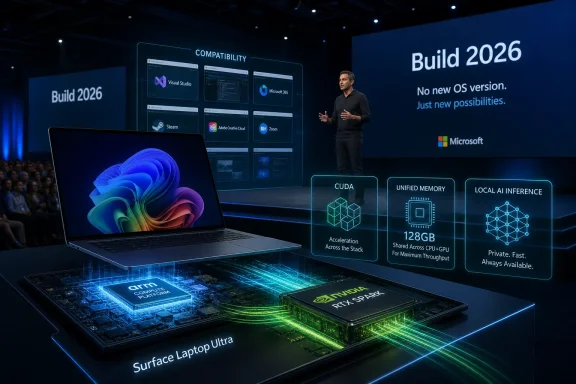
Microsoft entered Build 2026 week with Windows chief Pavan Davuluri publicly ruling out a new Windows version, while the company and Nvidia instead steered attention toward a Surface Laptop Ultra built around Nvidia’s new Arm-based RTX Spark platform. That makes the week less about “Windows 12” as a brand and more about whether Microsoft can make Windows feel newly competitive by changing the hardware underneath it. The operating system story has not disappeared; it has moved down the stack, into silicon, drivers, developer tools, AI models, and compatibility promises. For Windows users, that may matter more than a fresh logo ever would.
The most important sentence Microsoft said before Build was not a grand keynote line. It was Davuluri’s clarification that something new was coming for developers, but that it was “not a new OS version.” In a normal year, that might be a minor bit of expectation management. In 2026, after months of Windows 12 speculation, it functioned like a stop sign.
That matters because Windows has always been unusually vulnerable to version-number mythology. A new number gives the industry a clean narrative: new requirements, new UI, new devices, new complaints, new adoption charts. It also gives every IT department a reason to ask whether another migration cycle is about to land on its desk before the last one has fully settled.
Microsoft appears to have decided that this was the wrong kind of drama for Build. Developers do not need another slogan about the future of Windows if the practical story is still app performance, Arm compatibility, AI runtime access, and GPU acceleration. Enterprises do not need a fresh badge if their actual concern is whether existing workloads, drivers, management policies, security baselines, and peripherals will survive the next wave of PC hardware.
So the denial is not a small detail. It is Microsoft admitting, deliberately or not, that the Windows platform story has become broader than Windows branding. The company is trying to sell a new era of PCs without triggering the institutional fatigue that comes with a new Windows generation.
For years, Windows on Arm has had a strange reputation. It has been promising, often elegant, sometimes efficient, and repeatedly undercut by the same old problems: app compatibility, driver gaps, uneven performance, and the perception that “real” Windows work still belongs on x86. Qualcomm’s Snapdragon X generation improved that conversation, but it did not erase the old muscle memory. Many power users still hear “Arm Windows” and immediately ask what will not run.
Nvidia changes the emotional temperature of that conversation. CUDA support, RTX branding, Blackwell graphics, and large unified memory pools are not side notes for developers, creators, and AI tinkerers. They are the vocabulary of serious compute. Microsoft is not merely saying that Arm PCs are good enough for Office, Edge, Teams, and battery life; it is gesturing toward machines that can compile, render, infer, game, and prototype locally.
That is the real Build story. Microsoft is trying to make the PC itself newly interesting to developers at a time when much of the AI ecosystem has trained those same developers to think first about remote GPUs, API calls, cloud notebooks, and rented acceleration. A Windows laptop with serious local AI and graphics headroom is a bid to pull some of that experimentation back onto the desk.
A Surface Laptop Ultra built around Nvidia’s RTX Spark platform would restore some of the old Surface purpose. The line’s original job was not merely to sell Microsoft laptops. It was to show the rest of the ecosystem what Windows hardware could look like when Microsoft controlled enough of the design, firmware, display, input, and software integration to make a coherent argument.
This time the argument is not detachable tablets or precision hinges. It is unified memory, local AI, GPU compute, and Arm performance without the apologetic tone. The reported configuration — Nvidia Blackwell RTX graphics, up to 128GB of unified memory, full CUDA support, and AI compute claims in the petaflop class — is designed to sound less like a thin-and-light laptop and more like a workstation that happens to fold shut.
The risk is that this becomes another halo device admired from afar. Windows history is full of technically impressive machines that did not shift the mainstream because they were too expensive, too niche, or too dependent on software ecosystems that arrived later than promised. But halo devices can still matter if they reset assumptions. A Surface Laptop Ultra does not need to outsell every Dell or Lenovo business notebook to change what developers expect from Windows on Arm.
Windows 11 has had a difficult identity. It arrived with stricter hardware requirements, a redesigned shell, a centered taskbar, and a security-forward posture that made sense to Microsoft but irritated many users. Since then, it has absorbed Copilot branding, AI search experiments, account nudges, Start menu changes, widget pushes, and a steady flow of features that sometimes feel less like a polished platform vision and more like a live service constantly negotiating with itself.
For enthusiasts, Windows 12 became a container for hopes Microsoft had not satisfied. Maybe the next Windows would be cleaner. Maybe it would be more modular. Maybe it would separate AI features from core desktop reliability. Maybe it would undo some of the ads, recommendations, and cloud-account pressure that have made Windows 11 feel needier than its predecessors.
For IT administrators, the fantasy was different. A new Windows might at least provide a clean planning horizon. Hardware requirements, servicing timelines, management templates, security defaults, and application compatibility could be evaluated against a named release. The absence of Windows 12 does not remove that work; it makes the work more continuous and harder to narrate.
That is why Microsoft’s “not a new OS version” message is both reassuring and evasive. It reassures anyone who feared another disruptive migration. But it also leaves unresolved whether the company can make Windows 11 feel stable, coherent, and respectful while layering on the next generation of AI PC functionality.
Snapdragon X machines have made a strong case around efficiency, battery life, thermals, and increasingly respectable performance. They are natural MacBook Air competitors, and they have helped Microsoft argue that Windows laptops do not have to behave like the old hot, loud, short-lived stereotypes. But for developers, gamers, 3D artists, AI researchers, and workstation buyers, efficiency alone does not settle the matter.
Nvidia brings a different promise: if the software stack cooperates, Arm Windows can be a CUDA machine. That single fact reframes the platform. CUDA is not merely a feature checkbox; it is an ecosystem gravity well that has shaped machine learning, scientific computing, rendering pipelines, and GPU-accelerated development for years.
The phrase “full CUDA support” is therefore doing enormous work. It tells developers that this is not just another NPU story with limited framework support and uncertain scheduling behavior. It suggests a familiar acceleration path on a new class of Windows device. It also gives Microsoft a way to talk about AI PCs without relying solely on TOPS metrics that many buyers still do not understand and many developers cannot yet fully exploit.
The gaming angle is more complicated. Nvidia graphics do not automatically solve Windows on Arm gaming, because games are deeply entangled with anti-cheat systems, launchers, drivers, middleware, instruction-set assumptions, and years of x86 optimization. But if Microsoft can pair Nvidia hardware with better Arm64 game support and fewer emulation penalties, it could begin to weaken one of the most stubborn arguments against Arm Windows.
AI workloads are often less constrained by raw compute than by memory capacity, memory bandwidth, and the friction of moving data between CPU and GPU pools. A laptop that can dynamically allocate a large shared memory pool across CPU and GPU workloads changes what local experimentation looks like. It does not make cloud training clusters irrelevant, but it can make serious local inference, model testing, media generation, and multimodal workflows less painful.
That is why the Surface Laptop Ultra pitch is not aimed only at spreadsheet users who want longer battery life. It is aimed at people juggling local models, 3D assets, video timelines, code, containers, and GPU-accelerated tools. Those users know that “AI PC” can be marketing fluff when it means a modest NPU attached to otherwise ordinary hardware. A large unified memory machine with CUDA support is a more concrete proposition.
Apple has already taught the market to understand unified memory as part of a premium computing story. Microsoft and Nvidia are now trying to answer that story in Windows language. The answer is not just “we have Arm too.” It is “we have Arm, Nvidia graphics, CUDA, and enough memory to make local AI workflows plausible.”
That is a much sharper argument than Windows 12 would have been. A new Windows version can promise modernization. A machine that runs large local models and GPU workloads can demonstrate it.
The Windows ecosystem has been here before. Touch PCs arrived before enough great touch-first Windows apps. Pen computing has repeatedly surged and receded. Mixed reality never became the everyday Windows category Microsoft once imagined. Even the Microsoft Store, despite years of revisions, never became the central distribution hub the company wanted.
AI PCs risk the same fate if developers do not have compelling reasons to target local acceleration. Microsoft can ship Copilot experiences, Recall-like features, Studio Effects, and system-level AI conveniences, but those do not by themselves justify a premium workstation-class Arm laptop. The broader software ecosystem has to show why local models, GPU inference, and on-device data processing are worth paying for.
That means Microsoft’s developer story has to be practical. Toolchains must work. Arm64 native apps must be easy to build and worth distributing. Emulation must be good enough for legacy workloads but not become an excuse for developers to ignore native performance. Frameworks need to see the hardware consistently. Drivers need to be boring. Enterprise deployment tools need to understand these machines as first-class Windows PCs, not exotic exceptions.
This is where the “not Windows 12” message helps. If Microsoft had led with a new operating system, developers might reasonably wait for the dust to settle. By keeping the platform nominally Windows 11 while introducing dramatic hardware, Microsoft can argue for continuity: same Windows ecosystem, new performance envelope.
A new Arm-based Nvidia Windows laptop raises immediate questions that keynote demos rarely answer. How mature are the drivers? What breaks in VPN clients, endpoint detection tools, smart card middleware, printer stacks, kernel extensions, or old line-of-business apps? How does device imaging work? Are firmware updates reliable? Does existing management policy apply cleanly? Can security teams validate local AI features rather than simply disable them?
These questions do not mean enterprise IT will reject the category. In fact, local AI could be attractive in regulated environments if it reduces dependence on cloud processing for sensitive data. A powerful local machine that can run models without sending every prompt or document to a remote service has a real privacy and compliance argument, assuming the controls are credible.
But enterprises buy repeatability, not spectacle. They need consistent SKUs, long-term driver support, predictable repair channels, stable firmware, and documentation that survives beyond launch week. A dazzling Surface can open the door; it cannot close the procurement case by itself.
Microsoft also has to manage the politics of its silicon partnerships. Windows is supposed to be the Switzerland of PC hardware, running across Intel, AMD, Qualcomm, and now potentially Nvidia Arm platforms. If Surface appears to crown Nvidia too aggressively, OEMs and chip partners will watch closely. If Microsoft spreads its attention too thin, developers may not know which acceleration path to prioritize.
The average Windows user has been trained by years of PC marketing to distrust performance claims that depend on ideal workloads. “AI compute” is especially slippery because there is no single consumer task that maps neatly onto a petaflop number. Running a local model, generating an image, editing video, playing a game, compiling code, and using Copilot all stress different parts of the system.
If Microsoft markets the Surface Laptop Ultra as a no-compromises machine, it will be judged harshly whenever a familiar Windows app runs poorly under emulation, a game refuses to launch, or a peripheral lacks a driver. That is the burden of premium hardware. The higher the ambition, the less patience users have for platform asterisks.
At the same time, consumers may be more open to a new kind of Windows laptop than the industry assumes. Apple has normalized Arm laptops as fast, quiet, efficient, and premium. Gaming handhelds have made users more aware of performance-per-watt tradeoffs. AI tools have made local compute interesting again, especially for people uneasy about uploading everything to cloud services.
The opportunity is real. But Microsoft has to resist turning every capability into a slogan. The best consumer argument for this machine will not be that it belongs to a “new era.” It will be that it runs the things people care about quickly, quietly, and reliably.
That world has not vanished, but it has weakened. Today’s platform gravity is distributed across browsers, app stores, cloud APIs, AI models, GPUs, and development frameworks. Many users live inside Chrome, Teams, Steam, Discord, VS Code, and web apps more than they live inside the Windows shell. Many developers care less about the OS brand than about whether Docker, Python, CUDA, Node, WSL, Git, and their editor behave.
This is why the absence of Windows 12 is not necessarily a failure of imagination. Microsoft may have concluded that a version-number event would distract from the deeper work. If the company can make Windows 11 a better host for heterogeneous compute, local AI, Arm-native software, and modern security, then the platform advances even without a new name.
But there is a danger in that logic. Without a clean release boundary, Windows can feel like a moving target. Features arrive in waves, controlled rollouts, regional experiments, Insider builds, Copilot updates, Store packages, driver releases, and firmware dependencies. Users and admins are left trying to determine which “Windows 11” experience they actually have.
A Windows 12 launch would at least have forced Microsoft to explain itself. No Windows 12 means Microsoft must explain the platform through execution instead. That is harder, but it may be healthier if the execution is good.
But users do not upgrade because the industry needs a cycle. They upgrade when the new machine solves a problem the old one cannot. The challenge for Microsoft is to define those problems clearly.
Local AI can be compelling in several ways. It can reduce latency. It can preserve privacy. It can keep workflows running offline. It can make creative tools more responsive. It can let developers test models without renting cloud GPUs. It can allow enterprises to process sensitive internal data under tighter control. Those are real benefits, not just marketing theater.
Yet much of today’s AI usage still happens in the cloud because cloud services are easier to update, scale, meter, and monetize. Microsoft itself has enormous incentives to keep users connected to Azure-backed AI services. That creates a strategic tension: the company wants to sell local AI hardware while also selling cloud AI subscriptions and services.
The likely answer is hybrid computing. Local models handle private, low-latency, context-aware, or offline tasks; cloud models handle the largest, newest, and most expensive workloads. The Surface Laptop Ultra makes sense as a hybrid endpoint — not a cloud replacement, but a machine strong enough to decide when the cloud is unnecessary.
Microsoft’s greatest strength is that Windows runs nearly everything. Its greatest weakness is that Windows is expected to run nearly everything. That expectation makes architecture shifts brutally difficult. Apple could move the Mac to Apple Silicon with a smaller hardware ecosystem, tighter platform control, and a user base accustomed to periodic breaks. Microsoft has to move a sprawling global Windows estate without making the old world feel abandoned.
Emulation helps, but it is not a magic wand. It can preserve access to older apps, but it rarely delivers the same confidence as native support for performance-sensitive, driver-heavy, or security-sensitive software. Games are especially unforgiving because anti-cheat systems and graphics stacks often care deeply about the exact environment.
This is why Nvidia’s presence is both powerful and risky. If the GPU stack is excellent, it can make Windows on Arm feel newly legitimate. If drivers, game support, or developer tooling stumble, the disappointment will be louder because expectations are higher. Nvidia does not bring a modest promise; it brings a reputation for serious acceleration.
Microsoft’s job is to turn that reputation into a Windows platform advantage without letting the compatibility tax consume the story. That means getting the boring pieces right: installers, redistributables, management agents, SDKs, Store listings, driver delivery, crash reporting, and documentation. The future of the PC may be glamorous in keynote form, but it will be won or lost in support tickets.
Microsoft is telling developers that local AI and GPU acceleration on Windows are worth targeting. It is telling OEMs that Arm no longer belongs only to thin productivity laptops. It is telling Nvidia that Windows can be a serious client platform for its next silicon ambitions. It is telling users that the next major Windows shift may arrive as a device class before it arrives as an operating-system name.
The concrete takeaways are narrower than the marketing, but they are more important:
If Surface Laptop Ultra becomes a credible workstation-class Arm PC, Microsoft will have done something more interesting than changing the version number. It will have expanded what a Windows machine can be without forcing the ecosystem through an artificial doorway. If it falters, the week will be remembered as another case of PC-industry futurism outrunning the software people actually use.
Either way, the absence of Windows 12 is not the absence of a platform shift. It is the clue that Microsoft wants the next Windows transition to arrive less like a launch event and more like a hardware tide. The question after Build will not be whether Microsoft has a new OS name ready. It will be whether Windows, on whatever silicon comes next, can still make the PC feel like the most flexible computer in the room.
 Microsoft Killed the Windows 12 Moment Before It Could Own the Week
The most important sentence Microsoft said before Build was not a grand keynote line. It was Davuluri’s clarification that something new was coming for developers, but that it was “not a new OS version.” In a normal year, that might be a minor bit of expectation management. In 2026, after months of Windows 12 speculation, it functioned like a stop sign.That matters because Windows has always been unusually vulnerable to version-number mythology. A new number gives the industry a clean narrative: new requirements, new UI, new devices, new complaints, new adoption charts. It also gives every IT department a reason to ask whether another migration cycle is about to land on its desk before the last one has fully settled.
Microsoft appears to have decided that this was the wrong kind of drama for Build. Developers do not need another slogan about the future of Windows if the practical story is still app performance, Arm compatibility, AI runtime access, and GPU acceleration. Enterprises do not need a fresh badge if their actual concern is whether existing workloads, drivers, management policies, security baselines, and peripherals will survive the next wave of PC hardware.
So the denial is not a small detail. It is Microsoft admitting, deliberately or not, that the Windows platform story has become broader than Windows branding. The company is trying to sell a new era of PCs without triggering the institutional fatigue that comes with a new Windows generation.
The New Windows Story Is Being Written in Silicon
The replacement narrative is not subtle. Microsoft, Nvidia, Arm, and MediaTek are all orbiting the same idea: the PC is changing because the local machine now needs to do far more AI and graphics work without waiting on the cloud. That is why the rumored and now reported Surface Laptop Ultra matters. It is not simply another premium Surface; it is a statement that Windows on Arm should no longer be treated as a battery-life experiment with caveats.For years, Windows on Arm has had a strange reputation. It has been promising, often elegant, sometimes efficient, and repeatedly undercut by the same old problems: app compatibility, driver gaps, uneven performance, and the perception that “real” Windows work still belongs on x86. Qualcomm’s Snapdragon X generation improved that conversation, but it did not erase the old muscle memory. Many power users still hear “Arm Windows” and immediately ask what will not run.
Nvidia changes the emotional temperature of that conversation. CUDA support, RTX branding, Blackwell graphics, and large unified memory pools are not side notes for developers, creators, and AI tinkerers. They are the vocabulary of serious compute. Microsoft is not merely saying that Arm PCs are good enough for Office, Edge, Teams, and battery life; it is gesturing toward machines that can compile, render, infer, game, and prototype locally.
That is the real Build story. Microsoft is trying to make the PC itself newly interesting to developers at a time when much of the AI ecosystem has trained those same developers to think first about remote GPUs, API calls, cloud notebooks, and rented acceleration. A Windows laptop with serious local AI and graphics headroom is a bid to pull some of that experimentation back onto the desk.
Surface Becomes the Demo Rig Again
Surface has spent several years in an awkward role. It remained a premium Microsoft hardware brand, but it no longer reliably defined the frontier of the Windows PC market. OEMs often shipped bolder form factors, faster refresh cycles, and more aggressive performance configurations, while Surface carried the burden of being tasteful, restrained, and sometimes late.A Surface Laptop Ultra built around Nvidia’s RTX Spark platform would restore some of the old Surface purpose. The line’s original job was not merely to sell Microsoft laptops. It was to show the rest of the ecosystem what Windows hardware could look like when Microsoft controlled enough of the design, firmware, display, input, and software integration to make a coherent argument.
This time the argument is not detachable tablets or precision hinges. It is unified memory, local AI, GPU compute, and Arm performance without the apologetic tone. The reported configuration — Nvidia Blackwell RTX graphics, up to 128GB of unified memory, full CUDA support, and AI compute claims in the petaflop class — is designed to sound less like a thin-and-light laptop and more like a workstation that happens to fold shut.
The risk is that this becomes another halo device admired from afar. Windows history is full of technically impressive machines that did not shift the mainstream because they were too expensive, too niche, or too dependent on software ecosystems that arrived later than promised. But halo devices can still matter if they reset assumptions. A Surface Laptop Ultra does not need to outsell every Dell or Lenovo business notebook to change what developers expect from Windows on Arm.
The Ghost of Windows 12 Still Haunts the Room
Microsoft can deny a Windows 12 announcement and still be unable to escape the Windows 12 question. That is because the speculation was never only about a version number. It was about whether Windows 11 has become too compromised a vehicle for Microsoft’s next platform turn.Windows 11 has had a difficult identity. It arrived with stricter hardware requirements, a redesigned shell, a centered taskbar, and a security-forward posture that made sense to Microsoft but irritated many users. Since then, it has absorbed Copilot branding, AI search experiments, account nudges, Start menu changes, widget pushes, and a steady flow of features that sometimes feel less like a polished platform vision and more like a live service constantly negotiating with itself.
For enthusiasts, Windows 12 became a container for hopes Microsoft had not satisfied. Maybe the next Windows would be cleaner. Maybe it would be more modular. Maybe it would separate AI features from core desktop reliability. Maybe it would undo some of the ads, recommendations, and cloud-account pressure that have made Windows 11 feel needier than its predecessors.
For IT administrators, the fantasy was different. A new Windows might at least provide a clean planning horizon. Hardware requirements, servicing timelines, management templates, security defaults, and application compatibility could be evaluated against a named release. The absence of Windows 12 does not remove that work; it makes the work more continuous and harder to narrate.
That is why Microsoft’s “not a new OS version” message is both reassuring and evasive. It reassures anyone who feared another disruptive migration. But it also leaves unresolved whether the company can make Windows 11 feel stable, coherent, and respectful while layering on the next generation of AI PC functionality.
Nvidia Gives Windows on Arm the Thing It Lacked: Swagger
Qualcomm made Windows on Arm credible. Nvidia may make it desirable to a different crowd. That distinction matters.Snapdragon X machines have made a strong case around efficiency, battery life, thermals, and increasingly respectable performance. They are natural MacBook Air competitors, and they have helped Microsoft argue that Windows laptops do not have to behave like the old hot, loud, short-lived stereotypes. But for developers, gamers, 3D artists, AI researchers, and workstation buyers, efficiency alone does not settle the matter.
Nvidia brings a different promise: if the software stack cooperates, Arm Windows can be a CUDA machine. That single fact reframes the platform. CUDA is not merely a feature checkbox; it is an ecosystem gravity well that has shaped machine learning, scientific computing, rendering pipelines, and GPU-accelerated development for years.
The phrase “full CUDA support” is therefore doing enormous work. It tells developers that this is not just another NPU story with limited framework support and uncertain scheduling behavior. It suggests a familiar acceleration path on a new class of Windows device. It also gives Microsoft a way to talk about AI PCs without relying solely on TOPS metrics that many buyers still do not understand and many developers cannot yet fully exploit.
The gaming angle is more complicated. Nvidia graphics do not automatically solve Windows on Arm gaming, because games are deeply entangled with anti-cheat systems, launchers, drivers, middleware, instruction-set assumptions, and years of x86 optimization. But if Microsoft can pair Nvidia hardware with better Arm64 game support and fewer emulation penalties, it could begin to weaken one of the most stubborn arguments against Arm Windows.
Unified Memory Is the Quietly Radical Part
The headline number is one petaflop of AI compute. The more interesting number may be 128GB of unified memory.AI workloads are often less constrained by raw compute than by memory capacity, memory bandwidth, and the friction of moving data between CPU and GPU pools. A laptop that can dynamically allocate a large shared memory pool across CPU and GPU workloads changes what local experimentation looks like. It does not make cloud training clusters irrelevant, but it can make serious local inference, model testing, media generation, and multimodal workflows less painful.
That is why the Surface Laptop Ultra pitch is not aimed only at spreadsheet users who want longer battery life. It is aimed at people juggling local models, 3D assets, video timelines, code, containers, and GPU-accelerated tools. Those users know that “AI PC” can be marketing fluff when it means a modest NPU attached to otherwise ordinary hardware. A large unified memory machine with CUDA support is a more concrete proposition.
Apple has already taught the market to understand unified memory as part of a premium computing story. Microsoft and Nvidia are now trying to answer that story in Windows language. The answer is not just “we have Arm too.” It is “we have Arm, Nvidia graphics, CUDA, and enough memory to make local AI workflows plausible.”
That is a much sharper argument than Windows 12 would have been. A new Windows version can promise modernization. A machine that runs large local models and GPU workloads can demonstrate it.
Developers Are the Real Audience, Even When Consumers See the Ad
Build is a developer conference, and Microsoft’s timing is not accidental. The company does not need developers merely to admire the Surface Laptop Ultra. It needs them to make the Windows AI PC feel useful before buyers conclude that the hardware is ahead of the software again.The Windows ecosystem has been here before. Touch PCs arrived before enough great touch-first Windows apps. Pen computing has repeatedly surged and receded. Mixed reality never became the everyday Windows category Microsoft once imagined. Even the Microsoft Store, despite years of revisions, never became the central distribution hub the company wanted.
AI PCs risk the same fate if developers do not have compelling reasons to target local acceleration. Microsoft can ship Copilot experiences, Recall-like features, Studio Effects, and system-level AI conveniences, but those do not by themselves justify a premium workstation-class Arm laptop. The broader software ecosystem has to show why local models, GPU inference, and on-device data processing are worth paying for.
That means Microsoft’s developer story has to be practical. Toolchains must work. Arm64 native apps must be easy to build and worth distributing. Emulation must be good enough for legacy workloads but not become an excuse for developers to ignore native performance. Frameworks need to see the hardware consistently. Drivers need to be boring. Enterprise deployment tools need to understand these machines as first-class Windows PCs, not exotic exceptions.
This is where the “not Windows 12” message helps. If Microsoft had led with a new operating system, developers might reasonably wait for the dust to settle. By keeping the platform nominally Windows 11 while introducing dramatic hardware, Microsoft can argue for continuity: same Windows ecosystem, new performance envelope.
Enterprise IT Will Read the Fine Print, Not the Slogan
For sysadmins, the phrase “new era of the PC” is not a promise. It is a workload.A new Arm-based Nvidia Windows laptop raises immediate questions that keynote demos rarely answer. How mature are the drivers? What breaks in VPN clients, endpoint detection tools, smart card middleware, printer stacks, kernel extensions, or old line-of-business apps? How does device imaging work? Are firmware updates reliable? Does existing management policy apply cleanly? Can security teams validate local AI features rather than simply disable them?
These questions do not mean enterprise IT will reject the category. In fact, local AI could be attractive in regulated environments if it reduces dependence on cloud processing for sensitive data. A powerful local machine that can run models without sending every prompt or document to a remote service has a real privacy and compliance argument, assuming the controls are credible.
But enterprises buy repeatability, not spectacle. They need consistent SKUs, long-term driver support, predictable repair channels, stable firmware, and documentation that survives beyond launch week. A dazzling Surface can open the door; it cannot close the procurement case by itself.
Microsoft also has to manage the politics of its silicon partnerships. Windows is supposed to be the Switzerland of PC hardware, running across Intel, AMD, Qualcomm, and now potentially Nvidia Arm platforms. If Surface appears to crown Nvidia too aggressively, OEMs and chip partners will watch closely. If Microsoft spreads its attention too thin, developers may not know which acceleration path to prioritize.
The Consumer Pitch Is Simpler and More Dangerous
For everyday buyers, Microsoft’s message is likely to be less architectural: this is a powerful laptop that can do gaming, creation, and AI locally. That is a clean pitch. It is also easy to overpromise.The average Windows user has been trained by years of PC marketing to distrust performance claims that depend on ideal workloads. “AI compute” is especially slippery because there is no single consumer task that maps neatly onto a petaflop number. Running a local model, generating an image, editing video, playing a game, compiling code, and using Copilot all stress different parts of the system.
If Microsoft markets the Surface Laptop Ultra as a no-compromises machine, it will be judged harshly whenever a familiar Windows app runs poorly under emulation, a game refuses to launch, or a peripheral lacks a driver. That is the burden of premium hardware. The higher the ambition, the less patience users have for platform asterisks.
At the same time, consumers may be more open to a new kind of Windows laptop than the industry assumes. Apple has normalized Arm laptops as fast, quiet, efficient, and premium. Gaming handhelds have made users more aware of performance-per-watt tradeoffs. AI tools have made local compute interesting again, especially for people uneasy about uploading everything to cloud services.
The opportunity is real. But Microsoft has to resist turning every capability into a slogan. The best consumer argument for this machine will not be that it belongs to a “new era.” It will be that it runs the things people care about quickly, quietly, and reliably.
The Windows Brand No Longer Carries the Whole Platform
The old Microsoft playbook put Windows at the center of everything. Hardware existed to run Windows. Developers targeted Windows. OEMs licensed Windows. A new Windows release was the platform event.That world has not vanished, but it has weakened. Today’s platform gravity is distributed across browsers, app stores, cloud APIs, AI models, GPUs, and development frameworks. Many users live inside Chrome, Teams, Steam, Discord, VS Code, and web apps more than they live inside the Windows shell. Many developers care less about the OS brand than about whether Docker, Python, CUDA, Node, WSL, Git, and their editor behave.
This is why the absence of Windows 12 is not necessarily a failure of imagination. Microsoft may have concluded that a version-number event would distract from the deeper work. If the company can make Windows 11 a better host for heterogeneous compute, local AI, Arm-native software, and modern security, then the platform advances even without a new name.
But there is a danger in that logic. Without a clean release boundary, Windows can feel like a moving target. Features arrive in waves, controlled rollouts, regional experiments, Insider builds, Copilot updates, Store packages, driver releases, and firmware dependencies. Users and admins are left trying to determine which “Windows 11” experience they actually have.
A Windows 12 launch would at least have forced Microsoft to explain itself. No Windows 12 means Microsoft must explain the platform through execution instead. That is harder, but it may be healthier if the execution is good.
The AI PC Needs a Reason to Exist Outside the Keynote
The PC industry desperately wants the AI PC to become the next upgrade cycle. That is understandable. The pandemic hardware boom cooled, Windows 10’s support deadline pushed some replacement demand, and vendors need a story bigger than slightly better screens and battery life. AI offers a convenient banner.But users do not upgrade because the industry needs a cycle. They upgrade when the new machine solves a problem the old one cannot. The challenge for Microsoft is to define those problems clearly.
Local AI can be compelling in several ways. It can reduce latency. It can preserve privacy. It can keep workflows running offline. It can make creative tools more responsive. It can let developers test models without renting cloud GPUs. It can allow enterprises to process sensitive internal data under tighter control. Those are real benefits, not just marketing theater.
Yet much of today’s AI usage still happens in the cloud because cloud services are easier to update, scale, meter, and monetize. Microsoft itself has enormous incentives to keep users connected to Azure-backed AI services. That creates a strategic tension: the company wants to sell local AI hardware while also selling cloud AI subscriptions and services.
The likely answer is hybrid computing. Local models handle private, low-latency, context-aware, or offline tasks; cloud models handle the largest, newest, and most expensive workloads. The Surface Laptop Ultra makes sense as a hybrid endpoint — not a cloud replacement, but a machine strong enough to decide when the cloud is unnecessary.
Compatibility Remains the Tax on Every Windows Reinvention
Every bold Windows transition eventually meets the same adversary: the installed base.Microsoft’s greatest strength is that Windows runs nearly everything. Its greatest weakness is that Windows is expected to run nearly everything. That expectation makes architecture shifts brutally difficult. Apple could move the Mac to Apple Silicon with a smaller hardware ecosystem, tighter platform control, and a user base accustomed to periodic breaks. Microsoft has to move a sprawling global Windows estate without making the old world feel abandoned.
Emulation helps, but it is not a magic wand. It can preserve access to older apps, but it rarely delivers the same confidence as native support for performance-sensitive, driver-heavy, or security-sensitive software. Games are especially unforgiving because anti-cheat systems and graphics stacks often care deeply about the exact environment.
This is why Nvidia’s presence is both powerful and risky. If the GPU stack is excellent, it can make Windows on Arm feel newly legitimate. If drivers, game support, or developer tooling stumble, the disappointment will be louder because expectations are higher. Nvidia does not bring a modest promise; it brings a reputation for serious acceleration.
Microsoft’s job is to turn that reputation into a Windows platform advantage without letting the compatibility tax consume the story. That means getting the boring pieces right: installers, redistributables, management agents, SDKs, Store listings, driver delivery, crash reporting, and documentation. The future of the PC may be glamorous in keynote form, but it will be won or lost in support tickets.
The Week’s Real Message Fits on a Procurement Checklist
The most useful way to read Microsoft’s Build-week maneuver is not as a rumor being denied, but as a priority list being revealed. Windows 12 can wait. The hardware transition cannot.Microsoft is telling developers that local AI and GPU acceleration on Windows are worth targeting. It is telling OEMs that Arm no longer belongs only to thin productivity laptops. It is telling Nvidia that Windows can be a serious client platform for its next silicon ambitions. It is telling users that the next major Windows shift may arrive as a device class before it arrives as an operating-system name.
The concrete takeaways are narrower than the marketing, but they are more important:
- Microsoft has publicly taken a Windows 12 announcement off the table for Build 2026, lowering the odds of an immediate OS migration story.
- The company’s attention has shifted toward a new class of Arm-based Windows hardware built around Nvidia’s RTX Spark platform and Surface Laptop Ultra.
- The most consequential promises are not cosmetic Windows changes, but CUDA support, unified memory, local AI performance, and better Arm-native developer workflows.
- IT departments should treat this as an emerging platform category that requires compatibility testing, driver validation, security review, and management planning.
- The success of these machines will depend less on peak AI numbers than on whether everyday Windows apps, games, development tools, and enterprise agents behave normally.
Microsoft’s New PC Era Will Be Judged by the Old Windows Standard
For all the talk of Arm, AI, unified memory, and petaflop performance, Microsoft’s challenge is almost comically traditional. The company has to make the new thing feel like Windows in the best sense: broad, capable, compatible, manageable, and boring when it needs to be boring. That is harder than announcing Windows 12, but it is also more meaningful.If Surface Laptop Ultra becomes a credible workstation-class Arm PC, Microsoft will have done something more interesting than changing the version number. It will have expanded what a Windows machine can be without forcing the ecosystem through an artificial doorway. If it falters, the week will be remembered as another case of PC-industry futurism outrunning the software people actually use.
Either way, the absence of Windows 12 is not the absence of a platform shift. It is the clue that Microsoft wants the next Windows transition to arrive less like a launch event and more like a hardware tide. The question after Build will not be whether Microsoft has a new OS name ready. It will be whether Windows, on whatever silicon comes next, can still make the PC feel like the most flexible computer in the room.
References
- Primary source: PCWorld
Published: Mon, 01 Jun 2026 15:52:00 GMT
No Windows 12 at Build, but Microsoft has something else up its sleeve | PCWorld
Microsoft's Pavan Davuluri confirmed Windows 12 won't appear at Build 2026, but the new Surface Laptop Ultra with Nvidia N1X might steal the show.www.pcworld.com - Related coverage: axios.com
Microsoft debuts Nvidia-powered Microsoft Surface Ultra laptop
Microsoft is trying again to redefine the PC for the AI era.www.axios.com
- Related coverage: windowscentral.com
"A new era of PC": Microsoft and NVIDIA tease major announcement experts predict to be the fabled N1X chip | Windows Central
Microsoft and NVIDIA just hinted at major announcements at Computex and Build 2026.www.windowscentral.com - Related coverage: techradar.com
Windows 12 at Build 2026: What to expect | TechRadar
What Build 2026 signals about the future of the Windowswww.techradar.com - Related coverage: tomshardware.com
Nvidia and Microsoft tease "a new era of PC" ahead of Computex 2026 — coordinated social media posts could indicate that rumored N1X laptops will be Windows on Arm systems | Tom's Hardware
An Nvidia-powered Arm PC running Windows could inspire new local AI experiences beyond Copilot+.www.tomshardware.com - Related coverage: windowslatest.com
Microsoft confirms it's not launching Windows 12, as it teases a big announcement
Microsoft officially shut down Windows 12 rumors to make way for a hardware breakthrough with the new NVIDIA N1X coming for Windows on ARM www.windowslatest.com
- Related coverage: techspot.com
Microsoft unveils Surface Laptop Ultra with Nvidia RTX Spark chip and up to 128GB of RAM | TechSpot
The Surface Laptop Ultra features a standard design, without the more experimental elements seen in earlier Surface devices. That means it does not include a removable display...www.techspot.com - Related coverage: windowsforum.com
Microsoft Signals No Windows 12 at Build 2026: Focus Shifts to AI PC Hardware | Windows Forum
Microsoft said on May 29, 2026, that its Build 2026 announcements next week will not include Windows 12, while the Windows account separately teased “a new...windowsforum.com - Related coverage: pcgameshardware.de
Microsoft bestätigt: Kein Windows 12, aber "etwas Neues"
Microsoft schließt ein eigenes Windows 12 vorerst aus und stellt zur Computex 2026 stattdessen "etwas Neues" in Aussicht: Nvidias N1X für Windows on ARM.www.pcgameshardware.de
- Related coverage: aiweekly.co
- Official source: microsoft.com
Surface Laptop Ultra: The new performance Surface Laptop | Microsoft Surface
Discover the new Surface Laptop Ultra. Built for world makers and creative pros who require cutting-edge AI performance, power and portability.www.microsoft.com - Related coverage: gadgetsnow.indiatimes.com
Microsoft Surface Laptop Ultra Debuts With NVIDIA RTX Spark And 128GB Unified Memory
gadgetsnow.indiatimes.com
- Related coverage: pcgamer.com
Rumor that Microsoft plans to launch a 'modular' Windows 12 this year retracted by its source, refuted by others [Updated] | PC Gamer
Microsoft does not plan to ship a Windows 12 this year, according to sources reacting to a now-retracted PCWorld article.www.pcgamer.com
