

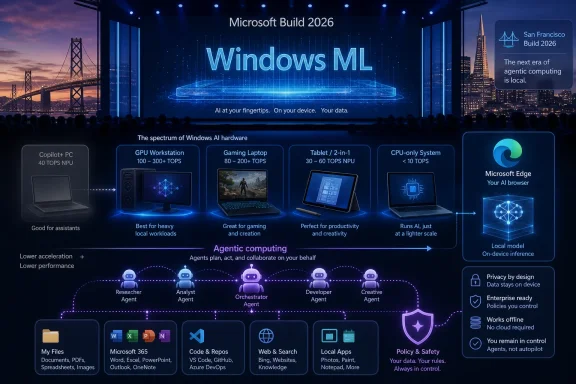
Microsoft used Build 2026 in San Francisco to recast Windows AI around local models, GPU acceleration, and software agents rather than the Copilot+ PC hardware brand it introduced in 2024. That is not a quiet branding adjustment; it is a strategic retreat from the idea that Windows’ AI future would be gated by a 40 TOPS NPU and a new laptop sticker. Copilot+ PCs are not dead as machines, but the argument for them as the exclusive doorway into Windows AI is visibly weakening. For users and administrators, that may be the best Windows AI news Microsoft has delivered yet.
Two years ago, Copilot+ PC was supposed to be the clean answer to a messy question: what makes a Windows machine ready for AI? Microsoft’s answer was unusually specific. A Copilot+ PC needed a neural processing unit capable of at least 40 trillion operations per second, 16GB of RAM, and enough storage to support a new class of on-device features.
That clarity was useful, at first. PC makers had a badge to put on boxes, reviewers had a spec line to compare, and Microsoft had a way to tell consumers that old Windows hardware was not merely aging but missing the future. The company paired that branding with features such as Recall, semantic search, image generation, and local language-model plumbing that leaned on the NPU as the defining silicon block of the AI PC era.
But Build 2026 told a different story. Satya Nadella’s message to developers was not that they should target Copilot+ PCs. It was that they could now build for local AI across a far broader range of Windows hardware, including GPUs and, in some cases, CPUs. That shift matters because developer gravity, not marketing copy, determines which platform assumptions survive.
The Copilot+ PC label still exists, and Microsoft is still selling machines that qualify for it. What changed is that the label no longer looks like the center of the story. It looks like one compatibility tier among several in a much larger attempt to make Windows the runtime for agentic computing.
There was logic in that. NPUs are well-suited to sustained inference tasks, especially on thin-and-light laptops where power draw and thermals matter. Offloading AI work from the CPU and GPU can preserve battery life and keep the rest of the system responsive. For translation, image effects, semantic indexing, and small model execution, the NPU is not a gimmick.
The problem was Microsoft turned a useful hardware accelerator into a product boundary. Many powerful Windows desktops, gaming laptops, and workstation-class machines lacked qualifying NPUs even though they had GPUs capable of far more raw AI compute. Users who had spent serious money on high-end PCs were told, in effect, that their machines were not part of the Windows AI future because they did not contain the right kind of accelerator.
That made Copilot+ feel less like a capability marker and more like a sales funnel. It was not simply “this works best on new hardware.” It was “this feature does not work unless you buy a very specific class of new hardware.” Windows users are accustomed to grumbling about minimum requirements, but this one landed awkwardly because the excluded machines were not necessarily weak.
Security researchers, privacy advocates, journalists, and ordinary users all focused on the same uncomfortable fact. A system that continuously records and indexes user activity is not just a productivity feature; it is an unusually sensitive data store. Even if the processing is local, the risk profile changes the moment such a database exists on a user’s device.
Microsoft eventually reworked Recall’s security and opt-in model, but the damage to the Copilot+ halo was done. Instead of becoming the feature that explained why a new NPU laptop was worth buying, Recall became a case study in how not to introduce ambient AI into a personal operating system. The backlash made the Copilot+ brand carry baggage before the category had even matured.
That is why the reported anecdote from Build — a protester, rather than Microsoft’s own stage messaging, being the person to bring Recall into the conversation — feels so telling. Microsoft did not need another Recall-centered keynote. It needed to move the conversation somewhere else.
That is a healthier architecture for Windows. The installed base is too large and too heterogeneous for a single hardware badge to define the future. Enterprise fleets contain old desktops, new laptops, virtualized environments, mobile workstations, and custom device classes. Enthusiasts may have GPUs that dwarf laptop NPUs in compute. Developers need APIs that degrade gracefully, not a binary yes-or-no sticker.
The Microsoft and Nvidia partnership around RTX Spark makes the point even more sharply. These machines are not being sold primarily as consumer Copilot+ laptops. They are being framed as local AI development systems: GPU-heavy, memory-rich devices for agents, model experimentation, fine-tuning, and sustained workloads. A Surface RTX Spark Dev Box with 128GB of unified memory and claimed petaflop-class AI performance is not a spiritual successor to the first Snapdragon Copilot+ laptops. It is a different animal.
That difference exposes the weakness in the original Copilot+ framing. If the future is local agents, tool use, model orchestration, and heterogeneous acceleration, then a narrow consumer badge built around an NPU threshold is too small a container. Microsoft appears to have realized this before the market fully did.
That is the more pragmatic version of local AI. It does not pretend every machine is equal. A GPU-equipped workstation will run heavier workloads than a budget laptop; a modern NPU will still be more efficient for certain always-on tasks than a CPU. But the feature boundary becomes a performance gradient rather than a locked door.
Browsers are also a sensible place to normalize local AI because they already mediate so much daily computing. If Edge can expose browser-managed local models to websites and extensions, Microsoft can seed useful AI capabilities without waiting for every Windows user to replace a laptop. Developers get a broader addressable market, and users get features that feel less like a hardware upsell.
This matters because AI features fail when they are treated as museum exhibits for new hardware. They need volume, iteration, and mundane usefulness. A summarizer that runs locally on many machines is more likely to change user behavior than a technically impressive feature available only to people who bought the right 2024-era laptop.
An agent that reads local files, manipulates apps, schedules work, summarizes meetings, queries enterprise data, and calls cloud services cannot be reduced to an NPU requirement. The hardware matters, but the trust model matters more. The permissions model matters more. The ability to audit what an agent did and why matters more.
That is why Microsoft’s pivot is not merely about letting GPUs into the party. It is about admitting that the next Windows AI platform is a runtime and security story, not a laptop-category story. The company wants Windows to be where agents live, act, and interact with local resources. If that is the ambition, restricting the best experiments to a small slice of new hardware would be self-defeating.
The danger is that Microsoft may replace one kind of confusion with another. Copilot, Copilot+, Windows AI, Windows ML, Foundry Local, Aion, Phi, agents, and RTX Spark all now sit in the same conceptual soup. The retreat from hardware exclusivity is welcome, but the company still has to explain what ordinary users are actually getting and what developers can reliably target.
Then the market moved under its feet. Apple’s low-cost MacBook Neo arrived with 8GB of unified memory and Apple Intelligence support, putting pressure on Windows OEMs to deliver cheaper machines that still look AI-adjacent. Dell, Acer, Chuwi, and even Microsoft’s own Surface line have been pulled into a renewed low-memory laptop fight, partly because RAM pricing and entry-level competition are both unforgiving.
That creates an awkward split. Microsoft’s formal Copilot+ requirements still say one thing about what a serious AI PC should contain, while its broader platform direction says AI features should reach more machines. The result is a brand that is becoming less useful as a guide to actual capability. A non-Copilot+ machine may still run local AI features; a Copilot+ machine may not be the most powerful local AI system in the room.
For IT buyers, this is not academic. A 16GB minimum is still a sensible floor for many business users in 2026, AI or not. But if Microsoft’s own software increasingly scales down to 8GB systems, procurement teams will have to separate “can run some AI feature” from “will remain a good Windows endpoint for the next four years.”
That has obvious appeal for developers. Running larger models locally, experimenting with agents without paying for every cloud inference call, and testing privacy-sensitive workflows on a desk-side system are all real advantages. Microsoft benefits because it can make Windows feel relevant to the AI developer community without asking everyone to live inside Azure for every step of the workflow.
But it also makes the Copilot+ badge look increasingly consumer-bound and underpowered as a strategic symbol. A system built around 128GB of unified memory and a powerful GPU may technically qualify for whatever AI branding Microsoft wants to attach, but that is not why anyone will buy it. They will buy it because it runs the workloads they care about.
That is the platform lesson Microsoft should keep close. Users do not care whether a feature is “Copilot+” if the branding does not predict usefulness. Developers do not care about a sticker if the APIs do not reach their users. Hardware partners do not want to chase a badge that Microsoft itself stops emphasizing after one product cycle.
On the other hand, local agents create a new administrative surface. A Windows agent that can see files, operate apps, call APIs, and reason across business context is a governance problem before it is a productivity feature. IT departments will want policy controls, logging, isolation, data-loss prevention hooks, and a way to disable or scope features by role.
That is where Microsoft’s enterprise advantage could matter. The company already owns identity, endpoint management, productivity apps, security tooling, and a massive amount of enterprise workflow. If it can make Windows agents manageable through familiar administrative channels, it has a credible path that smaller AI software vendors do not.
But Microsoft’s recent Windows history gives admins reason to be skeptical. Consumer-first AI experiments, uneven communication, and feature rollouts that arrive before policy clarity have burned trust. The company cannot simply declare the agentic Windows era and expect enterprise IT to applaud. It has to prove that local AI will be controllable, auditable, and boring enough to deploy.
But the brand’s strategic role is changing. In 2024, Copilot+ PC was presented as the gateway to Windows AI. In 2026, it looks more like one optimized path through a broader hardware landscape. That is a demotion, even if Microsoft never says so.
This is not necessarily failure. Technology categories often begin with rigid definitions and then dissolve into baseline expectations. “Multimedia PC,” “Centrino,” “Ultrabook,” and “VR-ready” all had moments when they seemed to define a buying era. Eventually, their useful parts were absorbed into ordinary product expectations, and the badges became less important than the capabilities they helped normalize.
If Copilot+ PCs pushed the Windows ecosystem toward NPUs, better webcams, more memory, and serious local AI APIs, the brand may have done part of its job. The mistake would be insisting that the badge remain the boundary long after the platform has moved on.
That is not a neat retail story. It does not fit cleanly on a laptop sticker. But it is how real computing platforms evolve.
Windows has always succeeded, when it succeeds, by abstracting hardware diversity rather than denying it. The PC ecosystem is messy, sprawling, backward-compatible, and often inelegant. Microsoft’s best move is to make that mess useful, not to pretend every meaningful AI experience must begin with a newly purchased Copilot+ laptop.
This is especially important for enthusiasts. Many WindowsForum readers have machines with discrete GPUs, upgraded RAM, unusual storage layouts, home-lab configurations, and hardware Microsoft’s retail narratives rarely acknowledge. A Windows AI platform that ignores those users in favor of a narrow laptop spec would squander one of Windows’ historic strengths.
 Microsoft’s AI PC Story Has Outgrown Its Own Sticker
Two years ago, Copilot+ PC was supposed to be the clean answer to a messy question: what makes a Windows machine ready for AI? Microsoft’s answer was unusually specific. A Copilot+ PC needed a neural processing unit capable of at least 40 trillion operations per second, 16GB of RAM, and enough storage to support a new class of on-device features.That clarity was useful, at first. PC makers had a badge to put on boxes, reviewers had a spec line to compare, and Microsoft had a way to tell consumers that old Windows hardware was not merely aging but missing the future. The company paired that branding with features such as Recall, semantic search, image generation, and local language-model plumbing that leaned on the NPU as the defining silicon block of the AI PC era.
But Build 2026 told a different story. Satya Nadella’s message to developers was not that they should target Copilot+ PCs. It was that they could now build for local AI across a far broader range of Windows hardware, including GPUs and, in some cases, CPUs. That shift matters because developer gravity, not marketing copy, determines which platform assumptions survive.
The Copilot+ PC label still exists, and Microsoft is still selling machines that qualify for it. What changed is that the label no longer looks like the center of the story. It looks like one compatibility tier among several in a much larger attempt to make Windows the runtime for agentic computing.
The NPU Was Supposed to Be the Gatekeeper
The original Copilot+ pitch depended on a very particular technical and commercial bargain. Microsoft argued that on-device AI needed dedicated acceleration, and the NPU was the efficient way to deliver it on battery-powered laptops. In exchange for buying new hardware, users would get faster, more private, more responsive AI experiences that did not have to round-trip everything to the cloud.There was logic in that. NPUs are well-suited to sustained inference tasks, especially on thin-and-light laptops where power draw and thermals matter. Offloading AI work from the CPU and GPU can preserve battery life and keep the rest of the system responsive. For translation, image effects, semantic indexing, and small model execution, the NPU is not a gimmick.
The problem was Microsoft turned a useful hardware accelerator into a product boundary. Many powerful Windows desktops, gaming laptops, and workstation-class machines lacked qualifying NPUs even though they had GPUs capable of far more raw AI compute. Users who had spent serious money on high-end PCs were told, in effect, that their machines were not part of the Windows AI future because they did not contain the right kind of accelerator.
That made Copilot+ feel less like a capability marker and more like a sales funnel. It was not simply “this works best on new hardware.” It was “this feature does not work unless you buy a very specific class of new hardware.” Windows users are accustomed to grumbling about minimum requirements, but this one landed awkwardly because the excluded machines were not necessarily weak.
Recall Poisoned the Launch Before the Platform Matured
No discussion of Copilot+ PCs can avoid Recall, because Recall became the feature that turned Microsoft’s AI PC branding from aspirational to radioactive for a large slice of the Windows community. The idea was technically bold: a searchable timeline of what you had seen and done on your PC, powered by local capture and indexing. The reception was immediate and brutal.Security researchers, privacy advocates, journalists, and ordinary users all focused on the same uncomfortable fact. A system that continuously records and indexes user activity is not just a productivity feature; it is an unusually sensitive data store. Even if the processing is local, the risk profile changes the moment such a database exists on a user’s device.
Microsoft eventually reworked Recall’s security and opt-in model, but the damage to the Copilot+ halo was done. Instead of becoming the feature that explained why a new NPU laptop was worth buying, Recall became a case study in how not to introduce ambient AI into a personal operating system. The backlash made the Copilot+ brand carry baggage before the category had even matured.
That is why the reported anecdote from Build — a protester, rather than Microsoft’s own stage messaging, being the person to bring Recall into the conversation — feels so telling. Microsoft did not need another Recall-centered keynote. It needed to move the conversation somewhere else.
Build 2026 Moved the Center of Gravity From Hardware to Runtime
The most important Windows AI phrase at Build was not Copilot+ PC. It was Windows ML. Microsoft’s developer pitch now emphasizes a local inferencing framework that can target available hardware more flexibly, rather than a fixed set of consumer-facing AI features chained to one class of laptop.That is a healthier architecture for Windows. The installed base is too large and too heterogeneous for a single hardware badge to define the future. Enterprise fleets contain old desktops, new laptops, virtualized environments, mobile workstations, and custom device classes. Enthusiasts may have GPUs that dwarf laptop NPUs in compute. Developers need APIs that degrade gracefully, not a binary yes-or-no sticker.
The Microsoft and Nvidia partnership around RTX Spark makes the point even more sharply. These machines are not being sold primarily as consumer Copilot+ laptops. They are being framed as local AI development systems: GPU-heavy, memory-rich devices for agents, model experimentation, fine-tuning, and sustained workloads. A Surface RTX Spark Dev Box with 128GB of unified memory and claimed petaflop-class AI performance is not a spiritual successor to the first Snapdragon Copilot+ laptops. It is a different animal.
That difference exposes the weakness in the original Copilot+ framing. If the future is local agents, tool use, model orchestration, and heterogeneous acceleration, then a narrow consumer badge built around an NPU threshold is too small a container. Microsoft appears to have realized this before the market fully did.
Edge Shows the Escape Route
The clearest example of Microsoft’s new direction may be Edge, not Windows Settings or some flashy desktop demo. Microsoft’s Aion-1.0-Instruct model is designed for on-device tasks such as summarization, rewriting, intent detection, and accessibility scenarios. Crucially, Microsoft is talking about support beyond specialized NPU hardware, including devices with less capable GPUs and even CPU inference.That is the more pragmatic version of local AI. It does not pretend every machine is equal. A GPU-equipped workstation will run heavier workloads than a budget laptop; a modern NPU will still be more efficient for certain always-on tasks than a CPU. But the feature boundary becomes a performance gradient rather than a locked door.
Browsers are also a sensible place to normalize local AI because they already mediate so much daily computing. If Edge can expose browser-managed local models to websites and extensions, Microsoft can seed useful AI capabilities without waiting for every Windows user to replace a laptop. Developers get a broader addressable market, and users get features that feel less like a hardware upsell.
This matters because AI features fail when they are treated as museum exhibits for new hardware. They need volume, iteration, and mundane usefulness. A summarizer that runs locally on many machines is more likely to change user behavior than a technically impressive feature available only to people who bought the right 2024-era laptop.
Agents Make the Old Copilot+ Boundary Look Artificial
Microsoft’s new obsession is agents, and that obsession does not map cleanly onto the Copilot+ PC definition. Agents are not just models. They require context, permissions, tool access, identity, security boundaries, memory, orchestration, and user trust. Some of that work benefits from local acceleration, but much of it is software architecture.An agent that reads local files, manipulates apps, schedules work, summarizes meetings, queries enterprise data, and calls cloud services cannot be reduced to an NPU requirement. The hardware matters, but the trust model matters more. The permissions model matters more. The ability to audit what an agent did and why matters more.
That is why Microsoft’s pivot is not merely about letting GPUs into the party. It is about admitting that the next Windows AI platform is a runtime and security story, not a laptop-category story. The company wants Windows to be where agents live, act, and interact with local resources. If that is the ambition, restricting the best experiments to a small slice of new hardware would be self-defeating.
The danger is that Microsoft may replace one kind of confusion with another. Copilot, Copilot+, Windows AI, Windows ML, Foundry Local, Aion, Phi, agents, and RTX Spark all now sit in the same conceptual soup. The retreat from hardware exclusivity is welcome, but the company still has to explain what ordinary users are actually getting and what developers can reliably target.
The RAM Retreat Is the Other Half of the Story
The Copilot+ PC requirement for 16GB of RAM looked, at launch, like a rare moment of sanity in the Windows ecosystem. For years, too many Windows laptops shipped with 8GB of memory long after that stopped feeling comfortable. By setting a 16GB floor for AI PCs, Microsoft seemed to be nudging the industry toward a better baseline.Then the market moved under its feet. Apple’s low-cost MacBook Neo arrived with 8GB of unified memory and Apple Intelligence support, putting pressure on Windows OEMs to deliver cheaper machines that still look AI-adjacent. Dell, Acer, Chuwi, and even Microsoft’s own Surface line have been pulled into a renewed low-memory laptop fight, partly because RAM pricing and entry-level competition are both unforgiving.
That creates an awkward split. Microsoft’s formal Copilot+ requirements still say one thing about what a serious AI PC should contain, while its broader platform direction says AI features should reach more machines. The result is a brand that is becoming less useful as a guide to actual capability. A non-Copilot+ machine may still run local AI features; a Copilot+ machine may not be the most powerful local AI system in the room.
For IT buyers, this is not academic. A 16GB minimum is still a sensible floor for many business users in 2026, AI or not. But if Microsoft’s own software increasingly scales down to 8GB systems, procurement teams will have to separate “can run some AI feature” from “will remain a good Windows endpoint for the next four years.”
Nvidia’s New Windows Role Changes the Politics of Local AI
The Nvidia angle is not just another hardware partnership. It changes the politics of Windows AI because it brings desktop-class and workstation-class assumptions into a conversation that Microsoft originally framed around laptop NPUs. RTX Spark and related Nvidia-powered systems suggest a Windows future where local AI is not merely a battery-efficient assistant layer, but a serious development and execution environment.That has obvious appeal for developers. Running larger models locally, experimenting with agents without paying for every cloud inference call, and testing privacy-sensitive workflows on a desk-side system are all real advantages. Microsoft benefits because it can make Windows feel relevant to the AI developer community without asking everyone to live inside Azure for every step of the workflow.
But it also makes the Copilot+ badge look increasingly consumer-bound and underpowered as a strategic symbol. A system built around 128GB of unified memory and a powerful GPU may technically qualify for whatever AI branding Microsoft wants to attach, but that is not why anyone will buy it. They will buy it because it runs the workloads they care about.
That is the platform lesson Microsoft should keep close. Users do not care whether a feature is “Copilot+” if the branding does not predict usefulness. Developers do not care about a sticker if the APIs do not reach their users. Hardware partners do not want to chase a badge that Microsoft itself stops emphasizing after one product cycle.
Enterprise IT Will Welcome Flexibility and Fear the Agent Layer
For administrators, the decline of Copilot+ exclusivity cuts both ways. On one hand, broader hardware support is good news. Enterprises do not refresh fleets overnight because Microsoft invented a new label. If AI-assisted search, summarization, accessibility, or helpdesk automation can run acceptably on existing machines, adoption becomes a software rollout question rather than a capital expenditure cliff.On the other hand, local agents create a new administrative surface. A Windows agent that can see files, operate apps, call APIs, and reason across business context is a governance problem before it is a productivity feature. IT departments will want policy controls, logging, isolation, data-loss prevention hooks, and a way to disable or scope features by role.
That is where Microsoft’s enterprise advantage could matter. The company already owns identity, endpoint management, productivity apps, security tooling, and a massive amount of enterprise workflow. If it can make Windows agents manageable through familiar administrative channels, it has a credible path that smaller AI software vendors do not.
But Microsoft’s recent Windows history gives admins reason to be skeptical. Consumer-first AI experiments, uneven communication, and feature rollouts that arrive before policy clarity have burned trust. The company cannot simply declare the agentic Windows era and expect enterprise IT to applaud. It has to prove that local AI will be controllable, auditable, and boring enough to deploy.
The Copilot+ Brand May Survive by Becoming Less Important
The most likely outcome is not that Microsoft kills Copilot+ PCs. The brand will probably linger as a premium consumer category, especially for laptops with efficient NPUs and a bundle of supported AI experiences. OEMs have already invested in the label, and Microsoft has little reason to erase it abruptly.But the brand’s strategic role is changing. In 2024, Copilot+ PC was presented as the gateway to Windows AI. In 2026, it looks more like one optimized path through a broader hardware landscape. That is a demotion, even if Microsoft never says so.
This is not necessarily failure. Technology categories often begin with rigid definitions and then dissolve into baseline expectations. “Multimedia PC,” “Centrino,” “Ultrabook,” and “VR-ready” all had moments when they seemed to define a buying era. Eventually, their useful parts were absorbed into ordinary product expectations, and the badges became less important than the capabilities they helped normalize.
If Copilot+ PCs pushed the Windows ecosystem toward NPUs, better webcams, more memory, and serious local AI APIs, the brand may have done part of its job. The mistake would be insisting that the badge remain the boundary long after the platform has moved on.
The Useful Future Is Messier Than the Marketing Future
The future Microsoft sketched at Build is harder to market but more technically honest. Some AI tasks should run on NPUs. Some should run on GPUs. Some can run on CPUs. Some should stay in the cloud. Some should move between local and cloud depending on latency, privacy, cost, battery, and model size.That is not a neat retail story. It does not fit cleanly on a laptop sticker. But it is how real computing platforms evolve.
Windows has always succeeded, when it succeeds, by abstracting hardware diversity rather than denying it. The PC ecosystem is messy, sprawling, backward-compatible, and often inelegant. Microsoft’s best move is to make that mess useful, not to pretend every meaningful AI experience must begin with a newly purchased Copilot+ laptop.
This is especially important for enthusiasts. Many WindowsForum readers have machines with discrete GPUs, upgraded RAM, unusual storage layouts, home-lab configurations, and hardware Microsoft’s retail narratives rarely acknowledge. A Windows AI platform that ignores those users in favor of a narrow laptop spec would squander one of Windows’ historic strengths.
The Build 2026 Message Windows Users Should Actually Hear
Microsoft did not announce the death of Copilot+ PCs at Build 2026, but it did something more consequential: it stopped treating them as the only plausible future of local Windows AI. The practical message is that Windows AI is becoming a capability spectrum rather than a members-only club.- Microsoft is shifting its developer pitch from Copilot+ exclusives toward Windows ML, local models, and heterogeneous acceleration across CPUs, GPUs, and NPUs.
- Copilot+ PCs still matter most where efficient on-device inference and battery life are the priority, but they no longer look like the sole target for Windows AI features.
- Edge’s Aion-1.0-Instruct work shows how Microsoft can bring local AI to more machines without waiting for a full hardware refresh cycle.
- Nvidia-powered Surface and RTX Spark systems point to a higher-end local AI developer tier that makes the original Copilot+ laptop definition feel too narrow.
- Enterprise adoption will depend less on AI branding and more on policy controls, auditability, data protection, and predictable lifecycle support.
- Buyers should treat Copilot+ as one signal of AI readiness, not as a guarantee that a machine is the best or only choice for future Windows AI workloads.
References
- Primary source: PCMag
Published: 2026-06-07T16:01:07.622096

At Build 2026, Microsoft Sent a Clear Message: Copilot+ PCs No Longer Matter
The company is moving beyond restrictive AI hardware requirements—and Windows users will benefit from the change.www.pcmag.com
- Related coverage: windowscentral.com
- Related coverage: tomshardware.com
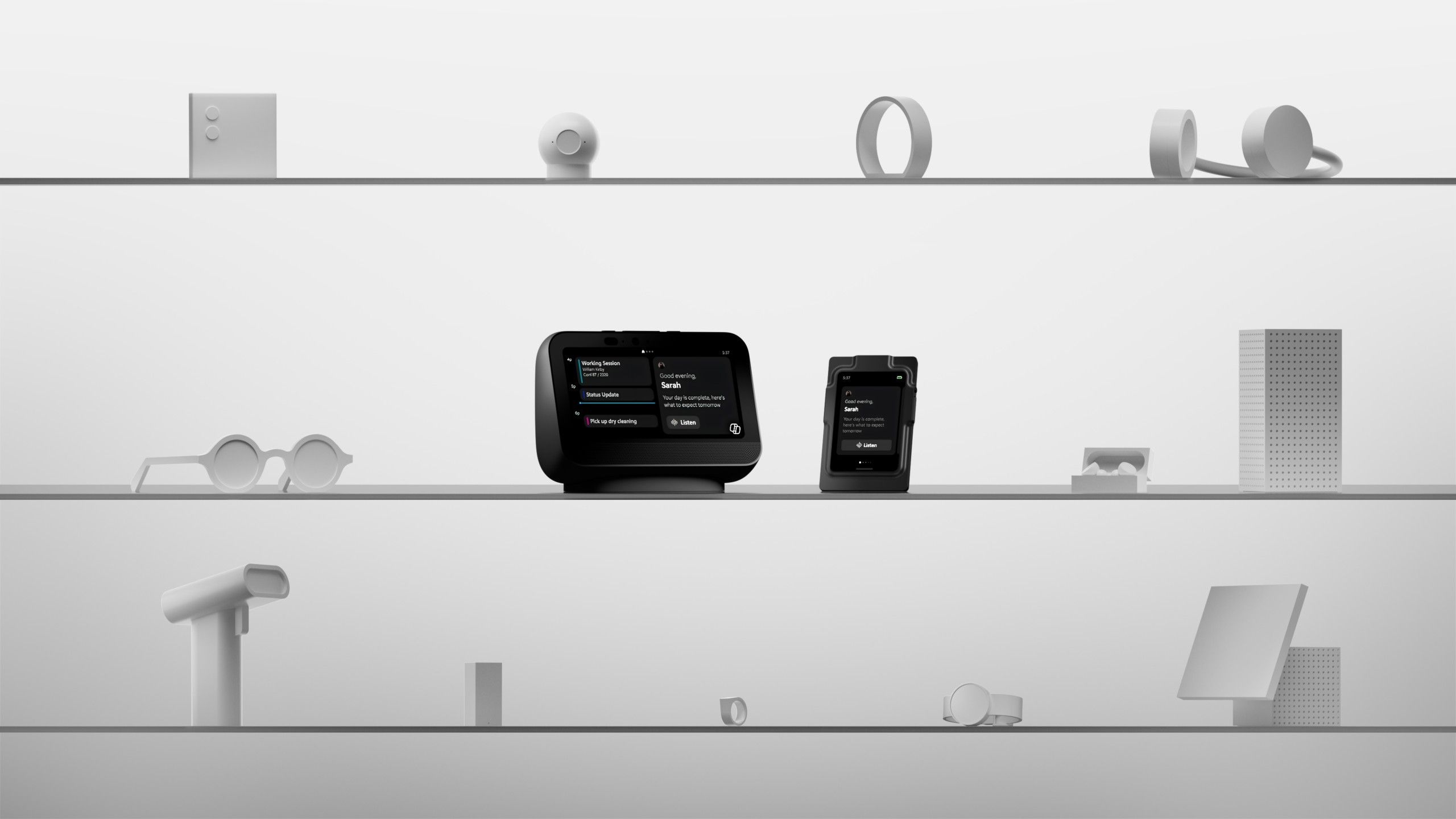
Microsoft unveils Project Solara AI, a chip-to-cloud platform built to power a new generation of 'agent-first' enterprise devices — hardware designed to run AI agents instead of traditional apps
Microsoft ditches Windows to build OS on Androidwww.tomshardware.com
- Related coverage: tomsguide.com
- Related coverage: techradar.com
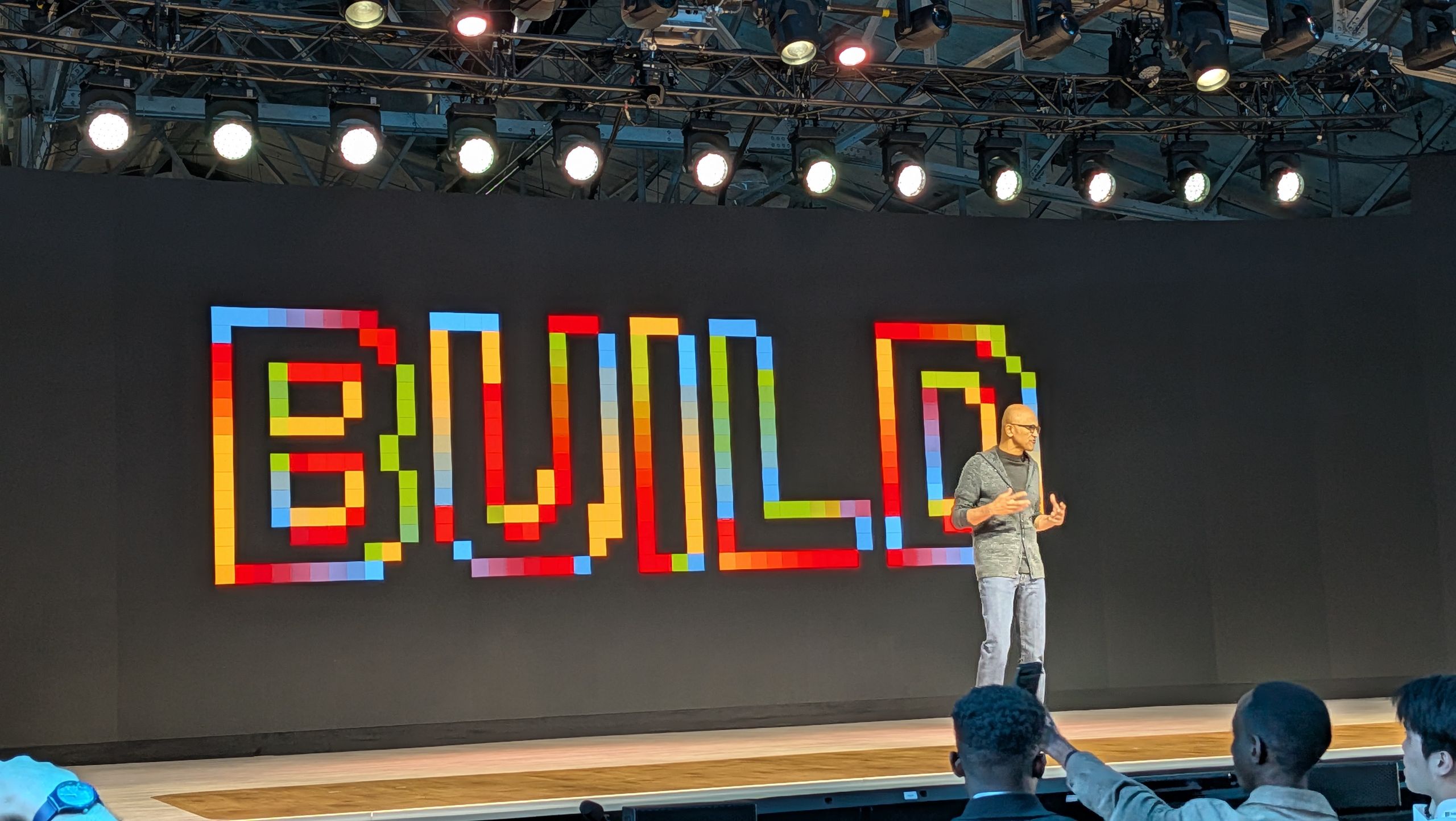
From Quantum to Containers - 4 big things you might have missed at Microsoft Build 2026
We round up some of the other major news from Microsoft Build 2026www.techradar.com
- Official source: developer.microsoft.com

Windows AI | Microsoft Developer
A unified, reliable and secure platform supporting the AI developer lifecycle from model selection, fine-tuning, optimizing and deployment across CPU, GPU, NPU and cloud.developer.microsoft.com
- Official source: blogs.windows.com

Expanding on‑device AI in Microsoft Edge: New models and APIs for the web
At Build 2025, we introduced the Prompt and Writing Assistance APIs in Microsoft Edge with the Phi-4-mini language model. Since then, we' blogs.windows.com
- Official source: support.microsoft.com
Windows Copilot+ AI components - Microsoft Support
 support.microsoft.com
- Official source: blogs.microsoft.com

Microsoft Build 2026: Be yourself at work - The Official Microsoft Blog
Platforms shift when developers build. We explore, choose tools, dream, create. This platform shift comes with more information than ever, ready at your fingertips. This shift, it’s about building fast AND THEN: it’s about building, operating, optimizing and observing. Securing your... blogs.microsoft.com
- Related coverage: winbuzzer.com

Microsoft Adds On-Device AI Model to Edge Browser
Microsoft has expanded Edge on-device AI with Aion and local language APIs, testing whether browser AI can run across lower-end GPUs and CPUs in preview. winbuzzer.com
- Related coverage: pcworld.com

Laptop makers embraced AI. Then Microsoft left them hanging
Copilot+ PCs are here in force, but they're already old news. www.pcworld.com
- Official source: news.microsoft.com
- Related coverage: techjacksolutions.com
Microsoft Aion 1.0 Unveiled: On-Device SLM for Windows
Microsoft Aion 1.0, the new on-device SLM family, is coming to Windows! Learn how this innovation from Build 2026 will transform your AI experience. techjacksolutions.com
- Related coverage: msthesource.thesourcemediaassets.com
- Official source: learn.microsoft.com
- Official source: microsoft.com
Shop Copilot+ PCs: Windows AI PCs and Laptop Devices | Microsoft Windows
Shop Copilot+ PCs, the fastest, most intelligent Windows PCs ever. Explore Windows AI tools and features built into the latest PCs, desktops, and laptop devices.www.microsoft.com
- Related coverage: makeuseof.com

Microsoft's Copilot+ Laptops Are Here, but What Does That Actually Mean?
They look sublime and have excellent battery life, but what does Microsoft's new AI-focused branding actually mean? www.makeuseof.com
- Related coverage: wired.com

Everything You Need to Know About Microsoft Copilot+ PCs
Microsoft aimed to revolutionize its Windows operating system with this AI-soaked laptop certification. It’s still a work in progress.www.wired.com
- Official source: info.microsoft.com


