

Caeves’ new Intelligent Deep Storage for Microsoft Azure promises to turn long‑forgotten archives into instantly searchable, AI‑ready assets while cutting archive costs dramatically — a claim the vendor packages as up to 70% lower TCO, plus instant, permission‑aware access for Microsoft 365 Copilot and enterprise search. tps://www.prnewswire.com/news-releases/caeves-launches-intelligent-deep-storage-for-microsoft-azure-302678599.html)
Enterprise archives have become a chronic drag on IT budgets and data‑centric initiatives. Organizations accumulate tens to hundreds of petabytes of unstructured files — documents, images, backups, and application binaries — and most of that content ends up in systems optimized for long‑term retention, not ongoing value extraction. The result is a large and growing body of dark data: low‑cost to hold but costly or impossible to search, analyze, or feed into AI workflows.
Caeves positions Intelligent Deep Storage as a software‑defined layer that sits natively inside a customer’s Azure tenancy, transparently tiering files into Azure object storage while maintaining file‑level semantics, metadata, and permissioning. The company emphasizes two outcomes: lower storage bills and continuous usability — the data remains accessible for direct file access, indexed search, and Retrieval‑Augmented Generation (RAG) with Microsoft 365 Copilot. These announcements are reflected in the vendor materials and the product listing in the Microsoft Marketplace.
From a customer perspective, this architecture yields several apparent benefits:
At the same time, the most attention‑grabbing numbers — 70% TCO reduction and 50× search speed — are vendor headline metrics that should be treated as promises to be validated, not audit‑ready facts. Azure’s own durability and access tier documentation shows much higher nuance and stronger durability guarantees depending on redundancy choices; matching Caeves’ claims to specific Azure configurations is a necessary step for procurement.
For enterprises wrestling with sprawling archives and looking to fold historical content into Microsoft Copilot and analytics pipelines, Caeves’ offering is worth a structured pilot. The questions that will separate a successful outcome from disappointment are practical and measurable: how indexing is priced and managed, how permissions are preserved and enforced, what actual retrieval and network costs look like under real workloads, and whether claimed search speeds and TCO reductions hold up against your baseline.
Caeves has launched on a credible platform and under a credible integration model; the next step for any buyer is empirical validation — a short, instrumented pilot that proves the vendor’s claims on the customer’s terms. If the vendor numbers are borne out in your environment, Intelligent Deep Storage could transform long‑term archives from a dark cost center into an actively useful, AI‑ready enterprise asset.
Source: StorageNewsletter Caeves Launches Intelligent Deep Storage for Microsoft Azure
 Background / Overview
Enterprise archives have become a chronic drag on IT budgets and data‑centric initiatives. Organizations accumulate tens to hundreds of petabytes of unstructured files — documents, images, backups, and application binaries — and most of that content ends up in systems optimized for long‑term retention, not ongoing value extraction. The result is a large and growing body of dark data: low‑cost to hold but costly or impossible to search, analyze, or feed into AI workflows.Caeves positions Intelligent Deep Storage as a software‑defined layer that sits natively inside a customer’s Azure tenancy, transparently tiering files into Azure object storage while maintaining file‑level semantics, metadata, and permissioning. The company emphasizes two outcomes: lower storage bills and continuous usability — the data remains accessible for direct file access, indexed search, and Retrieval‑Augmented Generation (RAG) with Microsoft 365 Copilot. These announcements are reflected in the vendor materials and the product listing in the Microsoft Marketplace.
What Caeves Announces
Caeves’ public statements and press materials highlight a compact set of headline claims that will shape procurement conversations:- Up to 70% lower total cost of ownership (TCO) compared to legacy archive systems and tape.
- Search speeds improved up to 50× over traditional archive search across multi‑petabyte datasets (vendor benchmark).
- Historical data AI‑ready in under 30 minutes — phrased as rapid deployment and activation for indexing.
- 99.99% data durability claimed on Azure infrastructure (vendor framing).
- Integration with Microsoft 365 Copilot via a “Caeves Copilot Connector” that surfaces indexed, permissioned archive content to Copilot and Search experiences.
How Intelligent Deep Storage Works — Architecture and Mechanics
Core design principles
Caeves describes its platform with three consistent technical priorities: cost optimization, continuous access, and AI‑readiness. The technical architecture the vendor outlines combines:- Transparent tiering from file interfaces (SMB/NFS semantics) to Azure Blob storage and long‑term object tiers.
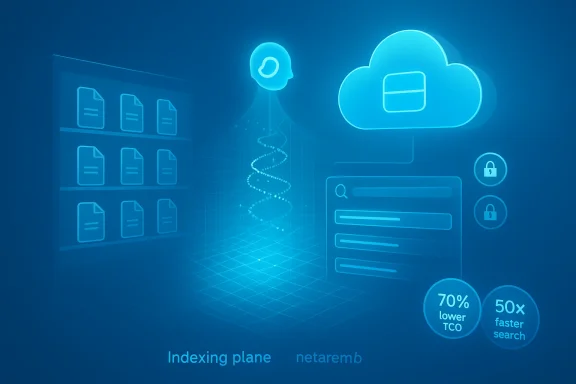
- An in‑tenant indexing and caching plane that keeps metadata, permissions, and searchable indexes available without requiring blob rehydration or large data movement.
- Containerized services deployed in the customer subscription to run indexing, embed generation, and the retrieval plane used for search and RAG.
What “transparent tiering” means in practice
Caeves exposes virtual SMB shares and file interfaces that map to objects in Azure Blob storage. Files that are cold or rarely accessed are placed in Azure’s long‑term tiers (Cool / Cold / Archive), but a persistent index and small caching layer remain online to serve metadata queries and targeted retrieval without the full rehydration that traditional archival workflows require. This design aims to reduce storage cost while preserving the user and application experience.Indexing, embeddings, and RAG
To enable semantic search and RAG scenarios, Caeves performs automated indexing and, where needed, computes vector embeddings for unstructured content. These vectors and textual indexes are then used to deliver natural‑language search and retrieval for downstream Copilot queries or enterprise search. Because the indexing and the retrieval compute run in the same tenant and region, Caeves argues this minimizes egress and data‑sovereignty concerns.Integration with Microsoft 365 Copilot and Azure
Caeves makes a deliberate play to be tightly coupled to Microsoft’s ecosystem: the Caeves Copilot Connector is described as a runner that feeds indexed, permissioned items into Microsoft Graph/Search so Microsoft 365 Copilot can ground responses in private enterprise content. Microsoft’s Copilot connectors model supports bringing external content into the Graph for Copilot and Copilot Search, and Caeves’ connector follows that pattern.From a customer perspective, this architecture yields several apparent benefits:
- Permission‑aware answers: Copilot can return content only if the Graph index marks the requester as authorized. Caeves emphasizes this alignment with Entra ID/Active Directory controls.
- No data copies outside tenant: Because indexing and retrieval live inside the customer Azure tenancy, the vendor claims no content leaves the subscription for indexing or AI processing.
- Faster enterprise search across archives: The persistent index avoids slow archive rehydration workflows and long waits for searches over petabyte estates.
Verifying the Claims: What’s Supported and What Needs Independent Validation
Caeves’ materials and press distribution include clear, repeated numbers. Good journalism and prudent procurement require separating what is verifiable from what is a vendor metric.- Availability in Microsoft Marketplace and the product launch are verifiable through the vendor’s marketplace listing and PR distribution. This is independently corroborated in the vendor materials and trade reporting.
- The integration model with Microsoft 365 Copilot follows Microsoft’s published connector architecture; the vendor’s approach is therefore technically plausible and compatible with Microsoft guidance. That compatibility is documented in Microsoft’s Copilot connectors documentation.
- The 99.99% data durability number requires careful unpacking. Azure provides very high designed durability across its redundancy options: Locally Redundant Storage (LRS) and Zone‑Redundant Storage (ZRS) provide multi‑9 durability guarantees (LRS at 11‑9s, ZRS at 12‑9s, and geo‑replication options claim much higher designed durability for objects over a year). Azure’s access tiers also have availability characteristics that vary by tier (Hot / Cool / Archive), and archive rehydration latencies remain hours for classic archive tiers. In short, the vendor’s 99.99% figure is not inconsistent with Azure’s platform durability claims, but it’s a vendor simplification of a more nuanced set of guarantees and tradeoffs. Customers should map the vendor claim to the exact Azure redundancy and access tier configuration proposed.
- The “up to 70% lower TCO” and “up to 50× faster search” claims are classic vendor headline metrics: they are convincing marketing statements but need customer‑specific benchmarking. TCO depends heavily on baseline assumptions (tape replacement cost, existing on‑prem facilities, expected retrieval rates, compression/dedupe profiles, egress and network pricing, regional Azure pricing). Search speed depends on dataset shape (file sizes, formats), index architecture, query mix, and baselines used in the comparison. Until Caeves makes benchmark methodologies and datasets publicly available or a third party reproduces results, treat these as vendor claims requiring proof.
- Ask for the vendor’s TCO model and the assumptions behind the claimed 70% savings.
- Request reproducible search benchmarks (dataset composition, query workload, baseline system configuration).
- Obtain a short proof‑of‑value with anonymized billing comparisons or a time‑boxed pilot on a representative dataset.
Use Cases Where Caeves’ Approach Makes Sense
Caeves’ architecture and go‑to‑market rhetoric target specific enterprise patterns. The solution is most likely to deliver measurable business value in:- Regulated industries with long retention needs (financial services, insurance, healthcare, energy) where archived records must remain discoverable for compliance, e‑discovery, or audit.
- Engineering, manufacturing, and media organizations that hold large volumes of seldom‑changed content (CAD, video, scientific datasets) but occasionally need fast retrieval and search across historical files.
- Organizations planning to adopt Copilot and other Microsoft AI workflows and wanting historical context to be inclusionary for LLM grounding and RAG without duplicating data or creating separate AI pipelines.
Practical Risks and Operational Caveats
No platform is a silver bullet. Buyers should consider and test for the following operational risks:- Index freshness and compute cost: Maintaining semantic indexes and embeddings for petabyte estates is resource intensive. Index refresh frequency, incremental indexing behavior, and the compute costs to keep embeddings current for AI use are central to ongoing TCO. Evaluate indexing cadence, throttling, and cost control mechanisms.
- Hidden network and egress exposure: While Caeves’ in‑tenant model avoids Internet egress for same‑region compute, cross‑region replication, multi‑cloud access, or third‑party integrations can still incur data transfer costs per Microsoft billing. Ask for a network‑flow analysis aligned to your architecture.
- Permission grounding and auditability: The promise of permission‑aware Copilot access depends on correct mapping of Entra ID/Active Directory attributes into the index. Buyers should validate that access checks are enforced at query time, that audit trails exist for Copilot responses, and that the indexer does not inadvertently expose content beyond intended audiences.
- Archive tier realities: Azure archive tiers have rehydration latency characteristics (hours in some cases). Caeves mitigates this with caching and the persistent index, but scenarios requiring full object reads at scale still implicate archive retrieval costs and latency. Confirm how often your workflows will trigger object retrievals and model those costs.
- Regulatory and legal holds: For regulated archives with legal holds, immutability, and chain‑of‑custody requirements, confirm how Caeves preserves retention tags, immutability policies, and e‑discovery readiness. These are design points that must be validated before moving regulated content.
- Vendor lock‑in vs. openness: While Caeves emphasizes no data leaves your tenant, the practical question is how portable are indexes, metadata schemas, and retrieval pipelines if you later choose another architecture. Ask for export mechanisms and interoperability guarantees.
Deployment, Pricing, and Procurement Considerations
Caeves offers a marketplace‑delivered deployment model, which can simplify procurement and trialing. But procurement teams should add disciplined checks:- Obtain the vendor’s TCO model and test it against your actual billing and data‑access patterns. Vendor calculators can be helpful, but they are only as good as their assumptions.
- Budget for the indexing compute and any Azure Container App or VM costs used to run the retrieval plane. Indexing costs can be front‑loaded during an initial crawl, then transition to ongoing incremental compute.
- Clarify licensing and Marketplace pricing: look for pay‑as‑you‑grow options, termination clauses, and any added fees for Copilot connector usage or AI indexing. Marketplace procurement simplifies billing but does not remove the need to model Azure resource consumption.
Recommendations for Buyers and IT Leaders
- Require reproducible benchmarks for TCO and search performance — insist on dataset composition and baseline configurations.
- Run a limited pilot on representative data with full security and compliance guardrails in place; measure index build time, incremental index costs, query latency, and actual Azure spend.
- Validate permission grounding end‑to‑end: index ingestion, Graph integration, Copilot queries, and audit trails. Ask for an attestation or architecture review that documents how identity and permissions are enforced.
- Model rehydration and retrieval costs against realistic access patterns to ensure the “70% lower TCO” projection survives real usage scenarios.
- Plan for index portability and export to avoid long‑term dependence on a single vendor’s index format.
Final Assessment
Caeves Intelligent Deep Storage is a compelling addition to the Azure ecosystem: it addresses a genuine market problem — the cost and inaccessibility of deep archives — with a product that is technically consistent with Microsoft’s connector and storage models and conveniently available via the Microsoft Marketplace. The platform’s architecture aligns with modern patterns for in‑tenant indexing, permission‑aware AI grounding, and object‑tier economics.At the same time, the most attention‑grabbing numbers — 70% TCO reduction and 50× search speed — are vendor headline metrics that should be treated as promises to be validated, not audit‑ready facts. Azure’s own durability and access tier documentation shows much higher nuance and stronger durability guarantees depending on redundancy choices; matching Caeves’ claims to specific Azure configurations is a necessary step for procurement.
For enterprises wrestling with sprawling archives and looking to fold historical content into Microsoft Copilot and analytics pipelines, Caeves’ offering is worth a structured pilot. The questions that will separate a successful outcome from disappointment are practical and measurable: how indexing is priced and managed, how permissions are preserved and enforced, what actual retrieval and network costs look like under real workloads, and whether claimed search speeds and TCO reductions hold up against your baseline.
Caeves has launched on a credible platform and under a credible integration model; the next step for any buyer is empirical validation — a short, instrumented pilot that proves the vendor’s claims on the customer’s terms. If the vendor numbers are borne out in your environment, Intelligent Deep Storage could transform long‑term archives from a dark cost center into an actively useful, AI‑ready enterprise asset.
Source: StorageNewsletter Caeves Launches Intelligent Deep Storage for Microsoft Azure
