

California lawmakers are moving to exempt open-source operating systems from the state’s Digital Age Assurance Act, a 2025 law scheduled to require OS-level age signals beginning January 1, 2027, after criticism that Linux distributions could not realistically comply with a platform model built for Apple, Google, and Microsoft. The retreat is not a footnote; it is the first visible crack in a regulatory theory that tries to make the operating system the internet’s age gate. The big commercial platforms may still be able to wire age brackets into account setup and app-store APIs, but Linux has exposed the fiction that “the OS provider” is always a single accountable company. California has not abandoned age assurance, but it has quietly admitted that software freedom breaks the neat diagrams of platform regulation.
The Digital Age Assurance Act was designed around a seductive idea: stop forcing every app and website to guess a user’s age, and instead have the device ecosystem provide a standard signal. In theory, that means the operating system asks for a birth date or age during setup, sorts the user into a bracket, and makes that status available to application stores and developers through a consistent interface.
For lawmakers, the appeal is obvious. Apple, Google, and Microsoft already control account systems, app distribution channels, parental controls, device setup flows, developer APIs, and terms of service. If the state wants a durable age signal, the platform layer looks like the place where leverage is strongest.
That is why the law landed so heavily in the Windows world. Windows setup already nudges users toward Microsoft accounts, and Microsoft’s consumer account system already asks for date-of-birth information. On paper, adding a compliance-oriented age signal looks like an extension of existing infrastructure rather than an alien demand.
But “on paper” is doing a heroic amount of work. Windows is not merely a login screen, and an age signal is not merely a field in an account database. Once an operating system becomes the legal conduit for age classification, the setup experience, account model, developer relationship, privacy posture, and update regime all become part of a state-mandated identity pipeline.
That is a major shift for commercial platforms. For open-source systems, it was close to absurd.
Some distributions are backed by companies. Some are community projects. Some are downstream rebuilds. Some are maintained by volunteers who package software, publish images, and rely on global mirrors. Many do not require an online account during setup at all, and many are designed precisely to avoid a dependency on a vendor-controlled cloud identity.
The law’s platform model assumes there is an entity that can modify setup, collect an age signal, maintain an API, authenticate developers, police access, and update the system when California changes the rules. That assumption maps imperfectly onto Windows, macOS, Android, and iOS. It maps disastrously onto the broader Linux ecosystem.
A Debian ISO can be downloaded, copied, remixed, installed offline, forked, mirrored, and altered. A hobbyist can build an image for an old laptop. A university can host a mirror. A sysadmin can PXE-boot a fleet. A Steam Deck can run Valve’s curated SteamOS experience, while a tinkerer installs another distribution entirely. The question “who is the operating system provider?” becomes less a compliance prompt than a philosophical trap.
California’s proposed amendment appears to recognize that trap. By excluding operating systems and applications distributed under license terms that allow recipients to copy, redistribute, and modify the software without platform-imposed restrictions on modified versions, lawmakers are drawing a line around open-source distribution. It is a technical-sounding carveout, but its political meaning is plain: the state does not want to spend 2027 pretending it can make Debian behave like iOS.
That distinction matters. Windows, macOS, Android, and iOS remain the obvious targets because they are governed by companies with accounts, app stores, developer programs, and compliance teams. The open-source exception lets the bill survive contact with reality without surrendering the central ambition of OS-level age assurance.
In that sense, Linux may be less the winner than the escape hatch. Lawmakers can preserve the idea that the dominant consumer platforms should emit age signals while dropping the most embarrassing edge case. The bill becomes easier to defend because critics can no longer point to every volunteer-run distribution as evidence that the statute was written by people who had never installed an operating system outside a walled garden.
The open-source world should still be cautious about celebrating. A carveout can narrow a law’s blast radius, but it can also normalize the broader framework. Once the public accepts that commercial operating systems should classify users by age and share bracket signals with apps, the argument shifts from whether the architecture is desirable to which software projects are large enough to absorb it.
That is exactly how platform regulation tends to harden. The first draft is too broad, critics object, lawmakers exempt the most sympathetic or impractical cases, and the remaining mandate starts to look reasonable by comparison.
Windows 11 setup has become increasingly account-centric. Microsoft has spent years pushing consumers toward Microsoft accounts, OneDrive integration, cloud backup, Microsoft Store identity, device encryption recovery keys, family safety features, and cross-device personalization. Even when local-account workarounds exist, the strategic direction is unmistakable: Windows setup is no longer just the act of creating a user on a PC. It is the opening move in joining a Microsoft-managed services environment.
That makes compliance easier, but not harmless. If a California age signal becomes part of Windows setup, the practical question is not whether Microsoft can ask for a birth date. The question is how that age bracket travels through the Windows ecosystem, which apps can request it, how developers are authorized, how parents correct errors, how minors age into new brackets, and how much of the plumbing becomes standardized for other jurisdictions.
Microsoft can plausibly implement all of this. It can expose APIs, update documentation, integrate age data with Microsoft accounts, and adjust the out-of-box experience for California users. But each of those steps pushes Windows further from the general-purpose PC tradition and closer to a regulated identity terminal.
That is the part enthusiasts will feel most strongly. Windows has always balanced two personalities: the managed platform Microsoft wants it to be and the messy, backward-compatible, user-controlled environment that made it dominant. OS-level age assurance strengthens the managed platform side of that conflict.
Age assurance changes the stakes. If governments begin to expect operating systems to emit user-status signals, then cloud accounts stop being just a business preference. They become compliance infrastructure.
That does not mean every Windows PC will necessarily require a Microsoft account forever. Microsoft could, in principle, build an age declaration flow for local accounts or provide a device-scoped age bracket stored locally. But the policy gravity pulls in the other direction. A cloud account is easier to audit, easier to synchronize, easier to expose to developers, and easier to update when legal obligations change.
For IT administrators, this is not an abstract culture-war issue. Schools, libraries, shared workstations, labs, kiosks, refurbished machines, and small businesses all rely on deployment models that do not fit neatly into a single person’s age-coded consumer identity. A device can have multiple users. A user can have multiple accounts. A parent may set up a machine used by a child. A teenager may use a family PC. A business laptop may be temporarily assigned, reimaged, or enrolled in management.
The more the law treats device setup as the decisive moment of age classification, the more brittle the system becomes. Windows can paper over that brittleness with enterprise policy, Entra ID, Intune, family accounts, and region-specific flows. But complexity does not disappear because Microsoft can implement it. It simply moves into the admin console.
That difference should have been acknowledged from the start. Apple and Google run mobile ecosystems where app distribution, developer identity, parental controls, payment systems, and device setup are tightly bound together. Microsoft is not as vertically integrated on the PC, but it has been moving Windows in that direction through account requirements, the Microsoft Store, Smart App Control, Defender reputation services, and cloud-backed settings.
Linux does not fit because Linux preserves separations that platform regulation often wants to collapse. The kernel is not the distribution. The distribution is not always the installer. The installer is not always an account provider. The app repository is not necessarily an app store. The maintainer is not necessarily a company. The user is not necessarily online.
That messiness is not a bug in the open-source model; it is the model’s resilience. It is why Linux runs on servers, routers, phones, handheld gaming devices, developer workstations, embedded boards, old laptops, and cloud infrastructure. It is also why a state-level rule that assumes a tidy provider-user-developer triangle breaks down so quickly.
The amendment’s language appears designed to distinguish software freedom from commercial platform control. If users can copy, redistribute, and modify the software, and if the original provider does not impose technical or contractual restrictions on installing modified versions, the distributor falls outside the operating-system-provider definition. That is a legal recognition of a practical fact: you cannot regulate a forkable commons as if it were an app-store landlord.
The problem is that age infrastructure rarely stays small. A system built to distinguish under-13 users from adults must collect, infer, store, or transmit information about age. Even if it sends only a bracket rather than a birth date, it creates a durable classification that apps may request and platforms must manage.
California’s model tries to avoid the worst version of identity verification by relying on declared age brackets rather than requiring every user to upload a government ID. That is a meaningful distinction. But it does not eliminate the concern that the operating system becomes a broker of personal status.
For Windows users, the privacy question is especially delicate because Microsoft already sits at the intersection of identity, telemetry, cloud sync, advertising, productivity software, gaming, app distribution, and security services. Adding state-mandated age signaling to that stack may be limited in design, but it reinforces a broader trend: the PC knows more about the person sitting in front of it, and more parties have reasons to ask.
The open-source exemption implicitly acknowledges another privacy reality. Systems that avoid centralized accounts and vendor APIs are harder to conscript into surveillance-adjacent compliance structures. That does not make every Linux installation private or secure. It does mean the architecture leaves fewer obvious handles for lawmakers to grab.
For large app makers, that may be welcome. A standardized platform signal could reduce the need to build separate age-estimation systems for every service. If Apple, Google, or Microsoft tells an app that a user falls into a certain bracket, the developer may be able to tune access, content, messaging, or parental-consent flows accordingly.
But the simplicity is deceptive. Developers still need to decide when to request the signal, what to do if it is unavailable, how to handle conflicting information, and how to avoid collecting more than necessary. They also need to understand how the rules vary across states and countries, because California will not be the only jurisdiction experimenting with age assurance.
The Linux exemption complicates the story further. If a developer releases an app for Windows, macOS, Android, iOS, and Linux, age-signal expectations may differ by platform. A California user on Windows may produce a platform signal. A California user on an exempt Linux distribution may not. A developer that treats missing signals as adult status risks undermining the law’s purpose; one that blocks access without a signal risks punishing open-source users.
That tension is not accidental. Whenever regulators place compliance duties at one layer of the stack, other layers must interpret the gaps. The open-source carveout solves one impossibility for Linux maintainers while creating a new unevenness for app developers.
For global platform companies, a patchwork is expensive but manageable. They have legal teams, compliance engineers, policy shops, and regional rollout machinery. They can build jurisdiction-aware setup flows and feature flags. They can lobby, litigate, delay, and adapt.
For smaller developers, open-source projects, and independent software vendors, patchwork regulation is a tax on existence. A rule written for trillion-dollar platforms can become a distribution risk for a hobby OS, a calculator firmware project, a niche app store, or a privacy-focused Android fork. Even when lawmakers later carve out some of those projects, the message is chilling: publish software widely enough and you may wake up inside a regulatory category no one designed for you.
That is why the Linux exemption is both sensible and unsettling. Sensible, because it prevents an unworkable mandate from hitting projects with no realistic compliance path. Unsettling, because it demonstrates how easily broad platform laws can misclassify the software ecosystem before anyone in the room notices.
WindowsForum readers should pay attention to this dynamic because Windows sits at the center of the regulated-platform future. Microsoft is large enough to comply, visible enough to be targeted, and eager enough to integrate accounts and cloud services that legal mandates may align with its product strategy. The result is not necessarily malicious. It may be worse: convenient.
That means the age-verification fight will become less about whether Linux Mint must add a birth-date prompt and more about how Microsoft, Apple, and Google implement state-mandated age infrastructure. The carveout removes the most technically embarrassing scenario, but it leaves the mainstream consumer-device market squarely in scope.
The legal uncertainty will not vanish. Hybrid systems such as SteamOS, commercial Linux appliances, Android forks, and vendor-curated open-source products may still raise hard questions. A system can be open source in license terms but distributed through controlled hardware, app stores, or update channels. The amendment’s language will matter, and so will enforcement choices.
GrapheneOS and similar privacy-first projects have already signaled that they may refuse to participate in laws requiring invasive setup-time age checks, even if that means limiting availability in certain regions. That posture illustrates the problem lawmakers face with software that is global, downloadable, and ideologically opposed to identity collection. Unlike a retailer with storefronts, a privacy OS can decide that noncompliance is part of its brand.
Linux slipped past the crackdown because it made the enforcement problem visible. The larger industry did not slip past anything. It is now standing alone in the compliance spotlight.
A minimal implementation would ask only what the law requires, expose only the narrow signal required, separate the data from advertising and personalization systems, provide clear controls, support local and managed accounts, and avoid using the mandate as an excuse to make Microsoft accounts harder to bypass. That version would still be controversial, but it would respect the boundary between compliance and product strategy.
A more aggressive implementation would fold age assurance into the broader Microsoft account funnel. It would make online setup feel even more mandatory, route family features through Microsoft services, encourage developers to rely on Microsoft-controlled identity signals, and treat local accounts as exceptions rather than first-class citizens. That version would be legally convenient and commercially useful.
The history of Windows 11 setup gives users reason to be skeptical. Microsoft has repeatedly tested how far it can push account requirements, online connectivity, Edge defaults, OneDrive prompts, and subscription tie-ins before backlash forces adjustment. A legal mandate for age signaling could become another ratchet in that same direction.
This is where regulators and users should demand specificity. If the state compels operating systems to provide age signals, then the implementation should be auditable, limited, and separable from unrelated account monetization. “Think of the children” cannot become a blank check for platform lock-in.
For Windows admins, the near-term task is not panic; it is inventory. Organizations should understand which devices are consumer-configured, which are domain-joined or cloud-managed, which are shared by minors, and which deployment paths might encounter consumer age-assurance prompts. The worst time to discover a new setup requirement is during a school refresh, a library imaging project, or a small-business hardware rollout.
Developers should begin thinking about age-signal absence as a normal condition, not an error state. Even if Windows, macOS, Android, and iOS eventually provide standard signals in California, exempt Linux systems and out-of-scope environments will exist. Good software will need policies for mixed signals, missing signals, and users who move across devices.
Users should expect the debate to become more confusing before it becomes clearer. Age assurance is not one technology. It can mean self-declared age, parental approval, platform account metadata, app-store signals, document verification, facial age estimation, credit-card checks, or combinations of those methods. California’s OS-level model is relatively restrained compared with some proposals, but it still shifts the default relationship between the user and the machine.
The open-source exemption is a win for feasibility. It is not yet a win for privacy, interoperability, or user autonomy.
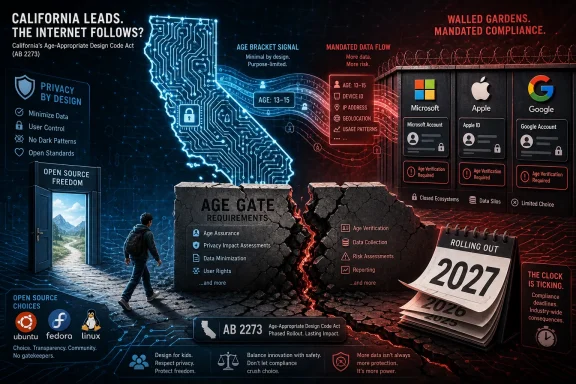 California Tried to Move the Age Check Down the Stack
The Digital Age Assurance Act was designed around a seductive idea: stop forcing every app and website to guess a user’s age, and instead have the device ecosystem provide a standard signal. In theory, that means the operating system asks for a birth date or age during setup, sorts the user into a bracket, and makes that status available to application stores and developers through a consistent interface.For lawmakers, the appeal is obvious. Apple, Google, and Microsoft already control account systems, app distribution channels, parental controls, device setup flows, developer APIs, and terms of service. If the state wants a durable age signal, the platform layer looks like the place where leverage is strongest.
That is why the law landed so heavily in the Windows world. Windows setup already nudges users toward Microsoft accounts, and Microsoft’s consumer account system already asks for date-of-birth information. On paper, adding a compliance-oriented age signal looks like an extension of existing infrastructure rather than an alien demand.
But “on paper” is doing a heroic amount of work. Windows is not merely a login screen, and an age signal is not merely a field in an account database. Once an operating system becomes the legal conduit for age classification, the setup experience, account model, developer relationship, privacy posture, and update regime all become part of a state-mandated identity pipeline.
That is a major shift for commercial platforms. For open-source systems, it was close to absurd.
Linux Was Never a Platform in the Way Sacramento Needed It to Be
The original concern was not that Linux users dislike filling in forms, though many certainly do. The deeper problem was that Linux does not behave like a platform in the legal and operational sense assumed by the statute. Ubuntu, Debian, Fedora, Arch, Linux Mint, SteamOS, and a long tail of smaller projects are not interchangeable subsidiaries of a single Linux corporation.Some distributions are backed by companies. Some are community projects. Some are downstream rebuilds. Some are maintained by volunteers who package software, publish images, and rely on global mirrors. Many do not require an online account during setup at all, and many are designed precisely to avoid a dependency on a vendor-controlled cloud identity.
The law’s platform model assumes there is an entity that can modify setup, collect an age signal, maintain an API, authenticate developers, police access, and update the system when California changes the rules. That assumption maps imperfectly onto Windows, macOS, Android, and iOS. It maps disastrously onto the broader Linux ecosystem.
A Debian ISO can be downloaded, copied, remixed, installed offline, forked, mirrored, and altered. A hobbyist can build an image for an old laptop. A university can host a mirror. A sysadmin can PXE-boot a fleet. A Steam Deck can run Valve’s curated SteamOS experience, while a tinkerer installs another distribution entirely. The question “who is the operating system provider?” becomes less a compliance prompt than a philosophical trap.
California’s proposed amendment appears to recognize that trap. By excluding operating systems and applications distributed under license terms that allow recipients to copy, redistribute, and modify the software without platform-imposed restrictions on modified versions, lawmakers are drawing a line around open-source distribution. It is a technical-sounding carveout, but its political meaning is plain: the state does not want to spend 2027 pretending it can make Debian behave like iOS.
The Amendment Is a Tactical Retreat, Not a Philosophical Conversion
It would be a mistake to read the carveout as a sudden embrace of software freedom. California is not saying that age verification is overreach, nor that operating systems are the wrong regulatory layer. It is saying that some operating systems are structurally incapable of serving the function lawmakers assigned to them.That distinction matters. Windows, macOS, Android, and iOS remain the obvious targets because they are governed by companies with accounts, app stores, developer programs, and compliance teams. The open-source exception lets the bill survive contact with reality without surrendering the central ambition of OS-level age assurance.
In that sense, Linux may be less the winner than the escape hatch. Lawmakers can preserve the idea that the dominant consumer platforms should emit age signals while dropping the most embarrassing edge case. The bill becomes easier to defend because critics can no longer point to every volunteer-run distribution as evidence that the statute was written by people who had never installed an operating system outside a walled garden.
The open-source world should still be cautious about celebrating. A carveout can narrow a law’s blast radius, but it can also normalize the broader framework. Once the public accepts that commercial operating systems should classify users by age and share bracket signals with apps, the argument shifts from whether the architecture is desirable to which software projects are large enough to absorb it.
That is exactly how platform regulation tends to harden. The first draft is too broad, critics object, lawmakers exempt the most sympathetic or impractical cases, and the remaining mandate starts to look reasonable by comparison.
Windows Is the Compliance Model and the Warning Sign
Windows users may look at the Linux exemption and wonder whether this is someone else’s fight. It is not. The open-source carveout highlights what makes Windows such an attractive target for age-assurance mandates: Microsoft has already built much of the machinery regulators want to conscript.Windows 11 setup has become increasingly account-centric. Microsoft has spent years pushing consumers toward Microsoft accounts, OneDrive integration, cloud backup, Microsoft Store identity, device encryption recovery keys, family safety features, and cross-device personalization. Even when local-account workarounds exist, the strategic direction is unmistakable: Windows setup is no longer just the act of creating a user on a PC. It is the opening move in joining a Microsoft-managed services environment.
That makes compliance easier, but not harmless. If a California age signal becomes part of Windows setup, the practical question is not whether Microsoft can ask for a birth date. The question is how that age bracket travels through the Windows ecosystem, which apps can request it, how developers are authorized, how parents correct errors, how minors age into new brackets, and how much of the plumbing becomes standardized for other jurisdictions.
Microsoft can plausibly implement all of this. It can expose APIs, update documentation, integrate age data with Microsoft accounts, and adjust the out-of-box experience for California users. But each of those steps pushes Windows further from the general-purpose PC tradition and closer to a regulated identity terminal.
That is the part enthusiasts will feel most strongly. Windows has always balanced two personalities: the managed platform Microsoft wants it to be and the messy, backward-compatible, user-controlled environment that made it dominant. OS-level age assurance strengthens the managed platform side of that conflict.
The Local Account Fight Now Has a Regulatory Shadow
For years, the local-account debate has been framed as a consumer-choice argument. Users who want privacy, simplicity, offline setup, lab deployment, resale flexibility, or plain old independence dislike being forced into a Microsoft account. Microsoft, meanwhile, has treated online identity as the gateway to security features, subscription services, app distribution, and telemetry-driven personalization.Age assurance changes the stakes. If governments begin to expect operating systems to emit user-status signals, then cloud accounts stop being just a business preference. They become compliance infrastructure.
That does not mean every Windows PC will necessarily require a Microsoft account forever. Microsoft could, in principle, build an age declaration flow for local accounts or provide a device-scoped age bracket stored locally. But the policy gravity pulls in the other direction. A cloud account is easier to audit, easier to synchronize, easier to expose to developers, and easier to update when legal obligations change.
For IT administrators, this is not an abstract culture-war issue. Schools, libraries, shared workstations, labs, kiosks, refurbished machines, and small businesses all rely on deployment models that do not fit neatly into a single person’s age-coded consumer identity. A device can have multiple users. A user can have multiple accounts. A parent may set up a machine used by a child. A teenager may use a family PC. A business laptop may be temporarily assigned, reimaged, or enrolled in management.
The more the law treats device setup as the decisive moment of age classification, the more brittle the system becomes. Windows can paper over that brittleness with enterprise policy, Entra ID, Intune, family accounts, and region-specific flows. But complexity does not disappear because Microsoft can implement it. It simply moves into the admin console.
Open Source Forced the Law to Admit Its Own Architecture
The Linux carveout is important because it reveals the hidden architecture of the Digital Age Assurance Act. This is not really a law about “operating systems” in the broad computing sense. It is a law about vertically integrated consumer platforms.That difference should have been acknowledged from the start. Apple and Google run mobile ecosystems where app distribution, developer identity, parental controls, payment systems, and device setup are tightly bound together. Microsoft is not as vertically integrated on the PC, but it has been moving Windows in that direction through account requirements, the Microsoft Store, Smart App Control, Defender reputation services, and cloud-backed settings.
Linux does not fit because Linux preserves separations that platform regulation often wants to collapse. The kernel is not the distribution. The distribution is not always the installer. The installer is not always an account provider. The app repository is not necessarily an app store. The maintainer is not necessarily a company. The user is not necessarily online.
That messiness is not a bug in the open-source model; it is the model’s resilience. It is why Linux runs on servers, routers, phones, handheld gaming devices, developer workstations, embedded boards, old laptops, and cloud infrastructure. It is also why a state-level rule that assumes a tidy provider-user-developer triangle breaks down so quickly.
The amendment’s language appears designed to distinguish software freedom from commercial platform control. If users can copy, redistribute, and modify the software, and if the original provider does not impose technical or contractual restrictions on installing modified versions, the distributor falls outside the operating-system-provider definition. That is a legal recognition of a practical fact: you cannot regulate a forkable commons as if it were an app-store landlord.
The Privacy Trade-Off Is Still Being Underplayed
Supporters of age-assurance laws usually frame them as child-safety measures, and that political framing is powerful. Parents are worried about harmful content, manipulative apps, addictive design, sexual exploitation, algorithmic feeds, and online services that treat minors as engagement inventory. Those concerns are real.The problem is that age infrastructure rarely stays small. A system built to distinguish under-13 users from adults must collect, infer, store, or transmit information about age. Even if it sends only a bracket rather than a birth date, it creates a durable classification that apps may request and platforms must manage.
California’s model tries to avoid the worst version of identity verification by relying on declared age brackets rather than requiring every user to upload a government ID. That is a meaningful distinction. But it does not eliminate the concern that the operating system becomes a broker of personal status.
For Windows users, the privacy question is especially delicate because Microsoft already sits at the intersection of identity, telemetry, cloud sync, advertising, productivity software, gaming, app distribution, and security services. Adding state-mandated age signaling to that stack may be limited in design, but it reinforces a broader trend: the PC knows more about the person sitting in front of it, and more parties have reasons to ask.
The open-source exemption implicitly acknowledges another privacy reality. Systems that avoid centralized accounts and vendor APIs are harder to conscript into surveillance-adjacent compliance structures. That does not make every Linux installation private or secure. It does mean the architecture leaves fewer obvious handles for lawmakers to grab.
Developers Will Inherit the Ambiguity
The law is not only about users and operating systems. It also changes the developer relationship. If apps can request age-bracket signals from the OS or application store, developers gain a new compliance tool — and a new source of liability.For large app makers, that may be welcome. A standardized platform signal could reduce the need to build separate age-estimation systems for every service. If Apple, Google, or Microsoft tells an app that a user falls into a certain bracket, the developer may be able to tune access, content, messaging, or parental-consent flows accordingly.
But the simplicity is deceptive. Developers still need to decide when to request the signal, what to do if it is unavailable, how to handle conflicting information, and how to avoid collecting more than necessary. They also need to understand how the rules vary across states and countries, because California will not be the only jurisdiction experimenting with age assurance.
The Linux exemption complicates the story further. If a developer releases an app for Windows, macOS, Android, iOS, and Linux, age-signal expectations may differ by platform. A California user on Windows may produce a platform signal. A California user on an exempt Linux distribution may not. A developer that treats missing signals as adult status risks undermining the law’s purpose; one that blocks access without a signal risks punishing open-source users.
That tension is not accidental. Whenever regulators place compliance duties at one layer of the stack, other layers must interpret the gaps. The open-source carveout solves one impossibility for Linux maintainers while creating a new unevenness for app developers.
The State-Level Patchwork Is the Real Long-Term Threat
California matters because California is large, influential, and often copied. But the bigger story is not one statute. It is the emerging patchwork of state and national attempts to regulate minors’ access to digital services through age verification, age estimation, parental consent, app-store controls, or device-level signals.For global platform companies, a patchwork is expensive but manageable. They have legal teams, compliance engineers, policy shops, and regional rollout machinery. They can build jurisdiction-aware setup flows and feature flags. They can lobby, litigate, delay, and adapt.
For smaller developers, open-source projects, and independent software vendors, patchwork regulation is a tax on existence. A rule written for trillion-dollar platforms can become a distribution risk for a hobby OS, a calculator firmware project, a niche app store, or a privacy-focused Android fork. Even when lawmakers later carve out some of those projects, the message is chilling: publish software widely enough and you may wake up inside a regulatory category no one designed for you.
That is why the Linux exemption is both sensible and unsettling. Sensible, because it prevents an unworkable mandate from hitting projects with no realistic compliance path. Unsettling, because it demonstrates how easily broad platform laws can misclassify the software ecosystem before anyone in the room notices.
WindowsForum readers should pay attention to this dynamic because Windows sits at the center of the regulated-platform future. Microsoft is large enough to comply, visible enough to be targeted, and eager enough to integrate accounts and cloud services that legal mandates may align with its product strategy. The result is not necessarily malicious. It may be worse: convenient.
The Exemption Saves Linux From a Bad Fit, Not Users From Age Gates
The practical outcome is straightforward. If the amendment becomes law in its expected form, mainstream open-source operating systems such as Debian, Fedora, Ubuntu, Arch, and similar distributions would likely avoid the California age-signal obligation. Commercial platform operating systems would remain under pressure to implement the law before its 2027 effective date.That means the age-verification fight will become less about whether Linux Mint must add a birth-date prompt and more about how Microsoft, Apple, and Google implement state-mandated age infrastructure. The carveout removes the most technically embarrassing scenario, but it leaves the mainstream consumer-device market squarely in scope.
The legal uncertainty will not vanish. Hybrid systems such as SteamOS, commercial Linux appliances, Android forks, and vendor-curated open-source products may still raise hard questions. A system can be open source in license terms but distributed through controlled hardware, app stores, or update channels. The amendment’s language will matter, and so will enforcement choices.
GrapheneOS and similar privacy-first projects have already signaled that they may refuse to participate in laws requiring invasive setup-time age checks, even if that means limiting availability in certain regions. That posture illustrates the problem lawmakers face with software that is global, downloadable, and ideologically opposed to identity collection. Unlike a retailer with storefronts, a privacy OS can decide that noncompliance is part of its brand.
Linux slipped past the crackdown because it made the enforcement problem visible. The larger industry did not slip past anything. It is now standing alone in the compliance spotlight.
Microsoft’s Incentives Deserve More Scrutiny Than Its Capabilities
There is little doubt Microsoft can build whatever California requires. The company has the engineering depth, identity infrastructure, developer documentation pipeline, and Windows Update reach to deliver an age-signal mechanism. The more important question is how Microsoft chooses to integrate it into the Windows experience.A minimal implementation would ask only what the law requires, expose only the narrow signal required, separate the data from advertising and personalization systems, provide clear controls, support local and managed accounts, and avoid using the mandate as an excuse to make Microsoft accounts harder to bypass. That version would still be controversial, but it would respect the boundary between compliance and product strategy.
A more aggressive implementation would fold age assurance into the broader Microsoft account funnel. It would make online setup feel even more mandatory, route family features through Microsoft services, encourage developers to rely on Microsoft-controlled identity signals, and treat local accounts as exceptions rather than first-class citizens. That version would be legally convenient and commercially useful.
The history of Windows 11 setup gives users reason to be skeptical. Microsoft has repeatedly tested how far it can push account requirements, online connectivity, Edge defaults, OneDrive prompts, and subscription tie-ins before backlash forces adjustment. A legal mandate for age signaling could become another ratchet in that same direction.
This is where regulators and users should demand specificity. If the state compels operating systems to provide age signals, then the implementation should be auditable, limited, and separable from unrelated account monetization. “Think of the children” cannot become a blank check for platform lock-in.
The Calendar Now Belongs to the Platform Lawyers
The 2027 effective date gives the industry time, but not comfort. Platform companies will need to design compliance systems, interpret the amendment, coordinate with developers, update setup flows, and prepare for enforcement guidance. Legislators may continue revising the statute as edge cases surface.For Windows admins, the near-term task is not panic; it is inventory. Organizations should understand which devices are consumer-configured, which are domain-joined or cloud-managed, which are shared by minors, and which deployment paths might encounter consumer age-assurance prompts. The worst time to discover a new setup requirement is during a school refresh, a library imaging project, or a small-business hardware rollout.
Developers should begin thinking about age-signal absence as a normal condition, not an error state. Even if Windows, macOS, Android, and iOS eventually provide standard signals in California, exempt Linux systems and out-of-scope environments will exist. Good software will need policies for mixed signals, missing signals, and users who move across devices.
Users should expect the debate to become more confusing before it becomes clearer. Age assurance is not one technology. It can mean self-declared age, parental approval, platform account metadata, app-store signals, document verification, facial age estimation, credit-card checks, or combinations of those methods. California’s OS-level model is relatively restrained compared with some proposals, but it still shifts the default relationship between the user and the machine.
The open-source exemption is a win for feasibility. It is not yet a win for privacy, interoperability, or user autonomy.
The Carveout Tells Windows Users Where the Fight Moves Next
California’s amendment narrows the blast radius, and that matters. But it also clarifies the battlefield. Linux distributions may avoid the mandate because they are too decentralized to conscript cleanly. Windows remains in scope because it is centralized enough to comply.- California’s age-assurance law is scheduled to affect operating-system setup beginning January 1, 2027, with an amendment moving to exclude qualifying open-source software.
- The exemption recognizes that Linux distributions generally lack the centralized account systems, app-store relationships, and developer APIs assumed by the original law.
- Windows, macOS, Android, and iOS remain the practical targets because their vendors already operate identity and developer ecosystems at platform scale.
- The biggest Windows risk is not the collection of a birth date by itself, but the possibility that age signaling becomes another reason to weaken local-account and offline setup paths.
- Developers should plan for uneven platform behavior, because exempt open-source systems may not provide the same age signals as commercial operating systems.
- The broader fight will be over implementation limits, data minimization, and whether child-safety mandates become a vehicle for deeper platform control.
References
- Primary source: Windows Central
Published: Tue, 26 May 2026 10:46:35 GMT
I knew Linux PCs would get a free pass from California's controversial age-verification law for operating systems | Windows Central
Linux and open-source systems won’t be subject to age-verification checks in the state.www.windowscentral.com - Related coverage: tomshardware.com
California introduces age verification law for all operating systems, including Linux and SteamOS — user age verified during OS account setup | Tom's Hardware
AB 1043 also requires OS providers to pipe a real-time age checker to every app developer who requests it.www.tomshardware.com - Related coverage: law.justia.com
California Civil Code § 1798.501 (2025) :: 2025 California Code :: U.S. Codes and Statutes :: U.S. Law :: Justia
Cal. CIV Code § 1798.501 - 1798.501. (a) An operating system provider shall do all of the following:(1) Provide an accessible interface at account setup that requires an account holder to indicate the birth date, age, or both,law.justia.com
- Related coverage: pcgamer.com
A new California law says all operating systems, including Linux, need to have some form of age verification at account setup | PC Gamer
I wonder how the government of California plans to enforce it?www.pcgamer.com - Related coverage: opensourceforu.com
California Age Law Puts Open Source Operating Systems In A Compliance Dilemma - Open Source For You
California’s new Digital Age Assurance Act requires operating systems to collect user age during device setup, triggering privacy concerns and technical www.opensourceforu.com
- Related coverage: linuxteck.com
California Age Verification Law Linux: Why AB 1043 Critically Fails Open Source In 2027
California age verification law Linux distros can't comply with AB 1043 — volunteer projects have no accounts, no budget, and no legal path by the 2027 deadline.www.linuxteck.com
- Related coverage: biometricupdate.com
California’s OS-based age verification law challenges open-source community | Biometric Update
California’s new online safety bill, AB 1043 (the Digital Age Assurance Act), adopts a declared age model for operating systems. www.biometricupdate.com
- Related coverage: techradar.com
California's age verification law is proving controversial — here's what you need to know, and why some Linux distros are in the firing line | TechRadar
Smaller, more niche Linux distros could be left out in the coldwww.techradar.com - Related coverage: ap7i.com
ap7i.com | California's Age Verification Law Has an Open-Source Problem
California’s Digital Age Assurance Act requires every operating system to verify user age and expose an API for apps. At least one open-source OS has responded by banning California users entirely.ap7i.com
