

A 93-page University of Cambridge study says some Boko Haram fighters in north-east Nigeria used ChatGPT, Claude, Gemini, Grok, Meta AI and DeepSeek for attack planning, weapons troubleshooting, surveillance and bomb design, based primarily on 57 interviews with 27 former members conducted between 2025 and 2026. The report’s significance is not that terrorists discovered chatbots; that outcome was foreseeable from the moment general-purpose AI became globally accessible. Its more disturbing claim is that both major Boko Haram factions reportedly turned consumer AI into an organized operational resource, complete with foreign trainers, paid accounts and dedicated internal units. Yet the study also arrives with a decisive limitation: it offers field testimony, not platform logs, forensic evidence or proof that AI made the insurgents measurably more capable.
The study, titled “God has helped us, and so will AI: How the Terrorist Group Boko Haram Uses Frontier AI,” was authored by Antonia Juelich, a terrorism researcher at the Cambridge Programme on AI Science & Policy. The New York Times first reported its findings, while Premium Times examined the report from the country where Boko Haram’s insurgency has inflicted its greatest human cost.
That Nigerian context matters. In the 17th year of the insurgency, more than 35,000 people have been killed and over two million displaced, according to the figures cited by Premium Times. A debate about chatbot safeguards can sound abstract in a laboratory, policy paper or Silicon Valley product meeting; in north-east Nigeria, the alleged users belong to an armed movement with an established record of mass killing, abduction and territorial violence.
Juelich characterizes the research as the first field-based evidence of terrorist organizations adopting frontier AI. That description rests on the nature of the interviews: rather than studying public propaganda, extremist social-media posts or hypothetical model outputs, the researcher spoke to people who said they had participated in Boko Haram’s internal operations.
The former members described AI use extending beyond the familiar information domain of translation, recruitment and propaganda. According to the report, fighters and commanders consulted chatbots for tactical planning, logistical problems, operational security, surveillance strategy, weapons troubleshooting, improvised explosive-device design and attempts to improve drone weaponization.
This is the study’s central contribution. It suggests that the practical danger of generative AI may not begin with an autonomous weapon or a spectacular breakthrough in destructive capability. It may begin with something quieter: a cheap, persistent adviser helping a violent organization solve hundreds of small problems faster than it could before.
That alleged platform agnosticism changes the security problem. If one chatbot refuses a request, a user can reportedly try another, alter the wording, divide the task into smaller questions or return later through a different account. Safety is therefore determined not only by the strongest platform but by the most permissive answer available across an entire market.
The report says both the Islamic State West Africa Province, or ISWAP, and Jama’atu Ahlis Sunna Lidda’awati wal-Jihad, or JAS, established dedicated AI units. Those units allegedly managed access, trained fighters and supported operational planning, turning what might otherwise have been isolated experimentation into an organizational capability.
The distinction between individual and institutional use is crucial. An individual fighter asking a chatbot a prohibited question is a content-moderation incident. A specialized team testing multiple platforms, teaching evasion methods and translating answers into field instructions is an adversarial program.
That program does not need a sophisticated data center. According to former commanders interviewed for the study, foreign trainers supplied laptops, virtual private networks, encrypted software and paid subscriptions to multiple AI platforms. None of those resources is exotic, and together they create a portable technical stack that can be deployed far from a conventional technology hub.
This is why the report should not be read as a story about one defective safety filter. Its argument is that an armed organization can combine widely available devices, commercial subscriptions, encrypted communications and human trainers into a resilient AI-access pipeline. Blocking one prompt or disabling one account may interrupt an interaction without dismantling the capability.
The former Boko Haram members reportedly treated the tools as interchangeable sources of advice. That means each company’s safeguards exist inside a competitive ecosystem in which failure can be routed around. A refusal from one service may simply reveal that the user needs to switch platforms, restate the question or conceal the intended purpose.
OpenAI says its policies prohibit terrorism, violence, weapons development and attempts to circumvent safeguards. The company also says ChatGPT is trained to refuse instructions, tactics or planning that could meaningfully enable violence, while automated systems and human reviewers can investigate concerning activity and revoke access.
According to coverage of the Cambridge findings, OpenAI said the reported conduct violated its policies. Google and Anthropic similarly pointed to protections designed to refuse dangerous requests. Those responses establish an important baseline: the reported activity was not an intended or permitted use of the products.
But policy prohibition and technical prevention are different things. A rule can make enforcement legitimate without making evasion impossible, particularly when a service must distinguish malicious planning from legitimate questions posed by researchers, journalists, engineers, soldiers, emergency workers or students.
The study claims fighters learned prompting methods that concealed malicious intent behind apparently legitimate projects. It is not necessary to reproduce those methods to understand the underlying problem. General-purpose systems infer intent from incomplete context, while an adversary can deliberately manipulate that context.
The alleged multi-platform approach also complicates accountability. No single provider sees the complete workflow if reconnaissance questions occur on one service, mechanical troubleshooting on another and tactical brainstorming on a third. Each company may observe fragments that appear ambiguous in isolation, even when the combined activity forms a coherent operational plan.
That fragmented visibility is familiar to cybersecurity professionals. Attackers routinely distribute infrastructure, identities and actions across providers so that no defender possesses the whole picture. The Cambridge report suggests terrorist use of generative AI could evolve along the same lines, transforming platform hopping from ordinary consumer choice into a form of operational resilience.
The report presents no platform logs, account records, preserved conversations, technical telemetry or forensic artifacts directly connecting Boko Haram to the named AI systems. Premium Times also noted that it was unclear whether the companies behind all the products had been contacted during the research or had independently confirmed attempted use by the group.
That gap prevents the strongest possible conclusion. The study cannot demonstrate that particular outputs came from particular products, that interviewees remembered every detail accurately or that claimed successes were caused by AI rather than by existing expertise, experimentation or knowledge obtained elsewhere.
It also cannot establish how frequently these tools were used across Boko Haram’s broader organization. Twenty-seven former members can provide rare qualitative access, but they do not necessarily constitute a representative sample of every unit, commander, region or period within a fragmented insurgency.
Former fighters may have incentives to exaggerate their importance, the sophistication of their units or the effectiveness of novel tools. They may also attribute successful operations to AI after the fact, especially when the technology has acquired a reputation for unusual power.
None of that makes the testimony worthless. Field research on clandestine armed groups almost always operates under imperfect conditions, and the absence of server-side evidence does not prove the absence of use. It means the correct reading is field evidence, not forensic proof.
The study’s credibility therefore depends partly on its restraint. Juelich does not claim to have measured a definitive increase in Boko Haram’s combat effectiveness. The report instead documents former members’ perception that AI made their organization more effective, a narrower finding that should not be inflated into a verified battlefield-performance metric.
That distinction is more than academic caution. If policymakers treat every reported chatbot interaction as proof of a revolutionary military capability, they risk designing policy around spectacle. If they dismiss all interview evidence until a technology company produces perfect logs, they risk ignoring a capability until it is mature and widely distributed.
The responsible position lies between those errors. The interviews are sufficiently detailed and internally consequential to justify investigation, defensive preparation and better data collection. They are not sufficient to declare that generative AI has transformed Boko Haram into a fundamentally new kind of military organization.
2025 — Juelich’s fieldwork period began, with interviews conducted among former Boko Haram members in north-east Nigeria.
2026 — The interview period concluded, and the resulting 93-page Cambridge report presented its account of AI use within ISWAP and JAS.
An organized adversary does not have to interact that way. It can spread a project across multiple accounts, people, devices, sessions and platforms. It can ask for individually benign components, insert fictional or educational framing, translate requests, vary terminology and combine general information outside the chatbot.
That is why refusal-rate testing, while useful, cannot fully model the threat described by the Cambridge report. A laboratory evaluation may determine whether one model answers a plainly malicious prompt. It may not determine whether a trained group can assemble useful assistance through dozens of superficially ordinary conversations.
The report’s claim about dedicated AI units raises the difficulty further. Specialized operators can learn which systems perform particular tasks well, maintain reusable prompting patterns, teach other members and review output before it reaches fighters. They become intermediaries between an unreliable chatbot and a violent organization.
Human intermediation matters because AI output does not need to be perfectly accurate to be valuable. A knowledgeable user can reject obvious errors, combine suggestions with field experience and test ideas incrementally. The model supplies possibilities; the organization supplies intent, local knowledge, materials and the willingness to experiment.
Conversely, inaccurate answers can still harm the user or derail an operation. Generative AI remains prone to fabrication, misplaced confidence and context failures. The Cambridge study does not prove that the named tools consistently delivered accurate weapons or tactical advice, only that former members believed they extracted operational value from them.
For safety engineers, this produces an uncomfortable dual requirement. Systems should avoid giving actionable assistance to violent actors, but they must also avoid assuming that hallucination is a defense. An unreliable answer may fail to help, yet a partially correct answer can still reduce the time, cost or expertise required for harmful experimentation.
That does not mean the model creates knowledge from nothing. Much of the underlying information may already exist in manuals, videos, online forums or the experience of other militants. The change is that a conversational system can retrieve, reframe and adapt information to a user’s immediate problem.
For a resource-constrained armed group, the resulting advantage may be less about invention than persistence. A fighter can repeatedly ask follow-up questions without exposing ignorance to a superior. A mechanic can describe a failure and receive diagnostic possibilities. A commander can compare scenarios without waiting for a scarce specialist to become available.
One former ISWAP commander summarized the alleged use under three broad functions: weapons and explosives learning, surveillance improvement and practical attack planning. The report’s phrase “We mostly used it in three ways” captures how ordinary the technology had reportedly become to some users—not an experimental superweapon, but a recurring support tool.
The operational value of such a system is likely uneven. AI may contribute little where success depends on scarce components, tacit craftsmanship, accurate intelligence or complex coordination. It may contribute more where the barrier is understanding unfamiliar terminology, generating options or remembering procedural knowledge.
This helps explain why the report emphasizes mundane uses such as logistics, communications and troubleshooting alongside more dramatic weapons claims. The cumulative benefit of many small efficiencies could matter more than any single prohibited answer. A violent organization does not need AI to devise an unprecedented attack if it can use AI to waste less time preparing an ordinary one.
The danger is therefore not limited to the maximum destructive capability of the most advanced model. It includes the minimum capability available from ordinary consumer products when combined with motivated users and existing expertise.
That terminology is the interviewee’s characterization, not an independently verified identification of the trainers. The report does not provide forensic proof of their nationality, travel, identities or organizational assignments. Still, the testimony describes knowledge transfer as an in-person process rather than a spontaneous discovery by isolated fighters.
Former commanders said the trainers brought laptops, VPNs, encrypted software and subscriptions to several AI services. The combination suggests a curriculum extending beyond basic chatbot use: account access, privacy, communications security, platform comparison and methods for obtaining responses despite safety controls.
If accurate, this is evidence that transnational militant networks can distribute AI practices much as they have historically distributed bomb-making knowledge, media techniques and operational doctrine. The strategic asset is not merely access to a website. It is a repeatable method for teaching others how to exploit a changing set of services.
Dedicated units would preserve that method even when specific products or accounts disappear. Operators can test new models, update their practices and transmit lessons internally. Organizational memory sits with the unit rather than with a particular chatbot.
This also makes model updates an adversarial feedback cycle. Providers strengthen safeguards, users test the new boundaries, successful workarounds are shared and providers adjust again. Consumer AI companies are accustomed to managing fraud, spam and cyber abuse at internet scale; the Cambridge study argues that terrorism-related misuse belongs in the same continuously monitored category.
The foreign-training allegation further complicates geographic assumptions. A platform may observe accounts that appear to belong to ordinary customers in one country while the resulting information is transferred to an armed unit somewhere else. VPN use, shared credentials, intermediaries and paid subscriptions can obscure both the user and the beneficiary.
The policy challenge is consequently international from the start. Boko Haram’s battlefield is centered in Nigeria and the surrounding region, but the named AI services, payment systems, app stores, hosting infrastructure and suspected trainers cross jurisdictions. No national content rule can see or govern the entire chain.
That resemblance limits blunt technical responses. VPNs protect journalists, companies and citizens as well as militants. Encryption is fundamental to modern security. Paid AI subscriptions are normal productivity tools, and laptops are ubiquitous.
The practical lesson for enterprise IT is not to classify ordinary privacy tools as suspicious. It is to understand that identity, endpoint and payment controls can become part of the evidence chain when high-risk activity appears. A compromised corporate account, stolen payment method or unmanaged AI subscription may provide an adversary with access and legitimacy it could not easily obtain alone.
Organizations operating in conflict zones, humanitarian networks, defense supply chains, telecommunications and government contracting face the clearest exposure. Their devices and accounts may be theft targets, their staff may encounter coercion, and their AI access could be abused to make activity appear institutional or benign.
Procurement teams also need visibility into which AI services employees can purchase and how those subscriptions are managed. An organization cannot investigate misuse effectively if it lacks an inventory of accounts, administrators, billing owners, data-retention settings and reporting contacts.
For AI providers, endpoint context can complement prompt analysis, though it must be handled with privacy safeguards and legal discipline. Patterns such as repeated account creation, coordinated safeguard evasion or unusual sharing may provide a stronger signal than a single ambiguous question. The goal should be risk-based correlation, not indiscriminate surveillance.
Blocking every relevant discussion would make general-purpose AI less useful without necessarily stopping determined actors. Overblocking also teaches malicious users which words trigger defenses, while creating a flood of false positives that human reviewers cannot investigate meaningfully.
The stronger approach is contextual and behavioral. Providers need to examine how a conversation evolves, whether the user is requesting increasingly actionable detail, whether safety boundaries are being repeatedly tested and whether several accounts exhibit coordinated patterns.
OpenAI publicly describes automated detection and human review for potentially dangerous activity, including patterns that become concerning only across a longer conversation. The Cambridge findings suggest that this temporal view should extend, where legally and technically possible, to repeat-account abuse and organized evasion.
Yet even sophisticated monitoring will have blind spots. A user can take general information from a model and combine it with knowledge acquired elsewhere. One member can operate an account while another carries out the physical task. An AI provider cannot see activity that happens after text leaves its service.
That is why the right model is defense in depth rather than faith in refusals. Model behavior, account integrity, abuse detection, payment security, incident reporting, expert review and law-enforcement coordination each cover a different part of the problem.
External expertise is particularly important. Terrorism researchers understand organizational hierarchy, recruitment, doctrine and tactical adaptation in ways that generic safety benchmarks do not. Regional experts can identify language, euphemisms and cultural context that automated moderation may miss.
Juelich argues that technical testing alone cannot capture how militant groups make decisions or exploit emerging technology. That is persuasive even if some of the report’s specific allegations remain unverified. A safety evaluation that ignores the organizational behavior of the adversary is measuring only the model, not the threat.
That restraint leaves governments and companies with difficult trade-offs. Restricting advanced AI access by geography may punish populations already excluded from useful technologies while determined groups adopt VPNs, intermediaries or alternative services. Mandatory identity controls could improve accountability but create privacy, civil-liberties and personal-safety risks.
Banning discussion of dual-use topics is similarly unsatisfactory. Engineers, researchers, soldiers, emergency responders and journalists require legitimate access to sensitive information. Models must separate harmful operational assistance from analysis and prevention, a distinction that is inherently contextual.
A platform-by-platform response also misses the ecosystem behavior described by the report. If users mix six services, effective defense requires common reporting channels, comparable abuse classifications and mechanisms for sharing high-confidence threat indicators under appropriate law and privacy controls.
That cooperation cannot become an informal global surveillance network. AI companies should not exchange raw user conversations merely because a person asked an uncomfortable question. Any cross-provider process would need clear thresholds, minimization rules, auditability and oversight.
Governments, meanwhile, need investigative capacity that connects digital traces to physical organizations. Platform intelligence is most useful when combined with financial records, captured equipment, human sources and field investigations. Without that bridge, providers may identify suspicious accounts without knowing whether they belong to an actual militant unit, a researcher or a provocateur.
The report also supports investment in local expertise. Nigerian researchers, civil-society groups, security agencies and affected communities possess context that cannot be recreated entirely from Silicon Valley or European policy centers. Their participation is essential both for threat assessment and for preventing poorly designed countermeasures from harming legitimate users.
The immediate need is not a theatrical promise to make AI impossible for terrorists to access. General-purpose models, alternative platforms and downloadable systems make that goal unrealistic. The achievable goal is to raise the cost of organized misuse, shorten the period before detection and reduce the operational usefulness of outputs.
It does not prove that AI-generated advice was correct. Interviewees’ belief in a system’s usefulness is not the same as a technical evaluation of its outputs. Some advice may have been generic, inaccurate or reconstructed through memory.
It does not prove that Boko Haram could not have obtained similar information elsewhere. Militant groups have long used human trainers, captured materials, manuals, videos, online communities and battlefield experimentation. AI may have reorganized existing knowledge rather than introduced unique capabilities.
Nor does it prove that the technology altered the insurgency’s strategic trajectory. The report cannot measure whether AI increased attack success, reduced casualties among fighters, expanded territorial control or changed the balance with Nigerian forces.
What it does provide is a detailed account of how former members say the technology fit into their organization. That account includes training, access management, cross-platform use and specialized units—features that are more strategically meaningful than a sensational screenshot of a chatbot answering one dangerous question.
The study should therefore be judged as an early-warning document. Early warnings are necessarily incomplete; if they contained comprehensive forensic evidence and years of confirmed outcome data, they would no longer be early.
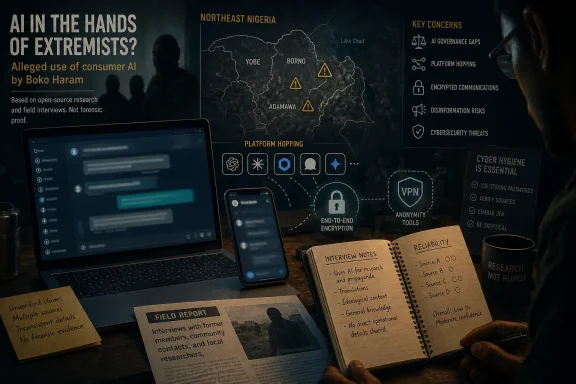 Cambridge Moves the AI-Terrorism Debate From Theory to Testimony
The study, titled “God has helped us, and so will AI: How the Terrorist Group Boko Haram Uses Frontier AI,” was authored by Antonia Juelich, a terrorism researcher at the Cambridge Programme on AI Science & Policy. The New York Times first reported its findings, while Premium Times examined the report from the country where Boko Haram’s insurgency has inflicted its greatest human cost.That Nigerian context matters. In the 17th year of the insurgency, more than 35,000 people have been killed and over two million displaced, according to the figures cited by Premium Times. A debate about chatbot safeguards can sound abstract in a laboratory, policy paper or Silicon Valley product meeting; in north-east Nigeria, the alleged users belong to an armed movement with an established record of mass killing, abduction and territorial violence.
Juelich characterizes the research as the first field-based evidence of terrorist organizations adopting frontier AI. That description rests on the nature of the interviews: rather than studying public propaganda, extremist social-media posts or hypothetical model outputs, the researcher spoke to people who said they had participated in Boko Haram’s internal operations.
The former members described AI use extending beyond the familiar information domain of translation, recruitment and propaganda. According to the report, fighters and commanders consulted chatbots for tactical planning, logistical problems, operational security, surveillance strategy, weapons troubleshooting, improvised explosive-device design and attempts to improve drone weaponization.
This is the study’s central contribution. It suggests that the practical danger of generative AI may not begin with an autonomous weapon or a spectacular breakthrough in destructive capability. It may begin with something quieter: a cheap, persistent adviser helping a violent organization solve hundreds of small problems faster than it could before.
The Most Important Claim Is Institutionalization, Not a Chatbot Brand
Headlines naturally focus on ChatGPT because it is the best-known product in the category. But the report names six systems—ChatGPT, Claude, Gemini, Grok, Meta AI and DeepSeek—and describes fighters moving among them rather than depending on a single provider.That alleged platform agnosticism changes the security problem. If one chatbot refuses a request, a user can reportedly try another, alter the wording, divide the task into smaller questions or return later through a different account. Safety is therefore determined not only by the strongest platform but by the most permissive answer available across an entire market.
The report says both the Islamic State West Africa Province, or ISWAP, and Jama’atu Ahlis Sunna Lidda’awati wal-Jihad, or JAS, established dedicated AI units. Those units allegedly managed access, trained fighters and supported operational planning, turning what might otherwise have been isolated experimentation into an organizational capability.
| Faction | Full name | Reported AI role | Organizational claim | Distinct evidence in the coverage |
|---|---|---|---|---|
| ISWAP | Islamic State West Africa Province | Attack planning, surveillance, weapons and explosives assistance, logistics and battlefield tactics | Dedicated AI unit reportedly managed access and training | Former commanders described foreign Islamic State trainers, equipment, software and paid AI subscriptions |
| JAS | Jama’atu Ahlis Sunna Lidda’awati wal-Jihad | Frontier AI reportedly supported combat and day-to-day operations | Dedicated AI unit reportedly trained users and supported planning | The Premium Times account attributes institutionalized use to JAS but provides less faction-specific detail about how it began |
That program does not need a sophisticated data center. According to former commanders interviewed for the study, foreign trainers supplied laptops, virtual private networks, encrypted software and paid subscriptions to multiple AI platforms. None of those resources is exotic, and together they create a portable technical stack that can be deployed far from a conventional technology hub.
This is why the report should not be read as a story about one defective safety filter. Its argument is that an armed organization can combine widely available devices, commercial subscriptions, encrypted communications and human trainers into a resilient AI-access pipeline. Blocking one prompt or disabling one account may interrupt an interaction without dismantling the capability.
Six Consumer Chatbots Become One Interchangeable Supply Chain
The modern AI market encourages users to compare systems. Consumers test which chatbot writes better, reasons more clearly, handles documents more accurately or refuses fewer requests. A determined malicious user can conduct the same comparison for an entirely different purpose.The former Boko Haram members reportedly treated the tools as interchangeable sources of advice. That means each company’s safeguards exist inside a competitive ecosystem in which failure can be routed around. A refusal from one service may simply reveal that the user needs to switch platforms, restate the question or conceal the intended purpose.
OpenAI says its policies prohibit terrorism, violence, weapons development and attempts to circumvent safeguards. The company also says ChatGPT is trained to refuse instructions, tactics or planning that could meaningfully enable violence, while automated systems and human reviewers can investigate concerning activity and revoke access.
According to coverage of the Cambridge findings, OpenAI said the reported conduct violated its policies. Google and Anthropic similarly pointed to protections designed to refuse dangerous requests. Those responses establish an important baseline: the reported activity was not an intended or permitted use of the products.
But policy prohibition and technical prevention are different things. A rule can make enforcement legitimate without making evasion impossible, particularly when a service must distinguish malicious planning from legitimate questions posed by researchers, journalists, engineers, soldiers, emergency workers or students.
The study claims fighters learned prompting methods that concealed malicious intent behind apparently legitimate projects. It is not necessary to reproduce those methods to understand the underlying problem. General-purpose systems infer intent from incomplete context, while an adversary can deliberately manipulate that context.
The alleged multi-platform approach also complicates accountability. No single provider sees the complete workflow if reconnaissance questions occur on one service, mechanical troubleshooting on another and tactical brainstorming on a third. Each company may observe fragments that appear ambiguous in isolation, even when the combined activity forms a coherent operational plan.
That fragmented visibility is familiar to cybersecurity professionals. Attackers routinely distribute infrastructure, identities and actions across providers so that no defender possesses the whole picture. The Cambridge report suggests terrorist use of generative AI could evolve along the same lines, transforming platform hopping from ordinary consumer choice into a form of operational resilience.
The Evidence Is Serious Because Its Limits Are Explicit
Premium Times found that many of the report’s central claims could not be independently verified. The evidence relies largely on former Boko Haram members who defected, and the secrecy of both ISWAP and JAS made access to active members and corroborating records difficult.The report presents no platform logs, account records, preserved conversations, technical telemetry or forensic artifacts directly connecting Boko Haram to the named AI systems. Premium Times also noted that it was unclear whether the companies behind all the products had been contacted during the research or had independently confirmed attempted use by the group.
That gap prevents the strongest possible conclusion. The study cannot demonstrate that particular outputs came from particular products, that interviewees remembered every detail accurately or that claimed successes were caused by AI rather than by existing expertise, experimentation or knowledge obtained elsewhere.
It also cannot establish how frequently these tools were used across Boko Haram’s broader organization. Twenty-seven former members can provide rare qualitative access, but they do not necessarily constitute a representative sample of every unit, commander, region or period within a fragmented insurgency.
Former fighters may have incentives to exaggerate their importance, the sophistication of their units or the effectiveness of novel tools. They may also attribute successful operations to AI after the fact, especially when the technology has acquired a reputation for unusual power.
None of that makes the testimony worthless. Field research on clandestine armed groups almost always operates under imperfect conditions, and the absence of server-side evidence does not prove the absence of use. It means the correct reading is field evidence, not forensic proof.
The study’s credibility therefore depends partly on its restraint. Juelich does not claim to have measured a definitive increase in Boko Haram’s combat effectiveness. The report instead documents former members’ perception that AI made their organization more effective, a narrower finding that should not be inflated into a verified battlefield-performance metric.
That distinction is more than academic caution. If policymakers treat every reported chatbot interaction as proof of a revolutionary military capability, they risk designing policy around spectacle. If they dismiss all interview evidence until a technology company produces perfect logs, they risk ignoring a capability until it is mature and widely distributed.
The responsible position lies between those errors. The interviews are sufficiently detailed and internally consequential to justify investigation, defensive preparation and better data collection. They are not sufficient to declare that generative AI has transformed Boko Haram into a fundamentally new kind of military organization.
Timeline
Around 2023 — Foreign Islamic State operatives allegedly began introducing AI tools and training to selected ISWAP commanders.2025 — Juelich’s fieldwork period began, with interviews conducted among former Boko Haram members in north-east Nigeria.
2026 — The interview period concluded, and the resulting 93-page Cambridge report presented its account of AI use within ISWAP and JAS.
Guardrails Fail Differently Against an Organized Adversary
Most consumer safety experiences are transactional. A user submits a request, the model evaluates it and the system either responds, refuses or redirects. That structure can create the impression that safety is a sequence of independent gates.An organized adversary does not have to interact that way. It can spread a project across multiple accounts, people, devices, sessions and platforms. It can ask for individually benign components, insert fictional or educational framing, translate requests, vary terminology and combine general information outside the chatbot.
That is why refusal-rate testing, while useful, cannot fully model the threat described by the Cambridge report. A laboratory evaluation may determine whether one model answers a plainly malicious prompt. It may not determine whether a trained group can assemble useful assistance through dozens of superficially ordinary conversations.
The report’s claim about dedicated AI units raises the difficulty further. Specialized operators can learn which systems perform particular tasks well, maintain reusable prompting patterns, teach other members and review output before it reaches fighters. They become intermediaries between an unreliable chatbot and a violent organization.
Human intermediation matters because AI output does not need to be perfectly accurate to be valuable. A knowledgeable user can reject obvious errors, combine suggestions with field experience and test ideas incrementally. The model supplies possibilities; the organization supplies intent, local knowledge, materials and the willingness to experiment.
Conversely, inaccurate answers can still harm the user or derail an operation. Generative AI remains prone to fabrication, misplaced confidence and context failures. The Cambridge study does not prove that the named tools consistently delivered accurate weapons or tactical advice, only that former members believed they extracted operational value from them.
For safety engineers, this produces an uncomfortable dual requirement. Systems should avoid giving actionable assistance to violent actors, but they must also avoid assuming that hallucination is a defense. An unreliable answer may fail to help, yet a partially correct answer can still reduce the time, cost or expertise required for harmful experimentation.
The Real Capability Gain Is Compressed Expertise
The study’s most alarming allegations involve bombs and attack planning, but its broader lesson concerns the compression of expertise. A chatbot can function as translator, technical explainer, brainstorming partner, troubleshooting assistant and conversational interface to information that might otherwise require several specialists.That does not mean the model creates knowledge from nothing. Much of the underlying information may already exist in manuals, videos, online forums or the experience of other militants. The change is that a conversational system can retrieve, reframe and adapt information to a user’s immediate problem.
For a resource-constrained armed group, the resulting advantage may be less about invention than persistence. A fighter can repeatedly ask follow-up questions without exposing ignorance to a superior. A mechanic can describe a failure and receive diagnostic possibilities. A commander can compare scenarios without waiting for a scarce specialist to become available.
One former ISWAP commander summarized the alleged use under three broad functions: weapons and explosives learning, surveillance improvement and practical attack planning. The report’s phrase “We mostly used it in three ways” captures how ordinary the technology had reportedly become to some users—not an experimental superweapon, but a recurring support tool.
The operational value of such a system is likely uneven. AI may contribute little where success depends on scarce components, tacit craftsmanship, accurate intelligence or complex coordination. It may contribute more where the barrier is understanding unfamiliar terminology, generating options or remembering procedural knowledge.
This helps explain why the report emphasizes mundane uses such as logistics, communications and troubleshooting alongside more dramatic weapons claims. The cumulative benefit of many small efficiencies could matter more than any single prohibited answer. A violent organization does not need AI to devise an unprecedented attack if it can use AI to waste less time preparing an ordinary one.
The danger is therefore not limited to the maximum destructive capability of the most advanced model. It includes the minimum capability available from ordinary consumer products when combined with motivated users and existing expertise.
Foreign Trainers Allegedly Turned Access Into Doctrine
The report’s most consequential organizational claim is that foreign Islamic State operatives introduced AI to ISWAP beginning around 2023. A former mid-ranking commander recalled that “The white guys came and taught us,” clarifying that he meant operatives associated with Libya, France and Arab countries.That terminology is the interviewee’s characterization, not an independently verified identification of the trainers. The report does not provide forensic proof of their nationality, travel, identities or organizational assignments. Still, the testimony describes knowledge transfer as an in-person process rather than a spontaneous discovery by isolated fighters.
Former commanders said the trainers brought laptops, VPNs, encrypted software and subscriptions to several AI services. The combination suggests a curriculum extending beyond basic chatbot use: account access, privacy, communications security, platform comparison and methods for obtaining responses despite safety controls.
If accurate, this is evidence that transnational militant networks can distribute AI practices much as they have historically distributed bomb-making knowledge, media techniques and operational doctrine. The strategic asset is not merely access to a website. It is a repeatable method for teaching others how to exploit a changing set of services.
Dedicated units would preserve that method even when specific products or accounts disappear. Operators can test new models, update their practices and transmit lessons internally. Organizational memory sits with the unit rather than with a particular chatbot.
This also makes model updates an adversarial feedback cycle. Providers strengthen safeguards, users test the new boundaries, successful workarounds are shared and providers adjust again. Consumer AI companies are accustomed to managing fraud, spam and cyber abuse at internet scale; the Cambridge study argues that terrorism-related misuse belongs in the same continuously monitored category.
The foreign-training allegation further complicates geographic assumptions. A platform may observe accounts that appear to belong to ordinary customers in one country while the resulting information is transferred to an armed unit somewhere else. VPN use, shared credentials, intermediaries and paid subscriptions can obscure both the user and the beneficiary.
The policy challenge is consequently international from the start. Boko Haram’s battlefield is centered in Nigeria and the surrounding region, but the named AI services, payment systems, app stores, hosting infrastructure and suspected trainers cross jurisdictions. No national content rule can see or govern the entire chain.
Windows and Enterprise IT Are Part of the Security Boundary
This may look distant from the daily concerns of Windows administrators, but the alleged infrastructure is conventional endpoint infrastructure: laptops, accounts, encrypted applications, browsers, VPNs and commercial subscriptions. The frontier model may run in a remote data center, yet access begins on a device that resembles millions of legitimate business endpoints.That resemblance limits blunt technical responses. VPNs protect journalists, companies and citizens as well as militants. Encryption is fundamental to modern security. Paid AI subscriptions are normal productivity tools, and laptops are ubiquitous.
The practical lesson for enterprise IT is not to classify ordinary privacy tools as suspicious. It is to understand that identity, endpoint and payment controls can become part of the evidence chain when high-risk activity appears. A compromised corporate account, stolen payment method or unmanaged AI subscription may provide an adversary with access and legitimacy it could not easily obtain alone.
Organizations operating in conflict zones, humanitarian networks, defense supply chains, telecommunications and government contracting face the clearest exposure. Their devices and accounts may be theft targets, their staff may encounter coercion, and their AI access could be abused to make activity appear institutional or benign.
Procurement teams also need visibility into which AI services employees can purchase and how those subscriptions are managed. An organization cannot investigate misuse effectively if it lacks an inventory of accounts, administrators, billing owners, data-retention settings and reporting contacts.
For AI providers, endpoint context can complement prompt analysis, though it must be handled with privacy safeguards and legal discipline. Patterns such as repeated account creation, coordinated safeguard evasion or unusual sharing may provide a stronger signal than a single ambiguous question. The goal should be risk-based correlation, not indiscriminate surveillance.
Action checklist for admins
- Inventory organization-funded AI accounts, including subscription owners, administrators, approved users and recovery contacts.
- Require strong multifactor authentication and promptly disable accounts tied to lost, stolen or unmanaged devices.
- Review acceptable-use policies so terrorism, violent planning, weapons assistance and safeguard circumvention are explicitly prohibited.
- Establish a documented escalation path for credible threats, including legal, security, privacy and law-enforcement review where appropriate.
- Preserve relevant account and endpoint records under an approved retention process rather than improvising after an incident.
- Train help-desk and security personnel to recognize coordinated account abuse without treating VPNs, encryption or foreign access as proof of wrongdoing.
- Ask AI vendors how they handle high-risk reports, repeat violators, account sharing and legally valid requests for preserved evidence.
Safety Teams Need Better Signals Than Forbidden Keywords
A keyword-centered defense will struggle against the activity described in the report. Many terms associated with weapons, drones, surveillance or explosives also appear in legitimate military history, journalism, engineering, public safety and academic research.Blocking every relevant discussion would make general-purpose AI less useful without necessarily stopping determined actors. Overblocking also teaches malicious users which words trigger defenses, while creating a flood of false positives that human reviewers cannot investigate meaningfully.
The stronger approach is contextual and behavioral. Providers need to examine how a conversation evolves, whether the user is requesting increasingly actionable detail, whether safety boundaries are being repeatedly tested and whether several accounts exhibit coordinated patterns.
OpenAI publicly describes automated detection and human review for potentially dangerous activity, including patterns that become concerning only across a longer conversation. The Cambridge findings suggest that this temporal view should extend, where legally and technically possible, to repeat-account abuse and organized evasion.
Yet even sophisticated monitoring will have blind spots. A user can take general information from a model and combine it with knowledge acquired elsewhere. One member can operate an account while another carries out the physical task. An AI provider cannot see activity that happens after text leaves its service.
That is why the right model is defense in depth rather than faith in refusals. Model behavior, account integrity, abuse detection, payment security, incident reporting, expert review and law-enforcement coordination each cover a different part of the problem.
External expertise is particularly important. Terrorism researchers understand organizational hierarchy, recruitment, doctrine and tactical adaptation in ways that generic safety benchmarks do not. Regional experts can identify language, euphemisms and cultural context that automated moderation may miss.
Juelich argues that technical testing alone cannot capture how militant groups make decisions or exploit emerging technology. That is persuasive even if some of the report’s specific allegations remain unverified. A safety evaluation that ignores the organizational behavior of the adversary is measuring only the model, not the threat.
The Policy Gap Is Coordination, Not Another Generic Ban
The report deliberately stops short of prescribing a detailed regulatory program. Juelich writes that “The specific policy implications are beyond the scope of this paper,” positioning the study as an empirical starting point rather than a completed policy design.That restraint leaves governments and companies with difficult trade-offs. Restricting advanced AI access by geography may punish populations already excluded from useful technologies while determined groups adopt VPNs, intermediaries or alternative services. Mandatory identity controls could improve accountability but create privacy, civil-liberties and personal-safety risks.
Banning discussion of dual-use topics is similarly unsatisfactory. Engineers, researchers, soldiers, emergency responders and journalists require legitimate access to sensitive information. Models must separate harmful operational assistance from analysis and prevention, a distinction that is inherently contextual.
A platform-by-platform response also misses the ecosystem behavior described by the report. If users mix six services, effective defense requires common reporting channels, comparable abuse classifications and mechanisms for sharing high-confidence threat indicators under appropriate law and privacy controls.
That cooperation cannot become an informal global surveillance network. AI companies should not exchange raw user conversations merely because a person asked an uncomfortable question. Any cross-provider process would need clear thresholds, minimization rules, auditability and oversight.
Governments, meanwhile, need investigative capacity that connects digital traces to physical organizations. Platform intelligence is most useful when combined with financial records, captured equipment, human sources and field investigations. Without that bridge, providers may identify suspicious accounts without knowing whether they belong to an actual militant unit, a researcher or a provocateur.
The report also supports investment in local expertise. Nigerian researchers, civil-society groups, security agencies and affected communities possess context that cannot be recreated entirely from Silicon Valley or European policy centers. Their participation is essential both for threat assessment and for preventing poorly designed countermeasures from harming legitimate users.
The immediate need is not a theatrical promise to make AI impossible for terrorists to access. General-purpose models, alternative platforms and downloadable systems make that goal unrealistic. The achievable goal is to raise the cost of organized misuse, shorten the period before detection and reduce the operational usefulness of outputs.
The Report Does Not Prove an AI Revolution in Terrorism
It does not prove that any named chatbot knowingly served Boko Haram. The alleged use violates the stated safety positions of the providers, and the available coverage contains no evidence that the companies intentionally permitted it.It does not prove that AI-generated advice was correct. Interviewees’ belief in a system’s usefulness is not the same as a technical evaluation of its outputs. Some advice may have been generic, inaccurate or reconstructed through memory.
It does not prove that Boko Haram could not have obtained similar information elsewhere. Militant groups have long used human trainers, captured materials, manuals, videos, online communities and battlefield experimentation. AI may have reorganized existing knowledge rather than introduced unique capabilities.
Nor does it prove that the technology altered the insurgency’s strategic trajectory. The report cannot measure whether AI increased attack success, reduced casualties among fighters, expanded territorial control or changed the balance with Nigerian forces.
What it does provide is a detailed account of how former members say the technology fit into their organization. That account includes training, access management, cross-platform use and specialized units—features that are more strategically meaningful than a sensational screenshot of a chatbot answering one dangerous question.
The study should therefore be judged as an early-warning document. Early warnings are necessarily incomplete; if they contained comprehensive forensic evidence and years of confirmed outcome data, they would no longer be early.
The Findings Security Teams Cannot Afford to Ignore
The report is strongest when read neither as proof of an AI superweapon nor as a collection of unverified anecdotes. It describes a plausible operational model in which a violent group combines commodity computing, consumer AI and human expertise to accelerate routine military problem-solving.- Cambridge’s findings are based primarily on 57 interviews with 27 former Boko Haram members, not technical records from the named platforms.
- Both ISWAP and JAS reportedly created dedicated units to manage AI access, train members and support operations.
- Fighters allegedly moved among ChatGPT, Claude, Gemini, Grok, Meta AI and DeepSeek rather than relying on one provider.
- Foreign Islamic State operatives reportedly introduced training, laptops, VPNs, encrypted software and paid subscriptions beginning around 2023.
- The study cannot determine whether AI measurably improved Boko Haram’s capabilities, only that former members perceived an advantage.
- The defensive priority is coordinated, context-aware detection backed by regional and terrorism expertise—not dependence on one chatbot refusal.
References
- Primary source: Premium Times Nigeria
Published: Sun, 12 Jul 2026 19:42:32 GMT
Boko Haram used ChatGPT, other AI tools to plan attacks, build bombs - Report
The report titled ‘God has helped us, and so will AI: How the Terrorist Group Boko Haram Uses Frontier AI’ is based primarily on 57 interviews with 27 former Boko Haram members.www.premiumtimesng.com - Related coverage: arise.tv
Report: Boko Haram Used AI Chatbots To Build Bombs, Plan Attacks – Arise News
Investigation says Boko Haram exploited AI tools for bomb-making and operational planning by disguising dangerous requests as legitimate projects. www.arise.tv
- Related coverage: en.softonic.com
Boko Haram is using mainstream chatbots: new Cambridge study warns - Softonic
Cambridge University has released a study from Dr. Antonia Juelich that warns Boko Haram and other extremist groups are using mainstream chatbots in ren.softonic.com - Related coverage: groundtruth.day
A field study documents Boko Haram using frontier AI for tactics and weapons — Ground Truth
A Cambridge research report based on interviews with 27 former Boko Haram members documents the group institutionalizing frontier AI -- using chatbots for battlefield tactics and weapons construction through dedicated units and internal training. groundtruth.day
- Related coverage: ctc.westpoint.edu
New York Times article features CTC report findings - Combating Terrorism Center at West Point
An October 25th article in The New York Times featured findings from a recently published report by the Combating Terrorism Center. The article, which focused on Boko Haram’s use of young females as suicide bombers, cited Dr. Jason Warner’s report “Exploding Stereotypes: The Unexpected... ctc.westpoint.edu
- Related coverage: newsminimalist.com
- Related coverage: longreads.com
Boko Haram Strapped Suicide Bombs to Them. Somehow These Teenage Girls Survived. - Longreads
The New York Times interviewed 18 teen girls — all of whom were kidnapped by Boko Haram in Nigeria to become suicide bombers for their cause. Unwilling to hurt and kill innocents, these girls — some as young as 13 years old — bravely defied the militants and sought help from citizens and... longreads.com
- Related coverage: ecoi.net
- Official source: openai.com
Introducing Lockdown Mode and Elevated Risk labels in ChatGPT | OpenAI
Introducing Lockdown Mode and Elevated Risk labels in ChatGPT to help organizations defend against prompt injection and AI-driven data exfiltration.openai.com - Official source: deploymentsafety.openai.com
