

Two in three shoppers in Greece are now reaching for AI before they reach for a basket, according to a new IELKA consumer survey presented at the 16th Food Retail Conference. The numbers suggest that chatbots are no longer novelty tools but part of the mainstream shopping journey, with ChatGPT emerging as the clear favorite, followed by Gemini and Microsoft Copilot. More importantly, consumers are already using these tools for practical retail tasks such as product research, store comparisons, and even drafting supermarket lists. The shift is subtle but significant: the “shopping mate” has moved from a person to a platform. IELKA findings arrive at a moment when artificial intelligence has already begun to move from the edge of consumer behavior into everyday decision-making. In Greece, consumers have spent years adopting digital intermediaries for shopping, first relying on family advice, then search engines, then price-comparison sites. AI is now the next layer in that sequence, and it is a more consequential one because it does not just retrieve information; it synthesizes, ranks, and recommends. That makes the technology feel less like a search tool and more like a personal assistant.
IELKA’s survey, conducted in the run-up to the 16th Food Retail Conference, suggests that this shift is broadening quickly. The institute said two in three respondents had already used AI applications such as chatbots or digital assistants, while 15% use them daily and 42% use them occasionally during the week. That is a meaningful adoption curve for a tool category that, only a few years ago, was still largely associated with experimentation rather than errands.
The retail signific lies in the fact that shopping decisions are rarely just about price. Consumers ask about ingredients, trustworthiness, convenience, nutrition, allergies, and competing brands all at once. AI is appealing precisely because it can collapse those questions into a single conversation, saving time and reducing friction. In that sense, the survey is less about gadget enthusiasm and more about how digital convenience is reshaping the economics of attention.
IELKA’s broader work also helps explain why the timing matters. The organization has repeatedly tracked grocery pricing, consumer pressure, and shopping patterns in Greece, including reports on supermarket price movements and consumer criteria for food choice. In 2025 it said money remained the key criterion for food selection, even if that pressure was easing somewhat. The new AI survey should be read against that background: when consumers are already price-sensitive and information-hungry, a faster decision tool has obvious appeal.
There is also a competitive dimension. The survey’s top AI brands are the same tools that dominate the wider consumer AI market: ChatGPT leads by a wide margin, Gemini is a distant second, and Copilot remains a meaningful third. That matters because retail behavior is increasingly being mediated by ecosystem power, not just product quality. The AI assistant that wins shopping may also be the assistant already embedded in a user’s browser, phone, or productivity suite.
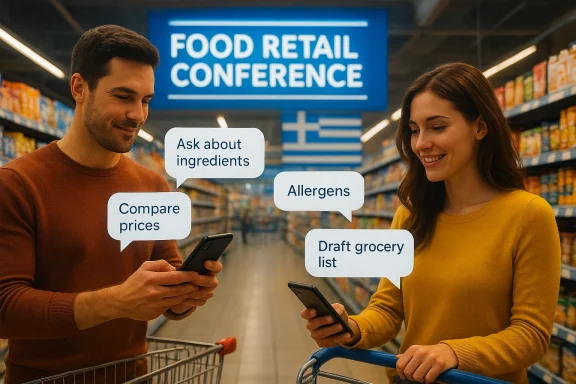
The headline finding is simple, but the details are more revealing. IELKA says 43% of AI users have asked for product or service information, 34% have requested product information before visiting a store, 27% have made product comparisons using AI, 11% have compared supermarket chains, and 6% have used AI to create their grocery list. Those are not abstract use cases. They are precisely the kinds of tasks that turn AI into a retail co-pilot rather than a novelty chatbot.
A few implications stand out:
Even more telling is the 12% who say they would use AI to check whether food contains allergens while shopping. That is a high-trust use case, because the consequence of error is not merely inconvenience. It points to a category where speed, accessibility, and perceived intelligence can outweigh the value of speaking to a store employee, especially when time is short or the consumer wants a second opinion.
That is why AI competition in consumer shopping is increasingly an ecosystem contest. The assistant that answers a product question today may be the one that receives the cart, the receipt, or the follow-up question tomorrow. For that reason, the retail implications extend well beyond grocery comparison into digital commerce more broadly.
There is also a trust advantage at play. General-purpose assistants win early because they feel flexible and neutral. Specialized retail tools, by contrast, can seem narrower or more promotional. That distinction matters in a market where consumers are suspicious of hidden incentives and advertising bias.
Still, Copilot could become more influential if retail interactions increasingly happen inside Microsoft’s ecosystem. If the browser, desktop, and assistant converge, shopping journeys may become less about standalone retail apps and more about embedded AI suggestions. That is an opportunity for Microsoft, but only if it can make the assistant feel genuinely useful rather than just present.
This matters for supermarkets, convenience stores, and branded consumer goods alike. The retailer no longer owns the first question in the customer journey. Instead, AI increasingly sits between intent and action.
That also means the old assumption that the shelf is where decisions happen is weakening. In practice, the shelf may now simply close the loop on a decision already partly made by an assistant. Retailers that understand this will invest differently in digital content, product metadata, and structured information.
This is one reason why AI-powered shopping is often described as a “choice compression” technology. It does not create demand from scratch; it reshapes how buyers evaluate the demand they already have. That can work in favor of low-cost retailers, private label products, or brands with strong product data.
A practical retail consequence is that businesses will need to think about how their products are described in machine-readable terms. If the assistant cannot parse a product clearly, the product may simply be ignored or misunderstood.
This creates a layered information model:
For retailers, this could actually improve in-store service if low-complexity queries are deflected to AI and staff spend more time on nuanced issues. But that only works if the online information layer is accurate enough to prevent confusion.
That means the spread of AI shopping advice will likely be strongest where the consumer values convenience but still wants verification. It is not a sign that people trust AI blindly. Rather, it shows that consumers increasingly treat AI as a fast, low-friction adviser within a broader decision process.
Retailers should pay attention to:
The competitive impact could be significant. Chains with cleaner data and better digital catalogs may appear more often in AI-generated recommendations, while smaller retailers with weaker information infrastructure could become less visible. That is an unglamorous but very real source of market power.
This is why AI shopping is not just a consumer interface story. It is a category-management story. Retailers that understand how assistants interpret value, quality, and trust will have an advantage over those that still think in terms of shelves and flyers alone.
That has implications beyond retail. Household organization, meal planning, budget management, and family preference tracking are all adjacent use cases. In other words, once AI helps with shopping, it can expand into the rest of the household economy.
The likely pattern is incremental rather than dramatic:
Consumers may also hesitate because of trust, habit, or uncertainty. They may not know what to ask, whether the response is current, or whether the answer is biased toward certain sources. Retailers and AI providers will need to address these concerns if they want shopping assistants to become a default behavior rather than a niche convenience.
That said, retail use cases may narrow the gap over time. If Google can combine shopping intent with search intent, Gemini could become more relevant. If Microsoft can integrate Copilot tightly into browsing and commerce experiences, it can strengthen its position. The battle is still fluid.
The broader implication is that AI shopping is becoming a market for assistive trust. Consumers do not need the smartest model on paper; they need the assistant that feels dependable, fast, and context-aware. That is a different kind of competition.
Retailers, AI vendors, and consumer brands will all be forced to adapt. Some will focus on visibility inside AI-generated answers, others on trust and accuracy, and still others on keeping the human touch where it still matters. The winners will be the ones that understand AI as a new interface to retail, not just a new technology bolted onto old habits.
What to watch next:
Source: eKathimerini.com Two in three consult AI before shopping | eKathimerini.com
IELKA’s survey, conducted in the run-up to the 16th Food Retail Conference, suggests that this shift is broadening quickly. The institute said two in three respondents had already used AI applications such as chatbots or digital assistants, while 15% use them daily and 42% use them occasionally during the week. That is a meaningful adoption curve for a tool category that, only a few years ago, was still largely associated with experimentation rather than errands.
The retail signific lies in the fact that shopping decisions are rarely just about price. Consumers ask about ingredients, trustworthiness, convenience, nutrition, allergies, and competing brands all at once. AI is appealing precisely because it can collapse those questions into a single conversation, saving time and reducing friction. In that sense, the survey is less about gadget enthusiasm and more about how digital convenience is reshaping the economics of attention.
IELKA’s broader work also helps explain why the timing matters. The organization has repeatedly tracked grocery pricing, consumer pressure, and shopping patterns in Greece, including reports on supermarket price movements and consumer criteria for food choice. In 2025 it said money remained the key criterion for food selection, even if that pressure was easing somewhat. The new AI survey should be read against that background: when consumers are already price-sensitive and information-hungry, a faster decision tool has obvious appeal.
There is also a competitive dimension. The survey’s top AI brands are the same tools that dominate the wider consumer AI market: ChatGPT leads by a wide margin, Gemini is a distant second, and Copilot remains a meaningful third. That matters because retail behavior is increasingly being mediated by ecosystem power, not just product quality. The AI assistant that wins shopping may also be the assistant already embedded in a user’s browser, phone, or productivity suite.
 What the IELKA Survey Shows
The headline finding is simple, but the details are more revealing. IELKA says 43% of AI users have asked for product or service information, 34% have requested product information before visiting a store, 27% have made product comparisons using AI, 11% have compared supermarket chains, and 6% have used AI to create their grocery list. Those are not abstract use cases. They are precisely the kinds of tasks that turn AI into a retail co-pilot rather than a novelty chatbot.How consumers are actually using AI
The survey suggests that consumeg general questions. They are using AI to shape the pre-shopping stage, which is where many purchase decisions are already made. That makes AI especially powerful because it intervenes before the customer reaches the shelf, when brand preferences, budget constraints, and product knowledge are still being formed.A few implications stand out:
- AI is acting as a pre-store filter, not just a post-purchase explainer.
- Consumers are using it for comparison, which is especially important in grocery and household goods.
- Grocery list creation is still a smaller use case, but it hints at deeper household integration.
- Store chain comparison is emerging, even if it is still relatively niche.
- A large share of users who have not tried these tasks say they plan to do so later, suggesting momentum rather than a plateau.
The meaning of the numbers
The most striking figure may be the 15% of respondents who use AI daily. For a retail-related survey, that is a meaningful signal of routine dependence rather than curiosity. Daily use suggests that consumers are already folding AI into their information habits the way they once folded in search engines or messaging apps.Even more telling is the 12% who say they would use AI to check whether food contains allergens while shopping. That is a high-trust use case, because the consequence of error is not merely inconvenience. It points to a category where speed, accessibility, and perceived intelligence can outweigh the value of speaking to a store employee, especially when time is short or the consumer wants a second opinion.
Why ChatGPT Leads the Pack
Among consumers who use AI, ChatGPT is the dominant choice at 79%, with Gemini at 35% and Microsoft Copilot at 19%. The spread is important because it shows that shopping-related AI adoption is not evenly distributed across platforms. The market leader is the general-purpose assistant that first made conversational AI feel mainstream; the runner-up benefits from Google’s search and Android ecosystem; and Copilot, while notable, appears to be more of a utility than a first choice.Ecosystem beats raw capability
That ranking tells us something deeper than brand preference. Consumers often de basis of benchmark performance or technical sophistication. They choose it based on availability, familiarity, and friction. If a tool already sits inside their browser, phone, or productivity workflow, it is more likely to become the default.That is why AI competition in consumer shopping is increasingly an ecosystem contest. The assistant that answers a product question today may be the one that receives the cart, the receipt, or the follow-up question tomorrow. For that reason, the retail implications extend well beyond grocery comparison into digital commerce more broadly.
There is also a trust advantage at play. General-purpose assistants win early because they feel flexible and neutral. Specialized retail tools, by contrast, can seem narrower or more promotional. That distinction matters in a market where consumers are suspicious of hidden incentives and advertising bias.
What Copilot’s third-place finish suggests
Copilot’s presence at 19% is still meaningful, particularly because Microsoft’s AI is increasingly woven into Windows, Edge, and Microsoft 365. But in shopping, Copilot appears to trail the conversational incumbents. That may be because many consumers associate it more with productivity than shopping discovery.Still, Copilot could become more influential if retail interactions increasingly happen inside Microsoft’s ecosystem. If the browser, desktop, and assistant converge, shopping journeys may become less about standalone retail apps and more about embedded AI suggestions. That is an opportunity for Microsoft, but only if it can make the assistant feel genuinely useful rather than just present.
What AI Changes in the Shopping Journey
The most important shift is that AI shortens the path from curiosity to decision. Instead of opening multiple tabs, reading review pages, and comparing ingredient lists manually, consumers can ask a single conversational system to do the synthesis for them. That changes not just convenience, but behavior. It lowers the effort required to become an informed shopper.Before the store, not at the store
IELKA’s data show that 34% of users have asked for product information before visiting the store, which indicates that AI is already influencing shopping before the consumer is physically present. That is a major shift because retailers have traditionally relied on the store visit itself as the moment of persuasion. If consumers arrive with a pre-formed shortlist, the shelf becomes less of a discovery space and more of a confirmation space.This matters for supermarkets, convenience stores, and branded consumer goods alike. The retailer no longer owns the first question in the customer journey. Instead, AI increasingly sits between intent and action.
That also means the old assumption that the shelf is where decisions happen is weakening. In practice, the shelf may now simply close the loop on a decision already partly made by an assistant. Retailers that understand this will invest differently in digital content, product metadata, and structured information.
Comparisons and substitutions
The fact that 27% of users compare products through AI is especially important because comparison is where retailer and brand advantage can disappear quickly. AI can make alternatives appear more similar, or more different, depending on the question asked. That means consumers may become less loyal to established labels if the assistant presents an alternative as more cost-effective or more suitable.This is one reason why AI-powered shopping is often described as a “choice compression” technology. It does not create demand from scratch; it reshapes how buyers evaluate the demand they already have. That can work in favor of low-cost retailers, private label products, or brands with strong product data.
A practical retail consequence is that businesses will need to think about how their products are described in machine-readable terms. If the assistant cannot parse a product clearly, the product may simply be ignored or misunderstood.
Trust, Expertise, and the Human Factor
The IELKA survey also touches an important tension: people may use AI, but they do not necessarily trust it equally across every domain. On food choices, the survey says the nutritionist remains the most trusted source, but AI ranks second overall and even leads on some practical criteria such as speed, accessibility, and affordability. That is a revealing split. Consumers seem ready to let AI assist them, even if they are not ready to surrender final judgment.AI versus store staff
IELKA notes that asking store staff about a product still appears to be the best option, which is hardly surprising. Human employees can answer context-specific questions, clarify ambiguity, and respond to follow-up concerns in a way AI often cannot. But AI is gaining ground as a first pass tool, especially when consumers want quick answers before committing to a store visit or purchase.This creates a layered information model:
- AI provides immediate orientation.
- Store staff handle clarifications and exceptions.
- Specialists such as nutritionists remain the highest-trust authority for sensitive choices.
- Consumers increasingly switch among these sources depending on urgency and stakes.
For retailers, this could actually improve in-store service if low-complexity queries are deflected to AI and staff spend more time on nuanced issues. But that only works if the online information layer is accurate enough to prevent confusion.
Allergens and high-stakes questions
The allergen use case deserves special attention. A consumer asking whether a food contains allergens is not making a casual request; they are seeking information with direct health consequences. AI can be useful here because it is immediate and easy to access, but it is also risky if it misreads an ingredient list or generates an overconfident answer.That means the spread of AI shopping advice will likely be strongest where the consumer values convenience but still wants verification. It is not a sign that people trust AI blindly. Rather, it shows that consumers increasingly treat AI as a fast, low-friction adviser within a broader decision process.
What This Means for Retailers
For supermarkets and consumer goods companies, the shift is both an opportunity and a warning. AI-assisted shopping can increase discovery, improve pre-purchase engagement, and make product information easier to access. But it also raises the bar for data quality and transparency. If an AI assistant misstates price, ingredients, or product differences, the retailer may inherit the reputational damage even if the model itself was the source of the error.Retailers must become machine-readable
The old retail playbook assumed that compelling packaging, shelf placement, and promotions were enough. That is no longer sufficient. In an AI-mediated shopping environment, product information needs to be structured, accurate, and easy for models to interpret. This includes ingredients, nutrition, origin, certifications, allergens, and even cross-store comparisons where relevant.Retailers should pay attention to:
- Structured product data on websites and apps
- Clear allergen and nutrition labeling
- Consistent product naming across channels
- Search-friendly descriptions and metadata
- Accurate pricing and promotion logic
- Cross-category comparison readiness
The competitive impact could be significant. Chains with cleaner data and better digital catalogs may appear more often in AI-generated recommendations, while smaller retailers with weaker information infrastructure could become less visible. That is an unglamorous but very real source of market power.
The private-label question
AI may also accelerate the appeal of private-label products. If consumers ask for the best value option, a model can easily surface a store brand if the data support it. That helps retailers that want to steer shoppers toward higher-margin own-label goods. At the same time, established consumer brands may need to work harder to justify premium positioning beyond reputation alone.This is why AI shopping is not just a consumer interface story. It is a category-management story. Retailers that understand how assistants interpret value, quality, and trust will have an advantage over those that still think in terms of shelves and flyers alone.
The Consumer Side: Convenience, Caution, and Habit Formation
The consumer story is not only about efficiency. It is about habit formation. Once shoppers learn that AI can answer practical questions quickly, they are likely to return to it for more routine tasks. That is how a tool becomes infrastructure. It starts with a question about a product and ends with a changed relationship to information.Everyday essentials become AI prompts
IELKA’s mention of consumers using AI to build supermarket lists may sound minor, but it is actually one of the most revealing findings in the survey. Grocery lists are mundane, repetitive, and deeply personal. When an AI assistant becomes useful for that task, it has penetrated the domestic core of shopping behavior.That has implications beyond retail. Household organization, meal planning, budget management, and family preference tracking are all adjacent use cases. In other words, once AI helps with shopping, it can expand into the rest of the household economy.
The likely pattern is incremental rather than dramatic:
- First, consumers ask for product facts.
- Then they compare alternatives.
- Then they ask for store or price suggestions.
- Finally, they use AI to plan the purchase itself.
What still limits adoption
Despite the strong numberows that AI shopping is still a partial behavior, not a universal one. A large share of respondents have not yet used AI for product comparisons, supermarket selection, or list-making. That means there is still plenty of room for education, better user interfaces, and clearer retail use cases.Consumers may also hesitate because of trust, habit, or uncertainty. They may not know what to ask, whether the response is current, or whether the answer is biased toward certain sources. Retailers and AI providers will need to address these concerns if they want shopping assistants to become a default behavior rather than a niche convenience.
Competitive Implications for AI Companies
The survey offers an early snapshot of how consumer AI platforms are likely to compete in commerce. The winners will not necessarily be the companies with the most powerful models; they will be the companies that become the easiest place to ask a shopping question. That favors broad, trusted, general-purpose assistants with strong consumer distribution.ChatGPT, Gemini, and Copilot in context
ChatGPT’s dominance in the survey is not surprising. It has become the cultural reference point for consumer AI, and that makes it a natural first choice. Gemini benefits from Google’s search and mobile reach, while Copilot benefits from Microsoft’s ecosystem, but neither yet seems to have displaced ChatGPT as the default conversational helper.That said, retail use cases may narrow the gap over time. If Google can combine shopping intent with search intent, Gemini could become more relevant. If Microsoft can integrate Copilot tightly into browsing and commerce experiences, it can strengthen its position. The battle is still fluid.
The broader implication is that AI shopping is becoming a market for assistive trust. Consumers do not need the smartest model on paper; they need the assistant that feels dependable, fast, and context-aware. That is a different kind of competition.
Strengths and Opportunities
The IELKA survey points to a market that is still early but already commercially meaningful. It suggests that consumers are not merely experimenting with AI; they are beginning to anchor shopping tasks around it, especially when speed, comparison, and information access matter most.- ChatGPT is already the leading consumer AI shopping companion.
- AI is strongest before the store visit, when choices are still forming.
- Product comparison is a natural fit for conversational assistants.
- Retailers that improve structured data may gain visibility.
- Store brands could benefit if AI frames them as value leaders.
- Consumers see AI as fast, accessible, and affordable.
- High-trust use cases such as allergen checks can drive deeper adoption.
Risks and Concerns
The upside is real, but so are the hazards. AI shopping introduces new failure modes, particularly when consumers treat model output as reliable fact. In retail, a mistaken ingredient detail, a stale price comparison, or an inaccurate product recommendation can quickly become a customer-service problem.- AI can misstate ingredients or allergen information.
- Consumer trust may exceed model reliability in some cases.
- Smaller retailers may be disadvantaged by weak product metadata.
- Retailers could lose control of the first customer touchpoint.
- Biased or incomplete comparisons may distort perceived value.
- Privacy concerns may grow as shopping preferences become more personalized.
- Overreliance on AI may reduce the chance of human verification.
Looking Ahead
The next stage of this story will be about depth, not just adoption. The key question is whether AI remains a convenient helper for product questions or becomes a routine shopping infrastructure across grocery, household essentials, and broader e-commerce. If the current trend holds, the answer is likely to be the latter.Retailers, AI vendors, and consumer brands will all be forced to adapt. Some will focus on visibility inside AI-generated answers, others on trust and accuracy, and still others on keeping the human touch where it still matters. The winners will be the ones that understand AI as a new interface to retail, not just a new technology bolted onto old habits.
What to watch next:
- Whether AI shopping adoption spreads from product research to checkout behavior
- Whether grocery chains start optimizing product data for AI assistants
- Whether consumer trust rises or stalls around nutrition and allergen questions
- Whether Copilot and Gemini close the gap with ChatGPT in retail use
- Whether supermarket brands redesign digital listings for machine readability
Source: eKathimerini.com Two in three consult AI before shopping | eKathimerini.com
Last edited:
