

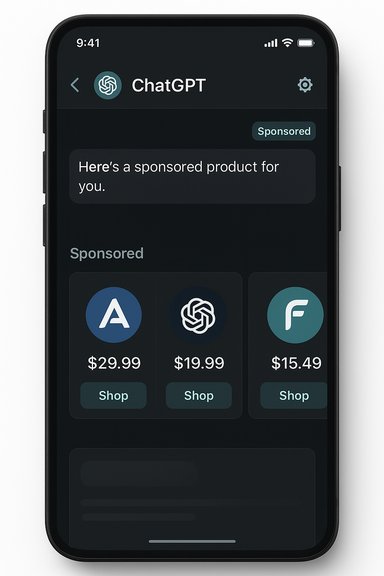
OpenAI’s ChatGPT Android beta contains code strings that strongly indicate the company is actively developing an advertising system for its mobile assistant — references to an “ads feature,” “bazaar content,” “search ad,” and a “search ads carousel” were discovered in the 1.2025.329 APK and shared publicly by an app reverse‑engineer, signaling that ads are being shaped as part of ChatGPT’s search and shopping experiences rather than indiscriminately injected into every chat.
Background
OpenAI launched ChatGPT as a largely ad‑free conversational assistant, monetizing primarily through paid tiers and API usage. That model has allowed rapid growth but comes with substantial operational costs: at scale, serving billions of queries to large language models is expensive. The presence of advert‑related strings in the Android beta suggests the company is exploring a hybrid monetization approach where ads supplement subscriptions to underwrite free access for large user populations. The specific artifact driving this reporting is the beta APK label 1.2025.329. Analysts who parse Play Store beta builds and debug strings in APKs found markers such as bazaar content and search ads carousel, which point to marketplace‑style product cards or carousels that could appear alongside organic assistant responses when users ask for shopping help or recommendations. That pattern mirrors how other AI search surfaces are already experimenting with monetized recommendations.What the code strings reveal — technical read on the APK evidence
The strings discovered in the APK are short but telling. Key identifiers include:- ads feature — implies a module, flag, or feature gate devoted to advertising.
- bazaar content — suggests a marketplace or product‑card format; “bazaar” is a common internal label for curated shopping content.
- search ad / search ads carousel — indicates ad placements tied to search results, possibly in a horizontal carousel UI pattern.
How ads would likely appear in ChatGPT (product hypotheses)
Based on the strings and comparable behavior in other AI platforms, the first wave of advertising inside ChatGPT would probably be constrained and context‑aware, focusing on high‑intent scenarios where users ask about shopping, local services, or product recommendations. Expect these features to follow one of several implementation patterns:- Inline, labeled sponsored suggestions embedded in a synthesized answer.
- Shoppable product cards or a marketplace “bazaar” grid that surfaces merchants, prices, and purchase links.
- A horizontally scrolling search ads carousel showing multiple paid product or merchant cards in a compact, tappable UI.
- Integrations with existing ad networks or commerce APIs to let advertisers bid for placement in generative answers.
Why OpenAI would do this: economics and product strategy
There are three pragmatic reasons OpenAI would add ads to ChatGPT:- Scale economics: Serving billions of queries and multimodal requests (images, video, agentic tasks) creates enormous compute costs. Advertising is a scalable revenue stream that can subsidize free tiers without raising subscription prices for casual users.
- Commercial utility: Users increasingly ask assistants for buying advice, comparisons, and local service discovery — contexts with clear conversion intent where advertisers pay premium CPC/CPL rates. Embedding commerce natively shortens the path from discovery to purchase and unlocks ad revenue tied to high‑intent queries.
- Competitive parity: Major competitors are already experimenting with similar tactics. If the market gravitates toward ad‑funded discovery within conversational AI, OpenAI faces pressure to participate to preserve monetization and strategic partnerships.
UX and labeling: the trust challenge
One of the hardest design problems for ads inside generative assistants is clear, unambiguous labeling. When an AI crafts a conversational answer, mixing sponsored content into that narrative risks confusing users about what is editorial and what is paid. To preserve trust, any ad integration must address at least these UX constraints:- Prominent, persistent labels that distinguish paid content from organic assistant responses without breaking conversational flow.
- Separate visual affordances (cards, "Sponsored" badges, distinct CTA styles) so users can scan and decide quickly.
- Frequency caps and relevance thresholds to avoid poisoning the experience with low‑value placements.
- User controls to prefer non‑sponsored results, opt out of personalized ads, or pay to remove ads via premium tiers.
Privacy and personalization: red flags and opt‑outs
The emergence of adverts in a context where ChatGPT stores optional memories and personalization settings raises privacy questions that cannot be deferred. Three areas demand scrutiny:- Use of memory signals: If ads are personalized using account memory (saved preferences, shopping history), the platform must be explicit and opt‑in. Leveraging memories for ad targeting without clear consent would create regulatory and reputational risk.
- Local context indexing: Talents such as on‑device search and screen indexing (used by some AI features) can surface local signals. Any use of local content for ad selection must be permissioned, auditable, and reversible.
- Data retention and third‑party sharing: Advertisers, measurement partners, and ad tech ecosystems will want signals for attribution. OpenAI must define whether it will share hashed or aggregated signals with third parties and how long those signals persist.
Publisher and web‑ecosystem impacts
Embedding monetized answers in an assistant that answers user queries directly increases the risk of zero‑click outcomes — when users obtain the information they need without visiting publisher sites. This phenomenon can materially affect referral traffic and publisher ad revenue. Two consequences worth noting:- Publishers could see declining referrals for queries that AI resolves end‑to‑end, especially in shopping and local discovery verticals.
- Aggregation of discovery and monetization inside a small number of platforms concentrates ad budgets and bargaining power, making direct publisher monetization harder.
Competitive landscape: how other players are approaching ads in generative answers
A useful way to understand OpenAI’s potential path is to compare recent moves by other major platforms:- Google has publicly tested ads inside AI Overviews and conversational search results, focusing on clearly labeled sponsored content and shopping placements. This established a template for ad placement inside synthesized answers.
- Microsoft has experimented with shopping and promoted content inside Copilot experiences and Edge integrations, leveraging its ad infrastructure and enterprise controls.
- Perplexity and other smaller vendors have already experimented with sponsored follow‑ups or “suggested” prompts that carry commercial intent, integrating native monetization in creative ways.
Governance, regulation, and recommended guardrails
If OpenAI proceeds, the following product and policy guardrails are critical to reduce harm and maintain trust:- Explicit labeling policy: Every paid placement must be visually distinct and include a machine‑readable label for audits.
- Memory opt‑in for ads: Personal memories should not be used for ad targeting by default; any use must require explicit, revocable consent.
- Publisher remediation and revenue sharing exploration: Engage with publishers to explore licensing or revenue‑share models where AI outputs substantially replace referrals.
- Independent audits: Periodic independent audits of ad placement fairness, click assignment, and disclosure practices to validate compliance and trust claims.
- Enterprise and region controls: Admin controls for managed accounts (BYOD, enterprise) to disable ad experimentation in corporate environments.
- Clear premium promise: Preserve a genuinely ad‑free experience for paid tiers — if paying users still see ads, churn and reputational damage will follow.
What WindowsForum readers and IT pros should do now
For IT administrators, digital marketers, and technically savvy users, this is the moment to prepare:- Evaluate BYOD policies and update acceptable‑use rules to explicitly cover AI assistants and their permission scopes.
- Monitor mobile app traffic and telemetry for new endpoints or ad‑related calls; block experimental feature updates via MDM if policy requires.
- Publishers should accelerate diversification — build direct subscriber channels and negotiate platform deals to protect referral economics.
- Advertisers should insist on measurement transparency and test AI placements cautiously with holdout experiments before reallocating significant spend.
- Privacy teams should map where ChatGPT memories and local indexing are stored and craft consent flows and retention rules accordingly.
What we do — and do not — know (limitations and unverifiable claims)
The APK strings provide clear product intent but do not confirm user‑facing behavior. Key unknowns that remain unverified:- Rollout timeline: There is no public schedule; the strings indicate development but not when or where ads will be visible. Expect staged testing and region‑gated rollouts.
- Ad formats and labels: While “carousel” and “bazaar” suggest formats, the live UI, labeling language, and controls are not published.
- Revenue model details: It is reasonable to infer free tiers would show ads and premium tiers would remain ad‑free, but the final paywall and revenue sharing terms are not confirmed.
- Use of memory signals: Reports and historical discussion imply OpenAI has considered memory‑based personalization, but no product change has been announced that enacts this for advertising. Any claim that memories will be used for ad targeting should be treated as speculative until OpenAI confirms policy and consent mechanisms.
Scenario planning: three possible paths OpenAI might take
- Conservative path (lowest risk)
- Ads restricted to clearly labeled shopping results.
- No use of memory for ad personalization.
- Premium tiers permanently ad‑free.
- Publisher compensation models explored.
- Hybrid path (likely)
- Ads appear in search/commerce contexts with limited personalization tied to session signals.
- Memories remain opt‑in for ad personalization.
- Premium tiers remove ads; free users subsidized via ads.
- Aggressive path (highest risk)
- Ads surfaced across broader assistant replies, with deep personalization using memories and local indexing.
- Minimal labeling and aggressive optimization for monetization.
- This path risks regulatory attention, user backlash, and publisher lawsuits.
Practical implications for consumers and advertisers
- Consumers: Expect the possibility of more commerce‑oriented results in ChatGPT mobile experiences, and look for settings to opt out of personalized ads or to pay for ad removal. Save and review memory controls now if you value privacy.
- Advertisers: Prepare test strategies for creative, measurement, and attribution in conversational surfaces. Demand transparency on placement mechanics and conversion metrics before shifting significant budgets.
Conclusion
The discovery of advert‑related strings in ChatGPT Android beta 1.2025.329 is a clear indicator that OpenAI is developing the technical scaffolding to introduce ads into its mobile assistant, most plausibly within search, shopping, and recommendation contexts. This development is a logical — if sensitive — step for an AI company balancing free user scale with expensive compute costs. The critical decisions ahead are governance and design: how ads are labeled, whether personal memories are used for targeting, and whether premium users retain a genuinely ad‑free experience. Early evidence should prompt measured preparation by IT teams, publishers, and advertisers while demanding transparency from OpenAI as these experiments move toward public testing and deployment.Source: TestingCatalog OpenAI plants testing ads in ChatGPT Android app
