

You can audit how ChatGPT, Google AI Overviews, Google Gemini, and Microsoft Copilot describe and recommend your brand from a Windows PC by running a repeatable set of recommendation prompts, recording the cited sources, and correcting inaccurate information at its original source. This guide covers Windows 10 and Windows 11 with Microsoft Edge, Google Chrome, or another current browser, and applies whether you use free consumer accounts or organization-managed accounts for the AI services.
A July 17, 2026 report from VaynerX and Profound argues that AI answer engines increasingly form brand recommendations from the wider web—reviews, creators, communities, publishers, and professional content—not only from a company’s own website. Treat that as a practical operating principle, not a guarantee of how every model works: test the outputs your customers see, then improve the evidence available online.
Before testing, decide exactly what you want to measure. “Does AI know our brand?” is too broad to produce usable results. Separate visibility from recommendation.
Use a Windows work account only if your organization permits it. Do not paste confidential roadmaps, customer lists, unannounced pricing, internal documents, or personally identifiable information into public AI services.
Start with these categories:
For every answer, inspect the sources the platform displays where available. Classify each source:
Work through findings in this order.
A durable content plan should cover the questions that occur before and after a purchase:
Creator, customer, review, community, and professional content may all contribute useful evidence. The correct approach is to earn coverage by offering a product, service, expertise, or demonstration worth discussing—not to manufacture consensus.
Use this schedule:
Use these checks:
A July 17, 2026 report from VaynerX and Profound argues that AI answer engines increasingly form brand recommendations from the wider web—reviews, creators, communities, publishers, and professional content—not only from a company’s own website. Treat that as a practical operating principle, not a guarantee of how every model works: test the outputs your customers see, then improve the evidence available online.
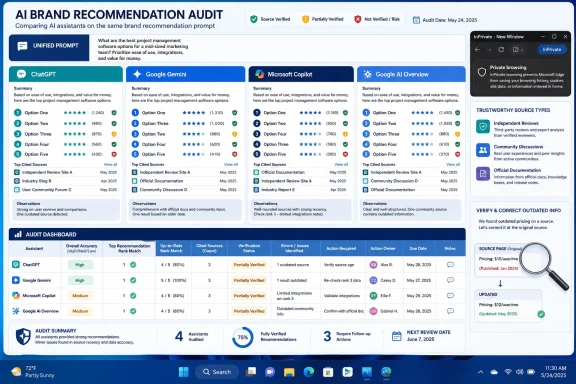 Prepare a controlled brand-recommendation audit
Before testing, decide exactly what you want to measure. “Does AI know our brand?” is too broad to produce usable results. Separate visibility from recommendation.- Visibility: Does the answer engine mention your brand?
- Accuracy: Does it describe your product, pricing, location, features, and audience correctly?
- Recommendation: Does it include your brand when asked for the best option for a defined customer need?
- Evidence: Which links, citations, reviews, videos, publishers, or community discussions support the answer?
- Competitive position: Which alternatives appear before or alongside your brand?
| Test date | Platform | Signed in? | Prompt | Location | Brand mentioned? | Rank/order | Recommendation wording | Sources shown | Errors | Action owner |
|---|
Run the same prompts across answer engines
Recommendation answers can differ by platform, location, account state, and time. Use a private browsing window for a baseline test, then repeat signed in if your customers are likely to use the service while signed in.- Open Microsoft Edge.
- Select the three dots menu in the upper-right corner.
- Select New InPrivate window.
In Google Chrome, select the three dots menu, then New Incognito window. - Search each prompt separately in:
- Microsoft Copilot
- ChatGPT
- Google Gemini
- Google Search, where an AI Overview appears
- Record the full answer, the sources shown, and whether the system asks follow-up questions before recommending brands.
- Repeat the same test from a normal signed-in browser session if permitted.
- Repeat again using a mobile device or a different city only when location meaningfully changes the buying decision, such as restaurants, installers, healthcare providers, or local services.
Start with these categories:
- Category discovery
- “What are the best project-management platforms for a 25-person marketing team?”
- “Which Windows laptop brands are reliable for college students?”
- “What are reputable managed IT providers for small businesses in [city]?”
- Need-based recommendation
- “I need a [product or service] for [use case], with a budget under [amount]. What should I consider?”
- “Compare the best options for [problem], including strengths, weaknesses, and who each is best for.”
- Brand-specific accuracy
- “What does [brand] offer?”
- “Who is [brand] best for?”
- “What are common complaints or limitations of [brand]?”
- “Compare [brand] with [competitor].”
- Trust and validation
- “What independent reviews exist for [brand]?”
- “What do customers say about [brand]?”
- “Are there credible comparisons, tutorials, or case studies about [brand]?”
- Local and transactional prompts
- “Which [service] providers near [city] have strong reviews and transparent pricing?”
- “Where can I buy [product type] near [ZIP code]?”
Review what the answer engine is using as evidence
Do not stop at whether your brand appeared. A mention based on outdated material, a low-quality directory listing, or an incorrect forum post is not recommendation authority.For every answer, inspect the sources the platform displays where available. Classify each source:
- Your official website or documentation
- Major publisher or trade publication
- Independent review site
- Creator video, tutorial, or comparison
- Marketplace or app-store listing
- Customer-review platform
- Social-media post
- Community discussion
- Partner, reseller, or distributor
- Directory or data aggregator
- Competitor material
- Unknown or low-quality source
- If AI systems recognize your company but describe it poorly, your factual information may be fragmented or outdated.
- If your company is accurate but absent from “best for” prompts, you may have visibility without strong third-party validation.
- If one platform consistently cites videos while another surfaces community discussions or professional sources, do not force a single content format across all channels.
- If a product page appears but independent comparison and review material does not, customers and AI systems may have too little external evidence to assess your fit.
Fix incorrect information at the source
Do not attempt to “correct” an AI answer by repeatedly prompting it. That is not a durable fix. Correct the website, listing, review response, publisher page, or other source that contains the error.Work through findings in this order.
- Correct owned information first.
- Verify product names, availability, technical specifications, compatibility, prices, contact details, policies, and locations on your official website.
- Ensure important claims are stated plainly in page text, not only embedded in images, PDFs, or videos.
- Keep discontinued products and old pricing clearly marked or removed where appropriate.
- Publish a clear comparison or “who this is for” page when customers routinely ask that question.
- Fix structured business listings.
- Check business profiles, marketplace listings, app-store entries, dealer pages, and major directories.
- Ensure the company name, address, telephone number, website, categories, hours, and product descriptions agree with your official records.
- Remove duplicates where the provider supports a removal or merge process.
- Address independent-review inaccuracies.
- Use the review platform’s correction or business-response process.
- Respond with verifiable facts, without pressuring reviewers to change genuine opinions.
- Do not create fake reviews or pay for undisclosed endorsements. That can create reputational, policy, and legal problems.
- Update partner and publisher material.
- Give distributors, agencies, resellers, and affiliates current descriptions, approved product details, and assets.
- Ask publishers to correct concrete factual errors, such as a discontinued feature or an incorrect price. Do not demand editorial changes merely because the coverage is unfavorable.
- Publish helpful explanatory content.
- Create troubleshooting guides, comparisons, tutorials, setup instructions, use-case pages, and transparent limitation pages.
- Make each page answer a real question a buyer would ask.
- Include dates when information is time-sensitive, especially pricing, compatibility, availability, certifications, regulations, and product releases.
Build recommendation evidence, not just brand mentions
The report’s practical distinction is important: visibility can put a brand into an answer, but broad evidence helps it become a recommendation.A durable content plan should cover the questions that occur before and after a purchase:
- What problem does the product solve?
- Who is it suitable for?
- Who should choose an alternative?
- How does it compare with common competitors?
- What does it cost and what affects the price?
- How is it installed, configured, maintained, returned, or supported?
- What limitations should a buyer know before purchasing?
- What do credible third parties demonstrate, review, or verify?
Creator, customer, review, community, and professional content may all contribute useful evidence. The correct approach is to earn coverage by offering a product, service, expertise, or demonstration worth discussing—not to manufacture consensus.
Establish an always-on monitoring routine
The report states that answer engines can cite recently published material quickly. Whether a particular platform reflects a new page immediately or not, waiting for an annual brand review is too slow for fast-moving categories.Use this schedule:
- Weekly
- Check high-priority product, category, and competitor prompts.
- Review new customer reviews and support trends.
- Check for urgent misinformation involving safety, security, pricing, or availability.
- Monthly
- Run the complete prompt set across all chosen platforms.
- Compare answers with the previous month’s results.
- Record newly cited domains and recurring misinformation.
- Assign corrective actions with an owner and deadline.
- Quarterly
- Review product documentation, comparison pages, listings, partner pages, and FAQs.
- Retire or update obsolete material.
- Reassess prompts based on actual search, sales, support, and customer-success questions.
Troubleshoot inconsistent or missing recommendations
If your brand appears in one answer engine but not another, do not assume a technical failure. Different systems can use different retrieval, ranking, source-selection, personalization, and freshness processes.Use these checks:
- The answer differs when signed in: Record both results. Personalization may affect the response, so use private browsing for a comparable baseline.
- The answer differs by location: Add the city or ZIP code to the audit record. Local recommendations depend heavily on location-specific information.
- The brand is confused with another company: Standardize your name, product names, domain, and descriptions across official pages and major listings.
- Old information is repeated: Locate the original page or listing, update it, then monitor future tests. Removing an old page does not guarantee immediate disappearance from every answer engine.
- A harmful claim appears without a visible source: Save the prompt, exact response, date, and screenshots. Use the platform’s available feedback or reporting controls, while simultaneously correcting the underlying public information.
- You are not cited despite strong owned content: Build independent validation through accurate reviews, comparisons, expert coverage, demonstrable tutorials, and trustworthy partner information. Owned pages alone may not answer a recommendation question convincingly.
- A competitor is recommended incorrectly: Do not target the competitor with misleading content or fabricated reviews. Strengthen your own factual, independently supported case instead.
References
- Primary source: Little Black Book | LBBOnline
Published: 2026-07-17T09:20:45.874000+00:00
Loading…
lbbonline.com