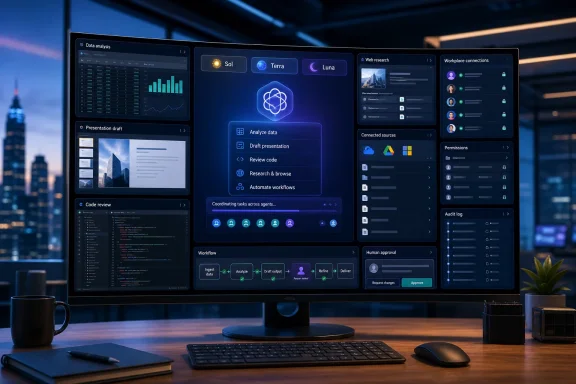
OpenAI launched ChatGPT Work in July 2026, combining ChatGPT with Codex so Pro, Enterprise and Edu users can produce documents, presentations and websites from plain-language instructions. The rollout begins on web and mobile, with a desktop app and hosted-website capability forming part of the broader product. Presented alongside the three-size GPT-5.6 model family, Work is described as OpenAI’s response to Anthropic’s Claude Cowork and Microsoft’s Copilot Cowork.
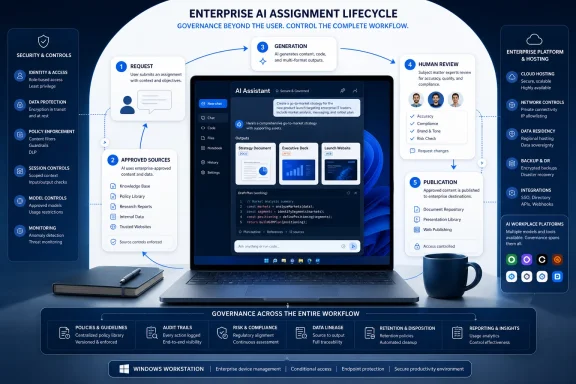
The immediate enterprise lesson is more important than the branding: organizations should govern the entire assignment lifecycle, not merely the chat account. When an AI system can turn source material into a document, deck or hosted site, policy must cover the sources it may use, the artifact it creates, the reviewer who approves it and the destination where it is eventually shared.
ChatGPT Work brings together the familiar ChatGPT interface and Codex, OpenAI’s coding system, for general workplace assignments. A user describes a desired outcome—a document, slide deck or website—and asks the combined system to produce it.
That is a meaningful change from asking a chatbot for advice or a block of draft text. The expected output is an artifact that can enter a business process, not simply an answer that remains inside a conversation.
The distinction is easy to see in a quarterly presentation. A conventional chatbot might suggest an outline, rewrite several paragraphs or propose slide titles. Work is presented as a way to request the presentation itself. The user still has to supply an appropriate brief, inspect the result and approve its use, but the product proposition shifts more of the production activity into the AI system.
Codex is relevant because software-development tools commonly work through objectives that require multiple connected operations. Bringing ChatGPT and Codex together applies that operating pattern to office outputs without requiring the user to interact with a terminal or write code.
The central bet behind the launch is straightforward: the task-oriented mechanics associated with coding systems can be packaged as ordinary office software.
That does not mean every business assignment becomes safe to automate. Producing an artifact is only one stage of completing responsible work. Source selection, factual validation, ownership, review, distribution and retention remain organizational responsibilities even when the production step becomes faster.
The confirmed similarities should not be stretched into claims of established feature parity. Public positioning can show that vendors are competing for a related type of work without proving that their products have equivalent access, controls, integrations or operational behavior.
The comparison is therefore directional rather than definitive. ChatGPT Work is clearly entering the same competitive conversation as Claude Cowork and Copilot Cowork. It is too early, based on the confirmed facts alone, to conclude that the products have the same capabilities or that one has secured a durable advantage.
WindowsForum’s assessment is that organizations should evaluate these products through representative assignments rather than vendor labels. A product may produce an impressive first result yet perform poorly when the source material is incomplete, the brief changes or a reviewer asks for substantial revisions.
The useful question is not simply, “Can it generate a deck?” It is, “Can our organization safely commission, inspect, approve, store and distribute the resulting deck?”
Consider an executive briefing. A chatbot can draft one from material supplied in a prompt. A work-oriented system is expected to carry more of the process needed to turn the request into a coherent document. The output then has to be checked against the source material, edited where necessary and approved by a responsible person.
A presentation adds visual and structural decisions. Information must be divided into slides, arranged into a narrative and presented in a form that remains useful to the intended audience. A polished result may save time, but it can also make unsupported claims or omitted context less obvious.
Website generation raises additional governance questions because the output may become a shared destination rather than a file passed between reviewers. A generated site can look complete even when its ownership, audience, maintenance obligations and retention status have not been settled.
The confirmed hosted-website capability is therefore significant, but its precise boundaries should not be assumed. Organizations need product documentation and their own testing before concluding what kinds of sites can be hosted, who can reach them or how long they remain available.
For pilot planning, IT teams should treat hosting as a separate stage from generation. A system may be allowed to create a proposed website while still being prohibited from publishing it to colleagues, customers or the public.
The broader product ambition is apparent: make ChatGPT a place where users request and receive usable workplace artifacts. Whether that ambition becomes a dependable enterprise workflow will depend on behavior that launch descriptions alone cannot establish.
This matters more for multi-stage assignments than for a short chat response. Producing a document, presentation or website may require repeated processing before the artifact is ready for review. The cost of the overall assignment can therefore matter more than the price of an individual interaction.
Routine formatting or document assembly may not require the same capability as a complex assignment built from inconsistent source material. In principle, multiple model sizes give OpenAI and its customers options for matching resources to the work.
The operational details will matter. Employees may not know which model size is appropriate, and asking every user to make a technical routing decision could undermine the simplicity of the product. Organizations will need to determine whether model selection should be made by the user, recommended by the product or standardized through internal guidance.
WindowsForum recommends measuring cost at the assignment level during a pilot. Useful metrics include:
Those questions are especially important on Windows PCs, where employees may keep downloaded attachments, work-in-progress documents and exports from internal systems. Before approving a desktop pilot, administrators should obtain current product documentation and test the application in a controlled environment.
The governance issue is not unique to ChatGPT Work. Any desktop AI application should be assessed according to the information it can reach and the actions it can perform in the tested configuration.
An appropriate review should determine:
For that reason, WindowsForum recommends beginning on web or mobile before enabling the desktop application. This does not make the pilot risk-free, but it reduces the number of variables while the organization learns how users formulate assignments and how reviewers validate the resulting artifacts.
The desktop app may eventually become central to daily use. It should earn that position through documented behavior and controlled testing rather than receiving broad approval solely because employees already recognize the ChatGPT brand.
The attraction is easy to understand. A user might turn approved information into a project page, internal briefing site or lightweight presentation of results. The hosted format can make the artifact easier for colleagues to open and navigate.
The governance problem is equally clear. A generated website can become visible to an audience before the organization has answered basic questions about responsibility and lifecycle.
Before allowing publication, a pilot owner should document:
A convincing demonstration is not enough. IT needs to know whether the resulting artifact can be governed throughout its useful life. Until ownership, access and retention are documented, generated sites should remain unpublished test artifacts.
Pro users may explore demanding individual workflows, while Enterprise and Edu users will test the product in organizational settings with different review and accountability requirements. Broader availability may increase employee interest before every company has adopted a formal policy.
That timing creates a familiar challenge for Windows administrators. Users may encounter a new capability through an existing account and interpret availability as organizational approval. IT and security teams should communicate whether the feature is approved, restricted to a pilot or not yet authorized for business data.
The risks are not limited to obviously incorrect output. A generated presentation or website can appear highly finished, making it more likely that a user will circulate it without sufficient review. The staged rollout should therefore be used to test human behavior as much as model behavior.
July 10, 2026 — A publication-date-like source value accompanies the ChatGPT Work and GPT-5.6 material. It should not be treated as evidence of separate preview and announcement events on unsupported dates.
July 2026 — ChatGPT Work launches with an initial web and mobile rollout for Pro, Enterprise and Edu users. The product combines ChatGPT and Codex and is presented alongside the three-size GPT-5.6 family.
The available facts support a July 2026 launch framing. They do not establish a June 26 GPT-5.6 preview or a separate July 9 ChatGPT Work announcement, so those entries should not be included as confirmed milestones.
That decision can become difficult to reverse. Teams may build templates, review practices, evaluation criteria and internal training around one product. Switching later could require more than replacing a license; it could require rebuilding the procedures through which assignments are specified and approved.
Vendor advantages should not be presented as established facts without current evidence. It is reasonable to analyze OpenAI’s existing ChatGPT presence, Microsoft’s role in Windows and Microsoft 365, and Anthropic’s earlier Cowork launch as competitive factors. It is not yet possible, from the confirmed launch facts alone, to declare that one company has the decisive advantage in context, distribution or agent design.
WindowsForum’s early assessment is that the purchasing decision will depend on four practical dimensions.
The test should include incomplete instructions, conflicting source material and mid-assignment revisions. A successful demonstration built from clean sample data does not establish production reliability.
Integration should be evaluated in the organization’s actual environment. Buyers should document which sources and destinations are supported rather than assuming that broad vendor positioning guarantees access to a particular application or repository.
This is the WindowsForum differentiator: governance must follow the assignment from request to destination. Controlling account access is necessary, but it does not answer whether a particular artifact was properly sourced, reviewed and published.
A fast first draft is not a saving if specialists must spend hours rebuilding it. Pilots should measure accepted outputs, review time, failed runs and correction effort alongside direct service cost.
Companies may initially deploy more than one product. Developers may continue using specialized coding tools while communications, operations or education teams test office-oriented agents. Microsoft-focused environments may evaluate Copilot Cowork alongside ChatGPT Work, while organizations already testing Claude Cowork may compare all three through the same assignments.
A multi-product pilot can be useful if every product receives the same brief, source package, review standard and success criteria. Otherwise, comparisons will reflect differences in testing rather than differences in capability.
An assignment can connect several actions that appear harmless when considered separately. Reading approved material may be acceptable. Summarizing it may be acceptable. Creating a proposed site may be acceptable. Publishing that site to an external audience may still be prohibited.
The policy must therefore cover five stages:
The reviewer should verify factual claims, calculations, confidential information, branding, accessibility and intended audience. The depth of review should reflect the consequences of the artifact rather than the speed with which it was created.
A rough response invites skepticism. A deck with consistent typography, confident headings and clean structure can feel authoritative before anyone checks the evidence. A functioning website may appear even more final because users experience it as a product rather than a draft.
Organizations should reverse the instinct to relax scrutiny when presentation quality improves. Better formatting is not evidence of better sourcing.
A mistake made near the beginning of an assignment can also shape everything that follows. If the wrong source is used, the resulting document may remain internally consistent while being fundamentally incorrect. The absence of a software error does not mean the business result is valid.
Enterprise tests should therefore examine the entire result, including:
It is reasonable to expect the products to compete for some of the same assignments. It is not yet established that they offer equivalent capabilities, integrations or controls. Organizations should resist making a platform-wide decision from product names or launch demonstrations.
Some companies may deploy both. Developers may use coding-focused systems while other teams test document, presentation and website generation. Different departments may also prefer different products because their source material, review obligations and approved destinations differ.
That does not mean an uncontrolled mix of tools is sustainable. If multiple products are permitted, the organization still needs one policy for assignment intake, approved data, human review, publication and incident handling.
Windows administrators should focus on the layer that remains under organizational control regardless of vendor: the lifecycle of the work.
A practical decision framework is:
It does not give them enough reason to assume feature parity with Claude Cowork or Copilot Cowork, nor does it establish that every advertised output is ready for unsupervised business use.
The next phase of workplace AI will not be decided solely by which system generates the most impressive artifact. It will be decided by whether organizations can tell what was requested, what information was used, who approved the result and where it ultimately went.
For WindowsForum readers, that is the durable conclusion: the chat account is only the entry point. The assignment lifecycle is the real security, governance and procurement boundary.
The redesigned ChatGPT desktop app reportedly presents Chat, Work and Codex as three parallel modes, while the previous desktop client is renamed ChatGPT Classic. Work supports continuous execution, scheduled tasks and user approval for critical actions, expanding the desktop governance questions beyond file access to application control and unattended activity.
The report also names GPT-5.6’s three tiers: flagship model Sol, balanced everyday model Terra and speed- and cost-focused Luna. It says GPT-5.6 completed its limited preview on July 9 and began rolling out across ChatGPT, Codex and the API.
Separately, GPT-5.6 is set to become Microsoft 365 Copilot’s preferred model across Word, Excel, PowerPoint, Copilot Chat and Cowork. For administrators, this means OpenAI’s latest model may enter workflows through both ChatGPT Work and Microsoft’s existing productivity environment, making consistent data-access, approval and auditing policies increasingly important.
The immediate enterprise lesson is more important than the branding: organizations should govern the entire assignment lifecycle, not merely the chat account. When an AI system can turn source material into a document, deck or hosted site, policy must cover the sources it may use, the artifact it creates, the reviewer who approves it and the destination where it is eventually shared.
 OpenAI Turns Codex Into an Office Product
ChatGPT Work brings together the familiar ChatGPT interface and Codex, OpenAI’s coding system, for general workplace assignments. A user describes a desired outcome—a document, slide deck or website—and asks the combined system to produce it.That is a meaningful change from asking a chatbot for advice or a block of draft text. The expected output is an artifact that can enter a business process, not simply an answer that remains inside a conversation.
The distinction is easy to see in a quarterly presentation. A conventional chatbot might suggest an outline, rewrite several paragraphs or propose slide titles. Work is presented as a way to request the presentation itself. The user still has to supply an appropriate brief, inspect the result and approve its use, but the product proposition shifts more of the production activity into the AI system.
Codex is relevant because software-development tools commonly work through objectives that require multiple connected operations. Bringing ChatGPT and Codex together applies that operating pattern to office outputs without requiring the user to interact with a terminal or write code.
The central bet behind the launch is straightforward: the task-oriented mechanics associated with coding systems can be packaged as ordinary office software.
That does not mean every business assignment becomes safe to automate. Producing an artifact is only one stage of completing responsible work. Source selection, factual validation, ownership, review, distribution and retention remain organizational responsibilities even when the production step becomes faster.
The Cowork Race Is Still an Early Category
ChatGPT Work arrives after Anthropic launched Claude Cowork in January as an autonomous multi-step agent. OpenAI describes Work as a response to both Claude Cowork and Microsoft’s Copilot Cowork, placing all three products in an emerging category of systems intended to handle broader assignments rather than isolated prompts.The confirmed similarities should not be stretched into claims of established feature parity. Public positioning can show that vendors are competing for a related type of work without proving that their products have equivalent access, controls, integrations or operational behavior.
Confirmed facts and early assessment
| Product | Confirmed characterization | What remains an early assessment |
|---|---|---|
| ChatGPT Work | Combines ChatGPT and Codex; generates documents, presentations and websites; includes a desktop app and hosted websites; begins rolling out on web and mobile to Pro, Enterprise and Edu users | How reliably it handles complete enterprise workflows, how organizations will standardize its use and how it compares operationally with competing products |
| Claude Cowork | An autonomous multi-step agent launched in January | Its relative strengths, enterprise fit and feature-by-feature position against ChatGPT Work |
| Copilot Cowork | Identified by OpenAI’s competitive framing as a product to which ChatGPT Work responds | The degree of practical overlap with ChatGPT Work and whether the products will prove interchangeable in real deployments |
WindowsForum’s assessment is that organizations should evaluate these products through representative assignments rather than vendor labels. A product may produce an impressive first result yet perform poorly when the source material is incomplete, the brief changes or a reviewer asks for substantial revisions.
The useful question is not simply, “Can it generate a deck?” It is, “Can our organization safely commission, inspect, approve, store and distribute the resulting deck?”
OpenAI Is Selling an Outcome, Not Another Chat Mode
The easiest way to misunderstand ChatGPT Work is to view it as a larger text box backed by a newer model. Its value will depend on whether the combination of ChatGPT and Codex can maintain a user’s objective across the production of an artifact.Consider an executive briefing. A chatbot can draft one from material supplied in a prompt. A work-oriented system is expected to carry more of the process needed to turn the request into a coherent document. The output then has to be checked against the source material, edited where necessary and approved by a responsible person.
A presentation adds visual and structural decisions. Information must be divided into slides, arranged into a narrative and presented in a form that remains useful to the intended audience. A polished result may save time, but it can also make unsupported claims or omitted context less obvious.
Website generation raises additional governance questions because the output may become a shared destination rather than a file passed between reviewers. A generated site can look complete even when its ownership, audience, maintenance obligations and retention status have not been settled.
The confirmed hosted-website capability is therefore significant, but its precise boundaries should not be assumed. Organizations need product documentation and their own testing before concluding what kinds of sites can be hosted, who can reach them or how long they remain available.
For pilot planning, IT teams should treat hosting as a separate stage from generation. A system may be allowed to create a proposed website while still being prohibited from publishing it to colleagues, customers or the public.
The broader product ambition is apparent: make ChatGPT a place where users request and receive usable workplace artifacts. Whether that ambition becomes a dependable enterprise workflow will depend on behavior that launch descriptions alone cannot establish.
Three GPT-5.6 Sizes Turn Intelligence Into a Budget Decision
ChatGPT Work was presented alongside GPT-5.6, with the model family offered in three sizes. That structure gives customers a potential way to balance capability and cost instead of treating every assignment as if it requires the same level of model capacity.This matters more for multi-stage assignments than for a short chat response. Producing a document, presentation or website may require repeated processing before the artifact is ready for review. The cost of the overall assignment can therefore matter more than the price of an individual interaction.
Routine formatting or document assembly may not require the same capability as a complex assignment built from inconsistent source material. In principle, multiple model sizes give OpenAI and its customers options for matching resources to the work.
The operational details will matter. Employees may not know which model size is appropriate, and asking every user to make a technical routing decision could undermine the simplicity of the product. Organizations will need to determine whether model selection should be made by the user, recommended by the product or standardized through internal guidance.
WindowsForum recommends measuring cost at the assignment level during a pilot. Useful metrics include:
- Time required to prepare the brief and source material
- Model or service consumption associated with the run
- Human review and correction time
- Percentage of outputs accepted after minor revision
- Percentage requiring substantial rework
- Number of assignments abandoned or restarted
- Time saved compared with the existing process
The Desktop App Moves the Governance Discussion Onto the PC
A desktop app forms part of the ChatGPT Work product, but organizations should avoid assuming capabilities that have not been confirmed. The existence of a desktop application does not, by itself, establish which local files it can inspect, whether it can modify them, what permissions it requests or how administrators can manage its behavior.Those questions are especially important on Windows PCs, where employees may keep downloaded attachments, work-in-progress documents and exports from internal systems. Before approving a desktop pilot, administrators should obtain current product documentation and test the application in a controlled environment.
The governance issue is not unique to ChatGPT Work. Any desktop AI application should be assessed according to the information it can reach and the actions it can perform in the tested configuration.
An appropriate review should determine:
- Which data becomes available to the application
- Whether access is initiated for each task or persists between tasks
- Whether the application creates new files, changes existing files or both
- What account is active when an assignment is performed
- What logs or records are available to the user and organization
- How generated artifacts are stored and removed
- How software updates are delivered and evaluated
- What happens when an employee changes roles or leaves the organization
For that reason, WindowsForum recommends beginning on web or mobile before enabling the desktop application. This does not make the pilot risk-free, but it reduces the number of variables while the organization learns how users formulate assignments and how reviewers validate the resulting artifacts.
The desktop app may eventually become central to daily use. It should earn that position through documented behavior and controlled testing rather than receiving broad approval solely because employees already recognize the ChatGPT brand.
Hosted Websites Push AI Output Beyond the File Cabinet
Documents and presentations generally fit established review processes. They can be saved, versioned, attached to a ticket or circulated for approval before wider use. Hosted websites require a clearer distinction between creating content and publishing it.The attraction is easy to understand. A user might turn approved information into a project page, internal briefing site or lightweight presentation of results. The hosted format can make the artifact easier for colleagues to open and navigate.
The governance problem is equally clear. A generated website can become visible to an audience before the organization has answered basic questions about responsibility and lifecycle.
Before allowing publication, a pilot owner should document:
- Who owns the site as a business asset
- Who is authorized to approve its contents
- Who can access it
- Whether its audience can change
- Where authoritative source information remains
- How corrections will be made
- How long the site should remain available
- What retention or deletion rule applies
- What happens if the creator’s account changes or is removed
A convincing demonstration is not enough. IT needs to know whether the resulting artifact can be governed throughout its useful life. Until ownership, access and retention are documented, generated sites should remain unpublished test artifacts.
The Staged Rollout Creates a Natural Pilot Window
ChatGPT Work begins rolling out on web and mobile to Pro, Enterprise and Edu users. The staged introduction gives organizations an opportunity to examine the product before treating it as an approved production platform.Pro users may explore demanding individual workflows, while Enterprise and Edu users will test the product in organizational settings with different review and accountability requirements. Broader availability may increase employee interest before every company has adopted a formal policy.
That timing creates a familiar challenge for Windows administrators. Users may encounter a new capability through an existing account and interpret availability as organizational approval. IT and security teams should communicate whether the feature is approved, restricted to a pilot or not yet authorized for business data.
The risks are not limited to obviously incorrect output. A generated presentation or website can appear highly finished, making it more likely that a user will circulate it without sufficient review. The staged rollout should therefore be used to test human behavior as much as model behavior.
Timeline
January 2026 — Anthropic launches Claude Cowork as an autonomous multi-step agent.July 10, 2026 — A publication-date-like source value accompanies the ChatGPT Work and GPT-5.6 material. It should not be treated as evidence of separate preview and announcement events on unsupported dates.
July 2026 — ChatGPT Work launches with an initial web and mobile rollout for Pro, Enterprise and Edu users. The product combines ChatGPT and Codex and is presented alongside the three-size GPT-5.6 family.
The available facts support a July 2026 launch framing. They do not establish a June 26 GPT-5.6 preview or a separate July 9 ChatGPT Work announcement, so those entries should not be included as confirmed milestones.
Enterprise Buyers Now Have to Evaluate a Workflow Standard
The practical question for companies is no longer whether generative AI can draft acceptable business material. The harder decision is whether a particular system should become an approved interface for requesting documents, presentations, websites and related work products.That decision can become difficult to reverse. Teams may build templates, review practices, evaluation criteria and internal training around one product. Switching later could require more than replacing a license; it could require rebuilding the procedures through which assignments are specified and approved.
Vendor advantages should not be presented as established facts without current evidence. It is reasonable to analyze OpenAI’s existing ChatGPT presence, Microsoft’s role in Windows and Microsoft 365, and Anthropic’s earlier Cowork launch as competitive factors. It is not yet possible, from the confirmed launch facts alone, to declare that one company has the decisive advantage in context, distribution or agent design.
WindowsForum’s early assessment is that the purchasing decision will depend on four practical dimensions.
Reliability
Can the product interpret a real business brief, create the requested artifact and expose uncertainty clearly enough for a reviewer to find problems?The test should include incomplete instructions, conflicting source material and mid-assignment revisions. A successful demonstration built from clean sample data does not establish production reliability.
Integration
Can employees use the product without creating unsafe or inefficient workarounds?Integration should be evaluated in the organization’s actual environment. Buyers should document which sources and destinations are supported rather than assuming that broad vendor positioning guarantees access to a particular application or repository.
Governance
Can the company identify who requested the work, what sources were approved, who reviewed the result and where the artifact was distributed?This is the WindowsForum differentiator: governance must follow the assignment from request to destination. Controlling account access is necessary, but it does not answer whether a particular artifact was properly sourced, reviewed and published.
Economics
Does the system reduce total work rather than simply shifting effort from creation to correction?A fast first draft is not a saving if specialists must spend hours rebuilding it. Pilots should measure accepted outputs, review time, failed runs and correction effort alongside direct service cost.
Companies may initially deploy more than one product. Developers may continue using specialized coding tools while communications, operations or education teams test office-oriented agents. Microsoft-focused environments may evaluate Copilot Cowork alongside ChatGPT Work, while organizations already testing Claude Cowork may compare all three through the same assignments.
A multi-product pilot can be useful if every product receives the same brief, source package, review standard and success criteria. Otherwise, comparisons will reflect differences in testing rather than differences in capability.
IT Must Govern the Assignment, Not Just the Account
Many existing AI policies focus on what employees may type or upload. ChatGPT Work requires a broader framework because the requested output may be a reusable business artifact.An assignment can connect several actions that appear harmless when considered separately. Reading approved material may be acceptable. Summarizing it may be acceptable. Creating a proposed site may be acceptable. Publishing that site to an external audience may still be prohibited.
The policy must therefore cover five stages:
- Request: Who may commission the work, and for what purpose?
- Sources: Which files, records or other materials may be used?
- Generation: What type of artifact may be created?
- Review: Who is accountable for validating it?
- Destination: Where may the approved result be stored, shared or published?
The reviewer should verify factual claims, calculations, confidential information, branding, accessibility and intended audience. The depth of review should reflect the consequences of the artifact rather than the speed with which it was created.
WindowsForum recommended pilot policy
The following procedure is a WindowsForum recommendation for a controlled pilot. It is not a description of confirmed ChatGPT Work administrative controls.- Assign managed corporate accounts. Do not conduct business pilots through personal accounts.
- Select one approved test folder. Populate it only with material specifically cleared for the pilot.
- Begin on web or mobile. Evaluate the desktop application separately after its behavior and permissions have been documented.
- Restrict the pilot to new, non-authoritative artifacts. Do not allow the product to replace or modify the organization’s official source records.
- Name a reviewer for every assignment. The reviewer must be accountable for checking the artifact before distribution.
- Prohibit external publication. Keep generated websites and other public-facing material unpublished until hosting ownership, access and retention have been documented.
- Record the assignment and outcome. Keep the brief, approved sources, generated artifact, review decision and correction time together.
- Review the pilot before expansion. Broader access should depend on demonstrated reliability and a documented operational owner.
Action checklist for admins
- Inventory teams already using ChatGPT, Codex, Claude or Microsoft 365 Copilot for multi-stage assignments.
- Publish a clear statement identifying whether ChatGPT Work is approved, restricted to a pilot or not yet authorized.
- Assign managed corporate accounts to approved participants.
- Create an approved test folder containing non-sensitive pilot material.
- Begin with web and mobile access.
- Evaluate the desktop app separately rather than assuming its permissions or controls.
- Use tasks that create new artifacts instead of changing authoritative records.
- Require a named reviewer for every generated document, presentation or website.
- Prohibit external publication during the initial pilot.
- Document ownership, audience, access and retention before any hosted site is released.
- Measure correction time, failure rate and accepted outputs rather than counting prompts.
- Establish an incident process for unintended disclosure, inaccurate publication or unapproved distribution.
Finished-Looking Work Is the Most Dangerous Kind of Error
The strongest visible capability of an office-oriented AI system is often the ability to produce coherent, polished output. That strength can also make errors harder to notice.A rough response invites skepticism. A deck with consistent typography, confident headings and clean structure can feel authoritative before anyone checks the evidence. A functioning website may appear even more final because users experience it as a product rather than a draft.
Organizations should reverse the instinct to relax scrutiny when presentation quality improves. Better formatting is not evidence of better sourcing.
A mistake made near the beginning of an assignment can also shape everything that follows. If the wrong source is used, the resulting document may remain internally consistent while being fundamentally incorrect. The absence of a software error does not mean the business result is valid.
Enterprise tests should therefore examine the entire result, including:
- Whether the artifact used the approved sources
- Whether important contradictions were disclosed
- Whether calculations can be reproduced
- Whether dates and version references are current
- Whether the output omitted limiting context
- Whether visual summaries accurately represent the underlying material
- Whether the intended audience and distribution channel are correct
Windows Becomes the Battleground for the AI Work Layer
For Windows organizations, the competition between ChatGPT Work and Copilot Cowork is especially significant. Microsoft supplies the operating system and a large share of the productivity environment used by corporate customers, while OpenAI is extending ChatGPT and Codex into a broader workplace product.It is reasonable to expect the products to compete for some of the same assignments. It is not yet established that they offer equivalent capabilities, integrations or controls. Organizations should resist making a platform-wide decision from product names or launch demonstrations.
Some companies may deploy both. Developers may use coding-focused systems while other teams test document, presentation and website generation. Different departments may also prefer different products because their source material, review obligations and approved destinations differ.
That does not mean an uncontrolled mix of tools is sustainable. If multiple products are permitted, the organization still needs one policy for assignment intake, approved data, human review, publication and incident handling.
Windows administrators should focus on the layer that remains under organizational control regardless of vendor: the lifecycle of the work.
A practical decision framework is:
- Approve use cases, not just applications.
- Define sources before granting broader access.
- Require new artifacts during early pilots.
- Assign a responsible reviewer before generation begins.
- Separate generation permission from publication permission.
- Document ownership and retention for hosted output.
- Compare products using identical business assignments.
- Expand only when the complete process is repeatable.
It does not give them enough reason to assume feature parity with Claude Cowork or Copilot Cowork, nor does it establish that every advertised output is ready for unsupervised business use.
The next phase of workplace AI will not be decided solely by which system generates the most impressive artifact. It will be decided by whether organizations can tell what was requested, what information was used, who approved the result and where it ultimately went.
For WindowsForum readers, that is the durable conclusion: the chat account is only the entry point. The assignment lifecycle is the real security, governance and procurement boundary.
Update: ChatGPT Work Adds Microsoft 365 Connections and Three GPT-5.6 Tiers (July 11, 2026)
New reporting from 36Kr provides additional detail about ChatGPT Work’s integrations and desktop experience. Work can connect with Microsoft 365, Google Workspace, Slack, Microsoft Teams, SharePoint, email, calendars, CRM platforms and project-management systems. It can also produce spreadsheets, use a built-in browser and, with user authorization, operate local desktop applications.The redesigned ChatGPT desktop app reportedly presents Chat, Work and Codex as three parallel modes, while the previous desktop client is renamed ChatGPT Classic. Work supports continuous execution, scheduled tasks and user approval for critical actions, expanding the desktop governance questions beyond file access to application control and unattended activity.
The report also names GPT-5.6’s three tiers: flagship model Sol, balanced everyday model Terra and speed- and cost-focused Luna. It says GPT-5.6 completed its limited preview on July 9 and began rolling out across ChatGPT, Codex and the API.
Separately, GPT-5.6 is set to become Microsoft 365 Copilot’s preferred model across Word, Excel, PowerPoint, Copilot Chat and Cowork. For administrators, this means OpenAI’s latest model may enter workflows through both ChatGPT Work and Microsoft’s existing productivity environment, making consistent data-access, approval and auditing policies increasingly important.
References
- Primary source: Resultsense
Published: 2026-07-10T09:50:08.929189
OpenAI's ChatGPT Work takes on Claude and Copilot
OpenAI has launched ChatGPT Work, an agent fusing its chatbot with Codex, escalating the enterprise AI contest with Anthropic and Microsoft.www.resultsense.com
- Related coverage: axios.com
OpenAI releases GPT-5.6 and ChatGPT Work tool
The leading players in AI are all speeding forward at breakneck speed.www.axios.com
- Related coverage: techradar.com
OpenAI’s next ChatGPT-5.6 upgrade may be too powerful to launch like a normal app update | TechRadar
There’s going to be a staggered rollout, starting Thursdaywww.techradar.com - Official source: support.microsoft.com
- Official source: microsoft.com
Microsoft 365 Copilot Cowork | Automate tasks and workflows
Describe the outcome you want. Cowork grounds the work in your emails, meetings, files, and business data—powered by Work IQ—then completes drafts for review.www.microsoft.com
- Official source: learn.microsoft.com
Copilot Cowork overview | Microsoft Learn
Learn about Microsoft 365 Copilot Cowork, which takes action on your behalf.learn.microsoft.com
- Official source: anthropic.com
Claude Cowork | Claude by Anthropic
With Claude Cowork, you can start a task at your desk, check in on it from your phone, and get a polished deck, document, or spreadsheet for review. Connect your data; schedule a daily, weekly, or monthly task; and ask for the format you need.www.anthropic.com - Related coverage: macrumors.com
OpenAI Debuts ChatGPT Work Agent and New GPT-5.6 Models
OpenAI today announced ChatGPT Work, a ChatGPT agent with built-in Codex that can complete tasks across web, mobile, and desktop using information from your apps. ChatGPT Work can execute multi-step tasks, using scheduling to work independently. Like Claude Cowork, ChatGPT can use your computer...www.macrumors.com - Official source: adoption.microsoft.com
Microsoft 365 Copilot Cowork – Microsoft Adoption
Copilot Cowork is an agentic system that plans, executes, and delivers work. It coordinates long-running, multi-step workflows across your apps, files, and data. Powered by Work IQ, it integrates signals from your work graph and applies task-appropriate models to produce context-aware results.www.adoption.microsoft.com - Official source: news.microsoft.com
Copilot Cowork est désormais généralement disponible - Source EMEA
 news.microsoft.com
- Official source: help-lb.openai.com
ChatGPT — Release Notes | OpenAI Help Center
A changelog of the latest updates and release notes for ChatGPT help-lb.openai.com
- Official source: openai.com
ChatGPT usage and adoption patterns at work | OpenAI
A data-driven report on how workers across industries use ChatGPT—covering adoption trends, top tasks, departmental patterns, and the future of AI at work.openai.com - Official source: help.openai.com
What is the canvas feature in ChatGPT and how do I use it? | OpenAI Help Center
Common questions about using the canvas feature in ChatGPT help.openai.com
- Official source: deploymentsafety.openai.com
- Official source: cdn.openai.com
Last edited: