

Check Point’s announcement that it will embed runtime AI Guardrails, Data Loss Prevention (DLP), and Threat Prevention directly into Microsoft Copilot Studio marks a meaningful step toward production-ready, enterprise-grade protections for agentic AI — but it is also an invitation to disciplined verification, careful procurement, and realistic operational planning before sensitive agent workloads are entrusted to any third‑party runtime enforcement.
Microsoft Copilot Studio is the enterprise-facing authoring, test and runtime environment for building generative‑AI agents that can read tenant data, call connectors and execute automated actions across Microsoft 365, Dataverse, Power Platform and external APIs. Because agents routinely aggregate and act on data from SharePoint, OneDrive, Exchange and third‑party connectors, they create a new class of attack surface where a single agent can — intentionally or through manipulation — exfiltrate or misuse sensitive information. Microsoft exposes runtime extensibility hooks designed for partner enforcement (notably an external webhook API that submits planned tool invocations for evaluation), and that contract is the technical mechanism vendors use to deliver synchronous, pre‑execution policy checks. Check Point’s public materials and the November 18, 2025 press release describe a collaboration with Microsoft to integrate Check Point’s Infinity AI security capabilities into Copilot Studio to provide continuous protection at runtime. The vendor frames the offering as an extension of its Infinity platform that brings real‑time AI Guardrails, agent‑aware DLP, and Threat Prevention into the agent execution path so that every tool call can be evaluated, redacted, blocked or allowed according to enterprise policy. Check Point’s statement, including a quote from Chief Product Officer Nataly Kremer, positions the integration as protection “by design” for enterprise agents.
Enterprises should:
The Check Point announcement is not an endpoint; it is a practical signal that enterprise‑grade AI security is moving from theory to engineering practice. The next chapters will be written in proof‑of‑concept environments, procurement review boards, and SOC playbooks — and the organizations that align policy, engineering validation and vendor accountability will be the ones that safely unlock agentic AI’s productivity gains.
Source: CXOToday.com Check Point, Microsoft Partner to Deliver Enterprise-Grade AI Security
 Background / Overview
Microsoft Copilot Studio is the enterprise-facing authoring, test and runtime environment for building generative‑AI agents that can read tenant data, call connectors and execute automated actions across Microsoft 365, Dataverse, Power Platform and external APIs. Because agents routinely aggregate and act on data from SharePoint, OneDrive, Exchange and third‑party connectors, they create a new class of attack surface where a single agent can — intentionally or through manipulation — exfiltrate or misuse sensitive information. Microsoft exposes runtime extensibility hooks designed for partner enforcement (notably an external webhook API that submits planned tool invocations for evaluation), and that contract is the technical mechanism vendors use to deliver synchronous, pre‑execution policy checks. Check Point’s public materials and the November 18, 2025 press release describe a collaboration with Microsoft to integrate Check Point’s Infinity AI security capabilities into Copilot Studio to provide continuous protection at runtime. The vendor frames the offering as an extension of its Infinity platform that brings real‑time AI Guardrails, agent‑aware DLP, and Threat Prevention into the agent execution path so that every tool call can be evaluated, redacted, blocked or allowed according to enterprise policy. Check Point’s statement, including a quote from Chief Product Officer Nataly Kremer, positions the integration as protection “by design” for enterprise agents. What the Check Point — Microsoft collaboration says it delivers
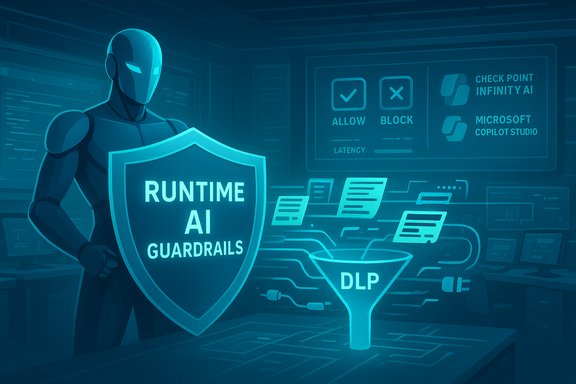
The partnership, as presented, promises four headline capabilities:- Runtime AI Guardrails — continuous, context‑aware inspection of planned agent actions to detect prompt injection, jailbreak attempts, and malicious instruction sequences in real time.
- Agent‑aware DLP — content inspection across tool inputs and outputs (including retrieval‑augmented generation contexts), enforcing sensitivity labels, redaction, or blocking before data leaves the tenant environment.
- Threat Prevention — detection of anomalous agent behavior, connector misuse, or indicators of compromise tied to agent lifecycles, with the ability to stop suspicious tool invocations synchronously.
- Enterprise‑grade scale with low latency claims — a vendor assertion that the stack will operate across large fleets of agents without materially impacting user experience; this claim requires independent validation.
Why runtime guardrails matter now
AI agents are not static chat widgets — they are programmable processes that read, reason and act across enterprise data and services. That unique capability introduces high‑impact risks not always addressed by classic perimeter or endpoint controls:- Prompt injection and RAG poisoning can coax agents into revealing protected data.
- Agents can execute multi‑step workflows (Power Automate flows, API calls, file writes) that transform a single exposure into a systemic operational incident.
- Agents often use long conversational context and retrieval pipelines, raising the possibility of “zero‑click” exfiltration where embedded content triggers undesirable behavior without explicit user intent.
The technical contract: how enforcement works in practice
Microsoft’s webhook API (the canonical integration path) requires partners to implement two endpoints:- POST /validate — health and readiness checks for the partner endpoint.
- POST /analyze-tool-execution — the main evaluation endpoint that receives planner context, tool definition, input values and conversation metadata and returns a blockAction boolean and optional diagnostics.
- Response time requirement: Copilot Studio expects a reply from the threat detection endpoint within less than 1,000 milliseconds. If the endpoint does not respond within that time frame, the agent proceeds as if the response were “allow” (i.e., fail‑open behavior by default). This behavior is explicit in Microsoft’s documentation and is the single most important operational rhythm in the vendor integration model.
- Authentication and identity plumbing: Partners must register apps in Microsoft Entra and accept authenticated calls from Copilot Studio; tenants control which external endpoints are authorized to mediate their agents’ actions. This means identity hygiene, least‑privilege and tenant‑scoped access are central to a safe deployment.
Strengths and practical value
- Enforcement at decision time. Synchronous blocking reduces the opportunity for exfiltration, because threats are intercepted in the execution path instead of being caught in logs later. That is materially better for preventing credential leaks, IP exfiltration, and automated data abuse.
- Combining mature DLP with agent context. Check Point brings decades of DLP and threat detection experience into the agent context. When DLP engines see retrieval context, entitlements and tool semantics, they can make more accurate allow/block decisions than content‑only filters. That can lower false negatives and improve enterprise signal‑to‑noise.
- Operational visibility and audit. A properly instrumented runtime enforcement plane produces lineage and telemetry that audit teams can use for compliance, incident response and eDiscovery — provided retention, residency and access policies are explicit and suitable for regulated environments.
- Vendor traction and ecosystem fit. Check Point’s outreach — including acquisitions and prior Azure integrations — shows a concerted strategy to secure the full AI lifecycle, which may speed enterprise adoption if operational proofs follow.
Risks, limitations, and what to validate in procurement
The integration is promising on paper, but enterprises must treat the announcement as the start of an engineering program rather than proof of turnkey readiness. Key areas to verify in any evaluation or purchase:- Latency and UX tradeoffs. The 1,000 ms budget is non‑trivial. Measure P50/P95/P99 latencies across representative multi‑step agents. If partner‑side decisions frequently approach the budget, users will perceive lag; if the partner endpoint is unstable, the platform’s fail‑open behavior will expose agents to unmitigated risk. Require measurable SLAs and run realistic load tests.
- Fail‑open semantics and incident runbooks. Microsoft’s default behavior (treating timeouts as “allow”) requires contractual attention. Buyers must negotiate explicit fail‑open/fail‑closed behavior, and joint runbooks for outages (how to disable/enable enforcement, how to revoke agent service principals, how to quarantine agents). Ask for explicit remediation SLAs and verified test outcomes.
- Data residency, telemetry retention and proofs of processing. Where is agent‑context processed — tenant‑local, partner‑managed cloud region, or multi‑tenant service? How long are prompts, chat histories and tool inputs retained? What controls are available for customer‑managed keys? These details materially affect regulatory compliance and must be negotiated.
- False positives and policy manageability. Over‑zealous DLP rules that block legitimate automation will generate help‑desk overload and operational friction, which in turn leads to shadowworkarounds. Define policy granularity (per‑agent, per‑connector, by sensitivity label), and require tooling for policy testing, simulation and staged rollout.
- Scope and visibility of enforcement. Confirm which tool calls and connectors are visible to the enforcement plane. Some third‑party connectors or on‑prem systems might escape inspection, leaving blind spots. Map connector coverage and require documented coverage matrices.
- Independent validation. Request joint customer references and independent technical benchmarks demonstrating detection efficacy for prompt‑injection and RAG‑layer exfiltration, plus measured latency under representative loads. Vendor marketing numbers are directional; treat them as such until validated.
Practical pilot checklist (what to test in a POC)
- Define scope and governance owners: security, product, compliance, and the teams that will author agents. Assign policy owners for each agent category.
- Validate identity plumbing:
- Confirm Entra app registrations and tenant allowlists.
- Confirm token lifetimes and least‑privilege flows.
- Measure latency and throughput:
- Run multi‑step agent flows and measure P50/P95/P99 round‑trip times to the partner webhook.
- Introduce concurrency to simulate expected peaks.
- Test fail scenarios:
- Simulate endpoint timeouts and network outages to observe fail‑open behavior.
- Exercise the runbook to revoke agent service principals, disable connectors and reclassify exposed documents.
- Test efficacy:
- Run adversarial prompt‑injection and RAG poisoning exercises specific to your tenant data.
- Measure detection rates and false positive rates for a mix of sensitive and benign data.
- Audit and compliance:
- Validate retention windows, access controls and eDiscovery export capabilities for webhook logs and decisions.
- Operationalize:
- Integrate webhook audit logs into SIEM and incident response tooling.
- Train SOC playbooks for agent compromise and escalations.
Procurement checklist — contract items to insist on
- Explicit data‑flow diagrams showing where prompt content, chat history and tool inputs are transmitted and stored.
- Data residency commitments and CMEK (customer‑managed encryption key) or regional processing guarantees where required.
- Latency SLAs (P95/P99), with financial remedies and joint acceptance tests.
- Clearly documented fail‑open/fail‑closed default behavior and a guaranteed runbook for outages.
- Joint incident response playbooks with responsibilities, contact windows and escalation paths.
- Audit access and evidence for compliance reviews and legal discovery (format, retention, exportability).
- Roadmap alignment: how will the vendor maintain compatibility with future Copilot Studio API changes and model routing updates?
- Joint customer references for similar deployments at similar scale and regulatory posture.
How this fits into a layered defense architecture
Runtime guardrails should not replace Microsoft’s native governance controls (Purview classification, Entra identity, Defender telemetry) or organizational processes. Instead, treat the partner enforcement as a complementary layer in a defense‑in‑depth strategy:- Baseline: Entra identities, least privilege, Purview sensitivity labels and conditional access.
- Design‑time controls: secure agent design, code reviews, model selection and prompt‑hardening during build/test.
- Runtime enforcement: synchronous webhook gating and DLP in the execution path (the Check Point layer).
- Observability and recovery: telemetry into SIEM, backups, Agent‑centric incident playbooks and rollback controls.
Competitive context and market direction
Check Point’s move is one of several industry responses to the same problem: vendors across the security stack are racing to provide agent‑aware DLP, runtime guardrails and model‑supply protections. The emergence of a partner ecosystem around Copilot Studio (webhook integrations, Foundry support, and specialized agent governance platforms) suggests the market will consolidate around a few patterns: synchronous webhooks for blocking decisions, tenant‑local adapters to reduce latency and hybrid enforcement models for regulated workloads. Expect further productization, partnerships and M&A to accelerate capability breadth — but the differentiators will be integration fidelity, latency at scale, and policy ergonomics.What to watch next
- Joint Microsoft technical guidance that codifies integration semantics for specific partner models (tenant‑local execution, telemetry contracts and failover semantics).
- Independent benchmark reports that measure detection efficacy for prompt‑injection and RAG‑exfiltration scenarios, as well as latency under load.
- Published customer case studies showing real‑world deployments, policy definitions, and operational outcomes.
- Evidence that key operational concerns (data residency, prompt log retention, customer‑managed keys) are contractually and technically resolved for regulated industries.
Final assessment and recommended posture for enterprise IT teams
The Check Point — Microsoft collaboration to embed runtime AI Guardrails, DLP and Threat Prevention into Copilot Studio is a pragmatic and necessary evolution for securing agentic AI. The approach — intercepting and evaluating planned tool calls at runtime — directly addresses the most severe attack vectors of agentic systems. That said, the effectiveness of any such integration is conditional on rigorous operational validation.Enterprises should:
- Treat vendor claims as starting points and require measurable, reproducible proofs in their own environment.
- Run conservative pilots that validate latency, fail‑open behavior, detection coverage and false positive characteristics.
- Insist on contractual guarantees for data residency, telemetry access and SLAs.
- Build AgentOps, including red‑team exercises tailored to prompt injection and RAG poisoning, and keep humans in the loop for high‑risk actions.
The Check Point announcement is not an endpoint; it is a practical signal that enterprise‑grade AI security is moving from theory to engineering practice. The next chapters will be written in proof‑of‑concept environments, procurement review boards, and SOC playbooks — and the organizations that align policy, engineering validation and vendor accountability will be the ones that safely unlock agentic AI’s productivity gains.
Source: CXOToday.com Check Point, Microsoft Partner to Deliver Enterprise-Grade AI Security
