

On April 30, 2026, Microsoft published a customer story detailing how Malaysia’s Chin Hin Group adopted Microsoft 365 Copilot and Microsoft Teams Rooms to build an AI-first workforce across its construction, property, manufacturing, trading, and home-living businesses. The headline result is not merely that a diversified builder bought Microsoft’s AI suite. It is that Chin Hin treated Copilot as an operating model, not a chatbot. That distinction matters because the next phase of enterprise AI will be won less by companies with the flashiest pilots than by companies that can turn ordinary work into measurable, governed, repeatable practice.
The easiest reading of Microsoft’s case study is the obvious one: another enterprise has deployed Microsoft 365 Copilot, trained users, and reported productivity gains. That is true, but it undersells the more interesting story. Chin Hin Group is a construction and real estate conglomerate, not a software-native startup with a blank-sheet workflow and a culture already organized around product sprints.
That makes its move more revealing. Construction, property development, manufacturing, procurement, safety reporting, and board reporting are disciplines full of documents, meetings, compliance artifacts, handoffs, and institutional memory. In other words, they are exactly the kinds of businesses where generative AI sounds promising in demos and then collides with the messiness of real operations.
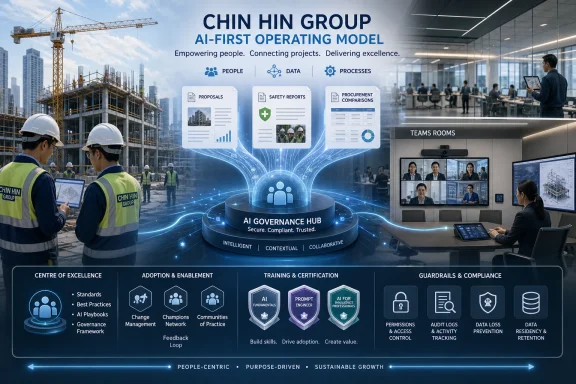
Chin Hin’s decision to build a Centre of Excellence around Microsoft 365 Copilot and Teams Rooms shows a more mature instinct than the familiar “give everyone a license and hope” approach. The company reportedly found through discovery workshops that repetitive tasks consumed up to 70 percent of HR and administrative teams’ time. That is not a marginal inefficiency; it is a structural tax on scaling.
The point is not that Copilot can summarize a meeting or draft a proposal. By now, that is table stakes. The point is that Chin Hin appears to have asked a harder question: which parts of the organization are spending human attention on work that can be standardized, accelerated, or partially automated without breaking accountability?
That ordinariness is the selling point. Meeting setup takes too long. Distributed teams lose alignment. HR teams drown in repeated administrative work. Safety reports, procurement comparisons, and board materials require synthesis from scattered sources. These are not glamorous use cases, but they are where enterprise software either proves itself or becomes another icon in the app launcher.
Chin Hin reported a 50 percent time saving in meeting setup, 91 percent meeting room utilization, a 93 percent employee satisfaction rate after implementation, more than 200 employees certified on Copilot, and 1,500 Copilot badges earned. Those figures should be read with the normal caution applied to vendor customer stories: they are selected successes, not independent audits. Still, they tell us what Microsoft wants the market to notice.
The company is not merely selling “AI that writes.” It is selling a workplace stack in which rooms, meetings, documents, credentials, governance, and eventually agents become one continuous system. Microsoft Teams Rooms matters in this story because it brings the physical conference room into that system. Copilot matters because it turns the meeting, document, and workflow residue into structured work product.
For WindowsForum readers, this is the more important platform shift. The Copilot story is not only happening inside Windows or the browser. It is happening in the enterprise substrate that Windows shops already manage: identity, devices, rooms, Teams, compliance boundaries, licensing, and user enablement.
Without that layer, generative AI adoption tends to split into two bad outcomes. In one, employees experiment informally, creating shadow processes that may be productive but are invisible to governance. In the other, IT locks down access so tightly that the official AI program becomes irrelevant while workers quietly use whatever tools are easiest.
Chin Hin’s model suggests a third route. The company embedded adoption at the policy level rather than treating it as a one-off training exercise. That matters because policy-level adoption forces the business to answer questions that a training deck can avoid: who owns prompt standards, what gets automated first, how success is measured, and when a task should remain human-led?
The company’s Chief Transformation Officer, Abel Saw, framed the bridge between human intelligence and artificial intelligence as skills rather than tools. That is the kind of quote vendors love, but it also happens to be correct. In most organizations, AI failure is not caused by a shortage of models. It is caused by a shortage of people who know how to turn ambiguous work into a reliable prompt, evaluate outputs, and redesign the surrounding process.
That is why Chin Hin’s badges and certification program matter more than the raw seat count. The company started with 114 Copilot seats and expanded as adoption grew. That staged approach is more credible than a sudden all-hands deployment, because it implies the organization was watching behavior, not just procurement.
Chin Hin reportedly made prompt fluency a core focus. That is the right emphasis, though the phrase can sound deceptively lightweight. Prompting is not magic wording. In a business setting, it is closer to translating intent into procedure: define the role, state the source material, specify the format, identify constraints, ask for assumptions, and require the model to expose uncertainty.
In construction and property development, that skill can become especially valuable because work often crosses professional domains. A procurement comparison may need commercial judgment, supplier history, technical compatibility, and risk language. A safety report summary may need to preserve incidents, dates, responsibility, and escalation items. A board update may need to turn operational detail into executive signal without inventing certainty.
This is where AI literacy becomes operational literacy. A poor prompt can generate a plausible summary that misses the one issue that mattered. A strong workflow can make Copilot a first-pass analyst while leaving final judgment with the person who understands the site, supplier, client, or regulator.
The cultural signal Microsoft highlighted — employees asking, “Can we do this in Copilot?” — is more important than it looks. That question means the tool has moved from novelty to reflex. The risk, of course, is that reflex can outrun discipline. The best AI cultures will not ask only whether Copilot can do something; they will ask whether Copilot should do it, under what controls, and with what human review.
The enterprise AI conversation often fixates on individual productivity. One user writes faster. One analyst summarizes more quickly. One manager clears email more efficiently. But much of the real cost in large organizations is collective friction: meetings that start late, decisions that vanish into chat threads, follow-ups that are forgotten, distributed teams that hear different versions of the same plan.
Teams Rooms plus Copilot addresses that layer. Meeting summaries, action items, and recaps are not glamorous, but they create a shared memory for the organization. In a diversified conglomerate, shared memory is not a soft benefit; it is an operating requirement.
The physical room also matters because hybrid work did not erase offices. It made them more complicated. If a meeting includes site staff, executives, vendors, remote teams, and room participants, the quality of the room experience determines whether the meeting is inclusive or performative. AI-generated recap is only as useful as the meeting capture beneath it.
That is why the hardware-software combination is central to Microsoft’s workplace strategy. The company does not need every customer to think of Teams Rooms as an AI product. It needs them to recognize that the room is now part of the data and collaboration fabric that AI can act on.
Using Copilot to summarize a meeting or draft a proposal is one kind of risk. Letting an autonomous or semi-autonomous agent execute parts of a procurement, HR, finance, or compliance process is another. The former can be reviewed as content. The latter must be governed as action.
Microsoft’s broader Copilot strategy has been moving steadily toward agents, with Copilot Studio positioned as the platform for building and extending them. Chin Hin is reportedly already discussing expansion into Copilot Studio and Security Copilot in FY26. That makes sense: once an organization has trained users and mapped repetitive workflows, the next step is to encode more of that work into agents.
But “agentic AI” is one of those industry phrases that can conceal as much as it reveals. A useful agent might gather data, prepare a comparison, draft a report, or route a request. A dangerous agent might take poorly scoped action, expose sensitive information, or create a false sense of completed work. The line between assistance and automation must be explicit.
This is where IT pros should resist both hype and cynicism. Agents are not science fiction, and they are not automatically enterprise-ready. They are software actors operating in permissioned environments, and the old disciplines still apply: least privilege, audit logs, data classification, exception handling, rollback, monitoring, and clear ownership.
Chin Hin’s advantage, if Microsoft’s account is accurate, is that it is not jumping straight to agents. It is building the workforce habits first. That sequence is the difference between automation as acceleration and automation as chaos.
But training is also a control mechanism. A workforce that understands how AI should be used is easier to govern than one that sees AI as either forbidden or magical. Certification creates a common vocabulary. Badges create a visible incentive structure. Training sessions give leadership a place to communicate boundaries as well as possibilities.
That matters because generative AI blurs lines employees used to understand intuitively. Is it acceptable to paste client information into a prompt? Should Copilot summarize a confidential board document? Who verifies a procurement comparison? When does AI-assisted drafting need disclosure? Which outputs can be reused, and which need legal or managerial review?
Microsoft 365 Copilot’s enterprise appeal rests partly on the claim that it works inside an organization’s existing Microsoft 365 permissions and data boundaries. That is a meaningful advantage over consumer AI tools, but it is not a substitute for governance. If a user has access to too much data, Copilot may inherit that problem. If SharePoint is a permissions landfill, AI will not magically turn it into a clean knowledge architecture.
In that sense, Copilot adoption is a mirror. It reflects the state of an organization’s identity, content management, meeting discipline, and data hygiene. Companies that treat the AI rollout as a reason to fix those foundations will get more value than those that treat Copilot as a shortcut around them.
The industry also sits at the intersection of physical and digital work. A site report is not just a file; it is a representation of conditions on the ground. A safety summary is not just an internal memo; it may shape escalation, compliance, and accountability. A procurement comparison is not just a spreadsheet; it can influence cost, schedule, quality, and supplier relationships.
That makes the sector a strong test of whether Copilot can move beyond office productivity theater. If AI can help synthesize site reports, compare procurement options, prepare finance updates, and keep distributed project teams aligned, it has a role in complex industrial workflows. If it merely produces tidy prose while humans still chase missing context, its value will be narrower.
Malaysia’s broader push around digital economy development and construction modernization gives Chin Hin’s move additional context. The country has been encouraging AI, cloud, digital skills, and Construction 4.0 capabilities such as BIM, IoT, big data, and automation. Chin Hin’s program sits squarely inside that national and sectoral pressure to modernize.
Yet the lesson is not Malaysia-specific. Builders, manufacturers, infrastructure firms, and property groups everywhere face the same underlying problem: they need to scale knowledge faster than they can scale experienced people. AI does not replace that experience. At its best, it helps capture, distribute, and apply it more consistently.
That is what Microsoft has always wanted from Microsoft 365. Word became boring. Excel became boring. Outlook became boring. Teams, for all its critics, became unavoidable. The business model works when a tool becomes infrastructure rather than a destination.
Copilot’s challenge is that AI does not become boring as easily as email or spreadsheets did. It can make mistakes in more human-looking ways. It can generate confidence without competence. It changes user expectations faster than IT departments can rewrite policy. It also carries a licensing cost that forces leadership to justify who gets access and why.
Chin Hin’s staged adoption offers one answer. Start with areas where repetitive work is visible. Train users deliberately. Tie learning to credentials. Measure operational outcomes. Expand seats as usage matures. Then consider agents where the workflow is well understood.
That is a more credible enterprise pattern than the breathless “AI for everyone, immediately” narrative. It acknowledges that productivity is not evenly distributed. Some departments will find value quickly. Others will need process redesign before the AI layer matters.
For example, proposal drafting is valuable only if quality, win rates, or turnaround improve without creating review bottlenecks. Safety report summarization is valuable only if it preserves critical details and improves escalation. Procurement comparison is valuable only if it helps buyers make better decisions, not merely faster ones. Finance and board reporting is valuable only if executives trust the numbers and assumptions.
This is where many AI programs will struggle. The first productivity gains are often easy to describe because they involve time saved. The second-order gains are harder: better decisions, fewer errors, faster onboarding, improved compliance, reduced rework, more consistent management practice. Those require baseline measurements most organizations never captured before AI arrived.
Microsoft’s customer story format naturally favors clean outcomes. That is not a criticism; it is what customer stories do. But IT leaders reading it should translate the marketing metrics into their own operational questions. What work is being accelerated? What work is being improved? What risk is being introduced? What should be measured six months later?
The danger is that AI adoption becomes performative: badges earned, sessions held, dashboards updated, but workflows unchanged. Chin Hin appears to be trying to avoid that trap by linking training to actual use cases and process layers. The real test will be whether those early gains survive expansion into more autonomous systems.
Speed matters, especially in sectors where margins, project timelines, and customer expectations are unforgiving. A company that can train faster, summarize faster, compare faster, and coordinate faster has a real advantage. But speed without control can turn into expensive noise.
The best version of Chin Hin’s model is not acceleration for its own sake. It is governed acceleration: faster meetings because rooms and recaps work; faster reports because source material is better organized; faster training because skills pathways are formalized; faster automation because processes have been mapped before agents are introduced.
This is where Microsoft’s enterprise stack has a strategic opening. The company can argue that Copilot is not merely another AI interface but a controlled layer inside the systems enterprises already trust. Whether that argument holds depends on implementation discipline. Microsoft can provide the platform; customers still have to clean up permissions, define policy, train users, and decide where automation stops.
IT departments should pay close attention to that balance. If business leaders hear only the velocity message, they may push for agentic automation before the organization is ready. If IT hears only the risk message, it may slow adoption until employees route around official channels. The winning posture is neither enthusiasm nor obstruction. It is architecture.
That means the internal politics matter as much as the technical configuration. HR, IT, operations, finance, and business-unit leaders all have to see themselves in the program. If AI is owned only by IT, it risks becoming a tool rollout. If it is owned only by the business, it risks becoming a governance headache. If it is owned by everyone in theory and no one in practice, it dies in committee.
Chin Hin’s Centre of Excellence is therefore less a bureaucratic flourish than a coordination mechanism. It gives the organization a place to turn AI enthusiasm into standards. It also gives employees a signal that the company is not merely asking them to do more with less; it is investing in a new skill base.
For Windows-centric environments, the relevance is immediate. Many organizations already have the Microsoft 365 substrate. They already manage Teams, Entra identity, SharePoint, Exchange, endpoint fleets, and meeting rooms. Copilot adoption will expose how well those pieces actually work together.
That exposure can be uncomfortable. But it is also useful. AI has a way of punishing messy information architecture and rewarding disciplined digital operations. In that sense, Copilot may become one of the strongest arguments for cleaning up the Microsoft estate that IT teams have ever had.
Chin Hin’s story shows both sides. On the positive side, Copilot and Teams Rooms give the company an integrated path from meetings to summaries, from documents to drafting, from training to credentials, and eventually from workflows to agents. On the cautionary side, a deep commitment to one vendor’s AI layer makes governance, licensing, data architecture, and future interoperability more strategic than ever.
This is not a reason to avoid the platform. Enterprise IT has always involved platform bets. The point is to make the bet consciously. If Copilot becomes central to training, reporting, meetings, procurement, and workflow automation, then Microsoft 365 is no longer just productivity software. It becomes a decision environment.
That raises the stakes for administrators and architects. Tenant configuration, retention policy, sensitivity labels, data access, Teams governance, meeting standards, device management, and auditability all become part of the AI system. The boundaries between “collaboration admin” and “AI governance” will keep dissolving.
Chin Hin’s example suggests that the companies most likely to benefit are those that understand this early. They will not ask whether Copilot belongs to IT, HR, or operations. They will build a model in which all three have defined responsibilities.
Source: Microsoft Chin Hin Group builds an AI-first workforce with Microsoft 365 Copilot and Teams Rooms | Microsoft Customer Stories
 Chin Hin’s Real Bet Is on Organizational Muscle, Not Software
The easiest reading of Microsoft’s case study is the obvious one: another enterprise has deployed Microsoft 365 Copilot, trained users, and reported productivity gains. That is true, but it undersells the more interesting story. Chin Hin Group is a construction and real estate conglomerate, not a software-native startup with a blank-sheet workflow and a culture already organized around product sprints.That makes its move more revealing. Construction, property development, manufacturing, procurement, safety reporting, and board reporting are disciplines full of documents, meetings, compliance artifacts, handoffs, and institutional memory. In other words, they are exactly the kinds of businesses where generative AI sounds promising in demos and then collides with the messiness of real operations.
Chin Hin’s decision to build a Centre of Excellence around Microsoft 365 Copilot and Teams Rooms shows a more mature instinct than the familiar “give everyone a license and hope” approach. The company reportedly found through discovery workshops that repetitive tasks consumed up to 70 percent of HR and administrative teams’ time. That is not a marginal inefficiency; it is a structural tax on scaling.
The point is not that Copilot can summarize a meeting or draft a proposal. By now, that is table stakes. The point is that Chin Hin appears to have asked a harder question: which parts of the organization are spending human attention on work that can be standardized, accelerated, or partially automated without breaking accountability?
Microsoft’s Copilot Pitch Finally Finds Its Most Persuasive Customer
Microsoft has spent the last few years trying to persuade enterprises that Copilot is not a novelty layer pasted onto Office. The company’s grand claim has been that AI belongs inside the daily flow of work — Outlook, Teams, Word, Excel, PowerPoint, SharePoint, and the surrounding Microsoft 365 graph. The Chin Hin story is useful to Microsoft because it presents Copilot not as a futuristic abstraction, but as a tool for deeply ordinary business friction.That ordinariness is the selling point. Meeting setup takes too long. Distributed teams lose alignment. HR teams drown in repeated administrative work. Safety reports, procurement comparisons, and board materials require synthesis from scattered sources. These are not glamorous use cases, but they are where enterprise software either proves itself or becomes another icon in the app launcher.
Chin Hin reported a 50 percent time saving in meeting setup, 91 percent meeting room utilization, a 93 percent employee satisfaction rate after implementation, more than 200 employees certified on Copilot, and 1,500 Copilot badges earned. Those figures should be read with the normal caution applied to vendor customer stories: they are selected successes, not independent audits. Still, they tell us what Microsoft wants the market to notice.
The company is not merely selling “AI that writes.” It is selling a workplace stack in which rooms, meetings, documents, credentials, governance, and eventually agents become one continuous system. Microsoft Teams Rooms matters in this story because it brings the physical conference room into that system. Copilot matters because it turns the meeting, document, and workflow residue into structured work product.
For WindowsForum readers, this is the more important platform shift. The Copilot story is not only happening inside Windows or the browser. It is happening in the enterprise substrate that Windows shops already manage: identity, devices, rooms, Teams, compliance boundaries, licensing, and user enablement.
The Centre of Excellence Is the Quietly Radical Part
The most consequential phrase in Microsoft’s account may be “Centre of Excellence.” It sounds like management wallpaper, but in enterprise AI it is becoming the difference between a pilot and a capability. A CoE gives the organization a place to decide what good AI use looks like, which workflows deserve priority, which data should be exposed, and how employees should be trained.Without that layer, generative AI adoption tends to split into two bad outcomes. In one, employees experiment informally, creating shadow processes that may be productive but are invisible to governance. In the other, IT locks down access so tightly that the official AI program becomes irrelevant while workers quietly use whatever tools are easiest.
Chin Hin’s model suggests a third route. The company embedded adoption at the policy level rather than treating it as a one-off training exercise. That matters because policy-level adoption forces the business to answer questions that a training deck can avoid: who owns prompt standards, what gets automated first, how success is measured, and when a task should remain human-led?
The company’s Chief Transformation Officer, Abel Saw, framed the bridge between human intelligence and artificial intelligence as skills rather than tools. That is the kind of quote vendors love, but it also happens to be correct. In most organizations, AI failure is not caused by a shortage of models. It is caused by a shortage of people who know how to turn ambiguous work into a reliable prompt, evaluate outputs, and redesign the surrounding process.
That is why Chin Hin’s badges and certification program matter more than the raw seat count. The company started with 114 Copilot seats and expanded as adoption grew. That staged approach is more credible than a sudden all-hands deployment, because it implies the organization was watching behavior, not just procurement.
Prompt Fluency Becomes the New Office Literacy
For two decades, digital workplace literacy meant being able to use email, spreadsheets, shared drives, presentations, and calendars without turning every task into a support ticket. Generative AI is shifting that baseline. The new literacy is not simply knowing where the Copilot button lives; it is knowing how to instruct, constrain, verify, and reuse AI assistance in the context of actual work.Chin Hin reportedly made prompt fluency a core focus. That is the right emphasis, though the phrase can sound deceptively lightweight. Prompting is not magic wording. In a business setting, it is closer to translating intent into procedure: define the role, state the source material, specify the format, identify constraints, ask for assumptions, and require the model to expose uncertainty.
In construction and property development, that skill can become especially valuable because work often crosses professional domains. A procurement comparison may need commercial judgment, supplier history, technical compatibility, and risk language. A safety report summary may need to preserve incidents, dates, responsibility, and escalation items. A board update may need to turn operational detail into executive signal without inventing certainty.
This is where AI literacy becomes operational literacy. A poor prompt can generate a plausible summary that misses the one issue that mattered. A strong workflow can make Copilot a first-pass analyst while leaving final judgment with the person who understands the site, supplier, client, or regulator.
The cultural signal Microsoft highlighted — employees asking, “Can we do this in Copilot?” — is more important than it looks. That question means the tool has moved from novelty to reflex. The risk, of course, is that reflex can outrun discipline. The best AI cultures will not ask only whether Copilot can do something; they will ask whether Copilot should do it, under what controls, and with what human review.
Teams Rooms Turns AI From Personal Assistant Into Shared Infrastructure
Microsoft Teams Rooms often gets treated as a meeting-room hardware story: cameras, microphones, displays, touch panels, and the eternal corporate dream of starting a meeting without five minutes of cable archaeology. Chin Hin’s reported 50 percent meeting setup savings and 91 percent room utilization put that hardware layer back into strategic context. Meetings are still where many organizations convert uncertainty into decisions.The enterprise AI conversation often fixates on individual productivity. One user writes faster. One analyst summarizes more quickly. One manager clears email more efficiently. But much of the real cost in large organizations is collective friction: meetings that start late, decisions that vanish into chat threads, follow-ups that are forgotten, distributed teams that hear different versions of the same plan.
Teams Rooms plus Copilot addresses that layer. Meeting summaries, action items, and recaps are not glamorous, but they create a shared memory for the organization. In a diversified conglomerate, shared memory is not a soft benefit; it is an operating requirement.
The physical room also matters because hybrid work did not erase offices. It made them more complicated. If a meeting includes site staff, executives, vendors, remote teams, and room participants, the quality of the room experience determines whether the meeting is inclusive or performative. AI-generated recap is only as useful as the meeting capture beneath it.
That is why the hardware-software combination is central to Microsoft’s workplace strategy. The company does not need every customer to think of Teams Rooms as an AI product. It needs them to recognize that the room is now part of the data and collaboration fabric that AI can act on.
The Agentic Ambition Is Where the Risk Starts to Rise
Chin Hin’s methodology reportedly moves through three layers: adding AI into existing processes, automating end-to-end workflows, and ultimately replacing workflows with agentic AI entirely. That progression captures the enterprise AI roadmap in miniature. It also marks the point where the conversation becomes more dangerous.Using Copilot to summarize a meeting or draft a proposal is one kind of risk. Letting an autonomous or semi-autonomous agent execute parts of a procurement, HR, finance, or compliance process is another. The former can be reviewed as content. The latter must be governed as action.
Microsoft’s broader Copilot strategy has been moving steadily toward agents, with Copilot Studio positioned as the platform for building and extending them. Chin Hin is reportedly already discussing expansion into Copilot Studio and Security Copilot in FY26. That makes sense: once an organization has trained users and mapped repetitive workflows, the next step is to encode more of that work into agents.
But “agentic AI” is one of those industry phrases that can conceal as much as it reveals. A useful agent might gather data, prepare a comparison, draft a report, or route a request. A dangerous agent might take poorly scoped action, expose sensitive information, or create a false sense of completed work. The line between assistance and automation must be explicit.
This is where IT pros should resist both hype and cynicism. Agents are not science fiction, and they are not automatically enterprise-ready. They are software actors operating in permissioned environments, and the old disciplines still apply: least privilege, audit logs, data classification, exception handling, rollback, monitoring, and clear ownership.
Chin Hin’s advantage, if Microsoft’s account is accurate, is that it is not jumping straight to agents. It is building the workforce habits first. That sequence is the difference between automation as acceleration and automation as chaos.
The Skills Story Is Also a Governance Story
Microsoft’s customer story presents training as empowerment, and that is fair. More than 1,000 employees participated in over 15 Copilot training sessions, more than 200 earned Copilot certification, and staff earned more than 1,500 badges. For a company in a non-software sector, those numbers suggest a serious internal campaign.But training is also a control mechanism. A workforce that understands how AI should be used is easier to govern than one that sees AI as either forbidden or magical. Certification creates a common vocabulary. Badges create a visible incentive structure. Training sessions give leadership a place to communicate boundaries as well as possibilities.
That matters because generative AI blurs lines employees used to understand intuitively. Is it acceptable to paste client information into a prompt? Should Copilot summarize a confidential board document? Who verifies a procurement comparison? When does AI-assisted drafting need disclosure? Which outputs can be reused, and which need legal or managerial review?
Microsoft 365 Copilot’s enterprise appeal rests partly on the claim that it works inside an organization’s existing Microsoft 365 permissions and data boundaries. That is a meaningful advantage over consumer AI tools, but it is not a substitute for governance. If a user has access to too much data, Copilot may inherit that problem. If SharePoint is a permissions landfill, AI will not magically turn it into a clean knowledge architecture.
In that sense, Copilot adoption is a mirror. It reflects the state of an organization’s identity, content management, meeting discipline, and data hygiene. Companies that treat the AI rollout as a reason to fix those foundations will get more value than those that treat Copilot as a shortcut around them.
Construction Is an Ideal Stress Test for Enterprise AI
It is tempting to think of AI adoption as a white-collar office story. Chin Hin complicates that assumption. Construction and real estate are document-heavy, coordination-heavy, risk-heavy sectors where delays, miscommunication, and administrative drag have material consequences.The industry also sits at the intersection of physical and digital work. A site report is not just a file; it is a representation of conditions on the ground. A safety summary is not just an internal memo; it may shape escalation, compliance, and accountability. A procurement comparison is not just a spreadsheet; it can influence cost, schedule, quality, and supplier relationships.
That makes the sector a strong test of whether Copilot can move beyond office productivity theater. If AI can help synthesize site reports, compare procurement options, prepare finance updates, and keep distributed project teams aligned, it has a role in complex industrial workflows. If it merely produces tidy prose while humans still chase missing context, its value will be narrower.
Malaysia’s broader push around digital economy development and construction modernization gives Chin Hin’s move additional context. The country has been encouraging AI, cloud, digital skills, and Construction 4.0 capabilities such as BIM, IoT, big data, and automation. Chin Hin’s program sits squarely inside that national and sectoral pressure to modernize.
Yet the lesson is not Malaysia-specific. Builders, manufacturers, infrastructure firms, and property groups everywhere face the same underlying problem: they need to scale knowledge faster than they can scale experienced people. AI does not replace that experience. At its best, it helps capture, distribute, and apply it more consistently.
Microsoft Wins When Copilot Becomes Boring
The most bullish sign for Microsoft is not an executive quote or an award. It is the possibility that Copilot becomes boring. Not boring as in unused, but boring as in assumed — part of how proposals, meetings, reports, and decisions move through the business.That is what Microsoft has always wanted from Microsoft 365. Word became boring. Excel became boring. Outlook became boring. Teams, for all its critics, became unavoidable. The business model works when a tool becomes infrastructure rather than a destination.
Copilot’s challenge is that AI does not become boring as easily as email or spreadsheets did. It can make mistakes in more human-looking ways. It can generate confidence without competence. It changes user expectations faster than IT departments can rewrite policy. It also carries a licensing cost that forces leadership to justify who gets access and why.
Chin Hin’s staged adoption offers one answer. Start with areas where repetitive work is visible. Train users deliberately. Tie learning to credentials. Measure operational outcomes. Expand seats as usage matures. Then consider agents where the workflow is well understood.
That is a more credible enterprise pattern than the breathless “AI for everyone, immediately” narrative. It acknowledges that productivity is not evenly distributed. Some departments will find value quickly. Others will need process redesign before the AI layer matters.
The Numbers Are Encouraging, but the Missing Metrics Matter
The reported metrics in the Chin Hin story are useful, but they are not the full scorecard. Time saved in meeting setup is concrete. Room utilization is concrete. Employee satisfaction is helpful. Certification counts show adoption momentum. But the next wave of AI measurement needs to go deeper.For example, proposal drafting is valuable only if quality, win rates, or turnaround improve without creating review bottlenecks. Safety report summarization is valuable only if it preserves critical details and improves escalation. Procurement comparison is valuable only if it helps buyers make better decisions, not merely faster ones. Finance and board reporting is valuable only if executives trust the numbers and assumptions.
This is where many AI programs will struggle. The first productivity gains are often easy to describe because they involve time saved. The second-order gains are harder: better decisions, fewer errors, faster onboarding, improved compliance, reduced rework, more consistent management practice. Those require baseline measurements most organizations never captured before AI arrived.
Microsoft’s customer story format naturally favors clean outcomes. That is not a criticism; it is what customer stories do. But IT leaders reading it should translate the marketing metrics into their own operational questions. What work is being accelerated? What work is being improved? What risk is being introduced? What should be measured six months later?
The danger is that AI adoption becomes performative: badges earned, sessions held, dashboards updated, but workflows unchanged. Chin Hin appears to be trying to avoid that trap by linking training to actual use cases and process layers. The real test will be whether those early gains survive expansion into more autonomous systems.
The Faster Company Still Needs Brakes
Saw’s quoted line that in the generative AI era “the faster” defeats “the slower” captures the mood of enterprise leadership right now. It is an effective rallying cry. It is also incomplete.Speed matters, especially in sectors where margins, project timelines, and customer expectations are unforgiving. A company that can train faster, summarize faster, compare faster, and coordinate faster has a real advantage. But speed without control can turn into expensive noise.
The best version of Chin Hin’s model is not acceleration for its own sake. It is governed acceleration: faster meetings because rooms and recaps work; faster reports because source material is better organized; faster training because skills pathways are formalized; faster automation because processes have been mapped before agents are introduced.
This is where Microsoft’s enterprise stack has a strategic opening. The company can argue that Copilot is not merely another AI interface but a controlled layer inside the systems enterprises already trust. Whether that argument holds depends on implementation discipline. Microsoft can provide the platform; customers still have to clean up permissions, define policy, train users, and decide where automation stops.
IT departments should pay close attention to that balance. If business leaders hear only the velocity message, they may push for agentic automation before the organization is ready. If IT hears only the risk message, it may slow adoption until employees route around official channels. The winning posture is neither enthusiasm nor obstruction. It is architecture.
The Chin Hin Pattern Is the One IT Shops Should Steal
Chin Hin’s deployment is interesting because it gives IT leaders a pattern they can adapt without pretending their organization is a Silicon Valley lab. The practical lesson is not “buy Copilot.” It is that AI adoption has to be treated as workforce design, workflow redesign, and platform governance at the same time.That means the internal politics matter as much as the technical configuration. HR, IT, operations, finance, and business-unit leaders all have to see themselves in the program. If AI is owned only by IT, it risks becoming a tool rollout. If it is owned only by the business, it risks becoming a governance headache. If it is owned by everyone in theory and no one in practice, it dies in committee.
Chin Hin’s Centre of Excellence is therefore less a bureaucratic flourish than a coordination mechanism. It gives the organization a place to turn AI enthusiasm into standards. It also gives employees a signal that the company is not merely asking them to do more with less; it is investing in a new skill base.
For Windows-centric environments, the relevance is immediate. Many organizations already have the Microsoft 365 substrate. They already manage Teams, Entra identity, SharePoint, Exchange, endpoint fleets, and meeting rooms. Copilot adoption will expose how well those pieces actually work together.
That exposure can be uncomfortable. But it is also useful. AI has a way of punishing messy information architecture and rewarding disciplined digital operations. In that sense, Copilot may become one of the strongest arguments for cleaning up the Microsoft estate that IT teams have ever had.
The Microsoft Customer Story Hides a Bigger Enterprise Bargain
The bargain Microsoft is offering is straightforward: keep your people in the Microsoft 365 world, and Microsoft will bring AI to the work they already do. That bargain is powerful because it lowers adoption friction. It is also constraining because it encourages organizations to frame AI transformation through the shape of Microsoft’s platform.Chin Hin’s story shows both sides. On the positive side, Copilot and Teams Rooms give the company an integrated path from meetings to summaries, from documents to drafting, from training to credentials, and eventually from workflows to agents. On the cautionary side, a deep commitment to one vendor’s AI layer makes governance, licensing, data architecture, and future interoperability more strategic than ever.
This is not a reason to avoid the platform. Enterprise IT has always involved platform bets. The point is to make the bet consciously. If Copilot becomes central to training, reporting, meetings, procurement, and workflow automation, then Microsoft 365 is no longer just productivity software. It becomes a decision environment.
That raises the stakes for administrators and architects. Tenant configuration, retention policy, sensitivity labels, data access, Teams governance, meeting standards, device management, and auditability all become part of the AI system. The boundaries between “collaboration admin” and “AI governance” will keep dissolving.
Chin Hin’s example suggests that the companies most likely to benefit are those that understand this early. They will not ask whether Copilot belongs to IT, HR, or operations. They will build a model in which all three have defined responsibilities.
The Copilot Rollout Playbook Is Starting to Come Into Focus
The most useful reading of Chin Hin’s experience is as an emerging playbook for mainstream enterprises. It is not universal, and it is not guaranteed. But it is concrete enough to matter.- Chin Hin’s reported success came from pairing Microsoft 365 Copilot with Teams Rooms, not from treating AI as a standalone chatbot.
- The company built a Centre of Excellence to connect HR modernization, talent development, workflow improvement, and AI governance.
- Training was treated as a formal adoption system, with more than 1,000 participants, internal certification, and Microsoft-aligned badges.
- The strongest early use cases were practical and document-heavy, including proposal drafting, safety reporting, procurement comparison, meeting summaries, and executive reporting.
- The move toward Copilot Studio and Security Copilot will raise the governance bar because agents turn AI from a content assistant into a workflow actor.
- The broader lesson for IT leaders is that Copilot adoption should begin with process discovery, permissions hygiene, and workforce skills rather than license assignment alone.
Source: Microsoft Chin Hin Group builds an AI-first workforce with Microsoft 365 Copilot and Teams Rooms | Microsoft Customer Stories
