

The Semiconductor Industry Association on June 16, 2026 praised new U.S. Commerce Department incentives for Coherent’s indium phosphide manufacturing expansion in Sherman, Texas, a CHIPS Act-backed project expected to create more than 1,000 jobs and increase domestic output of photonic devices for AI data centers. The announcement is not simply another ribbon-cutting in America’s semiconductor subsidy era. It is a sign that the AI supply chain has moved beyond GPUs and advanced packaging into the less glamorous, more fragile world of optical plumbing. If Washington wants the United States to own more of the AI stack, it has to fund the lasers as well as the logic.
The first wave of AI infrastructure politics was easy to understand because it had a protagonist: the accelerator. GPUs became the shorthand for everything from national competitiveness to export controls, and the public conversation followed the money toward Nvidia, TSMC, advanced packaging, and high-bandwidth memory. But inside a modern AI data center, compute is only part of the problem. The other problem is moving staggering amounts of data fast enough, cheaply enough, and efficiently enough that those accelerators behave like one useful machine rather than a room full of expensive islands.
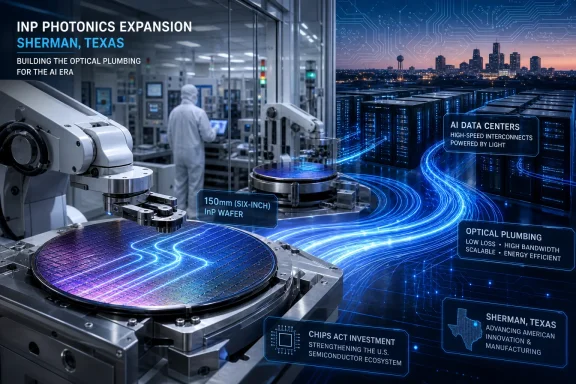
That is where Coherent’s Sherman expansion matters. Indium phosphide, often shortened to InP, is a compound semiconductor material used in photonic devices that can emit and manipulate light at wavelengths used in fiber-optic communications. In plain English, it helps make the lasers and optical components that move data through high-speed networks. For AI clusters, those networks are no longer peripheral infrastructure. They are the nervous system.
SIA’s statement is predictably celebratory, and it should be read as industry advocacy rather than neutral analysis. Still, the emphasis is revealing. The trade group did not frame the Coherent incentives around consumer electronics, telecom nostalgia, or generic industrial policy. It framed them around artificial intelligence systems, advanced communications networks, and next-generation data centers. That is the new hierarchy of urgency.
The Commerce Department’s reported support for Coherent comes as chip policy is being forced to mature. It is no longer enough to ask whether the United States can manufacture leading-edge processors. The better question is whether it can manufacture enough of the surrounding technologies that make those processors useful. In that sense, a Texas InP fab may be less photogenic than a giant logic fab in Arizona, but it may be just as telling.
The numbers are small by CHIPS Act standards. TSMC, Intel, Samsung, Micron, and other giants have been associated with awards measured in billions. Coherent’s award belongs to a different category: targeted support for a specialized technology that may sit several layers beneath the headline component but still determine whether the headline component can scale.
That is precisely why it deserves attention. Industrial policy is often judged by the size of the check, but supply-chain resilience is usually determined by the parts of the bill of materials that most people ignore. The AI boom has made optical interconnects more strategically visible because the economics of compute increasingly depend on data movement. If electrons are too slow, too hot, or too power-hungry over the relevant distances, light becomes the practical answer.
Sherman is also a useful political stage. Texas has become a center of gravity for semiconductor investment, packaging, assembly, data centers, and power-hungry AI infrastructure. State support has layered on top of federal support, including a Texas Semiconductor Innovation Fund grant announced earlier in 2026 for Coherent’s indium phosphide work. That stack of incentives is the modern American chip strategy in miniature: federal grants, state money, private capital, and a promise that critical nodes of the supply chain will land on U.S. soil.
The promise is compelling, but it is not self-executing. A grant announcement does not guarantee smooth hiring, yield improvement, reliable scale-up, or long-term competitiveness. The U.S. semiconductor revival has already shown that factories are slower than press releases. Coherent’s project will be judged not by the ceremony but by whether six-inch InP production in Texas can reliably meet AI-era demand.
Moving InP production to larger wafer formats is important because scale changes cost, throughput, and consistency. Six-inch, or 150mm, InP wafers allow more devices per wafer than smaller formats and can support more industrialized manufacturing. For optical components that need to feed hyperscale AI networks, that matters. The point is not just to make exotic devices. It is to make enough of them with enough repeatability.
This is one reason the Commerce Department’s involvement makes strategic sense. The United States does not need to subsidize every chip-adjacent business simply because the word “AI” appears in the deck. But it does need to identify where concentrated technical expertise and manufacturing capacity could become leverage points. InP photonics is one of those areas because it is deeply tied to high-speed optical networking, and high-speed optical networking is deeply tied to the next phase of AI infrastructure.
Coherent also brings an important distinction: this is not a startup trying to invent demand. The company is an established photonics and materials supplier with exposure to communications, industrial lasers, sensing, and data-center infrastructure. That does not remove execution risk, but it changes the nature of the bet. Washington is not merely sprinkling money on a speculative frontier; it is attempting to expand a known industrial capability at a moment when demand is accelerating.
The six-inch wafer detail also clarifies why this announcement should interest WindowsForum readers who may not live in the semiconductor weeds. The services running on Windows PCs, Azure instances, local developer workstations, and enterprise endpoints increasingly depend on AI infrastructure somewhere else. Faster copilots, smarter security tooling, lower-latency cloud applications, and more capable developer services all rely on data-center systems that can move information efficiently. The optical layer is becoming part of the user experience, even if users never see it.
For years, the industry sold performance through the drama of the processor. The new AI data-center race is increasingly about the cluster: accelerators, memory, switches, optics, power delivery, cooling, racks, software, and the physical layout of the facility. When Nvidia talks about “AI factories,” it is not merely marketing. It is describing a vertically integrated industrial model in which computation becomes a continuous production process.
That model has a brutal implication. If one layer of the stack cannot scale, the entire machine becomes constrained. GPUs can be available, and still a deployment can be limited by networking gear. Data centers can be built, and still power or cooling can throttle them. Software can improve, and still the hardware fabric can impose latency and bandwidth penalties. Optical components are one of the places where the abstract promise of AI meets the physical reality of materials science.
This is why SIA’s applause is more than the usual trade-association reflex. The group is arguing, implicitly, that semiconductor policy must expand its definition of “critical.” A narrow version of chip nationalism would chase only advanced logic and memory. A more serious version asks what the AI supply chain actually consumes. That answer includes photonics.
There is also a geopolitical undercurrent. AI infrastructure is increasingly treated as a strategic asset, and strategic assets invite concerns about supply concentration, export controls, trusted manufacturing, and domestic resilience. If high-performance AI systems depend on optical components manufactured through fragile or geographically concentrated supply chains, the United States has a problem. Funding Coherent does not solve that problem by itself, but it addresses a real piece of it.
Coherent’s project is a good example of why the broader definition is necessary. Photonic devices are semiconductors, but they do not fit neatly into the consumer story of faster laptops or smaller phone processors. Their value is infrastructural. They make networks work. They reduce energy waste in data movement. They help large compute systems scale.
That also makes the jobs argument more complicated. SIA says the incentives will create more than 1,000 jobs, while other reporting has separated that figure into direct advanced manufacturing, engineering, and technical positions plus additional construction and indirect employment. Those jobs are politically important because they connect federal semiconductor spending to local economic development. But the deeper industrial value may lie in process knowledge that is harder to count.
A country that can run high-volume InP manufacturing domestically has more than a payroll win. It has technicians who understand the process, suppliers that adapt around the factory, engineers who learn the failure modes, and customers who can collaborate more tightly with production. That is the often invisible case for industrial policy. It tries to rebuild industrial ecosystems, not just purchase finished goods.
The risk is that policymakers oversell job creation while underselling execution. Semiconductor manufacturing is capital-intensive and demanding. The number of jobs is not the only measure of success, and in some cases it is not even the best measure. A highly automated, high-yield, strategically important facility may produce fewer jobs than a political speech would prefer, yet still be a national asset. The public debate needs enough maturity to hold both ideas at once.
Photonic components are a classic weak-point candidate because they sit between categories. They are not the main processor, not the data center, not the cloud service, and not the consumer application. They are the enabling layer that becomes visible only when it fails to keep up. The AI buildout is making them visible before a catastrophic shortage forces the issue, which is exactly when policy should be paying attention.
This is also where vendor positioning and observed effects need to be separated. Coherent, Nvidia, SIA, and the Commerce Department all have incentives to describe the project in grand terms. The project supports AI infrastructure, but that does not mean it alone determines the fate of U.S. AI leadership. It strengthens a piece of the stack, but it does not eliminate dependence on overseas manufacturing for other critical components. It creates jobs, but the final distribution of benefits will depend on hiring, training, local capacity, and demand.
Still, the underlying industrial logic is sound. AI has turned data movement into a central engineering constraint. Optical interconnects are one of the main ways the industry is responding. Domestic InP capacity gives the United States more room to maneuver in a market where demand is likely to remain intense, uneven, and politically sensitive.
For Windows administrators and enterprise IT buyers, this may sound distant until it becomes procurement reality. AI features are already being pushed into productivity suites, endpoint security products, development tools, observability platforms, and operating-system experiences. Those services run on infrastructure whose cost and availability shape licensing, latency, regional capacity, and reliability. When optical supply chains tighten, the effects can surface as slower rollouts, higher cloud costs, or more limited availability of advanced services.
Optical interconnects are attractive because light can move data over useful distances with high bandwidth and lower loss than many electrical alternatives. That does not make optics magic, and it does not erase the energy demands of AI data centers. But it does make photonics part of the efficiency battle. In an era when power availability can determine where data centers get built, shaving waste from data movement is no longer a boutique engineering concern.
This matters for Microsoft’s ecosystem even though Microsoft is not the company in the announcement. Azure, Windows cloud services, GitHub Copilot, Microsoft 365 Copilot, Defender, Intune analytics, and a widening range of AI-backed enterprise features all depend on hyperscale infrastructure. The affordability of those services will be shaped partly by how efficiently the underlying hardware can be built and operated.
The industry’s rhetoric often presents AI infrastructure as inevitable, as if data centers simply appear wherever demand requires them. The reality is messier. Power grids, water constraints, local permitting, transmission capacity, thermal management, and component supply all impose limits. Photonics is one lever among many, but it is a lever that touches both performance and energy.
That makes the Coherent incentives more defensible than they might appear at first glance. Public money should not be handed out merely because a company participates in a fashionable market. But if a targeted investment can expand domestic production of components that improve the efficiency and scalability of AI infrastructure, the policy case is stronger. The harder question is whether the government will track outcomes rigorously enough to know whether that case was vindicated.
Coherent’s project shows how that premise is expanding. The original political imagination centered on shortages of automotive chips, dependence on Taiwan for leading-edge logic, and the need to restore manufacturing capacity. Now the focus includes AI infrastructure, compound semiconductors, photonics, and the hidden layers of high-performance computing. The threat model has widened from “Can we get enough chips?” to “Can we control enough of the stack that makes modern computation possible?”
That widening can be healthy, but it also carries danger. If everything becomes strategically critical, the label loses discipline. The government must distinguish between companies seeking ordinary corporate assistance and technologies that genuinely sit at supply-chain choke points. Coherent’s InP expansion has a plausible claim to the latter category. Not every applicant will.
There is a second political risk: subsidy fatigue. Voters can tolerate industrial policy when they see a link between public spending, domestic capability, and national resilience. They become more skeptical when announcements pile up without visible accountability. The Commerce Department and CHIPS Program Office therefore need to keep explaining not just who receives money, but why each project matters to the larger system.
SIA’s role is to keep pushing the broadest possible interpretation of semiconductor competitiveness. That is what trade groups do. The public role is to interrogate that interpretation without dismissing it reflexively. In this case, the argument deserves to be taken seriously because AI infrastructure does not scale on processors alone.
But the strategic competition is not between Sherman and another American city. It is between domestic capacity and a global market in which critical manufacturing knowledge has often accumulated elsewhere. Semiconductor supply chains are path-dependent. Once expertise, supplier networks, tooling familiarity, and customer relationships cluster in a region, they are difficult to recreate quickly.
That is why the “world’s first” language around six-inch InP manufacturing in Texas, used in earlier government and company descriptions, is more than boosterism. If the claim holds in practical production terms, it means the United States is attempting to plant a flag in a specialized manufacturing frontier rather than simply repatriate yesterday’s capacity. That distinction matters. Durable competitiveness is built where the next process generation is learned.
The challenge will be labor. Creating more than 1,000 jobs is easier to announce than to staff, especially in a sector competing for engineers, technicians, equipment specialists, maintenance workers, process experts, and construction trades. Texas has advantages, including an existing semiconductor footprint and aggressive state support. But every major chip-region announcement now competes with every other announcement for similar human capital.
Training pipelines will determine whether the project becomes a sustainable ecosystem or a facility dependent on imported expertise. Community colleges, universities, workforce boards, and suppliers will matter more than they usually do in the press release. Industrial policy succeeds when the factory becomes an anchor for capability. It disappoints when it becomes an island.
That is especially true as Microsoft and its rivals push AI deeper into everyday workflows. Copilot-branded features, AI-assisted search, code generation, meeting summarization, endpoint detection, and automated administration all depend on enormous backend capacity. Users experience those features as software. Administrators experience them as licensing, policy, latency, governance, and reliability. Underneath, they are also hardware supply-chain stories.
If optical interconnects reduce bottlenecks or power overhead in AI clusters, the effects can eventually reach enterprise IT. More efficient infrastructure can improve service scaling, make regional deployments more feasible, and moderate cost pressure. Less efficient or supply-constrained infrastructure can do the opposite. The connection is indirect, but it is not imaginary.
There is also a security dimension. Domestic production does not automatically make a component trustworthy, and foreign production does not automatically make it suspect. But for critical infrastructure, defense, and regulated industries, supply-chain visibility matters. Components used in AI networking will increasingly be part of risk assessments, especially where AI systems touch sensitive data or national-security workloads.
WindowsForum readers have seen this pattern before. Features that begin as distant cloud architecture eventually become admin-console realities. A capacity constraint in a data center becomes a delayed feature rollout. A security requirement becomes a procurement clause. A hardware dependency becomes a compliance conversation. Coherent’s InP expansion belongs to that category of infrastructure news that looks remote until it suddenly is not.
The signal here is that Washington recognizes photonics as part of the AI supply chain. That recognition matters because policy attention can influence capital allocation, workforce planning, and supplier confidence. Companies are more likely to invest when they believe a technology sits inside a durable national strategy rather than a temporary market fad.
The signal also tells hyperscalers and system vendors that the government is watching more than headline processors. That could encourage a more complete domestic ecosystem for AI infrastructure, including optics, packaging, power electronics, thermal systems, and equipment. The United States does not need to make everything at home, but it needs enough domestic capability to reduce coercive dependence and absorb shocks.
There is a caution buried in that ambition. Subsidies can distort markets if they chase political geography rather than technical need. They can also reward incumbents without forcing measurable outcomes. The Coherent award will look wise if it helps create scalable, competitive InP production tied to real demand. It will look less wise if it becomes another line item in a subsidy ledger with little transparency about performance.
The best interpretation is neither cynicism nor cheerleading. The award is a targeted bet on a specialized capability that AI infrastructure appears likely to need more of. That is exactly the kind of bet industrial policy should make, provided the government remains willing to measure, enforce, and learn.
 The AI Boom Has Found Its Bottleneck in the Light Path
The first wave of AI infrastructure politics was easy to understand because it had a protagonist: the accelerator. GPUs became the shorthand for everything from national competitiveness to export controls, and the public conversation followed the money toward Nvidia, TSMC, advanced packaging, and high-bandwidth memory. But inside a modern AI data center, compute is only part of the problem. The other problem is moving staggering amounts of data fast enough, cheaply enough, and efficiently enough that those accelerators behave like one useful machine rather than a room full of expensive islands.That is where Coherent’s Sherman expansion matters. Indium phosphide, often shortened to InP, is a compound semiconductor material used in photonic devices that can emit and manipulate light at wavelengths used in fiber-optic communications. In plain English, it helps make the lasers and optical components that move data through high-speed networks. For AI clusters, those networks are no longer peripheral infrastructure. They are the nervous system.
SIA’s statement is predictably celebratory, and it should be read as industry advocacy rather than neutral analysis. Still, the emphasis is revealing. The trade group did not frame the Coherent incentives around consumer electronics, telecom nostalgia, or generic industrial policy. It framed them around artificial intelligence systems, advanced communications networks, and next-generation data centers. That is the new hierarchy of urgency.
The Commerce Department’s reported support for Coherent comes as chip policy is being forced to mature. It is no longer enough to ask whether the United States can manufacture leading-edge processors. The better question is whether it can manufacture enough of the surrounding technologies that make those processors useful. In that sense, a Texas InP fab may be less photogenic than a giant logic fab in Arizona, but it may be just as telling.
Coherent Turns Sherman Into a Test Case for Industrial Policy
Coherent’s Sherman, Texas facility has been on the federal radar for some time. In late 2024, the Commerce Department announced a preliminary agreement for up to $33 million in CHIPS Act funding tied to the modernization and expansion of the site. The June 2026 announcement points to a larger package, reportedly up to $50 million in direct federal funding, supporting expansion of Coherent’s six-inch indium phosphide wafer production.The numbers are small by CHIPS Act standards. TSMC, Intel, Samsung, Micron, and other giants have been associated with awards measured in billions. Coherent’s award belongs to a different category: targeted support for a specialized technology that may sit several layers beneath the headline component but still determine whether the headline component can scale.
That is precisely why it deserves attention. Industrial policy is often judged by the size of the check, but supply-chain resilience is usually determined by the parts of the bill of materials that most people ignore. The AI boom has made optical interconnects more strategically visible because the economics of compute increasingly depend on data movement. If electrons are too slow, too hot, or too power-hungry over the relevant distances, light becomes the practical answer.
Sherman is also a useful political stage. Texas has become a center of gravity for semiconductor investment, packaging, assembly, data centers, and power-hungry AI infrastructure. State support has layered on top of federal support, including a Texas Semiconductor Innovation Fund grant announced earlier in 2026 for Coherent’s indium phosphide work. That stack of incentives is the modern American chip strategy in miniature: federal grants, state money, private capital, and a promise that critical nodes of the supply chain will land on U.S. soil.
The promise is compelling, but it is not self-executing. A grant announcement does not guarantee smooth hiring, yield improvement, reliable scale-up, or long-term competitiveness. The U.S. semiconductor revival has already shown that factories are slower than press releases. Coherent’s project will be judged not by the ceremony but by whether six-inch InP production in Texas can reliably meet AI-era demand.
Six-Inch Wafers Are a Bigger Deal Than They Sound
To consumers trained to think in nanometers, the phrase “six-inch indium phosphide wafer” may sound almost quaint. Leading-edge silicon logic is discussed in terms of process nodes, extreme ultraviolet lithography, and ever more elaborate transistor architectures. Compound semiconductors follow a different industrial logic. Materials quality, wafer size, defect density, device performance, and manufacturability can matter more than a familiar node number.Moving InP production to larger wafer formats is important because scale changes cost, throughput, and consistency. Six-inch, or 150mm, InP wafers allow more devices per wafer than smaller formats and can support more industrialized manufacturing. For optical components that need to feed hyperscale AI networks, that matters. The point is not just to make exotic devices. It is to make enough of them with enough repeatability.
This is one reason the Commerce Department’s involvement makes strategic sense. The United States does not need to subsidize every chip-adjacent business simply because the word “AI” appears in the deck. But it does need to identify where concentrated technical expertise and manufacturing capacity could become leverage points. InP photonics is one of those areas because it is deeply tied to high-speed optical networking, and high-speed optical networking is deeply tied to the next phase of AI infrastructure.
Coherent also brings an important distinction: this is not a startup trying to invent demand. The company is an established photonics and materials supplier with exposure to communications, industrial lasers, sensing, and data-center infrastructure. That does not remove execution risk, but it changes the nature of the bet. Washington is not merely sprinkling money on a speculative frontier; it is attempting to expand a known industrial capability at a moment when demand is accelerating.
The six-inch wafer detail also clarifies why this announcement should interest WindowsForum readers who may not live in the semiconductor weeds. The services running on Windows PCs, Azure instances, local developer workstations, and enterprise endpoints increasingly depend on AI infrastructure somewhere else. Faster copilots, smarter security tooling, lower-latency cloud applications, and more capable developer services all rely on data-center systems that can move information efficiently. The optical layer is becoming part of the user experience, even if users never see it.
Nvidia’s Shadow Explains the Timing
Coherent’s Texas story is difficult to separate from Nvidia’s larger AI-infrastructure campaign. Reporting around the announcement described Nvidia as a major customer and partner in the effort, with executives framing optical interconnects as a way to make chips work together at greater speed and efficiency. That framing matters because it shows how the center of gravity in AI hardware is shifting from the single chip to the system.For years, the industry sold performance through the drama of the processor. The new AI data-center race is increasingly about the cluster: accelerators, memory, switches, optics, power delivery, cooling, racks, software, and the physical layout of the facility. When Nvidia talks about “AI factories,” it is not merely marketing. It is describing a vertically integrated industrial model in which computation becomes a continuous production process.
That model has a brutal implication. If one layer of the stack cannot scale, the entire machine becomes constrained. GPUs can be available, and still a deployment can be limited by networking gear. Data centers can be built, and still power or cooling can throttle them. Software can improve, and still the hardware fabric can impose latency and bandwidth penalties. Optical components are one of the places where the abstract promise of AI meets the physical reality of materials science.
This is why SIA’s applause is more than the usual trade-association reflex. The group is arguing, implicitly, that semiconductor policy must expand its definition of “critical.” A narrow version of chip nationalism would chase only advanced logic and memory. A more serious version asks what the AI supply chain actually consumes. That answer includes photonics.
There is also a geopolitical undercurrent. AI infrastructure is increasingly treated as a strategic asset, and strategic assets invite concerns about supply concentration, export controls, trusted manufacturing, and domestic resilience. If high-performance AI systems depend on optical components manufactured through fragile or geographically concentrated supply chains, the United States has a problem. Funding Coherent does not solve that problem by itself, but it addresses a real piece of it.
The CHIPS Act Is Becoming Less About Chips in the Popular Sense
The Coherent incentives underscore a semantic problem with the CHIPS Act. The public hears “chips” and imagines processors. Policymakers use “semiconductors” to include a much wider industrial base: materials, wafers, power devices, analog components, RF parts, photonics, packaging, and manufacturing equipment. The mismatch matters because political patience may run out if voters expect every award to look like a CPU fab.Coherent’s project is a good example of why the broader definition is necessary. Photonic devices are semiconductors, but they do not fit neatly into the consumer story of faster laptops or smaller phone processors. Their value is infrastructural. They make networks work. They reduce energy waste in data movement. They help large compute systems scale.
That also makes the jobs argument more complicated. SIA says the incentives will create more than 1,000 jobs, while other reporting has separated that figure into direct advanced manufacturing, engineering, and technical positions plus additional construction and indirect employment. Those jobs are politically important because they connect federal semiconductor spending to local economic development. But the deeper industrial value may lie in process knowledge that is harder to count.
A country that can run high-volume InP manufacturing domestically has more than a payroll win. It has technicians who understand the process, suppliers that adapt around the factory, engineers who learn the failure modes, and customers who can collaborate more tightly with production. That is the often invisible case for industrial policy. It tries to rebuild industrial ecosystems, not just purchase finished goods.
The risk is that policymakers oversell job creation while underselling execution. Semiconductor manufacturing is capital-intensive and demanding. The number of jobs is not the only measure of success, and in some cases it is not even the best measure. A highly automated, high-yield, strategically important facility may produce fewer jobs than a political speech would prefer, yet still be a national asset. The public debate needs enough maturity to hold both ideas at once.
Washington Is Learning That AI Hardware Is a Supply Chain, Not a Logo
The Coherent announcement arrives after years of public fascination with a handful of logos. Nvidia became the symbol of the AI boom. TSMC became the symbol of advanced manufacturing dependence. ASML became the symbol of lithography chokepoints. Those companies deserve attention, but they can distort the map. Supply chains are not pyramids with a single company at the top. They are webs of dependencies, and the weak points are not always where the headlines are.Photonic components are a classic weak-point candidate because they sit between categories. They are not the main processor, not the data center, not the cloud service, and not the consumer application. They are the enabling layer that becomes visible only when it fails to keep up. The AI buildout is making them visible before a catastrophic shortage forces the issue, which is exactly when policy should be paying attention.
This is also where vendor positioning and observed effects need to be separated. Coherent, Nvidia, SIA, and the Commerce Department all have incentives to describe the project in grand terms. The project supports AI infrastructure, but that does not mean it alone determines the fate of U.S. AI leadership. It strengthens a piece of the stack, but it does not eliminate dependence on overseas manufacturing for other critical components. It creates jobs, but the final distribution of benefits will depend on hiring, training, local capacity, and demand.
Still, the underlying industrial logic is sound. AI has turned data movement into a central engineering constraint. Optical interconnects are one of the main ways the industry is responding. Domestic InP capacity gives the United States more room to maneuver in a market where demand is likely to remain intense, uneven, and politically sensitive.
For Windows administrators and enterprise IT buyers, this may sound distant until it becomes procurement reality. AI features are already being pushed into productivity suites, endpoint security products, development tools, observability platforms, and operating-system experiences. Those services run on infrastructure whose cost and availability shape licensing, latency, regional capacity, and reliability. When optical supply chains tighten, the effects can surface as slower rollouts, higher cloud costs, or more limited availability of advanced services.
The Energy Story Is the One Hiding in Plain Sight
AI infrastructure is not only a compute story. It is an energy story. Training and serving large models require massive data movement, and moving data consumes power. As clusters grow, the interconnect fabric becomes one of the critical areas where efficiency gains can translate into real operating savings.Optical interconnects are attractive because light can move data over useful distances with high bandwidth and lower loss than many electrical alternatives. That does not make optics magic, and it does not erase the energy demands of AI data centers. But it does make photonics part of the efficiency battle. In an era when power availability can determine where data centers get built, shaving waste from data movement is no longer a boutique engineering concern.
This matters for Microsoft’s ecosystem even though Microsoft is not the company in the announcement. Azure, Windows cloud services, GitHub Copilot, Microsoft 365 Copilot, Defender, Intune analytics, and a widening range of AI-backed enterprise features all depend on hyperscale infrastructure. The affordability of those services will be shaped partly by how efficiently the underlying hardware can be built and operated.
The industry’s rhetoric often presents AI infrastructure as inevitable, as if data centers simply appear wherever demand requires them. The reality is messier. Power grids, water constraints, local permitting, transmission capacity, thermal management, and component supply all impose limits. Photonics is one lever among many, but it is a lever that touches both performance and energy.
That makes the Coherent incentives more defensible than they might appear at first glance. Public money should not be handed out merely because a company participates in a fashionable market. But if a targeted investment can expand domestic production of components that improve the efficiency and scalability of AI infrastructure, the policy case is stronger. The harder question is whether the government will track outcomes rigorously enough to know whether that case was vindicated.
The Bipartisan Chip Strategy Survives Because the Threat Model Keeps Expanding
The CHIPS Act has lived through changing political conditions because its core argument is difficult to dismiss. The United States became too dependent on fragile overseas semiconductor supply chains, and the pandemic, geopolitical tension, and AI arms race all made that dependence more obvious. The details are disputed, but the strategic premise has held.Coherent’s project shows how that premise is expanding. The original political imagination centered on shortages of automotive chips, dependence on Taiwan for leading-edge logic, and the need to restore manufacturing capacity. Now the focus includes AI infrastructure, compound semiconductors, photonics, and the hidden layers of high-performance computing. The threat model has widened from “Can we get enough chips?” to “Can we control enough of the stack that makes modern computation possible?”
That widening can be healthy, but it also carries danger. If everything becomes strategically critical, the label loses discipline. The government must distinguish between companies seeking ordinary corporate assistance and technologies that genuinely sit at supply-chain choke points. Coherent’s InP expansion has a plausible claim to the latter category. Not every applicant will.
There is a second political risk: subsidy fatigue. Voters can tolerate industrial policy when they see a link between public spending, domestic capability, and national resilience. They become more skeptical when announcements pile up without visible accountability. The Commerce Department and CHIPS Program Office therefore need to keep explaining not just who receives money, but why each project matters to the larger system.
SIA’s role is to keep pushing the broadest possible interpretation of semiconductor competitiveness. That is what trade groups do. The public role is to interrogate that interpretation without dismissing it reflexively. In this case, the argument deserves to be taken seriously because AI infrastructure does not scale on processors alone.
Sherman’s Real Competition Is Not Another Texas City
Local coverage will understandably focus on jobs in Sherman, construction activity, and the regional economic boost. That is real. A high-tech manufacturing expansion can reshape a local labor market, attract suppliers, and reinforce North Texas as a semiconductor corridor. For the community, the project is not an abstraction.But the strategic competition is not between Sherman and another American city. It is between domestic capacity and a global market in which critical manufacturing knowledge has often accumulated elsewhere. Semiconductor supply chains are path-dependent. Once expertise, supplier networks, tooling familiarity, and customer relationships cluster in a region, they are difficult to recreate quickly.
That is why the “world’s first” language around six-inch InP manufacturing in Texas, used in earlier government and company descriptions, is more than boosterism. If the claim holds in practical production terms, it means the United States is attempting to plant a flag in a specialized manufacturing frontier rather than simply repatriate yesterday’s capacity. That distinction matters. Durable competitiveness is built where the next process generation is learned.
The challenge will be labor. Creating more than 1,000 jobs is easier to announce than to staff, especially in a sector competing for engineers, technicians, equipment specialists, maintenance workers, process experts, and construction trades. Texas has advantages, including an existing semiconductor footprint and aggressive state support. But every major chip-region announcement now competes with every other announcement for similar human capital.
Training pipelines will determine whether the project becomes a sustainable ecosystem or a facility dependent on imported expertise. Community colleges, universities, workforce boards, and suppliers will matter more than they usually do in the press release. Industrial policy succeeds when the factory becomes an anchor for capability. It disappoints when it becomes an island.
The Windows Angle Is the Cloud You Cannot See
At first glance, a photonics investment in Texas may seem far removed from Windows. It is not. Modern Windows is increasingly bound to cloud services, identity systems, security telemetry, AI assistants, development pipelines, and enterprise management tools that rely on hyperscale infrastructure. The PC may still sit on the desk, but more of its intelligence is mediated through data centers.That is especially true as Microsoft and its rivals push AI deeper into everyday workflows. Copilot-branded features, AI-assisted search, code generation, meeting summarization, endpoint detection, and automated administration all depend on enormous backend capacity. Users experience those features as software. Administrators experience them as licensing, policy, latency, governance, and reliability. Underneath, they are also hardware supply-chain stories.
If optical interconnects reduce bottlenecks or power overhead in AI clusters, the effects can eventually reach enterprise IT. More efficient infrastructure can improve service scaling, make regional deployments more feasible, and moderate cost pressure. Less efficient or supply-constrained infrastructure can do the opposite. The connection is indirect, but it is not imaginary.
There is also a security dimension. Domestic production does not automatically make a component trustworthy, and foreign production does not automatically make it suspect. But for critical infrastructure, defense, and regulated industries, supply-chain visibility matters. Components used in AI networking will increasingly be part of risk assessments, especially where AI systems touch sensitive data or national-security workloads.
WindowsForum readers have seen this pattern before. Features that begin as distant cloud architecture eventually become admin-console realities. A capacity constraint in a data center becomes a delayed feature rollout. A security requirement becomes a procurement clause. A hardware dependency becomes a compliance conversation. Coherent’s InP expansion belongs to that category of infrastructure news that looks remote until it suddenly is not.
The Subsidy Is Small, but the Signal Is Large
A federal incentive of up to $50 million will not, by itself, transform the AI hardware landscape. In semiconductor terms, it is a modest amount. The private investment, customer demand, state support, and execution capability around the project are more important than the federal grant alone. But public incentives often function as signals as well as financing.The signal here is that Washington recognizes photonics as part of the AI supply chain. That recognition matters because policy attention can influence capital allocation, workforce planning, and supplier confidence. Companies are more likely to invest when they believe a technology sits inside a durable national strategy rather than a temporary market fad.
The signal also tells hyperscalers and system vendors that the government is watching more than headline processors. That could encourage a more complete domestic ecosystem for AI infrastructure, including optics, packaging, power electronics, thermal systems, and equipment. The United States does not need to make everything at home, but it needs enough domestic capability to reduce coercive dependence and absorb shocks.
There is a caution buried in that ambition. Subsidies can distort markets if they chase political geography rather than technical need. They can also reward incumbents without forcing measurable outcomes. The Coherent award will look wise if it helps create scalable, competitive InP production tied to real demand. It will look less wise if it becomes another line item in a subsidy ledger with little transparency about performance.
The best interpretation is neither cynicism nor cheerleading. The award is a targeted bet on a specialized capability that AI infrastructure appears likely to need more of. That is exactly the kind of bet industrial policy should make, provided the government remains willing to measure, enforce, and learn.
The Fine Print Behind the Applause
The concrete facts are useful because they cut through the fog of AI-infrastructure rhetoric. SIA’s statement is short, but the surrounding context makes the stakes clearer.- The Commerce Department incentives announced with Coherent on June 16, 2026 support expansion of the company’s indium phosphide manufacturing operations in Sherman, Texas.
- The project is expected to create more than 1,000 jobs, including advanced manufacturing, engineering, technical, construction, and related roles.
- The expansion targets six-inch indium phosphide wafer production used in photonic devices for high-speed optical interconnects.
- Those optical components are increasingly important for AI systems, advanced communications networks, and next-generation data centers.
- The federal support builds on earlier CHIPS Act activity and state-level Texas semiconductor incentives tied to Coherent’s Sherman facility.
- The strategic issue is not whether this one award changes the AI race overnight, but whether the United States can build enough domestic capacity in the hidden layers that make AI infrastructure work.
References
- Primary source: Semiconductor Industry Association | SIA
Published: Tue, 16 Jun 2026 19:46:22 GMT
SIA Applauds CHIPS Act Incentives for Coherent - Semiconductor Industry Association
WASHINGTON, June 16, 2026—The Semiconductor Industry Association (SIA) today released the following statement from SIA President and CEO John Neuffer applauding manufacturing incentives announced by the Commerce Department and Coherent to support the expansion of Coherent’s indium phosphide...www.semiconductors.org - Related coverage: investing.com
Coherent to receive up to $50M in CHIPS Act funding for Texas By Investing.com
Coherent to receive up to $50M in CHIPS Act funding for Texaswww.investing.com - Related coverage: gov.texas.gov
- Official source: nist.gov
Coherent (Texas)
The proposed investment in Coherent would support the expansion and modernization of the company’s existing facility in Sherman, Texas.www.nist.gov - Related coverage: commerce.gov
U.S. Department of Commerce Announces CHIPS Incentives Awards with Corning, Edwards Vacuum, and Infinera to Increase Domestic Production Capacity of Chips and Equipment Critical for U.S. Technological Leadership
Awards in New York, California, and Pennsylvania Will Strengthen U.S. Supply Chain Resiliency CHIPS Announces Amended Award with GlobalFoundries to Support Advanced Packaging Capabilities www.commerce.gov
- Related coverage: newsbytesapp.com
NVIDIA, Coherent to build $2B AI factory in Sherman Texas
Nvidia CEO Jensen Huang envisions AI as a catalyst for U.S. manufacturing growth, with a $2B Texas factory creating 1,000 jobs and advancing critical AI technologies.www.newsbytesapp.com

- Related coverage: electropages.com
SIA applauds CHIPS Act incentives for ADI and Coherent
CHIPS Act incentives strengthen US semiconductor growth with ADI and Coherent investing in R&D, manufacturing, and innovation for supply chain resilience. www.electropages.com
- Related coverage: globaltradealert.org
United States of America (Texas): USD 14.1 million grant to Coherent Corp under Texas Semiconductor Innovation Fund - Global Trade Alert
<p>In February 2026, the government of the state of Texas announced a USD 14.1 million grant to Coherent Corp for the production of indium phosphide wafers. The grant is provided through the Texas Semiconductor Innovation Fund.</p>globaltradealert.org - Related coverage: hoodline.com
Sherman Snags $14M Chip Windfall As Coherent Supercharges InP Fab
Coherent received a $14,076,031 TSIF grant to accelerate six‑inch indium phosphide wafer production at its Sherman facility, supporting $154M+ in investment.hoodline.com - Related coverage: semiconductor-today.com
- Related coverage: europarl.europa.eu
CHIPS ACT II
A new plan for Europe's sustainable prosperity and competitivenesswww.europarl.europa.eu
- Related coverage: coherent.com
