

Dutch research institute TNO and lithography giant ASML have formed a strategic partnership in Eindhoven to help move indium phosphide photonic chips from pilot-line experimentation toward higher-volume manufacturing on 6-inch wafers. The deal is not another abstract “Europe needs chips” communique. It is a very Dutch attempt to turn a regional strength — precision machinery, applied research, and photonics know-how clustered around the High Tech Campus — into a manufacturing platform. The wager is that Europe’s semiconductor future will not be won only by chasing the smallest logic node, but by industrializing the less glamorous technologies that AI, networking, sensing, and data-center infrastructure increasingly require.
For years, Europe’s semiconductor debate has been haunted by the same uncomfortable comparison: the continent has world-class research and ASML, but it lacks the scale of Taiwan, South Korea, and the United States in leading-edge chip fabrication. That has made some policy rhetoric sound like a moonshot without a launch vehicle. Photonic chips offer a different kind of opportunity.
Integrated photonics does not require Europe to outspend TSMC at the bleeding edge of CMOS logic. It asks whether Europe can build a manufacturable stack around light-based components: lasers, modulators, waveguides, detectors, and optical interconnects that move and process information in ways conventional electronics struggle to match. That is still hard, but it is a more natural fit for a region that already has deep competence in lithography, metrology, compound semiconductors, optical systems, and high-end equipment.
The TNO-ASML partnership matters because it targets the middle of the innovation pipeline, where promising European technologies too often get stuck. Universities and research institutes can produce impressive devices. Startups can make convincing prototypes. But the jump from a lab process to repeatable wafer-scale manufacturing is brutal, expensive, and unforgiving.
That is the gap TNO’s Photonic Chip Pilot Line is meant to fill. By placing ASML’s lithography and process-control expertise inside that environment, the project becomes more than a cleanroom with good intentions. It becomes a test of whether Europe can build the industrial muscle memory needed to make photonics boring enough to buy in volume.
That is the point. Photonic chips are not simply “smaller transistors with light.” Their manufacturing challenges are different. Optical components care intensely about shape, sidewall roughness, overlay, material quality, coupling loss, and process repeatability. A tiny variation that might be tolerable in one type of electronic device can become a yield killer when light has to travel cleanly through a waveguide or couple efficiently into a fiber.
ASML brings more than scanners to that problem. It brings a worldview: that manufacturing is a system of lithography, metrology, process control, feedback loops, and relentless statistical discipline. If that sounds mundane, it is because successful chip manufacturing is mundane by design. The goal is to remove surprise.
For ASML, the collaboration also gives the company a closer view of how lithography tools behave in a photonics context. The firm’s biggest commercial story remains advanced logic and memory, but the semiconductor market is broadening. AI data centers, optical communications, sensors, automotive systems, medical devices, and quantum-adjacent hardware all create demand for specialized chips that do not map neatly onto the classic CPU-and-DRAM playbook.
This is not ASML pivoting away from its core business. It is ASML extending its ecosystem influence into a technology domain where Europe has a plausible claim to leadership. The company does not need photonics to become the next logic-node race for the partnership to matter. It only needs photonics manufacturing to become demanding enough that ASML’s tool and process expertise becomes indispensable.
TNO’s facility at the High Tech Campus in Eindhoven is designed to support indium phosphide photonic chips on 6-inch wafers. Indium phosphide is especially important because it can support active optical functions such as lasers and amplifiers. That makes it highly relevant for communications and sensing applications, where generating and manipulating light on-chip is not optional.
Moving to 6-inch wafer-scale work is significant because photonics needs more than clever device physics. It needs wafer-level process stability, packaging strategies, test flows, and design rules that companies can trust. Customers do not buy national strategy; they buy components that meet specifications at a cost and volume they can plan around.
The pilot line’s job is therefore partly technical and partly psychological. It must convince startups, system vendors, investors, and larger industrial customers that European photonics can scale beyond boutique runs. That confidence is often invisible in policy documents, but it is central to whether ecosystems survive.
A good pilot line does not guarantee a manufacturing renaissance. It does, however, create a place where failure becomes useful. Processes can be tuned, design kits can mature, equipment recipes can be validated, and customers can see what is real rather than what is promised in a slide deck.
That is why photonics keeps moving from the edges of the conversation toward the center. Optical links already dominate long-distance data transmission, and the frontier keeps creeping closer to the processor. Co-packaged optics, optical I/O, silicon photonics, and compound-semiconductor photonics are all attempts to solve versions of the same problem: moving more data with less energy and less heat.
This does not mean photonic chips will replace electronic chips. That tired framing obscures the real shift. Photonics is likely to be absorbed into heterogeneous systems, sitting alongside electronics, packaging, memory, and advanced substrates. The winners will be the companies and regions that understand integration, not slogans.
For WindowsForum readers, this may sound far from the desktop. But the downstream effects are familiar. Faster cloud services, lower-latency AI infrastructure, more efficient networking hardware, better sensors, and denser data-center fabrics all shape the computing environment in which Windows clients, Azure workloads, enterprise applications, and edge devices operate.
The industry’s future is not one chip doing everything. It is a system of specialized parts connected in increasingly sophisticated ways. Photonics is one of the technologies that could make that system less power-hungry and more scalable.
The TNO line sits inside a broader Dutch and European photonics push that includes the Photonic Integration Technology Centre, Eindhoven University of Technology, the University of Twente, PhotonDelta, SMART Photonics, and other regional players. That network matters because photonics is not a single invention waiting to be commercialized. It is a stack of mutually dependent capabilities.
Europe has often been better at funding research programs than at building enduring industrial flywheels. Eindhoven is trying to do the latter. A pilot line next to companies and research groups creates a venue where process lessons do not disappear into academic papers or one-off projects. They compound.
The comparison with older semiconductor clusters is instructive. Taiwan’s strength did not emerge from fabrication plants alone; it emerged from foundries, suppliers, design houses, packaging firms, universities, and customers reinforcing each other over decades. Europe does not need to copy that model exactly, but it does need to stop pretending that isolated grants can substitute for dense industrial ecosystems.
The ASML-TNO partnership is therefore less about one facility than about creating a gravity well. If the pilot line works, it can attract design activity, packaging work, materials suppliers, measurement specialists, and early customers. If it fails, Europe will still have strong research, but the commercialization gap will remain painfully visible.
But the sharper competition may be between manufacturing philosophies. Photonics is still open enough that different process routes, materials platforms, and integration models can compete. Some players emphasize silicon photonics because it can leverage existing CMOS infrastructure. Others focus on indium phosphide because of its strengths in active optical components. Still others explore heterogeneous integration, wafer bonding, or alternative lithography routes.
Europe’s advantage will not come from declaring one path correct too early. It will come from building flexible infrastructure that lets companies test, iterate, and industrialize without leaving the region. That is where a serious pilot line can matter.
The TNO-ASML collaboration also arrives in a geopolitical climate where lithography is no longer treated as a neutral industrial input. Export controls, supply-chain security, and strategic autonomy have turned chip equipment into a policy instrument. Photonics will not be exempt from that logic if it becomes central to AI infrastructure, telecom networks, defense systems, and sensing.
That raises the stakes for Europe. A domestic photonics manufacturing capability is not merely an economic development project. It is an insurance policy against future bottlenecks in technologies that may become as strategically sensitive as advanced logic is today.
Packaging is especially unforgiving. Getting light into and out of chips efficiently can be harder than fabricating the chip itself. Fiber alignment, thermal stability, optical loss, and reliability under real-world conditions can turn a promising die into a costly assembly problem. Any serious commercialization effort has to treat packaging and testing as first-order concerns, not downstream chores.
There is also the question of standardization. Electronics benefits from decades of design automation, process design kits, foundry models, and industry conventions. Photonics has made progress, but design flows and manufacturing interfaces remain less standardized. For customers, that can translate into risk: longer qualification cycles, fewer second sources, and uncertainty about whether a prototype can become a product.
Then there is cost. Photonic chips often promise lower power or new capabilities at the system level, but individual components must still compete against entrenched electronic and optical approaches. A pilot line can reduce risk and improve yield, but it cannot repeal the economics of adoption.
The TNO-ASML partnership is best understood as an attempt to attack these barriers systematically. Lithography alone will not solve photonics manufacturing. But lithography plus metrology plus process control plus an ecosystem of designers and users is the kind of foundation that gives the technology a fighting chance.
The TNO-ASML partnership is a more concrete expression of that idea. It does not promise that Europe will dominate every layer of the semiconductor stack. It identifies a strategic technology, places it in a region with relevant expertise, and tries to solve the manufacturing bridge that often kills hardware innovation.
That is more credible than trying to will an entire leading-edge logic industry into existence from policy ambition alone. Europe’s strongest chip assets are not evenly distributed across the map. They are concentrated in particular clusters and specialties. The rational strategy is to amplify those strengths rather than pretend all semiconductor capabilities are interchangeable.
Photonic chips fit that model. They are aligned with Europe’s strengths in optics, equipment, research, telecommunications, and precision engineering. They also serve markets that are likely to grow as AI infrastructure, cloud computing, and high-speed networking continue to expand.
The risk, of course, is that Europe underfunds the unglamorous middle. Research gets applause. Fab announcements get headlines. But pilot manufacturing, process engineering, packaging, workforce development, and customer qualification are where competitiveness is actually built. Eindhoven’s pilot line is important precisely because it lives in that middle.
Still, infrastructure changes eventually reshape the client experience. Cloud AI assistants become more responsive when back-end systems move data faster and waste less power. Remote desktops, gaming streams, collaboration tools, and enterprise SaaS platforms benefit from better networks. Edge devices become more capable when sensing and communications hardware improves.
For sysadmins and IT buyers, the lesson is not to start ordering photonic hardware tomorrow. It is to watch where the bottlenecks in computing are moving. The industry has spent decades optimizing compute. Now the pain is increasingly in memory bandwidth, interconnects, power delivery, cooling, and data movement. Photonics is one answer to that broader systems problem.
Microsoft’s own ecosystem is part of this story, even if the TNO-ASML announcement is not a Microsoft story. Windows endpoints increasingly connect to AI-heavy cloud services, identity systems, management platforms, and distributed workloads. The performance and economics of that cloud layer depend on hardware choices far beneath the operating system.
That is why semiconductor manufacturing stories deserve attention from Windows professionals. The platform is no longer only the device in front of the user. It is the device plus the cloud plus the network plus the silicon supply chain that determines what services can be delivered at scale.
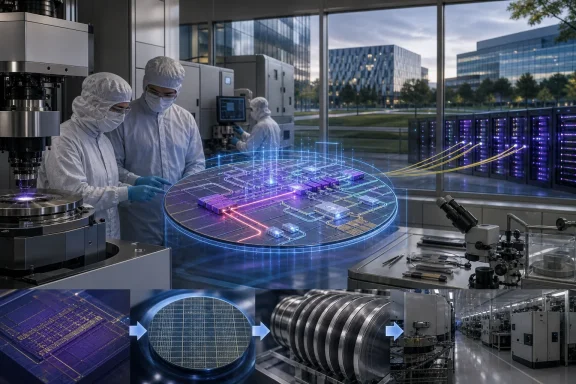 Europe’s Chip Strategy Finds a More Plausible Battlefield
For years, Europe’s semiconductor debate has been haunted by the same uncomfortable comparison: the continent has world-class research and ASML, but it lacks the scale of Taiwan, South Korea, and the United States in leading-edge chip fabrication. That has made some policy rhetoric sound like a moonshot without a launch vehicle. Photonic chips offer a different kind of opportunity.Integrated photonics does not require Europe to outspend TSMC at the bleeding edge of CMOS logic. It asks whether Europe can build a manufacturable stack around light-based components: lasers, modulators, waveguides, detectors, and optical interconnects that move and process information in ways conventional electronics struggle to match. That is still hard, but it is a more natural fit for a region that already has deep competence in lithography, metrology, compound semiconductors, optical systems, and high-end equipment.
The TNO-ASML partnership matters because it targets the middle of the innovation pipeline, where promising European technologies too often get stuck. Universities and research institutes can produce impressive devices. Startups can make convincing prototypes. But the jump from a lab process to repeatable wafer-scale manufacturing is brutal, expensive, and unforgiving.
That is the gap TNO’s Photonic Chip Pilot Line is meant to fill. By placing ASML’s lithography and process-control expertise inside that environment, the project becomes more than a cleanroom with good intentions. It becomes a test of whether Europe can build the industrial muscle memory needed to make photonics boring enough to buy in volume.
ASML Is Not Just Selling Tools Here
ASML’s role in the partnership is easy to misread. The company is famous for extreme ultraviolet lithography, the fantastically complex technology used for the most advanced logic chips. But the photonics pilot line is built around deep ultraviolet and i-line lithography, older and broader classes of lithography that remain essential across large parts of the semiconductor industry.That is the point. Photonic chips are not simply “smaller transistors with light.” Their manufacturing challenges are different. Optical components care intensely about shape, sidewall roughness, overlay, material quality, coupling loss, and process repeatability. A tiny variation that might be tolerable in one type of electronic device can become a yield killer when light has to travel cleanly through a waveguide or couple efficiently into a fiber.
ASML brings more than scanners to that problem. It brings a worldview: that manufacturing is a system of lithography, metrology, process control, feedback loops, and relentless statistical discipline. If that sounds mundane, it is because successful chip manufacturing is mundane by design. The goal is to remove surprise.
For ASML, the collaboration also gives the company a closer view of how lithography tools behave in a photonics context. The firm’s biggest commercial story remains advanced logic and memory, but the semiconductor market is broadening. AI data centers, optical communications, sensors, automotive systems, medical devices, and quantum-adjacent hardware all create demand for specialized chips that do not map neatly onto the classic CPU-and-DRAM playbook.
This is not ASML pivoting away from its core business. It is ASML extending its ecosystem influence into a technology domain where Europe has a plausible claim to leadership. The company does not need photonics to become the next logic-node race for the partnership to matter. It only needs photonics manufacturing to become demanding enough that ASML’s tool and process expertise becomes indispensable.
The Pilot Line Is the Product Before the Product
The most important phrase in the announcement is not “photonic chip.” It is pilot line. In semiconductor manufacturing, the pilot line is where optimism meets defect density, cycle time, equipment availability, calibration drift, and the thousand small indignities that separate a beautiful device from a commercial product.TNO’s facility at the High Tech Campus in Eindhoven is designed to support indium phosphide photonic chips on 6-inch wafers. Indium phosphide is especially important because it can support active optical functions such as lasers and amplifiers. That makes it highly relevant for communications and sensing applications, where generating and manipulating light on-chip is not optional.
Moving to 6-inch wafer-scale work is significant because photonics needs more than clever device physics. It needs wafer-level process stability, packaging strategies, test flows, and design rules that companies can trust. Customers do not buy national strategy; they buy components that meet specifications at a cost and volume they can plan around.
The pilot line’s job is therefore partly technical and partly psychological. It must convince startups, system vendors, investors, and larger industrial customers that European photonics can scale beyond boutique runs. That confidence is often invisible in policy documents, but it is central to whether ecosystems survive.
A good pilot line does not guarantee a manufacturing renaissance. It does, however, create a place where failure becomes useful. Processes can be tuned, design kits can mature, equipment recipes can be validated, and customers can see what is real rather than what is promised in a slide deck.
Photonics Is Becoming Infrastructure, Not Ornament
The timing is not accidental. Modern computing is increasingly constrained by data movement. AI systems in particular are hungry not only for compute, but for bandwidth: between chips, between servers, across racks, and across data centers. Electrical interconnects are improving, but they face power and reach limitations that become more painful as systems scale.That is why photonics keeps moving from the edges of the conversation toward the center. Optical links already dominate long-distance data transmission, and the frontier keeps creeping closer to the processor. Co-packaged optics, optical I/O, silicon photonics, and compound-semiconductor photonics are all attempts to solve versions of the same problem: moving more data with less energy and less heat.
This does not mean photonic chips will replace electronic chips. That tired framing obscures the real shift. Photonics is likely to be absorbed into heterogeneous systems, sitting alongside electronics, packaging, memory, and advanced substrates. The winners will be the companies and regions that understand integration, not slogans.
For WindowsForum readers, this may sound far from the desktop. But the downstream effects are familiar. Faster cloud services, lower-latency AI infrastructure, more efficient networking hardware, better sensors, and denser data-center fabrics all shape the computing environment in which Windows clients, Azure workloads, enterprise applications, and edge devices operate.
The industry’s future is not one chip doing everything. It is a system of specialized parts connected in increasingly sophisticated ways. Photonics is one of the technologies that could make that system less power-hungry and more scalable.
Eindhoven Is Playing the Cluster Game Properly
The High Tech Campus in Eindhoven is not incidental geography. Semiconductor ecosystems are built through proximity: researchers near equipment suppliers, startups near pilot facilities, manufacturers near design expertise, and customers close enough to give painful feedback before a product reaches the market.The TNO line sits inside a broader Dutch and European photonics push that includes the Photonic Integration Technology Centre, Eindhoven University of Technology, the University of Twente, PhotonDelta, SMART Photonics, and other regional players. That network matters because photonics is not a single invention waiting to be commercialized. It is a stack of mutually dependent capabilities.
Europe has often been better at funding research programs than at building enduring industrial flywheels. Eindhoven is trying to do the latter. A pilot line next to companies and research groups creates a venue where process lessons do not disappear into academic papers or one-off projects. They compound.
The comparison with older semiconductor clusters is instructive. Taiwan’s strength did not emerge from fabrication plants alone; it emerged from foundries, suppliers, design houses, packaging firms, universities, and customers reinforcing each other over decades. Europe does not need to copy that model exactly, but it does need to stop pretending that isolated grants can substitute for dense industrial ecosystems.
The ASML-TNO partnership is therefore less about one facility than about creating a gravity well. If the pilot line works, it can attract design activity, packaging work, materials suppliers, measurement specialists, and early customers. If it fails, Europe will still have strong research, but the commercialization gap will remain painfully visible.
The Real Competition Is Not Just Asia or America
It is tempting to frame the partnership as Europe versus the rest of the world. There is truth in that. The United States has thrown immense public money at semiconductor reshoring. China is pushing hard to reduce dependence on Western equipment. Taiwan, South Korea, and Japan remain central to advanced manufacturing and materials supply chains.But the sharper competition may be between manufacturing philosophies. Photonics is still open enough that different process routes, materials platforms, and integration models can compete. Some players emphasize silicon photonics because it can leverage existing CMOS infrastructure. Others focus on indium phosphide because of its strengths in active optical components. Still others explore heterogeneous integration, wafer bonding, or alternative lithography routes.
Europe’s advantage will not come from declaring one path correct too early. It will come from building flexible infrastructure that lets companies test, iterate, and industrialize without leaving the region. That is where a serious pilot line can matter.
The TNO-ASML collaboration also arrives in a geopolitical climate where lithography is no longer treated as a neutral industrial input. Export controls, supply-chain security, and strategic autonomy have turned chip equipment into a policy instrument. Photonics will not be exempt from that logic if it becomes central to AI infrastructure, telecom networks, defense systems, and sensing.
That raises the stakes for Europe. A domestic photonics manufacturing capability is not merely an economic development project. It is an insurance policy against future bottlenecks in technologies that may become as strategically sensitive as advanced logic is today.
The Hard Part Begins After the Ribbon Cutting
The danger with announcements like this is that they can make progress sound inevitable. It is not. Scaling photonic chips is hard because the ecosystem lacks the maturity of conventional semiconductor manufacturing, and because photonics adds its own complications in packaging and testing.Packaging is especially unforgiving. Getting light into and out of chips efficiently can be harder than fabricating the chip itself. Fiber alignment, thermal stability, optical loss, and reliability under real-world conditions can turn a promising die into a costly assembly problem. Any serious commercialization effort has to treat packaging and testing as first-order concerns, not downstream chores.
There is also the question of standardization. Electronics benefits from decades of design automation, process design kits, foundry models, and industry conventions. Photonics has made progress, but design flows and manufacturing interfaces remain less standardized. For customers, that can translate into risk: longer qualification cycles, fewer second sources, and uncertainty about whether a prototype can become a product.
Then there is cost. Photonic chips often promise lower power or new capabilities at the system level, but individual components must still compete against entrenched electronic and optical approaches. A pilot line can reduce risk and improve yield, but it cannot repeal the economics of adoption.
The TNO-ASML partnership is best understood as an attempt to attack these barriers systematically. Lithography alone will not solve photonics manufacturing. But lithography plus metrology plus process control plus an ecosystem of designers and users is the kind of foundation that gives the technology a fighting chance.
Brussels Wanted Sovereignty; Eindhoven Is Building Machinery
European industrial policy has spent the last several years using the language of sovereignty. That word can be useful, but it can also become a fog machine. Sovereignty in semiconductors does not mean making every chip domestically. It means having enough capability, leverage, and know-how that Europe is not merely a customer at the end of someone else’s supply chain.The TNO-ASML partnership is a more concrete expression of that idea. It does not promise that Europe will dominate every layer of the semiconductor stack. It identifies a strategic technology, places it in a region with relevant expertise, and tries to solve the manufacturing bridge that often kills hardware innovation.
That is more credible than trying to will an entire leading-edge logic industry into existence from policy ambition alone. Europe’s strongest chip assets are not evenly distributed across the map. They are concentrated in particular clusters and specialties. The rational strategy is to amplify those strengths rather than pretend all semiconductor capabilities are interchangeable.
Photonic chips fit that model. They are aligned with Europe’s strengths in optics, equipment, research, telecommunications, and precision engineering. They also serve markets that are likely to grow as AI infrastructure, cloud computing, and high-speed networking continue to expand.
The risk, of course, is that Europe underfunds the unglamorous middle. Research gets applause. Fab announcements get headlines. But pilot manufacturing, process engineering, packaging, workforce development, and customer qualification are where competitiveness is actually built. Eindhoven’s pilot line is important precisely because it lives in that middle.
Windows Users Will Feel This Indirectly, Then All at Once
Most PC users will never buy a “photonic chip” as a discrete product. They will experience the technology through infrastructure. The first visible effects are likely to show up in data centers, telecom networks, AI clusters, enterprise storage, and high-performance sensing systems rather than in a consumer laptop spec sheet.Still, infrastructure changes eventually reshape the client experience. Cloud AI assistants become more responsive when back-end systems move data faster and waste less power. Remote desktops, gaming streams, collaboration tools, and enterprise SaaS platforms benefit from better networks. Edge devices become more capable when sensing and communications hardware improves.
For sysadmins and IT buyers, the lesson is not to start ordering photonic hardware tomorrow. It is to watch where the bottlenecks in computing are moving. The industry has spent decades optimizing compute. Now the pain is increasingly in memory bandwidth, interconnects, power delivery, cooling, and data movement. Photonics is one answer to that broader systems problem.
Microsoft’s own ecosystem is part of this story, even if the TNO-ASML announcement is not a Microsoft story. Windows endpoints increasingly connect to AI-heavy cloud services, identity systems, management platforms, and distributed workloads. The performance and economics of that cloud layer depend on hardware choices far beneath the operating system.
That is why semiconductor manufacturing stories deserve attention from Windows professionals. The platform is no longer only the device in front of the user. It is the device plus the cloud plus the network plus the silicon supply chain that determines what services can be delivered at scale.
The Dutch Deal Says More Than Its Press Release
The practical meaning of the TNO-ASML partnership can be reduced to a few concrete points, but the larger message is strategic: Europe is choosing a semiconductor fight where its existing strengths might actually compound.- TNO’s Photonic Chip Pilot Line in Eindhoven is intended to bridge the gap between laboratory photonics research and commercial manufacturing.
- ASML will contribute lithography and process expertise, including DUV and i-line technologies, rather than the EUV systems that dominate its public image.
- The facility is aimed at 6-inch indium phosphide photonic chip production, a meaningful step for scaling active optical components.
- The partnership strengthens the existing Eindhoven photonics cluster rather than trying to build an isolated national showcase.
- The hardest commercialization problems will still include yield, packaging, testing, standardization, and customer qualification.
- The downstream impact for Windows and enterprise IT will likely appear first through cloud, networking, AI, and data-center infrastructure rather than client PCs.
References
- Primary source: Electronics For You BUSINESS
Published: 2026-06-30T07:10:13.058631
- Related coverage: tno.nl
TNO and ASML scale up European production of photonic chips
TNO and ASML announce collaboration to strengthen the European semiconductor ecosystem through the development and industrialisation of photonic chips. www.tno.nl
- Related coverage: hightechcampus.com
ASML joins TNO’s Eindhoven photonics factory - High Tech Campus Eindhoven
TNO and ASML join forces on the new Photonic Chip Pilot Line at the High Tech Campus Eindhoven to design photonic chips. hightechcampus.com
- Related coverage: scetrader.nl
ASML: Samenwerking photonics met TNO - Wat betekent dit
ASML en TNO gaan samenwerken om de Europese productie van fotonische chips op te schalen. De samenwerking richt zich op de Photonic Chip Pilot Line op de High Tech Campus Eindhoven, onderdeel van het Europese PIXEurope-project. Het doel is om Indium Phosphide-fotonische chips uit de... www.scetrader.nl
- Related coverage: news.metal.com
- Related coverage: electrooptics.com
High Tech Campus Eindhoven and TNO launch photonic chip pilot line | Electro Optics
TNO’s 6-inch InP photonic chips will be made at the new facility at the High Tech Campus Eindhovenwww.electrooptics.com
- Related coverage: tomshardware.com
Chinese startup claims photonic chip production without DUV lithography, says nanoimprint process cuts costs by 90% — 8-inch wafers produced without conventional optical lithography | Tom's Hardware
Technology may help circumvent US export restrictionswww.tomshardware.com
