

OpenAI’s ChatGPT may be the household name that brought conversational AI into the mainstream, but recent user‑focused tests and a rapidly diversifying market show that “best” depends heavily on what you value: truthfulness, follow‑through across a changing conversation, up‑to‑date knowledge, or seamless ecosystem integration. A recent BGR piece highlighted a Prolific study called “Humaine” that reportedly placed ChatGPT eighth behind Google’s Gemini variants, DeepSeek, Grok, and France’s Mistral Magistral — an eye‑catching result that, if accurate, signals how quickly user priorities can reshape perceived rankings. That claim appears in public coverage, but the underlying Prolific materials are not included in the files provided here and should be treated cautiously until the original Humaine report is reviewed.
This feature unpacks that claim, situates it in the wider landscape of independent evaluations and hands‑on reviews, and gives Windows users and IT decision‑makers a practical framework for choosing the right AI chatbot in 2025. The analysis cross‑references multiple independent reports and hands‑on tests included in the supplied files, highlights where vendor claims need verification, and flags real operational and privacy risks you should weigh before adopting any assistant.
AI chatbots evolved from novelty demos into productivity infrastructure almost overnight. The arrival of ChatGPT in late 2022 popularized conversational LLMs and carved out expectations for what a modern assistant should do: hold a coherent conversation, answer follow‑ups, and help with tasks ranging from drafting emails to coding. But once a broad cross‑section of users started treating chatbots as decision‑adjacent tools, the evaluation bar shifted: people now prize accuracy, provenance, and the assistant’s ability to hold context across a changing thread. These practical metrics often matter more to end users than raw benchmark scores.
Independent assessments in 2024–2025 have therefore moved beyond synthetic language benchmarks to user‑facing tests — travel itineraries, consumer‑rights questions, coding tasks and multi‑step workflows — producing a mosaic of winners depending on the test design and the user priorities emphasized. That’s why head‑to‑head “who’s best” headlines can be misleading: some bots excel at research and citations, others at creative composition, and some are optimized for enterprise governance and tenant‑grounded context.
At the same time, claims about precise rankings (for example, Prolific’s “Humaine” placing ChatGPT eighth) require a review of the original methodology and dataset before being treated as definitive — that Prolific report is not included among the current files and should be examined directly for details. Until then, treat those headlines as directional rather than dispositive, pilot candidate assistants against your real workflows, insist on human verification where outputs have consequences, and bake governance, contractual non‑training clauses, and redundancy plans into any serious deployment.
The market today rewards specialization and realistic governance as much as raw model quality. For Windows users and IT leaders, the practical winner will be the assistant that best maps to your workflows, compliance needs, and verification practices — not necessarily the one with the flashiest demo.
Source: bgr.com These 7 AI Chatbots Are Better Than ChatGPT, According To Users - BGR
This feature unpacks that claim, situates it in the wider landscape of independent evaluations and hands‑on reviews, and gives Windows users and IT decision‑makers a practical framework for choosing the right AI chatbot in 2025. The analysis cross‑references multiple independent reports and hands‑on tests included in the supplied files, highlights where vendor claims need verification, and flags real operational and privacy risks you should weigh before adopting any assistant.
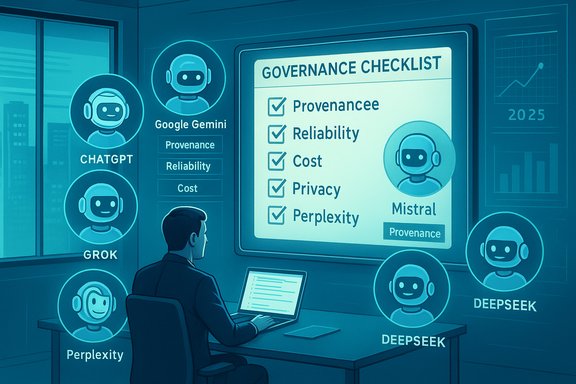 Background / Overview
AI chatbots evolved from novelty demos into productivity infrastructure almost overnight. The arrival of ChatGPT in late 2022 popularized conversational LLMs and carved out expectations for what a modern assistant should do: hold a coherent conversation, answer follow‑ups, and help with tasks ranging from drafting emails to coding. But once a broad cross‑section of users started treating chatbots as decision‑adjacent tools, the evaluation bar shifted: people now prize accuracy, provenance, and the assistant’s ability to hold context across a changing thread. These practical metrics often matter more to end users than raw benchmark scores.Independent assessments in 2024–2025 have therefore moved beyond synthetic language benchmarks to user‑facing tests — travel itineraries, consumer‑rights questions, coding tasks and multi‑step workflows — producing a mosaic of winners depending on the test design and the user priorities emphasized. That’s why head‑to‑head “who’s best” headlines can be misleading: some bots excel at research and citations, others at creative composition, and some are optimized for enterprise governance and tenant‑grounded context.
What the BGR/Prolific headline claimed — and what’s verifiable
The BGR excerpt supplied by the user summarises a Prolific “Humaine” benchmark that purportedly ranked ChatGPT eighth, behind two Gemini models, two DeepSeek versions, multiples of Grok, and Mistral Magistral. That is notable because it flips the default assumption that ChatGPT is top in user satisfaction or general usefulness.- The claim that consumer‑facing user studies prioritize understanding, dialog continuity, clarity, and factuality over narrow technical benchmarks aligns with broader editorial and testing trends seen across independent reviews. Multiple hands‑on tests emphasize those same criteria — accuracy, clarity, and the ability to handle conversational pivots are now front‑and‑center.
- The specific Prolific/Humaine ranking is present in the BGR text you provided, but the actual Humaine report or an independently archived copy is not included among the files available for verification here. That means the ranking should be treated as a reported result, not a confirmed dataset until the Prolific report itself is reviewed. The prudent reader and IT buyer should request the full Humaine methodology before treating the ranking as definitive.
The seven challengers named in the BGR summary — a practical reality check
Below is a pragmatic look at each chatbot named as beating ChatGPT in the BGR/Prolific summary, checked against the supplied independent reviews and reporting. Where vendor claims are widely reported, those are noted; where a claim is only present in the BGR summary and not reproduced in the files, that is flagged.Google Gemini (two variants)
- Why users like it: real‑time web grounding, multimodal inputs (voice, image, video), and native integration with Google Workspace make Gemini a powerful assistant for people who rely on Google apps. Independent reviews praise Gemini’s multimodal capabilities and integration advantages.
- Strengths: strong at in‑document automation, image/video generation and voice interactions; convenient for users already invested in Google services.
- Risks and limits: can be formulaic on subjective tasks and its premium tiers and exact capabilities (Flash vs Pro families) produce different outcomes in tests; results depend on the variant used.
DeepSeek (two versions)
- Why users notice it: aggressive pricing and strong logic/coding performance in several hands‑on reports made DeepSeek a viral entrant in 2025. Several forum and review write‑ups document rapid spikes in downloads and attention.
- Strengths: cost efficiency and competitive performance in narrow reasoning/coding tasks.
- Risks: independent reporting flags potential issues with geopolitical bias, censorship limitations, and vendor claims (model size, training cost) that require independent validation; treat vendor‑originated technical numbers with skepticism.
xAI Grok (two appearances in the ranking)
- Why users like it: Grok often wins praise for personality and conversational feel — the sort of “human” tone that helps for travel itineraries and creative prompts. Tests repeatedly emphasize Grok’s natural tone and strong conversational cadence.
- Strengths: engaging, personable outputs — good for conversational and creative tasks.
- Risks: image fidelity and some technical outputs can be inconsistent across access methods; enterprise readiness and governance options are less mature than the big incumbents.
Mistral Magistral (French bot)
- Why it’s noteworthy: Mistral’s models have been recognized for strong general‑purpose language modeling and a European posture that appeals to users wanting alternatives to US Big Tech. In the file set, Mistral is mentioned as a regional standout and part of the mid‑tier cluster of capable assistants.
- Strengths and risks: Mistral is often strong on fluency; enterprise features and longitudinal evaluation data should be checked before broad deployment.
What independent hands‑on testing and consumer audits say (synthesis)
Several independent reviews and consumer audits included in the available files converge on an actionable set of conclusions:- Practical tests prioritize accuracy, clarity, and real‑world utility over pure fluency benchmarks. Review methodologies now use realistic user prompts (travel planning, legal queries, finance scenarios, coding tasks) and score replies for usefulness and safety, not just rhetorical quality. This change explains why a well‑rounded but less sensational model might win user rankings.
- Some specialist assistants — Perplexity for research and citations, Copilot for Office‑centric automation, and smaller models like DeepSeek for coding logic under constrained budgets — can outperform generalist models on narrowly defined tasks. The Which? consumer reliability evaluation and several hands‑on comparisons support that pattern.
- The same model can behave differently based on variant, region, and access method: free flash tiers trade depth for speed; premium tiers increase reasoning budgets and context windows — reviewers document that difference and stress the need to test the exact product configuration you plan to use.
- No bot is flawless. Common failure modes across tests include hallucinated facts, weak jurisdiction‑specific legal or tax advice, and questionable source links, reinforcing the recommendation that AI outputs must be validated in human‑in‑the‑loop workflows.
Strengths and notable advantages across the field
- Ecosystem‑embedded copilots (Microsoft Copilot, Google Gemini): offer deep context by accessing tenant or product data — very valuable for enterprise users who want assistant outputs that reference calendar, email, or internal documents with governance controls. These tools have built‑in admin controls and contractual non‑training options for enterprise customers.
- Research‑first assistants (Perplexity): show clear advantages when provenance matters because they surface citations that allow quick verification, which is essential for research, journalism, and regulated work. Independent reviews place Perplexity high on reliability in research tests.
- Low‑cost entrants (DeepSeek): democratize access when cost is the primary constraint, and some tests show competitive reasoning in narrow domains such as coding. But cost savings come with governance, localization and risk trade‑offs.
- Conversational winners (Grok): provide a superior feels‑like‑human interface for tasks where tone, empathy, or an informal planning voice improves the user experience.
Practical recommendations for Windows users, IT teams and decision makers
- Define the primary value you need from an assistant:
- Research & citations → Perplexity or citation‑aware assistants.
- Office automation and tenant governance → Microsoft Copilot.
- Creative writing and broad‑use generalist → ChatGPT or Gemini depending on tone and features.
- Cost‑sensitive coding & logic tasks → investigate DeepSeek with careful governance.
- Pilot before purchase:
- Run the exact prompt set you’ll use in production across candidate assistants.
- Test both free and paid premium variants because test outcomes can change by tier.
- Enforce human‑in‑the‑loop (HITL) for high‑risk output:
- Always validate advice in finance, health, legal, or regulated contexts.
- Use automated checks for numeric thresholds and a human reviewer for final sign‑off. Independent auditors repeatedly flag hallucination‑driven misadvice as a top operational hazard.
- Review contractual data usage:
- Choose vendors with non‑training guarantees for sensitive enterprise data or require on‑prem/tenant‑isolated deployments. Vendor pages and enterprise offerings vary substantially.
- Plan for redundancy and outage resilience:
- Outages happen. Maintain fallback assistants and an escalation plan for mission‑critical workflows. Multiple reviews emphasize practical resiliency planning.
Risks, governance problems, and where caution is essential
- Hallucinations and incorrect legal/financial guidance: Independent consumer tests show assistants confidently returning wrong numeric thresholds or oversimplified legal advice — a material risk for users relying on “first pass” guidance. That’s one reason Which? and industry reviewers penalize assistants that prioritize fluency over correctness.
- Vendor claims that are hard to verify: statements about model parameter counts, unit training costs, or headline market impacts are often vendor‑asserted or amplified by press; treat such numbers as marketing until independently audited. DeepSeek’s training‑cost and scale claims are a prominent example of a point that needs third‑party validation.
- Privacy and data residency: tools that integrate with cloud productivity suites can surface internal data — great for convenience but risky without contractual protections, audit logs, and clear retention policies. Microsoft’s Copilot is frequently called out as having strong tenant‑grounded governance options, which matters for regulated industries.
- Regional limitations and content moderation: some chatbots intentionally avoid or censor politically sensitive content, which can harm global applicability for certain use cases. DeepSeek and other regional entrants may apply content restrictions tied to local regulation, which is an operational factor for multinational deployments.
How to interpret “Chatbots are better than ChatGPT” headlines
Headlines that declare a definitive reorder of the leaderboard should be read with context. Consider these checklist items when you encounter such claims:- Which metric was used? (accuracy, likability, citation quality, creativity)
- Who made the judgment? (expert panel, consumer survey, controlled test)
- Which model variant and tier were tested? (free Flash tier vs premium reasoning tier)
- Were the tests repeatable and are the prompts available?
Quick decision matrix for Windows users (one‑page)
- Need enterprise governance + Office context → Microsoft Copilot.
- Need research with verifiable sources → Perplexity.
- Need best generalist creative assistant → ChatGPT or Gemini (test both; compare premium tiers).
- Need low‑cost coding/logic help → DeepSeek (validate legal and privacy posture first).
- Need conversational “personality” for planning/advice → Grok.
Conclusion
The BGR/Prolific headline that “seven AI chatbots are better than ChatGPT, according to users” captures an important truth: the AI chatbot market is no longer a single‑winner game. Evaluations that focus on what end‑users actually value — factual accuracy, dialog continuity, clear explanations and trustworthy sourcing — can produce very different leaders than benchmarks centered on language modeling alone. Independent hands‑on tests and consumer audits included in the supplied materials repeatedly show that context and metrics matter: Perplexity, Copilot, Grok, Gemini, DeepSeek and regional players like Mistral can out‑score ChatGPT on specific user‑centred dimensions.At the same time, claims about precise rankings (for example, Prolific’s “Humaine” placing ChatGPT eighth) require a review of the original methodology and dataset before being treated as definitive — that Prolific report is not included among the current files and should be examined directly for details. Until then, treat those headlines as directional rather than dispositive, pilot candidate assistants against your real workflows, insist on human verification where outputs have consequences, and bake governance, contractual non‑training clauses, and redundancy plans into any serious deployment.
The market today rewards specialization and realistic governance as much as raw model quality. For Windows users and IT leaders, the practical winner will be the assistant that best maps to your workflows, compliance needs, and verification practices — not necessarily the one with the flashiest demo.
Source: bgr.com These 7 AI Chatbots Are Better Than ChatGPT, According To Users - BGR
